Knowledge Management
Presented By:
Nirmal Prasad Sitaula
Prakash K.C
Pratik Shrestha
Assignment I: Entrepreneurship
Presentation Outline
 Introduction of Knowledge
 Types of Knowledge
 Knowledge Management (KM)
 Knowledge Management Hierarchy
 Knowledge Management Significance
 Knowledge Management Process
 Knowledge Management Life Cycle
Introduction to Knowledge
 What is Knowledge?
 What knowledge is not; Knowledge can certainly not be assumed to be equal to a dose of data and
above all, knowledge cannot be considered equal to information
 Primarily be described as something that makes both data and information manageable
 Lets take an comparison on getting a bus to some places
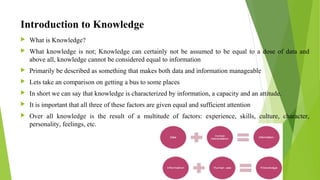
 In short we can say that knowledge is characterized by information, a capacity and an attitude.
 It is important that all three of these factors are given equal and sufficient attention
 Over all knowledge is the result of a multitude of factors: experience, skills, culture, character,
personality, feelings, etc.
Types of Knowledge
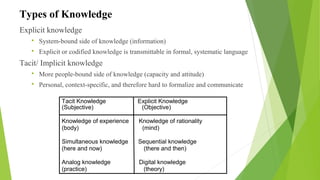
Explicit knowledge
 System-bound side of knowledge (information)
 Explicit or codified knowledge is transmittable in formal, systematic language
Tacit/ Implicit knowledge
 More people-bound side of knowledge (capacity and attitude)
 Personal, context-specific, and therefore hard to formalize and communicate
Tacit Knowledge Explicit Knowledge
(Subjective) (Objective)
Knowledge of experience Knowledge of rationality
(body) (mind)
Simultaneous knowledge Sequential knowledge
(here and now) (there and then)
Analog knowledge Digital knowledge
(practice) (theory)
Knowledge Management (KM)
 Collection of processes that govern the creation, dissemination, and utilization of
knowledge
 Discipline within an organization that ensures that the intellectual capabilities of that
organization are shared, maintained and institutionalized
 The process of systematically and actively managing and leveraging the stores of
knowledge in an organization
 The way a company stores, organizes and accesses internal and external information.
 Refers to an entire integrated system for accumulation, integration, manipulation, and
access of data across multiple organizations
 Knowledge domains in organization management: organization, marketing and
technology
Knowledge Management Hierarchy
Knowledge Management
Tacit Knowledge Explicit Knowledge
Knowledge
Information
Data
Knowledge Management Significance
Traditional reasons for KM are:
 Improving Decision Making by reusing knowledge
 Capturing knowledge from transient work forces
Additionally, we are finding we need KM because of:
 Supporting knowledge communities
 Obsolescence/Innovation
 Knowledge persistence
Knowledge assets have often become more important to companies than financial and physical assets
and are often the only way for a company to distinguish itself from its competitor & gain competitive
advantage
Knowledge Management Process
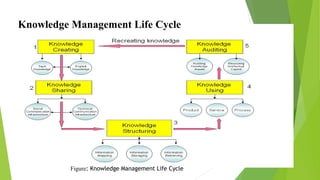
Knowledge Management Life Cycle
Figure: Knowledge Management Life Cycle
References
1. “Knowledge Management and Development of Entrepreneurial Skills Among Students in Vocational
Technical Institutions in Lagos, Nigeria”; Stella Ify Anumnu, Federal College of Education Akoka,
Lagos Nigeria
2. “Knowledge management in small and medium-sized companies: knowledge management for
entrepreneurs” , R.P. uit Beijerse, Journal of Knowledge Management. Kempston: 2000. Vol. 4, Iss.
2; pg. 162
3. “The Role of Knowledge Management in Developing the Characteristics of Entrepreneurial
Organization Entrepreneurial Organization Entrepreneur Styles as Moderator Variables”, Ahmad Ali
Salih, International Journal of Small Business and Entrepreneurship Research
4. “Understanding Knowledge Management Concept”, Dr. Rajendra Suwal, Nepal Administrative Staff
College
Knowledge Management

Knowledge Management

  • 1.
    Knowledge Management Presented By: NirmalPrasad Sitaula Prakash K.C Pratik Shrestha Assignment I: Entrepreneurship
  • 2.
    Presentation Outline  Introductionof Knowledge  Types of Knowledge  Knowledge Management (KM)  Knowledge Management Hierarchy  Knowledge Management Significance  Knowledge Management Process  Knowledge Management Life Cycle
  • 3.
    Introduction to Knowledge What is Knowledge?  What knowledge is not; Knowledge can certainly not be assumed to be equal to a dose of data and above all, knowledge cannot be considered equal to information  Primarily be described as something that makes both data and information manageable  Lets take an comparison on getting a bus to some places  In short we can say that knowledge is characterized by information, a capacity and an attitude.  It is important that all three of these factors are given equal and sufficient attention  Over all knowledge is the result of a multitude of factors: experience, skills, culture, character, personality, feelings, etc.
  • 4.
    Types of Knowledge Explicitknowledge  System-bound side of knowledge (information)  Explicit or codified knowledge is transmittable in formal, systematic language Tacit/ Implicit knowledge  More people-bound side of knowledge (capacity and attitude)  Personal, context-specific, and therefore hard to formalize and communicate Tacit Knowledge Explicit Knowledge (Subjective) (Objective) Knowledge of experience Knowledge of rationality (body) (mind) Simultaneous knowledge Sequential knowledge (here and now) (there and then) Analog knowledge Digital knowledge (practice) (theory)
  • 5.
    Knowledge Management (KM) Collection of processes that govern the creation, dissemination, and utilization of knowledge  Discipline within an organization that ensures that the intellectual capabilities of that organization are shared, maintained and institutionalized  The process of systematically and actively managing and leveraging the stores of knowledge in an organization  The way a company stores, organizes and accesses internal and external information.  Refers to an entire integrated system for accumulation, integration, manipulation, and access of data across multiple organizations  Knowledge domains in organization management: organization, marketing and technology
  • 6.
    Knowledge Management Hierarchy KnowledgeManagement Tacit Knowledge Explicit Knowledge Knowledge Information Data
  • 7.
    Knowledge Management Significance Traditionalreasons for KM are:  Improving Decision Making by reusing knowledge  Capturing knowledge from transient work forces Additionally, we are finding we need KM because of:  Supporting knowledge communities  Obsolescence/Innovation  Knowledge persistence Knowledge assets have often become more important to companies than financial and physical assets and are often the only way for a company to distinguish itself from its competitor & gain competitive advantage
  • 8.
  • 9.
    Knowledge Management LifeCycle Figure: Knowledge Management Life Cycle
  • 10.
    References 1. “Knowledge Managementand Development of Entrepreneurial Skills Among Students in Vocational Technical Institutions in Lagos, Nigeria”; Stella Ify Anumnu, Federal College of Education Akoka, Lagos Nigeria 2. “Knowledge management in small and medium-sized companies: knowledge management for entrepreneurs” , R.P. uit Beijerse, Journal of Knowledge Management. Kempston: 2000. Vol. 4, Iss. 2; pg. 162 3. “The Role of Knowledge Management in Developing the Characteristics of Entrepreneurial Organization Entrepreneurial Organization Entrepreneur Styles as Moderator Variables”, Ahmad Ali Salih, International Journal of Small Business and Entrepreneurship Research 4. “Understanding Knowledge Management Concept”, Dr. Rajendra Suwal, Nepal Administrative Staff College