Knowledge Management System
(KMS)
Prashant Bajpai(91)
Priyank Jain(92)
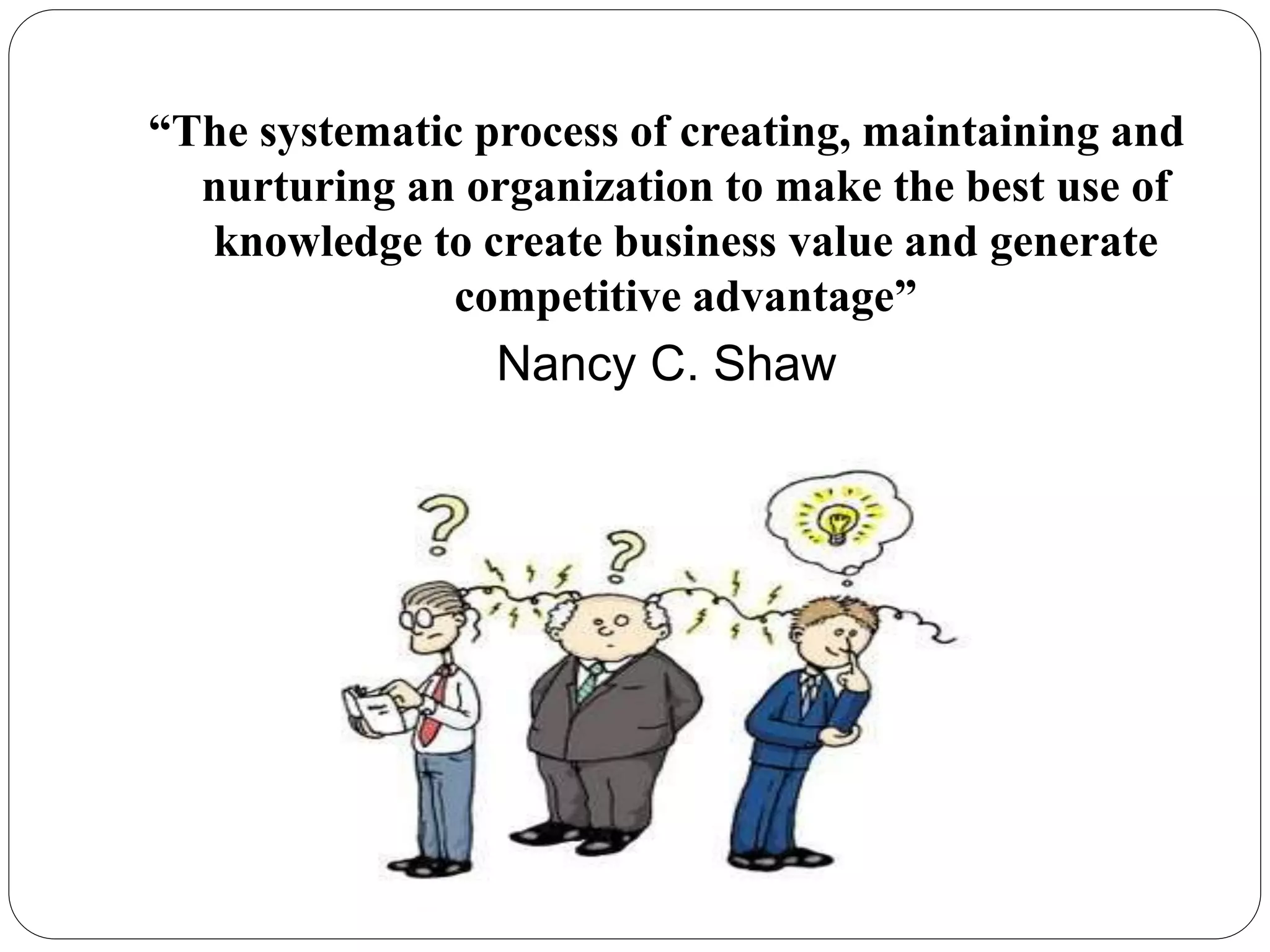
“The systematic process of creating, maintaining and
nurturing an organization to make the best use of
knowledge to create business value and generate
competitive advantage”
Nancy C. Shaw
Knowledge Management
Fundamentals
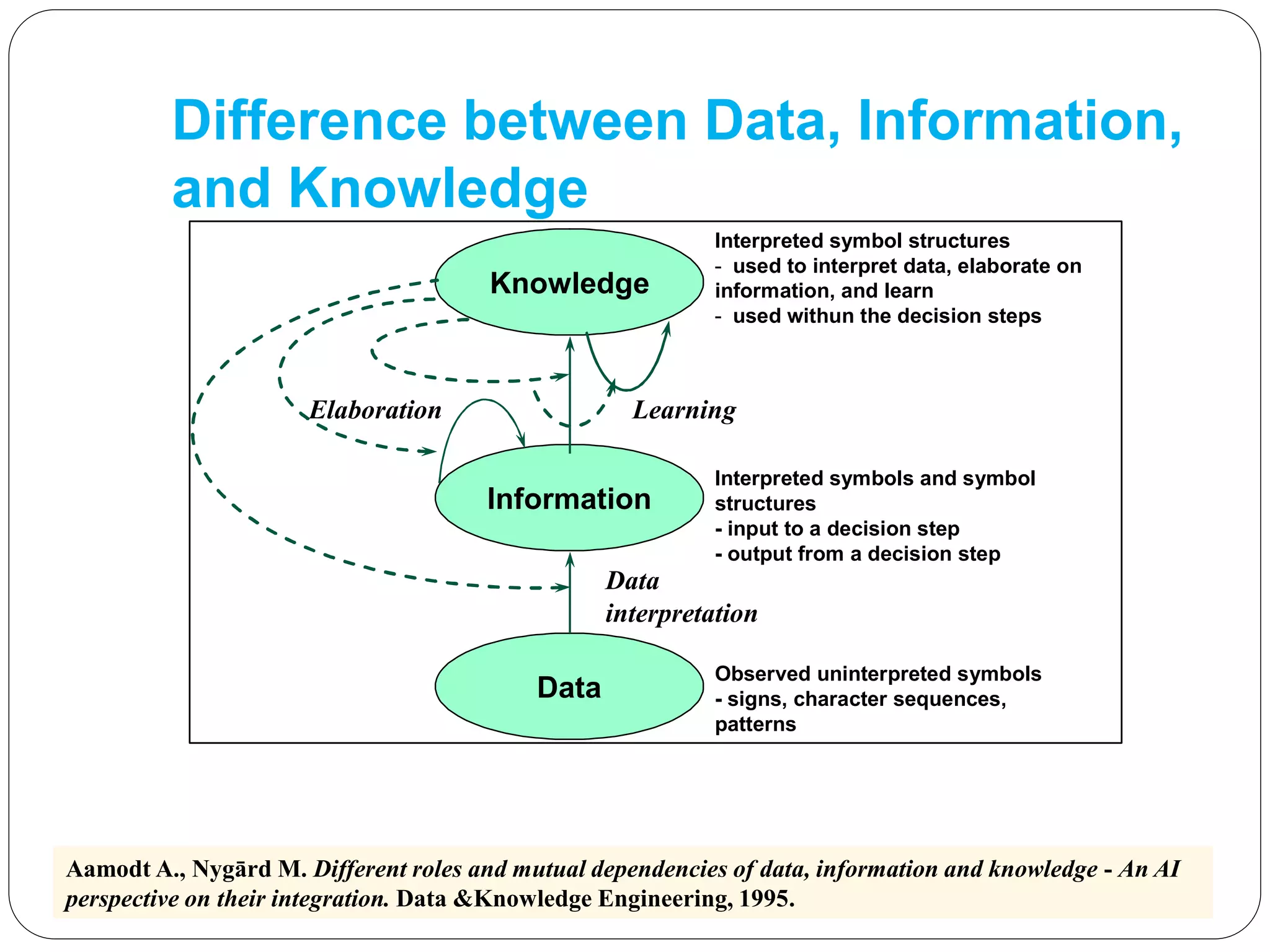
 Data: Facts, numbers or individual entities without
context or purpose.
 Information: Data that has been organized into a
meaningful context (to aid decision making).
 Knowledge: The human capacity (potential &
actual ability) to take effective action in varied and
uncertain situations
Forms of Knowledge
 Concepts, methodologies
 Facts, beliefs, truths & laws
 Know what, Know how, Know why
 Judgments, expectations and insights
 Relationships, leverage points
 Intuition & feelings
 Meaning and sense making
Benefits of Good Business
Knowledge Management
 The foundation of the enterprise
 Increases when shared
 Snowball effect when shared (innovation)
 Creates value through efficiency (process
knowledge)
 Reduces uncertainty/ increases time of response
(environment knowledge)
 Enhances the current value of products
(customer knowledge)
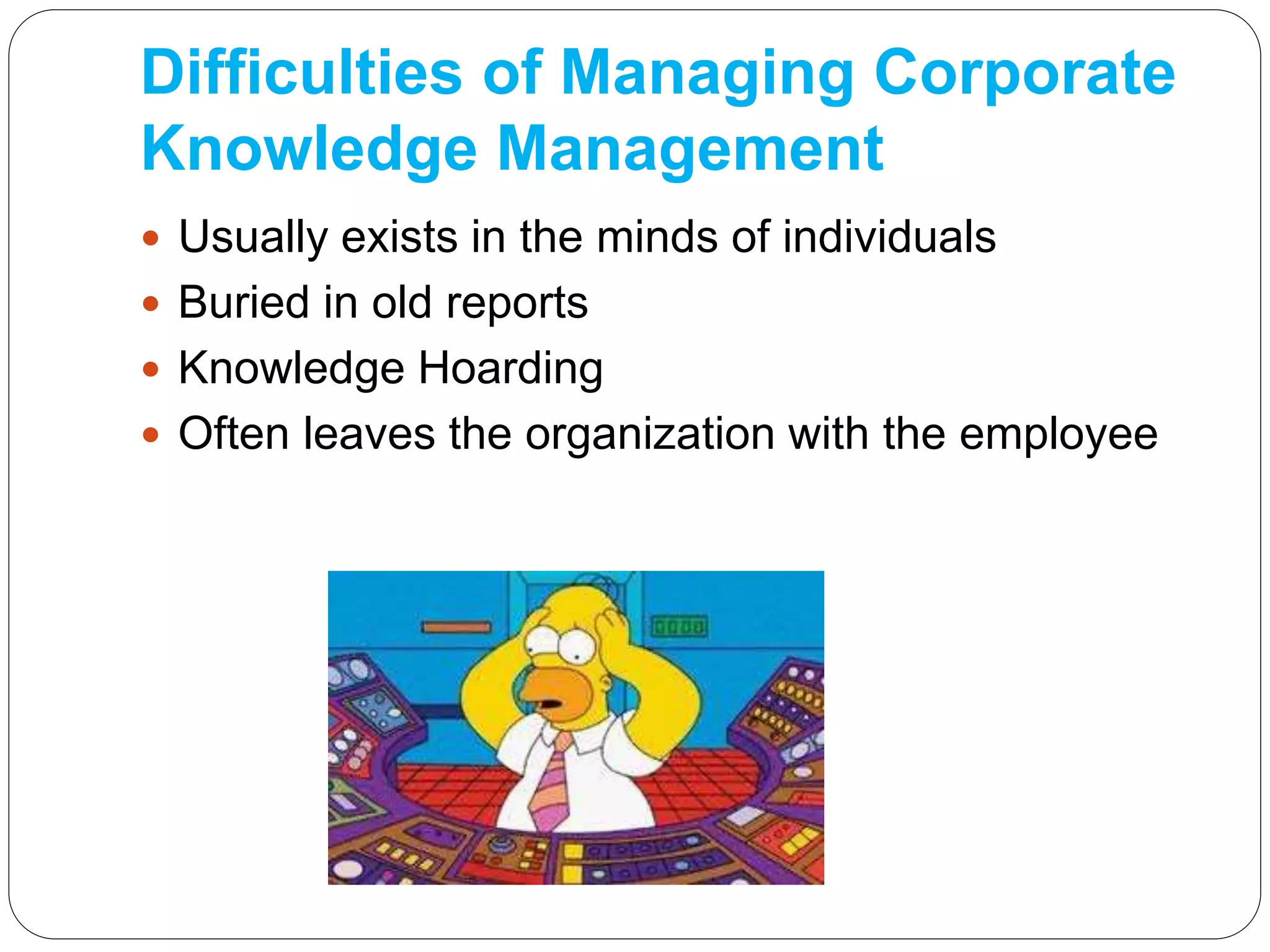
Difficulties of Managing Corporate
Knowledge Management
 Usually exists in the minds of individuals
 Buried in old reports
 Knowledge Hoarding
 Often leaves the organization with the employee
Why is KMS important?
 Companies can...
 Sustain knowledge regarding their products
and services
 Connect employees with knowledge they
otherwise wouldn't have
 Encouraging innovation and ideas
 Creating better business decisions
 Expedite projects due to less wait time of
information
How can this be done?
 Actively managing knowledge in a database or
repository
 Creating incentives for employees for providing
and updating and using knowledge
 Experts of the field providing information that will
help others better accomplish their jobs
 Use of Wiki’s, Software solutions
Difference between Data, Information,
and Knowledge
Knowledge
Data
Information
Data
interpretation
Elaboration Learning
Interpreted symbol structures
- used to interpret data, elaborate on
information, and learn
- used withun the decision steps
Interpreted symbols and symbol
structures
- input to a decision step
- output from a decision step
Observed uninterpreted symbols
- signs, character sequences,
patterns
Aamodt A., Nygārd M. Different roles and mutual dependencies of data, information and knowledge - An AI
perspective on their integration. Data &Knowledge Engineering, 1995.
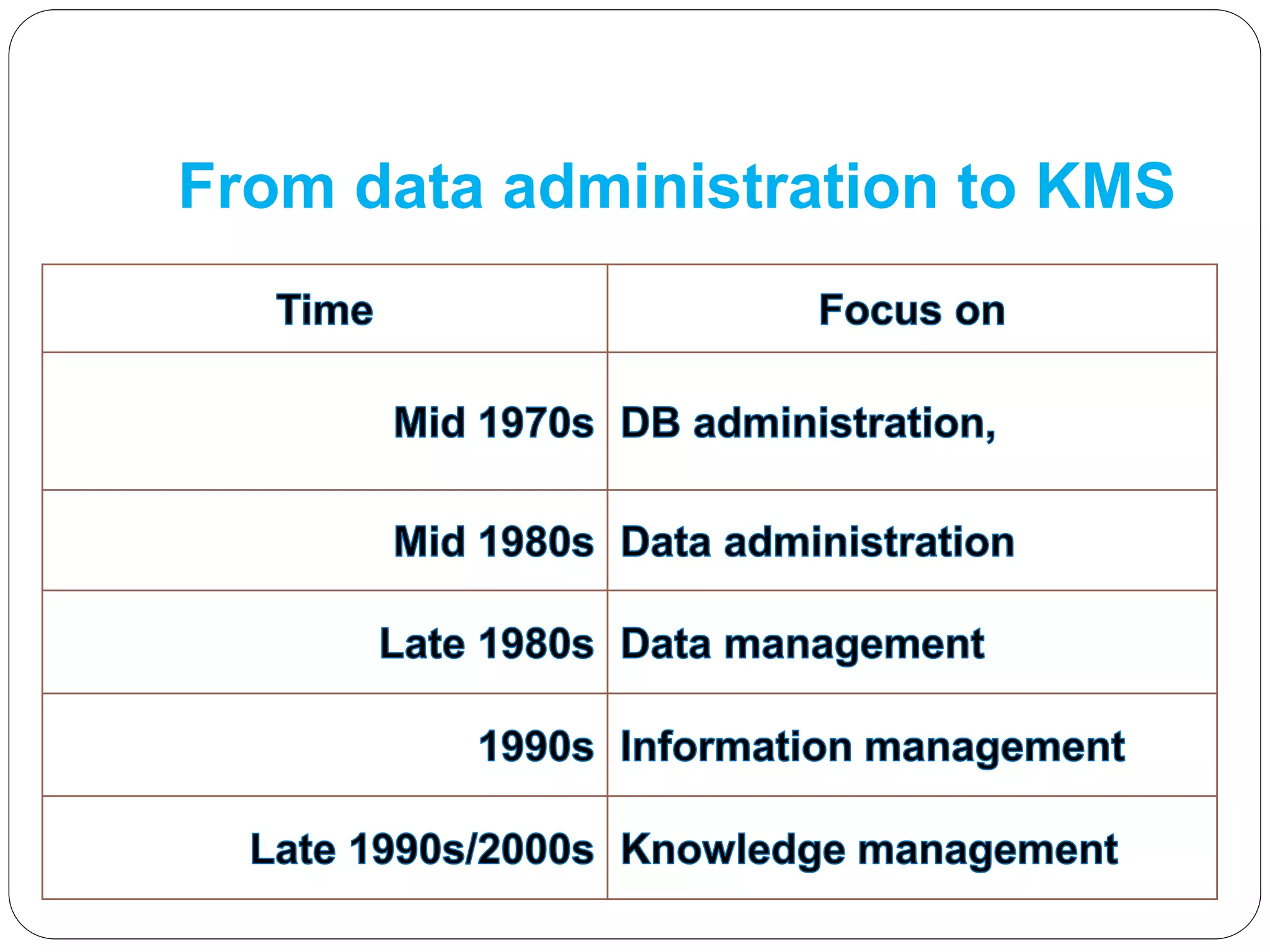
From data administration to KMS
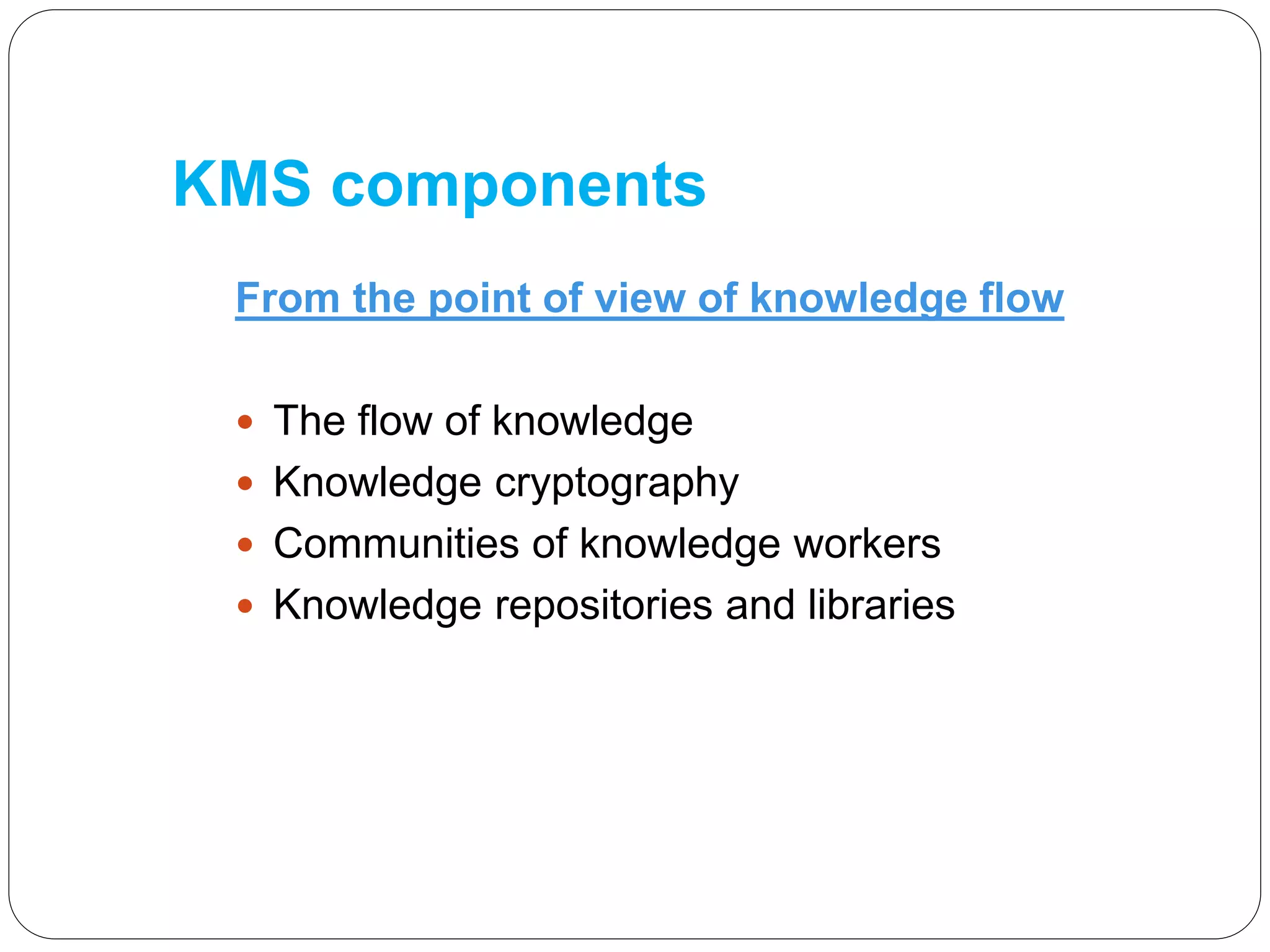
KMS components
From the point of view of knowledge flow
 The flow of knowledge
 Knowledge cryptography
 Communities of knowledge workers
 Knowledge repositories and libraries
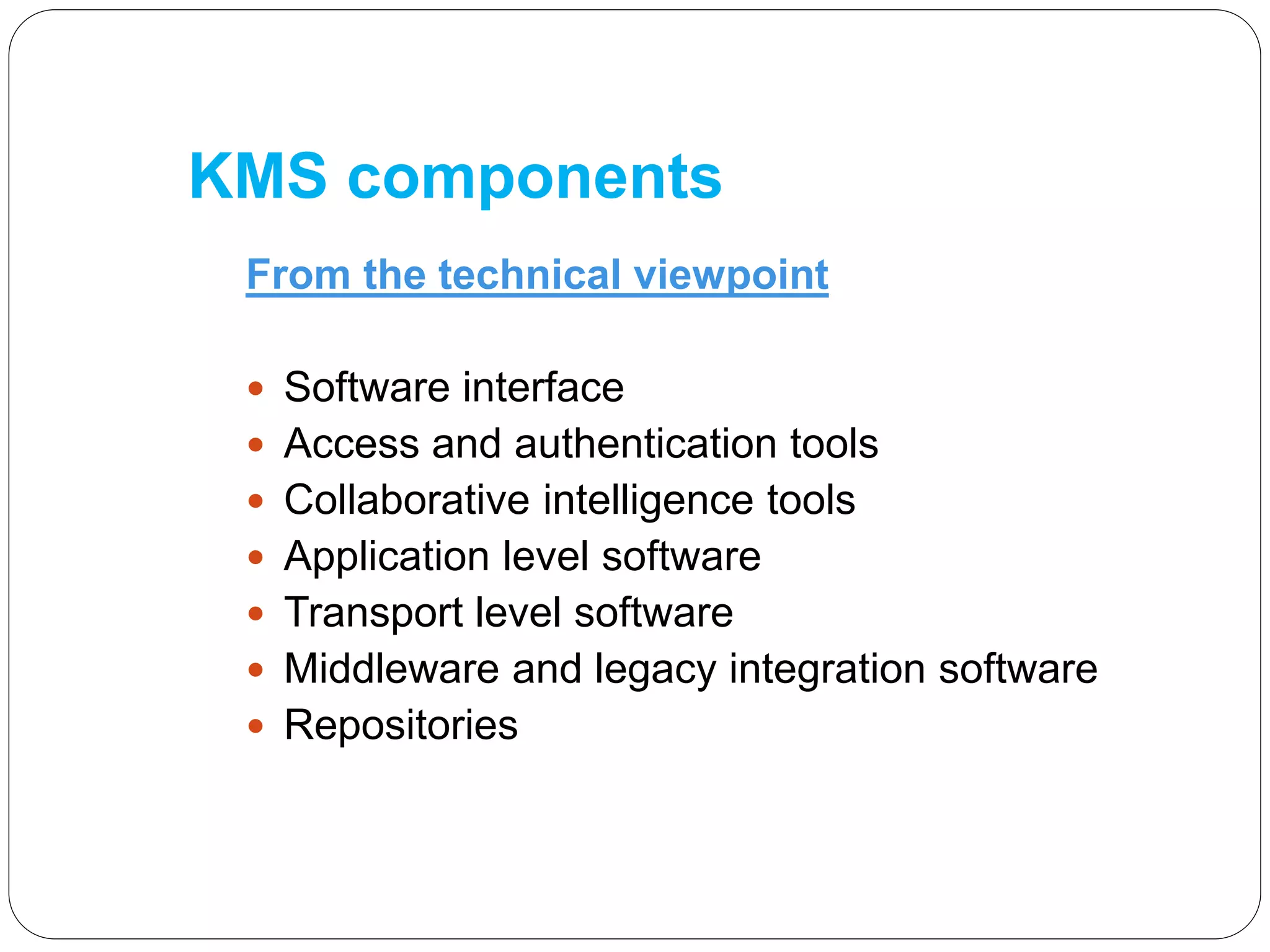
KMS components
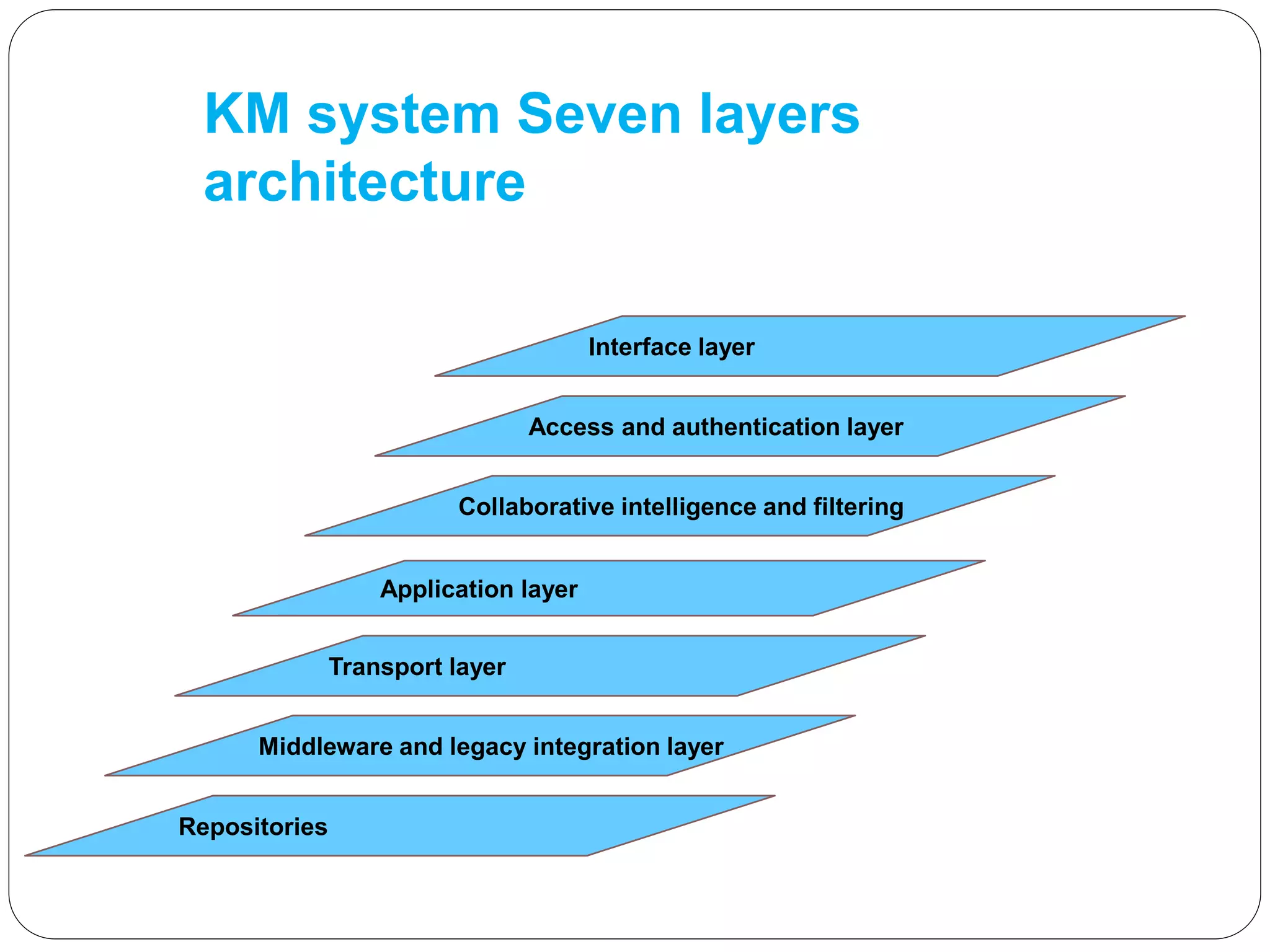
From the technical viewpoint
 Software interface
 Access and authentication tools
 Collaborative intelligence tools
 Application level software
 Transport level software
 Middleware and legacy integration software
 Repositories
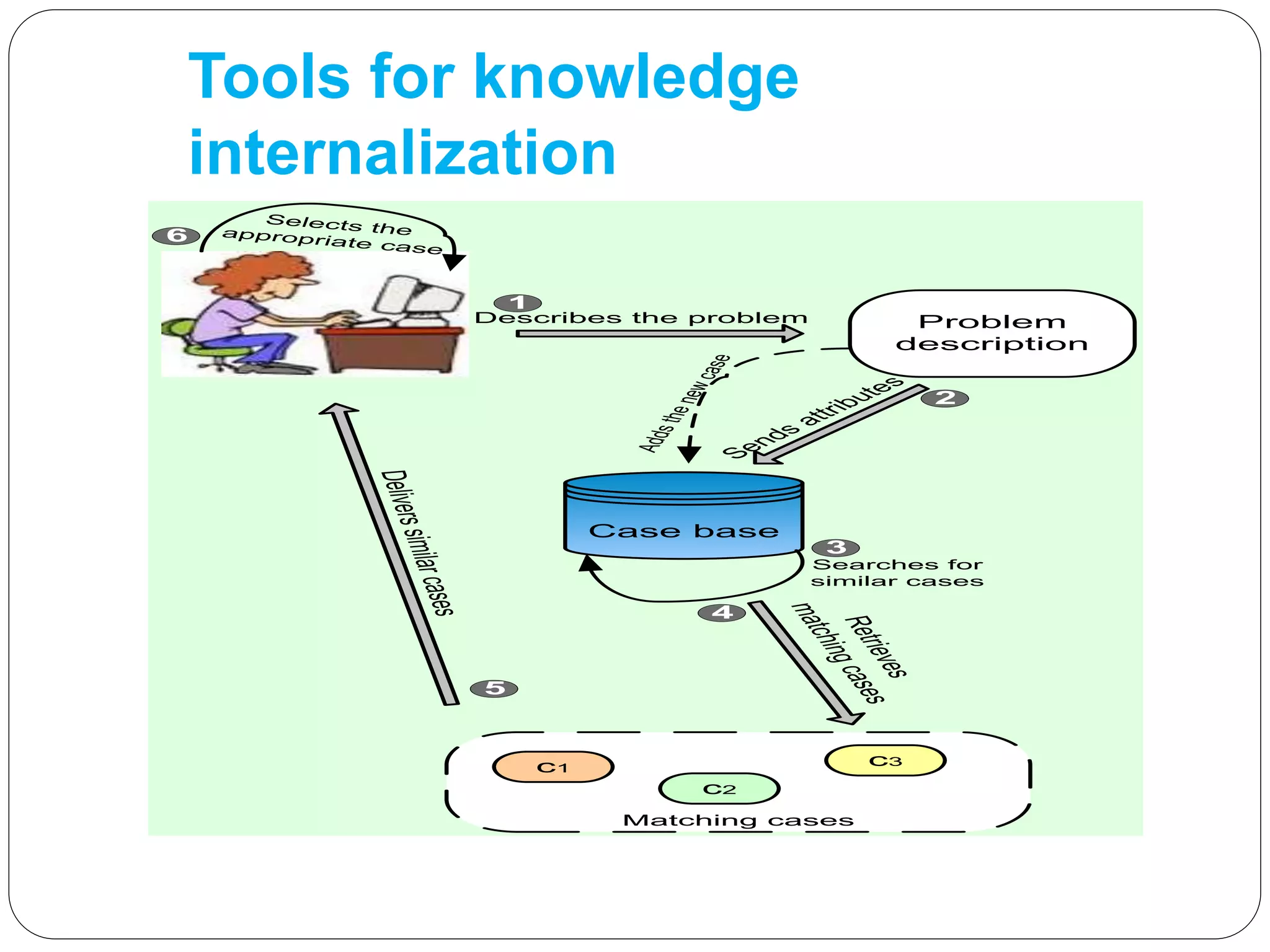
Tools for knowledge
internalization
Case base
Problem
description
Describes the problem
S
e
n
d
s
a
ttrib
u
te
s
Retrieves
matchingcases
Searches for
similar cases
Matching cases
c1
c3
c2
Deliverssimilarcases
Addsthenewcase
Selects theappropriate case
1
2
3
4
5
6
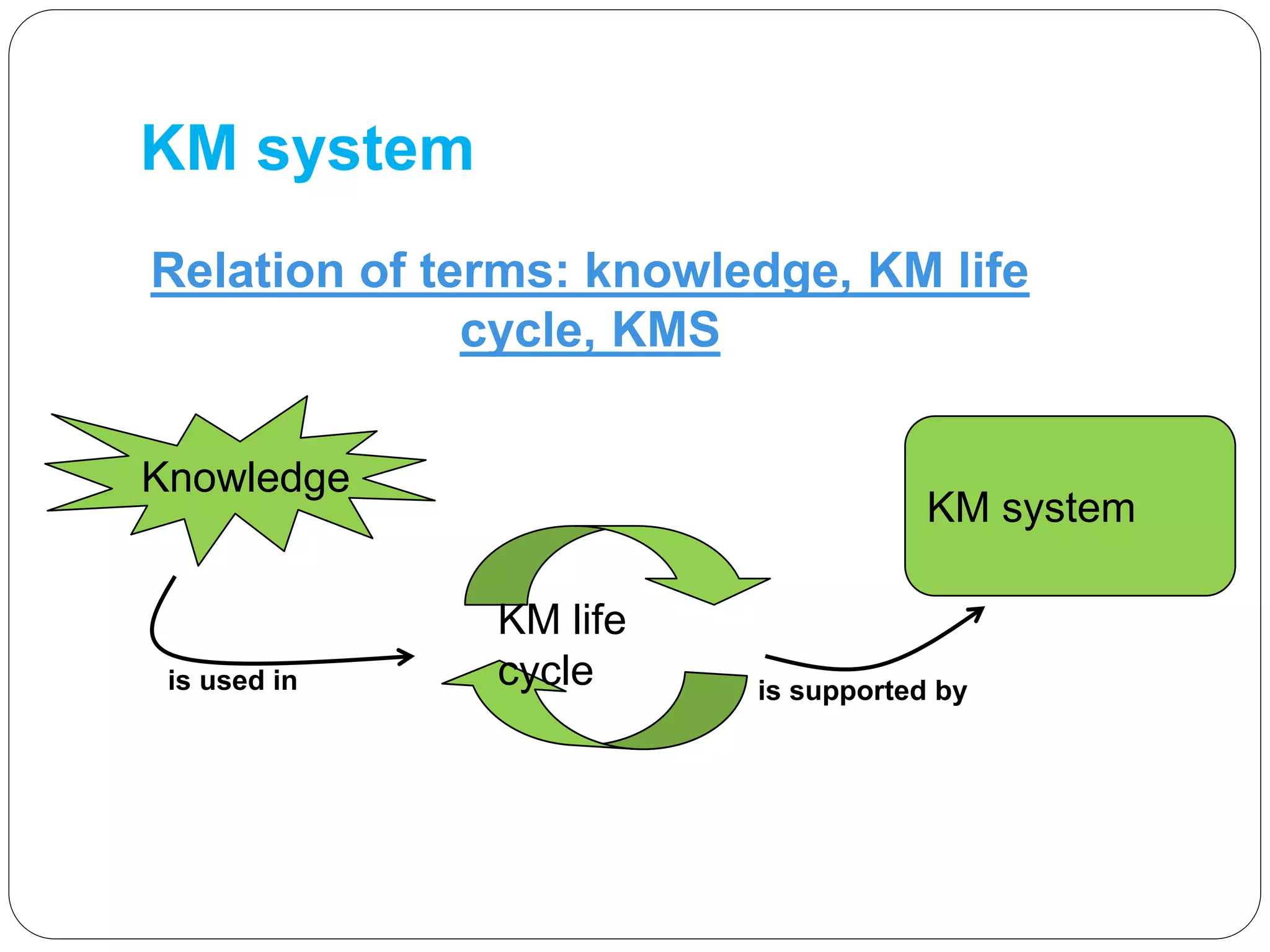
KM system
Knowledge
KM life
cycle
KM system
Relation of terms: knowledge, KM life
cycle, KMS
is used in is supported by
KM system Seven layers
architecture
Interface layer
Access and authentication layer
Collaborative intelligence and filtering
Application layer
Transport layer
Middleware and legacy integration layer
Repositories
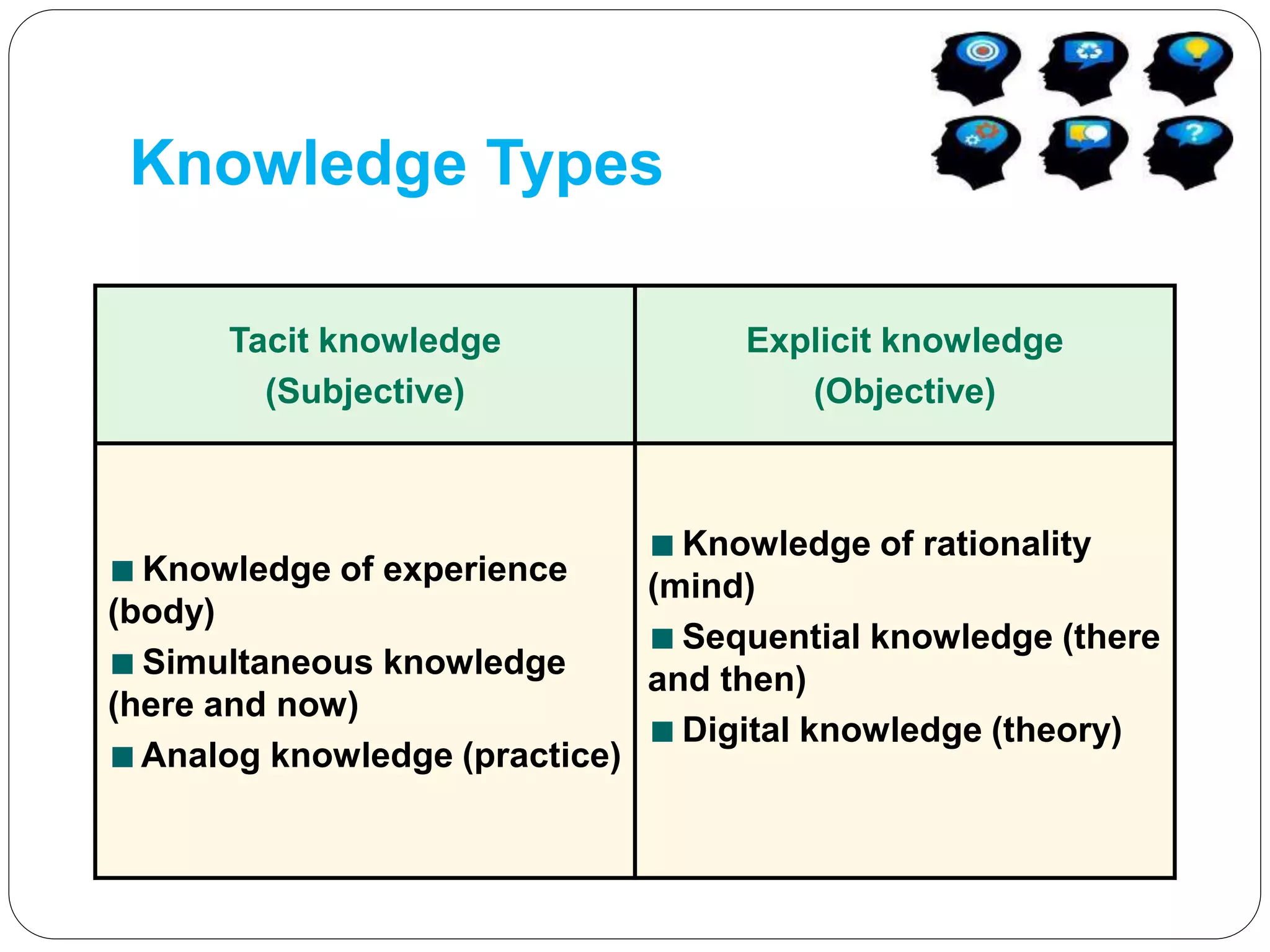
Knowledge Types
Tacit knowledge
(Subjective)
Explicit knowledge
(Objective)
Knowledge of experience
(body)
Simultaneous knowledge
(here and now)
Analog knowledge (practice)
Knowledge of rationality
(mind)
Sequential knowledge (there
and then)
Digital knowledge (theory)
Example: KMS Software
Tacit Active Net
 Helps to find people
 Initiate and manage collaboration
 Coordinate your activities automatically with those of other
people across the enterprise
 Automatically learns about people's activities and focus,
and identifies who should be talking or working together
 Makes it easy to locate and share files, find answers to
questions, or find the online conversations you should join
KM - Impact on businesses
According to a survey conducted by E&Y in 2012on business
intelligence, 87% of companies, whatever their industry is believe that
they are knowledge based business.
 Promotes many “healthy” business activities
 The recording of knowledge artefacts
 Quality management of knowledge
 Leveraging lessons learned from past decisions and
experiences
 The sharing of best practices and the building of
consistent processes
KM Impact on businesses
cont’
 Knowledge management involves stewards (those
accountable for knowledge)
 Knowledge management eliminates the risks associated with
attrition.
 knowledge management system promotes getting a good
understanding of the knowledge, information, and data needs
of employees
 A knowledge management portal provides 24x7 access to
ALL recorded knowledge
Case Study - Xerox
 Established in the 1980’s – The Document
Company
 KM Incorporated into Organizational Business
Strategy (1995)
 Conduced extensive research before introduction
into organization
 Effectively communicated to employees the
benefits of using KM
Case Study - Xerox
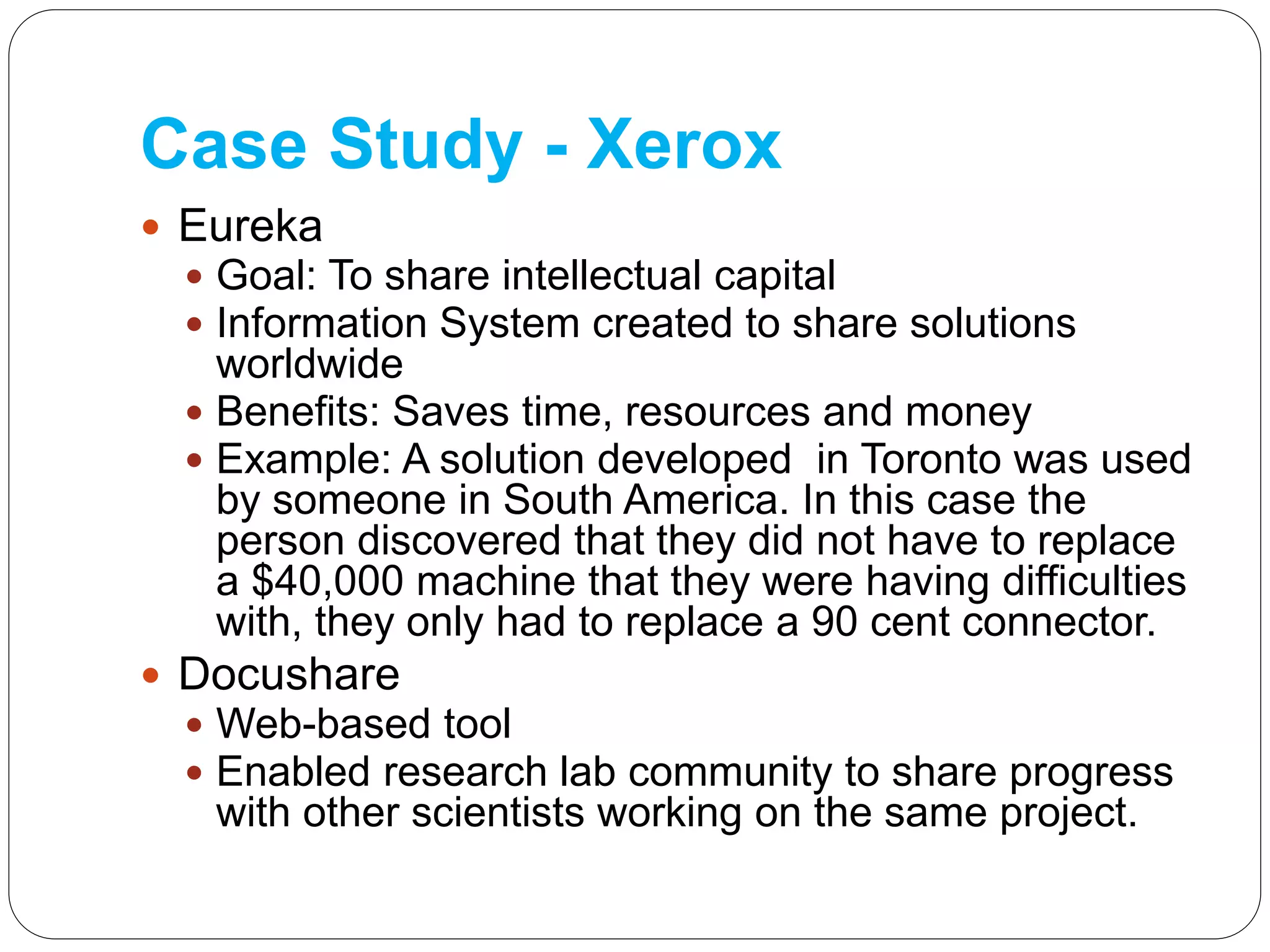
 Eureka
 Goal: To share intellectual capital
 Information System created to share solutions
worldwide
 Benefits: Saves time, resources and money
 Example: A solution developed in Toronto was used
by someone in South America. In this case the
person discovered that they did not have to replace
a $40,000 machine that they were having difficulties
with, they only had to replace a 90 cent connector.
 Docushare
 Web-based tool
 Enabled research lab community to share progress
with other scientists working on the same project.
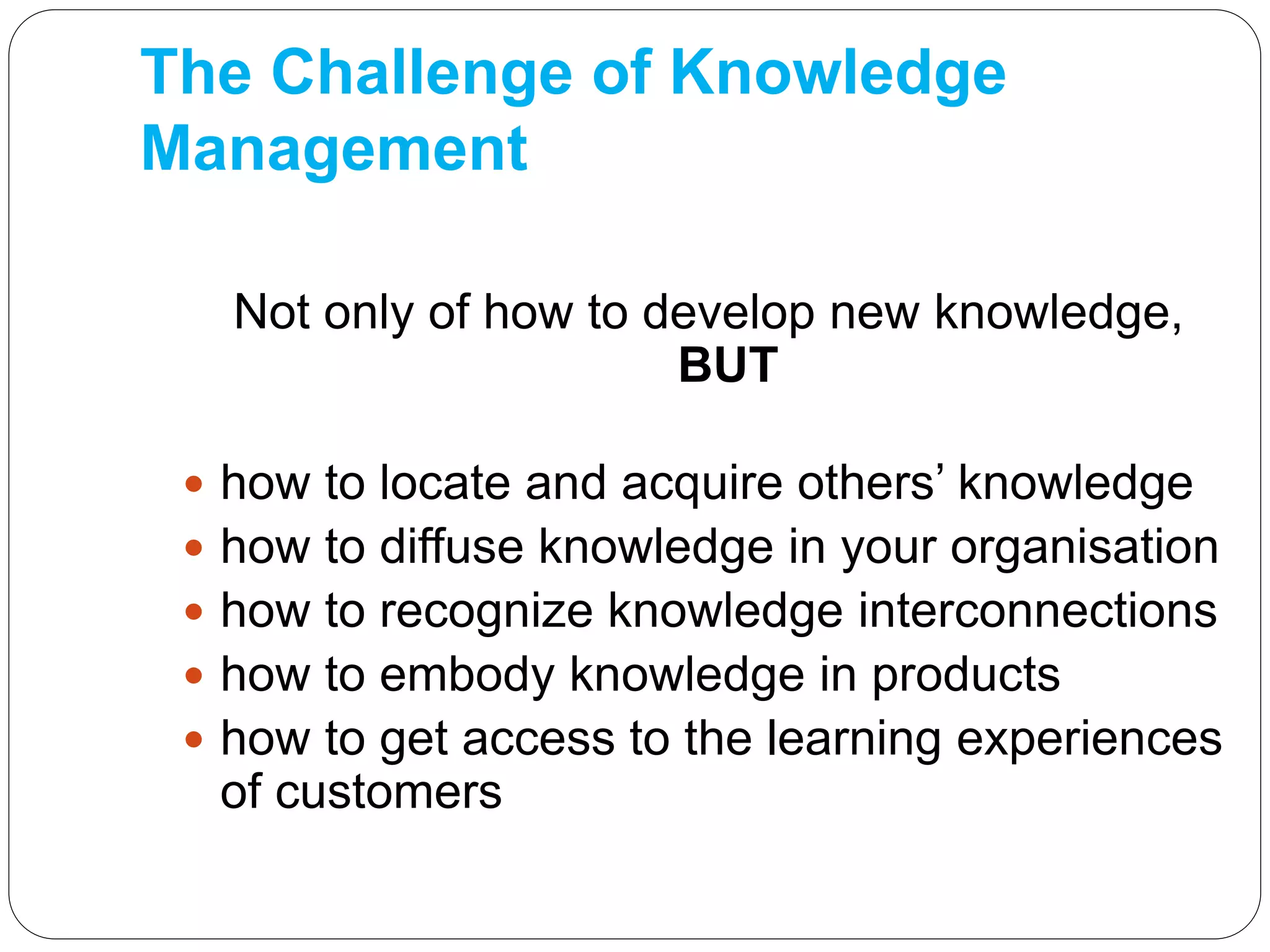
The Challenge of Knowledge
Management
Not only of how to develop new knowledge,
BUT
 how to locate and acquire others’ knowledge
 how to diffuse knowledge in your organisation
 how to recognize knowledge interconnections
 how to embody knowledge in products
 how to get access to the learning experiences
of customers
References
 http://www.kmworld.com/Articles/Editorial/Feature/KMWorl
d-100-Companies-That-Matter-in-Knowledge-
Management-52787.aspx
 http://eos.gsfc.nasa.gov/eos-ll/references/xerox.pdf
 http://articles.techrepublic.com.com/5100-10878_11-
1048267.html
 http://www.xerox.com/go/xrx/template/inv_rel_newsroom.js
p?ed_name=NR_2006March8_KMWorld&app=Newsroom
&view=newsrelease&format=article&Xcntry=USA&Xlang=e
n_US
 http://www.icasit.org/km/intro/slideshow/kmoverview_files/f
rame.htm
 http://www.coemergnece.com
Knowledge management system priyank

Knowledge management system priyank

  • 1.
    Knowledge Management System (KMS) PrashantBajpai(91) Priyank Jain(92)
  • 2.
    “The systematic processof creating, maintaining and nurturing an organization to make the best use of knowledge to create business value and generate competitive advantage” Nancy C. Shaw
  • 3.
    Knowledge Management Fundamentals  Data:Facts, numbers or individual entities without context or purpose.  Information: Data that has been organized into a meaningful context (to aid decision making).  Knowledge: The human capacity (potential & actual ability) to take effective action in varied and uncertain situations
  • 4.
    Forms of Knowledge Concepts, methodologies  Facts, beliefs, truths & laws  Know what, Know how, Know why  Judgments, expectations and insights  Relationships, leverage points  Intuition & feelings  Meaning and sense making
  • 5.
    Benefits of GoodBusiness Knowledge Management  The foundation of the enterprise  Increases when shared  Snowball effect when shared (innovation)  Creates value through efficiency (process knowledge)  Reduces uncertainty/ increases time of response (environment knowledge)  Enhances the current value of products (customer knowledge)
  • 6.
    Difficulties of ManagingCorporate Knowledge Management  Usually exists in the minds of individuals  Buried in old reports  Knowledge Hoarding  Often leaves the organization with the employee
  • 7.
    Why is KMSimportant?  Companies can...  Sustain knowledge regarding their products and services  Connect employees with knowledge they otherwise wouldn't have  Encouraging innovation and ideas  Creating better business decisions  Expedite projects due to less wait time of information
  • 8.
    How can thisbe done?  Actively managing knowledge in a database or repository  Creating incentives for employees for providing and updating and using knowledge  Experts of the field providing information that will help others better accomplish their jobs  Use of Wiki’s, Software solutions
  • 9.
    Difference between Data,Information, and Knowledge Knowledge Data Information Data interpretation Elaboration Learning Interpreted symbol structures - used to interpret data, elaborate on information, and learn - used withun the decision steps Interpreted symbols and symbol structures - input to a decision step - output from a decision step Observed uninterpreted symbols - signs, character sequences, patterns Aamodt A., Nygārd M. Different roles and mutual dependencies of data, information and knowledge - An AI perspective on their integration. Data &Knowledge Engineering, 1995.
  • 10.
  • 11.
    KMS components From thepoint of view of knowledge flow  The flow of knowledge  Knowledge cryptography  Communities of knowledge workers  Knowledge repositories and libraries
  • 12.
    KMS components From thetechnical viewpoint  Software interface  Access and authentication tools  Collaborative intelligence tools  Application level software  Transport level software  Middleware and legacy integration software  Repositories
  • 13.
    Tools for knowledge internalization Casebase Problem description Describes the problem S e n d s a ttrib u te s Retrieves matchingcases Searches for similar cases Matching cases c1 c3 c2 Deliverssimilarcases Addsthenewcase Selects theappropriate case 1 2 3 4 5 6
  • 14.
    KM system Knowledge KM life cycle KMsystem Relation of terms: knowledge, KM life cycle, KMS is used in is supported by
  • 15.
    KM system Sevenlayers architecture Interface layer Access and authentication layer Collaborative intelligence and filtering Application layer Transport layer Middleware and legacy integration layer Repositories
  • 16.
    Knowledge Types Tacit knowledge (Subjective) Explicitknowledge (Objective) Knowledge of experience (body) Simultaneous knowledge (here and now) Analog knowledge (practice) Knowledge of rationality (mind) Sequential knowledge (there and then) Digital knowledge (theory)
  • 17.
    Example: KMS Software TacitActive Net  Helps to find people  Initiate and manage collaboration  Coordinate your activities automatically with those of other people across the enterprise  Automatically learns about people's activities and focus, and identifies who should be talking or working together  Makes it easy to locate and share files, find answers to questions, or find the online conversations you should join
  • 18.
    KM - Impacton businesses According to a survey conducted by E&Y in 2012on business intelligence, 87% of companies, whatever their industry is believe that they are knowledge based business.  Promotes many “healthy” business activities  The recording of knowledge artefacts  Quality management of knowledge  Leveraging lessons learned from past decisions and experiences  The sharing of best practices and the building of consistent processes
  • 19.
    KM Impact onbusinesses cont’  Knowledge management involves stewards (those accountable for knowledge)  Knowledge management eliminates the risks associated with attrition.  knowledge management system promotes getting a good understanding of the knowledge, information, and data needs of employees  A knowledge management portal provides 24x7 access to ALL recorded knowledge
  • 20.
    Case Study -Xerox  Established in the 1980’s – The Document Company  KM Incorporated into Organizational Business Strategy (1995)  Conduced extensive research before introduction into organization  Effectively communicated to employees the benefits of using KM
  • 21.
    Case Study -Xerox  Eureka  Goal: To share intellectual capital  Information System created to share solutions worldwide  Benefits: Saves time, resources and money  Example: A solution developed in Toronto was used by someone in South America. In this case the person discovered that they did not have to replace a $40,000 machine that they were having difficulties with, they only had to replace a 90 cent connector.  Docushare  Web-based tool  Enabled research lab community to share progress with other scientists working on the same project.
  • 22.
    The Challenge ofKnowledge Management Not only of how to develop new knowledge, BUT  how to locate and acquire others’ knowledge  how to diffuse knowledge in your organisation  how to recognize knowledge interconnections  how to embody knowledge in products  how to get access to the learning experiences of customers
  • 24.
    References  http://www.kmworld.com/Articles/Editorial/Feature/KMWorl d-100-Companies-That-Matter-in-Knowledge- Management-52787.aspx  http://eos.gsfc.nasa.gov/eos-ll/references/xerox.pdf http://articles.techrepublic.com.com/5100-10878_11- 1048267.html  http://www.xerox.com/go/xrx/template/inv_rel_newsroom.js p?ed_name=NR_2006March8_KMWorld&app=Newsroom &view=newsrelease&format=article&Xcntry=USA&Xlang=e n_US  http://www.icasit.org/km/intro/slideshow/kmoverview_files/f rame.htm  http://www.coemergnece.com