A CRITICAL REVIEW OF KNOWLEDGE MANAGEMENT AS A MANAGEMENT TOOL Prepared by Yaw Chooi Fun, Master of Business Administration, University of Hertfordshire, UK @ July 2009
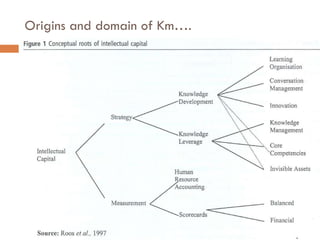
Origins and domain of Knowledge Management Roos et al suggest that “intellectual capital” can be traced to two streams of thought, strategy and measurement.  Strategic area, focus on studying the creation and use of knowledge and the relationship between knowledge and success or value creation.  Measurement, focus on the need to develop new information systems, measuring non-financial data alongside the traditional financial.
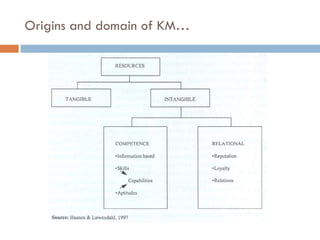
Origins and domain of Km…. Figure 2 Intangible resources Sources: Haanes & Lowendahl, 1997
Origins and domain of KM… Haanes & Lowendahl categorise intangible resources into competence and relational resources. Competence, the ability to perform a given task and exist at both the individual and organizational level.
Origins and domain of KM…
Empirical origins to KM DiMattia and Oder (1997) argue that the growth of KM has emerged from 2 fundamental shifts: Downsizing strategy Technological development
Downsizing strategy Downsizing => reduce overhead and increase profits => resulted in a loss of the knowledge => Organizations recognize that lost years of valuable information and expertise and were now determined to protect themselves against a recurrence. Use technology and system to capture the knowledge residing in the minds of their employees, easily shared within organization. Stored and reusable resource
Technological development KM is an attempt to cope with the explosion of information and to capitalize on increased knowledge in the workplace. The emerging technological development enables global sharing of information across platforms and continents and serve as a tool within an organization to use knowledge more effectively.
Domain of Knowledge Management Definition of knowledge: Characteristics of knowledge Tacit and explicit knowledge
Characteristics of knowledge Knowledge cannot easily be stored. Knowledge involves the processing, creation, or use of information in the individual mind. Knowledge is information combined with experience, context, interpretation, reflection, and perspective. Knowledge is ineffectual if it’s not used.
Tacit and explicit knowledge  Tacit knowledge  is documented and public; structured, fixed-content, externalized, and conscious. It can be captured and shared. Explicit knowledge is resides in the human mind, behaviour, and perception. People’s interactions and requires skill and practice.
KM as a Management tool KM as an information handling tool KM as an strategic management tool
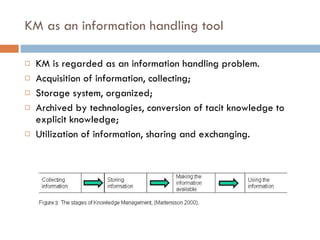
KM as an information handling tool KM is regarded as an information handling problem. Acquisition of information, collecting; Storage system, organized; Archived by technologies, conversion of tacit knowledge to explicit knowledge; Utilization of information, sharing and exchanging.
KM as an strategic management tool Organizations must adjust their capabilities to constantly changing complex external environment. Must build systems for capturing and transferring internal knowledge and best practices. Expected outcomes of an organisation with KM:  improve performance, productivity, and competitiveness improve effective acquisition, sharing and usage of information improve decision making capture best practices reduce research costs and delays more innovative organization.
Critical elements of KM strategy Suggestions for critical elements must be included to successfully create and implement a KM strategy. The “so what?” question Support from top management Communication Creativity Culture and people Sharing knowledge Incentives Times Evaluation
Knowledge management in organization 2 types of knowledge Explicit knowledge Embodies in a code or a language Can be verbalized, communicated, processed, transmitted and stored relativelt easily Tacit knowledge Rooted in action, procedures commitment, values and emotions. Acquired by sharing experiences, by observation and imitaiton
THE USE OF TACIT KNOWLEDGE WITHIN INNOVATIVE COMPANIES: KNOWLEDGE MANAGEMENT IN INNOVATIVE ENTERPRISES Prepare By Lee Tai Keong
Tacit knowledge Management Tacit knowledge  as personal knowledge that each individual possesses that is unique and once unlocked can be creative contribution in an organization Critical to the key organizational task of creating new knowledge, generating new products and improving new business procedures leading to innovation.
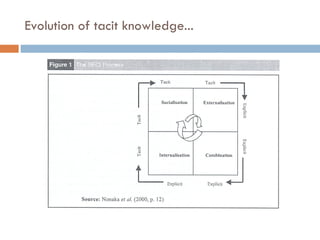
Evolution of tacit knowledge Knowledge conversion – SECI Socialisation (from tacit knowledge to tacit knowledge) Externalisation (from tacit knowledge to explicit knowledge) Combination (from explicit knowledge to explicit knowledge) Internalisation (from explicti knowledge to tacit knowledge)
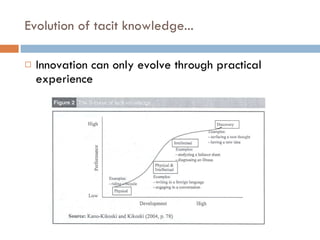
Evolution of tacit knowledge...
Evolution of tacit knowledge... Innovation can only evolve through practical experience
Vitalisation of tacit knowledge Can be transferred both in and outside the organization Inside the organization Enhance the tacit know-how competence Outside the organization Recruit the right individuals with the requisite education or work experience By acquiring parts of or whole new companies By engaging appropriate consultants or building network with other companies.
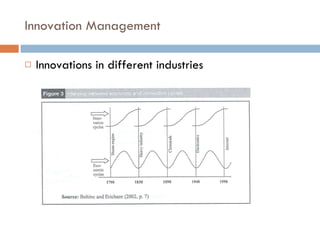
Innovation Management Innovations in different industries
Transfer of tacit knowledge Barriers Fear of losing ownership A position of privilege Superiority Lack of insufficient rewards Unaware their knowledge might be interest to others
Success factors to tacit knowledge transfer Human related factors such as Motivation, Commitment, Hopes and Rewards Good relationship, trust and openess between sender and recipient  Behavior of the management leader as role models to offer reward for imitation Personal interaction processes: Informal atmosphere and face-to-face
KNOWLEDGE MANAGEMENT AND PROCESS PERFORMANCE Prepare By Norazian
KM and Process Performance Processes are activities that use resources to stimulate and bring about change. Process improvements focus on being more responsive to customers and improve performance in quality, time, speed and reliability with reduced production costs.
KM and Process Performance… Radical improvements in numerous performance dimensions simultaneously were attained through quality management approaches. Total quality management approaches identify an organisation as a set of business processes incorporated for operational and strategic levels.
KM and Process Performance… Business process management manages these flows of materials, people and information. Links strategy to operational implementation and defines management responsibility focused on processes rather than functions. These processes allows knowledge to play an important role in organisational effectiveness.
Points to Ponder Can the incorporation of ideas about knowledge processes lead to greater effectiveness in operational processes for the organisation? Will taking a knowledge management approach help to open up new possibilities?
Points to Ponder… Knowledge management (KM) focuses on core competences providing sustainable advantage over competitors KM accepts that processes, people and technology come together to improve organisational effectiveness through learning. KM processes with greatest impact on operations are the creation, transfer, embedding and using of knowledge
Points to Ponder… Creation – network of experts with access to knowledge technologies to produce solutions in the problem solving domain.  Transfer – individuals within networks who facilitate the access and transfer of knowledge. Embedding – organisational effectiveness through incorporation of knowledge into organisational processes
Points to Ponder… Knowledge based process management leads to improved capability and performance through three conversion processes:-  Improvement or change of form – manufacturing of goods  Care and counter effects of potential harm – crowd control Transfer or change of place – transport and telecomunications
Points to Ponder… The knowledge model addresses customer knowledge with an holistic approach to gain understanding of the needs, condition and expectations of the customer. The knowledge equivalent of material supply chain is the basis of a model applicable to variety of operational processes in manufacturing, public administration and consultancy.
Points to Ponder… Knowledge processes are supported by information and communication technology in 4 areas; Databases  Decision support tools – Artificial Intelligence Group ware – Email, Video Conferencing Net technology – Intranets
Points to Ponder… Application of KM in operations to assess KPIs:  Quality, dependability, responsiveness and speed of delivery system Flexibility of operational processes Cost reduction  Issues addressed by KM: Increasing market turbulence Reduced tolerance for trade offs in performance Network organisations
Points to Ponder… Knowledge processes require effective collaboration, used as source of competitive advantage and forces constant examination of operational processes KM introduces new measures of customer service and efficiency by allowing managers to reduce the effects of difficult processes and achieve operational success
Points to Ponder… KM assists in the planning and control of achieving performance excellence and enables improvements to operational processes.
KNOWLEDGE OUTSOURCING Prepare By Eu Wee Khai
Knowledge Outsourcing Knowledge Management ( KM )  how organizations capture knowledge from experts with the organization, and formalise and package knowledge assets for dissemination and reuse by other employees ( Markus 2001 ) Knowledge Outsourcing ( KO ) The external experts are clearly contracted to generate knowledge-intensive assets which are subsequently internalized by the organization.
Outsourcing Concept Information systems where there has already been significant study in outsourcing as starting point to conceptualize to KO. Is a business transaction which involves contracting or selling an organisation’s IT assets., people and activities to a third party supplier. ( Kern 1997 )

Knowledge Management

  • 1.
    A CRITICAL REVIEWOF KNOWLEDGE MANAGEMENT AS A MANAGEMENT TOOL Prepared by Yaw Chooi Fun, Master of Business Administration, University of Hertfordshire, UK @ July 2009
  • 2.
    Origins and domainof Knowledge Management Roos et al suggest that “intellectual capital” can be traced to two streams of thought, strategy and measurement. Strategic area, focus on studying the creation and use of knowledge and the relationship between knowledge and success or value creation. Measurement, focus on the need to develop new information systems, measuring non-financial data alongside the traditional financial.
  • 3.
    Origins and domainof Km…. Figure 2 Intangible resources Sources: Haanes & Lowendahl, 1997
  • 4.
    Origins and domainof KM… Haanes & Lowendahl categorise intangible resources into competence and relational resources. Competence, the ability to perform a given task and exist at both the individual and organizational level.
  • 5.
  • 6.
    Empirical origins toKM DiMattia and Oder (1997) argue that the growth of KM has emerged from 2 fundamental shifts: Downsizing strategy Technological development
  • 7.
    Downsizing strategy Downsizing=> reduce overhead and increase profits => resulted in a loss of the knowledge => Organizations recognize that lost years of valuable information and expertise and were now determined to protect themselves against a recurrence. Use technology and system to capture the knowledge residing in the minds of their employees, easily shared within organization. Stored and reusable resource
  • 8.
    Technological development KMis an attempt to cope with the explosion of information and to capitalize on increased knowledge in the workplace. The emerging technological development enables global sharing of information across platforms and continents and serve as a tool within an organization to use knowledge more effectively.
  • 9.
    Domain of KnowledgeManagement Definition of knowledge: Characteristics of knowledge Tacit and explicit knowledge
  • 10.
    Characteristics of knowledgeKnowledge cannot easily be stored. Knowledge involves the processing, creation, or use of information in the individual mind. Knowledge is information combined with experience, context, interpretation, reflection, and perspective. Knowledge is ineffectual if it’s not used.
  • 11.
    Tacit and explicitknowledge Tacit knowledge is documented and public; structured, fixed-content, externalized, and conscious. It can be captured and shared. Explicit knowledge is resides in the human mind, behaviour, and perception. People’s interactions and requires skill and practice.
  • 12.
    KM as aManagement tool KM as an information handling tool KM as an strategic management tool
  • 13.
    KM as aninformation handling tool KM is regarded as an information handling problem. Acquisition of information, collecting; Storage system, organized; Archived by technologies, conversion of tacit knowledge to explicit knowledge; Utilization of information, sharing and exchanging.
  • 14.
    KM as anstrategic management tool Organizations must adjust their capabilities to constantly changing complex external environment. Must build systems for capturing and transferring internal knowledge and best practices. Expected outcomes of an organisation with KM: improve performance, productivity, and competitiveness improve effective acquisition, sharing and usage of information improve decision making capture best practices reduce research costs and delays more innovative organization.
  • 15.
    Critical elements ofKM strategy Suggestions for critical elements must be included to successfully create and implement a KM strategy. The “so what?” question Support from top management Communication Creativity Culture and people Sharing knowledge Incentives Times Evaluation
  • 16.
    Knowledge management inorganization 2 types of knowledge Explicit knowledge Embodies in a code or a language Can be verbalized, communicated, processed, transmitted and stored relativelt easily Tacit knowledge Rooted in action, procedures commitment, values and emotions. Acquired by sharing experiences, by observation and imitaiton
  • 17.
    THE USE OFTACIT KNOWLEDGE WITHIN INNOVATIVE COMPANIES: KNOWLEDGE MANAGEMENT IN INNOVATIVE ENTERPRISES Prepare By Lee Tai Keong
  • 18.
    Tacit knowledge ManagementTacit knowledge as personal knowledge that each individual possesses that is unique and once unlocked can be creative contribution in an organization Critical to the key organizational task of creating new knowledge, generating new products and improving new business procedures leading to innovation.
  • 19.
    Evolution of tacitknowledge Knowledge conversion – SECI Socialisation (from tacit knowledge to tacit knowledge) Externalisation (from tacit knowledge to explicit knowledge) Combination (from explicit knowledge to explicit knowledge) Internalisation (from explicti knowledge to tacit knowledge)
  • 20.
    Evolution of tacitknowledge...
  • 21.
    Evolution of tacitknowledge... Innovation can only evolve through practical experience
  • 22.
    Vitalisation of tacitknowledge Can be transferred both in and outside the organization Inside the organization Enhance the tacit know-how competence Outside the organization Recruit the right individuals with the requisite education or work experience By acquiring parts of or whole new companies By engaging appropriate consultants or building network with other companies.
  • 23.
    Innovation Management Innovationsin different industries
  • 24.
    Transfer of tacitknowledge Barriers Fear of losing ownership A position of privilege Superiority Lack of insufficient rewards Unaware their knowledge might be interest to others
  • 25.
    Success factors totacit knowledge transfer Human related factors such as Motivation, Commitment, Hopes and Rewards Good relationship, trust and openess between sender and recipient Behavior of the management leader as role models to offer reward for imitation Personal interaction processes: Informal atmosphere and face-to-face
  • 26.
    KNOWLEDGE MANAGEMENT ANDPROCESS PERFORMANCE Prepare By Norazian
  • 27.
    KM and ProcessPerformance Processes are activities that use resources to stimulate and bring about change. Process improvements focus on being more responsive to customers and improve performance in quality, time, speed and reliability with reduced production costs.
  • 28.
    KM and ProcessPerformance… Radical improvements in numerous performance dimensions simultaneously were attained through quality management approaches. Total quality management approaches identify an organisation as a set of business processes incorporated for operational and strategic levels.
  • 29.
    KM and ProcessPerformance… Business process management manages these flows of materials, people and information. Links strategy to operational implementation and defines management responsibility focused on processes rather than functions. These processes allows knowledge to play an important role in organisational effectiveness.
  • 30.

    Points to PonderCan the incorporation of ideas about knowledge processes lead to greater effectiveness in operational processes for the organisation? Will taking a knowledge management approach help to open up new possibilities?
  • 31.
    Points to Ponder…Knowledge management (KM) focuses on core competences providing sustainable advantage over competitors KM accepts that processes, people and technology come together to improve organisational effectiveness through learning. KM processes with greatest impact on operations are the creation, transfer, embedding and using of knowledge
  • 32.
    Points to Ponder…Creation – network of experts with access to knowledge technologies to produce solutions in the problem solving domain. Transfer – individuals within networks who facilitate the access and transfer of knowledge. Embedding – organisational effectiveness through incorporation of knowledge into organisational processes
  • 33.
    Points to Ponder…Knowledge based process management leads to improved capability and performance through three conversion processes:- Improvement or change of form – manufacturing of goods Care and counter effects of potential harm – crowd control Transfer or change of place – transport and telecomunications
  • 34.
    Points to Ponder…The knowledge model addresses customer knowledge with an holistic approach to gain understanding of the needs, condition and expectations of the customer. The knowledge equivalent of material supply chain is the basis of a model applicable to variety of operational processes in manufacturing, public administration and consultancy.
  • 35.
    Points to Ponder…Knowledge processes are supported by information and communication technology in 4 areas; Databases Decision support tools – Artificial Intelligence Group ware – Email, Video Conferencing Net technology – Intranets
  • 36.
    Points to Ponder…Application of KM in operations to assess KPIs: Quality, dependability, responsiveness and speed of delivery system Flexibility of operational processes Cost reduction Issues addressed by KM: Increasing market turbulence Reduced tolerance for trade offs in performance Network organisations
  • 37.
    Points to Ponder…Knowledge processes require effective collaboration, used as source of competitive advantage and forces constant examination of operational processes KM introduces new measures of customer service and efficiency by allowing managers to reduce the effects of difficult processes and achieve operational success
  • 38.
    Points to Ponder…KM assists in the planning and control of achieving performance excellence and enables improvements to operational processes.
  • 39.
  • 40.
    Knowledge Outsourcing KnowledgeManagement ( KM ) how organizations capture knowledge from experts with the organization, and formalise and package knowledge assets for dissemination and reuse by other employees ( Markus 2001 ) Knowledge Outsourcing ( KO ) The external experts are clearly contracted to generate knowledge-intensive assets which are subsequently internalized by the organization.
  • 41.
    Outsourcing Concept Informationsystems where there has already been significant study in outsourcing as starting point to conceptualize to KO. Is a business transaction which involves contracting or selling an organisation’s IT assets., people and activities to a third party supplier. ( Kern 1997 )

Editor's Notes

  • #7 KM – Knowledge Management
  • #13 KM – Knowledge Management
  • #14 KM – Knowledge Management