

Presented By
       M.TULASINADH
       K.B.N PG COLLEGE
1.   Information is not knowledge…..

2.   The only source of knowledge is experience….
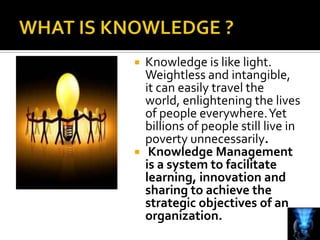
 Knowledge is like light.
  Weightless and intangible,
  it can easily travel the
  world, enlightening the lives
  of people everywhere. Yet
  billions of people still live in
  poverty unnecessarily.
 Knowledge Management
  is a system to facilitate
  learning, innovation and
  sharing to achieve the
  strategic objectives of an
  organization.
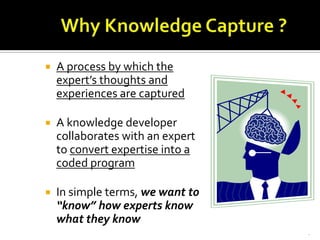
   A process by which the
    expert’s thoughts and
    experiences are captured

   A knowledge developer
    collaborates with an expert
    to convert expertise into a
    coded program

   In simple terms, we want to
    “know” how experts know
    what they know
                                  .
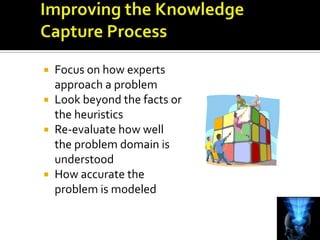
 Focus on how experts
  approach a problem
 Look beyond the facts or
  the heuristics
 Re-evaluate how well
  the problem domain is
  understood
 How accurate the
  problem is modeled


                             4-5
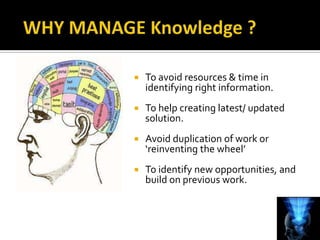
   To avoid resources & time in
    identifying right information.
   To help creating latest/ updated
    solution.
   Avoid duplication of work or
    ‘reinventing the wheel’
   To identify new opportunities, and
    build on previous work.
   EXPLICIT
     Can be codified in tangible form
     Can be easily communicated and shared
     Characteristics – “Know-What”, “Know-Why” and “Know-Who”

   TACIT
       Highly personal and therefore inexpressible
       Not easy to visualize and hard to express
       Characteristics – “Know-How”
       Is highly elusive
MOVEMENT OF TACIT KNOWLEDGE

 “Movement of tacit knowledge within the organization is a
 distinct experience, not a gradual process of dissemination,
 and depends on the characteristics of everyone
 involved…..more of a mindset issue!”
 Mere information of law is no longer an USP…..
 Clients pay for ‘solutions’ not ‘information’
 Information imperfections do not exist in the
  practice of law
 Real-time transactions require firms to offer real-
  time solutions
 Practice of law requires firms to adapt and replicate
  knowledge into readily usable form
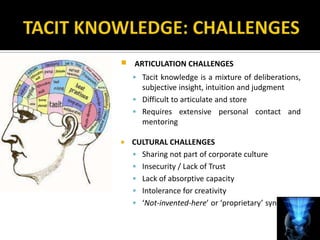
   ARTICULATION CHALLENGES
     Tacit knowledge is a mixture of deliberations,
      subjective insight, intuition and judgment
     Difficult to articulate and store
     Requires extensive personal contact and
      mentoring

   CULTURAL CHALLENGES
     Sharing not part of corporate culture
     Insecurity / Lack of Trust
     Lack of absorptive capacity
     Intolerance for creativity
     ‘Not-invented-here’ or ‘proprietary’ syndrome
MODES OF TRANSFERRING
              – TACIT KNOWLEDGE

 SOCIALIZATION - Tacit to Tacit
    Occurs through apprenticeship, mentoring or collegial
    relations. Also described as “implicit learning” or “learning
    by doing”
   EXTERNALIZATION – Tacit to Explicit
    Written down or communicated through anecdotes,
    narratives, conversations, memos, emails, presentations,
    group discussions, etc. Also described as “articulation”
   COMBINATION – Explicit to Explicit
    Knowledge transferred though standardized and systematic
    procedures. For ex., through a computer database
   INTERNALIZATION – Explicit to Tacit
    Results in distribution of knowledge throughout the
    organisation and beyond.
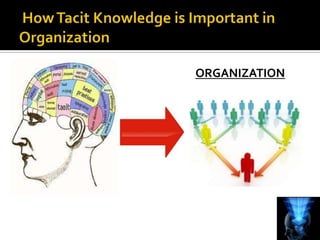
ORGANIZATION
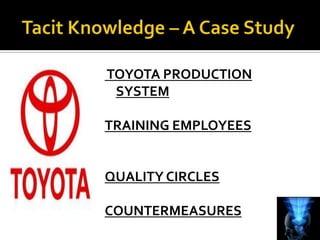
TOYOTA PRODUCTION
 SYSTEM

TRAINING EMPLOYEES


QUALITY CIRCLES

COUNTERMEASURES
Communities of Practice
 Creation of Shared workspace or environment
 Tacit Knowledge by creating a Cultural Environment
 Personnel Training
 Knowledge Sharing Activities
 Incentives to encourage knowledge sharing
 Time spent in working hours on knowledge sharing
  activities should be regarded as legitimate
 The knowledge sharing depends upon social
  interactions
 Tacit Knowledge Thru Strong facilitator
 Focus on Individual
.

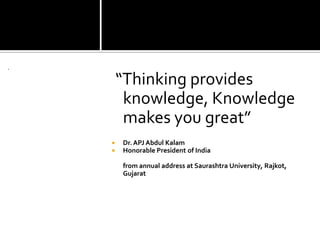
        “Thinking provides
         knowledge, Knowledge
         makes you great”
       Dr. APJ Abdul Kalam
       Honorable President of India

        from annual address at Saurashtra University, Rajkot,
        Gujarat
.

    .
Managing tacit knowledge  case study

Managing tacit knowledge case study

  • 1.
    Presented By M.TULASINADH K.B.N PG COLLEGE
  • 2.
    1. Information is not knowledge….. 2. The only source of knowledge is experience….
  • 3.
     Knowledge islike light. Weightless and intangible, it can easily travel the world, enlightening the lives of people everywhere. Yet billions of people still live in poverty unnecessarily.  Knowledge Management is a system to facilitate learning, innovation and sharing to achieve the strategic objectives of an organization.
  • 4.
    A process by which the expert’s thoughts and experiences are captured  A knowledge developer collaborates with an expert to convert expertise into a coded program  In simple terms, we want to “know” how experts know what they know .
  • 5.
     Focus onhow experts approach a problem  Look beyond the facts or the heuristics  Re-evaluate how well the problem domain is understood  How accurate the problem is modeled 4-5
  • 6.
    To avoid resources & time in identifying right information.  To help creating latest/ updated solution.  Avoid duplication of work or ‘reinventing the wheel’  To identify new opportunities, and build on previous work.
  • 7.
    EXPLICIT  Can be codified in tangible form  Can be easily communicated and shared  Characteristics – “Know-What”, “Know-Why” and “Know-Who”  TACIT  Highly personal and therefore inexpressible  Not easy to visualize and hard to express  Characteristics – “Know-How”  Is highly elusive
  • 8.
    MOVEMENT OF TACITKNOWLEDGE “Movement of tacit knowledge within the organization is a distinct experience, not a gradual process of dissemination, and depends on the characteristics of everyone involved…..more of a mindset issue!”
  • 9.
     Mere informationof law is no longer an USP…..  Clients pay for ‘solutions’ not ‘information’  Information imperfections do not exist in the practice of law  Real-time transactions require firms to offer real- time solutions  Practice of law requires firms to adapt and replicate knowledge into readily usable form
  • 10.
    ARTICULATION CHALLENGES  Tacit knowledge is a mixture of deliberations, subjective insight, intuition and judgment  Difficult to articulate and store  Requires extensive personal contact and mentoring  CULTURAL CHALLENGES  Sharing not part of corporate culture  Insecurity / Lack of Trust  Lack of absorptive capacity  Intolerance for creativity  ‘Not-invented-here’ or ‘proprietary’ syndrome
  • 11.
    MODES OF TRANSFERRING – TACIT KNOWLEDGE  SOCIALIZATION - Tacit to Tacit Occurs through apprenticeship, mentoring or collegial relations. Also described as “implicit learning” or “learning by doing”  EXTERNALIZATION – Tacit to Explicit Written down or communicated through anecdotes, narratives, conversations, memos, emails, presentations, group discussions, etc. Also described as “articulation”  COMBINATION – Explicit to Explicit Knowledge transferred though standardized and systematic procedures. For ex., through a computer database  INTERNALIZATION – Explicit to Tacit Results in distribution of knowledge throughout the organisation and beyond.
  • 13.
  • 14.
    TOYOTA PRODUCTION SYSTEM TRAININGEMPLOYEES QUALITY CIRCLES COUNTERMEASURES
  • 15.
    Communities of Practice Creation of Shared workspace or environment  Tacit Knowledge by creating a Cultural Environment  Personnel Training  Knowledge Sharing Activities  Incentives to encourage knowledge sharing  Time spent in working hours on knowledge sharing activities should be regarded as legitimate  The knowledge sharing depends upon social interactions  Tacit Knowledge Thru Strong facilitator  Focus on Individual
  • 16.
    . “Thinking provides knowledge, Knowledge makes you great”  Dr. APJ Abdul Kalam  Honorable President of India from annual address at Saurashtra University, Rajkot, Gujarat
  • 17.
    . .