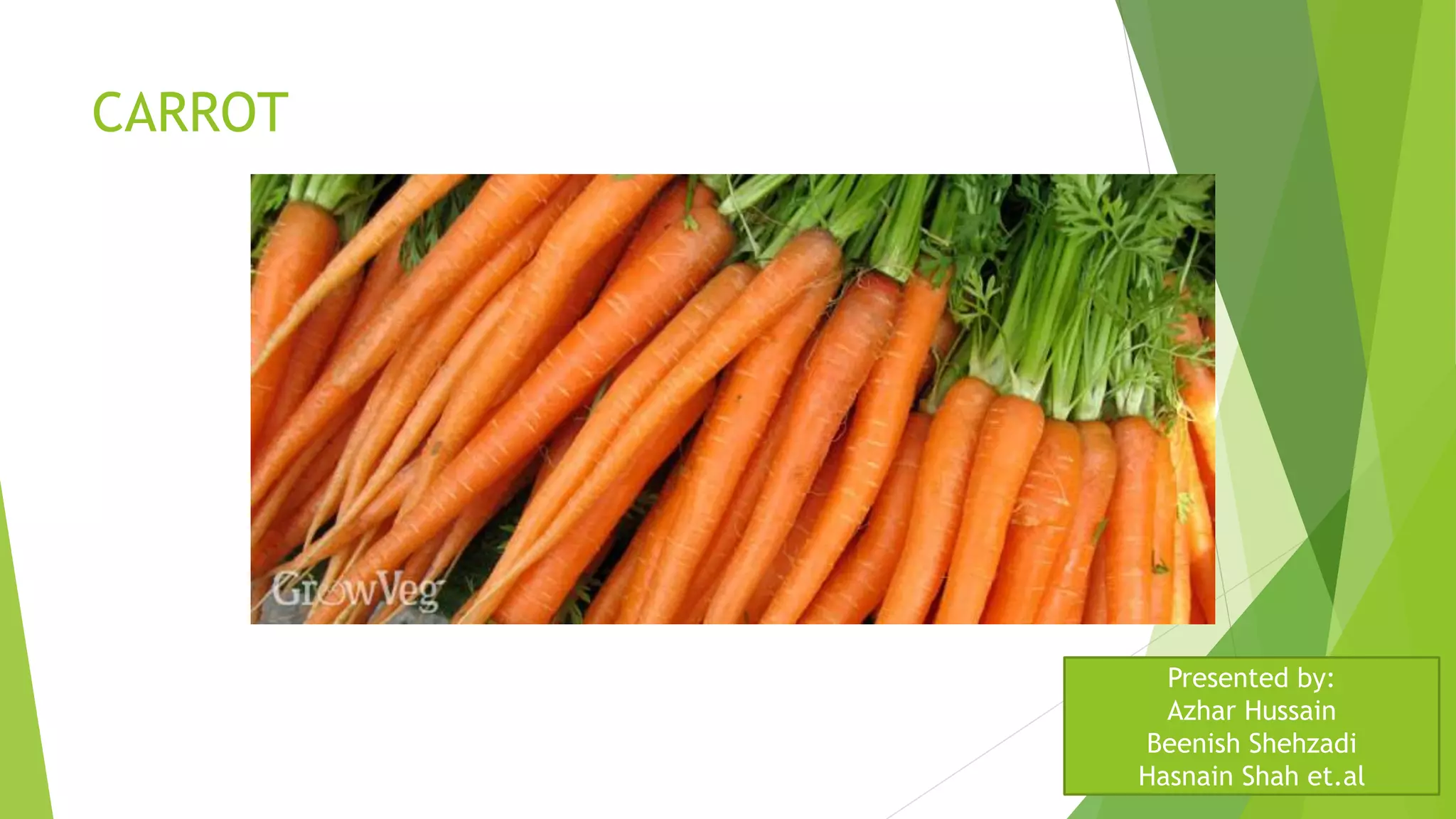
CARROT
Presented by:
Azhar Hussain
Beenish Shehzadi
Hasnain Shah et.al
INTRODUCTION
 Botanical name: Daucus carota L.
 Family Apiaceae
 Origin Asia
 Roots long and thin, purple or yellow in colour white
orange, orange or orange-red colour
 Roots Shape Cylindrical, conical, or even spherical in shape
INTRODUCTION
 Rich in carotene (vitamin A)
 Consumed either fresh, as a salad crop, or cooked
 Very important vegetable crop in South Africa
 Biennial plant (grows vegetatively in 1st season and produces seed in 2nd
year)
ENVIRONMENTAL REQUIREMENTS
 Climate
 Moderately climate required
 Heavy frost before harvesting can scorch leaves
 Grow best under cool conditions (10° to 25°C)
 Grown throughout the year except in very cold areas
 Late summer and autumn, high humidity and heavy dew
(Alternaria leaf blight)
 Insufficient soil moisture results in a longer and thinner root
VARIETIES
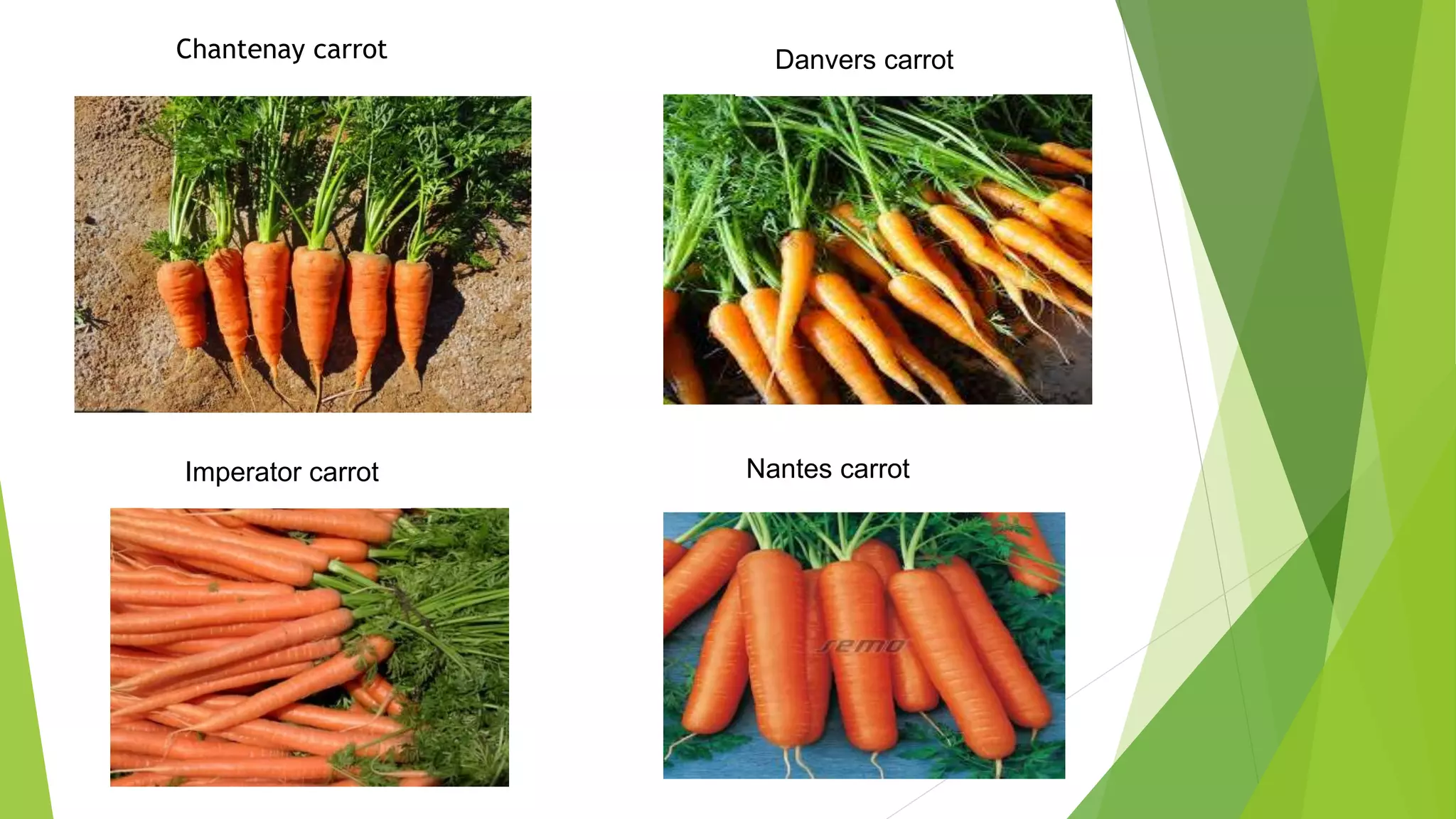
 Chantenay carrot (roots are shorter, vigorous foliage, broad in the shoulders)
 Danvers carrot (strong foliage and the roots are longe well-defined shoulder)
 Imperator carrot (vigorous foliage, high sugar content, long and slender roots)
 Nantes carrot (sparse foliage, cylindrical, short tip, skin is easily damaged, high
in sugar and store less)
Chantenay carrot Danvers carrot
Imperator carrot Nantes carrot
SOIL
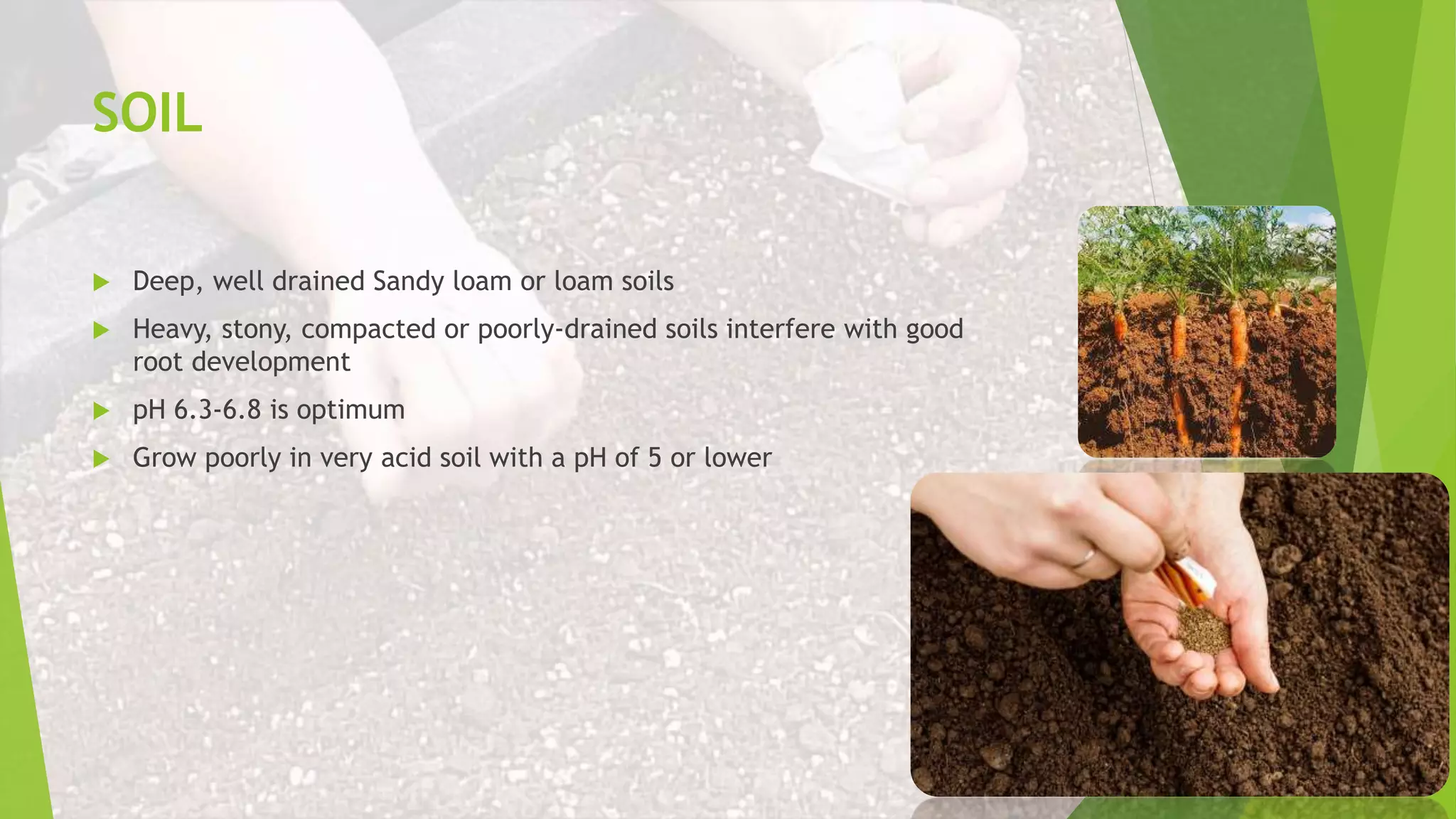
 Deep, well drained Sandy loam or loam soils
 Heavy, stony, compacted or poorly-drained soils interfere with good
root development
 pH 6.3-6.8 is optimum
 Grow poorly in very acid soil with a pH of 5 or lower
CULTURAL ASPECTS
 Soil Preparation
 Deep ploughing to a depth of at least 30 cm for root development
 Sub-soiling for breaking compacted soil layers
 Sowing times
 Cold areas (heavy frosts) August - March
 Warm areas (light frosts) January - November
 Hot areas (no frost) February - September
CULTURAL ASPECTS
 Seeding rates
 20 to 25 kg per hectare
 Red Core Chantenay for large, blocky roots 3 kg seed/ha
SEEDING
 Carrot is seeded about 1/2 to 3/4 inch deep in the soil for better germination
 Seed should be kept moist until the plants are well established
 In loose, light sand, seeds could be planted 40 mm deep
 Shallow planting is preferred for heavier soils
 Row-to-Row distance 60 cm, plant-to-plant as 3 to 4 cm
 Seed should be sown on both sides of ridges
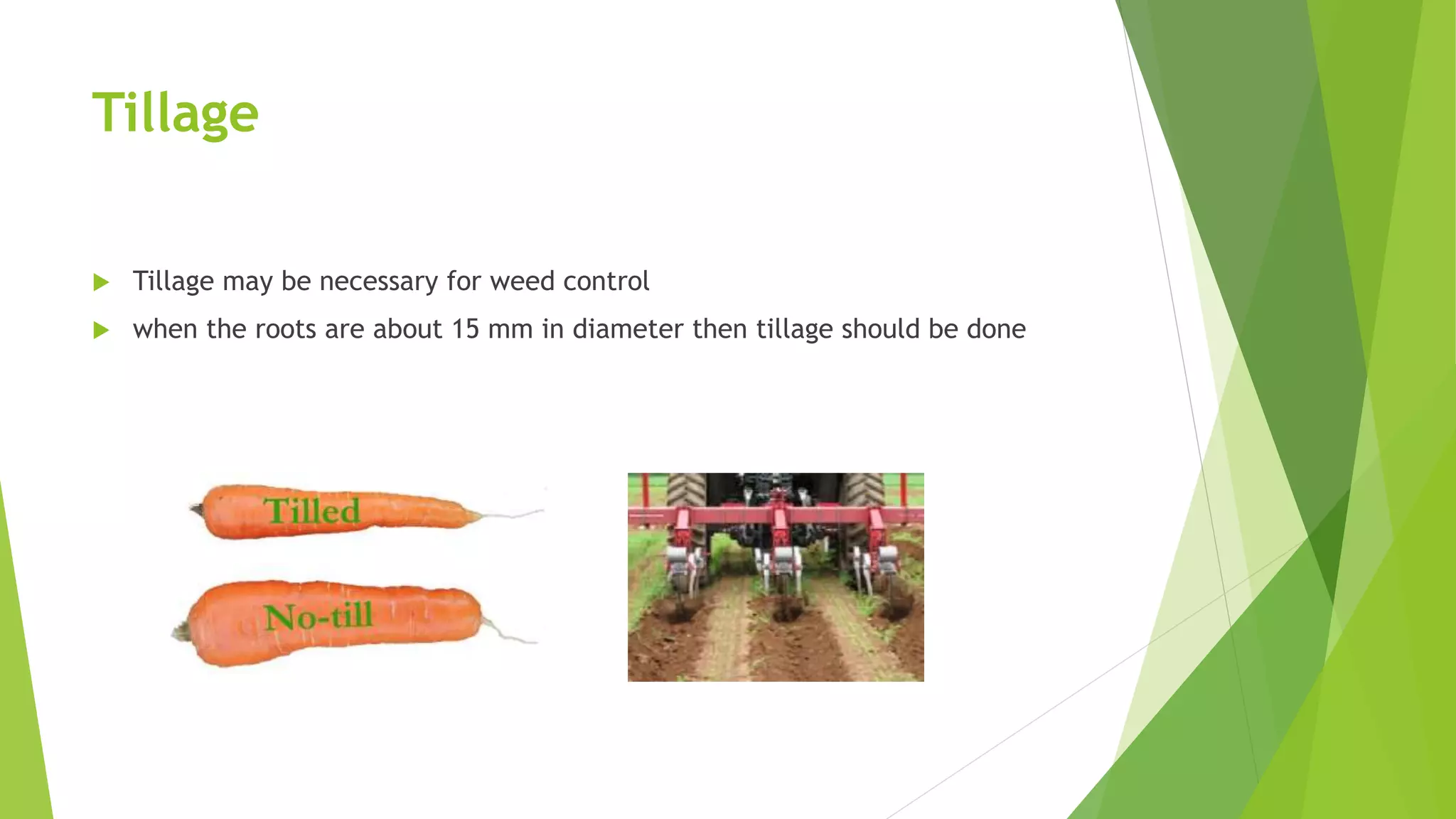
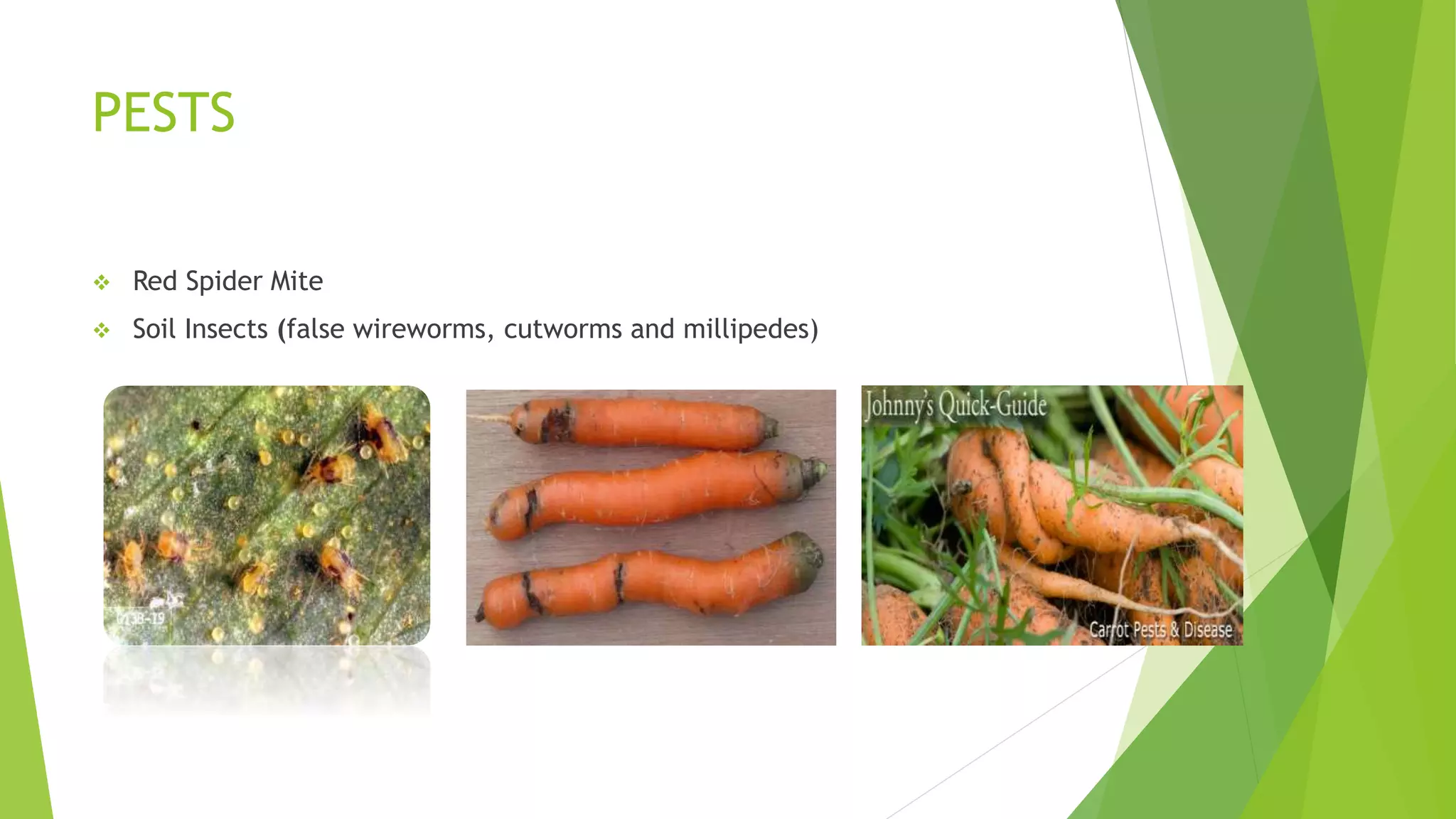
Tillage
 Tillage may be necessary for weed control
 when the roots are about 15 mm in diameter then tillage should be done
CULTURAL ASPECTS
 Fertilizer
 N 80kg/ha for good yield
 P 20kg/ha for root development
 K 200kg/ha for better quality, better coloured roots (4 to 8 weeks after
planting)
IRRIGATION
 Soil should never be allowed to dry out until the plants emergence
 In ridge-planting frequent light irrigations required
IRRIGATION (Continue….)
 In summer apply water once or even twice a day
 Soil moisture maintained at above 50% throughout growth
 In dry condition yields and quality reduce while long, thin roots are produced
 Excess moisture result in a larger diameter but excessively short roots
ROTATION
 Three-year rotation necessary to reduce the risk of pest and disease build-up
CULTURAL ASPECTS
 WEED CONTROL
 Weeds be controlled in the early stages of crop
development
 Affect on plant growth and lowering of crop yields
 Mechanically and chemically
 HERBICIDES
 Fluazifop-P-butyl on post emergence stage
 Flurochloridone on Preemergence stage
PESTS
 Nematodes
 Aphids
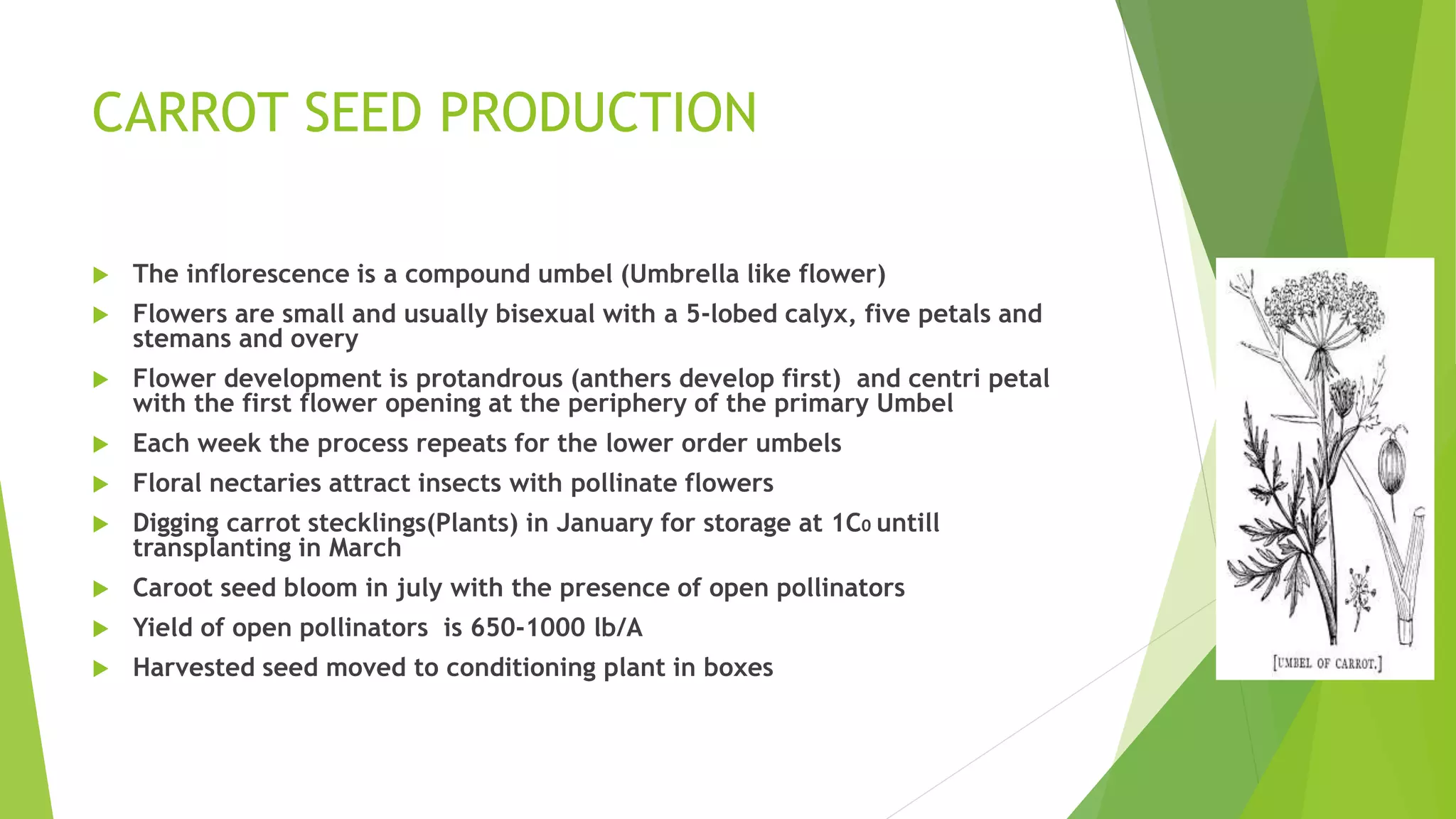
PESTS
 Red Spider Mite
 Soil Insects (false wireworms, cutworms and millipedes)
DISEASES
 Alternaria Leaf Blight
 Bacterial Blight
 White Mould
HARVESTING AND MARKETING
 Ready for market within 3 to 3½ months a month longer during cold
conditions
 Harvested on desired size (Diameter of 20 mm)
 When tips have colored up properly, the c o arrtis "ripe" (lifted without
further delay)
 MARKETING
 Carrots are marketed by being bunched, with leaves attached
 packed in crates or even mesh pockets
 The freshness and quality of leaf is often important to buyers
HARVESTING AND MARKETING
 Mesh pockets
 Packing to create
 Plastic bags (one and two kg perforated)
 Cardboard boxes (for bulk-packed)
 Yield
 20 and 40 ton per hectare
 60 ton or more are sometimes obtained by
successful farmers
STORAGE
 Stored several months in the refrigerator or over winter in a moist, cool place
 Unwashed carrots placed in a bucket between layers of sand (For Long
Storage)
 32 to 40 °F (0 to 5 °C) is best.
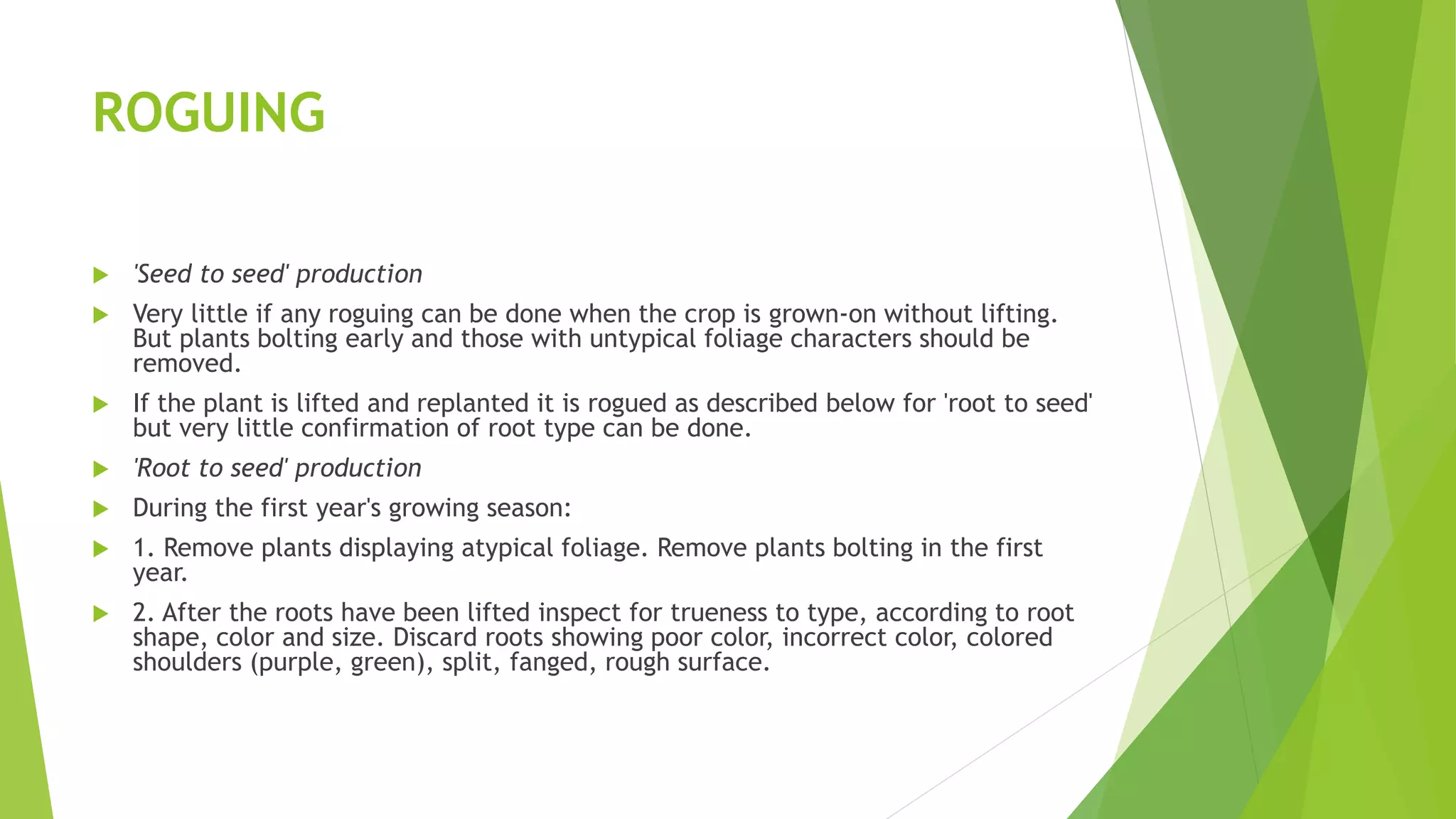
CARROT SEED PRODUCTION
 The inflorescence is a compound umbel (Umbrella like flower)
 Flowers are small and usually bisexual with a 5-lobed calyx, five petals and
stemans and overy
 Flower development is protandrous (anthers develop first) and centri petal
with the first flower opening at the periphery of the primary Umbel
 Each week the process repeats for the lower order umbels
 Floral nectaries attract insects with pollinate flowers
 Digging carrot stecklings(Plants) in January for storage at 1C0 untill
transplanting in March
 Caroot seed bloom in july with the presence of open pollinators
 Yield of open pollinators is 650-1000 lb/A
 Harvested seed moved to conditioning plant in boxes
CARROT SEED PRODUCTION
 Carrot seeds require isolation from other carrot seed crops to avoid
contamination
 Contamination zone can vary from 1 to 4 kilometers
 Cropping systems that have a harvest in December are well suited to carrot
seed production
 There are two types of carrot seed available to the market;
 (a) Open pollinated varieties which includes heirloom varieties,
 (b) F1 or hybrid varieties which refers to varieties that have been cross
pollinated to incorporate specific traits or characteristics that are considered
beneficial
CLEANING
 Carrot has spines or "beards" on the seed
 Removed by a debearder before further cleaning operations
 Debearding improves the seed flow and reduces the volume of the seed-lot
 Further cleaning is achieved by indent cylinders
ROGUING
 'Seed to seed' production
 Very little if any roguing can be done when the crop is grown-on without lifting.
But plants bolting early and those with untypical foliage characters should be
removed.
 If the plant is lifted and replanted it is rogued as described below for 'root to seed'
but very little confirmation of root type can be done.
 'Root to seed' production
 During the first year's growing season:
 1. Remove plants displaying atypical foliage. Remove plants bolting in the first
year.
 2. After the roots have been lifted inspect for trueness to type, according to root
shape, color and size. Discard roots showing poor color, incorrect color, colored
shoulders (purple, green), split, fanged, rough surface.
SEED YIELD
 At present expected yield of open-pollinated cultivars in the temperate
regions is about 600 kg per hectare with highest yields achieved reaching 1000
kg per hectare
 1000 grain weight is c. 0.8 g
 Yields in the tropical regions are about 300 kg per hectare should be expected
for the European types
 The Asiatic types produce only about 250 kg per hectare when seeded in the
tropics
Carrot Production Technology

Carrot Production Technology

  • 1.
    CARROT Presented by: Azhar Hussain BeenishShehzadi Hasnain Shah et.al
  • 2.
    INTRODUCTION  Botanical name:Daucus carota L.  Family Apiaceae  Origin Asia  Roots long and thin, purple or yellow in colour white orange, orange or orange-red colour  Roots Shape Cylindrical, conical, or even spherical in shape
  • 3.
    INTRODUCTION  Rich incarotene (vitamin A)  Consumed either fresh, as a salad crop, or cooked  Very important vegetable crop in South Africa  Biennial plant (grows vegetatively in 1st season and produces seed in 2nd year)
  • 4.
    ENVIRONMENTAL REQUIREMENTS  Climate Moderately climate required  Heavy frost before harvesting can scorch leaves  Grow best under cool conditions (10° to 25°C)  Grown throughout the year except in very cold areas  Late summer and autumn, high humidity and heavy dew (Alternaria leaf blight)  Insufficient soil moisture results in a longer and thinner root
  • 5.
    VARIETIES  Chantenay carrot(roots are shorter, vigorous foliage, broad in the shoulders)  Danvers carrot (strong foliage and the roots are longe well-defined shoulder)  Imperator carrot (vigorous foliage, high sugar content, long and slender roots)  Nantes carrot (sparse foliage, cylindrical, short tip, skin is easily damaged, high in sugar and store less)
  • 6.
    Chantenay carrot Danverscarrot Imperator carrot Nantes carrot
  • 7.
    SOIL  Deep, welldrained Sandy loam or loam soils  Heavy, stony, compacted or poorly-drained soils interfere with good root development  pH 6.3-6.8 is optimum  Grow poorly in very acid soil with a pH of 5 or lower
  • 8.
    CULTURAL ASPECTS  SoilPreparation  Deep ploughing to a depth of at least 30 cm for root development  Sub-soiling for breaking compacted soil layers  Sowing times  Cold areas (heavy frosts) August - March  Warm areas (light frosts) January - November  Hot areas (no frost) February - September
  • 9.
    CULTURAL ASPECTS  Seedingrates  20 to 25 kg per hectare  Red Core Chantenay for large, blocky roots 3 kg seed/ha
  • 10.
    SEEDING  Carrot isseeded about 1/2 to 3/4 inch deep in the soil for better germination  Seed should be kept moist until the plants are well established  In loose, light sand, seeds could be planted 40 mm deep  Shallow planting is preferred for heavier soils  Row-to-Row distance 60 cm, plant-to-plant as 3 to 4 cm  Seed should be sown on both sides of ridges
  • 11.
    Tillage  Tillage maybe necessary for weed control  when the roots are about 15 mm in diameter then tillage should be done
  • 12.
    CULTURAL ASPECTS  Fertilizer N 80kg/ha for good yield  P 20kg/ha for root development  K 200kg/ha for better quality, better coloured roots (4 to 8 weeks after planting)
  • 13.
    IRRIGATION  Soil shouldnever be allowed to dry out until the plants emergence  In ridge-planting frequent light irrigations required
  • 14.
    IRRIGATION (Continue….)  Insummer apply water once or even twice a day  Soil moisture maintained at above 50% throughout growth  In dry condition yields and quality reduce while long, thin roots are produced  Excess moisture result in a larger diameter but excessively short roots
  • 15.
    ROTATION  Three-year rotationnecessary to reduce the risk of pest and disease build-up
  • 16.
    CULTURAL ASPECTS  WEEDCONTROL  Weeds be controlled in the early stages of crop development  Affect on plant growth and lowering of crop yields  Mechanically and chemically  HERBICIDES  Fluazifop-P-butyl on post emergence stage  Flurochloridone on Preemergence stage
  • 17.
  • 18.
    PESTS  Red SpiderMite  Soil Insects (false wireworms, cutworms and millipedes)
  • 19.
    DISEASES  Alternaria LeafBlight  Bacterial Blight  White Mould
  • 20.
    HARVESTING AND MARKETING Ready for market within 3 to 3½ months a month longer during cold conditions  Harvested on desired size (Diameter of 20 mm)  When tips have colored up properly, the c o arrtis "ripe" (lifted without further delay)  MARKETING  Carrots are marketed by being bunched, with leaves attached  packed in crates or even mesh pockets  The freshness and quality of leaf is often important to buyers
  • 21.
    HARVESTING AND MARKETING Mesh pockets  Packing to create  Plastic bags (one and two kg perforated)  Cardboard boxes (for bulk-packed)  Yield  20 and 40 ton per hectare  60 ton or more are sometimes obtained by successful farmers
  • 22.
    STORAGE  Stored severalmonths in the refrigerator or over winter in a moist, cool place  Unwashed carrots placed in a bucket between layers of sand (For Long Storage)  32 to 40 °F (0 to 5 °C) is best.
  • 23.
    CARROT SEED PRODUCTION The inflorescence is a compound umbel (Umbrella like flower)  Flowers are small and usually bisexual with a 5-lobed calyx, five petals and stemans and overy  Flower development is protandrous (anthers develop first) and centri petal with the first flower opening at the periphery of the primary Umbel  Each week the process repeats for the lower order umbels  Floral nectaries attract insects with pollinate flowers  Digging carrot stecklings(Plants) in January for storage at 1C0 untill transplanting in March  Caroot seed bloom in july with the presence of open pollinators  Yield of open pollinators is 650-1000 lb/A  Harvested seed moved to conditioning plant in boxes
  • 24.
    CARROT SEED PRODUCTION Carrot seeds require isolation from other carrot seed crops to avoid contamination  Contamination zone can vary from 1 to 4 kilometers  Cropping systems that have a harvest in December are well suited to carrot seed production  There are two types of carrot seed available to the market;  (a) Open pollinated varieties which includes heirloom varieties,  (b) F1 or hybrid varieties which refers to varieties that have been cross pollinated to incorporate specific traits or characteristics that are considered beneficial
  • 25.
    CLEANING  Carrot hasspines or "beards" on the seed  Removed by a debearder before further cleaning operations  Debearding improves the seed flow and reduces the volume of the seed-lot  Further cleaning is achieved by indent cylinders
  • 26.
    ROGUING  'Seed toseed' production  Very little if any roguing can be done when the crop is grown-on without lifting. But plants bolting early and those with untypical foliage characters should be removed.  If the plant is lifted and replanted it is rogued as described below for 'root to seed' but very little confirmation of root type can be done.  'Root to seed' production  During the first year's growing season:  1. Remove plants displaying atypical foliage. Remove plants bolting in the first year.  2. After the roots have been lifted inspect for trueness to type, according to root shape, color and size. Discard roots showing poor color, incorrect color, colored shoulders (purple, green), split, fanged, rough surface.
  • 28.
    SEED YIELD  Atpresent expected yield of open-pollinated cultivars in the temperate regions is about 600 kg per hectare with highest yields achieved reaching 1000 kg per hectare  1000 grain weight is c. 0.8 g  Yields in the tropical regions are about 300 kg per hectare should be expected for the European types  The Asiatic types produce only about 250 kg per hectare when seeded in the tropics