WELCOME
WELCOME
KELADI SHIVAPPA NAYAKA UNIVERSITY OF AGRICULTURAL AND HORTICULTURAL
SCIENCES, SHIVAMOGGA
COLLEGE OF HORTICULTURE, MUDIGERE
Topic : Production Technology of Asparagus
Submitted to
Dr. V. Srinivasa
Professor and Head
Department of Vegetable Science
Submitted By :
Vinay Kumar
Jr. MSc
Vegetable Science
PRODUCTION TECHNOLOGY OF ASPARAGUS
INTRODUCTION
• Scientific Name : Asparagus officinalis
• Family: Liliaceae
• Chromosome No: 2n=20
• Origin : Temperate Europe
• Edible part: Spear
• Monocot, perennial vegetable
USES
• Asparagus is an herbaceous perennial and is grown in large
areas in countries like USA, Germany, Spain and France,
while India’s contribution is meagre.
• The tender shoots called ‘spears’ are used as vegetable and in
preparation of soup.
• It is also eaten as salad.
• The canned and frozen spears are also used as processed
foods.
• The tender shoots contain a white crystalline substance,
asparagine, which is used in medicine as diuretic in cardiac
dropsy and chronic gout.
• It has good potential as fresh vegetable.
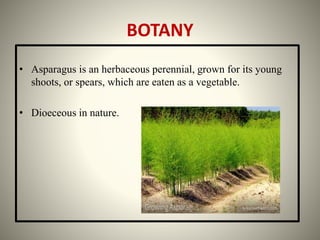
BOTANY
• Asparagus is an herbaceous perennial, grown for its young
shoots, or spears, which are eaten as a vegetable.
• Dioeceous in nature.
The tender shoots called ‘spears’ are used as vegetable.
Asparagus plant is tall with scale like leaves emerging from
the underground stem (rhizome) and has stout stems and
feathery foliage.
Flowers are bell shaped and occur alone or in pairs. They
are green-white to yellow in color.
After flowering, a round red berry is formed with 1 to 6
black seeds.
TYPES
VARIETIES
• With green coloured spears : more popular and mainly used in
fresh market
• With white or light green coloured asparagus - mainly used for
processing.
• All available male hybrids are more productive and do not
produce seed which sprouts to become a weed.
• Jersey Gem, Jersey Giant and Greenwich produce superior
yields in North Carolina.
• Jersey Gem has the added benefit of having tolerance to the
disease Cercospora leaf spot.
VARIETIES
Perfection:
Recommended by IARI, New Delhi.
• It is an early, uniform, productive variety, delicious with high
food value.
• The spears are large, green, succulent and light tipped.
• Average yield is 80-100 q/ha.
Selection-841:
Bush type, medium, uniform plants and productive.
• The spears are 15-20 cm long, succulent, tender, green with
better flavour and suitable for soup preparation.
• Yield is 90-110q green spears/ha.
• Palmetta, Argentenil and Mary Washington: These are
most important varieties and produce very high yield. The tips
of spear before exposer to the light are purplish and spears
become dark green in sunlight.
• Violet Touch: It is the oldest variety which may be regarded as
the form from which all the modern types have been derived.
• White German: It is selected in Germany and widely grown
by Germans. It has rounded tips and good quality spears.
• Palmetto: It has a little difference in appearance than other
varieties and considerably resistant to rust and extensively
grown throughout America.
• Schewetzinger: It is a commercial variety and has a greater
vigour when planted by clones.
• UC 711: It is a better hybrid than other and gives maximum
yield and high return.
• Paradise: It is a selection of Mary Washington developed in
California are said to be superior to the standard strain in
some regions.
• Jersey Queen: A clone cultivar selected from Mary
Washington. It produces high quality spear and maximum
yield.
CLIMATE
• Asparagus is grown in temperate and sub-tropical regions.
• Mean day temperature of 25-30oC and 15-20oC at night are
ideal.
• It requires a temperature range of 15.5 to 23.80C for most of
the growing season for spear production.
• Lower temperature of about 60 to 90 days during dormant
season.
• It tolerates frost.
• For economic yields, an elevation of about 1000m is ideal.
SOIL
• Well drained sandy soils are preferred.
• Good drainage is important to control crown rot disease.
• Avoid sites which retain standing water for more than 8
hours after a heavy rain.
• The optimum pH is 6.5-7.5.
SEASON/SOWING TIME
• In hills : March-May
• In plains : July-November
PROPAGATION
• Asparagus can be propagated through seeds, seedlings and
crowns but most commonly followed practice is through seeds
only.
• It requires about 3-4 kg seed for cultivation in one hectare.
• Seeds are pre soaked for 3 to 5 days, and sow the seeds in well
prepared nursery beds at depth of 1.5- 2cm .
• After germination, seedlings are thinned to spacing of 5-7cm
between plants within row.
• Seeds germinates within 3-4 weeks.
PLANTING
There are three methods of planting
a) Crown planting
• Use only certified crowns for planting .
• Crowns with one year old is used for propagation.
• Plant asparagus crowns (roots plus plant buds) so that the top
of the crown is 15 cm below the soil level.
• Depth of planting is critical, if planted too shallow, asparagus
will produce a large number of small spears that are not
commercially sale.
• If planted too deep, spears will be
very large, but will be few in
number.
• Plant crowns 30 cm apart in the
row with the buds upright, and
150 cm between rows to have
21,750 crowns per hectare.
• Cover crowns with 5-7.5 cm of
soil after planting
b) Direct seeding method
• Seeds should be placed 5 cm apart in the row, 2 to 2.5 cm
deep.
• Single row seedlings require 2.5-3.4kg of seed per hectare and
double row seeding require 4.5 to 6.8 kg seeds per hectare.
• Asparagus seeds germinate best at 24°C.
• Direct seeding is preferred when the soil temperature is at least
16°C.
c) Seedling transplant method
• Asparagus seedlings can be grown successfully in peat pots,
plastic pots, trays, peat pellets or seedling type trays.
• Seedling growth and survival are usually better with larger
cells up to 5x5 cm seedling cells.
• Good growth above the crown and good root system
development require planting the seed not more than 1.25 cm
deep.
• Transplanting of seedling is preferred after the threat of frost
but before temperatures get above 32°C.
• Favourable conditions usually occur in April and May.
USE OF PLANT GROWTH REGULATORS
• Abscissic acid appears to promote sink strength or encourage
phloem uploading.
• Gibberellic Acid promotes growth of asparagus buds.
• Butyric Acid supports spear emergence.
IRRIGATION
• Adequate moisture should be maintained for good germination
and early seedling growth.
• Do not let asparagus plants become dry while they are
establishing a root system during the first two months.
• Water stress during this early stage can reduce yields.
• After the root system is established, irrigation is needed only
during extreme drought.
WEED MANAGEMENT
• Weed control in asparagus production is very important.
• Timely cultivation is a critical part of any asparagus weed
control program, especially during the first two years.
• Pre-emergence application of Metribuzin @ 1kg/hac in
direct sown asparagus and early post emergence is
recommended for control of broad leaved weeds.
HARVESTING
• Aerial shoots called spears arise from buds on rhizome six
months after planting of crowns or seedlings.
• Spears should not be harvested upto 1 year after planting,
because of active growth of root system and rhizome
during this period.
• First cutting should be done 2 years after planting.
• In one year, cutting season should be restricted to limited
period of 2 to 3 weeks in first cutting and 8-12 weeks in
subsequent years of regular harvesting.
• Spears are cut with knife called asparagus knife.
BLANCHING
• Mounding the soil to a height of 25-30 cm over the rows is
practiced to blanch the young spears and get ‘white asparagus’
for canning.
• After harvest, the spears should be held in a cool shaded place
and sprinkled with water to prevent shriveling and wilting.
• Asparagus should be hydro cooled before packing.
YIELD
• Male plants give the higher total yield while female plants
produce larger individual spears.
• Yield varies with varieties, region, climate, and sex form.
• On an average, 25-40 q spears are produced in one hectare
STORAGE
• Asparagus can be stored for 2-3 weeks at 95 percent relative
humidity and at 0-2oC.
• Spears stored in wet tissue paper looked fresh and firm after
13 or 16 days of storage.
• At room temperature, spears become tougher if stored even for
a short time.
DISEASES OF ASPARAGUS
Purple Spot
Stemphylium vesicarium/Pleospora herbarum
Symptoms
• Sunken, purple, oval-shaped
lesions that develop on
asparagus spears.
• Epidemics may affect 60-90%
of the spears.
• Tan to brown lesions on the
fern, including the needle like
leaves (cladophylls).
• May expand, coalesce and cause
defoliation.
• Premature defoliation of the fern limits photosynthetic
capability of the plant, decreasing carbohydrate reserves in
the crown for the following year’s crop.
• This can reduce spear quality and marketable yield and
make the plant more susceptible to Fusarium and
Phytophthora.
• It also reduces longevity of plantings.
Rust (Puccinia asparagi)
Symptoms
• Foliar disease.
• Four different lesions caused by four spore types.
Spring: Oval, light-green lesions form.
Early summer: These lesions become sunken and turn orange.
Mid-late summer: New lesions on the foliage are brick-red
colored and appear “blistered” above the plant surface.
Early fall: Lesions on the foliage become black.
• Severe infections can defoliate plants.
Rust Symptoms
Fusarium Crown, Root and Lower Stem Rot
Fusarium oxysporum f. sp. asparagi /Fusarium proliferatum
Symptoms
• Infection more likely when plants are stressed by drought.
• Russet-coloured lesions on roots, lower stems and/or crowns.
• Damping-off of seedlings in crown nurseries. Crown death in
nursery and commercial fields.
• Can shorten the lifespan of production fields by 50% despite
good cultural practices.
Yellowing of fern of infected plants.
Phytophthora Crown, Root and Spear Rot
Phytophthora asparagi
• Infection more likely when soils are wet.
• Spear rot begins as soft, watersoaked lesions and/or shriveling
occurring slightly above or below the soil line. Continued
growth of infected spears result in shepherd’s crook of spears
and fern.
Roots shriveling
Watersoaking Shepherd’s crook with shriveling
PESTS OF ASPARAGUS
Common Asparagus Beetle
Crioceris asparagi
Family - Chrysomelidae
Identification
Adults have few black spots on a red thorax (middle
segment), the abdomen (main body) has a patchy creamy
yellow coloration interspersed with black and a maroon border
around the rim.
Biology
• Larvae and eggs are located throughout the fern.
• Larvae and adults feed on the fern by chewing.
• Damage is composed of broken cladophylls and removal of
photosynthetic tissue.
Asparagus Aphid
Brachycorynella asparagi
Family – Aphididae
Symptoms
• Feeding causes distorted growth
and branching (broomed
appearance).
• Shoots with aphids also produce
flowers after the rest of the field
is done flowering.
• Reduces root growth and can kill
seedlings or small plants under
heavy infestations
Tarnished Plant Bug
Lygus lineolaris
• Family - Miridae
Identification
• Adults are about 1/4 inch long, greenish brown with
distinct reddish brown markings on the back and
membranous hind-wings.
• Adults have small, yellow-tipped triangle behind the
head.
• Nymphs resemble adults but without full wings.
Symptoms
• Suck plant juices through a beak, causing necrosis around
feeding sites and tip dieback on developing shoots.
Seed Production
• Asparagus is dioecious crop with male and female
flowers, cross pollination is the rule and the cultivars
should be grown in isolation to maintain the genetic
purity. The ratio of male and female plant is kept at 1:4 in
the field.
Isolation Distance
• Isolation distance for the foundation seeds is 1600 m and
for certified seed 1000 m is maintained between two
varieties for seed production.
Following points should be considered while seed production
of asparagus:-
i. Spears should not be harvested because it reduces stored
reserves for maximum stalk growth and seed production.
ii. A large population of bee is necessary for good
pollination.
iii. Asparagus beetles should be controlled timely.
iv. Red ripe fruit should be harvested because seed from ripe
berries are superior in germination to that fromless mature
bronzed coloured fruits.
• Plantations of four to eight years are chosen so they are
said to yield the best seed.
• The branches of the fruiting plants are shortened, in
order to promote early ripening and well-nourished
seeds.
• A seed measuring 3 mm in diameter and weight
equivalent to 500 g to 1kg is regarded as good.
• After harvest seeds should be separated from skin and
pulp and dried in sun.
• Seed production is better and faster under glass house
than in open field.
REFERENCES:
• D.K. SINGH & SHASHANK SHEKAR SINGH, (2018),
Modern Vegetable Varieties and Production Technology
• K.V. PETER & PRANAB HAZRA, (2015), Hand Book of
Vegetables
• PREM NATH & K.R.M. SWAMY, (2016), Vegetable Crops
• D.N. SINGH & VISHAL NATH, (2014), Winter Vegetables
( Advances and Development)
• VISHNU SWARUP, (2006), Vegetable Science & Technology
in India
Asparagus .pptx

Asparagus .pptx

  • 1.
  • 2.
    KELADI SHIVAPPA NAYAKAUNIVERSITY OF AGRICULTURAL AND HORTICULTURAL SCIENCES, SHIVAMOGGA COLLEGE OF HORTICULTURE, MUDIGERE Topic : Production Technology of Asparagus Submitted to Dr. V. Srinivasa Professor and Head Department of Vegetable Science Submitted By : Vinay Kumar Jr. MSc Vegetable Science
  • 3.
  • 4.
    INTRODUCTION • Scientific Name: Asparagus officinalis • Family: Liliaceae • Chromosome No: 2n=20 • Origin : Temperate Europe • Edible part: Spear • Monocot, perennial vegetable
  • 5.
    USES • Asparagus isan herbaceous perennial and is grown in large areas in countries like USA, Germany, Spain and France, while India’s contribution is meagre. • The tender shoots called ‘spears’ are used as vegetable and in preparation of soup. • It is also eaten as salad. • The canned and frozen spears are also used as processed foods. • The tender shoots contain a white crystalline substance, asparagine, which is used in medicine as diuretic in cardiac dropsy and chronic gout. • It has good potential as fresh vegetable.
  • 6.
    BOTANY • Asparagus isan herbaceous perennial, grown for its young shoots, or spears, which are eaten as a vegetable. • Dioeceous in nature.
  • 7.
    The tender shootscalled ‘spears’ are used as vegetable.
  • 8.
    Asparagus plant istall with scale like leaves emerging from the underground stem (rhizome) and has stout stems and feathery foliage.
  • 9.
    Flowers are bellshaped and occur alone or in pairs. They are green-white to yellow in color.
  • 10.
    After flowering, around red berry is formed with 1 to 6 black seeds.
  • 12.
  • 17.
    VARIETIES • With greencoloured spears : more popular and mainly used in fresh market • With white or light green coloured asparagus - mainly used for processing. • All available male hybrids are more productive and do not produce seed which sprouts to become a weed. • Jersey Gem, Jersey Giant and Greenwich produce superior yields in North Carolina. • Jersey Gem has the added benefit of having tolerance to the disease Cercospora leaf spot.
  • 18.
    VARIETIES Perfection: Recommended by IARI,New Delhi. • It is an early, uniform, productive variety, delicious with high food value. • The spears are large, green, succulent and light tipped. • Average yield is 80-100 q/ha. Selection-841: Bush type, medium, uniform plants and productive. • The spears are 15-20 cm long, succulent, tender, green with better flavour and suitable for soup preparation. • Yield is 90-110q green spears/ha.
  • 19.
    • Palmetta, Argenteniland Mary Washington: These are most important varieties and produce very high yield. The tips of spear before exposer to the light are purplish and spears become dark green in sunlight. • Violet Touch: It is the oldest variety which may be regarded as the form from which all the modern types have been derived. • White German: It is selected in Germany and widely grown by Germans. It has rounded tips and good quality spears. • Palmetto: It has a little difference in appearance than other varieties and considerably resistant to rust and extensively grown throughout America.
  • 20.
    • Schewetzinger: Itis a commercial variety and has a greater vigour when planted by clones. • UC 711: It is a better hybrid than other and gives maximum yield and high return. • Paradise: It is a selection of Mary Washington developed in California are said to be superior to the standard strain in some regions. • Jersey Queen: A clone cultivar selected from Mary Washington. It produces high quality spear and maximum yield.
  • 21.
    CLIMATE • Asparagus isgrown in temperate and sub-tropical regions. • Mean day temperature of 25-30oC and 15-20oC at night are ideal. • It requires a temperature range of 15.5 to 23.80C for most of the growing season for spear production. • Lower temperature of about 60 to 90 days during dormant season. • It tolerates frost. • For economic yields, an elevation of about 1000m is ideal.
  • 22.
    SOIL • Well drainedsandy soils are preferred. • Good drainage is important to control crown rot disease. • Avoid sites which retain standing water for more than 8 hours after a heavy rain. • The optimum pH is 6.5-7.5. SEASON/SOWING TIME • In hills : March-May • In plains : July-November
  • 23.
    PROPAGATION • Asparagus canbe propagated through seeds, seedlings and crowns but most commonly followed practice is through seeds only. • It requires about 3-4 kg seed for cultivation in one hectare. • Seeds are pre soaked for 3 to 5 days, and sow the seeds in well prepared nursery beds at depth of 1.5- 2cm . • After germination, seedlings are thinned to spacing of 5-7cm between plants within row. • Seeds germinates within 3-4 weeks.
  • 24.
    PLANTING There are threemethods of planting a) Crown planting • Use only certified crowns for planting . • Crowns with one year old is used for propagation. • Plant asparagus crowns (roots plus plant buds) so that the top of the crown is 15 cm below the soil level. • Depth of planting is critical, if planted too shallow, asparagus will produce a large number of small spears that are not commercially sale.
  • 25.
    • If plantedtoo deep, spears will be very large, but will be few in number. • Plant crowns 30 cm apart in the row with the buds upright, and 150 cm between rows to have 21,750 crowns per hectare. • Cover crowns with 5-7.5 cm of soil after planting
  • 26.
    b) Direct seedingmethod • Seeds should be placed 5 cm apart in the row, 2 to 2.5 cm deep. • Single row seedlings require 2.5-3.4kg of seed per hectare and double row seeding require 4.5 to 6.8 kg seeds per hectare. • Asparagus seeds germinate best at 24°C. • Direct seeding is preferred when the soil temperature is at least 16°C.
  • 27.
    c) Seedling transplantmethod • Asparagus seedlings can be grown successfully in peat pots, plastic pots, trays, peat pellets or seedling type trays. • Seedling growth and survival are usually better with larger cells up to 5x5 cm seedling cells. • Good growth above the crown and good root system development require planting the seed not more than 1.25 cm deep. • Transplanting of seedling is preferred after the threat of frost but before temperatures get above 32°C. • Favourable conditions usually occur in April and May.
  • 28.
    USE OF PLANTGROWTH REGULATORS • Abscissic acid appears to promote sink strength or encourage phloem uploading. • Gibberellic Acid promotes growth of asparagus buds. • Butyric Acid supports spear emergence.
  • 29.
    IRRIGATION • Adequate moistureshould be maintained for good germination and early seedling growth. • Do not let asparagus plants become dry while they are establishing a root system during the first two months. • Water stress during this early stage can reduce yields. • After the root system is established, irrigation is needed only during extreme drought.
  • 30.
    WEED MANAGEMENT • Weedcontrol in asparagus production is very important. • Timely cultivation is a critical part of any asparagus weed control program, especially during the first two years. • Pre-emergence application of Metribuzin @ 1kg/hac in direct sown asparagus and early post emergence is recommended for control of broad leaved weeds.
  • 31.
    HARVESTING • Aerial shootscalled spears arise from buds on rhizome six months after planting of crowns or seedlings. • Spears should not be harvested upto 1 year after planting, because of active growth of root system and rhizome during this period. • First cutting should be done 2 years after planting. • In one year, cutting season should be restricted to limited period of 2 to 3 weeks in first cutting and 8-12 weeks in subsequent years of regular harvesting.
  • 32.
    • Spears arecut with knife called asparagus knife.
  • 33.
    BLANCHING • Mounding thesoil to a height of 25-30 cm over the rows is practiced to blanch the young spears and get ‘white asparagus’ for canning. • After harvest, the spears should be held in a cool shaded place and sprinkled with water to prevent shriveling and wilting. • Asparagus should be hydro cooled before packing.
  • 34.
    YIELD • Male plantsgive the higher total yield while female plants produce larger individual spears. • Yield varies with varieties, region, climate, and sex form. • On an average, 25-40 q spears are produced in one hectare
  • 35.
    STORAGE • Asparagus canbe stored for 2-3 weeks at 95 percent relative humidity and at 0-2oC. • Spears stored in wet tissue paper looked fresh and firm after 13 or 16 days of storage. • At room temperature, spears become tougher if stored even for a short time.
  • 36.
  • 37.
    Purple Spot Stemphylium vesicarium/Pleosporaherbarum Symptoms • Sunken, purple, oval-shaped lesions that develop on asparagus spears. • Epidemics may affect 60-90% of the spears. • Tan to brown lesions on the fern, including the needle like leaves (cladophylls). • May expand, coalesce and cause defoliation.
  • 38.
    • Premature defoliationof the fern limits photosynthetic capability of the plant, decreasing carbohydrate reserves in the crown for the following year’s crop. • This can reduce spear quality and marketable yield and make the plant more susceptible to Fusarium and Phytophthora. • It also reduces longevity of plantings.
  • 39.
    Rust (Puccinia asparagi) Symptoms •Foliar disease. • Four different lesions caused by four spore types. Spring: Oval, light-green lesions form. Early summer: These lesions become sunken and turn orange. Mid-late summer: New lesions on the foliage are brick-red colored and appear “blistered” above the plant surface. Early fall: Lesions on the foliage become black. • Severe infections can defoliate plants.
  • 40.
  • 41.
    Fusarium Crown, Rootand Lower Stem Rot Fusarium oxysporum f. sp. asparagi /Fusarium proliferatum Symptoms • Infection more likely when plants are stressed by drought. • Russet-coloured lesions on roots, lower stems and/or crowns. • Damping-off of seedlings in crown nurseries. Crown death in nursery and commercial fields. • Can shorten the lifespan of production fields by 50% despite good cultural practices.
  • 42.
    Yellowing of fernof infected plants.
  • 43.
    Phytophthora Crown, Rootand Spear Rot Phytophthora asparagi • Infection more likely when soils are wet. • Spear rot begins as soft, watersoaked lesions and/or shriveling occurring slightly above or below the soil line. Continued growth of infected spears result in shepherd’s crook of spears and fern. Roots shriveling
  • 44.
  • 45.
  • 46.
    Common Asparagus Beetle Criocerisasparagi Family - Chrysomelidae Identification Adults have few black spots on a red thorax (middle segment), the abdomen (main body) has a patchy creamy yellow coloration interspersed with black and a maroon border around the rim.
  • 47.
    Biology • Larvae andeggs are located throughout the fern. • Larvae and adults feed on the fern by chewing. • Damage is composed of broken cladophylls and removal of photosynthetic tissue.
  • 48.
    Asparagus Aphid Brachycorynella asparagi Family– Aphididae Symptoms • Feeding causes distorted growth and branching (broomed appearance). • Shoots with aphids also produce flowers after the rest of the field is done flowering. • Reduces root growth and can kill seedlings or small plants under heavy infestations
  • 49.
    Tarnished Plant Bug Lyguslineolaris • Family - Miridae Identification • Adults are about 1/4 inch long, greenish brown with distinct reddish brown markings on the back and membranous hind-wings. • Adults have small, yellow-tipped triangle behind the head. • Nymphs resemble adults but without full wings.
  • 50.
    Symptoms • Suck plantjuices through a beak, causing necrosis around feeding sites and tip dieback on developing shoots.
  • 51.
    Seed Production • Asparagusis dioecious crop with male and female flowers, cross pollination is the rule and the cultivars should be grown in isolation to maintain the genetic purity. The ratio of male and female plant is kept at 1:4 in the field. Isolation Distance • Isolation distance for the foundation seeds is 1600 m and for certified seed 1000 m is maintained between two varieties for seed production.
  • 52.
    Following points shouldbe considered while seed production of asparagus:- i. Spears should not be harvested because it reduces stored reserves for maximum stalk growth and seed production. ii. A large population of bee is necessary for good pollination. iii. Asparagus beetles should be controlled timely. iv. Red ripe fruit should be harvested because seed from ripe berries are superior in germination to that fromless mature bronzed coloured fruits.
  • 53.
    • Plantations offour to eight years are chosen so they are said to yield the best seed. • The branches of the fruiting plants are shortened, in order to promote early ripening and well-nourished seeds. • A seed measuring 3 mm in diameter and weight equivalent to 500 g to 1kg is regarded as good. • After harvest seeds should be separated from skin and pulp and dried in sun. • Seed production is better and faster under glass house than in open field.
  • 54.
    REFERENCES: • D.K. SINGH& SHASHANK SHEKAR SINGH, (2018), Modern Vegetable Varieties and Production Technology • K.V. PETER & PRANAB HAZRA, (2015), Hand Book of Vegetables • PREM NATH & K.R.M. SWAMY, (2016), Vegetable Crops • D.N. SINGH & VISHAL NATH, (2014), Winter Vegetables ( Advances and Development) • VISHNU SWARUP, (2006), Vegetable Science & Technology in India