Course Title : Production Technology of Warm SeasonCourse Title : Production Technology of Warm Season
Vegetable CropsVegetable Crops
Course No. : VSC 502Course No. : VSC 502
Course Teacher : Prof. S. D. Warade & Dr. P. SarmaCourse Teacher : Prof. S. D. Warade & Dr. P. Sarma
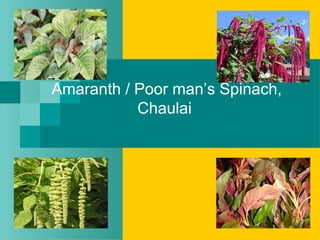
Amaranth / Poor man’s Spinach,
Chaulai
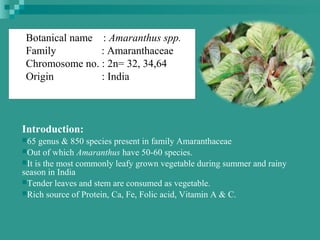
Botanical name : Amaranthus spp.
Family : Amaranthaceae
Chromosome no. : 2n= 32, 34,64
Origin : India
Introduction:
65 genus & 850 species present in family Amaranthaceae
Out of which Amaranthus have 50-60 species.
It is the most commonly leafy grown vegetable during summer and rainy
season in India
Tender leaves and stem are consumed as vegetable.
Rich source of Protein, Ca, Fe, Folic acid, Vitamin A & C.
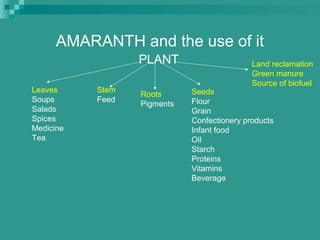
AMARANTH and the use of it
PLANT
Leaves
Soups
Salads
Spices
Medicine
Tea
Stem
Feed
Roots
Pigments
Seeds
Flour
Grain
Confectionery products
Infant food
Oil
Starch
Proteins
Vitamins
Beverage
Land reclamation
Green manure
Source of biofuel
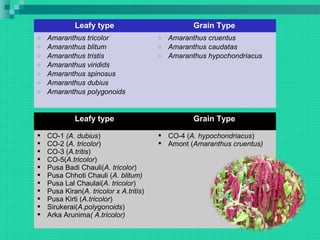
Leafy type Grain Type
o Amaranthus tricolor
o Amaranthus blitum
o Amaranthus tristis
o Amaranthus viridids
o Amaranthus spinosus
o Amaranthus dubius
o Amaranthus polygonoids
o Amaranthus cruentus
o Amaranthus caudatas
o Amaranthus hypochondriacus
Leafy type Grain Type
 CO-1 (A. dubius)
 CO-2 (A. tricolor)
 CO-3 (A.tritis)
 CO-5(A.tricolor)
 Pusa Badi Chauli(A. tricolor)
 Pusa Chhoti Chauli (A. blitum)
 Pusa Lal Chaulai(A. tricolor)
 Pusa Kiran(A. tricolor x A.tritis)
 Pusa Kirti (A.tricolor)
 Sirukerai(A.polygonoids)
 Arka Arunima( A.tricolor)
 CO-4 (A. hypochondriacus)
 Amont (Amaranthus cruentus)
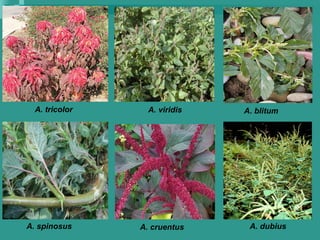
A. tricolor A. viridis A. blitum
A. spinosus A. cruentus A. dubius
Climate and Soil requirement
 Amaranthus is a warm season crop, requires hot, humid condition.
 It can also be grown under temperate climate during summer.
 20-30o
C optimum for vegetative growth.
 Best crop is harvested from fertile loamy soils.
 The best soil pH range 5.5 and 7.5 but some variety can grow up to 10
pH.
 The soil should be brought to a fine tilth by ploughing 3-4 times
followed by planking.
-
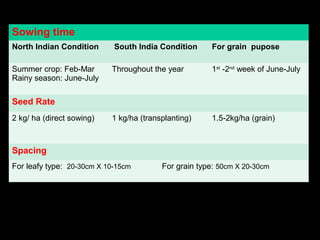
Sowing time
North Indian Condition South India Condition For grain pupose
Summer crop: Feb-Mar
Rainy season: June-July
Throughout the year 1st
-2nd
week of June-July
Seed Rate
2 kg/ ha (direct sowing) 1 kg/ha (transplanting) 1.5-2kg/ha (grain)
Spacing
For leafy type: 20-30cm X 10-15cm For grain type: 50cm X 20-30cm
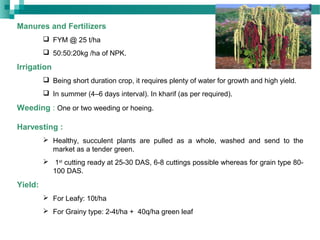
Manures and Fertilizers
 FYM @ 25 t/ha
 50:50:20kg /ha of NPK.
Irrigation
 Being short duration crop, it requires plenty of water for growth and high yield.
 In summer (4–6 days interval). In kharif (as per required).
Weeding : One or two weeding or hoeing.
Harvesting :
 Healthy, succulent plants are pulled as a whole, washed and send to the
market as a tender green.
 1st
cutting ready at 25-30 DAS, 6-8 cuttings possible whereas for grain type 80-
100 DAS.
Yield:
 For Leafy: 10t/ha
 For Grainy type: 2-4t/ha + 40q/ha green leaf
Storage and Marketing
 Doesn’t stand storage for more than a day under room temp.
 Under cold storage conditions it can be stored for 10-15 days with 95% relative
humidity.
Seed production of amaranthus
 30cm × 30cm spacing.
 The fertilizer schedule of N:P :K @ 50:50:30 kg/ha for better seed yield.
 Isolation distance of 400m
 Harvesting of seeds done when plants turn yellow or deep brown in colour.
 Seeds are threshed with pliable bamboo sticks and strained through 2mm sieve.
 Dried seeds with 6% moisture content are stored after treating with Bavistin @
2g/kg seed.
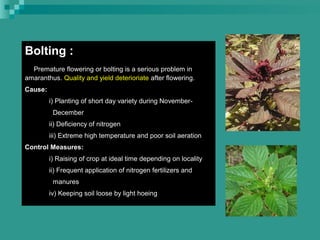
Bolting :
Premature flowering or bolting is a serious problem in
amaranthus. Quality and yield deterioriate after flowering.
Cause:
i) Planting of short day variety during November-
December
ii) Deficiency of nitrogen
iii) Extreme high temperature and poor soil aeration
Control Measures:
i) Raising of crop at ideal time depending on locality
ii) Frequent application of nitrogen fertilizers and
manures
iv) Keeping soil loose by light hoeing
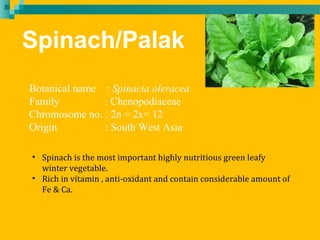
Spinach/Palak
Botanical name : Spinacia oleracea
Family : Chenopodiaceae
Chromosome no. : 2n = 2x= 12
Origin : South West Asia
• Spinach is the most important highly nutritious green leafy
winter vegetable.
• Rich in vitamin , anti-oxidant and contain considerable amount of
Fe & Ca.
Climate and Soil requirement
 Spinach is strictly cool season vegetable crop.
 High temperature and long days caused bolting.
 Range for optimum growth and development is 15-25o
C
 Best suited to cultivate in hills and temperate regions.
 Thrive well in well drained fertile soil.
 Soil pH 6-7 ideal for cultivation.
Sowing and Seed rate
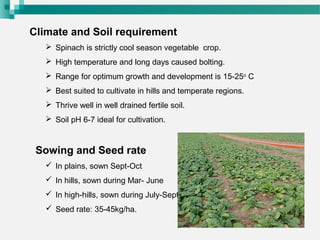
 In plains, sown Sept-Oct
 In hills, sown during Mar- June
 In high-hills, sown during July-Sept
 Seed rate: 35-45kg/ha.
Improved varieties in India
a)Pusa Jyoti: It produces large, green, thick, tender, succulent and crisp.
It gives 6 to 8 cuttings.
b)Pusa All green: Green tender leaves, gives about 6 cuttings depending
upon time of sowing and management.
c)Pusa Harit
d)Jobner Green.
e)Virgia Savoy
f)Early smooth leaf
g)Giant Noble
h)Prickly seeded
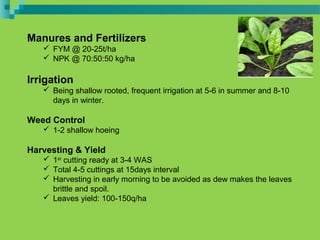
Manures and Fertilizers
 FYM @ 20-25t/ha
 NPK @ 70:50:50 kg/ha
Irrigation
 Being shallow rooted, frequent irrigation at 5-6 in summer and 8-10
days in winter.
Weed Control
 1-2 shallow hoeing
Harvesting & Yield
 1st
cutting ready at 3-4 WAS
 Total 4-5 cuttings at 15days interval
 Harvesting in early morning to be avoided as dew makes the leaves
brittle and spoil.
 Leaves yield: 100-150q/ha
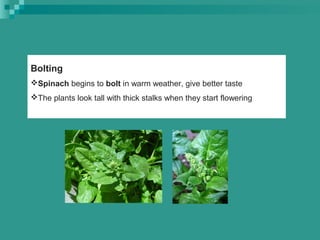
Bolting
Spinach begins to bolt in warm weather, give better taste
The plants look tall with thick stalks when they start flowering
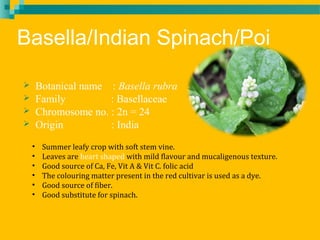
Basella/Indian Spinach/Poi
 Botanical name : Basella rubra
 Family : Basellaceae
 Chromosome no. : 2n = 24
 Origin : India
• Summer leafy crop with soft stem vine.
• Leaves are heart shaped with mild flavour and mucaligenous texture.
• Good source of Ca, Fe, Vit A & Vit C. folic acid
• The colouring matter present in the red cultivar is used as a dye.
• Good source of fiber.
• Good substitute for spinach.
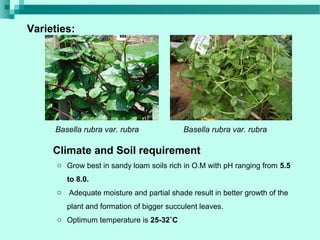
Varieties:
Climate and Soil requirement
o Grow best in sandy loam soils rich in O.M with pH ranging from 5.5
to 8.0.
o Adequate moisture and partial shade result in better growth of the
plant and formation of bigger succulent leaves.
o Optimum temperature is 25-32˚C
Basella rubra var. rubra Basella rubra var. rubra
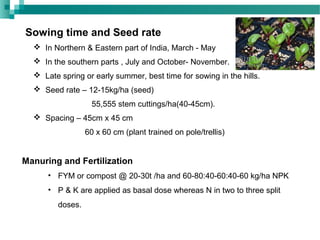
Sowing time and Seed rate
 In Northern & Eastern part of India, March - May
 In the southern parts , July and October- November.
 Late spring or early summer, best time for sowing in the hills.
 Seed rate – 12-15kg/ha (seed)
55,555 stem cuttings/ha(40-45cm).
 Spacing – 45cm x 45 cm
60 x 60 cm (plant trained on pole/trellis)
Manuring and Fertilization
• FYM or compost @ 20-30t /ha and 60-80:40-60:40-60 kg/ha NPK
• P & K are applied as basal dose whereas N in two to three split
doses.
Irrigation :
 The crop, in general requires 5-6 irrigations (summer) and the
frequency of irrigation depends on the soil type
Intercultural operations are to be done as and when necessary. The
field should be kept free from weeds.
Harvesting & Yield:
 Crop raised from seeds will produce edible leaves and stems
after 60-70 DAS.
 The plants raised from root or stem cuttings will be ready for
harvest in about 45 DAP.
 Yield – 150-200q/ha.
Thank you

production technology on leafy vegetables by MD. RAMAJN

  • 1.
    Course Title :Production Technology of Warm SeasonCourse Title : Production Technology of Warm Season Vegetable CropsVegetable Crops Course No. : VSC 502Course No. : VSC 502 Course Teacher : Prof. S. D. Warade & Dr. P. SarmaCourse Teacher : Prof. S. D. Warade & Dr. P. Sarma
  • 2.
    Amaranth / Poorman’s Spinach, Chaulai
  • 3.
    Botanical name :Amaranthus spp. Family : Amaranthaceae Chromosome no. : 2n= 32, 34,64 Origin : India Introduction: 65 genus & 850 species present in family Amaranthaceae Out of which Amaranthus have 50-60 species. It is the most commonly leafy grown vegetable during summer and rainy season in India Tender leaves and stem are consumed as vegetable. Rich source of Protein, Ca, Fe, Folic acid, Vitamin A & C.
  • 4.
    AMARANTH and theuse of it PLANT Leaves Soups Salads Spices Medicine Tea Stem Feed Roots Pigments Seeds Flour Grain Confectionery products Infant food Oil Starch Proteins Vitamins Beverage Land reclamation Green manure Source of biofuel
  • 5.
    Leafy type GrainType o Amaranthus tricolor o Amaranthus blitum o Amaranthus tristis o Amaranthus viridids o Amaranthus spinosus o Amaranthus dubius o Amaranthus polygonoids o Amaranthus cruentus o Amaranthus caudatas o Amaranthus hypochondriacus Leafy type Grain Type  CO-1 (A. dubius)  CO-2 (A. tricolor)  CO-3 (A.tritis)  CO-5(A.tricolor)  Pusa Badi Chauli(A. tricolor)  Pusa Chhoti Chauli (A. blitum)  Pusa Lal Chaulai(A. tricolor)  Pusa Kiran(A. tricolor x A.tritis)  Pusa Kirti (A.tricolor)  Sirukerai(A.polygonoids)  Arka Arunima( A.tricolor)  CO-4 (A. hypochondriacus)  Amont (Amaranthus cruentus)
  • 6.
    A. tricolor A.viridis A. blitum A. spinosus A. cruentus A. dubius
  • 7.
    Climate and Soilrequirement  Amaranthus is a warm season crop, requires hot, humid condition.  It can also be grown under temperate climate during summer.  20-30o C optimum for vegetative growth.  Best crop is harvested from fertile loamy soils.  The best soil pH range 5.5 and 7.5 but some variety can grow up to 10 pH.  The soil should be brought to a fine tilth by ploughing 3-4 times followed by planking.
  • 8.
    - Sowing time North IndianCondition South India Condition For grain pupose Summer crop: Feb-Mar Rainy season: June-July Throughout the year 1st -2nd week of June-July Seed Rate 2 kg/ ha (direct sowing) 1 kg/ha (transplanting) 1.5-2kg/ha (grain) Spacing For leafy type: 20-30cm X 10-15cm For grain type: 50cm X 20-30cm
  • 9.
    Manures and Fertilizers FYM @ 25 t/ha  50:50:20kg /ha of NPK. Irrigation  Being short duration crop, it requires plenty of water for growth and high yield.  In summer (4–6 days interval). In kharif (as per required). Weeding : One or two weeding or hoeing. Harvesting :  Healthy, succulent plants are pulled as a whole, washed and send to the market as a tender green.  1st cutting ready at 25-30 DAS, 6-8 cuttings possible whereas for grain type 80- 100 DAS. Yield:  For Leafy: 10t/ha  For Grainy type: 2-4t/ha + 40q/ha green leaf
  • 10.
    Storage and Marketing Doesn’t stand storage for more than a day under room temp.  Under cold storage conditions it can be stored for 10-15 days with 95% relative humidity. Seed production of amaranthus  30cm × 30cm spacing.  The fertilizer schedule of N:P :K @ 50:50:30 kg/ha for better seed yield.  Isolation distance of 400m  Harvesting of seeds done when plants turn yellow or deep brown in colour.  Seeds are threshed with pliable bamboo sticks and strained through 2mm sieve.  Dried seeds with 6% moisture content are stored after treating with Bavistin @ 2g/kg seed.
  • 11.
    Bolting : Premature floweringor bolting is a serious problem in amaranthus. Quality and yield deterioriate after flowering. Cause: i) Planting of short day variety during November- December ii) Deficiency of nitrogen iii) Extreme high temperature and poor soil aeration Control Measures: i) Raising of crop at ideal time depending on locality ii) Frequent application of nitrogen fertilizers and manures iv) Keeping soil loose by light hoeing
  • 12.
    Spinach/Palak Botanical name :Spinacia oleracea Family : Chenopodiaceae Chromosome no. : 2n = 2x= 12 Origin : South West Asia • Spinach is the most important highly nutritious green leafy winter vegetable. • Rich in vitamin , anti-oxidant and contain considerable amount of Fe & Ca.
  • 13.
    Climate and Soilrequirement  Spinach is strictly cool season vegetable crop.  High temperature and long days caused bolting.  Range for optimum growth and development is 15-25o C  Best suited to cultivate in hills and temperate regions.  Thrive well in well drained fertile soil.  Soil pH 6-7 ideal for cultivation. Sowing and Seed rate  In plains, sown Sept-Oct  In hills, sown during Mar- June  In high-hills, sown during July-Sept  Seed rate: 35-45kg/ha.
  • 14.
    Improved varieties inIndia a)Pusa Jyoti: It produces large, green, thick, tender, succulent and crisp. It gives 6 to 8 cuttings. b)Pusa All green: Green tender leaves, gives about 6 cuttings depending upon time of sowing and management. c)Pusa Harit d)Jobner Green. e)Virgia Savoy f)Early smooth leaf g)Giant Noble h)Prickly seeded
  • 15.
    Manures and Fertilizers FYM @ 20-25t/ha  NPK @ 70:50:50 kg/ha Irrigation  Being shallow rooted, frequent irrigation at 5-6 in summer and 8-10 days in winter. Weed Control  1-2 shallow hoeing Harvesting & Yield  1st cutting ready at 3-4 WAS  Total 4-5 cuttings at 15days interval  Harvesting in early morning to be avoided as dew makes the leaves brittle and spoil.  Leaves yield: 100-150q/ha
  • 16.
    Bolting Spinach begins tobolt in warm weather, give better taste The plants look tall with thick stalks when they start flowering
  • 17.
    Basella/Indian Spinach/Poi  Botanicalname : Basella rubra  Family : Basellaceae  Chromosome no. : 2n = 24  Origin : India • Summer leafy crop with soft stem vine. • Leaves are heart shaped with mild flavour and mucaligenous texture. • Good source of Ca, Fe, Vit A & Vit C. folic acid • The colouring matter present in the red cultivar is used as a dye. • Good source of fiber. • Good substitute for spinach.
  • 18.
    Varieties: Climate and Soilrequirement o Grow best in sandy loam soils rich in O.M with pH ranging from 5.5 to 8.0. o Adequate moisture and partial shade result in better growth of the plant and formation of bigger succulent leaves. o Optimum temperature is 25-32˚C Basella rubra var. rubra Basella rubra var. rubra
  • 19.
    Sowing time andSeed rate  In Northern & Eastern part of India, March - May  In the southern parts , July and October- November.  Late spring or early summer, best time for sowing in the hills.  Seed rate – 12-15kg/ha (seed) 55,555 stem cuttings/ha(40-45cm).  Spacing – 45cm x 45 cm 60 x 60 cm (plant trained on pole/trellis) Manuring and Fertilization • FYM or compost @ 20-30t /ha and 60-80:40-60:40-60 kg/ha NPK • P & K are applied as basal dose whereas N in two to three split doses.
  • 20.
    Irrigation :  Thecrop, in general requires 5-6 irrigations (summer) and the frequency of irrigation depends on the soil type Intercultural operations are to be done as and when necessary. The field should be kept free from weeds. Harvesting & Yield:  Crop raised from seeds will produce edible leaves and stems after 60-70 DAS.  The plants raised from root or stem cuttings will be ready for harvest in about 45 DAP.  Yield – 150-200q/ha.
  • 21.