Chapter 8  From Single-Celled Organisms to Kingdoms Figure CO: Tree © Carlos Caetano/ShutterStock , Inc.
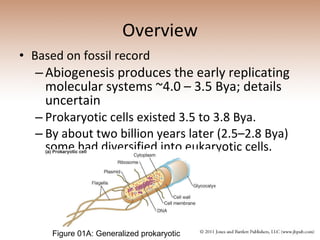
Overview Based on fossil record Abiogenesis produces the early replicating molecular systems ~4.0 – 3.5 Bya; details uncertain Prokaryotic cells existed 3.5 to 3.8 Bya. By about two billion years later (2.5–2.8 Bya) some had diversified into eukaryotic cells. Figure 01A: Generalized prokaryotic
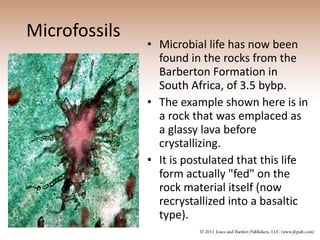
Microfossils Microbial life has now been found in the rocks from the Barberton Formation in South Africa, of 3.5 bybp. The example shown here is in a rock that was emplaced as a glassy lava before crystallizing.  It is postulated that this life form actually "fed" on the rock material itself (now recrystallized into a basaltic type).
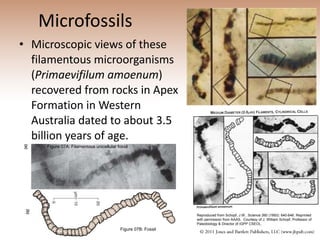
Microfossils   Microscopic views of these filamentous microorganisms ( Primaevifilum amoenum ) recovered from rocks in Apex Formation in Western Australia dated to about 3.5 billion years of age.   Reproduced from Schopf, J.W., Science 260 (1993): 640-646. Reprinted with permission from AAAS.  Courtesy of J. William Schopf, Professor of Paleobiology & Director of IGPP CSEOL. Figure 07A: Filamentous unicellular fossil  Figure 07B: Fossil
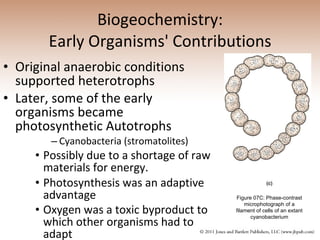
Biogeochemistry: Early Organisms' Contributions Original anaerobic conditions supported heterotrophs Later, some of the early organisms became photosynthetic Autotrophs Cyanobacteria (stromatolites)  Possibly due to a shortage of raw materials for energy.  Photosynthesis was an adaptive advantage  Oxygen was a toxic byproduct to which other organisms had to adapt   Figure 07C: Phase-contrast microphotograph of a filament of cells of an extant cyanobacterium
Fascinating Fossil Finds Methane Evidence for the existence of prokaryotic life more than 3.5 Bya and provide clues to their likely metabolic pathways. Stromatolites Prokaryotes already had diversified 3.4 Bya, and existed in a structured, biological ecosystem.
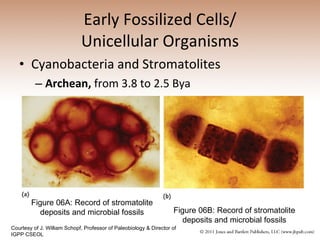
Fossil Evidence for Dating Early Life Stromatolites  in carbonate sediments  Cyanobacteria or blue-green algae  Oldest are 3.4 - 3.5 bybp (Archean)  Abundant in rocks 2.8 - 3 bybp (Proterozoic)  Algal filament fossils  found in chert  3.5 bybp at North Pole, western Australia  Spheroidal  bacterial structures (Monera)  Prokaryotic cells; cell division?  3.0 - 3.1 bybp  Fig Tree Group, South Africa
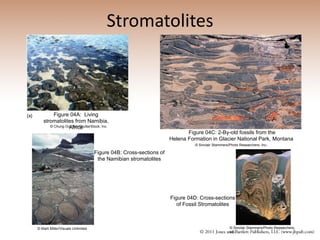
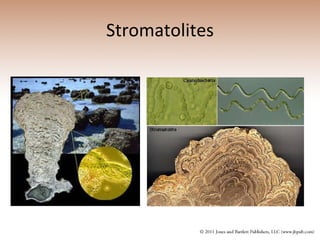
Stromatolites Figure 04C: 2-By-old fossils from the Helena Formation in Glacier National Park, Montana  © Chung Ooi Tan/ShutterStock, Inc. Figure 04B: Cross-sections of the Namibian stromatolites Figure 04A:  Living stromatolites from Namibia, Africa © Marli Miller/Visuals Unlimited © Sinclair Stammers/Photo Researchers, Inc . Figure 04D:  Cross-sections of Fossil  Stromatolites © Sinclair Stammers/Photo Researchers, Inc.
Stromatolites
Early Fossilized Cells/ Unicellular Organisms Cyanobacteria and Stromatolites Archean,  from 3.8 to 2.5 Bya Figure 06B: Record of stromatolite deposits and microbial fossils Courtesy of J. William Schopf, Professor of Paleobiology & Director of IGPP CSEOL Figure 06A: Record of stromatolite deposits and microbial fossils
The Tree of Life All organisms, no matter how we name, classify or arrange them on The Tree of Life, are bound together by four essential facts. 1. They share a common inheritance. 2. Their past has been long enough for inherited changes to accumulate. 3. The discoverable relationships among organisms are the result of evolution. 4. Discoverable biological processes explain how organisms arose and how they were modified through time by the process of evolution
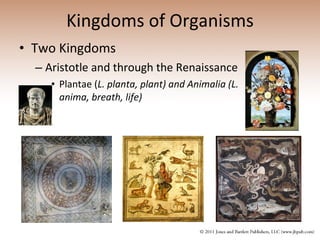
Kingdoms of Organisms Two Kingdoms Aristotle and through the Renaissance Plantae ( L. planta, plant) and Animalia (L. anima, breath, life)
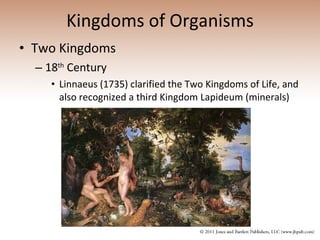
Kingdoms of Organisms Two Kingdoms 18 th  Century Linnaeus (1735) clarified the Two Kingdoms of Life, and also recognized a third Kingdom Lapideum (minerals)
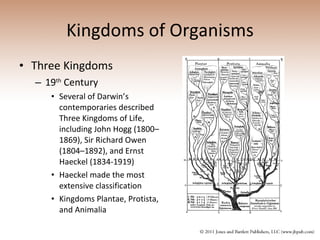
Kingdoms of Organisms Three Kingdoms 19 th  Century Several of Darwin’s contemporaries described Three Kingdoms of Life, including John Hogg (1800–1869), Sir Richard Owen (1804–1892), and Ernst Haeckel (1834-1919) Haeckel made the most extensive classification Kingdoms Plantae, Protista, and Animalia
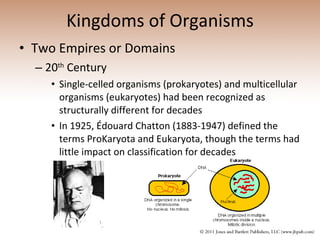
Kingdoms of Organisms Two Empires or Domains 20 th  Century Single-celled organisms (prokaryotes) and multicellular organisms (eukaryotes) had been recognized as structurally different for decades In 1925, Édouard Chatton (1883-1947) defined the terms ProKaryota and Eukaryota, though the terms had little impact on classification for decades
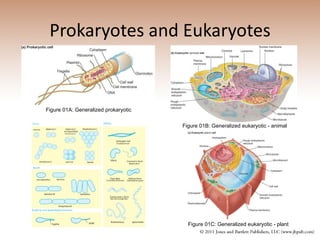
Prokaryotes and Eukaryotes Figure 01B: Generalized eukaryotic - animal Figure 01C: Generalized eukaryotic - plant Figure 01A: Generalized prokaryotic
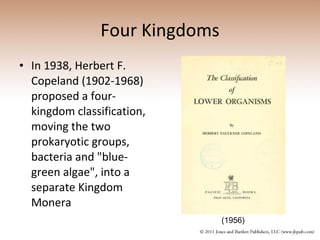
Four Kingdoms In 1938, Herbert F. Copeland (1902-1968) proposed a four-kingdom classification, moving the two prokaryotic groups, bacteria and "blue-green algae", into a separate Kingdom Monera (1956)
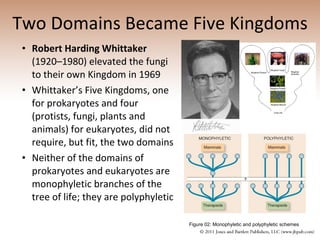
Two Domains Became Five Kingdoms Robert Harding Whittaker  (1920–1980) elevated the fungi to their own Kingdom in 1969 Whittaker’s Five Kingdoms, one for prokaryotes and four (protists, fungi, plants and animals) for eukaryotes, did not require, but fit, the two domains Neither of the domains of prokaryotes and eukaryotes are monophyletic branches of the tree of life; they are polyphyletic Figure 02: Monophyletic and polyphyletic schemes
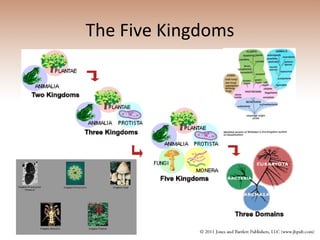
The Five Kingdoms
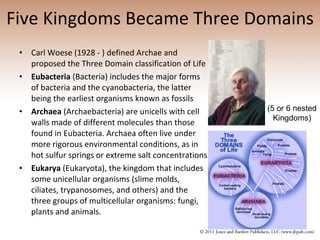
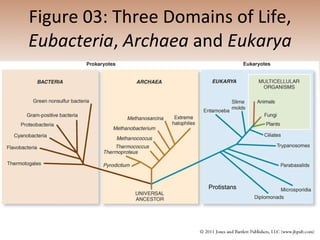
Five Kingdoms Became Three Domains Carl Woese (1928 - ) defined Archae and proposed the Three Domain classification of Life Eubacteria  (Bacteria) includes the major forms of bacteria and the cyanobacteria, the latter being the earliest organisms known as fossils Archaea  (Archaebacteria) are unicells with cell walls made of different molecules than those found in Eubacteria. Archaea often live under more rigorous environmental conditions, as in hot sulfur springs or extreme salt concentrations Eukarya  (Eukaryota), the kingdom that includes some unicellular organisms (slime molds, ciliates, trypanosomes, and others) and the three groups of multicellular organisms: fungi, plants and animals. (5 or 6 nested Kingdoms)
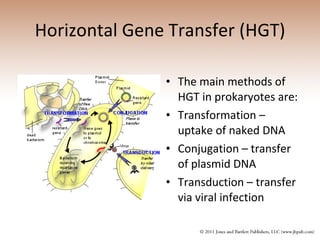
Figure 03: Three Domains of Life,  Eubacteria ,  Archaea  and  Eukarya Protistans
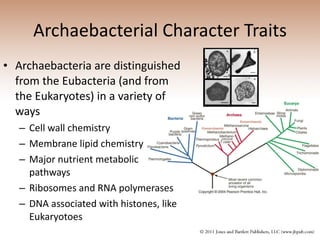
Archaebacterial Character Traits Archaebacteria are distinguished from the Eubacteria (and from the Eukaryotes) in a variety of ways Cell wall chemistry Membrane lipid chemistry Major nutrient metabolic pathways Ribosomes and RNA polymerases DNA associated with histones, like Eukaryotoes
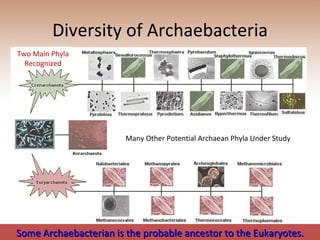
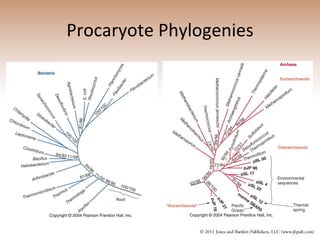
Diversity of Archaebacteria Two Main Phyla Recognized Many Other Potential Archaean Phyla Under Study Some Archaebacterian is the probable ancestor to the Eukaryotes.
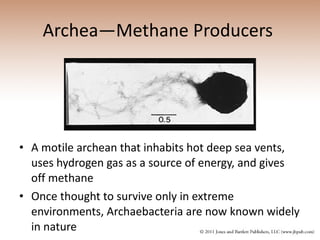
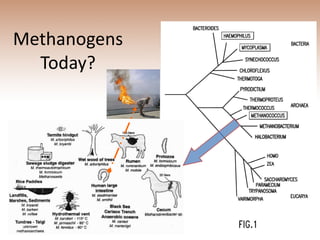
Archea—Methane Producers  A motile archean that inhabits hot deep sea vents, uses hydrogen gas as a source of energy, and gives off methane  Once thought to survive only in extreme environments, Archaebacteria are now known widely in nature
Methanogens Today?
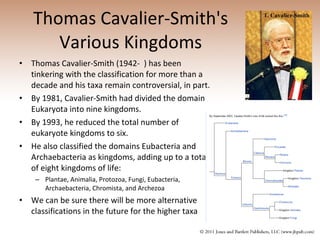
Thomas Cavalier-Smith's Various Kingdoms Thomas Cavalier-Smith (1942-  ) has been tinkering with the classification for more than a decade and his taxa remain controversial, in part. By 1981, Cavalier-Smith had divided the domain Eukaryota into nine kingdoms.   By 1993, he reduced the total number of eukaryote kingdoms to six.  He also classified the domains Eubacteria and Archaebacteria as kingdoms, adding up to a total of eight kingdoms of life: Plantae, Animalia, Protozoa, Fungi, Eubacteria, Archaebacteria, Chromista, and Archezoa We can be sure there will be more alternative classifications in the future for the higher taxa
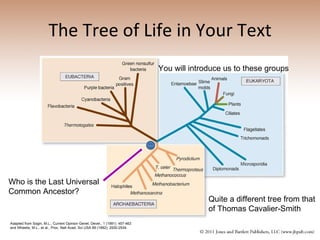
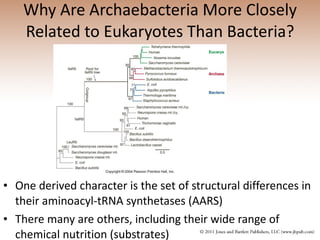
The Tree of Life in Your Text Figure 05: Phylogenetic tree Adapted from Sogin, M.L., Current Opinion Genet. Devel., 1 (1991): 457-463 and Wheelis, M.L., et al., Proc. Natl Acad. Sci USA 89 (1992): 2930-2934. Quite a different tree from that of Thomas Cavalier-Smith Who is the Last Universal Common Ancestor? You will introduce us to these groups
Last Universal Common Ancestor DNA as the hereditary material DNA replication with helicases and DNA synthetases ribosome-based protein synthesis several common metabolic pathways and ATP phospholipid bilayer cell membranes active transport across membranes
Why Are Archaebacteria More Closely Related to Eukaryotes Than Bacteria? One derived character is the set of structural differences in their aminoacyl-tRNA synthetases (AARS) There many are others, including their wide range of chemical nutrition (substrates)
Procaryote Phylogenies
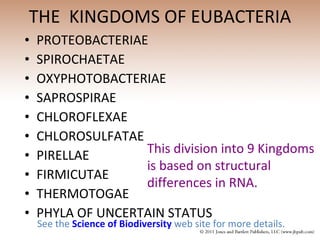
THE  KINGDOMS OF EUBACTERIA PROTEOBACTERIAE SPIROCHAETAE OXYPHOTOBACTERIAE SAPROSPIRAE CHLOROFLEXAE CHLOROSULFATAE PIRELLAE FIRMICUTAE THERMOTOGAE PHYLA OF UNCERTAIN STATUS See the  Science of Biodiversity  web site for more details. This division into 9 Kingdoms is based on structural differences in RNA.
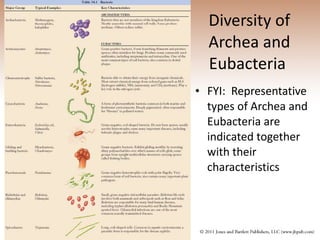
Diversity of Archea and Eubacteria   FYI:  Representative types of Archea and Eubacteria are indicated together with their characteristics
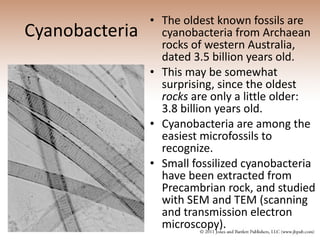
Cyanobacteria The oldest known fossils are cyanobacteria from Archaean rocks of western Australia, dated 3.5 billion years old.  This may be somewhat surprising, since the oldest  rocks  are only a little older: 3.8 billion years old. Cyanobacteria are among the easiest microfossils to recognize.  Small fossilized cyanobacteria have been extracted from Precambrian rock, and studied with SEM and TEM (scanning and transmission electron microscopy).
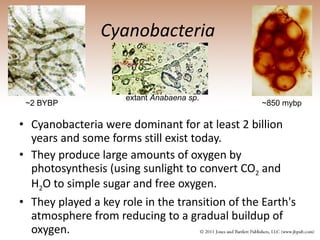
Cyanobacteria   Cyanobacteria were dominant for at least 2 billion years and some forms still exist today.  They produce large amounts of oxygen by photosynthesis (using sunlight to convert CO 2  and H 2 O to simple sugar and free oxygen.  They played a key role in the transition of the Earth's atmosphere from reducing to a gradual buildup of oxygen.  ~2 BYBP ~850 mybp extant  Anabaena sp .
Biogeochemistry: Early Organisms' Contributions Eukaryotic (modern differentiated) cells   Likely formed by symbiosis and incorporation   Chloroplasts  Mitochondria   More mobile and adaptable We’ll meet them in Chapter 9   The Biosphere is   a major force in the Earth's C, P, N, Si, O geochemical cycles  Photosynthesis/respiration  O 2  + CH 2 O ↔ CO 2  + H 2 O
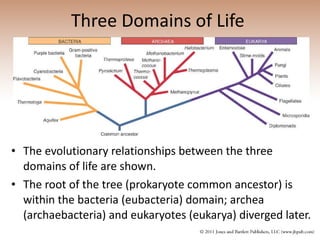
Three Domains of Life  The evolutionary relationships between the three domains of life are shown.  The root of the tree (prokaryote common ancestor) is within the bacteria (eubacteria) domain; archea (archaebacteria) and eukaryotes (eukarya) diverged later.
Horizontal Gene Transfer  and the Tree of Life HGT is effected by a virus or a small, circular DNA particle known as a  plasmid  that contains a foreign gene that can be transferred. Between unicellular organisms E.g. Almost 20 percent of the  E. coli  genome can be traced to HGT. Overall, as much as one third of the genome of some prokaryotic organisms has been acquired through HGT.
Horizontal Gene Transfer (HGT) To or between multicellular organisms HGT appears most prevalent among bdelloid rotifers, a group of asexually reproducing fresh-water invertebrates. Less than 10 percent of eukaryotes acquired one or more protein families by HGT.
Horizontal Gene Transfer (HGT) The main methods of HGT in prokaryotes are:  Transformation – uptake of naked DNA Conjugation – transfer of plasmid DNA Transduction – transfer via viral infection
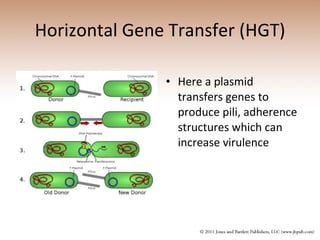
Horizontal Gene Transfer (HGT) Here a plasmid transfers genes to produce pili, adherence structures which can increase virulence
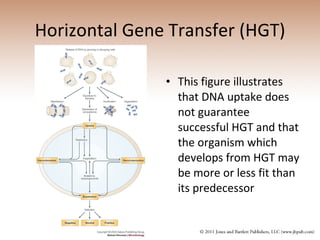
Horizontal Gene Transfer (HGT) This figure illustrates that DNA uptake does not guarantee successful HGT and that the organism which develops from HGT may be more or less fit than its predecessor
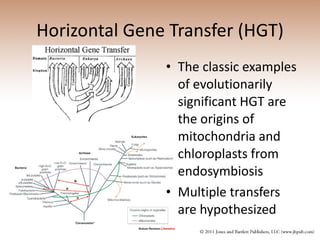
Horizontal Gene Transfer (HGT) The classic examples of evolutionarily significant HGT are the origins of mitochondria and chloroplasts from endosymbiosis Multiple transfers are hypothesized
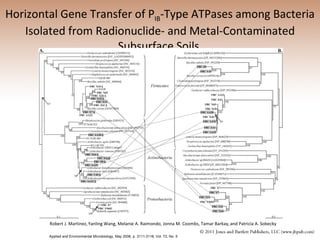
Horizontal Gene Transfer of P IB -Type ATPases among Bacteria Isolated from Radionuclide- and Metal-Contaminated Subsurface Soils   Applied and Environmental Microbiology, May 2006, p. 3111-3118, Vol. 72, No. 5 Robert J. Martinez,   Yanling Wang, Melanie A. Raimondo, Jonna M. Coombs, Tamar Barkay,   and Patricia A. Sobecky
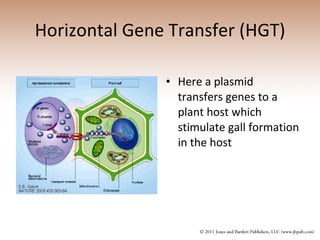
Horizontal Gene Transfer (HGT) Here a plasmid transfers genes to a plant host which stimulate gall formation in the host
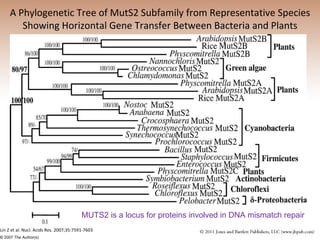
A Phylogenetic Tree of MutS2 Subfamily from Representative Species Showing Horizontal Gene Transfer Between Bacteria and Plants Lin Z et al. Nucl. Acids Res. 2007;35:7591-7603 © 2007 The Author(s) ‏ MUTS2 is a locus for proteins involved in DNA mismatch repair
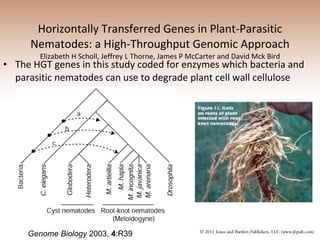
Horizontally Transferred Genes in Plant-Parasitic Nematodes: a High-Throughput Genomic Approach Elizabeth H Scholl, Jeffrey L Thorne, James P McCarter and David Mck Bird The HGT genes in this study coded for enzymes which bacteria and parasitic nematodes can use to degrade plant cell wall cellulose Genome Biology  2003,  4 :R39 
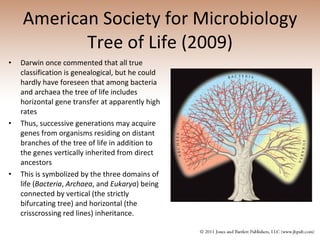
American Society for Microbiology Tree of Life (2009) Darwin once commented that all true classification is genealogical, but he could hardly have foreseen that among bacteria and archaea the tree of life includes horizontal gene transfer at apparently high rates Thus, successive generations may acquire genes from organisms residing on distant branches of the tree of life in addition to the genes vertically inherited from direct ancestors This is symbolized by the three domains of life ( Bacteria ,  Archaea , and  Eukarya ) being connected by vertical (the strictly bifurcating tree) and horizontal (the crisscrossing red lines) inheritance.
More on The Tree of Life The Tree of Life: Tangled Roots and Sexy Shoots Tracing the genetic pathway from the first Eukaryotes to Homo sapiens Chris King 6 Jan 2011 This is an excellent summary article and includes discussion of horizontal gene transfer
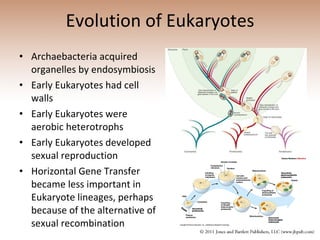
Evolution of Eukaryotes Archaebacteria acquired organelles by endosymbiosis Early Eukaryotes had cell walls Early Eukaryotes were aerobic heterotrophs Early Eukaryotes developed sexual reproduction Horizontal Gene Transfer became less important in Eukaryote lineages, perhaps because of the alternative of sexual recombination
Chapter 8 End

From single-celled organism to kingdoms

  • 1.
    Chapter 8 From Single-Celled Organisms to Kingdoms Figure CO: Tree © Carlos Caetano/ShutterStock , Inc.
  • 2.
    Overview Based onfossil record Abiogenesis produces the early replicating molecular systems ~4.0 – 3.5 Bya; details uncertain Prokaryotic cells existed 3.5 to 3.8 Bya. By about two billion years later (2.5–2.8 Bya) some had diversified into eukaryotic cells. Figure 01A: Generalized prokaryotic
  • 3.
    Microfossils Microbial lifehas now been found in the rocks from the Barberton Formation in South Africa, of 3.5 bybp. The example shown here is in a rock that was emplaced as a glassy lava before crystallizing. It is postulated that this life form actually "fed" on the rock material itself (now recrystallized into a basaltic type).
  • 4.
    Microfossils Microscopic views of these filamentous microorganisms ( Primaevifilum amoenum ) recovered from rocks in Apex Formation in Western Australia dated to about 3.5 billion years of age. Reproduced from Schopf, J.W., Science 260 (1993): 640-646. Reprinted with permission from AAAS. Courtesy of J. William Schopf, Professor of Paleobiology & Director of IGPP CSEOL. Figure 07A: Filamentous unicellular fossil Figure 07B: Fossil
  • 5.
    Biogeochemistry: Early Organisms'Contributions Original anaerobic conditions supported heterotrophs Later, some of the early organisms became photosynthetic Autotrophs Cyanobacteria (stromatolites) Possibly due to a shortage of raw materials for energy. Photosynthesis was an adaptive advantage Oxygen was a toxic byproduct to which other organisms had to adapt Figure 07C: Phase-contrast microphotograph of a filament of cells of an extant cyanobacterium
  • 6.
    Fascinating Fossil FindsMethane Evidence for the existence of prokaryotic life more than 3.5 Bya and provide clues to their likely metabolic pathways. Stromatolites Prokaryotes already had diversified 3.4 Bya, and existed in a structured, biological ecosystem.
  • 7.
    Fossil Evidence forDating Early Life Stromatolites in carbonate sediments Cyanobacteria or blue-green algae Oldest are 3.4 - 3.5 bybp (Archean) Abundant in rocks 2.8 - 3 bybp (Proterozoic) Algal filament fossils found in chert 3.5 bybp at North Pole, western Australia Spheroidal bacterial structures (Monera) Prokaryotic cells; cell division? 3.0 - 3.1 bybp Fig Tree Group, South Africa
  • 8.
    Stromatolites Figure 04C:2-By-old fossils from the Helena Formation in Glacier National Park, Montana © Chung Ooi Tan/ShutterStock, Inc. Figure 04B: Cross-sections of the Namibian stromatolites Figure 04A: Living stromatolites from Namibia, Africa © Marli Miller/Visuals Unlimited © Sinclair Stammers/Photo Researchers, Inc . Figure 04D: Cross-sections of Fossil Stromatolites © Sinclair Stammers/Photo Researchers, Inc.
  • 9.
  • 10.
    Early Fossilized Cells/Unicellular Organisms Cyanobacteria and Stromatolites Archean, from 3.8 to 2.5 Bya Figure 06B: Record of stromatolite deposits and microbial fossils Courtesy of J. William Schopf, Professor of Paleobiology & Director of IGPP CSEOL Figure 06A: Record of stromatolite deposits and microbial fossils
  • 11.
    The Tree ofLife All organisms, no matter how we name, classify or arrange them on The Tree of Life, are bound together by four essential facts. 1. They share a common inheritance. 2. Their past has been long enough for inherited changes to accumulate. 3. The discoverable relationships among organisms are the result of evolution. 4. Discoverable biological processes explain how organisms arose and how they were modified through time by the process of evolution
  • 12.
    Kingdoms of OrganismsTwo Kingdoms Aristotle and through the Renaissance Plantae ( L. planta, plant) and Animalia (L. anima, breath, life)
  • 13.
    Kingdoms of OrganismsTwo Kingdoms 18 th Century Linnaeus (1735) clarified the Two Kingdoms of Life, and also recognized a third Kingdom Lapideum (minerals)
  • 14.
    Kingdoms of OrganismsThree Kingdoms 19 th Century Several of Darwin’s contemporaries described Three Kingdoms of Life, including John Hogg (1800–1869), Sir Richard Owen (1804–1892), and Ernst Haeckel (1834-1919) Haeckel made the most extensive classification Kingdoms Plantae, Protista, and Animalia
  • 15.
    Kingdoms of OrganismsTwo Empires or Domains 20 th Century Single-celled organisms (prokaryotes) and multicellular organisms (eukaryotes) had been recognized as structurally different for decades In 1925, Édouard Chatton (1883-1947) defined the terms ProKaryota and Eukaryota, though the terms had little impact on classification for decades
  • 16.
    Prokaryotes and EukaryotesFigure 01B: Generalized eukaryotic - animal Figure 01C: Generalized eukaryotic - plant Figure 01A: Generalized prokaryotic
  • 17.
    Four Kingdoms In1938, Herbert F. Copeland (1902-1968) proposed a four-kingdom classification, moving the two prokaryotic groups, bacteria and "blue-green algae", into a separate Kingdom Monera (1956)
  • 18.
    Two Domains BecameFive Kingdoms Robert Harding Whittaker (1920–1980) elevated the fungi to their own Kingdom in 1969 Whittaker’s Five Kingdoms, one for prokaryotes and four (protists, fungi, plants and animals) for eukaryotes, did not require, but fit, the two domains Neither of the domains of prokaryotes and eukaryotes are monophyletic branches of the tree of life; they are polyphyletic Figure 02: Monophyletic and polyphyletic schemes
  • 19.
  • 20.
    Five Kingdoms BecameThree Domains Carl Woese (1928 - ) defined Archae and proposed the Three Domain classification of Life Eubacteria (Bacteria) includes the major forms of bacteria and the cyanobacteria, the latter being the earliest organisms known as fossils Archaea (Archaebacteria) are unicells with cell walls made of different molecules than those found in Eubacteria. Archaea often live under more rigorous environmental conditions, as in hot sulfur springs or extreme salt concentrations Eukarya (Eukaryota), the kingdom that includes some unicellular organisms (slime molds, ciliates, trypanosomes, and others) and the three groups of multicellular organisms: fungi, plants and animals. (5 or 6 nested Kingdoms)
  • 21.
    Figure 03: ThreeDomains of Life, Eubacteria , Archaea and Eukarya Protistans
  • 22.
    Archaebacterial Character TraitsArchaebacteria are distinguished from the Eubacteria (and from the Eukaryotes) in a variety of ways Cell wall chemistry Membrane lipid chemistry Major nutrient metabolic pathways Ribosomes and RNA polymerases DNA associated with histones, like Eukaryotoes
  • 23.
    Diversity of ArchaebacteriaTwo Main Phyla Recognized Many Other Potential Archaean Phyla Under Study Some Archaebacterian is the probable ancestor to the Eukaryotes.
  • 24.
    Archea—Methane Producers A motile archean that inhabits hot deep sea vents, uses hydrogen gas as a source of energy, and gives off methane Once thought to survive only in extreme environments, Archaebacteria are now known widely in nature
  • 25.
  • 26.
    Thomas Cavalier-Smith's VariousKingdoms Thomas Cavalier-Smith (1942- ) has been tinkering with the classification for more than a decade and his taxa remain controversial, in part. By 1981, Cavalier-Smith had divided the domain Eukaryota into nine kingdoms. By 1993, he reduced the total number of eukaryote kingdoms to six. He also classified the domains Eubacteria and Archaebacteria as kingdoms, adding up to a total of eight kingdoms of life: Plantae, Animalia, Protozoa, Fungi, Eubacteria, Archaebacteria, Chromista, and Archezoa We can be sure there will be more alternative classifications in the future for the higher taxa
  • 27.
    The Tree ofLife in Your Text Figure 05: Phylogenetic tree Adapted from Sogin, M.L., Current Opinion Genet. Devel., 1 (1991): 457-463 and Wheelis, M.L., et al., Proc. Natl Acad. Sci USA 89 (1992): 2930-2934. Quite a different tree from that of Thomas Cavalier-Smith Who is the Last Universal Common Ancestor? You will introduce us to these groups
  • 28.
    Last Universal CommonAncestor DNA as the hereditary material DNA replication with helicases and DNA synthetases ribosome-based protein synthesis several common metabolic pathways and ATP phospholipid bilayer cell membranes active transport across membranes
  • 29.
    Why Are ArchaebacteriaMore Closely Related to Eukaryotes Than Bacteria? One derived character is the set of structural differences in their aminoacyl-tRNA synthetases (AARS) There many are others, including their wide range of chemical nutrition (substrates)
  • 30.
  • 31.
    THE  KINGDOMS OFEUBACTERIA PROTEOBACTERIAE SPIROCHAETAE OXYPHOTOBACTERIAE SAPROSPIRAE CHLOROFLEXAE CHLOROSULFATAE PIRELLAE FIRMICUTAE THERMOTOGAE PHYLA OF UNCERTAIN STATUS See the Science of Biodiversity web site for more details. This division into 9 Kingdoms is based on structural differences in RNA.
  • 32.
    Diversity of Archeaand Eubacteria FYI: Representative types of Archea and Eubacteria are indicated together with their characteristics
  • 33.
    Cyanobacteria The oldestknown fossils are cyanobacteria from Archaean rocks of western Australia, dated 3.5 billion years old. This may be somewhat surprising, since the oldest rocks are only a little older: 3.8 billion years old. Cyanobacteria are among the easiest microfossils to recognize. Small fossilized cyanobacteria have been extracted from Precambrian rock, and studied with SEM and TEM (scanning and transmission electron microscopy).
  • 34.
    Cyanobacteria Cyanobacteria were dominant for at least 2 billion years and some forms still exist today. They produce large amounts of oxygen by photosynthesis (using sunlight to convert CO 2 and H 2 O to simple sugar and free oxygen. They played a key role in the transition of the Earth's atmosphere from reducing to a gradual buildup of oxygen. ~2 BYBP ~850 mybp extant Anabaena sp .
  • 35.
    Biogeochemistry: Early Organisms'Contributions Eukaryotic (modern differentiated) cells Likely formed by symbiosis and incorporation Chloroplasts Mitochondria More mobile and adaptable We’ll meet them in Chapter 9 The Biosphere is a major force in the Earth's C, P, N, Si, O geochemical cycles Photosynthesis/respiration O 2 + CH 2 O ↔ CO 2 + H 2 O
  • 36.
    Three Domains ofLife The evolutionary relationships between the three domains of life are shown. The root of the tree (prokaryote common ancestor) is within the bacteria (eubacteria) domain; archea (archaebacteria) and eukaryotes (eukarya) diverged later.
  • 37.
    Horizontal Gene Transfer and the Tree of Life HGT is effected by a virus or a small, circular DNA particle known as a plasmid that contains a foreign gene that can be transferred. Between unicellular organisms E.g. Almost 20 percent of the E. coli genome can be traced to HGT. Overall, as much as one third of the genome of some prokaryotic organisms has been acquired through HGT.
  • 38.
    Horizontal Gene Transfer(HGT) To or between multicellular organisms HGT appears most prevalent among bdelloid rotifers, a group of asexually reproducing fresh-water invertebrates. Less than 10 percent of eukaryotes acquired one or more protein families by HGT.
  • 39.
    Horizontal Gene Transfer(HGT) The main methods of HGT in prokaryotes are: Transformation – uptake of naked DNA Conjugation – transfer of plasmid DNA Transduction – transfer via viral infection
  • 40.
    Horizontal Gene Transfer(HGT) Here a plasmid transfers genes to produce pili, adherence structures which can increase virulence
  • 41.
    Horizontal Gene Transfer(HGT) This figure illustrates that DNA uptake does not guarantee successful HGT and that the organism which develops from HGT may be more or less fit than its predecessor
  • 42.
    Horizontal Gene Transfer(HGT) The classic examples of evolutionarily significant HGT are the origins of mitochondria and chloroplasts from endosymbiosis Multiple transfers are hypothesized
  • 43.
    Horizontal Gene Transferof P IB -Type ATPases among Bacteria Isolated from Radionuclide- and Metal-Contaminated Subsurface Soils Applied and Environmental Microbiology, May 2006, p. 3111-3118, Vol. 72, No. 5 Robert J. Martinez, Yanling Wang, Melanie A. Raimondo, Jonna M. Coombs, Tamar Barkay, and Patricia A. Sobecky
  • 44.
    Horizontal Gene Transfer(HGT) Here a plasmid transfers genes to a plant host which stimulate gall formation in the host
  • 45.
    A Phylogenetic Treeof MutS2 Subfamily from Representative Species Showing Horizontal Gene Transfer Between Bacteria and Plants Lin Z et al. Nucl. Acids Res. 2007;35:7591-7603 © 2007 The Author(s) ‏ MUTS2 is a locus for proteins involved in DNA mismatch repair
  • 46.
    Horizontally Transferred Genesin Plant-Parasitic Nematodes: a High-Throughput Genomic Approach Elizabeth H Scholl, Jeffrey L Thorne, James P McCarter and David Mck Bird The HGT genes in this study coded for enzymes which bacteria and parasitic nematodes can use to degrade plant cell wall cellulose Genome Biology 2003, 4 :R39 
  • 47.
    American Society forMicrobiology Tree of Life (2009) Darwin once commented that all true classification is genealogical, but he could hardly have foreseen that among bacteria and archaea the tree of life includes horizontal gene transfer at apparently high rates Thus, successive generations may acquire genes from organisms residing on distant branches of the tree of life in addition to the genes vertically inherited from direct ancestors This is symbolized by the three domains of life ( Bacteria , Archaea , and Eukarya ) being connected by vertical (the strictly bifurcating tree) and horizontal (the crisscrossing red lines) inheritance.
  • 48.
    More on TheTree of Life The Tree of Life: Tangled Roots and Sexy Shoots Tracing the genetic pathway from the first Eukaryotes to Homo sapiens Chris King 6 Jan 2011 This is an excellent summary article and includes discussion of horizontal gene transfer
  • 49.
    Evolution of EukaryotesArchaebacteria acquired organelles by endosymbiosis Early Eukaryotes had cell walls Early Eukaryotes were aerobic heterotrophs Early Eukaryotes developed sexual reproduction Horizontal Gene Transfer became less important in Eukaryote lineages, perhaps because of the alternative of sexual recombination
  • 50.

Editor's Notes

  • #46 A phylogenetic tree of MutS2 subfamily from representative species showing horizontal gene transfer between bacteria and plants. Phylogenetic trees were constructed using full-length MutS2 protein sequences. The methods used in tree reconstruction and percent bootstrap values are given as in Figure 2.