Amphioxus
Structure, Digestive system, Circulatory system,
Sense organs and Protonephridia
Dr. Manoj K. Bangadkar
Introduction
• Pallas discovered Amphioxus in 1778
• Fish like animals that show distinct chordate features throughout the
life.
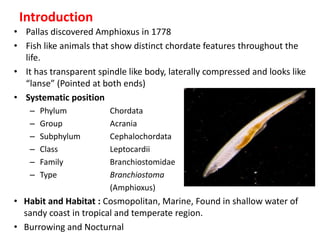
• It has transparent spindle like body, laterally compressed and looks like
“lanse” (Pointed at both ends)
• Systematic position
– Phylum Chordata
– Group Acrania
– Subphylum Cephalochordata
– Class Leptocardii
– Family Branchiostomidae
– Type Branchiostoma
(Amphioxus)
• Habit and Habitat : Cosmopolitan, Marine, Found in shallow water of
sandy coast in tropical and temperate region.
• Burrowing and Nocturnal
External features
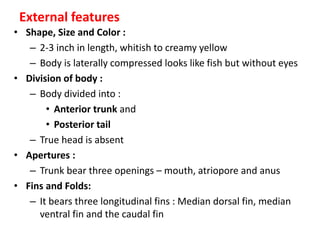
• Shape, Size and Color :
– 2-3 inch in length, whitish to creamy yellow
– Body is laterally compressed looks like fish but without eyes
• Division of body :
– Body divided into :
• Anterior trunk and
• Posterior tail
– True head is absent
• Apertures :
– Trunk bear three openings – mouth, atriopore and anus
• Fins and Folds:
– It bears three longitudinal fins : Median dorsal fin, median
ventral fin and the caudal fin
External features
External features
• Myotomes and Gonads :
– On each lateral side of the body a series of < shaped muscle bands,
called the myotomes are present.
– Below the myotome, Between mouth and atriopore a series of
gonads are found on either side.
• Body wall :
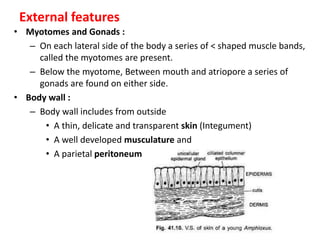
– Body wall includes from outside
• A thin, delicate and transparent skin (Integument)
• A well developed musculature and
• A parietal peritoneum
External features
• Skeleton :
– Exoskeleton absent
– Endoskeleton present but they are neither bony not cartilagenous
– Notocord : Chief axial endoskeleton, structurally it is elongated,
narrow, cylindrical and rod like
– Other skeletal structures : fin ray boxes supporting fins, oral ring
supporting oral hood, gill rods supporting gill slits
• Coelom :
– True coelomate
– Enterocoelomate filled with coelomic fluid
• Atrium :
– Space formed by metapleural folds one on either side of gill slits of
embryo
– Gill slits opens directly into atrium
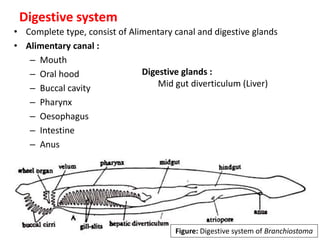
Digestive system
• Complete type, consist of Alimentary canal and digestive glands
• Alimentary canal :
– Mouth
– Oral hood
– Buccal cavity
– Pharynx
– Oesophagus
– Intestine
– Anus
Digestive glands :
Mid gut diverticulum (Liver)
Figure: Digestive system of Branchiostoma
Digestive system
• Physiology of digestive system:
– Food: Microphagus
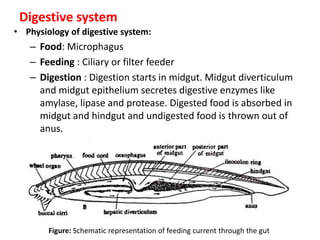
– Feeding : Ciliary or filter feeder
– Digestion : Digestion starts in midgut. Midgut diverticulum
and midgut epithelium secretes digestive enzymes like
amylase, lipase and protease. Digested food is absorbed in
midgut and hindgut and undigested food is thrown out of
anus.
Figure: Schematic representation of feeding current through the gut
Circulatory system
• Closed type
• Colorless blood due to lack of blood pigment
• Role of blood is to transport food and excretory waste.
• Heart is absent and blood is present in blood vessel and lymph vessel
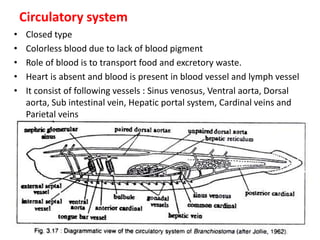
• It consist of following vessels : Sinus venosus, Ventral aorta, Dorsal
aorta, Sub intestinal vein, Hepatic portal system, Cardinal veins and
Parietal veins
Circulatory system
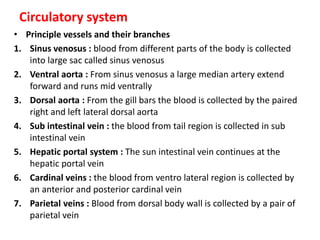
• Principle vessels and their branches
1. Sinus venosus : blood from different parts of the body is collected
into large sac called sinus venosus
2. Ventral aorta : From sinus venosus a large median artery extend
forward and runs mid ventrally
3. Dorsal aorta : From the gill bars the blood is collected by the paired
right and left lateral dorsal aorta
4. Sub intestinal vein : the blood from tail region is collected in sub
intestinal vein
5. Hepatic portal system : The sun intestinal vein continues at the
hepatic portal vein
6. Cardinal veins : the blood from ventro lateral region is collected by
an anterior and posterior cardinal vein
7. Parietal veins : Blood from dorsal body wall is collected by a pair of
parietal vein
Circulatory system
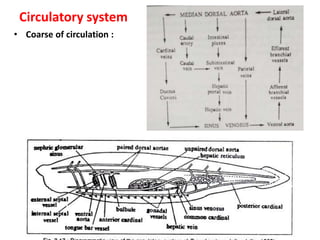
• Coarse of circulation :
Sense Organs (Receptors)
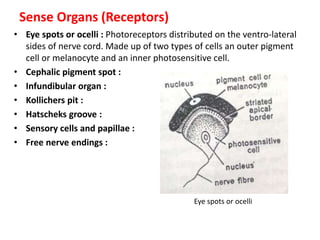
• Eye spots or ocelli : Photoreceptors distributed on the ventro-lateral
sides of nerve cord. Made up of two types of cells an outer pigment
cell or melanocyte and an inner photosensitive cell.
• Cephalic pigment spot :
• Infundibular organ :
• Kollichers pit :
• Hatscheks groove :
• Sensory cells and papillae :
• Free nerve endings :
Eye spots or ocelli
Excretory system
• Lacks kidney
• Excretion occurs through solenocytes
• Solenocytes of Amphioxus are closely
resemble the protonephridia of flatworm
or annelids (Parallel evolution)
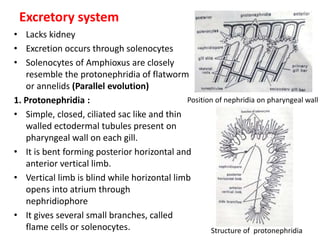
1. Protonephridia :
• Simple, closed, ciliated sac like and thin
walled ectodermal tubules present on
pharyngeal wall on each gill.
• It is bent forming posterior horizontal and
anterior vertical limb.
• Vertical limb is blind while horizontal limb
opens into atrium through
nephridiophore
• It gives several small branches, called
flame cells or solenocytes.
Position of nephridia on pharyngeal wall
Structure of protonephridia
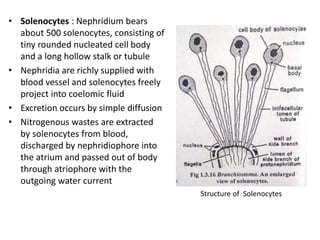
• Solenocytes : Nephridium bears
about 500 solenocytes, consisting of
tiny rounded nucleated cell body
and a long hollow stalk or tubule
• Nephridia are richly supplied with
blood vessel and solenocytes freely
project into coelomic fluid
• Excretion occurs by simple diffusion
• Nitrogenous wastes are extracted
by solenocytes from blood,
discharged by nephridiophore into
the atrium and passed out of body
through atriophore with the
outgoing water current
Structure of Solenocytes
2. Hatschecks nephridium :
• A single long and straight tube, called the nephridium of hatschecks lies
in the roof of oral hood slightly towards left and ventral to notochord.
• Supplied blood by the dorsal aorta
• Structure basically like protonephridia and extracting nitrogenous
wastes
3. Brown funnel :
• Two sac like brown funnels are situated dorsally upon the posterior end
of pharynx.
• It is excretory
4. Renal papillae :
• Group of cells present on the flow of atrial cavity form renal papillae
which are probably also excretory in function

Amphioxus (Branchiostoma)

  • 1.
    Amphioxus Structure, Digestive system,Circulatory system, Sense organs and Protonephridia Dr. Manoj K. Bangadkar
  • 2.
    Introduction • Pallas discoveredAmphioxus in 1778 • Fish like animals that show distinct chordate features throughout the life. • It has transparent spindle like body, laterally compressed and looks like “lanse” (Pointed at both ends) • Systematic position – Phylum Chordata – Group Acrania – Subphylum Cephalochordata – Class Leptocardii – Family Branchiostomidae – Type Branchiostoma (Amphioxus) • Habit and Habitat : Cosmopolitan, Marine, Found in shallow water of sandy coast in tropical and temperate region. • Burrowing and Nocturnal
  • 3.
    External features • Shape,Size and Color : – 2-3 inch in length, whitish to creamy yellow – Body is laterally compressed looks like fish but without eyes • Division of body : – Body divided into : • Anterior trunk and • Posterior tail – True head is absent • Apertures : – Trunk bear three openings – mouth, atriopore and anus • Fins and Folds: – It bears three longitudinal fins : Median dorsal fin, median ventral fin and the caudal fin
  • 4.
  • 5.
    External features • Myotomesand Gonads : – On each lateral side of the body a series of < shaped muscle bands, called the myotomes are present. – Below the myotome, Between mouth and atriopore a series of gonads are found on either side. • Body wall : – Body wall includes from outside • A thin, delicate and transparent skin (Integument) • A well developed musculature and • A parietal peritoneum
  • 6.
    External features • Skeleton: – Exoskeleton absent – Endoskeleton present but they are neither bony not cartilagenous – Notocord : Chief axial endoskeleton, structurally it is elongated, narrow, cylindrical and rod like – Other skeletal structures : fin ray boxes supporting fins, oral ring supporting oral hood, gill rods supporting gill slits • Coelom : – True coelomate – Enterocoelomate filled with coelomic fluid • Atrium : – Space formed by metapleural folds one on either side of gill slits of embryo – Gill slits opens directly into atrium
  • 7.
    Digestive system • Completetype, consist of Alimentary canal and digestive glands • Alimentary canal : – Mouth – Oral hood – Buccal cavity – Pharynx – Oesophagus – Intestine – Anus Digestive glands : Mid gut diverticulum (Liver) Figure: Digestive system of Branchiostoma
  • 8.
    Digestive system • Physiologyof digestive system: – Food: Microphagus – Feeding : Ciliary or filter feeder – Digestion : Digestion starts in midgut. Midgut diverticulum and midgut epithelium secretes digestive enzymes like amylase, lipase and protease. Digested food is absorbed in midgut and hindgut and undigested food is thrown out of anus. Figure: Schematic representation of feeding current through the gut
  • 9.
    Circulatory system • Closedtype • Colorless blood due to lack of blood pigment • Role of blood is to transport food and excretory waste. • Heart is absent and blood is present in blood vessel and lymph vessel • It consist of following vessels : Sinus venosus, Ventral aorta, Dorsal aorta, Sub intestinal vein, Hepatic portal system, Cardinal veins and Parietal veins
  • 10.
    Circulatory system • Principlevessels and their branches 1. Sinus venosus : blood from different parts of the body is collected into large sac called sinus venosus 2. Ventral aorta : From sinus venosus a large median artery extend forward and runs mid ventrally 3. Dorsal aorta : From the gill bars the blood is collected by the paired right and left lateral dorsal aorta 4. Sub intestinal vein : the blood from tail region is collected in sub intestinal vein 5. Hepatic portal system : The sun intestinal vein continues at the hepatic portal vein 6. Cardinal veins : the blood from ventro lateral region is collected by an anterior and posterior cardinal vein 7. Parietal veins : Blood from dorsal body wall is collected by a pair of parietal vein
  • 11.
  • 12.
    Sense Organs (Receptors) •Eye spots or ocelli : Photoreceptors distributed on the ventro-lateral sides of nerve cord. Made up of two types of cells an outer pigment cell or melanocyte and an inner photosensitive cell. • Cephalic pigment spot : • Infundibular organ : • Kollichers pit : • Hatscheks groove : • Sensory cells and papillae : • Free nerve endings : Eye spots or ocelli
  • 13.
    Excretory system • Lackskidney • Excretion occurs through solenocytes • Solenocytes of Amphioxus are closely resemble the protonephridia of flatworm or annelids (Parallel evolution) 1. Protonephridia : • Simple, closed, ciliated sac like and thin walled ectodermal tubules present on pharyngeal wall on each gill. • It is bent forming posterior horizontal and anterior vertical limb. • Vertical limb is blind while horizontal limb opens into atrium through nephridiophore • It gives several small branches, called flame cells or solenocytes. Position of nephridia on pharyngeal wall Structure of protonephridia
  • 14.
    • Solenocytes :Nephridium bears about 500 solenocytes, consisting of tiny rounded nucleated cell body and a long hollow stalk or tubule • Nephridia are richly supplied with blood vessel and solenocytes freely project into coelomic fluid • Excretion occurs by simple diffusion • Nitrogenous wastes are extracted by solenocytes from blood, discharged by nephridiophore into the atrium and passed out of body through atriophore with the outgoing water current Structure of Solenocytes
  • 15.
    2. Hatschecks nephridium: • A single long and straight tube, called the nephridium of hatschecks lies in the roof of oral hood slightly towards left and ventral to notochord. • Supplied blood by the dorsal aorta • Structure basically like protonephridia and extracting nitrogenous wastes 3. Brown funnel : • Two sac like brown funnels are situated dorsally upon the posterior end of pharynx. • It is excretory 4. Renal papillae : • Group of cells present on the flow of atrial cavity form renal papillae which are probably also excretory in function