Welcome to: Key-Device for Identification
By N.Sannigrahi, Associate Professor,
Nistarini College, Purulia(W.B) 723101, India
INTRODUCTION
• Explore the above beauty in the light of taxonomy. Plant
diversity is a pleasure for a taxonomist for having an
innovative tresure.Identification is the basic process of
classification & it is the determination of the group to
which it belongs to by a direct comparison of an unknown
specimen with the already classified, circumscribed and
named taxa.Identification –determination of similarities or
differences between the two specimens or the assignment
of an unidentified taxon to the correct class in an
established system of classification. But very often choice
is provided between two contradictory statement resulting
in the acceptance one & rejection of other. From here, Key
comes under consideration.
DEFINITION
• Keys are devices consisting of a series of contrasting
or contradictory elements or propositions requiring
the identifier to make comparisons and decisions
based on the statements in the key as related to the
material to be identified. It is a device to identify a
species an unknown plant belongs by a number of
choices. A single pair of contradictory statements is
called couplet and each statement of a couplet is
termed as Lead.
• Aims: I. To provide an ease and certainty of
identification(Davis & Heywood,1963),
• II. To make artificial separation of groups using one
or two easily observable characteristics .
Suggestions for Construction of Keys
• 1. Constant characteristics rather than variable one
should be used,
• 2. Proper measurements rather than term like small,
large to be used,
• 3.characteristics generally available to the user of the
key rather than those available in the field to be used,
• 4. A positive choice to be made,
• 5. If possible, one should start both the choices of the
pair with the same word,
• d. The descriptive terms should be preceded wit the
name of the part to which they apply.
TYPES OF KEY
• Key of two types-Punched card key & Dichotomous
key, the later is again subdivided into Indented &
Bracketed Key.
• Punched card key-It consists of cards of appropriate
size where the names of all taxa like families , genera
, species should be printed on each having a serial
number & the taxa having the characteristics should
be indicated by a hole(punching) in front of their
name and others remain without it.
• Dichotomous key-Comprising couplet & lead, leads
should have same words, key observable with more
than one quantitative differentiating characters.
INDENTED /YOKED KEY
• Each of the couplets in indented a fixed distance from
the left margin of the page. Successive yokes are
arranged one above the other. The two choices of the
couplet are usually labelled 1 or 1’ or 1a & 1b but
numbering is not mandatory.
• Fruit a group of achenes, unspurred flowers
– Petals absent
• Sepals usually 4, involucres absent-------
Clematis
• Sepals usually 5, involucres present------
Anemone
Examples
• Fruit a group of follicles, spurred flowers
– Spurs 5, flowers regular-----Aquilegia
– Spur 1, flowers regular------Delphinium
Please note here, Fruit’-written parallel in both the cases.
BRACKETED KEY: It is also called parallel key, the
couplets are always next to each other in consecutive lines
on the page. At the end of each line in the key, there is
either number or name referring to a couplet.
Examples of Bracketed key on Rhododendron.
1a.flowers in shades of red----------------go to 2
1b.flowers in shades of rose pink--------go to 3
2a.flowers blood red, leaves oblong ovate, leathery thick,
matty structure----R.sikkimmese
EXAMPLES
• 2b.Flowers crimson red, leaves broad, oval to elliptic
oblong, shiny green above---R.fulgens
• 3a.Calyx 3-5 cm long, leaf under surface covered
with tufts of brown hair-------R.wallichi
• 3b.Calyx obscure, 1-2 mm long, leaf under surface
covered with continuous indumentum—go to 4
• 4a.Corolla in shades of deep rose pink flushed
externally with red –purple, young leaves areuginose,
leaf margins inrolled---R.aeruginosum
• 4b.corolla pale lavender blue, leaf margins not
inrolled---R.campanulatum
Limitations of Dichotomous keys
• May rely on features not present in scenario,
• May not include “all” species of interest,
• One may misinterpret the key may not include all
potential variations of species,
• t a feature or make a mistake.
• POLYCLAVE/RANDOM/SYNOPTIC KEYS:
• System of identification based of organisms by a
process of elimination , as a multientry, order free key
implemented in several different formats. The user of
this system is free to choose any character, in order or
sequence and thus avoid the rigid format of
dichotomous key.
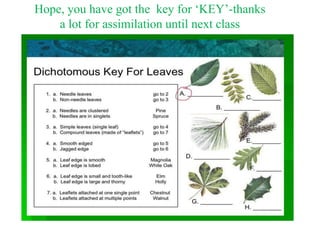
Hope, you have got the key for ‘KEY’-thanks
a lot for assimilation until next class

Key device for identification

  • 1.
    Welcome to: Key-Devicefor Identification By N.Sannigrahi, Associate Professor, Nistarini College, Purulia(W.B) 723101, India
  • 2.
    INTRODUCTION • Explore theabove beauty in the light of taxonomy. Plant diversity is a pleasure for a taxonomist for having an innovative tresure.Identification is the basic process of classification & it is the determination of the group to which it belongs to by a direct comparison of an unknown specimen with the already classified, circumscribed and named taxa.Identification –determination of similarities or differences between the two specimens or the assignment of an unidentified taxon to the correct class in an established system of classification. But very often choice is provided between two contradictory statement resulting in the acceptance one & rejection of other. From here, Key comes under consideration.
  • 3.
    DEFINITION • Keys aredevices consisting of a series of contrasting or contradictory elements or propositions requiring the identifier to make comparisons and decisions based on the statements in the key as related to the material to be identified. It is a device to identify a species an unknown plant belongs by a number of choices. A single pair of contradictory statements is called couplet and each statement of a couplet is termed as Lead. • Aims: I. To provide an ease and certainty of identification(Davis & Heywood,1963), • II. To make artificial separation of groups using one or two easily observable characteristics .
  • 4.
    Suggestions for Constructionof Keys • 1. Constant characteristics rather than variable one should be used, • 2. Proper measurements rather than term like small, large to be used, • 3.characteristics generally available to the user of the key rather than those available in the field to be used, • 4. A positive choice to be made, • 5. If possible, one should start both the choices of the pair with the same word, • d. The descriptive terms should be preceded wit the name of the part to which they apply.
  • 5.
    TYPES OF KEY •Key of two types-Punched card key & Dichotomous key, the later is again subdivided into Indented & Bracketed Key. • Punched card key-It consists of cards of appropriate size where the names of all taxa like families , genera , species should be printed on each having a serial number & the taxa having the characteristics should be indicated by a hole(punching) in front of their name and others remain without it. • Dichotomous key-Comprising couplet & lead, leads should have same words, key observable with more than one quantitative differentiating characters.
  • 6.
    INDENTED /YOKED KEY •Each of the couplets in indented a fixed distance from the left margin of the page. Successive yokes are arranged one above the other. The two choices of the couplet are usually labelled 1 or 1’ or 1a & 1b but numbering is not mandatory. • Fruit a group of achenes, unspurred flowers – Petals absent • Sepals usually 4, involucres absent------- Clematis • Sepals usually 5, involucres present------ Anemone
  • 7.
    Examples • Fruit agroup of follicles, spurred flowers – Spurs 5, flowers regular-----Aquilegia – Spur 1, flowers regular------Delphinium Please note here, Fruit’-written parallel in both the cases. BRACKETED KEY: It is also called parallel key, the couplets are always next to each other in consecutive lines on the page. At the end of each line in the key, there is either number or name referring to a couplet. Examples of Bracketed key on Rhododendron. 1a.flowers in shades of red----------------go to 2 1b.flowers in shades of rose pink--------go to 3 2a.flowers blood red, leaves oblong ovate, leathery thick, matty structure----R.sikkimmese
  • 8.
    EXAMPLES • 2b.Flowers crimsonred, leaves broad, oval to elliptic oblong, shiny green above---R.fulgens • 3a.Calyx 3-5 cm long, leaf under surface covered with tufts of brown hair-------R.wallichi • 3b.Calyx obscure, 1-2 mm long, leaf under surface covered with continuous indumentum—go to 4 • 4a.Corolla in shades of deep rose pink flushed externally with red –purple, young leaves areuginose, leaf margins inrolled---R.aeruginosum • 4b.corolla pale lavender blue, leaf margins not inrolled---R.campanulatum
  • 9.
    Limitations of Dichotomouskeys • May rely on features not present in scenario, • May not include “all” species of interest, • One may misinterpret the key may not include all potential variations of species, • t a feature or make a mistake. • POLYCLAVE/RANDOM/SYNOPTIC KEYS: • System of identification based of organisms by a process of elimination , as a multientry, order free key implemented in several different formats. The user of this system is free to choose any character, in order or sequence and thus avoid the rigid format of dichotomous key.
  • 10.
    Hope, you havegot the key for ‘KEY’-thanks a lot for assimilation until next class