A Presentation by:
Dr. N. Sannigrahi,
Associate Professor,
Department of Botany,
Nistarini College, Purulia (W.B)
723101, INDIA
 Until detailed genetic evidence became available, the classification of
flowering plants was based on their morphology (particularly that of the
flower) and their biochemistry (what kinds of chemical compound they
contained or produced).
 Classification systems were typically produced by an individual botanist
or by a small group. The result was a large number of such systems.
 Different systems and their updates tended to be favored in different
countries; e.g. the Engler system in continental Europe; the Bentham &
Hooker system in Britain (particularly influential because it was used by
Kew); the Takhtajan system in the former Soviet Union and countries
within its sphere of influence; and the Cronquist system in the United
States.
 The Angiosperm Phylogeny Group, or APG, refers to an informal
international group of systematic botanists who came together to try to
establish a consensus view of the taxonomy of flowering plants
(angiosperms) that would reflect new knowledge about their relationships
based upon phylogenetic studies.
 Bentham and Hooker (1883)- 202
 Englar and Prantle (1915)- 303
 Arthur Cronquist(1981)-386
 APG I (1998)-462
 APG II (2003)-457
 APG III (2009)-415
 APG IV( 2016)-416.
 The Classification of the flowering plants either in the line of phylogeny or
not has experienced a number of changes,
 The APG I, II, III, and IV have experienced a number of negative changes
up to the APG III but in the APG IV, there is a little bit increases by only a
number 1,
 Thus, the smaller families have been grouped into larger one for the same
outcomes.
 Total Angiosperms= 2,95. 383 species belongs to 13164 genera out of 415
families (Monocots-74273; Eudicots-2,10,008)
 There are altogether four versions of APG System of classification-
 APG I-1998
 APG II- 2003
 APG III-2009
 APG IV-2016
 The all four versions have come to the domain of plant classification to
explore the recent trends of research in the context of plant phylogeny with
data inputs.
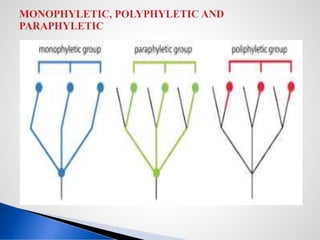
 Understanding of APG system needs the concept of the phylogeny lines-
Monophyletic, Polyphyletic and Paraphyletic
 MONOPHYLETIC: A group originated from a single ancestor at a single
time in the past because the present day angiosperms show remarkable
consistency in their characters like uniform staminal structure, endothecial
layer in the anther wall, double fertilization, formation of triploid
endosperm and presence of sieve tubes in all.
 POLYPHYLETIC: When dicots and monocots thought to be originated at
different times from different primitive stocks and attained their present
status through parallel or convergent evolution .Fossil records variety in
perianth and the nature of carpel in both dicot and monocot support the
theory of polyphylesis.
 PARAPHYLETIC
 A paraphyletic group is a group of any size and systematic rank that
originated from a single common ancestor, but does not – as opposed to a
monophyletic group – contain all descendants from this ancestor. The
ancestral species of this group is thus also the ancestor of one or more other
groups.
 Group should be Monophyletic.
 A broad approach is taken to define the limits of groups such as families
and orders,
 Above or parallel to order and families, another term is coined known as
“Clade”.
 The term “Clade” was first coined by Julian Huxley in the year 1957 to
refer to the result of Cladogenesis.
 A clade is a single branch “ or monophyllum on the tree of life” i.e.
Cladograms (family tree) is of a biological group.
 This system based on Cladistic and Phylogenetic studies,
 Angiosperms are not classified into monocots and dicots,
 Angiosperms are directly divided into super orders,
 Angiosperms are monophyletic in origin,
 The monophyletic origin has been strengthened on the basis of the
information received from the different branches of knowledge like
morphology, anatomy, embryology, phytochemistry, palynology,
karyology, molecular data and others ,
 The molecular data based on the chloroplast DNA using RFLP technique,
 The molecular studies were carried out with respect to the DNA sequences
of two chloroplast genes- atpB and rbcL along with one nuclear gene,
nuclear ribosome 18S rDNA.
 The genes atpB gene i.e. ATPase beta sub-unit gene having 1540 bp, rbcL
gene i.e. Ribulose –biphosphate carboxylase Form L gene having 1428 bp
and 18S rDNA i.e. 18S Ribosomal DNA having 1855 bp.
 Total bp= (1540+1428+18550bp)=4734 bp.
 Thus, the APG system of classification consists of number of diverse
characters that has made it more holistic in characters taking the features of
the different sisters domain of biological sciences.
 It is considered as “reference tool of broad utility”.
 It considers 40 monophyletic orders and 462 families,
 Uncertain position of 25 families,
 Scientific names are not used above the rank of order; clade is being used,
 Alternate classification of the same group is used; smaller families to be
included into larger families.e.g. Fumariaceae can be treated as separate
family or to be included under the family Papaveraceae,
 Traditional; division of angiosperms into monocots and dicots were
abolished; monocots was treated as separate clade,
 Dicots are not treated as separate clade; instead of that, it is Eudicots or
true dicots.
 Peter Stevens questioned the validity of discussion regarding family
delimitation in the absence of changers of Phylogenetic relationship.
 The large gene banks of plastid, mitochondria and nuclear ribosome were
considered.
 Uses of alternative “Bracketed” taxa allowing the choice of either a large
family or a number of smaller ones. For example, the large ‘Asperagaceae
‘family includes 7 ‘Bracketed’ families which either can be considered as
Asperagaceae family or as separate families.
 New orders are proposed and previously unplaced families placed in the
system of APG II,
 Several major families were restructured,
 APG II recognized 45 orders; 5 more than that of the APG I system of
classification,
 5 new orders were introduced . All of which families were unplaced as to
orders,
 APG II recognized 457 families and the number of the families reduced by 5 as
the orders have increased,
 55 Families were included under “Bracketed” families
 The number of order goes up to 59 which was 10 more than the previous
one.
 10 families are not placed in an order and only two of these-
Apodanthaceae and Cynomoriaceae are left entirely outside the
classification.
 14 new orders were accepted,
 The designation of “Alternative Bracketed” families was not used in APG
III.
 Reduced number families reached to 415, rather than 457 of APG II as
stated before,
 10 families unplaced in an order,
 21 new families accepted,
 Three genera like Gumillea, Nicobariodendron and Petenaea were placed
within angiosperms incertae sedis ( of uncertain placemen).
 The Angiosperm Phylogeny Group IV system of flowering plant
classification is the fourth version of a modern, mostly molecular-based,
system of plant taxonomy for flowering plants (angiosperms) being
developed by the Angiosperm Phylogeny Group (APG).
 The Angiosperm Phylogeny Group IV system of flowering plant
classification is the fourth version of a modern, mostly molecular-based,
system of plant taxonomy for flowering plants (angiosperms) being
developed by the Angiosperm Phylogeny Group (APG).
 The general scheme of the arrangement of major groups was also clear: a
grade of isolated taxa (the ANA grade, or ANITA grade as it was then
called) leading to the major radiation of angiosperms, a clade of all
monocots, a clade of Magnoliid families and a large Eudicots (tricolpate)
clade composed of several small clades and two major groups, rosids and
asterids, each composed of two major sub-clades.
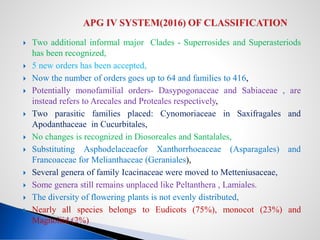
 Two additional informal major Clades - Superrosides and Superasteriods
has been recognized,
 5 new orders has been accepted,
 Now the number of orders goes up to 64 and families to 416,
 Potentially monofamilial orders- Dasypogonaceae and Sabiaceae , are
instead refers to Arecales and Proteales respectively,
 Two parasitic families placed: Cynomoriaceae in Saxifragales and
Apodanthaceae in Cucurbitales,
 No changes is recognized in Diosoreales and Santalales,
 Substituting Asphodelaceaefor Xanthorrhoeaceae (Asparagales) and
Francoaceae for Melianthaceae (Geraniales),
 Several genera of family Icacinaceae were moved to Metteniusaceae,
 Some genera still remains unplaced like Peltanthera , Lamiales.
 The diversity of flowering plants is not evenly distributed,
 Nearly all species belongs to Eudicots (75%), monocot (23%) and
Magnoliid (2%)
 The remaining 5 Clades contain a little over 250 species among 9 families
which is less than 0.1% of the flowering diversity.
 GENERAL OUTLINE OF THE APG IV CLASSIFICATION
 Angiosperms divided into Early angiosperms, Monocots and Eudicots,
 EARLY ANGIOSPERMS- 8 orders & 26 families consists of ANA Grade+
Magnoliids +Choranthales,
 MONOCOTS- 11 Orders and 77 Families consists of Basal Monocots,
Lilioids and Commelinids,
 EUDICOTS- Consists of 45 Orders and 313 Families,
 It is further divided into Early Diverging Eudicots, Super Rosids and super
Asterids,
 Early diverging Eudicots – 7 Orders & 17 Families including EED+
Ceratophyllales +Dilleniales,
 Super Rosids- 18 orders and 150 families consists of Saxifragales +Rosidas
(17 Orders & 135 Families includes Vitales + Fabids +Malvids)
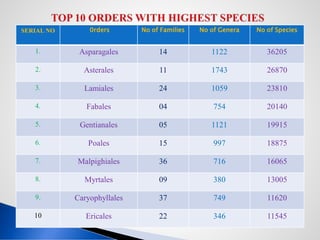
SERIAL NO 0rders No of Families No of Genera No of Species
1. Asparagales 14 1122 36205
2. Asterales 11 1743 26870
3. Lamiales 24 1059 23810
4. Fabales 04 754 20140
5. Gentianales 05 1121 19915
6. Poales 15 997 18875
7. Malpighiales 36 716 16065
8. Myrtales 09 380 13005
9. Caryophyllales 37 749 11620
10 Ericales 22 346 11545
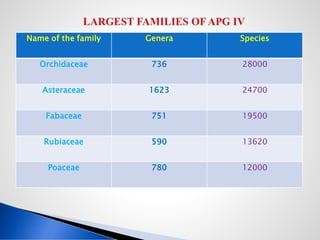
Name of the family Genera Species
Orchidaceae 736 28000
Asteraceae 1623 24700
Fabaceae 751 19500
Rubiaceae 590 13620
Poaceae 780 12000
 The understanding of the concept of phylogeny in general and
primitiveness in particular was a serious concern and number of theories
have been put forward in order to extinguish the problems by the different
phylogenists from time to time.
 The APG system has brought many changes in this aspect as stated below.
 Monocots are treated as monophyletic in origin and hence the terminology
was retained,
 The real Ranalean families especially the arborescent one are no more the
primitive families as per APG system. According to this system of
classification, Arborellaceae, Nymphaceae, Magnoliaceae, Chloranthaceae
form the early angiosperms,
 Dicots are polyphyletic group . As a consequence, the use of term
Dicotyledons need no longer in use , instead of Eudicots,
 Liliaceous is split into 14 families,
 Molluginaceae and Gisekiaceae are recognized separately from Aizoaceae,
 Euphorbiaceae is split into Phyllanthaceae, Picrodendraceae and
Putranjivaceae,
 Brassicaceae is split into three families like Brasicaceae, Cappraceae and
Cleoamaceae,
 Asclepiadace is merged into Apocynaceae,
 Chenopodiaceae is merged with Amaranthaceae,
 Bombacaceae, Sterculiaceae and Tiliaceae are merged into Malvaceae,
 Many genera that are conventionally treated into Verbenaceae such as
Clerodendron, Vitex and Tectona are transferred into Lamiaceae based on
the modification of the circumscription of these families.
 Thus, a gross changes are noticed in the APG system of classification and
the status of a number of genera have been changes accordingly.
 The system shows monophyly origin in groups,
 This system is based on m molecular data.
 Families with primitive characters were placed in the beginning,
APG IV adopts phylogenetic principles of monophyly.
 DEMERITS
 This classification is only applicable up to families. This system is not
suitable for identification of flora in the true sense.
 The fate of some unplaced families and few replaced genera is still
uncertain.
 Botanical nomenclature Code has not been assigned to new group,
 Not very popular , difficult in the use in Herbaria
 Google for images,
 Different websites for content and enrichment,
 Text Book of Plant Systematics- Chittaranjan Mohanty
 Plant Taxonomy by O.P. Sharma,
 Taxonomy of angiosperms- Nayek.
 Plant Taxonomy- Gurucharan Singh
 A text Book of Botany- Hait, Bhattacharyya & Ghosh
 Advanced Plant Taxonomy- A.K. Mondal.
 Disclaimer: This presentation has been developed to enrich free open
source of the study materials for Biology students without any financial
issues.