DOCUMENTATION AND KEYS
DOCUMENTAION
 Documentation refers to the creation of scientific information,
and bringing out the same in the form of a scientific publication.
 This enables dissemination of information to various users, and
its reproduction and retrieval.
 Taxonomic and systematic research can be documented/
published in various forms, such as floras, monographs, or in
journals (traditionally printed and now online version also).
FLORA
 Flora is the document of all plant species in a given
geographic area.
 Flora consists of total number of plant species in an area and
gives information about flowering season, fruiting season and
distribution for the given geographic area.
 It also provides details on rare and endemic species of that
area. Example: Flora of Tamil Nadu Carnatic by
K.M.Matthew. Floras are categorized based on the scope and
area covered.
Local Flora
It covers the limited areas, usually state, country, city or
mountain range. Example: ‘Flora of kashmir, Flora of J and K.
Regional Flora
It includes large geographical area or a botanical region. Example:
‘Flora of India.
Continental Flora
This flora covers the entire continent.
Example: ‘Flora of Europaea’ by
D.A.Web. Electronic Floras (e - floras)
It is nothing but the digitized form of a flora published online.
Example: ‘e –FloraChina’. This provides the
information and also functions as an identification
tool.
Introduction
 Authentic identification of an unknown plant is always done
with the help of published taxonomic literature, like floras
monographs, and revisions, etc.
 The most essential and useful feature of such literature is the
use of identification keys.
 It doesn’t require the much time, materials, or experience
involved in comparison and recognition.
 In biology, an identification key is a printed or computer
aided device that aids the identification of biological entities,
such as plants, animals, fossils, microorganisms, and pollen
grains.
 A botanical key is an analytical device for the
determination of the names of the plants.
 It is a series of specially arranged pairs of
contrasting statements.
 The user is called upon to compare his plant with
the first of these pairs, to decide which of its two
contrasting statements applies better to his plant,
and then to pass on as directed to the
appropriate following pair.
 This process is then repeated until the plant is
named.
Principles of a good key
 Only diagnostic characters should be used at
each identification step of key.
 It is also suggested that redundant characters
should be used at each step wherever necessary
 Use macroscopic, morphological characters
and constant character states.
 Avoid characteristics that can only be seen in the
field or on specially prepared specimens
 A consistent terminology should be used in the
identification
Besides these, there are some more suggestions which
need to be taken care of while constructing a
dichotomous key; these include:
1.start each couplet with a noun
2.avoid unnecessary words
3.avoid negatives
4.avoid trichotomies
5.The two statements of couplet should be mutually
exclusive; refer to the same feature and each couplet should
include all of the potential variations in the feature.
6.use obvious and fixed features, avoid variable, obscure or
highly technical ones
7.start with the most distinctive features
8.the finished key should have n-1 couplets (where n equals
the number of units in the key)
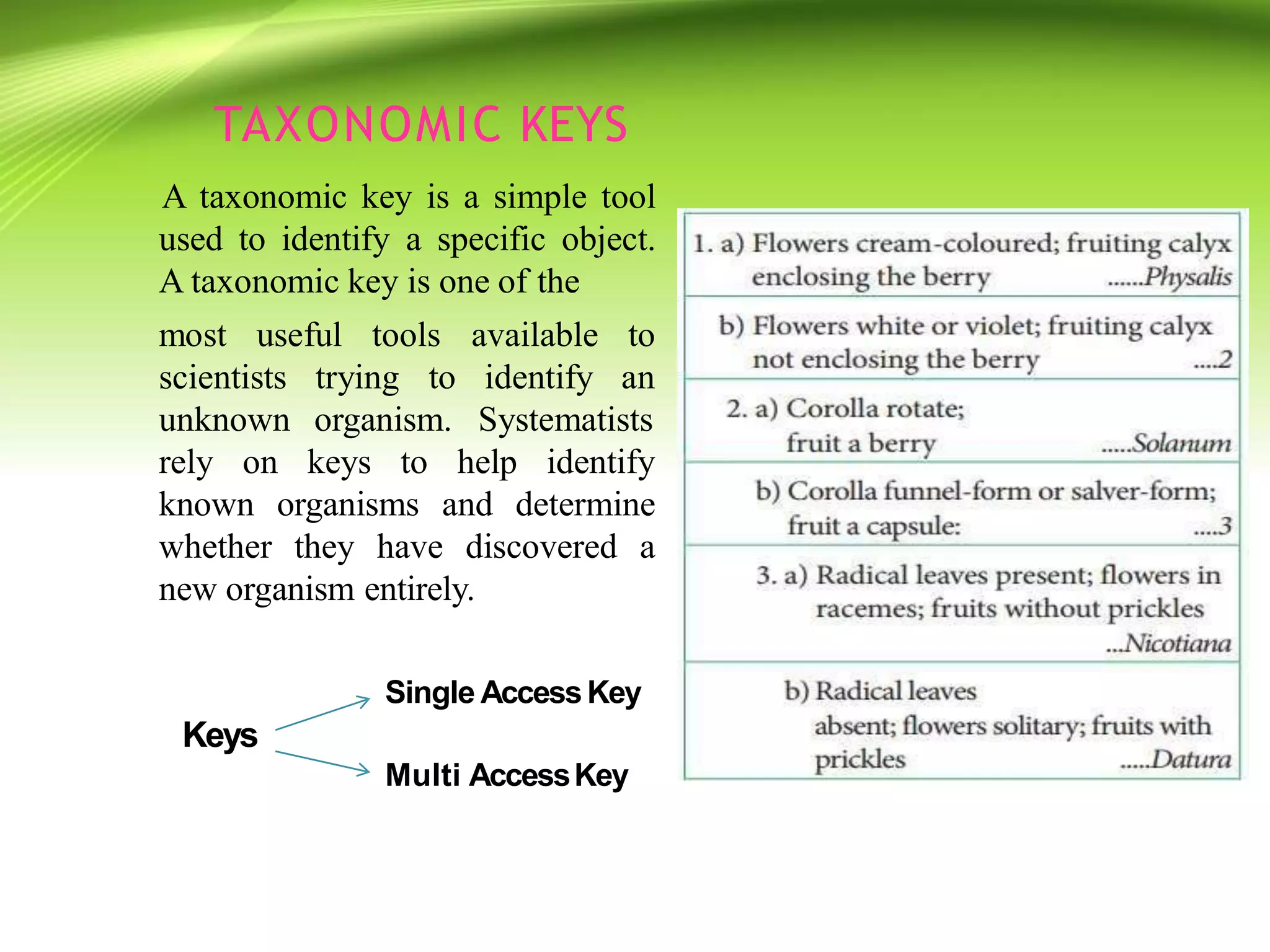
TAXONOMIC KEYS
A taxonomic key is a simple tool
used to identify a specific object.
A taxonomic key is one of the
most useful tools available to
to identify an
scientists trying
unknown organism. Systematists
rely on keys to help identify
known organisms and determine
whether they have discovered a
new organism entirely.
Single AccessKey
Keys
Multi AccessKey
Single Access Key
Single Access Key also called dichotomous key. It consists of a
sequence of two contrasting statements. A pair of contrasting
statements is known as couplet. Each statement is known as lead.
The plant is correctly identified with keys by narrowing down the
characters found in plant.
In phylogenetics a Single access key is an identification key where the
sequence and structure of identification steps is fixed by the Author of
the key.
Two types of dichotomous keys which are generally
used in plant identification are indented or yoked
keys and bracketed or parallel keys.
Indented key/ yoked key- indents the leads of the
couplet at equal distance from the left margin
• The two choices are labelled 1 and 1- or 1a and
1b
Bracketed key- both choices are given side by side
• Choices are numbered/lettered
Indented key on Rhododendron
1a.Flowers in shades of red
2a. Flowers blood red, leaves oblong-ovate, leathery and thick matty
texture- R.sikkimense
2b.Fowers crimson red, leaves broad, oval to elliptic oblong, shiny green
above- R.fulgens
1b.Flowers in shades of rose pink
3a. Calyx 3-5 mm long, leaf undersurface covered by brown hair-
R.wallichi
3b. Calyx 1-2 mm long, leaf undersurface glabrous- R.campanulatu
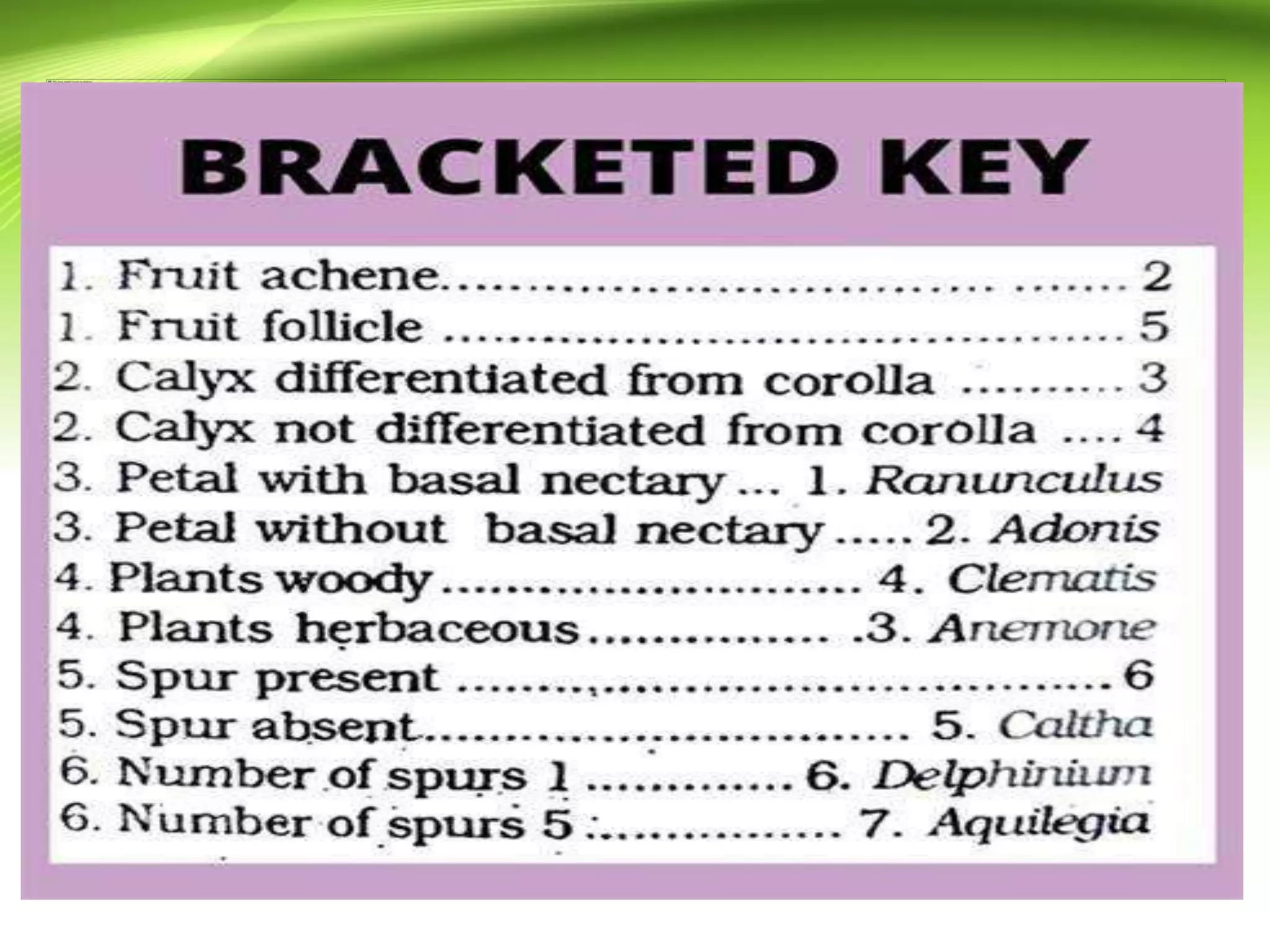
Bracketed or Parallel Key
 In this type of key, two leads of a couplet are always together and the
distance from the margin is always the same. Such arrangement of
couplet is useful for longer keys where keys run to several pages.
 In this type of key it is easy to locate the alternate lead of the initial
couplet and it also provides good space economy. Such a type of key is
illustrated as below:
Multi-access key is an identification key which
overcomes the problem of the more traditional single-
access keys (dichotomous keys) of requiring a fixed
sequence of identification steps. A multi-access key
enables the user to freely choose the characteristics
that are convenient to evaluate for the item to be
identified.
Although good single-access keys will try to start with
characters that are reliable, convenient to observe and
generally available throughout most of the year, it is often
impossible to achieve this for all taxa in a key.
A multi-access key lets the user adapt the key to the
particular organism that is being identified and to the
circumstances of identification (e.g. field or laboratory).
Multi-access keys may be printed in various way (tabular,
matrix, formula style, etc.) but are more commonly used as
computer-aided, interactive keys.
Construction of keys
 Always use constant characters, not variables
 Never use terms such as large/small, instead make correct
measurements
 Characters always available are to be used rather than
seasonal characters
 Always use positive terms. Eg. Stipule Is present - can be
used but not- stipule is not present
 As far as possible both choices of a pair to be started with the
same word- • eg. Seeds round Seeds oblong
Drawback of a dichotomous key
 There are so many deficiencies in a dichotomous key as it
sometimes may fail to work if the specimen we are trying to
identify is intermediate in its characters between two of the
species that are separated out by the key.
 The specimen could be an extreme environmental variant or it
could be a hybrid between two of the species in the key.
 Thirdly it might be representing a new, previously undiscovered
species that is not included in the key. These are some defects we
are not able to get a proper idea of the range of variation of the
species concerned.
 Another drawback of this type of keys is that, as it is designed to
identify plants from a particular area
flora keys.pptx

flora keys.pptx

  • 1.
  • 2.
    DOCUMENTAION  Documentation refersto the creation of scientific information, and bringing out the same in the form of a scientific publication.  This enables dissemination of information to various users, and its reproduction and retrieval.  Taxonomic and systematic research can be documented/ published in various forms, such as floras, monographs, or in journals (traditionally printed and now online version also).
  • 3.
    FLORA  Flora isthe document of all plant species in a given geographic area.  Flora consists of total number of plant species in an area and gives information about flowering season, fruiting season and distribution for the given geographic area.  It also provides details on rare and endemic species of that area. Example: Flora of Tamil Nadu Carnatic by K.M.Matthew. Floras are categorized based on the scope and area covered.
  • 4.
    Local Flora It coversthe limited areas, usually state, country, city or mountain range. Example: ‘Flora of kashmir, Flora of J and K. Regional Flora It includes large geographical area or a botanical region. Example: ‘Flora of India. Continental Flora This flora covers the entire continent. Example: ‘Flora of Europaea’ by D.A.Web. Electronic Floras (e - floras) It is nothing but the digitized form of a flora published online. Example: ‘e –FloraChina’. This provides the information and also functions as an identification tool.
  • 5.
    Introduction  Authentic identificationof an unknown plant is always done with the help of published taxonomic literature, like floras monographs, and revisions, etc.  The most essential and useful feature of such literature is the use of identification keys.  It doesn’t require the much time, materials, or experience involved in comparison and recognition.  In biology, an identification key is a printed or computer aided device that aids the identification of biological entities, such as plants, animals, fossils, microorganisms, and pollen grains.
  • 6.
     A botanicalkey is an analytical device for the determination of the names of the plants.  It is a series of specially arranged pairs of contrasting statements.  The user is called upon to compare his plant with the first of these pairs, to decide which of its two contrasting statements applies better to his plant, and then to pass on as directed to the appropriate following pair.  This process is then repeated until the plant is named.
  • 7.
    Principles of agood key  Only diagnostic characters should be used at each identification step of key.  It is also suggested that redundant characters should be used at each step wherever necessary  Use macroscopic, morphological characters and constant character states.
  • 8.
     Avoid characteristicsthat can only be seen in the field or on specially prepared specimens  A consistent terminology should be used in the identification
  • 9.
    Besides these, thereare some more suggestions which need to be taken care of while constructing a dichotomous key; these include: 1.start each couplet with a noun 2.avoid unnecessary words 3.avoid negatives 4.avoid trichotomies 5.The two statements of couplet should be mutually exclusive; refer to the same feature and each couplet should include all of the potential variations in the feature. 6.use obvious and fixed features, avoid variable, obscure or highly technical ones 7.start with the most distinctive features 8.the finished key should have n-1 couplets (where n equals the number of units in the key)
  • 10.
    TAXONOMIC KEYS A taxonomickey is a simple tool used to identify a specific object. A taxonomic key is one of the most useful tools available to to identify an scientists trying unknown organism. Systematists rely on keys to help identify known organisms and determine whether they have discovered a new organism entirely. Single AccessKey Keys Multi AccessKey
  • 11.
    Single Access Key SingleAccess Key also called dichotomous key. It consists of a sequence of two contrasting statements. A pair of contrasting statements is known as couplet. Each statement is known as lead. The plant is correctly identified with keys by narrowing down the characters found in plant. In phylogenetics a Single access key is an identification key where the sequence and structure of identification steps is fixed by the Author of the key.
  • 12.
    Two types ofdichotomous keys which are generally used in plant identification are indented or yoked keys and bracketed or parallel keys. Indented key/ yoked key- indents the leads of the couplet at equal distance from the left margin • The two choices are labelled 1 and 1- or 1a and 1b Bracketed key- both choices are given side by side • Choices are numbered/lettered
  • 13.
    Indented key onRhododendron 1a.Flowers in shades of red 2a. Flowers blood red, leaves oblong-ovate, leathery and thick matty texture- R.sikkimense 2b.Fowers crimson red, leaves broad, oval to elliptic oblong, shiny green above- R.fulgens 1b.Flowers in shades of rose pink 3a. Calyx 3-5 mm long, leaf undersurface covered by brown hair- R.wallichi 3b. Calyx 1-2 mm long, leaf undersurface glabrous- R.campanulatu
  • 14.
    Bracketed or ParallelKey  In this type of key, two leads of a couplet are always together and the distance from the margin is always the same. Such arrangement of couplet is useful for longer keys where keys run to several pages.  In this type of key it is easy to locate the alternate lead of the initial couplet and it also provides good space economy. Such a type of key is illustrated as below:
  • 16.
    Multi-access key isan identification key which overcomes the problem of the more traditional single- access keys (dichotomous keys) of requiring a fixed sequence of identification steps. A multi-access key enables the user to freely choose the characteristics that are convenient to evaluate for the item to be identified.
  • 17.
    Although good single-accesskeys will try to start with characters that are reliable, convenient to observe and generally available throughout most of the year, it is often impossible to achieve this for all taxa in a key. A multi-access key lets the user adapt the key to the particular organism that is being identified and to the circumstances of identification (e.g. field or laboratory). Multi-access keys may be printed in various way (tabular, matrix, formula style, etc.) but are more commonly used as computer-aided, interactive keys.
  • 18.
    Construction of keys Always use constant characters, not variables  Never use terms such as large/small, instead make correct measurements  Characters always available are to be used rather than seasonal characters  Always use positive terms. Eg. Stipule Is present - can be used but not- stipule is not present  As far as possible both choices of a pair to be started with the same word- • eg. Seeds round Seeds oblong
  • 19.
    Drawback of adichotomous key  There are so many deficiencies in a dichotomous key as it sometimes may fail to work if the specimen we are trying to identify is intermediate in its characters between two of the species that are separated out by the key.  The specimen could be an extreme environmental variant or it could be a hybrid between two of the species in the key.  Thirdly it might be representing a new, previously undiscovered species that is not included in the key. These are some defects we are not able to get a proper idea of the range of variation of the species concerned.  Another drawback of this type of keys is that, as it is designed to identify plants from a particular area