Kevlar Fiber
• Rizwan Younis
Introduction
• Developed by Stephanie Kwolek at DuPont in
1965, this high-strength material was first
commercially used in the early 1970s as a
replacement for steel in racing tires.
• According to FTC;
• Manufactured high-modulus fiber in which the
fiber-forming substance is a long-chain synthetic
aromatic polyamide in which at least 85% of the
amide linkages are attached directly to aromatic
rings.
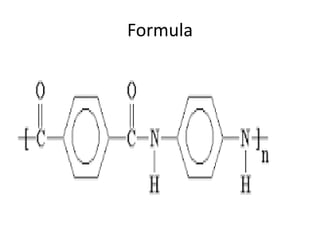
Formula
Raw Material
• 1,4-phenylene-diamine
• Teraphthalyal Chloride
• N-methyl-pyrrolidone
• Calcium chloride
• Sulphuric Acid
Kevlar
Production
• 1,4-phenylene-diamine (para-
phenylenediamine) and terephthayal
chloride react in a condensation
reaction yielding hydrochloric acid as a
byproduct.
• The result has liquid_crystalline behavior.
• mechanical drawing orients the polymer
chains in the fiber's direction
Production
• Viscous polymer is obtained
• Polymer is disloved in N-methyl-pyrrolidone or
calcium chloride.
• It is also treated with concentrated sulfuric
acid, needed to keep the water-insoluble
polymer in solution during its synthesis and
spinning.
• This makes its production expensive
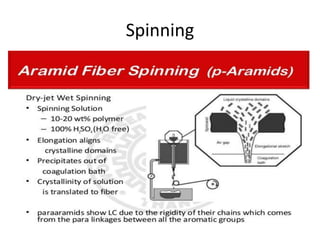
Spinning
• A hot, concentrated, and very viscous solution
treated with sulphuric acid is forced through a
spinneret into a aqueous coagulating bath,
with an air gap separating the spinneret from
the bath.
• The fiber is than washed thoroughly with
water and dried.
Spinning
• The fibers are then cut to length and woven
into a tough mat to make the super-strong,
super-stiff finished material we know as
Kevlar.
Spinning
Properities
• Light weight
• Very good tempareture resistence
• Upto 450 centidegreegrade
• Resistence to almost all type of chemicals
• Immense strength
• Negative cofficient of thermal expansion
• Abrasion resistence
Properties
• Nonconductive under regular conditions, but
can absorb water and salt water.
• Sensitive to shock load. Can fail unexpectedly
if subject to shock.
• Sensitive to degradation from ultraviolet
radiation.
• Kevlar is quite stiff and has low stretching at
break.
Comparison
Advantages
• High strength to weight
ratio
• Impact resistence
• Abrasion resistence
• Don’t expand on heating
Disadvantages
• Absorbs moisture
• Poor
compressive strength
• Difficult to cut and
drill
Application
It has application wherever you need strength
It has application in following areas;
 Industrial Equipments
 Sports equipment
 In Military
 Safety equipments
 Musical instruments
 Music
Application
Due to its great strength it has huge application
its strength combined with light weight makes
it very popular fiber

kevlar

  • 1.
  • 2.
    Introduction • Developed byStephanie Kwolek at DuPont in 1965, this high-strength material was first commercially used in the early 1970s as a replacement for steel in racing tires. • According to FTC; • Manufactured high-modulus fiber in which the fiber-forming substance is a long-chain synthetic aromatic polyamide in which at least 85% of the amide linkages are attached directly to aromatic rings.
  • 3.
  • 4.
    Raw Material • 1,4-phenylene-diamine •Teraphthalyal Chloride • N-methyl-pyrrolidone • Calcium chloride • Sulphuric Acid
  • 5.
  • 6.
    Production • 1,4-phenylene-diamine (para- phenylenediamine)and terephthayal chloride react in a condensation reaction yielding hydrochloric acid as a byproduct. • The result has liquid_crystalline behavior. • mechanical drawing orients the polymer chains in the fiber's direction
  • 7.
    Production • Viscous polymeris obtained • Polymer is disloved in N-methyl-pyrrolidone or calcium chloride. • It is also treated with concentrated sulfuric acid, needed to keep the water-insoluble polymer in solution during its synthesis and spinning. • This makes its production expensive
  • 8.
    Spinning • A hot,concentrated, and very viscous solution treated with sulphuric acid is forced through a spinneret into a aqueous coagulating bath, with an air gap separating the spinneret from the bath. • The fiber is than washed thoroughly with water and dried.
  • 9.
    Spinning • The fibersare then cut to length and woven into a tough mat to make the super-strong, super-stiff finished material we know as Kevlar.
  • 10.
  • 11.
    Properities • Light weight •Very good tempareture resistence • Upto 450 centidegreegrade • Resistence to almost all type of chemicals • Immense strength • Negative cofficient of thermal expansion • Abrasion resistence
  • 12.
    Properties • Nonconductive underregular conditions, but can absorb water and salt water. • Sensitive to shock load. Can fail unexpectedly if subject to shock. • Sensitive to degradation from ultraviolet radiation. • Kevlar is quite stiff and has low stretching at break.
  • 13.
    Comparison Advantages • High strengthto weight ratio • Impact resistence • Abrasion resistence • Don’t expand on heating Disadvantages • Absorbs moisture • Poor compressive strength • Difficult to cut and drill
  • 14.
    Application It has applicationwherever you need strength It has application in following areas;  Industrial Equipments  Sports equipment  In Military  Safety equipments  Musical instruments  Music
  • 15.
    Application Due to itsgreat strength it has huge application its strength combined with light weight makes it very popular fiber