a
ARAMID FIBERS
AS
REINFORCEMENT
Presented by:
 M. Zain (16-NTU-1406)
 Zeshan Faisal (17-NTU-1088)
(Batch-2017)
Department of Polymer Engineering,
National Textile University,
Faisalabad.
Contents
History
Introduction
Types
Fabrication Process
Reinforcement Types
Properties
Applications
ARAMID FIBERS 2
History
o American chemist Stephanie Kwolek invented 1st Para-Aramid Fiber which
was after named as Kevlar.
o Dr. Wilfred Sweeny a Scottish born scientist was responsible for discovering
Meta-Aramid Fiber after named as Nomex.
o In 1960, they were firslty introduced for commercial applications.
ARAMID FIBERS 3
Dr. Wilfred SweenyStephanie Kwolek
Introduction
ARAMID FIBERS 4
Amide
Carbonyl and amino group condensate to generate amide monomer.
There are basically two types of polyamides:
Nylon Aramids
 Less than 85% amide linkages.  Atleast 85% amide linkages.
 Have [(CH2)n] chains b/w amide linkages.  Have (aromatic ring) b/w amide linkages.
Cont.
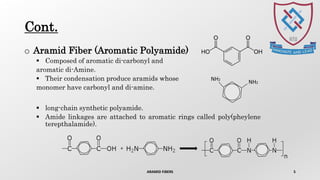
o Aramid Fiber (Aromatic Polyamide)
 Composed of aromatic di-carbonyl and
aromatic di-Amine.
 Their condensation produce aramids whose
monomer have carbonyl and di-amine.
 long-chain synthetic polyamide.
 Amide linkages are attached to aromatic rings called poly(pheylene
terepthalamide).
ARAMID FIBERS 5
NH2
NH2
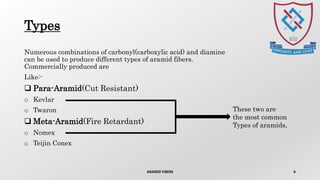
Types
Numerous combinations of carbonyl(carboxylic acid) and diamine
can be used to produce different types of aramid fibers.
Commercially produced are
Like:-
 Para-Aramid(Cut Resistant)
o Kevlar
o Twaron
 Meta-Aramid(Fire Retardant)
o Nomex
o Teijin Conex
ARAMID FIBERS 6
These two are
the most common
Types of aramids.
ARAMID FIBERS 7
Worldwide production of Aramid Fibers
Fiber Name Basic Polymer Producer Estimated Capacity
(Ton/Yr)
M-Aramid Fiber
Nomex Poly(m-phenylene isopthalamide) DuPont Co. 10,000
Teijin Conex Poly(m-phenylene isopthalamide) Teijin Ltd. 5000
Fenilin Poly(m-phenylene isopthalamide) Russia 1000
P-Aramid Fiber
Kevlar Poly(m-phenylene isopthalamide) Du Pont Co. 20,000
Twaron Poly(m-phenylene isopthalamide) Akzo Nobel 10,000
Aramid Co-Polymer Fibers
Technora Copoly(l,4-phenylene/3,4′- diphenylether
terephthalamide)
Teijin Ltd. 1000
Armos Copoly[p-phenylene/5-amino-2- (p
aminophenyl)benzimidazole terephthalamide]
Russia Unknown
Trevar Aramid Copolymer Hoechst AG Unknown
Reinforcement Types
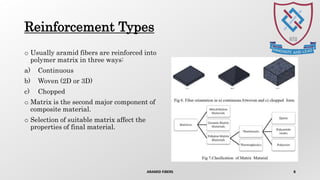
o Usually aramid fibers are reinforced into
polymer matrix in three ways:
a) Continuous
b) Woven (2D or 3D)
c) Chopped
o Matrix is the second major component of
composite material.
o Selection of suitable matrix affect the
properties of final material.
ARAMID FIBERS 8
Manufacturing Process
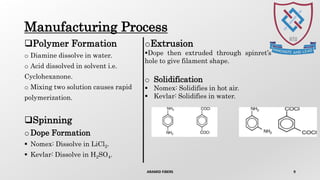
Polymer Formation
o Diamine dissolve in water.
o Acid dissolved in solvent i.e.
Cyclohexanone.
o Mixing two solution causes rapid
polymerization.
Spinning
o Dope Formation
 Nomex: Dissolve in LiCl2.
 Kevlar: Dissolve in H2SO4.
ARAMID FIBERS 9
oExtrusion
Dope then extruded through spinret’s
hole to give filament shape.
o Solidification
 Nomex: Solidifies in hot air.
 Kevlar: Solidifies in water.
Properties
ARAMID FIBERS 10
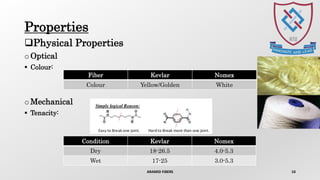
Physical Properties
o Optical
 Colour:
o Mechanical
 Tenacity:
Condition Kevlar Nomex
Dry 18-26.5 4.0-5.3
Wet 17-25 3.0-5.3
Fiber Kevlar Nomex
Colour Yellow/Golden White
Cont.
ARAMID FIBERS 11
 Density:
Kevlar Nomex
1.44 (g/cm3) 1.38 (g/cm3)
Fiber Type Density
(g/cm3)
% Elongation Modulus
(MPa)
Tenacity
Kevlar 29 1.43 3.6 70 20-23
Kevlar 49 1.45 2.8 135 20-26
Kevlar 149 1.47 1.5 143 18
Nomex 1.38 22 17 5.8
Cont.
ARAMID FIBERS 12
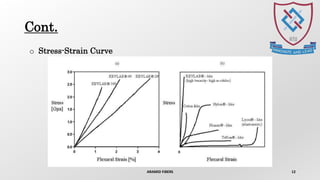
o Stress-Strain Curve
Cont.
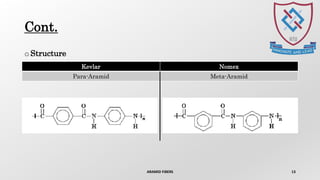
o Structure
ARAMID FIBERS 13
Kevlar Nomex
Para-Aramid Meta-Aramid
Cont.
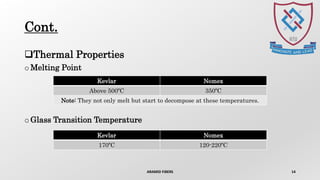
Thermal Properties
o Melting Point
o Glass Transition Temperature
ARAMID FIBERS 14
Kevlar Nomex
Above 500ºC 350ºC
Note: They not only melt but start to decompose at these temperatures.
Kevlar Nomex
170ºC 120-220ºC
Drawbacks
 Quickly absorbs moisture.
 Poor UV resistance.
 Difficult to cut and to grind without special equipment. (e.g. special scissors for
cutting)
 Poor compressive properties.
ARAMID FIBERS 15
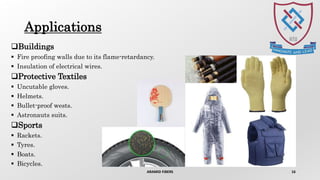
Applications
Buildings
 Fire proofing walls due to its flame-retardancy.
 Insulation of electrical wires.
Protective Textiles
 Uncutable gloves.
 Helmets.
 Bullet-proof wests.
 Astronauts suits.
Sports
 Rackets.
 Tyres.
 Boats.
 Bicycles.
ARAMID FIBERS 16
ARAMID FIBERS 17
“Please Ask Question”
If any?

Aramid Fiber as reinforcement

  • 1.
    a ARAMID FIBERS AS REINFORCEMENT Presented by: M. Zain (16-NTU-1406)  Zeshan Faisal (17-NTU-1088) (Batch-2017) Department of Polymer Engineering, National Textile University, Faisalabad.
  • 2.
  • 3.
    History o American chemistStephanie Kwolek invented 1st Para-Aramid Fiber which was after named as Kevlar. o Dr. Wilfred Sweeny a Scottish born scientist was responsible for discovering Meta-Aramid Fiber after named as Nomex. o In 1960, they were firslty introduced for commercial applications. ARAMID FIBERS 3 Dr. Wilfred SweenyStephanie Kwolek
  • 4.
    Introduction ARAMID FIBERS 4 Amide Carbonyland amino group condensate to generate amide monomer. There are basically two types of polyamides: Nylon Aramids  Less than 85% amide linkages.  Atleast 85% amide linkages.  Have [(CH2)n] chains b/w amide linkages.  Have (aromatic ring) b/w amide linkages.
  • 5.
    Cont. o Aramid Fiber(Aromatic Polyamide)  Composed of aromatic di-carbonyl and aromatic di-Amine.  Their condensation produce aramids whose monomer have carbonyl and di-amine.  long-chain synthetic polyamide.  Amide linkages are attached to aromatic rings called poly(pheylene terepthalamide). ARAMID FIBERS 5 NH2 NH2
  • 6.
    Types Numerous combinations ofcarbonyl(carboxylic acid) and diamine can be used to produce different types of aramid fibers. Commercially produced are Like:-  Para-Aramid(Cut Resistant) o Kevlar o Twaron  Meta-Aramid(Fire Retardant) o Nomex o Teijin Conex ARAMID FIBERS 6 These two are the most common Types of aramids.
  • 7.
    ARAMID FIBERS 7 Worldwideproduction of Aramid Fibers Fiber Name Basic Polymer Producer Estimated Capacity (Ton/Yr) M-Aramid Fiber Nomex Poly(m-phenylene isopthalamide) DuPont Co. 10,000 Teijin Conex Poly(m-phenylene isopthalamide) Teijin Ltd. 5000 Fenilin Poly(m-phenylene isopthalamide) Russia 1000 P-Aramid Fiber Kevlar Poly(m-phenylene isopthalamide) Du Pont Co. 20,000 Twaron Poly(m-phenylene isopthalamide) Akzo Nobel 10,000 Aramid Co-Polymer Fibers Technora Copoly(l,4-phenylene/3,4′- diphenylether terephthalamide) Teijin Ltd. 1000 Armos Copoly[p-phenylene/5-amino-2- (p aminophenyl)benzimidazole terephthalamide] Russia Unknown Trevar Aramid Copolymer Hoechst AG Unknown
  • 8.
    Reinforcement Types o Usuallyaramid fibers are reinforced into polymer matrix in three ways: a) Continuous b) Woven (2D or 3D) c) Chopped o Matrix is the second major component of composite material. o Selection of suitable matrix affect the properties of final material. ARAMID FIBERS 8
  • 9.
    Manufacturing Process Polymer Formation oDiamine dissolve in water. o Acid dissolved in solvent i.e. Cyclohexanone. o Mixing two solution causes rapid polymerization. Spinning o Dope Formation  Nomex: Dissolve in LiCl2.  Kevlar: Dissolve in H2SO4. ARAMID FIBERS 9 oExtrusion Dope then extruded through spinret’s hole to give filament shape. o Solidification  Nomex: Solidifies in hot air.  Kevlar: Solidifies in water.
  • 10.
    Properties ARAMID FIBERS 10 PhysicalProperties o Optical  Colour: o Mechanical  Tenacity: Condition Kevlar Nomex Dry 18-26.5 4.0-5.3 Wet 17-25 3.0-5.3 Fiber Kevlar Nomex Colour Yellow/Golden White
  • 11.
    Cont. ARAMID FIBERS 11 Density: Kevlar Nomex 1.44 (g/cm3) 1.38 (g/cm3) Fiber Type Density (g/cm3) % Elongation Modulus (MPa) Tenacity Kevlar 29 1.43 3.6 70 20-23 Kevlar 49 1.45 2.8 135 20-26 Kevlar 149 1.47 1.5 143 18 Nomex 1.38 22 17 5.8
  • 12.
    Cont. ARAMID FIBERS 12 oStress-Strain Curve
  • 13.
    Cont. o Structure ARAMID FIBERS13 Kevlar Nomex Para-Aramid Meta-Aramid
  • 14.
    Cont. Thermal Properties o MeltingPoint o Glass Transition Temperature ARAMID FIBERS 14 Kevlar Nomex Above 500ºC 350ºC Note: They not only melt but start to decompose at these temperatures. Kevlar Nomex 170ºC 120-220ºC
  • 15.
    Drawbacks  Quickly absorbsmoisture.  Poor UV resistance.  Difficult to cut and to grind without special equipment. (e.g. special scissors for cutting)  Poor compressive properties. ARAMID FIBERS 15
  • 16.
    Applications Buildings  Fire proofingwalls due to its flame-retardancy.  Insulation of electrical wires. Protective Textiles  Uncutable gloves.  Helmets.  Bullet-proof wests.  Astronauts suits. Sports  Rackets.  Tyres.  Boats.  Bicycles. ARAMID FIBERS 16
  • 17.
    ARAMID FIBERS 17 “PleaseAsk Question” If any?