Kevlar-29
Friday, Group 3
Clement Amanor
James Li
Umamah Najeeb,
Aarthi Raghavan
Kevlar Rope
(http://www.dube.com)
Overview of the Presentation
• History
• Chemical
Properties
Clement ProcessingUmamah Mechanical
PropertiesJames
• Applications
• Conclusion
Aarthi
History
In 1965, Stephanie
Kwolek invented
Kevlar under DuPont
as a superior
replacement for
nylon and polyester.
What is Kevlar-29?
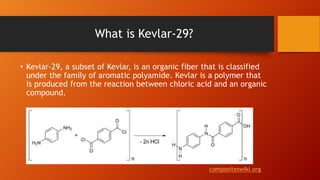
• Kevlar-29, a subset of Kevlar, is an organic fiber that is classified
under the family of aromatic polyamide. Kevlar is a polymer that
is produced from the reaction between chloric acid and an organic
compound.
compositeswiki.org
Poly-amide
• Structure: Network
• Geometrical Isomer: trans
conformation (amorphous)
• Conclusion: long straight
chains, strong lattice (very
similar to crystalline
structure), few flaws, high
strength, hard and durable
What Makes Kevlar So Strong?
• Consists of repeating
monomers
• Crystalline structure
• Hydrogen Bond
• High degree of symmetry
http://www.lbl.gov/
Why is Kevlar Essential for Modern Society?
• Kevlar is useful for military and police applications due to its high
strength and lightweight, which mitigates the encumbering weight
of the gears, such as backpacks, helmets, and vests, used by
military personnel and law enforcers.
• With the prevalence of modern fire arms, there is a need for
protection against these deadly weapons that are life threatening
to both the society and armed forces. Kevlar has become one of
the common material that fulfills this role.
Processing
Polymerization
Reaction
Purification
Wet Spinning
1. Polymerization Reaction
• First under a low temperature of - 15º C to 30ºC, a synthesis
reaction occurs between an amide and a carboxylic acid.
• This reaction is initiated by two chemicals:
a solvent to dissolve the polymer
a co-solvent with an ionic component to decompose the hydrogen bond.
• In addition, during this process, a base is required to neutralize
the acid that is produced as a by-product.
Purpose: to combine molecules into long chains
2. Purification
• The polymerization reaction produces a semi-viscous material. It
is then purified of undesired materials, such as salt and calcium.
• Then the material is isolated by mixing it with water and
converting it to powder.
• With the help of water and alcohol, the material is washed and
finally dried in the vacuum overnight at 60ºC to 70ºC produce a
fiber to be spun.
Purpose: Insolate the polymer and prepare it for the spinneret
3 Wet Spinning
• During the spinning process, the sulfuric acid acts as the
dissolvent. After the fiber is dissolved to form a liquid, it is then
heated to produce a new complex material.
• This material is passed through a spinneret, where the molecules
are uniformly aligned.
• Finally, the material is quenched, stretched on a roller and wound
into cloth
Wet Spinning (continued)
http://ymcichem.wikispaces.com/B+-+Synthetic+Fibres
Cost
Materials Cost ($/kg)
Kevlar 31.00
E-Glass 22.00
Nylon-66
Raw form 4.40–6.00
Extruded 9.40
Polyester 1.50–4.40
Polyethylene
Low density, raw form 1.20–1.35
High density, raw form 1.00–1.70
Ultrahigh molecular weight,
raw form 3.00–8.50
Carbon Fiber
Standard modulus 40.00–60.00
Intermediate modulus 100.00–130.00
High modulus 200.00–275.00
Obtained from
Appendix C / Costs and Relative Costs for
Selected Engineering Materials
http://f3.tiera.ru/
Mechanical Properties
• High tensile Strength
• Low density
• Flame resistant
• High modulus (rigidity of the structure)
• Low Breaking Elongation
• Low Electrical Conductivity
• High Cut Resistant
Mechanical Properties
High strength and Low Breaking Elongation
Cut resistant (Cut Test)
Fire resistant (Flame Test)
Thermal Properties
Thermal conductivity 0.04 W/(m-K)
Maximum service temperature 149°C - 177°C
Decomposition 450°C
Lowest temperature resistance -196°C
Thermal Properties
Body Armor
1. Body Armors
• Kevlar is used extensively in body
armor due to its high strength and
light weight.
• Inside the vest, Kevlar fabric is
woven in an interlaced pattern.
• When the bullet hits the armor, all
the interlocked fibers pull on each
other and increase the area of
impact.
• This is possible due to its high
tenacity and ability to stretch. “THE USE OF POLY-PARAPHENYLENE TEREPHTHALAMIDE
(KEVLAR) IN PERSONAL BODY ARMOR”
Helmets
2. Kevlar Helmet
• Kevlar 29 has high strength
and low elongation.
• Hence, it can catch the bullet
and disperse the force without
much back-face signature,
protecting the skull and brain
from penetration and pressure
damage.
Vehicle armor
3. Vehicle protection
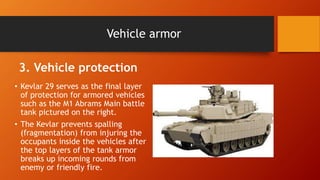
• Kevlar 29 serves as the final layer
of protection for armored vehicles
such as the M1 Abrams Main battle
tank pictured on the right.
• The Kevlar prevents spalling
(fragmentation) from injuring the
occupants inside the vehicles after
the top layers of the tank armor
breaks up incoming rounds from
enemy or friendly fire.
Vehicle Armor (contd.)
• Furthermore, using Kevlar as vehicle armor helps in the following:
o It reduces weight, which allows for reduced fuel consumption, higher
payloads, and increased maneuverability.
o It allows for a thinner, lighter armor system.
o It does not act as a fuel source nor sustain combustion; hence, is fire
resistant.
o It offers excellent thermal stability and can be used continuously at
temperatures above 120°C without loss of performance.
o Its performance maintains for many years.
Testing
Limitations
• Strength degrades in water
• Damages when exposed to
Ultraviolet Light
• May result in Muscle Trauma
Effect and internal organ
damage, when hit by a bullet
Solutions
• Most applications of Kevlar are
composed of multiple
materials, such as Kevlar
sealed between plastic or
ceramics. This out layers are
waterproof and provide
protection against the
ultraviolet light.
Recommendations for the Future
• Liquid Body Armor
o A liquid called Shear-Thickening Fluid (STF) is inserted into the Kevlar
armor.
o This liquid reduces the number of Kevlar fabric layers and makes it even
lighter than the normal Kevlar armor.
o When a bullet hits the armor, the liquid hardens, making the Kevlar stronger
and stopping the bullet.
o This prevents Muscle Trauma Effect, as it doesn’t have to spread the energy
of the impact all over the vest.
Recommendations for the Future
References
• Chilutti, D., & Schaub, E. (2012). The Use of Poly-Paraphenylene Terephthalamide
(Kevlar) in Personal Body Armor. Pittsburg: University of Pittsburg.
• Kirkland, D. R. (2008). Environmental Impact of Various Kayak Core Materials.
Massachusttes Institute of Technology.
• Kabir, R. B., & Ferdous, N. (2012). Kevlar-The Super Tough Fiber. International
Journal of Textile Science, 78-83.
• Kevlar. (2006, October 17). Retrieved from Engineering.com:
http://www.engineering.com/Library/ArticlesPage/tabid/85/ArticleID/91/KEVLAR.
aspx
• Technical Guide: Kevlar Aramid Fiber. (n.d.). DuPont.
• Bellis, M. (n.d.). About.com. Retrieved from History of Body Armor and Bullet Proof
Vests: http://inventors.about.com/od/bstartinventions/a/Body_Armor.htm
• High Strength Modulus Fibers. (n.d.). Retrieved from:
http://inventors.about.com/od/bstartinventions/a/Body_Armor.htm
• Vehicle Armor made with Kevlar Fiber. (n.d.). Retrieved from DuPont:
http://www.dupont.com/products-and-services/fabrics-fibers-
nonwovens/fibers/brands/kevlar/products/vehicle-armor-kevlar.html

Kevlar-29

  • 1.
    Kevlar-29 Friday, Group 3 ClementAmanor James Li Umamah Najeeb, Aarthi Raghavan Kevlar Rope (http://www.dube.com)
  • 2.
    Overview of thePresentation • History • Chemical Properties Clement ProcessingUmamah Mechanical PropertiesJames • Applications • Conclusion Aarthi
  • 3.
    History In 1965, Stephanie Kwolekinvented Kevlar under DuPont as a superior replacement for nylon and polyester.
  • 4.
    What is Kevlar-29? •Kevlar-29, a subset of Kevlar, is an organic fiber that is classified under the family of aromatic polyamide. Kevlar is a polymer that is produced from the reaction between chloric acid and an organic compound. compositeswiki.org
  • 5.
    Poly-amide • Structure: Network •Geometrical Isomer: trans conformation (amorphous) • Conclusion: long straight chains, strong lattice (very similar to crystalline structure), few flaws, high strength, hard and durable
  • 6.
    What Makes KevlarSo Strong? • Consists of repeating monomers • Crystalline structure • Hydrogen Bond • High degree of symmetry http://www.lbl.gov/
  • 7.
    Why is KevlarEssential for Modern Society? • Kevlar is useful for military and police applications due to its high strength and lightweight, which mitigates the encumbering weight of the gears, such as backpacks, helmets, and vests, used by military personnel and law enforcers. • With the prevalence of modern fire arms, there is a need for protection against these deadly weapons that are life threatening to both the society and armed forces. Kevlar has become one of the common material that fulfills this role.
  • 8.
  • 9.
    1. Polymerization Reaction •First under a low temperature of - 15º C to 30ºC, a synthesis reaction occurs between an amide and a carboxylic acid. • This reaction is initiated by two chemicals: a solvent to dissolve the polymer a co-solvent with an ionic component to decompose the hydrogen bond. • In addition, during this process, a base is required to neutralize the acid that is produced as a by-product. Purpose: to combine molecules into long chains
  • 10.
    2. Purification • Thepolymerization reaction produces a semi-viscous material. It is then purified of undesired materials, such as salt and calcium. • Then the material is isolated by mixing it with water and converting it to powder. • With the help of water and alcohol, the material is washed and finally dried in the vacuum overnight at 60ºC to 70ºC produce a fiber to be spun. Purpose: Insolate the polymer and prepare it for the spinneret
  • 11.
    3 Wet Spinning •During the spinning process, the sulfuric acid acts as the dissolvent. After the fiber is dissolved to form a liquid, it is then heated to produce a new complex material. • This material is passed through a spinneret, where the molecules are uniformly aligned. • Finally, the material is quenched, stretched on a roller and wound into cloth
  • 12.
  • 13.
    Cost Materials Cost ($/kg) Kevlar31.00 E-Glass 22.00 Nylon-66 Raw form 4.40–6.00 Extruded 9.40 Polyester 1.50–4.40 Polyethylene Low density, raw form 1.20–1.35 High density, raw form 1.00–1.70 Ultrahigh molecular weight, raw form 3.00–8.50 Carbon Fiber Standard modulus 40.00–60.00 Intermediate modulus 100.00–130.00 High modulus 200.00–275.00 Obtained from Appendix C / Costs and Relative Costs for Selected Engineering Materials http://f3.tiera.ru/
  • 14.
    Mechanical Properties • Hightensile Strength • Low density • Flame resistant • High modulus (rigidity of the structure) • Low Breaking Elongation • Low Electrical Conductivity • High Cut Resistant
  • 15.
  • 16.
    High strength andLow Breaking Elongation
  • 17.
  • 18.
  • 19.
    Thermal Properties Thermal conductivity0.04 W/(m-K) Maximum service temperature 149°C - 177°C Decomposition 450°C Lowest temperature resistance -196°C
  • 20.
  • 21.
    Body Armor 1. BodyArmors • Kevlar is used extensively in body armor due to its high strength and light weight. • Inside the vest, Kevlar fabric is woven in an interlaced pattern. • When the bullet hits the armor, all the interlocked fibers pull on each other and increase the area of impact. • This is possible due to its high tenacity and ability to stretch. “THE USE OF POLY-PARAPHENYLENE TEREPHTHALAMIDE (KEVLAR) IN PERSONAL BODY ARMOR”
  • 22.
    Helmets 2. Kevlar Helmet •Kevlar 29 has high strength and low elongation. • Hence, it can catch the bullet and disperse the force without much back-face signature, protecting the skull and brain from penetration and pressure damage.
  • 23.
    Vehicle armor 3. Vehicleprotection • Kevlar 29 serves as the final layer of protection for armored vehicles such as the M1 Abrams Main battle tank pictured on the right. • The Kevlar prevents spalling (fragmentation) from injuring the occupants inside the vehicles after the top layers of the tank armor breaks up incoming rounds from enemy or friendly fire.
  • 24.
    Vehicle Armor (contd.) •Furthermore, using Kevlar as vehicle armor helps in the following: o It reduces weight, which allows for reduced fuel consumption, higher payloads, and increased maneuverability. o It allows for a thinner, lighter armor system. o It does not act as a fuel source nor sustain combustion; hence, is fire resistant. o It offers excellent thermal stability and can be used continuously at temperatures above 120°C without loss of performance. o Its performance maintains for many years.
  • 25.
    Testing Limitations • Strength degradesin water • Damages when exposed to Ultraviolet Light • May result in Muscle Trauma Effect and internal organ damage, when hit by a bullet Solutions • Most applications of Kevlar are composed of multiple materials, such as Kevlar sealed between plastic or ceramics. This out layers are waterproof and provide protection against the ultraviolet light.
  • 26.
    Recommendations for theFuture • Liquid Body Armor o A liquid called Shear-Thickening Fluid (STF) is inserted into the Kevlar armor. o This liquid reduces the number of Kevlar fabric layers and makes it even lighter than the normal Kevlar armor. o When a bullet hits the armor, the liquid hardens, making the Kevlar stronger and stopping the bullet. o This prevents Muscle Trauma Effect, as it doesn’t have to spread the energy of the impact all over the vest.
  • 27.
  • 29.
    References • Chilutti, D.,& Schaub, E. (2012). The Use of Poly-Paraphenylene Terephthalamide (Kevlar) in Personal Body Armor. Pittsburg: University of Pittsburg. • Kirkland, D. R. (2008). Environmental Impact of Various Kayak Core Materials. Massachusttes Institute of Technology. • Kabir, R. B., & Ferdous, N. (2012). Kevlar-The Super Tough Fiber. International Journal of Textile Science, 78-83. • Kevlar. (2006, October 17). Retrieved from Engineering.com: http://www.engineering.com/Library/ArticlesPage/tabid/85/ArticleID/91/KEVLAR. aspx • Technical Guide: Kevlar Aramid Fiber. (n.d.). DuPont. • Bellis, M. (n.d.). About.com. Retrieved from History of Body Armor and Bullet Proof Vests: http://inventors.about.com/od/bstartinventions/a/Body_Armor.htm • High Strength Modulus Fibers. (n.d.). Retrieved from: http://inventors.about.com/od/bstartinventions/a/Body_Armor.htm • Vehicle Armor made with Kevlar Fiber. (n.d.). Retrieved from DuPont: http://www.dupont.com/products-and-services/fabrics-fibers- nonwovens/fibers/brands/kevlar/products/vehicle-armor-kevlar.html