Aramid: High
Performance Fibres
Mukesh Kumar Singh
Professor, UPTTI Kanpur
stronger, lighter, safer
Commodity Fibres
Volume driven
Price oriented
Large scale
production
Continuous line
production
Hiperformance Fibres
Technically driven
Specialty oriented
Small scale Production
Batch type production
high temperature resistant fibers
synthetic fiber with a continuous operating
temperature ranging from 3750 F to 6000 F
High PERFORMANCE FIBRE
• A fibre that is specially designed and
manufactured to give some specific
performance characteristics under some
specific ambient conditions
Example HM-HT Fibre
Kevlar, UHMWPE Fibre, PBO
Thermal resistant
Nomex, Kevlar, PBO, Carbon
History
Nomex -1960
Kevlar- 1971
Twaron (by Teijin ) 1980 by Ozawa &Matsuda
Last 20 years: structure and properties of
Aramid
Definition
United States Federal Trade Commission
1974
• Aramid ia a manufactured fiber in which
the fiber forming substance is a long-chain
synthetic polyamide in which at least 85%
of the amide (-CO-NH-) linkages are
attached directly between two aromatic
rings.
• p-phenylene terephthalarnide
(PTA), of which Kevlar fibres are made
Aramid manufacturing
• By reaction between amine and carboxylic acid
halide group to synthesize AB homopolymer
nNH2 Ar COCl NH2 Ar CO
n
nHCl
A B
• Similarly AABB homopolymer can also be
synthesized
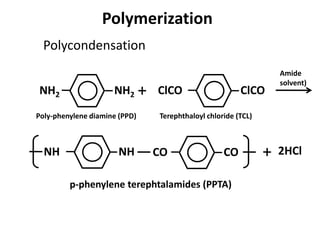
Polymerization
Polycondensation
NH2
NH2
Poly-phenylene diamine (PPD)
ClCO
ClCO
Terephthaloyl chloride (TCL)
Amide
solvent)
NH
NH CO
CO 2HCl
p-phenylene terephtalamides (PPTA)
Process
Dissolve PPD in a mixture of hexamythylphosphoramide (HMPA)
and N-methylpurrolidone (NMP)
Cooling in ice/ecetone to -15°C in N2 atmosphere
Add TCL with rapid stirring: paste like gel
Stand overnight with gradual warming to room temp
Resultant mixture is agitated with water to wash solvent and HCL
Polymer is collected by filteration
History of Aramid
• Aromatic polyamides were first introduced
in 1960s, with a meta-aramid fiber
produced by DuPont under the tradename
Nomex.
• Meta-aramid is also produced
Teijin: Conex
Kermel France: Kermel
Production
• World capacity of para-aramid production
is estimated at about 41,000 tons/yr in
2002 and increases each year by 5-10%. In
2007 this means a total production
capacity of around 55,000 tons/yr.
Aramid Fibre Production
Polymer solvent for spinning PPTA is generally 100% (water free)
sulfuric acid (H2SO4)
• The aromatic polyamide solution processing temperature is of the
order of 80°C for the highly concentrated solution in 100%
sulphuric acid
• At this temperature, the solution state corresponds to a pneumatic
crystalline phase
• The degree of orientation of these polymer chains depends on
solution temperature and polymer concentration. The radial
crystalline orientation can only be brought about using the dry-jet
wet spinning process
• Kevlar fibres have a very high molecular orientation, which has an
almost directly proportional relationship to fibre modulus and is
highly dependent on drying conditions, temperature and tension
• Monomers’ are made up of fourteen
Carbon atoms, two Nitrogen atoms, two
Oxygen atoms and ten Hydrogen atoms.
• A single Kevlar polymer chain could
possibly have anywhere from one to five
million monomers bonded together.
Kevlar
• Kevlar is the trade name (registered by
DuPont Co.) of aramid (poly-para-phenylene
terephthalamide) fibers.
• Kevlar fibers were originally developed as a
replacement of steel in automotive tires
• Kevlar is high impact resistance and low
density fibre
Spinning
• Solution is prepared by using H2SO4 as
solvent (100% free from water)
• Solution is heated to 80C
• Solution solid content 10%
Liquid crystalline domains
Spinneret
Air gap Elongational stretch
Coagulation bath
Gel spinning
Liquid crystalline solution

Semi-crystalline polymer
like nylon 6
Kevlar
Atomic configuration
a trans-amide
the peptide bond
carbonyl
carbon
amide
nitrogen
In the trans amide, the
Hydrocarbon group are on
opposite side of peptide bond
In the cis amide, the hydrocarbon
group are on the same side
of peptide bond
O
C
N
H
Properties of Kevlar Fibre
• High tensile strength (five times stronger per weight
unite than steel)
• High modulus of elasticity
• Very low elongation up to breaking point
• Low weight
• High chemical inertness
• Very low coefficient of thermal expansion
• High Fracture Toughness (impact resistance)
• High cut resistance
• Textile processibility
• Flame resistance (burning starts at 427C
0 5 10 15 20
1
2
3
4
Elongation (%)
Specific
stress
(N/tex)
Polyamide
Polyester
Steel
S-Glass
Aramid
Carbon-HS
HDPE
Moisture attraction by Kevlar
• X-ray data have shown that the water
molecules from moisture uptake do not
enter the unit cell of the crystal lattice.
• Hence, the amide-water molecular
interactions are likely to be confined to the
polymer chains on the surface.
• Secondly, the presence of microvoids on
the surface
Limitations of Kevlar Fibre
• Very low moisture regain
• Very difficult to cut
• Low compressive strength
Physical properties of materials
MATERIAL
Ultimate Strength
MPa
Density
g/cm3
Spectra fiber (UHMWPE) 2300-3500 .97
Kevlar (ARAMID) 2757 1.44
Carbon Fibre 4137 1.75
Carbon laminate 1600 1.5
E Glass Fibre 3450 2.57
E Glass laminate 1500 1.97
Polypropylene 19.7-80 .91
S Glass Fibre 4710 2.47
Spider Silk 1000 1.3
Steel alloy ASTM A36 400 7.8
Epoxy 12-30 1.23
Nylon 75 1.15
Modulus of materials
Material
Young's Modulus
GPa
PTFE (Teflon) 0.5
Rubber (small strain) 0.01–0.1
PTFE (Teflon) 0.5
Low density polyethylene 0.2
UHMWPE (such as Dyneena or Spectra) .7
Polypropylene 1.5-2
Nylon 2–4
Pine wood (along grain) 8.963
Glass-reinforced plastic (70/30 by weight
fibre/matrix, unidirectional, along grain)
40–45
Carbon fiber (depends on direction and type) 300-400
Carbon fiber reinforced plastic (70/30
fibre/matrix, unidirectional, along grain)
181
Steel 200
Single-walled carbon nanotube 1,000+
Molecular requirement of Aramids
Improvement Polymeric composition
Thermal resistance Wholly aromatic polyamide, absence of
unstable linkage (urethane, urea, alkylene etc.)
Solubility Copolymer with dissymmetrical units inclusion
of –O-, -CO-, -SO2- etc., amides rather than
esters
Drawing potential High molecular weight
Enhanced chain flexibility by incorporating -O-,
-CO-, -SO2-, etc
Dimensional
stability
Rigid molecular chain, crystallinity
Chemical properties of Kevlar
Aramid Fibers are Chemically quite
Resistant
• Aramids are not sensitive to organic solvents or oil.
• Kevlar, Twaron and other Aramids are sensitive to strong acids, bases, and
certain oxidizers, like chlorine bleach* (sodium hypochlorite).
• Exposure to these cause degradation of the fiber.
• Regular chlorine bleach (e.g. Clorox®) cannot be used with Kevlar®, oxygen
bleaches such as sodium perborate (e.g. OxiClean®) can be used without
damaging the Aramid fiber.
• Hydrogen Peroxide cannot be used to whiten Aramid though.
• This is important for anyone cleaning boat ropes or sails containing Kevlar.
• Polyester (Dacron) is not particularly sensitive to bleach but Kevlar's
strength will be destroyed! Nylon is also attacked by bleach
• Most organic solvents (oil) have little effect on the material, and most salt
solutions (sodium chloride) have no effect on Kevlar fiber. However, strong
acids and bases (hydrochloric acid and sodium hydroxide) at high
concentrations or elevated temperatures are able to attack Kevlar fiber.
Types of Kevlar fibre
• Kevlar 29 – high strength (3600 MPa), low density
(1.44 g/cc3), used for bullet-proof vests, composite
armor reinforcement, helmets, ropes, cables,
asbestos replacing parts
• Kevlar 49 – high modulus (131 GPa), high strength
(3800 MPa), low density (1.440 g/cm³) used in
aerospace, automotive and marine applications
• Kevlar 149 – ultra high modulus (186 GPa), high
strength (3400 MPa), low density (1.470 g/cm³)
highly crystalline, used as reinforcing dispersed
phase for composite aircraft components.
a trans-amide a cis-amide
O
C N
H
O
C N
H
In Nomex the aromatic group are linked into the
Molecular chain through 1 and 3 positions
(i.e meta-linkage)
O
C N
H
O
C N
H
In Kevlar the aromatic group are linked into the
Molecular chain through 1 and 4 positions
(i.e para-linkage)
n
C
N
O
H
C
N
O
H
C
N
O
H
C
N
O
H
C
O
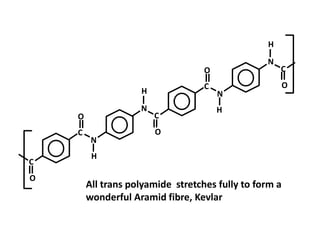
All trans polyamide stretches fully to form a
wonderful Aramid fibre, Kevlar
Fibre axis
Crystalline region
Amorphous region
Cross-linking
Applications of Kevlar
• Kevlar may protect carbon fibers and improve their
properties: hybrid fabric (Kevlar + Carbon fibers)
combines very high tensile strength with high impact
and abrasion resistance
•
• The most popular matrix materials for manufacturing
Kevlar (aramid) Fiber Reinforced Polymers are
Thermosets such as Epoxies (EP), Vinylester and
Phenolics (PF)
• Kevlar Fiber Reinforced Polymers are manufactured by
open mold processes, closed mold processes and
Pultrusion method
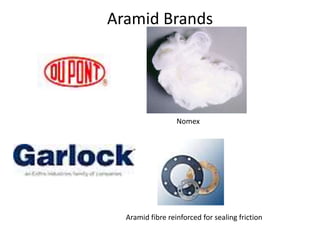
Aramid Brands
Nomex
Aramid fibre reinforced for sealing friction
Conveyor belts
Technora Sulfron
Aramid fibre: Kevlar
Aramid Brands
Aramid /PVC: Clad for optical fibre
Aramid fibre honeycomb
Aramid fibre braided sleeve “Sharx”
Fabrics for aircraft Aramid for shipbuilding Aramid fire blanket
Aramid fire retardant
clothing
Aramid: cut resistant gloves
Aramid: seat cover fabric
Aramid: aircraft tyres Aramid: brake
linings
Aramid: mooring
ropes
Aramid: clutch
facings
Aramid: vehicle cover Aramid: hoses for
Off-shore

Aramid

  • 1.
    Aramid: High Performance Fibres MukeshKumar Singh Professor, UPTTI Kanpur stronger, lighter, safer
  • 2.
    Commodity Fibres Volume driven Priceoriented Large scale production Continuous line production Hiperformance Fibres Technically driven Specialty oriented Small scale Production Batch type production
  • 3.
    high temperature resistantfibers synthetic fiber with a continuous operating temperature ranging from 3750 F to 6000 F
  • 4.
    High PERFORMANCE FIBRE •A fibre that is specially designed and manufactured to give some specific performance characteristics under some specific ambient conditions Example HM-HT Fibre Kevlar, UHMWPE Fibre, PBO Thermal resistant Nomex, Kevlar, PBO, Carbon
  • 5.
    History Nomex -1960 Kevlar- 1971 Twaron(by Teijin ) 1980 by Ozawa &Matsuda Last 20 years: structure and properties of Aramid
  • 6.
    Definition United States FederalTrade Commission 1974 • Aramid ia a manufactured fiber in which the fiber forming substance is a long-chain synthetic polyamide in which at least 85% of the amide (-CO-NH-) linkages are attached directly between two aromatic rings. • p-phenylene terephthalarnide (PTA), of which Kevlar fibres are made
  • 7.
    Aramid manufacturing • Byreaction between amine and carboxylic acid halide group to synthesize AB homopolymer nNH2 Ar COCl NH2 Ar CO n nHCl A B • Similarly AABB homopolymer can also be synthesized
  • 8.
    Polymerization Polycondensation NH2 NH2 Poly-phenylene diamine (PPD) ClCO ClCO Terephthaloylchloride (TCL) Amide solvent) NH NH CO CO 2HCl p-phenylene terephtalamides (PPTA)
  • 9.
    Process Dissolve PPD ina mixture of hexamythylphosphoramide (HMPA) and N-methylpurrolidone (NMP) Cooling in ice/ecetone to -15°C in N2 atmosphere Add TCL with rapid stirring: paste like gel Stand overnight with gradual warming to room temp Resultant mixture is agitated with water to wash solvent and HCL Polymer is collected by filteration
  • 10.
    History of Aramid •Aromatic polyamides were first introduced in 1960s, with a meta-aramid fiber produced by DuPont under the tradename Nomex. • Meta-aramid is also produced Teijin: Conex Kermel France: Kermel
  • 11.
    Production • World capacityof para-aramid production is estimated at about 41,000 tons/yr in 2002 and increases each year by 5-10%. In 2007 this means a total production capacity of around 55,000 tons/yr.
  • 12.
    Aramid Fibre Production Polymersolvent for spinning PPTA is generally 100% (water free) sulfuric acid (H2SO4) • The aromatic polyamide solution processing temperature is of the order of 80°C for the highly concentrated solution in 100% sulphuric acid • At this temperature, the solution state corresponds to a pneumatic crystalline phase • The degree of orientation of these polymer chains depends on solution temperature and polymer concentration. The radial crystalline orientation can only be brought about using the dry-jet wet spinning process • Kevlar fibres have a very high molecular orientation, which has an almost directly proportional relationship to fibre modulus and is highly dependent on drying conditions, temperature and tension
  • 13.
    • Monomers’ aremade up of fourteen Carbon atoms, two Nitrogen atoms, two Oxygen atoms and ten Hydrogen atoms. • A single Kevlar polymer chain could possibly have anywhere from one to five million monomers bonded together.
  • 14.
    Kevlar • Kevlar isthe trade name (registered by DuPont Co.) of aramid (poly-para-phenylene terephthalamide) fibers. • Kevlar fibers were originally developed as a replacement of steel in automotive tires • Kevlar is high impact resistance and low density fibre
  • 16.
    Spinning • Solution isprepared by using H2SO4 as solvent (100% free from water) • Solution is heated to 80C • Solution solid content 10%
  • 17.
    Liquid crystalline domains Spinneret Airgap Elongational stretch Coagulation bath
  • 19.
  • 20.
  • 21.
  • 22.
    Atomic configuration a trans-amide thepeptide bond carbonyl carbon amide nitrogen In the trans amide, the Hydrocarbon group are on opposite side of peptide bond In the cis amide, the hydrocarbon group are on the same side of peptide bond O C N H
  • 23.
    Properties of KevlarFibre • High tensile strength (five times stronger per weight unite than steel) • High modulus of elasticity • Very low elongation up to breaking point • Low weight • High chemical inertness • Very low coefficient of thermal expansion • High Fracture Toughness (impact resistance) • High cut resistance • Textile processibility • Flame resistance (burning starts at 427C
  • 24.
    0 5 1015 20 1 2 3 4 Elongation (%) Specific stress (N/tex) Polyamide Polyester Steel S-Glass Aramid Carbon-HS HDPE
  • 25.
    Moisture attraction byKevlar • X-ray data have shown that the water molecules from moisture uptake do not enter the unit cell of the crystal lattice. • Hence, the amide-water molecular interactions are likely to be confined to the polymer chains on the surface. • Secondly, the presence of microvoids on the surface
  • 26.
    Limitations of KevlarFibre • Very low moisture regain • Very difficult to cut • Low compressive strength
  • 27.
    Physical properties ofmaterials MATERIAL Ultimate Strength MPa Density g/cm3 Spectra fiber (UHMWPE) 2300-3500 .97 Kevlar (ARAMID) 2757 1.44 Carbon Fibre 4137 1.75 Carbon laminate 1600 1.5 E Glass Fibre 3450 2.57 E Glass laminate 1500 1.97 Polypropylene 19.7-80 .91 S Glass Fibre 4710 2.47 Spider Silk 1000 1.3 Steel alloy ASTM A36 400 7.8 Epoxy 12-30 1.23 Nylon 75 1.15
  • 28.
    Modulus of materials Material Young'sModulus GPa PTFE (Teflon) 0.5 Rubber (small strain) 0.01–0.1 PTFE (Teflon) 0.5 Low density polyethylene 0.2 UHMWPE (such as Dyneena or Spectra) .7 Polypropylene 1.5-2 Nylon 2–4 Pine wood (along grain) 8.963 Glass-reinforced plastic (70/30 by weight fibre/matrix, unidirectional, along grain) 40–45 Carbon fiber (depends on direction and type) 300-400 Carbon fiber reinforced plastic (70/30 fibre/matrix, unidirectional, along grain) 181 Steel 200 Single-walled carbon nanotube 1,000+
  • 29.
    Molecular requirement ofAramids Improvement Polymeric composition Thermal resistance Wholly aromatic polyamide, absence of unstable linkage (urethane, urea, alkylene etc.) Solubility Copolymer with dissymmetrical units inclusion of –O-, -CO-, -SO2- etc., amides rather than esters Drawing potential High molecular weight Enhanced chain flexibility by incorporating -O-, -CO-, -SO2-, etc Dimensional stability Rigid molecular chain, crystallinity
  • 30.
    Chemical properties ofKevlar Aramid Fibers are Chemically quite Resistant • Aramids are not sensitive to organic solvents or oil. • Kevlar, Twaron and other Aramids are sensitive to strong acids, bases, and certain oxidizers, like chlorine bleach* (sodium hypochlorite). • Exposure to these cause degradation of the fiber. • Regular chlorine bleach (e.g. Clorox®) cannot be used with Kevlar®, oxygen bleaches such as sodium perborate (e.g. OxiClean®) can be used without damaging the Aramid fiber. • Hydrogen Peroxide cannot be used to whiten Aramid though. • This is important for anyone cleaning boat ropes or sails containing Kevlar. • Polyester (Dacron) is not particularly sensitive to bleach but Kevlar's strength will be destroyed! Nylon is also attacked by bleach • Most organic solvents (oil) have little effect on the material, and most salt solutions (sodium chloride) have no effect on Kevlar fiber. However, strong acids and bases (hydrochloric acid and sodium hydroxide) at high concentrations or elevated temperatures are able to attack Kevlar fiber.
  • 31.
    Types of Kevlarfibre • Kevlar 29 – high strength (3600 MPa), low density (1.44 g/cc3), used for bullet-proof vests, composite armor reinforcement, helmets, ropes, cables, asbestos replacing parts • Kevlar 49 – high modulus (131 GPa), high strength (3800 MPa), low density (1.440 g/cm³) used in aerospace, automotive and marine applications • Kevlar 149 – ultra high modulus (186 GPa), high strength (3400 MPa), low density (1.470 g/cm³) highly crystalline, used as reinforcing dispersed phase for composite aircraft components.
  • 32.
    a trans-amide acis-amide
  • 33.
    O C N H O C N H InNomex the aromatic group are linked into the Molecular chain through 1 and 3 positions (i.e meta-linkage) O C N H O C N H In Kevlar the aromatic group are linked into the Molecular chain through 1 and 4 positions (i.e para-linkage) n
  • 34.
    C N O H C N O H C N O H C N O H C O All trans polyamidestretches fully to form a wonderful Aramid fibre, Kevlar
  • 35.
  • 36.
  • 37.
    Applications of Kevlar •Kevlar may protect carbon fibers and improve their properties: hybrid fabric (Kevlar + Carbon fibers) combines very high tensile strength with high impact and abrasion resistance • • The most popular matrix materials for manufacturing Kevlar (aramid) Fiber Reinforced Polymers are Thermosets such as Epoxies (EP), Vinylester and Phenolics (PF) • Kevlar Fiber Reinforced Polymers are manufactured by open mold processes, closed mold processes and Pultrusion method
  • 38.
    Aramid Brands Nomex Aramid fibrereinforced for sealing friction
  • 39.
  • 40.
    Aramid Brands Aramid /PVC:Clad for optical fibre Aramid fibre honeycomb Aramid fibre braided sleeve “Sharx”
  • 41.
    Fabrics for aircraftAramid for shipbuilding Aramid fire blanket Aramid fire retardant clothing Aramid: cut resistant gloves
  • 42.
    Aramid: seat coverfabric Aramid: aircraft tyres Aramid: brake linings Aramid: mooring ropes
  • 43.
    Aramid: clutch facings Aramid: vehiclecover Aramid: hoses for Off-shore