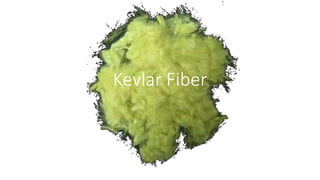
Kevlar Fiber
Outlines
• Introduction
• History
• Production
• Structure and Properties
• Thermal Properties
• Application
• Composite Materials
• Reference
Introduction
Introductions
History
• Poly-paraphenylene terephthalamide – branded Kevlar – was invented by Polish-
American chemist Stephanie Kwolek while working for DuPont, in anticipation of
a gasoline shortage.
• In 1964, her group began searching for a new lightweight strong fiber to use for
light but strong tires. The polymers she had been working with at the time, poly-
p-phenylene-terephthalate and polybenzamide, formed liquid crystal while in
solution, something unique to those polymers at the time.
• The solution was "cloudy, opalescent upon being stirred, and of low viscosity"
and usually was thrown away. However, Kwolek persuaded the technician,
Charles Smullen, who ran the "spinneret", to test her solution, and was amazed
to find that the fiber did not break, unlike nylon.
• Her supervisor and her laboratory director understood the significance of her
accidental discovery and a new field of polymer chemistry quickly arose. By 1971,
modern Kevlar was introduced. However, Kwolek was not very involved in
developing the applications of Kevlar.
History
Production
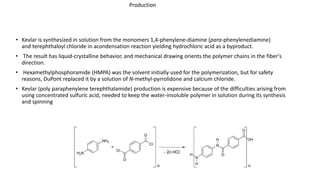
• Kevlar is synthesized in solution from the monomers 1,4-phenylene-diamine (para-phenylenediamine)
and terephthaloyl chloride in acondensation reaction yielding hydrochloric acid as a byproduct.
• The result has liquid-crystalline behavior, and mechanical drawing orients the polymer chains in the fiber's
direction.
• Hexamethylphosphoramide (HMPA) was the solvent initially used for the polymerization, but for safety
reasons, DuPont replaced it by a solution of N-methyl-pyrrolidone and calcium chloride.
• Kevlar (poly paraphenylene terephthalamide) production is expensive because of the difficulties arising from
using concentrated sulfuric acid, needed to keep the water-insoluble polymer in solution during its synthesis
and spinning
Production
Structure and
Properties
• When Kevlar is spun, the resulting fiber has a tensile strength of about 3,620
MPa, and a relative density of 1.44. The polymer owes its high strength to the
many inter-chain bonds.
• These inter-molecular hydrogen bonds form between the carbonyl groups and
NH centers. Additional strength is derived from aromatic stacking
interactions between adjacent strands.
• These interactions have a greater influence on Kevlar than the van der
Waals interactions and chain length that typically influence the properties of
other synthetic polymers and fibers such as Dyneema.
• The presence of salts and certain other impurities, especially calcium, could
interfere with the strand interactions and care is taken to avoid inclusion in its
production. Kevlar's structure consists of relatively rigid molecules which tend to
form mostly planar sheet-like structures rather like silk protein.
Structure and Properties
Thermal Properties
• Kevlar maintains its strength and resilience down to cryogenic
temperatures (−196 °C); in fact, it is slightly stronger at low
temperatures.
• At higher temperatures the tensile strength is immediately reduced
by about 10–20%, and after some hours the strength progressively
reduces further.
• For example, at 160 °C (320 °F) about 10% reduction in strength
occurs after 500 hours.
• At 260 °C (500 °F) 50% strength reduction occurs after 70 hours.
Thermal Properties
Application
Protection
• Kevlar is often used in the field of cryogenics for its low thermal
conductivity and high strength relative to other materials
for suspension purposes.
• It is most often used to suspend a paramagnetic salt enclosure from
a superconducting magnet mandrel in order to minimize any heat
leaks to the paramagnetic material.
• It is also used as a thermal standoff or structural support where low
heat leaks are desired.
Application
Armor
• Kevlar is a well-known component of personal armor such as combat
helmets, ballistic face masks, and ballistic vests. The PASGT helmet and
vest used by United States military forces since the 1980s both have Kevlar
as a key component, as do their replacements.
• Other military uses include bulletproof facemasks used by sentries
and spall liners used to protect the crews of armoured fighting vehicles.
• Even Nimitz-class aircraft carriers include Kevlar armor around vital spaces.
• Related civilian applications include emergency services' protection gear if
it involves high heat (e.g., fire fighting), and Kevlar body armor such as
vests for police officers, security, and SWAT.
Application
Personal protection
• Kevlar is used to manufacture gloves, sleeves, jackets, chaps and
other articles of clothing designed to protect users from cuts,
abrasions and heat. Kevlar based protective gear is often considerably
lighter and thinner than equivalent gear made of more traditional
materials.
Application
Sports
• It is used for motorcycle safety clothing, especially in the areas
featuring padding such as shoulders and elbows.
• In fencing it is used in the protective jackets, breeches, plastrons and
the bib of the masks.
• It is increasingly being used in the peto, the padded covering which
protects the picadors' horses in the bullring.
Application
Equipment
• In kyudo, or Japanese archery, it may be used as an alternative to
more expensive hemp for bow strings. It is one of the main materials
used for paraglider suspension lines.
• It is used as an inner lining for some bicycle tires to prevent
punctures.
• In table tennis, plies of Kevlar are added to custom ply blades, or
paddles, in order to increase bounce and reduce weight. Tennis
racquets are sometimes strung with Kevlar.
• It is used in sails for high performance racing boats.
Application
Shoes
• With advancements in technology, Nike used Kevlar in shoes for the first
time. It launched the Elite II Series, with enhancements to its earlier
version of basketball shoes by using Kevlar in the anterior as well as
the shoe laces.
• This was done to decrease the elasticity of the tip of the shoe in contrast to
nylon used conventionally as Kevlar expanded by about 1% against nylon
which expanded by about 30%.
• Shoes in this range included LeBron, HyperDunk and Zoom Kobe VII.
However these shoes were launched at a price range much higher than
average cost of basketball shoes.
• It was also used as speed control patches for certain Soap Shoes models.
and the laces for the adidas F50 adiZero Prime football boot.
Application
Other Use
•Fire dancing
•Frying pans
•Rope, cable, sheath
•Electricity generation
•Building construction
•Brakes
•Expansion joints and hoses
•Particle physics
•Smartphones
Composite Materials
• Aramid fibers are widely used for reinforcing composite materials,
often in combination with carbon fiber and glass fiber.
• The matrix for high performance composites is usually epoxy resin.
Typical applications include monocoque bodies for F1 racing,
cars, helicopter rotor blades, tennis, table
tennis, badminton and squash rackets, kayaks, cricket bats, and field
hockey, ice hockey and lacrosse sticks.
Reference:
https://en.wikipedia.org/wiki/Kevlar

Kevlar fiber

  • 1.
  • 2.
    Outlines • Introduction • History •Production • Structure and Properties • Thermal Properties • Application • Composite Materials • Reference
  • 3.
  • 4.
  • 5.
  • 6.
    • Poly-paraphenylene terephthalamide– branded Kevlar – was invented by Polish- American chemist Stephanie Kwolek while working for DuPont, in anticipation of a gasoline shortage. • In 1964, her group began searching for a new lightweight strong fiber to use for light but strong tires. The polymers she had been working with at the time, poly- p-phenylene-terephthalate and polybenzamide, formed liquid crystal while in solution, something unique to those polymers at the time. • The solution was "cloudy, opalescent upon being stirred, and of low viscosity" and usually was thrown away. However, Kwolek persuaded the technician, Charles Smullen, who ran the "spinneret", to test her solution, and was amazed to find that the fiber did not break, unlike nylon. • Her supervisor and her laboratory director understood the significance of her accidental discovery and a new field of polymer chemistry quickly arose. By 1971, modern Kevlar was introduced. However, Kwolek was not very involved in developing the applications of Kevlar. History
  • 7.
  • 8.
    • Kevlar issynthesized in solution from the monomers 1,4-phenylene-diamine (para-phenylenediamine) and terephthaloyl chloride in acondensation reaction yielding hydrochloric acid as a byproduct. • The result has liquid-crystalline behavior, and mechanical drawing orients the polymer chains in the fiber's direction. • Hexamethylphosphoramide (HMPA) was the solvent initially used for the polymerization, but for safety reasons, DuPont replaced it by a solution of N-methyl-pyrrolidone and calcium chloride. • Kevlar (poly paraphenylene terephthalamide) production is expensive because of the difficulties arising from using concentrated sulfuric acid, needed to keep the water-insoluble polymer in solution during its synthesis and spinning Production
  • 9.
  • 10.
    • When Kevlaris spun, the resulting fiber has a tensile strength of about 3,620 MPa, and a relative density of 1.44. The polymer owes its high strength to the many inter-chain bonds. • These inter-molecular hydrogen bonds form between the carbonyl groups and NH centers. Additional strength is derived from aromatic stacking interactions between adjacent strands. • These interactions have a greater influence on Kevlar than the van der Waals interactions and chain length that typically influence the properties of other synthetic polymers and fibers such as Dyneema. • The presence of salts and certain other impurities, especially calcium, could interfere with the strand interactions and care is taken to avoid inclusion in its production. Kevlar's structure consists of relatively rigid molecules which tend to form mostly planar sheet-like structures rather like silk protein. Structure and Properties
  • 11.
  • 12.
    • Kevlar maintainsits strength and resilience down to cryogenic temperatures (−196 °C); in fact, it is slightly stronger at low temperatures. • At higher temperatures the tensile strength is immediately reduced by about 10–20%, and after some hours the strength progressively reduces further. • For example, at 160 °C (320 °F) about 10% reduction in strength occurs after 500 hours. • At 260 °C (500 °F) 50% strength reduction occurs after 70 hours. Thermal Properties
  • 13.
  • 14.
    Protection • Kevlar isoften used in the field of cryogenics for its low thermal conductivity and high strength relative to other materials for suspension purposes. • It is most often used to suspend a paramagnetic salt enclosure from a superconducting magnet mandrel in order to minimize any heat leaks to the paramagnetic material. • It is also used as a thermal standoff or structural support where low heat leaks are desired. Application
  • 15.
    Armor • Kevlar isa well-known component of personal armor such as combat helmets, ballistic face masks, and ballistic vests. The PASGT helmet and vest used by United States military forces since the 1980s both have Kevlar as a key component, as do their replacements. • Other military uses include bulletproof facemasks used by sentries and spall liners used to protect the crews of armoured fighting vehicles. • Even Nimitz-class aircraft carriers include Kevlar armor around vital spaces. • Related civilian applications include emergency services' protection gear if it involves high heat (e.g., fire fighting), and Kevlar body armor such as vests for police officers, security, and SWAT. Application
  • 16.
    Personal protection • Kevlaris used to manufacture gloves, sleeves, jackets, chaps and other articles of clothing designed to protect users from cuts, abrasions and heat. Kevlar based protective gear is often considerably lighter and thinner than equivalent gear made of more traditional materials. Application
  • 17.
    Sports • It isused for motorcycle safety clothing, especially in the areas featuring padding such as shoulders and elbows. • In fencing it is used in the protective jackets, breeches, plastrons and the bib of the masks. • It is increasingly being used in the peto, the padded covering which protects the picadors' horses in the bullring. Application
  • 18.
    Equipment • In kyudo,or Japanese archery, it may be used as an alternative to more expensive hemp for bow strings. It is one of the main materials used for paraglider suspension lines. • It is used as an inner lining for some bicycle tires to prevent punctures. • In table tennis, plies of Kevlar are added to custom ply blades, or paddles, in order to increase bounce and reduce weight. Tennis racquets are sometimes strung with Kevlar. • It is used in sails for high performance racing boats. Application
  • 19.
    Shoes • With advancementsin technology, Nike used Kevlar in shoes for the first time. It launched the Elite II Series, with enhancements to its earlier version of basketball shoes by using Kevlar in the anterior as well as the shoe laces. • This was done to decrease the elasticity of the tip of the shoe in contrast to nylon used conventionally as Kevlar expanded by about 1% against nylon which expanded by about 30%. • Shoes in this range included LeBron, HyperDunk and Zoom Kobe VII. However these shoes were launched at a price range much higher than average cost of basketball shoes. • It was also used as speed control patches for certain Soap Shoes models. and the laces for the adidas F50 adiZero Prime football boot. Application
  • 20.
  • 21.
    •Fire dancing •Frying pans •Rope,cable, sheath •Electricity generation •Building construction •Brakes •Expansion joints and hoses •Particle physics •Smartphones
  • 22.
  • 23.
    • Aramid fibersare widely used for reinforcing composite materials, often in combination with carbon fiber and glass fiber. • The matrix for high performance composites is usually epoxy resin. Typical applications include monocoque bodies for F1 racing, cars, helicopter rotor blades, tennis, table tennis, badminton and squash rackets, kayaks, cricket bats, and field hockey, ice hockey and lacrosse sticks.
  • 24.