S
PRESENTED BY
MD.ASHRAFUL HOQUE
DEPT. OF TEXTILE
ENGINEERING
SOUTHEAST UNIVERSITY
FORMATION OF CARBON FIBER
&
ITS APPLICATION
WHAT IS CARBON FIBER?
 Carbon fiber (an extremely lightweight fiber )is
defined as a fiber containing at least 92 wt % carbon.
 It is a material consisting of several fibers and
composed mostly of carbon atoms. Each fiber is
about 5 – 10 μm thick in diameter. Carbon fiber is
made from organic polymers. Firstly manufactured by
Dr. Roger Bacon in 1950.
STRUCTURE
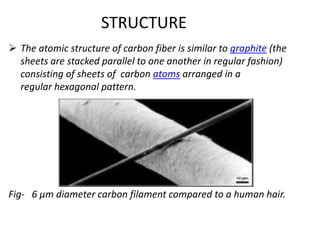
 The atomic structure of carbon fiber is similar to graphite (the
sheets are stacked parallel to one another in regular fashion)
consisting of sheets of carbon atoms arranged in a
regular hexagonal pattern.
Fig- 6 μm diameter carbon filament compared to a human hair.
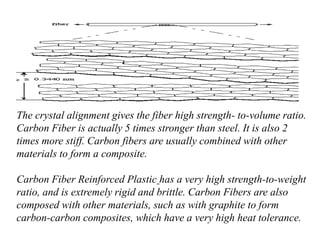
The crystal alignment gives the fiber high strength- to-volume ratio.
Carbon Fiber is actually 5 times stronger than steel. It is also 2
times more stiff. Carbon fibers are usually combined with other
materials to form a composite.
Carbon Fiber Reinforced Plastic has a very high strength-to-weight
ratio, and is extremely rigid and brittle. Carbon Fibers are also
composed with other materials, such as with graphite to form
carbon-carbon composites, which have a very high heat tolerance.
Manufacturing Challenges
The need for more cost effective recovery and
repair.
Close control required to ensure consistent
quality.
Health and safety issues.
Skin irritation
Breathing irritation.
Raw Materials
Polyacrylonitrile (PAN) or
Rayon or
Petroleum pitch
Gases, liquids, and other materials used in the
manufacturing process create specific effects,
qualities, and grades of carbon fiber.
The Manufacturing Process of Carbon
Fibers
Polyacrylonitrile (PAN) and pitch are the two most common
raw products used to produce carbon fibers.
 In the thermo set treatment, the fibers are stretched and
heated to no more than 400 C. This step cross-links the carbon
chains so that the fibers will not melt in subsequent treatments.
 In the carbonize treatment, the fibers are heated to about
800C in an oxygen free environment. This step removes non-
carbon impurities.
 The fibers are graphitized; this step stretches the fibers
between 50 to 100% elongation, and heats them to
temperatures ranging from 1100C to 3000C.
 The last two treatment steps are surface treatment and epoxy
sizing, are preformed to enhance the carbon fiber / epoxy
bonding strength.
Figure: Schematic of PAN and pitch based carbon fiber manufacturing procedure.
.
Carbon fiber manufacturing from PAN
 The molecular structure of PAN contains highly polar CN groups
and arranged on either side of chain.
 The filaments are stretched at an elevated temperature during
the polymer chains are aligned in the filament direction .
 The stretched elements are then heated in air at 200C – 300C for
a few hours ,during this stage the CN groups located on the same
side of the original chain combine to form a more stable and rigid
ladder structure and some of the CH2 groups are oxidized .
 Next step PAN filaments are carbonized by heating them at a
controlled rate at 1000C -2000C in an inert atmosphere.
 Tension is maintained on the filaments to prevent shrinking as
well as to improve molecular orientation.
 With the elimination of oxygen and nitrogen atoms ,the filaments
now contain mostly carbon atoms .
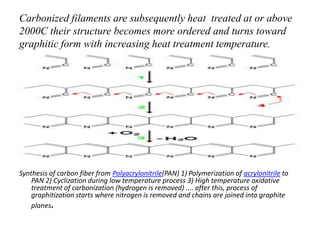
Carbonized filaments are subsequently heat treated at or above
2000C their structure becomes more ordered and turns toward
graphitic form with increasing heat treatment temperature.
Synthesis of carbon fiber from Polyacrylonitrile(PAN) 1) Polymerization of acrylonitrile to
PAN 2) Cyclization during low temperature process 3) High temperature oxidative
treatment of carbonization (hydrogen is removed) .... after this, process of
graphitization starts where nitrogen is removed and chains are joined into graphite
planes.
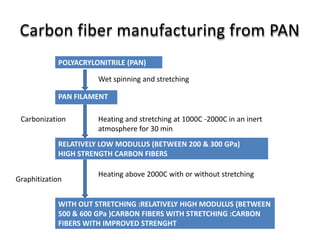
Carbon fiber manufacturing from PAN
POLYACRYLONITRILE (PAN)
PAN FILAMENT
RELATIVELY LOW MODULUS (BETWEEN 200 & 300 GPa)
HIGH STRENGTH CARBON FIBERS
WITH OUT STRETCHING :RELATIVELY HIGH MODULUS (BETWEEN
500 & 600 GPa )CARBON FIBERS WITH STRETCHING :CARBON
FIBERS WITH IMPROVED STRENGHT
Wet spinning and stretching
Carbonization Heating and stretching at 1000C -2000C in an inert
atmosphere for 30 min
Graphitization
Heating above 2000C with or without stretching
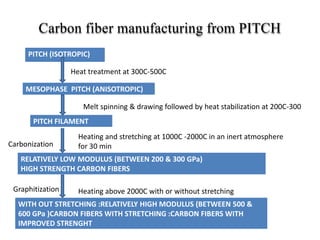
Carbon fiber manufacturing from PITCH
 Carbon atoms in pitch are arranged in low molecular
weight aromatic ring patterns ,Heating to temperature
above 300C polymerizes these molecule into long , two
dimensional sheet like structures .
 Pitch filaments are produced by melt spinning of pitch
which are highly viscous state passing through a
spinneret die , the highly viscous state pitch molecules
become aligned in the filament direction. The filaments
are cooled to freeze the molecular orientation and
subsequently heated between 200C and 300C in an
oxygen containing atmosphere to stabilize them and make
make them infusible.
 Next step filaments are carbonized at temperatures
around 2000C.
Carbon fiber manufacturing from PITCH
PITCH (ISOTROPIC)
MESOPHASE PITCH (ANISOTROPIC)
RELATIVELY LOW MODULUS (BETWEEN 200 & 300 GPa)
HIGH STRENGTH CARBON FIBERS
WITH OUT STRETCHING :RELATIVELY HIGH MODULUS (BETWEEN 500 &
600 GPa )CARBON FIBERS WITH STRETCHING :CARBON FIBERS WITH
IMPROVED STRENGHT
Heat treatment at 300C-500C
Carbonization
Heating and stretching at 1000C -2000C in an inert atmosphere
for 30 min
Graphitization Heating above 2000C with or without stretching
PITCH FILAMENT
Melt spinning & drawing followed by heat stabilization at 200C-300
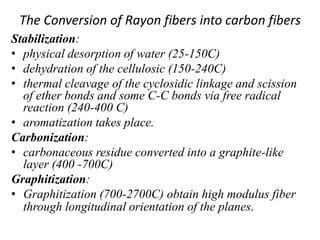
The Conversion of Rayon fibers into carbon fibers
Stabilization:
• physical desorption of water (25-150C)
• dehydration of the cellulosic (150-240C)
• thermal cleavage of the cyclosidic linkage and scission
of ether bonds and some C-C bonds via free radical
reaction (240-400 C)
• aromatization takes place.
Carbonization:
• carbonaceous residue converted into a graphite-like
layer (400 -700C)
Graphitization:
• Graphitization (700-2700C) obtain high modulus fiber
through longitudinal orientation of the planes.
.
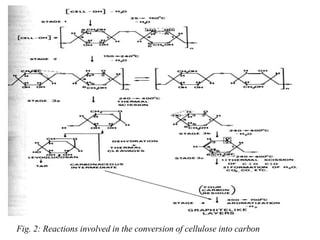
Fig. 2: Reactions involved in the conversion of cellulose into carbon
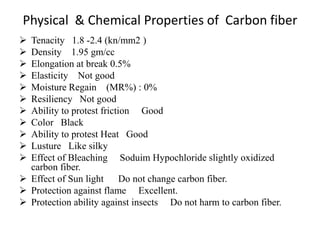
Physical & Chemical Properties of Carbon fiber
 Tenacity 1.8 -2.4 (kn/mm2 )
 Density 1.95 gm/cc
 Elongation at break 0.5%
 Elasticity Not good
 Moisture Regain (MR%) : 0%
 Resiliency Not good
 Ability to protest friction Good
 Color Black
 Ability to protest Heat Good
 Lusture Like silky
 Effect of Bleaching Soduim Hypochloride slightly oxidized
carbon fiber.
 Effect of Sun light Do not change carbon fiber.
 Protection against flame Excellent.
 Protection ability against insects Do not harm to carbon fiber.
Advantages
 It has the greatest compressive strength of all
reinforcing materials.
 Long service life.
 Low coefficient of thermal expansion.
 Its density is much lower than the density of steel.
 Exhibit properties better than any other metal.
 Insensitive to temperature changes High tensile
strength.
 Electrically and thermally conductive. Light weight and
low density.
 High abrasion and wear resistance.
Disadvantages
The main disadvantage of carbon fiber is its cost.
This fiber will cause some forms of cancer of the
lungs.
Applications
• Aerospace and Aircraft Industry.
• Sports equipments.
• Automotive parts.
• Acoustics.
• Civil Engineering.
Applications
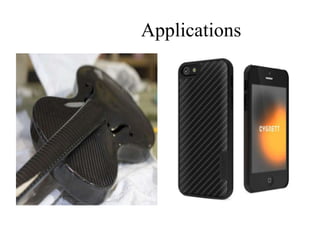
Musical Instruments Mobile Case
Applications
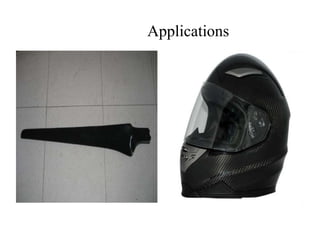
Wind Turbine Blades Helmets
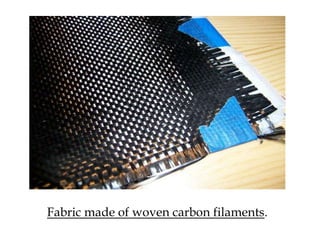
Fabric made of woven carbon filaments.
Future of Carbon Fiber
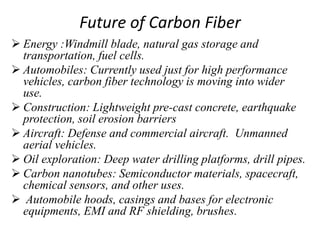
 Energy :Windmill blade, natural gas storage and
transportation, fuel cells.
 Automobiles: Currently used just for high performance
vehicles, carbon fiber technology is moving into wider
use.
 Construction: Lightweight pre-cast concrete, earthquake
protection, soil erosion barriers
 Aircraft: Defense and commercial aircraft. Unmanned
aerial vehicles.
 Oil exploration: Deep water drilling platforms, drill pipes.
 Carbon nanotubes: Semiconductor materials, spacecraft,
chemical sensors, and other uses.
 Automobile hoods, casings and bases for electronic
equipments, EMI and RF shielding, brushes.
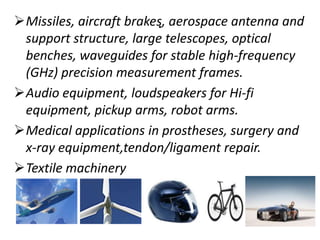
.Missiles, aircraft brakes, aerospace antenna and
support structure, large telescopes, optical
benches, waveguides for stable high-frequency
(GHz) precision measurement frames.
Audio equipment, loudspeakers for Hi-fi
equipment, pickup arms, robot arms.
Medical applications in prostheses, surgery and
x-ray equipment,tendon/ligament repair.
Textile machinery
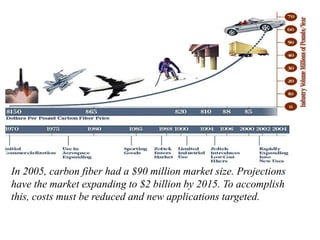
In 2005, carbon fiber had a $90 million market size. Projections
have the market expanding to $2 billion by 2015. To accomplish
this, costs must be reduced and new applications targeted.
.
Manufacturers of carbon fibers
Major manufacturers of carbon fibers
include Hexcel, SGL Carbon, Toho Tenax, Toray
Industries and Zoltek. Manufacturers typically make
different grades of fibers for different applications.
Higher modulus carbon fibers are typically more
expensive
Conclusion
It revolutionized the field of light weight
materials. The new substitute for metals.
In short it is the future manufacturing
material.
Carbon fiber formation

Carbon fiber formation

  • 1.
  • 2.
    PRESENTED BY MD.ASHRAFUL HOQUE DEPT.OF TEXTILE ENGINEERING SOUTHEAST UNIVERSITY
  • 3.
    FORMATION OF CARBONFIBER & ITS APPLICATION
  • 4.
    WHAT IS CARBONFIBER?  Carbon fiber (an extremely lightweight fiber )is defined as a fiber containing at least 92 wt % carbon.  It is a material consisting of several fibers and composed mostly of carbon atoms. Each fiber is about 5 – 10 μm thick in diameter. Carbon fiber is made from organic polymers. Firstly manufactured by Dr. Roger Bacon in 1950.
  • 5.
    STRUCTURE  The atomicstructure of carbon fiber is similar to graphite (the sheets are stacked parallel to one another in regular fashion) consisting of sheets of carbon atoms arranged in a regular hexagonal pattern. Fig- 6 μm diameter carbon filament compared to a human hair.
  • 6.
    The crystal alignmentgives the fiber high strength- to-volume ratio. Carbon Fiber is actually 5 times stronger than steel. It is also 2 times more stiff. Carbon fibers are usually combined with other materials to form a composite. Carbon Fiber Reinforced Plastic has a very high strength-to-weight ratio, and is extremely rigid and brittle. Carbon Fibers are also composed with other materials, such as with graphite to form carbon-carbon composites, which have a very high heat tolerance.
  • 7.
    Manufacturing Challenges The needfor more cost effective recovery and repair. Close control required to ensure consistent quality. Health and safety issues. Skin irritation Breathing irritation.
  • 8.
    Raw Materials Polyacrylonitrile (PAN)or Rayon or Petroleum pitch Gases, liquids, and other materials used in the manufacturing process create specific effects, qualities, and grades of carbon fiber.
  • 9.
    The Manufacturing Processof Carbon Fibers Polyacrylonitrile (PAN) and pitch are the two most common raw products used to produce carbon fibers.  In the thermo set treatment, the fibers are stretched and heated to no more than 400 C. This step cross-links the carbon chains so that the fibers will not melt in subsequent treatments.  In the carbonize treatment, the fibers are heated to about 800C in an oxygen free environment. This step removes non- carbon impurities.  The fibers are graphitized; this step stretches the fibers between 50 to 100% elongation, and heats them to temperatures ranging from 1100C to 3000C.  The last two treatment steps are surface treatment and epoxy sizing, are preformed to enhance the carbon fiber / epoxy bonding strength.
  • 10.
    Figure: Schematic ofPAN and pitch based carbon fiber manufacturing procedure. .
  • 11.
    Carbon fiber manufacturingfrom PAN  The molecular structure of PAN contains highly polar CN groups and arranged on either side of chain.  The filaments are stretched at an elevated temperature during the polymer chains are aligned in the filament direction .  The stretched elements are then heated in air at 200C – 300C for a few hours ,during this stage the CN groups located on the same side of the original chain combine to form a more stable and rigid ladder structure and some of the CH2 groups are oxidized .  Next step PAN filaments are carbonized by heating them at a controlled rate at 1000C -2000C in an inert atmosphere.  Tension is maintained on the filaments to prevent shrinking as well as to improve molecular orientation.  With the elimination of oxygen and nitrogen atoms ,the filaments now contain mostly carbon atoms .
  • 12.
    Carbonized filaments aresubsequently heat treated at or above 2000C their structure becomes more ordered and turns toward graphitic form with increasing heat treatment temperature. Synthesis of carbon fiber from Polyacrylonitrile(PAN) 1) Polymerization of acrylonitrile to PAN 2) Cyclization during low temperature process 3) High temperature oxidative treatment of carbonization (hydrogen is removed) .... after this, process of graphitization starts where nitrogen is removed and chains are joined into graphite planes.
  • 13.
    Carbon fiber manufacturingfrom PAN POLYACRYLONITRILE (PAN) PAN FILAMENT RELATIVELY LOW MODULUS (BETWEEN 200 & 300 GPa) HIGH STRENGTH CARBON FIBERS WITH OUT STRETCHING :RELATIVELY HIGH MODULUS (BETWEEN 500 & 600 GPa )CARBON FIBERS WITH STRETCHING :CARBON FIBERS WITH IMPROVED STRENGHT Wet spinning and stretching Carbonization Heating and stretching at 1000C -2000C in an inert atmosphere for 30 min Graphitization Heating above 2000C with or without stretching
  • 14.
    Carbon fiber manufacturingfrom PITCH  Carbon atoms in pitch are arranged in low molecular weight aromatic ring patterns ,Heating to temperature above 300C polymerizes these molecule into long , two dimensional sheet like structures .  Pitch filaments are produced by melt spinning of pitch which are highly viscous state passing through a spinneret die , the highly viscous state pitch molecules become aligned in the filament direction. The filaments are cooled to freeze the molecular orientation and subsequently heated between 200C and 300C in an oxygen containing atmosphere to stabilize them and make make them infusible.  Next step filaments are carbonized at temperatures around 2000C.
  • 15.
    Carbon fiber manufacturingfrom PITCH PITCH (ISOTROPIC) MESOPHASE PITCH (ANISOTROPIC) RELATIVELY LOW MODULUS (BETWEEN 200 & 300 GPa) HIGH STRENGTH CARBON FIBERS WITH OUT STRETCHING :RELATIVELY HIGH MODULUS (BETWEEN 500 & 600 GPa )CARBON FIBERS WITH STRETCHING :CARBON FIBERS WITH IMPROVED STRENGHT Heat treatment at 300C-500C Carbonization Heating and stretching at 1000C -2000C in an inert atmosphere for 30 min Graphitization Heating above 2000C with or without stretching PITCH FILAMENT Melt spinning & drawing followed by heat stabilization at 200C-300
  • 16.
    The Conversion ofRayon fibers into carbon fibers Stabilization: • physical desorption of water (25-150C) • dehydration of the cellulosic (150-240C) • thermal cleavage of the cyclosidic linkage and scission of ether bonds and some C-C bonds via free radical reaction (240-400 C) • aromatization takes place. Carbonization: • carbonaceous residue converted into a graphite-like layer (400 -700C) Graphitization: • Graphitization (700-2700C) obtain high modulus fiber through longitudinal orientation of the planes.
  • 17.
    . Fig. 2: Reactionsinvolved in the conversion of cellulose into carbon
  • 18.
    Physical & ChemicalProperties of Carbon fiber  Tenacity 1.8 -2.4 (kn/mm2 )  Density 1.95 gm/cc  Elongation at break 0.5%  Elasticity Not good  Moisture Regain (MR%) : 0%  Resiliency Not good  Ability to protest friction Good  Color Black  Ability to protest Heat Good  Lusture Like silky  Effect of Bleaching Soduim Hypochloride slightly oxidized carbon fiber.  Effect of Sun light Do not change carbon fiber.  Protection against flame Excellent.  Protection ability against insects Do not harm to carbon fiber.
  • 19.
    Advantages  It hasthe greatest compressive strength of all reinforcing materials.  Long service life.  Low coefficient of thermal expansion.  Its density is much lower than the density of steel.  Exhibit properties better than any other metal.  Insensitive to temperature changes High tensile strength.  Electrically and thermally conductive. Light weight and low density.  High abrasion and wear resistance.
  • 20.
    Disadvantages The main disadvantageof carbon fiber is its cost. This fiber will cause some forms of cancer of the lungs.
  • 21.
    Applications • Aerospace andAircraft Industry. • Sports equipments. • Automotive parts. • Acoustics. • Civil Engineering.
  • 22.
  • 23.
  • 24.
    Fabric made ofwoven carbon filaments.
  • 25.
    Future of CarbonFiber  Energy :Windmill blade, natural gas storage and transportation, fuel cells.  Automobiles: Currently used just for high performance vehicles, carbon fiber technology is moving into wider use.  Construction: Lightweight pre-cast concrete, earthquake protection, soil erosion barriers  Aircraft: Defense and commercial aircraft. Unmanned aerial vehicles.  Oil exploration: Deep water drilling platforms, drill pipes.  Carbon nanotubes: Semiconductor materials, spacecraft, chemical sensors, and other uses.  Automobile hoods, casings and bases for electronic equipments, EMI and RF shielding, brushes.
  • 26.
    .Missiles, aircraft brakes,aerospace antenna and support structure, large telescopes, optical benches, waveguides for stable high-frequency (GHz) precision measurement frames. Audio equipment, loudspeakers for Hi-fi equipment, pickup arms, robot arms. Medical applications in prostheses, surgery and x-ray equipment,tendon/ligament repair. Textile machinery
  • 27.
    In 2005, carbonfiber had a $90 million market size. Projections have the market expanding to $2 billion by 2015. To accomplish this, costs must be reduced and new applications targeted. .
  • 28.
    Manufacturers of carbonfibers Major manufacturers of carbon fibers include Hexcel, SGL Carbon, Toho Tenax, Toray Industries and Zoltek. Manufacturers typically make different grades of fibers for different applications. Higher modulus carbon fibers are typically more expensive
  • 29.
    Conclusion It revolutionized thefield of light weight materials. The new substitute for metals. In short it is the future manufacturing material.