BY: SUMAIR IQBAL
(TS-1A)
ASSIGNMENT ON
POLYESTER
DEFINATION
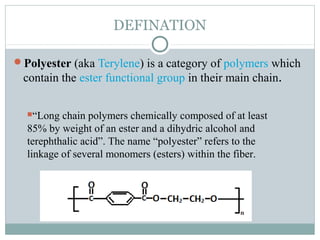
Polyester (aka Terylene) is a category of polymers which
contain the ester functional group in their main chain.
“Long chain polymers chemically composed of at least
85% by weight of an ester and a dihydric alcohol and
terephthalic acid”. The name “polyester” refers to the
linkage of several monomers (esters) within the fiber.
HISTORY
 In 1926, United States-based E.I. du Pont de Nemours and Co. began research
into very large molecules and synthetic fibers
 W.H. Carothers, centered on what became nylon, the first synthetic fiber.
 1939-41, British research chemists took interest in the du Pont studies and
conducted their own research in the laboratories of Calico Printers
Association, Ltd. This work resulted in the creation of the polyester fiber
known in England as Terylene.
 In 1946, du Pont purchased the right to produce this polyester fiber in the
United States.
 The company conducted some further developmental work, and in 1951,
began to market the fiber under the name Dacron
FORMS OF POLYESTER
1. Filament
2. Staple
3. Tow
4. Fiberfill
Uses Of Different Form In Different Places
1. In the filament form, each individual strand of polyester fiber
is continuous in length, producing smooth-surfaced fabrics
2. In staple form, filaments are cut to short, predetermined
lengths. In this form polyester is easier to blend with other
fibers
3. Tow is a form in which continuous filaments are drawn loosely
together
4. Fiberfill is the voluminous form used in the manufacture of
quilts, pillows, and outerwear
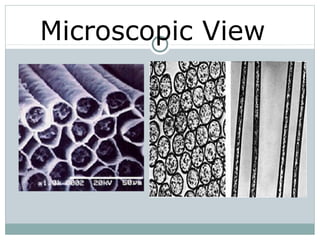
Microscopic View
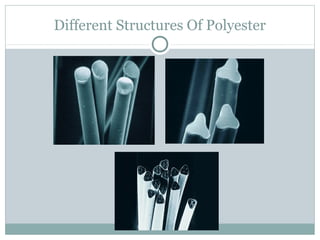
Different Structures Of Polyester
STRUCTURE AND APPERANCE
COLOURLESS AND TRANSPARENT
SMOOTH AND LUSTURUOS
SHAPE AS WE REQIURE
SHINY GLASSROD LIKE
Polyester Fiber Characteristics
 Strong
 Resistant to stretching and shrinking
 Resistant to most chemicals
 Quick drying
 Crisp and resilient when wet or dry
 Wrinkle resistant
 Mildew resistant
 Abrasion resistant
 Retains heat-set pleats and crease
 Easily washed
DISTINGUISHING FORM OTHERS
DISTINGUISHING POLYESTERS FROM OTHER FIBERS:
Polyester is soluble in hot meta cresol; however ,unlike acetate it is not soluble in acetone,
and unlike nylon it is not soluble in concentrated formic acid.
Polyester Blends
 Polyester and Cotton
1. Resist wrinkles
2. Resist stains
3. Retain shape
Polyester Blends
 Polyester and Wool
1. Wrinkle resistance
2. Shape retention
3. Increase durability
Polyester Blends
 Polyester and Rayon
1. More durable
2. Shape retention
3. More resilience
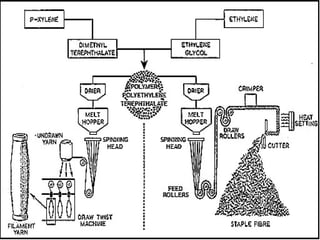
Manufacturing Filament Yarn
Polymerization
Drying
Melt spinning
Drawing the fiber
Winding
Polymerization
 To form polyester, dimethyl terephthalate is first reacted with ethylene glycol in the
presence of a catalyst at a temperature of 302-410°F (150-210°C).
 The resulting chemical, a monomer (single, non-repeating molecule) alcohol, is
combined with terephthalic acid and raised to a temperature of 472°F (280°C). Newly-
formed polyester, which is clear and molten, is extruded through a slot to form long
ribbons.
Drying
 PET polyester fabrics are readily dried at 120˚C. and are normally handled on pin or
clip sentres. Care must be taken to ensure that the fabric is not stentered under heavy
tension. If it is necessary to remove scouring creases, the damp fabric should be
stentered out, without overfeed, to a width which exceeds the scoured width by 7-14
mm per m (¼-½ in. per yd.), and then drier at 140-150˚C. Relaxed drying methods are
preferred for caustic soda softened fabrics and some yarn dyed fabrics.
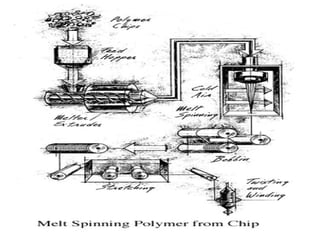
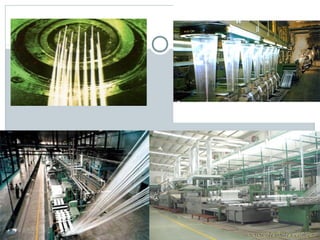
Melt spinning
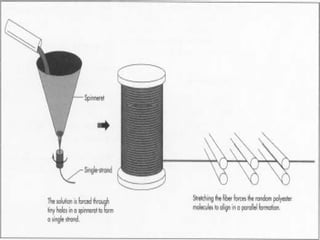
Polymer chips are melted at 500-518°F (260-270°C) to form a
syrup-like solution. The solution is put in a metal container called
a spinneret and forced through its tiny holes, which are usually
round, but may be pentagonal or any other shape to produce
special fibers. The number of holes in the spinneret determines
the size of the yarn, as the emerging fibers are brought together to
form a single strand.
At the spinning stage, other chemicals may be added to the
solution to make the resulting material flame retardant, antistatic,
or easier to dye.
Drawing the fiber
 When polyester emerges from the spinneret, it is soft and easily
elongated up to five times its original length. This increases the strength,
tenacity, and resilience of the fiber. This time, when the filaments dry,
the fibers become solid and strong instead of brittle.
 Drawn fibers may vary greatly in diameter and length, Also, as the fibers
are drawn, they may be textured or twisted to create softer or duller
fabrics.
Winding
 After the polyester yarn is drawn, it is wound on large bobbins or flat-
wound packages, ready to be woven into material.
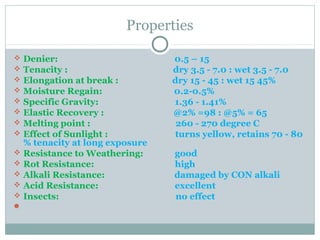
Properties
 Denier: 0.5 – 15
 Tenacity : dry 3.5 - 7.0 : wet 3.5 - 7.0
 Elongation at break : dry 15 - 45 : wet 15 45%
 Moisture Regain: 0.2-0.5%
 Specific Gravity: 1.36 - 1.41%
 Elastic Recovery : @2% =98 : @5% = 65
 Melting point : 260 - 270 degree C
 Effect of Sunlight : turns yellow, retains 70 - 80
% tenacity at long exposure
 Resistance to Weathering: good
 Rot Resistance: high
 Alkali Resistance: damaged by CON alkali
 Acid Resistance: excellent
 Insects: no effect

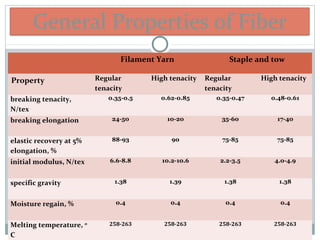
General Properties of Fiber
Filament Yarn Staple and tow
Property Regular
tenacity
High tenacity Regular
tenacity
High tenacity
breaking tenacity,
N/tex
0.35-0.5 0.62-0.85 0.35-0.47 0.48-0.61
breaking elongation 24-50 10-20 35-60 17-40
elastic recovery at 5%
elongation, %
88-93 90 75-85 75-85
initial modulus, N/tex 6.6-8.8 10.2-10.6 2.2-3.5 4.0-4.9
specific gravity 1.38 1.39 1.38 1.38
Moisture regain, % 0.4 0.4 0.4 0.4
Melting temperature, o
C
258-263 258-263 258-263 258-263
Chemistry of Polyester fiber
COOHHOOC + CH3OH COOCH3CH3OOC
COOCH3CH3OOC + HOCH2CH2OH
COOCH2CH2OHHOCH2CH2OOC CH3OH+
Terephthalic Acid Dimethyl Terephthalate
Bis(2-Hydroxyethyl) Terephthlate
Polyester
Ethylene Glycol
C
O
COCH2CH2O
O
C
O
OCH2CH2OC
O
Polymerization
n
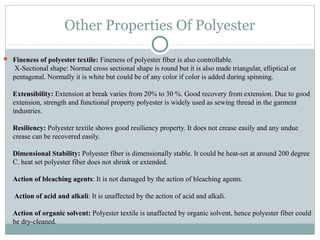
Other Properties Of Polyester
 Fineness of polyester textile: Fineness of polyester fiber is also controllable.
X-Sectional shape: Normal cross sectional shape is round but it is also made triangular, elliptical or
pentagonal. Normally it is white but could be of any color if color is added during spinning.
Extensibility: Extension at break varies from 20% to 30 %. Good recovery from extension. Due to good
extension, strength and functional property polyester is widely used as sewing thread in the garment
industries.
Resiliency: Polyester textile shows good resiliency property. It does not crease easily and any undue
crease can be recovered easily.
Dimensional Stability: Polyester fiber is dimensionally stable. It could be heat-set at around 200 degree
C. heat set polyester fiber does not shrink or extended.
Action of bleaching agents: It is not damaged by the action of bleaching agents.
Action of acid and alkali: It is unaffected by the action of acid and alkali.
Action of organic solvent: Polyester textile is unaffected by organic solvent, hence polyester fiber could
be dry-cleaned.
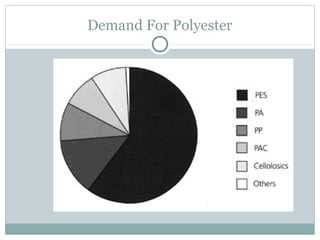
Demand For Polyester
DYEING
Polyester fibres are hydrophobic, and dyeing of
useful depth are obtained by using those classes of
dyestuffs which are substantially insoluble in
water. These include the disperse dyestuffs, azoic
dyestuffs (applied by a modified technique), and a
limited number of vat dyes.
PRINTING
 Fabrics woven from 100% PET polyester fibre yarn are
usually printed with disperse dyestuffs, although a limited
number of vat dyestuff may be used. The disperse dye
provide a wide range of bright and deep shades, but the
choice of individual dyestuffs is governed not only by the
projected end-use, but also by the method to be used in
fixing the color on to the fibre.
FUTURE
 Biodegradable and biocompatible poly(3-hydroxybutyrate-co-3-
hydroxyvalerate) (PHBV), a copolymer of microbial polyester, was
fabricated as a Nano fibrous mat by electro spinning
 The researchers have developed a process in which polyester is
dramatically strengthened with a material known as a liquid
crystalline polymer. The liquid crystalline polymer used in the
research is called Vectra , a plastic material similar to Kevlar that is
five times stronger than steel. Polyester is used because its chemical
structure is ideal for making bonds with the liquid crystalline
polymer
Some Major Polyester Fiber Uses
Apparel: Every form of clothing
Home Furnishings: Carpets, curtains, draperies,
sheets and pillow cases, wall coverings, and upholstery
Other Uses: hoses, power belting, ropes and nets,
thread, tire cord, auto upholstery, sails, floppy disk
liners, and fiberfill for various products including pillows
and furniture
Care of your polyester garment:
1. Machine-wash your fabric in cold water.
2. Wash with light colors.
3. Use a gentle cycle while washing.
4. Tumble dry with the setting low.
5. Do not bleach.
6. If needed, iron with a cool iron.

Polyester

  • 1.
  • 2.
    DEFINATION Polyester (aka Terylene)is a category of polymers which contain the ester functional group in their main chain. “Long chain polymers chemically composed of at least 85% by weight of an ester and a dihydric alcohol and terephthalic acid”. The name “polyester” refers to the linkage of several monomers (esters) within the fiber.
  • 3.
    HISTORY  In 1926,United States-based E.I. du Pont de Nemours and Co. began research into very large molecules and synthetic fibers  W.H. Carothers, centered on what became nylon, the first synthetic fiber.  1939-41, British research chemists took interest in the du Pont studies and conducted their own research in the laboratories of Calico Printers Association, Ltd. This work resulted in the creation of the polyester fiber known in England as Terylene.  In 1946, du Pont purchased the right to produce this polyester fiber in the United States.  The company conducted some further developmental work, and in 1951, began to market the fiber under the name Dacron
  • 4.
    FORMS OF POLYESTER 1.Filament 2. Staple 3. Tow 4. Fiberfill
  • 5.
    Uses Of DifferentForm In Different Places 1. In the filament form, each individual strand of polyester fiber is continuous in length, producing smooth-surfaced fabrics 2. In staple form, filaments are cut to short, predetermined lengths. In this form polyester is easier to blend with other fibers 3. Tow is a form in which continuous filaments are drawn loosely together 4. Fiberfill is the voluminous form used in the manufacture of quilts, pillows, and outerwear
  • 6.
  • 7.
  • 8.
    STRUCTURE AND APPERANCE COLOURLESSAND TRANSPARENT SMOOTH AND LUSTURUOS SHAPE AS WE REQIURE SHINY GLASSROD LIKE
  • 9.
    Polyester Fiber Characteristics Strong  Resistant to stretching and shrinking  Resistant to most chemicals  Quick drying  Crisp and resilient when wet or dry  Wrinkle resistant  Mildew resistant  Abrasion resistant  Retains heat-set pleats and crease  Easily washed
  • 10.
    DISTINGUISHING FORM OTHERS DISTINGUISHINGPOLYESTERS FROM OTHER FIBERS: Polyester is soluble in hot meta cresol; however ,unlike acetate it is not soluble in acetone, and unlike nylon it is not soluble in concentrated formic acid.
  • 11.
    Polyester Blends  Polyesterand Cotton 1. Resist wrinkles 2. Resist stains 3. Retain shape
  • 12.
    Polyester Blends  Polyesterand Wool 1. Wrinkle resistance 2. Shape retention 3. Increase durability
  • 13.
    Polyester Blends  Polyesterand Rayon 1. More durable 2. Shape retention 3. More resilience
  • 14.
  • 15.
    Polymerization  To formpolyester, dimethyl terephthalate is first reacted with ethylene glycol in the presence of a catalyst at a temperature of 302-410°F (150-210°C).  The resulting chemical, a monomer (single, non-repeating molecule) alcohol, is combined with terephthalic acid and raised to a temperature of 472°F (280°C). Newly- formed polyester, which is clear and molten, is extruded through a slot to form long ribbons. Drying  PET polyester fabrics are readily dried at 120˚C. and are normally handled on pin or clip sentres. Care must be taken to ensure that the fabric is not stentered under heavy tension. If it is necessary to remove scouring creases, the damp fabric should be stentered out, without overfeed, to a width which exceeds the scoured width by 7-14 mm per m (¼-½ in. per yd.), and then drier at 140-150˚C. Relaxed drying methods are preferred for caustic soda softened fabrics and some yarn dyed fabrics.
  • 16.
    Melt spinning Polymer chipsare melted at 500-518°F (260-270°C) to form a syrup-like solution. The solution is put in a metal container called a spinneret and forced through its tiny holes, which are usually round, but may be pentagonal or any other shape to produce special fibers. The number of holes in the spinneret determines the size of the yarn, as the emerging fibers are brought together to form a single strand. At the spinning stage, other chemicals may be added to the solution to make the resulting material flame retardant, antistatic, or easier to dye.
  • 19.
    Drawing the fiber When polyester emerges from the spinneret, it is soft and easily elongated up to five times its original length. This increases the strength, tenacity, and resilience of the fiber. This time, when the filaments dry, the fibers become solid and strong instead of brittle.  Drawn fibers may vary greatly in diameter and length, Also, as the fibers are drawn, they may be textured or twisted to create softer or duller fabrics. Winding  After the polyester yarn is drawn, it is wound on large bobbins or flat- wound packages, ready to be woven into material.
  • 22.
    Properties  Denier: 0.5– 15  Tenacity : dry 3.5 - 7.0 : wet 3.5 - 7.0  Elongation at break : dry 15 - 45 : wet 15 45%  Moisture Regain: 0.2-0.5%  Specific Gravity: 1.36 - 1.41%  Elastic Recovery : @2% =98 : @5% = 65  Melting point : 260 - 270 degree C  Effect of Sunlight : turns yellow, retains 70 - 80 % tenacity at long exposure  Resistance to Weathering: good  Rot Resistance: high  Alkali Resistance: damaged by CON alkali  Acid Resistance: excellent  Insects: no effect 
  • 23.
    General Properties ofFiber Filament Yarn Staple and tow Property Regular tenacity High tenacity Regular tenacity High tenacity breaking tenacity, N/tex 0.35-0.5 0.62-0.85 0.35-0.47 0.48-0.61 breaking elongation 24-50 10-20 35-60 17-40 elastic recovery at 5% elongation, % 88-93 90 75-85 75-85 initial modulus, N/tex 6.6-8.8 10.2-10.6 2.2-3.5 4.0-4.9 specific gravity 1.38 1.39 1.38 1.38 Moisture regain, % 0.4 0.4 0.4 0.4 Melting temperature, o C 258-263 258-263 258-263 258-263
  • 24.
    Chemistry of Polyesterfiber COOHHOOC + CH3OH COOCH3CH3OOC COOCH3CH3OOC + HOCH2CH2OH COOCH2CH2OHHOCH2CH2OOC CH3OH+ Terephthalic Acid Dimethyl Terephthalate Bis(2-Hydroxyethyl) Terephthlate Polyester Ethylene Glycol C O COCH2CH2O O C O OCH2CH2OC O Polymerization n
  • 25.
    Other Properties OfPolyester  Fineness of polyester textile: Fineness of polyester fiber is also controllable. X-Sectional shape: Normal cross sectional shape is round but it is also made triangular, elliptical or pentagonal. Normally it is white but could be of any color if color is added during spinning. Extensibility: Extension at break varies from 20% to 30 %. Good recovery from extension. Due to good extension, strength and functional property polyester is widely used as sewing thread in the garment industries. Resiliency: Polyester textile shows good resiliency property. It does not crease easily and any undue crease can be recovered easily. Dimensional Stability: Polyester fiber is dimensionally stable. It could be heat-set at around 200 degree C. heat set polyester fiber does not shrink or extended. Action of bleaching agents: It is not damaged by the action of bleaching agents. Action of acid and alkali: It is unaffected by the action of acid and alkali. Action of organic solvent: Polyester textile is unaffected by organic solvent, hence polyester fiber could be dry-cleaned.
  • 26.
  • 27.
    DYEING Polyester fibres arehydrophobic, and dyeing of useful depth are obtained by using those classes of dyestuffs which are substantially insoluble in water. These include the disperse dyestuffs, azoic dyestuffs (applied by a modified technique), and a limited number of vat dyes.
  • 28.
    PRINTING  Fabrics wovenfrom 100% PET polyester fibre yarn are usually printed with disperse dyestuffs, although a limited number of vat dyestuff may be used. The disperse dye provide a wide range of bright and deep shades, but the choice of individual dyestuffs is governed not only by the projected end-use, but also by the method to be used in fixing the color on to the fibre.
  • 29.
    FUTURE  Biodegradable andbiocompatible poly(3-hydroxybutyrate-co-3- hydroxyvalerate) (PHBV), a copolymer of microbial polyester, was fabricated as a Nano fibrous mat by electro spinning  The researchers have developed a process in which polyester is dramatically strengthened with a material known as a liquid crystalline polymer. The liquid crystalline polymer used in the research is called Vectra , a plastic material similar to Kevlar that is five times stronger than steel. Polyester is used because its chemical structure is ideal for making bonds with the liquid crystalline polymer
  • 30.
    Some Major PolyesterFiber Uses Apparel: Every form of clothing Home Furnishings: Carpets, curtains, draperies, sheets and pillow cases, wall coverings, and upholstery Other Uses: hoses, power belting, ropes and nets, thread, tire cord, auto upholstery, sails, floppy disk liners, and fiberfill for various products including pillows and furniture
  • 31.
    Care of yourpolyester garment: 1. Machine-wash your fabric in cold water. 2. Wash with light colors. 3. Use a gentle cycle while washing. 4. Tumble dry with the setting low. 5. Do not bleach. 6. If needed, iron with a cool iron.