Viscose Rayon
Rayons
According to FTC (Federal trade
commission):
A manufactured fiber composed of
regenerated cellulose in which
substituent have replaced not more
than 15 % of hydrogen of hydroxyl
groups
Viscose Rayon
 Rayon is the oldest commercial manmade
fiber.
 The process of making viscose was
discovered by C.F.Cross and E.J.Bevan in
1891
 It is now manufactured abundantly as its
raw material is cellulose and is available in
large quantities in timber and vegetable
matter
Viscose Rayon
 The viscose method is relatively
inexpensive and of particular significance in
the production of nonwoven fabrics.
 It is not synthetic.
 Its properties are more similar to cotton and
flax rather than polyester and nylon.
 Viscose Rayon has silk like aesthetic and
good feel.
 The name viscose was derived from the
word viscous, which mean liquid state of
spinning solution.
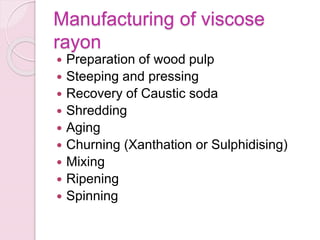
Manufacturing of viscose
rayon
 Preparation of wood pulp
 Steeping and pressing
 Recovery of Caustic soda
 Shredding
 Aging
 Churning (Xanthation or Sulphidising)
 Mixing
 Ripening
 Spinning
Preparation of Wooden pulp
 Soft wood trees are used
 Wood is chipped into pieces about
0.9’’ X 0.5’’ X 0.25’’
 Chips are treated with Calcium bi sulphite
Ca(HSO3)2 for 8 -12 hours
 Chips are cooked with steam under
pressure for 14 hours to convert into pulp
form
 Pulp is washed with water to remove
Calcium bi sulphite
 Pulp is bleached with sodium hypo chlorite
(NaOCl) solution
 Pulp is converted into paper board
Steeping and
pressing
 The cellulose pulp sheets are steeped
in 17.5 % NaOH solution for 1-4 hours
 It is then pressed to remove excess
solution
 This process is called “ steeping”
 Cellulose is swollen and liquid turn
brown
 Excess of alkali is pressed out
 This process is known as “ pressing”
 Moist soda cellulose mass is obtained
Recovery of caustic soda
 Moist soda cellulose is allowed to
diffuse through parchment
membranes to obtain pure caustic
soda
 Recovery of caustic soda is important
for economic purpose
 Used Caustic soda is concentrated
and mixed with fresh caustic soda to
Empirical formulae of cellulose =
(C6H10O5)n
Steeping:
(C6H10O5)n + NaOH = [C6H9O4-ONa]n
(Soda cellulose)
Xanthation:
[C6H9O4-ONa]n + nCS2 → [C6H9O4-
OCS2Na]n
Shredding
 The shredding machine consists of
drum inside which high speed
revolving blades with serrated edges
are installed
 Moist soda sheets are shredded and
converted into fine crumbs
Shredding Machine
Ageing
 Carried out in stirring vessel
 Very important for properties of fabric
 Polymeric chains of cellulose are
degraded in the presence of
atmospheric oxygen at temp 20-25
degree centigrade
 Completed in 1-2 days
Churning
 Stainless steel air-tight rotating drum
 It can rotate at about 2 rpm
 Soda cellulose crumbs contain about 30%
cellulose
 10% CS2 solution is added to soda cellulose
crumbs
 Soda cellulose and CS2 are churned
together to form deep orange gelatinous
mass of sodium cellulose xanthate
 Churning is completed after 3 hours
 After completion of churning, sodium
cellulose xanthate is discharged
Mixing and blending
 Dilute NaOH soln is added in sodium cellulose
xanthate and mixing is carried out for 4-5 hours
 A clear viscous liquid is obtained which is
known as viscose
 Viscose contains 6.5 % NaOH and 7.5 % of
cellulose
 Different viscose solutions obtained from
different mixers are blended together along with
TiO2 to balance inequalities and to obtain
 Uniform homogeneous mixture produces
better quality of Rayon
 It is filtered to remove any un dissolved
particles
 Air bubbles are removed
Ripening
 It is very important part of manufacturing
process
 The uniform homogenous viscous solution
is stored in stainless steel vessel at 10-18
◦C for 4-5 days for ripening
 During ripening, first of all the viscosity of
solution falls down and then again reaches
to its original viscosity
 When original viscosity reaches, this is
the proper time to spin the solution
and solution is immediately spun
Spinning
 A ripened viscose solution is forced to a
centrifugal pump by compressed air, which
delivers it to filtering media and then glass
tubing which carries a spinneret jet
 The centrifugal pump delivers the viscose
solution constantly and regularly
 The spinneret is submerged in acid bath
 Viscose solution comes out into acid bath
after passing through “spinneret” solidifies
into filaments owing to regeneration of
cellulose
 Temp. of acid bath = 40~55 ⁰C
Longitudinal view
Cross sectional view
Properties of viscose rayon:
Tensile strength:
The tensile strength of normal viscose
rayon is 30000 – 46000 lbs per square
inch.
Elongation:
Normally it will elongate 17-25 % of its
original length before breaking.
Elastic properties:
At 2% extension it has elastic recovery of
60%
Specific gravity:
1.50 to 1.52
Effect of moisture:
It has moisture regain of 13%.
Effect of heat:
It begins to lose strength at 150
degree centigrade and decomposes at
205 degree centigrade.
Effect of sunlight:
It can withstand exposure to sunlight
without discoloration.
Chemical properties:
It can be attacked by oxidizing agents
like hydrogen peroxide.
Effect of Acids:
Can be attacked by hot dilute acids
and cold concentrated acids.
Effect of alkali:
It has high resistance to dilute alkali
and can be attacked by strong alkalis.
Resistance to insects:
Resistance to insects is good but can
be attacked by silver fish.
Microorganisms:
Resistance to mildews is much better
than cotton.
Major uses of Rayon:
 Apparel: Accessories, dresses,
jackets, sport shirts, sportswear,
suits, ties, work clothes etc.
 Home Furnishings: Bedspreads,
blankets, curtains, sheets,
tablecloths.

viscose rayon

  • 1.
  • 2.
    Rayons According to FTC(Federal trade commission): A manufactured fiber composed of regenerated cellulose in which substituent have replaced not more than 15 % of hydrogen of hydroxyl groups
  • 3.
    Viscose Rayon  Rayonis the oldest commercial manmade fiber.  The process of making viscose was discovered by C.F.Cross and E.J.Bevan in 1891  It is now manufactured abundantly as its raw material is cellulose and is available in large quantities in timber and vegetable matter
  • 4.
    Viscose Rayon  Theviscose method is relatively inexpensive and of particular significance in the production of nonwoven fabrics.  It is not synthetic.  Its properties are more similar to cotton and flax rather than polyester and nylon.  Viscose Rayon has silk like aesthetic and good feel.  The name viscose was derived from the word viscous, which mean liquid state of spinning solution.
  • 5.
    Manufacturing of viscose rayon Preparation of wood pulp  Steeping and pressing  Recovery of Caustic soda  Shredding  Aging  Churning (Xanthation or Sulphidising)  Mixing  Ripening  Spinning
  • 7.
    Preparation of Woodenpulp  Soft wood trees are used  Wood is chipped into pieces about 0.9’’ X 0.5’’ X 0.25’’  Chips are treated with Calcium bi sulphite Ca(HSO3)2 for 8 -12 hours  Chips are cooked with steam under pressure for 14 hours to convert into pulp form  Pulp is washed with water to remove Calcium bi sulphite  Pulp is bleached with sodium hypo chlorite (NaOCl) solution  Pulp is converted into paper board
  • 9.
    Steeping and pressing  Thecellulose pulp sheets are steeped in 17.5 % NaOH solution for 1-4 hours  It is then pressed to remove excess solution  This process is called “ steeping”  Cellulose is swollen and liquid turn brown  Excess of alkali is pressed out  This process is known as “ pressing”  Moist soda cellulose mass is obtained
  • 10.
    Recovery of causticsoda  Moist soda cellulose is allowed to diffuse through parchment membranes to obtain pure caustic soda  Recovery of caustic soda is important for economic purpose  Used Caustic soda is concentrated and mixed with fresh caustic soda to
  • 11.
    Empirical formulae ofcellulose = (C6H10O5)n Steeping: (C6H10O5)n + NaOH = [C6H9O4-ONa]n (Soda cellulose) Xanthation: [C6H9O4-ONa]n + nCS2 → [C6H9O4- OCS2Na]n
  • 12.
    Shredding  The shreddingmachine consists of drum inside which high speed revolving blades with serrated edges are installed  Moist soda sheets are shredded and converted into fine crumbs
  • 13.
  • 14.
    Ageing  Carried outin stirring vessel  Very important for properties of fabric  Polymeric chains of cellulose are degraded in the presence of atmospheric oxygen at temp 20-25 degree centigrade  Completed in 1-2 days
  • 15.
    Churning  Stainless steelair-tight rotating drum  It can rotate at about 2 rpm  Soda cellulose crumbs contain about 30% cellulose  10% CS2 solution is added to soda cellulose crumbs  Soda cellulose and CS2 are churned together to form deep orange gelatinous mass of sodium cellulose xanthate  Churning is completed after 3 hours  After completion of churning, sodium cellulose xanthate is discharged
  • 16.
    Mixing and blending Dilute NaOH soln is added in sodium cellulose xanthate and mixing is carried out for 4-5 hours  A clear viscous liquid is obtained which is known as viscose  Viscose contains 6.5 % NaOH and 7.5 % of cellulose  Different viscose solutions obtained from different mixers are blended together along with TiO2 to balance inequalities and to obtain
  • 17.
     Uniform homogeneousmixture produces better quality of Rayon  It is filtered to remove any un dissolved particles  Air bubbles are removed
  • 18.
    Ripening  It isvery important part of manufacturing process  The uniform homogenous viscous solution is stored in stainless steel vessel at 10-18 ◦C for 4-5 days for ripening  During ripening, first of all the viscosity of solution falls down and then again reaches to its original viscosity
  • 19.
     When originalviscosity reaches, this is the proper time to spin the solution and solution is immediately spun
  • 20.
    Spinning  A ripenedviscose solution is forced to a centrifugal pump by compressed air, which delivers it to filtering media and then glass tubing which carries a spinneret jet  The centrifugal pump delivers the viscose solution constantly and regularly  The spinneret is submerged in acid bath  Viscose solution comes out into acid bath after passing through “spinneret” solidifies into filaments owing to regeneration of cellulose  Temp. of acid bath = 40~55 ⁰C
  • 21.
  • 22.
  • 24.
    Properties of viscoserayon: Tensile strength: The tensile strength of normal viscose rayon is 30000 – 46000 lbs per square inch. Elongation: Normally it will elongate 17-25 % of its original length before breaking.
  • 25.
    Elastic properties: At 2%extension it has elastic recovery of 60% Specific gravity: 1.50 to 1.52 Effect of moisture: It has moisture regain of 13%.
  • 26.
    Effect of heat: Itbegins to lose strength at 150 degree centigrade and decomposes at 205 degree centigrade. Effect of sunlight: It can withstand exposure to sunlight without discoloration.
  • 27.
    Chemical properties: It canbe attacked by oxidizing agents like hydrogen peroxide. Effect of Acids: Can be attacked by hot dilute acids and cold concentrated acids. Effect of alkali: It has high resistance to dilute alkali and can be attacked by strong alkalis.
  • 28.
    Resistance to insects: Resistanceto insects is good but can be attacked by silver fish. Microorganisms: Resistance to mildews is much better than cotton.
  • 30.
    Major uses ofRayon:  Apparel: Accessories, dresses, jackets, sport shirts, sportswear, suits, ties, work clothes etc.  Home Furnishings: Bedspreads, blankets, curtains, sheets, tablecloths.

Editor's Notes

  • #13 Serrated----- saw like
  • #15 Galvanized----- stirring For storage purpose------
  • #17 TiO2