REINFORCEMENTS:
Fibers- glass,
silica,
Kevlar,
carbon,
boron,
silicon carbide, and
Born carbide fibers
In materials science, reinforcement is a constituent of a composite
material which increases the composite's stiffness and tensile strength.
Following are the functions of the reinforcement in a composite:
It increases the mechanical properties of the composite.
It provides strength and stiffness to the composite in one direction as
reinforcement carries the load along the length of the fiber
• Reinforcement Material
• Nanotubes.
• Nanocomposite.
• Carbon Fiber.
• Composite Materials.
• Glass Fiber.
• Matrix Material.
• Natural Fiber.
• Resin.
Glass fiber
• Glass fiber is the most widely used
reinforcement material in pultrusion industry.
Glass fiber is used as a reinforcing agent for
many polymer products; the resulting
composite material, properly known as fiber-
reinforced polymer (FRP) or glass-reinforced
plastic (GRP), is called "Fiberglass" in popular
usage.
FIBER GLASS
Fiber reinforcement
• Crack propagation is prevented considerably, while rigidity is added
normally by the reinforcement. Thin fibers can have very high strength, and
they can increase substantially the overall properties of the composite
provided they are linked mechanically to the matrix.
• Fiber-reinforced composites have two types, and they are short fiber-
reinforced and continuous fiber-reinforced. Sheet moulding and
compression moulding operations usually use the long and short fibers.
These are available in the form of chips, flakes and random mate (which
also can be produced from a continuous fiber laid randomly till the desired
thickness of the laminate/ply is attained).
• A laminated or layered structure is usually constituted in continuous
reinforced materials. The continuous and woven fiber styles are usually
available in various forms, being pre-impregnated with the given matrix
(resin), dry, uni-directional tapes of different widths, plain weave, harness
satins, braided, and stitched.
• Reinforcement uses some of the common fibers such as carbon fibers,
cellulose (wood/paper fiber and straw), glass fibers and high strength
polymers, for example, aramid. For high-temperature applications, Silicon
carbide fibers are used
A chemical that can dissolve in
water, combine with acids to form
salts, and make acids less acidic.
Alkalis have a bitter taste and turn
certain dyes blue. Some alkalis can
help the body work the way it
should. An example of an alkali is
sodium hydroxide.
• In chemistry, an alkali') is a basic, ionic salt of an alkali metal or an alkaline earth metal. An
alkali can also be defined as a base that dissolves in water. A solution of a soluble base has
a pH greater than 7.0.
• a figure expressing the acidity or alkalinity of a solution on a logarithmic scale on which 7 is
neutral, lower values are more acid and higher values more alkaline. The pH is equal to
−log10 c, where c is the hydrogen ion concentration in moles per liter
silica
Kevlar
• Kevlar (para-aramid)is a strong, heat-resistant synthetic fiber, related to other aramids such
as Nomex and Technora. Developed by Stephanie Kwolek at DuPont in 1965, the high-strength material was
first used commercially in the early 1970s as a replacement for steel in racing tires. It is typically spun into
ropes or fabric sheets that can be used as such, or as an ingredient in composite material components.
• Kevlar has many applications, ranging from bicycle tires and racing sails to bulletproof vests, all due to its
high tensile strength-to-weight ratio; by this measure it is five times stronger than steel.[2] It is also used to
make modern marching drumheads that withstand high impact; and for mooring lines and other underwater
applications.
• Kevlar, a lightweight and strong fiber, was invented by chemist Stephanie Kwolek at DuPont in anticipation of a
gasoline shortage. It is synthesized from monomers 1,4-phenylene-diamine and terephthaloyl chloride through
a condensation reaction. Kevlar is available in various grades for diverse applications, including industrial use,
cables, ropes, and ballistic protection. The fiber has a high tensile strength and a molecular structure that
includes inter-chain bonds and aromatic stacking interactions. However, Kevlar is vulnerable to UV degradation
and is not commonly used outdoors without protection. Its thermal properties allow it to maintain strength and
resilience in extreme temperatures, although prolonged exposure to high temperatures can reduce its strength.
• Kevlar is widely used in various applications due to its strength, low thermal conductivity, and high-
performance characteristics. In science, it is employed for suspension purposes in cryogenics and as a thermal
standoff. It is a crucial component in personal armor, including combat helmets, ballistic face masks, and vests.
Kevlar is also used in protective clothing, gloves, and sports equipment such as racing canoes, bicycle tires, and
tennis racquets.
• Additionally, Kevlar is utilized in the manufacturing of loudspeaker cones, musical instrument parts, and fiber
optic cables. In motor vehicles, it serves as a structural component and replacement for asbestos in brake pads.
Kevlar is also found in fire-dancing wicks, non-stick frying pans, ropes, cables, and cell phone back plates. The
material is often used to reinforce composite materials, such as in aircraft construction, high-performance
composites, and sports equipment.
• Kevlar is synthesized in solution from the monomers 1,4-phenylene-
diamine (para-phenylenediamine) and terephthaloyl chloride in
a condensation reaction yielding hydrochloric acid as a byproduct.
The result has liquid-crystalline behavior, and mechanical drawing
orients the polymer chains in the fiber's
direction. Hexamethylphosphoramide (HMPA) was the solvent
initially used for the polymerization, but for safety reasons, DuPont
replaced it by a solution of N-methyl-pyrrolidone and calcium
chloride. As this process had been patented by Akzo (see above) in
the production of Twaron, a patent war ensued.[9]
• Kevlar production is expensive because of the difficulties arising
from using concentrated sulfuric acid, needed to keep the water-
insoluble polymer in solution during its synthesis and spinning
Several grades of Kevlar are available:
• Kevlar K-29 – in industrial applications, such as
cables, asbestos replacement, tires, and brake linings.
• Kevlar K49 – high modulus used in cable and rope products.
• Kevlar K100 – colored version of Kevlar
• Kevlar K119 – higher-elongation, flexible and more fatigue resistant
• Kevlar K129 – higher tenacity for ballistic applications
• Kevlar K149 – highest tenacity for ballistic, armor, and aerospace
applications
• Kevlar AP – 15% higher tensile strength than K-29
• Kevlar XP – lighter weight resin and KM2 plus fiber combination
• Kevlar KM2 – enhanced ballistic resistance for armor applications
The ultraviolet component of sunlight degrades and decomposes Kevlar, a
problem known as UV degradation, and so it is rarely used outdoors
without protection against sunlight.
Carbon
• Carbon (from Latin carbo 'coal') is a chemical element with the
symbol C and atomic number 6. It is nonmetallic and
tetravalent—its atom making four electrons available to form
covalent chemical bonds. It belongs to group 14 of the periodic
table. Carbon makes up about 0.025 percent of Earth's crust
• carbon composite, or just carbon, are extremely strong and light fiber-
reinforced plastics that contain carbon fibers. CFRPs can be expensive to
produce, but are commonly used wherever high strength-to-weight
ratio and stiffness (rigidity) are required, such as aerospace,
superstructures of ships, automotive, civil engineering, sports
equipment, and an increasing number of consumer and technical
applications
• The properties of the final CFRP product can be affected by the type of
additives introduced to the binding matrix (resin). The most common
additive is silica, but other additives such as rubber and carbon
nanotubes can be used.
• Carbon fiber is sometimes referred to as graphite-reinforced
polymer or graphite fiber-reinforced polymer (GFRP is less common, as it
clashes with glass-(fiber)-reinforced polymer)
• CFRP are composite materials. In this case the composite consists of two
parts: a matrix and a reinforcement. In CFRP the reinforcement is carbon
fiber, which provides its strength. The matrix is usually a thermosetting
plastic, such as polyester resin, to bind the reinforcements together.
Because CFRP consists of two distinct elements, the material properties
depend on these two elements
• Reinforcement gives CFRP its strength and rigidity, measured
by stress and elastic modulus respectively. Unlike isotropic materials like steel
and aluminum, CFRP has directional strength properties. The properties of
CFRP depend on the layouts of the carbon fiber and the proportion of the
carbon fibers relative to the polymer. The two different equations governing the
net elastic modulus of composite materials using the properties of the carbon
fibers and the polymer matrix can also be applied to carbon fiber reinforced
plastics.
• is valid for composite materials with the fibers oriented in the direction of the
applied load. �Ec� is the total composite modulus, �Vm �and ��Vf are
the volume fractions of the matrix and fiber respectively in the composite,
and Em�� and Ef �are the elastic moduli of the matrix and fibers
respectively. The other extreme case of the elastic modulus of the composite
with the fibers oriented transverse to the applied load can be found using the
following equation
• The primary element of CFRP is a carbon filament; this is produced from a
precursor polymer such as polyacrylonitrile (PAN), rayon, or petroleum pitch. For
synthetic polymers such as PAN or rayon, the precursor is first spun into filament
yarns, using chemical and mechanical processes to initially align the polymer chains
in a way to enhance the final physical properties of the completed carbon fiber.
Precursor compositions and mechanical processes used during spinning filament
yarns may vary among manufacturers. After drawing or spinning, the polymer
filament yarns are then heated to drive off non-carbon atoms (carbonization),
producing the final carbon fiber. The carbon fibers filament yarns may be further
treated to improve handling qualities, then wound on to bobbins. From these
fibers, a unidirectional sheet is created. These sheets are layered onto each other
in a quasi-isotropic layup,
Molding
• One method of producing CFRP parts is by layering sheets of carbon fiber cloth into
a mold in the shape of the final product. The alignment and weave of the cloth
fibers is chosen to optimize the strength and stiffness properties of the resulting
material. The mold is then filled with epoxy and is heated or air-cured. The
resulting part is very corrosion-resistant,
Vacuum bagging
• For simple pieces of which relatively few copies are needed (1–2 per
day), a vacuum bag can be used. A fiberglass, carbon fiber, or aluminum
mold is polished and waxed, and has a release agent applied before the
fabric and resin are applied, and the vacuum is pulled and set aside to
allow the piece to cure (harden). There are three ways to apply the
resin to the fabric in a vacuum mold
Compression molding
• A quicker method uses a compression mold, also commonly known as
carbon fiber forging. This is a two (male and female), or multi-piece
mold, usually made out of aluminum or steel and more recently 3d
printed plastic. The mold components are pressed together with the
fabric and resin loaded into the inner cavity that ultimately becomes
the desired component. The benefit is the speed of the entire process
Filament winding[
• For difficult or convoluted shapes, a filament winder can be used to
make CFRP parts by winding filaments around a mandrel or a core
Aerospace engineering
• The Airbus A350 XWB is built of 52% CFRP[14] including wing spars and fuselage components, overtaking
the Boeing 787 Dreamliner, for the aircraft with the highest weight ratio for CFRP, which is 50%. This was
one of the first commercial aircraft to have wing spars made from composites. The Airbus A380 was one
of the first commercial airliners to have a central wing-box made of CFRP; it is the first to have a
smoothly contoured wing cross-section instead of the wings being partitioned span-wise into sections.
This flowing, continuous cross section optimises aerodynamic efficiency. Moreover, the trailing edge,
along with the rear bulkhead, empennage, and un-pressurised fuselage are made of CFRP.
Automotive engineering
• The high cost of carbon fiber is mitigated by the material's unsurpassed strength-to-weight ratio, and
low weight is essential for high-performance automobile racing. Race-car manufacturers have also
developed methods to give carbon fiber pieces strength in a certain direction, making it strong in a load-
bearing direction, but weak in directions where little or no load would be placed on the member.
Conversely, manufacturers developed omnidirectional carbon fiber weaves that apply strength in all
directions. This type of carbon fiber assembly is most widely used in the "safety cell" monocoque chassis
assembly of high-performance race-cars. The first carbon fiber monocoque chassis was introduced
in Formula One by McLaren in the 1981 season
Civil engineering
• CFRP has become a notable material in structural engineering applications. Studied in an academic context as to its
potential benefits in construction, it has also proved itself cost-effective in a number of field applications strengthening
concrete, masonry, steel, cast iron, and timber structures. Its use in industry can be either for retrofitting to strengthen
an existing structure or as an alternative reinforcing (or pre-stressing) material instead of steel from the outset of a
project.
• Retrofitting has become the increasingly dominant use of the material in civil engineering, and applications include
increasing the load capacity of old structures (such as bridges) that were designed to tolerate far lower service loads
than they are experiencing today, seismic retrofitting, and repair of damaged structures. Retrofitting is popular in many
instances as the cost of replacing the deficient structure can greatly exceed the cost of strengthening using CFRP
Carbon-fiber microelectrodes
• Carbon fibers are used for fabrication of carbon-
fiber microelectrodes. In this application typically a single carbon
fiber with diameter of 5–7 μm is sealed in a glass capillary.[26] At the
tip the capillary is either sealed with epoxy and polished to make
carbon-fiber disk microelectrode or the fiber is cut to a length of 75–
150 μm to make carbon-fiber cylinder electrode. Carbon-fiber
microelectrodes are used either in amperometry or fast-scan cyclic
voltammetry for detection of biochemical signaling.
Sports goods
• CFRP is now widely used in sports equipment such as in squash,
tennis, and badminton racquets, sport kite spars, high-quality arrow
shafts, hockey sticks, fishing rods, surfboards, high end swim fins,
and rowing shells. Amputee athletes such as Jonnie Peacock use
carbon fiber blades for running. It is used as a shank plate in
some basketball sneakers to keep the foot stable, usually running the
length of the shoe just above the sole and left exposed in some
areas, usually in the arch
Applications of carbon fibers
• Musical instruments, including violin bows; guitar picks, necks (carbon fiber rods), and
pick-guards; drum shells; bagpipe chanters; piano actions; and entire musical
instruments such as Luis and Clark's carbon fiber cellos, violas, and violins;
and Blackbird Guitars' acoustic guitars and ukuleles; also audio components such as
turntables and loudspeakers.
• Firearms use it to replace certain metal, wood, and fiberglass components but many of
the internal parts are still limited to metal alloys as current reinforced plastics are
unsuitable.
• High-performance drone bodies and other radio-controlled vehicle and aircraft
components such as helicopter rotor blades.
• Lightweight poles such as: tripod legs, tent poles, fishing rods, billiards cues, walking
sticks, and high-reach poles such as for window cleaning.
• Dentistry, carbon fiber posts are used in restoring root canal treated teeth.
• Railed train bogies for passenger service. This reduces the weight by up to 50%
compared to metal bogies, which contributes to energy savings.[32]
• Laptop shells and other high performance cases.
• Carbon woven fabrics.
• Archery: carbon fiber arrows and bolts, stock (for crossbows) and riser (for vertical
bows), and rail.
• As a filament for the 3D fused deposition modeling printing process, carbon fiber-
reinforced plastic (polyamide-carbon filament) is used for the production of sturdy but
lightweight tools and parts due to its high strength and tear length.
• District heating pipe rehabilitation, using CIPP method.
Boron fiber
• Boron fiber or boron filament is an amorphous product which represents the
major industrial use of elemental boron. Boron fiber manifests a combination
of high strength and high elastic modulus.
• A common use of boron fibers is in the construction of high tensile strength
tapes. Boron fiber use results in high-strength, lightweight materials that are
used chiefly for advanced aerospace structures as a component of composite
materials, as well as limited production consumer and sporting goods such
as golf clubs and fishing rods.
• One of the uses of boron fiber composites was the horizontal tail surfaces of
the F-14 Tomcat fighter. This was done because carbon fiber composites were
not then developed to the point they could be used, as they were in many
subsequent aircraft designs.
• In the production process, elemental boron is deposited on an
even tungsten wire substrate which produces diameters of 4.0 mil (102 micron)
and 5.6 mil (142 micron). It consists of a fully borided tungsten core
with amorphous boron.
• Boron fibers and sub-millimeter sized crystalline boron springs are produced
by laser-assisted chemical vapor deposition. Translation of the focused laser
beam allows to produce even complex helical structures. Such structures show
good mechanical properties (elastic modulus 450 GPa, fracture strain 3.7%,
fracture stress 17 GPa) and can be applied as reinforcement of ceramics or
in micromechanical systems
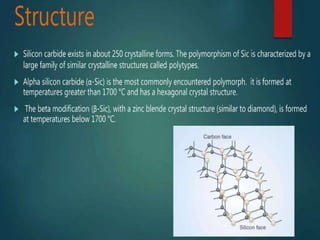
Silicon carbide
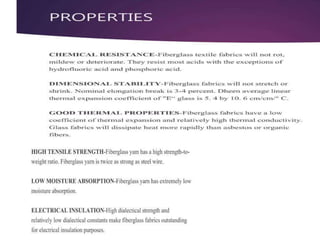
Properties

REINFORCEMENTS.pptx

  • 1.
  • 2.
    In materials science,reinforcement is a constituent of a composite material which increases the composite's stiffness and tensile strength. Following are the functions of the reinforcement in a composite: It increases the mechanical properties of the composite. It provides strength and stiffness to the composite in one direction as reinforcement carries the load along the length of the fiber • Reinforcement Material • Nanotubes. • Nanocomposite. • Carbon Fiber. • Composite Materials. • Glass Fiber. • Matrix Material. • Natural Fiber. • Resin.
  • 3.
    Glass fiber • Glassfiber is the most widely used reinforcement material in pultrusion industry. Glass fiber is used as a reinforcing agent for many polymer products; the resulting composite material, properly known as fiber- reinforced polymer (FRP) or glass-reinforced plastic (GRP), is called "Fiberglass" in popular usage.
  • 4.
  • 5.
    Fiber reinforcement • Crackpropagation is prevented considerably, while rigidity is added normally by the reinforcement. Thin fibers can have very high strength, and they can increase substantially the overall properties of the composite provided they are linked mechanically to the matrix. • Fiber-reinforced composites have two types, and they are short fiber- reinforced and continuous fiber-reinforced. Sheet moulding and compression moulding operations usually use the long and short fibers. These are available in the form of chips, flakes and random mate (which also can be produced from a continuous fiber laid randomly till the desired thickness of the laminate/ply is attained). • A laminated or layered structure is usually constituted in continuous reinforced materials. The continuous and woven fiber styles are usually available in various forms, being pre-impregnated with the given matrix (resin), dry, uni-directional tapes of different widths, plain weave, harness satins, braided, and stitched. • Reinforcement uses some of the common fibers such as carbon fibers, cellulose (wood/paper fiber and straw), glass fibers and high strength polymers, for example, aramid. For high-temperature applications, Silicon carbide fibers are used
  • 8.
    A chemical thatcan dissolve in water, combine with acids to form salts, and make acids less acidic. Alkalis have a bitter taste and turn certain dyes blue. Some alkalis can help the body work the way it should. An example of an alkali is sodium hydroxide.
  • 9.
    • In chemistry,an alkali') is a basic, ionic salt of an alkali metal or an alkaline earth metal. An alkali can also be defined as a base that dissolves in water. A solution of a soluble base has a pH greater than 7.0. • a figure expressing the acidity or alkalinity of a solution on a logarithmic scale on which 7 is neutral, lower values are more acid and higher values more alkaline. The pH is equal to −log10 c, where c is the hydrogen ion concentration in moles per liter
  • 14.
  • 15.
    Kevlar • Kevlar (para-aramid)isa strong, heat-resistant synthetic fiber, related to other aramids such as Nomex and Technora. Developed by Stephanie Kwolek at DuPont in 1965, the high-strength material was first used commercially in the early 1970s as a replacement for steel in racing tires. It is typically spun into ropes or fabric sheets that can be used as such, or as an ingredient in composite material components. • Kevlar has many applications, ranging from bicycle tires and racing sails to bulletproof vests, all due to its high tensile strength-to-weight ratio; by this measure it is five times stronger than steel.[2] It is also used to make modern marching drumheads that withstand high impact; and for mooring lines and other underwater applications. • Kevlar, a lightweight and strong fiber, was invented by chemist Stephanie Kwolek at DuPont in anticipation of a gasoline shortage. It is synthesized from monomers 1,4-phenylene-diamine and terephthaloyl chloride through a condensation reaction. Kevlar is available in various grades for diverse applications, including industrial use, cables, ropes, and ballistic protection. The fiber has a high tensile strength and a molecular structure that includes inter-chain bonds and aromatic stacking interactions. However, Kevlar is vulnerable to UV degradation and is not commonly used outdoors without protection. Its thermal properties allow it to maintain strength and resilience in extreme temperatures, although prolonged exposure to high temperatures can reduce its strength. • Kevlar is widely used in various applications due to its strength, low thermal conductivity, and high- performance characteristics. In science, it is employed for suspension purposes in cryogenics and as a thermal standoff. It is a crucial component in personal armor, including combat helmets, ballistic face masks, and vests. Kevlar is also used in protective clothing, gloves, and sports equipment such as racing canoes, bicycle tires, and tennis racquets. • Additionally, Kevlar is utilized in the manufacturing of loudspeaker cones, musical instrument parts, and fiber optic cables. In motor vehicles, it serves as a structural component and replacement for asbestos in brake pads. Kevlar is also found in fire-dancing wicks, non-stick frying pans, ropes, cables, and cell phone back plates. The material is often used to reinforce composite materials, such as in aircraft construction, high-performance composites, and sports equipment.
  • 16.
    • Kevlar issynthesized in solution from the monomers 1,4-phenylene- diamine (para-phenylenediamine) and terephthaloyl chloride in a condensation reaction yielding hydrochloric acid as a byproduct. The result has liquid-crystalline behavior, and mechanical drawing orients the polymer chains in the fiber's direction. Hexamethylphosphoramide (HMPA) was the solvent initially used for the polymerization, but for safety reasons, DuPont replaced it by a solution of N-methyl-pyrrolidone and calcium chloride. As this process had been patented by Akzo (see above) in the production of Twaron, a patent war ensued.[9] • Kevlar production is expensive because of the difficulties arising from using concentrated sulfuric acid, needed to keep the water- insoluble polymer in solution during its synthesis and spinning
  • 17.
    Several grades ofKevlar are available: • Kevlar K-29 – in industrial applications, such as cables, asbestos replacement, tires, and brake linings. • Kevlar K49 – high modulus used in cable and rope products. • Kevlar K100 – colored version of Kevlar • Kevlar K119 – higher-elongation, flexible and more fatigue resistant • Kevlar K129 – higher tenacity for ballistic applications • Kevlar K149 – highest tenacity for ballistic, armor, and aerospace applications • Kevlar AP – 15% higher tensile strength than K-29 • Kevlar XP – lighter weight resin and KM2 plus fiber combination • Kevlar KM2 – enhanced ballistic resistance for armor applications The ultraviolet component of sunlight degrades and decomposes Kevlar, a problem known as UV degradation, and so it is rarely used outdoors without protection against sunlight.
  • 18.
    Carbon • Carbon (fromLatin carbo 'coal') is a chemical element with the symbol C and atomic number 6. It is nonmetallic and tetravalent—its atom making four electrons available to form covalent chemical bonds. It belongs to group 14 of the periodic table. Carbon makes up about 0.025 percent of Earth's crust
  • 19.
    • carbon composite,or just carbon, are extremely strong and light fiber- reinforced plastics that contain carbon fibers. CFRPs can be expensive to produce, but are commonly used wherever high strength-to-weight ratio and stiffness (rigidity) are required, such as aerospace, superstructures of ships, automotive, civil engineering, sports equipment, and an increasing number of consumer and technical applications • The properties of the final CFRP product can be affected by the type of additives introduced to the binding matrix (resin). The most common additive is silica, but other additives such as rubber and carbon nanotubes can be used. • Carbon fiber is sometimes referred to as graphite-reinforced polymer or graphite fiber-reinforced polymer (GFRP is less common, as it clashes with glass-(fiber)-reinforced polymer) • CFRP are composite materials. In this case the composite consists of two parts: a matrix and a reinforcement. In CFRP the reinforcement is carbon fiber, which provides its strength. The matrix is usually a thermosetting plastic, such as polyester resin, to bind the reinforcements together. Because CFRP consists of two distinct elements, the material properties depend on these two elements
  • 20.
    • Reinforcement givesCFRP its strength and rigidity, measured by stress and elastic modulus respectively. Unlike isotropic materials like steel and aluminum, CFRP has directional strength properties. The properties of CFRP depend on the layouts of the carbon fiber and the proportion of the carbon fibers relative to the polymer. The two different equations governing the net elastic modulus of composite materials using the properties of the carbon fibers and the polymer matrix can also be applied to carbon fiber reinforced plastics. • is valid for composite materials with the fibers oriented in the direction of the applied load. �Ec� is the total composite modulus, �Vm �and ��Vf are the volume fractions of the matrix and fiber respectively in the composite, and Em�� and Ef �are the elastic moduli of the matrix and fibers respectively. The other extreme case of the elastic modulus of the composite with the fibers oriented transverse to the applied load can be found using the following equation
  • 21.
    • The primaryelement of CFRP is a carbon filament; this is produced from a precursor polymer such as polyacrylonitrile (PAN), rayon, or petroleum pitch. For synthetic polymers such as PAN or rayon, the precursor is first spun into filament yarns, using chemical and mechanical processes to initially align the polymer chains in a way to enhance the final physical properties of the completed carbon fiber. Precursor compositions and mechanical processes used during spinning filament yarns may vary among manufacturers. After drawing or spinning, the polymer filament yarns are then heated to drive off non-carbon atoms (carbonization), producing the final carbon fiber. The carbon fibers filament yarns may be further treated to improve handling qualities, then wound on to bobbins. From these fibers, a unidirectional sheet is created. These sheets are layered onto each other in a quasi-isotropic layup, Molding • One method of producing CFRP parts is by layering sheets of carbon fiber cloth into a mold in the shape of the final product. The alignment and weave of the cloth fibers is chosen to optimize the strength and stiffness properties of the resulting material. The mold is then filled with epoxy and is heated or air-cured. The resulting part is very corrosion-resistant,
  • 22.
    Vacuum bagging • Forsimple pieces of which relatively few copies are needed (1–2 per day), a vacuum bag can be used. A fiberglass, carbon fiber, or aluminum mold is polished and waxed, and has a release agent applied before the fabric and resin are applied, and the vacuum is pulled and set aside to allow the piece to cure (harden). There are three ways to apply the resin to the fabric in a vacuum mold Compression molding • A quicker method uses a compression mold, also commonly known as carbon fiber forging. This is a two (male and female), or multi-piece mold, usually made out of aluminum or steel and more recently 3d printed plastic. The mold components are pressed together with the fabric and resin loaded into the inner cavity that ultimately becomes the desired component. The benefit is the speed of the entire process Filament winding[ • For difficult or convoluted shapes, a filament winder can be used to make CFRP parts by winding filaments around a mandrel or a core
  • 23.
    Aerospace engineering • TheAirbus A350 XWB is built of 52% CFRP[14] including wing spars and fuselage components, overtaking the Boeing 787 Dreamliner, for the aircraft with the highest weight ratio for CFRP, which is 50%. This was one of the first commercial aircraft to have wing spars made from composites. The Airbus A380 was one of the first commercial airliners to have a central wing-box made of CFRP; it is the first to have a smoothly contoured wing cross-section instead of the wings being partitioned span-wise into sections. This flowing, continuous cross section optimises aerodynamic efficiency. Moreover, the trailing edge, along with the rear bulkhead, empennage, and un-pressurised fuselage are made of CFRP. Automotive engineering • The high cost of carbon fiber is mitigated by the material's unsurpassed strength-to-weight ratio, and low weight is essential for high-performance automobile racing. Race-car manufacturers have also developed methods to give carbon fiber pieces strength in a certain direction, making it strong in a load- bearing direction, but weak in directions where little or no load would be placed on the member. Conversely, manufacturers developed omnidirectional carbon fiber weaves that apply strength in all directions. This type of carbon fiber assembly is most widely used in the "safety cell" monocoque chassis assembly of high-performance race-cars. The first carbon fiber monocoque chassis was introduced in Formula One by McLaren in the 1981 season Civil engineering • CFRP has become a notable material in structural engineering applications. Studied in an academic context as to its potential benefits in construction, it has also proved itself cost-effective in a number of field applications strengthening concrete, masonry, steel, cast iron, and timber structures. Its use in industry can be either for retrofitting to strengthen an existing structure or as an alternative reinforcing (or pre-stressing) material instead of steel from the outset of a project. • Retrofitting has become the increasingly dominant use of the material in civil engineering, and applications include increasing the load capacity of old structures (such as bridges) that were designed to tolerate far lower service loads than they are experiencing today, seismic retrofitting, and repair of damaged structures. Retrofitting is popular in many instances as the cost of replacing the deficient structure can greatly exceed the cost of strengthening using CFRP
  • 24.
    Carbon-fiber microelectrodes • Carbonfibers are used for fabrication of carbon- fiber microelectrodes. In this application typically a single carbon fiber with diameter of 5–7 μm is sealed in a glass capillary.[26] At the tip the capillary is either sealed with epoxy and polished to make carbon-fiber disk microelectrode or the fiber is cut to a length of 75– 150 μm to make carbon-fiber cylinder electrode. Carbon-fiber microelectrodes are used either in amperometry or fast-scan cyclic voltammetry for detection of biochemical signaling. Sports goods • CFRP is now widely used in sports equipment such as in squash, tennis, and badminton racquets, sport kite spars, high-quality arrow shafts, hockey sticks, fishing rods, surfboards, high end swim fins, and rowing shells. Amputee athletes such as Jonnie Peacock use carbon fiber blades for running. It is used as a shank plate in some basketball sneakers to keep the foot stable, usually running the length of the shoe just above the sole and left exposed in some areas, usually in the arch
  • 25.
    Applications of carbonfibers • Musical instruments, including violin bows; guitar picks, necks (carbon fiber rods), and pick-guards; drum shells; bagpipe chanters; piano actions; and entire musical instruments such as Luis and Clark's carbon fiber cellos, violas, and violins; and Blackbird Guitars' acoustic guitars and ukuleles; also audio components such as turntables and loudspeakers. • Firearms use it to replace certain metal, wood, and fiberglass components but many of the internal parts are still limited to metal alloys as current reinforced plastics are unsuitable. • High-performance drone bodies and other radio-controlled vehicle and aircraft components such as helicopter rotor blades. • Lightweight poles such as: tripod legs, tent poles, fishing rods, billiards cues, walking sticks, and high-reach poles such as for window cleaning. • Dentistry, carbon fiber posts are used in restoring root canal treated teeth. • Railed train bogies for passenger service. This reduces the weight by up to 50% compared to metal bogies, which contributes to energy savings.[32] • Laptop shells and other high performance cases. • Carbon woven fabrics. • Archery: carbon fiber arrows and bolts, stock (for crossbows) and riser (for vertical bows), and rail. • As a filament for the 3D fused deposition modeling printing process, carbon fiber- reinforced plastic (polyamide-carbon filament) is used for the production of sturdy but lightweight tools and parts due to its high strength and tear length. • District heating pipe rehabilitation, using CIPP method.
  • 26.
    Boron fiber • Boronfiber or boron filament is an amorphous product which represents the major industrial use of elemental boron. Boron fiber manifests a combination of high strength and high elastic modulus. • A common use of boron fibers is in the construction of high tensile strength tapes. Boron fiber use results in high-strength, lightweight materials that are used chiefly for advanced aerospace structures as a component of composite materials, as well as limited production consumer and sporting goods such as golf clubs and fishing rods. • One of the uses of boron fiber composites was the horizontal tail surfaces of the F-14 Tomcat fighter. This was done because carbon fiber composites were not then developed to the point they could be used, as they were in many subsequent aircraft designs. • In the production process, elemental boron is deposited on an even tungsten wire substrate which produces diameters of 4.0 mil (102 micron) and 5.6 mil (142 micron). It consists of a fully borided tungsten core with amorphous boron. • Boron fibers and sub-millimeter sized crystalline boron springs are produced by laser-assisted chemical vapor deposition. Translation of the focused laser beam allows to produce even complex helical structures. Such structures show good mechanical properties (elastic modulus 450 GPa, fracture strain 3.7%, fracture stress 17 GPa) and can be applied as reinforcement of ceramics or in micromechanical systems
  • 28.
  • 39.