Chapter 3: Foreign Policy Decision Making
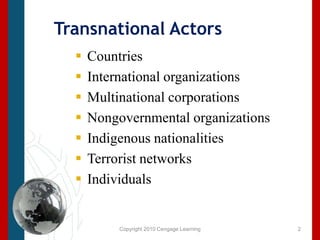
Copyright 2010 Cengage LearningTransnational ActorsCountriesInternational organizationsMultinational corporationsNongovernmental organizationsIndigenous nationalitiesTerrorist networksIndividuals 2
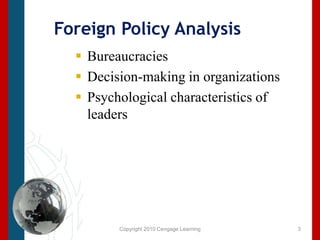
Copyright 2010 Cengage LearningForeign Policy Analysis  BureaucraciesDecision-making in organizationsPsychological characteristics of leaders 3
Copyright 2010 Cengage LearningMost Foreign Policy Analysis Centers on the Executive BranchThe head of government is responsible for making policyThe country needs to have a single voice abroadHeads of government tend to make foreign policy because they control the executive branch of government4
Copyright 2010 Cengage LearningLegislatures and Courts in Foreign Policy The “power of the purse”Courts’ jurisdiction generally limited to domestic affairs “Pentagon Papers” 19715
Copyright 2010 Cengage LearningThe Rational Action Model A logical attempt to achieve an identifiable goalCalculates costs and benefitsWhat goal does this policy serve?6
Copyright 2010 Cengage LearningExpected Utility Theory Payoffs and profitabilityDoes not seek optimum solution, but the policy with best ratio of payoff/probability7
Copyright 2010 Cengage LearningBureaucracies in Foreign Policies Department of State and Department of Defense CIA and NSADifferent bureaucracies have distinct, and often competing, interests. 8
Copyright 2010 Cengage LearningThe Organizational Process Model 9Procedures influence decision contentStandard operating proceduresEfficiency is goal, difficulties when dealing with unique situations
Copyright 2010 Cengage LearningSmall Group Decision Making GroupthinkMay be caused by need for consensus10
Copyright 2010 Cengage LearningIndividual Decision Making Perception and misperception Motivated and unmotivated biasBounded rationality 	11
Copyright 2010 Cengage LearningAttribution Theory Fundamental Attribution BiasNaïve scientistsPre-existing beliefsSecurity dilemma 12
Copyright 2010 Cengage LearningHistorical LessonsThe Lessons of MunichThe Lessons of VietnamFuture Lessons of Iraq? 13
Copyright 2010 Cengage LearningOther Theories of Decision-MakingProspect TheoryStatus quo Bias Motivated Bias	Cognitive Dissonance Bolstering Two-level gamesSatisficing14
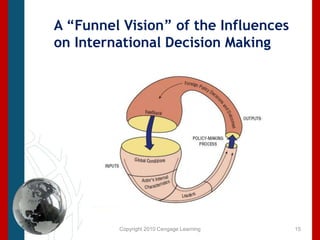
Copyright 2010 Cengage LearningA “Funnel Vision” of the Influences on International Decision Making15
Copyright 2010 Cengage LearningPolicy Making as Rational ChoiceProblem recognition and definitionGoal selectionIdentification of alternativesChoiceAssociated with realist/state as unitary actor1962 Cuban Missile Crisis2003 Iraq War16
Copyright 2010 Cengage LearningFactors Affecting Leadership CapacityPersonalityDegree of control over foreign policySense of political efficacyAmount of available informationAbility to deal with crises“Great person” versus zeitgeist debate 17
Copyright 2010 Cengage LearningInfluences on Foreign Policy Choice International Polarity and polarizationGeographic positionDomesticMilitary capabilitiesEconomic conditionsType of government18
Copyright 2010 Cengage LearningDemocratic Peace Theory Asserts that democracies are more peaceful than other states.Ironically, could provide a rationale for war, because a war that instills a democracy could reduce the chances of war in the long run. 19
Copyright 2010 Cengage LearningTwo Versions The Simple Democratic Peace Model The Dyadic View Structural argumentNormative argument Institutional argument20
Copyright 2010 Cengage LearningZone of Peace European Union (EU)North Atlantic Treaty Organization (NATO) 21
Copyright 2010 Cengage LearningInterest Groups in Foreign Policy What do they want? Money, protection, policyHow do they influence foreign policy? Votes, money, lobbyistsTo what extent do interest groups drive foreign policy? Very influential in the U.S., varies in other states22
Copyright 2010 Cengage LearningPublic Opinion What does public opinion look like? What effect should public opinion have on policy? What effect does public opinion have on foreign policy?What influences public opinion on foreign policy?  23
Copyright 2010 Cengage LearningThe Media in Foreign Policy The businesses aspect of journalismEfforts to influence media coverage Media power: “the CNN effect”  24
Copyright 2010 Cengage LearningThree Models of Influence Rational action modelBureaucratic politics modelOrganizational process model25
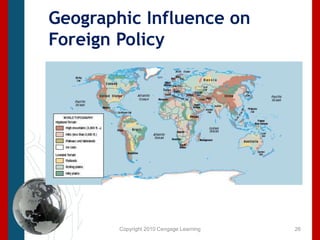
Copyright 2010 Cengage LearningGeographic Influence on Foreign Policy26
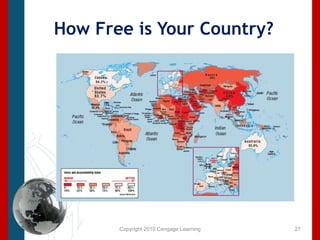
Copyright 2010 Cengage LearningHow Free is Your Country?27

Kegley Chapter 3

  • 1.
    Chapter 3: ForeignPolicy Decision Making
  • 2.
    Copyright 2010 CengageLearningTransnational ActorsCountriesInternational organizationsMultinational corporationsNongovernmental organizationsIndigenous nationalitiesTerrorist networksIndividuals 2
  • 3.
    Copyright 2010 CengageLearningForeign Policy Analysis BureaucraciesDecision-making in organizationsPsychological characteristics of leaders 3
  • 4.
    Copyright 2010 CengageLearningMost Foreign Policy Analysis Centers on the Executive BranchThe head of government is responsible for making policyThe country needs to have a single voice abroadHeads of government tend to make foreign policy because they control the executive branch of government4
  • 5.
    Copyright 2010 CengageLearningLegislatures and Courts in Foreign Policy The “power of the purse”Courts’ jurisdiction generally limited to domestic affairs “Pentagon Papers” 19715
  • 6.
    Copyright 2010 CengageLearningThe Rational Action Model A logical attempt to achieve an identifiable goalCalculates costs and benefitsWhat goal does this policy serve?6
  • 7.
    Copyright 2010 CengageLearningExpected Utility Theory Payoffs and profitabilityDoes not seek optimum solution, but the policy with best ratio of payoff/probability7
  • 8.
    Copyright 2010 CengageLearningBureaucracies in Foreign Policies Department of State and Department of Defense CIA and NSADifferent bureaucracies have distinct, and often competing, interests. 8
  • 9.
    Copyright 2010 CengageLearningThe Organizational Process Model 9Procedures influence decision contentStandard operating proceduresEfficiency is goal, difficulties when dealing with unique situations
  • 10.
    Copyright 2010 CengageLearningSmall Group Decision Making GroupthinkMay be caused by need for consensus10
  • 11.
    Copyright 2010 CengageLearningIndividual Decision Making Perception and misperception Motivated and unmotivated biasBounded rationality 11
  • 12.
    Copyright 2010 CengageLearningAttribution Theory Fundamental Attribution BiasNaïve scientistsPre-existing beliefsSecurity dilemma 12
  • 13.
    Copyright 2010 CengageLearningHistorical LessonsThe Lessons of MunichThe Lessons of VietnamFuture Lessons of Iraq? 13
  • 14.
    Copyright 2010 CengageLearningOther Theories of Decision-MakingProspect TheoryStatus quo Bias Motivated Bias Cognitive Dissonance Bolstering Two-level gamesSatisficing14
  • 15.
    Copyright 2010 CengageLearningA “Funnel Vision” of the Influences on International Decision Making15
  • 16.
    Copyright 2010 CengageLearningPolicy Making as Rational ChoiceProblem recognition and definitionGoal selectionIdentification of alternativesChoiceAssociated with realist/state as unitary actor1962 Cuban Missile Crisis2003 Iraq War16
  • 17.
    Copyright 2010 CengageLearningFactors Affecting Leadership CapacityPersonalityDegree of control over foreign policySense of political efficacyAmount of available informationAbility to deal with crises“Great person” versus zeitgeist debate 17
  • 18.
    Copyright 2010 CengageLearningInfluences on Foreign Policy Choice International Polarity and polarizationGeographic positionDomesticMilitary capabilitiesEconomic conditionsType of government18
  • 19.
    Copyright 2010 CengageLearningDemocratic Peace Theory Asserts that democracies are more peaceful than other states.Ironically, could provide a rationale for war, because a war that instills a democracy could reduce the chances of war in the long run. 19
  • 20.
    Copyright 2010 CengageLearningTwo Versions The Simple Democratic Peace Model The Dyadic View Structural argumentNormative argument Institutional argument20
  • 21.
    Copyright 2010 CengageLearningZone of Peace European Union (EU)North Atlantic Treaty Organization (NATO) 21
  • 22.
    Copyright 2010 CengageLearningInterest Groups in Foreign Policy What do they want? Money, protection, policyHow do they influence foreign policy? Votes, money, lobbyistsTo what extent do interest groups drive foreign policy? Very influential in the U.S., varies in other states22
  • 23.
    Copyright 2010 CengageLearningPublic Opinion What does public opinion look like? What effect should public opinion have on policy? What effect does public opinion have on foreign policy?What influences public opinion on foreign policy? 23
  • 24.
    Copyright 2010 CengageLearningThe Media in Foreign Policy The businesses aspect of journalismEfforts to influence media coverage Media power: “the CNN effect” 24
  • 25.
    Copyright 2010 CengageLearningThree Models of Influence Rational action modelBureaucratic politics modelOrganizational process model25
  • 26.
    Copyright 2010 CengageLearningGeographic Influence on Foreign Policy26
  • 27.
    Copyright 2010 CengageLearningHow Free is Your Country?27

Editor's Notes

  • #5 In presidential government systems, the head of government is the chief executive officer of the executive branch. In the United States, the president is the head of government. In Great Britain, Japan, Spain, Sweden and Canada, the prime minister serves as the head of government.
  • #6 Pentagon Papers: the name for a series of top-secret documents prepared by the U.S. Department of Defense regarding U.S. involvement in Vietnam. In 1971, the documents were leaked to the New York Times, and led to a series of protests, political controversies and lawsuits, culminating in Supreme Court rulings regarding First Amendment issues.
  • #9 In Great Britain (and most other countries), bureaucratic departments are known as ministries.
  • #10 Standard operating procedures are the hallmark of bureaucracies, from the military to intelligence-gathering operations.
  • #11 The tendency for groupthink is one of the reasons organizations (including governments) tend to favor continuity over change. In some cases, disagreeing with the leader has negative consequences for individuals, leading to reduced access and influence. In extreme cases (such as the Stalin regime), it leads to imprisonment, exile or execution.
  • #13 During the Cold War, the United States interpreted a variety of Soviet actions as proof of aggressive expansion plans, particularly the installation of pro-Soviet governments in Poland, Czechoslovakia and East Germany.
  • #14 The lessons of Vietnam still resonate in U.S. elections and policymaking. However, decision-makers are uneven in their use of history, and often disagree about its lessons.
  • #15 Satisficing: the tendency for decision makers to choose the first satisfactory option, rather than searching for a better alternative
  • #18 The Bush Doctrine in the early 2000s is an example of the history-making individuals model of policy decision making.
  • #22 The European Union and the North Atlantic Treaty Organization (NATO) have both worked to promote democracy throughout Europe, in hopes of expanding the zone of peace. Generally speaking, they have been successful, as both organizations continue to grow.
  • #24 In 1898, public opinion forced the United States into the Spanish-American War, as Americans blamed Spanish forces for destroying the U.S. Battleship Maine, harbored in Cuba, and demanded retribution. Recently, how has public opinion influenced the course of war in Iraq?
  • #25 The mass media are those sources directed at the broadest groups in society, including large-circulation newspapers, news magazines, television shows and radio programs. The influence and range of Internet media sources are more difficult to measure.
  • #28 The World Bank’s Worldwide Governance Indicators ranks countries by the level of freedom citizens have to voice opinions and choose their government. Liberal democratic theory predicts that as freedom across countries increases, so will peaceful relations among these democracies.