APA Style BasicsIDS 1001
Documentation StyleA “documentation style” refers to the way researchers and writers illustrate that information from sources used to support their assertions has been borrowed.
PlagiarismThe failure to properly acknowledge a borrowed source in an essay is a serious academic crime and could be   deemed plagiarism.The word comes from the Latin word plagiarius, meaning “kidnapping” or “literary thief.”
APA StyleTo maintain coherence throughout the curriculum, Hodges University has adopted APA style as the standard method used to document sources in essay writing.  APA is  used by many colleges and universities.
What is APA style?It is a social sciences    	published style guide that	advises researchers and	writers on how to incorporate,	document, and format papers.
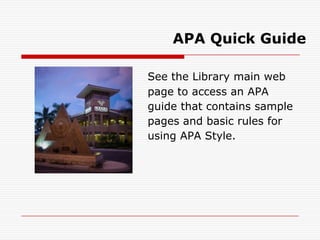
APA Quick GuideSee the Library main web page to access an APA guide that contains sample pages and basic rules for using APA Style.
APA Style in the essayYour essays should contain reliable and valid sourcesThe essays should be formatted properlyThey should follow APA rules for mechanics and  expression (grammar)They must have proper in-text citationsThey must have a reference page with proper source citations
Reliable and Valid SourcesA reliable source is one that is generally current and written by an expert in the subject area.A valid source is one that specifically addresses your chosen topic and can be used to support your assertions.These sources would include books, periodicals (magazines, professional journals, newspapers), and respected organization web sites.
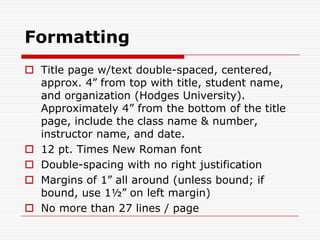
FormattingTitle page w/text double-spaced, centered, approx. 4” from top with title, student name, and organization (Hodges University).  Approximately 4” from the bottom of the title page, include the class name & number, instructor name, and date.12 pt. Times New Roman fontDouble-spacing with no right justificationMargins of 1” all around (unless bound; if bound, use 1½” on left margin)No more than 27 lines / page
Formatting (cont.)Header w/page numbers in upper right corner (title page counts as page 1)Indent each paragraph 5-7 spaces or one tab strokeTables and content footnotes appear after references Reference page at end listing only sources used in the text as supportAbstract comes after title page, if instructor requiresSee examples in the APA Publication Manual and the Hodges APA Guide.
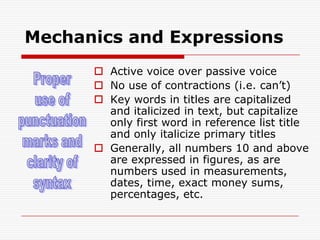
Mechanics and ExpressionsActive voice over passive voiceNo use of contractions (i.e. can’t)Key words in titles are capitalized and italicized in text, but capitalize only first word in reference list title and only italicize primary titlesGenerally, all numbers 10 and above are expressed in figures, as are numbers used in measurements, dates, time, exact money sums, percentages, etc. Properuse ofpunctuationmarks andclarity ofsyntax
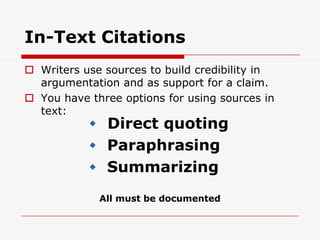
In-Text CitationsWriters use sources to build credibility in argumentation and as support for a claim.You have three options for using sources in text:Direct quoting
  Paraphrasing
  SummarizingAll must be documented
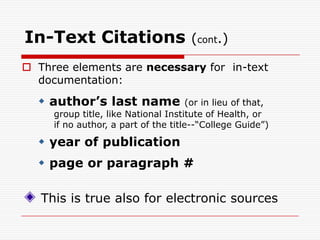
In-Text Citations (cont.)Three elements are necessary for  in-text documentation:author’s last name(or in lieu of that,             	group title, like National Institute of Health, or 	if no author, a part of the title--“College Guide”)
year of publication
page or paragraph #This is true also for electronic sources
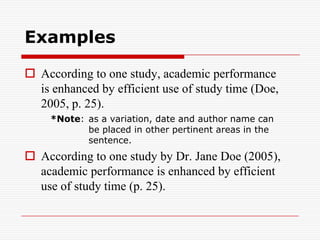
ExamplesAccording to one study, academic performance is enhanced by efficient use of study time (Doe, 2005, p. 25). *Note:	as a variation, date and author name can 			be placed in other pertinent areas in the 			sentence.According to one study by Dr. Jane Doe (2005), academic performance is enhanced by efficient use of study time (p. 25).
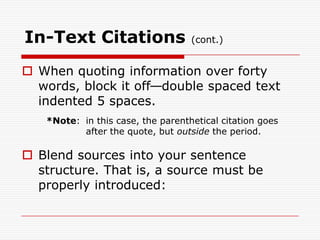
In-Text Citations (cont.)When quoting information over forty words, block it off—double spaced text indented 5 spaces.        *Note:	in this case, the parenthetical citation goes 		after the quote, but outside the period.Blend sources into your sentence structure. That is, a source must be properly introduced:
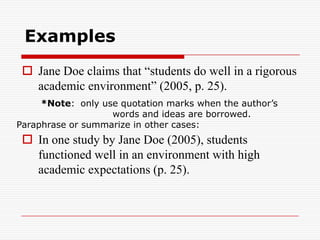
ExamplesJane Doe claims that “students do well in a rigorous academic environment” (2005, p. 25).In one study by Jane Doe (2005), students functioned well in an environment with high academic expectations (p. 25).        *Note:	only use quotation marks when the author’s 			words and ideas are borrowed. Paraphrase or summarize in other cases:
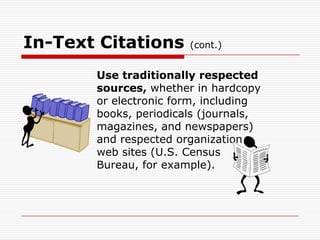
In-Text Citations (cont.)Use traditionally respected sources, whether in hardcopy or electronic form, including books, periodicals (journals, magazines, and newspapers) and respected organization web sites (U.S. Census Bureau, for example).
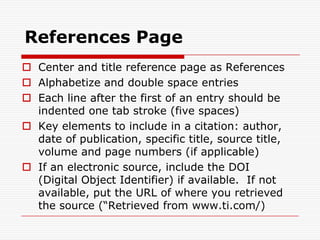
References PageCenter and title reference page as ReferencesAlphabetize and double space entriesEach line after the first of an entry should be indented one tab stroke (five spaces)Key elements to include in a citation: author, date of publication, specific title, source title, volume and page numbers (if applicable)If an electronic source, include the DOI (Digital Object Identifier) if available.  If not available, put the URL of where you retrieved the source (“Retrieved from www.ti.com/)
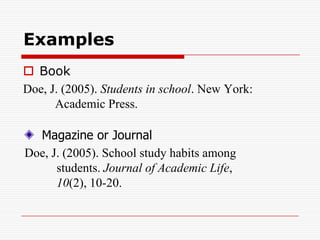
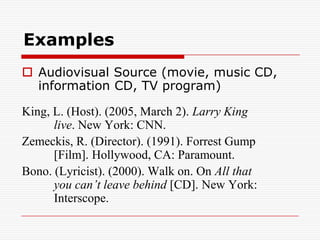
ExamplesBookDoe, J. (2005). Students in school. New York: 	Academic Press.  Magazine or JournalDoe, J. (2005). School study habits among 	students. Journal of Academic Life, 	10(2), 10-20.
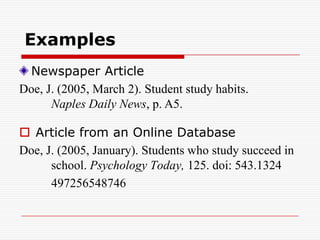
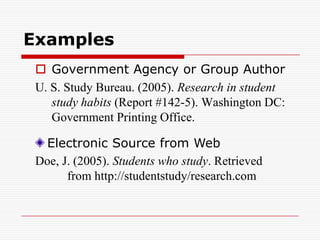
ExamplesNewspaper ArticleDoe, J. (2005, March 2). Student study habits. 	Naples Daily News, p. A5.Article from an Online DatabaseDoe, J. (2005, January). Students who study succeed in 	school. Psychology Today, 125. doi: 543.1324		497256548746

APA Style Bsics - IDS1001

  • 1.
  • 2.
    Documentation StyleA “documentationstyle” refers to the way researchers and writers illustrate that information from sources used to support their assertions has been borrowed.
  • 3.
    PlagiarismThe failure toproperly acknowledge a borrowed source in an essay is a serious academic crime and could be deemed plagiarism.The word comes from the Latin word plagiarius, meaning “kidnapping” or “literary thief.”
  • 4.
    APA StyleTo maintaincoherence throughout the curriculum, Hodges University has adopted APA style as the standard method used to document sources in essay writing. APA is used by many colleges and universities.
  • 5.
    What is APAstyle?It is a social sciences published style guide that advises researchers and writers on how to incorporate, document, and format papers.
  • 6.
    APA Quick GuideSeethe Library main web page to access an APA guide that contains sample pages and basic rules for using APA Style.
  • 7.
    APA Style inthe essayYour essays should contain reliable and valid sourcesThe essays should be formatted properlyThey should follow APA rules for mechanics and expression (grammar)They must have proper in-text citationsThey must have a reference page with proper source citations
  • 8.
    Reliable and ValidSourcesA reliable source is one that is generally current and written by an expert in the subject area.A valid source is one that specifically addresses your chosen topic and can be used to support your assertions.These sources would include books, periodicals (magazines, professional journals, newspapers), and respected organization web sites.
  • 9.
    FormattingTitle page w/textdouble-spaced, centered, approx. 4” from top with title, student name, and organization (Hodges University). Approximately 4” from the bottom of the title page, include the class name & number, instructor name, and date.12 pt. Times New Roman fontDouble-spacing with no right justificationMargins of 1” all around (unless bound; if bound, use 1½” on left margin)No more than 27 lines / page
  • 10.
    Formatting (cont.)Header w/pagenumbers in upper right corner (title page counts as page 1)Indent each paragraph 5-7 spaces or one tab strokeTables and content footnotes appear after references Reference page at end listing only sources used in the text as supportAbstract comes after title page, if instructor requiresSee examples in the APA Publication Manual and the Hodges APA Guide.
  • 11.
    Mechanics and ExpressionsActivevoice over passive voiceNo use of contractions (i.e. can’t)Key words in titles are capitalized and italicized in text, but capitalize only first word in reference list title and only italicize primary titlesGenerally, all numbers 10 and above are expressed in figures, as are numbers used in measurements, dates, time, exact money sums, percentages, etc. Properuse ofpunctuationmarks andclarity ofsyntax
  • 12.
    In-Text CitationsWriters usesources to build credibility in argumentation and as support for a claim.You have three options for using sources in text:Direct quoting
  • 13.
  • 14.
    SummarizingAllmust be documented
  • 15.
    In-Text Citations (cont.)Threeelements are necessary for in-text documentation:author’s last name(or in lieu of that, group title, like National Institute of Health, or if no author, a part of the title--“College Guide”)
  • 16.
  • 17.
    page or paragraph#This is true also for electronic sources
  • 18.
    ExamplesAccording to onestudy, academic performance is enhanced by efficient use of study time (Doe, 2005, p. 25). *Note: as a variation, date and author name can be placed in other pertinent areas in the sentence.According to one study by Dr. Jane Doe (2005), academic performance is enhanced by efficient use of study time (p. 25).
  • 19.
    In-Text Citations (cont.)Whenquoting information over forty words, block it off—double spaced text indented 5 spaces. *Note: in this case, the parenthetical citation goes after the quote, but outside the period.Blend sources into your sentence structure. That is, a source must be properly introduced:
  • 20.
    ExamplesJane Doe claimsthat “students do well in a rigorous academic environment” (2005, p. 25).In one study by Jane Doe (2005), students functioned well in an environment with high academic expectations (p. 25). *Note: only use quotation marks when the author’s words and ideas are borrowed. Paraphrase or summarize in other cases:
  • 21.
    In-Text Citations (cont.)Usetraditionally respected sources, whether in hardcopy or electronic form, including books, periodicals (journals, magazines, and newspapers) and respected organization web sites (U.S. Census Bureau, for example).
  • 22.
    References PageCenter andtitle reference page as ReferencesAlphabetize and double space entriesEach line after the first of an entry should be indented one tab stroke (five spaces)Key elements to include in a citation: author, date of publication, specific title, source title, volume and page numbers (if applicable)If an electronic source, include the DOI (Digital Object Identifier) if available. If not available, put the URL of where you retrieved the source (“Retrieved from www.ti.com/)
  • 23.
    ExamplesBookDoe, J. (2005).Students in school. New York: Academic Press. Magazine or JournalDoe, J. (2005). School study habits among students. Journal of Academic Life, 10(2), 10-20.
  • 24.
    ExamplesNewspaper ArticleDoe, J.(2005, March 2). Student study habits. Naples Daily News, p. A5.Article from an Online DatabaseDoe, J. (2005, January). Students who study succeed in school. Psychology Today, 125. doi: 543.1324 497256548746