US Foreign Policy: Part I Who is involved in formulating US foreign policy? What ideas are fundamental in foreign policy creation?
Global Perspective
Definition Foreign Policy- A nation’s external goals and the techniques and strategies used to achieve them. (Schmidt et. al)
Policymaking Process   Implementation Policy Formation Policy   Evaluation Agenda  Setting Policy   Adoption
Foreign Policy Change Source of policy change is external “ Geographical ‘realities’ and  ideological challenges  from potential aggressors” (Kegley and Wittkopf) Includes all factors “of America’s external environment or any actions occurring  abroad  that…influence the choices made by its officials” (Rosenau)
Institutions Struggle
Institutions: Policy Formation Government Institutions in Policy Formation  Invitation to Struggle “ America’s unique constitutional system creates an ‘invitation to struggle’ between the president and Congress in the foreign policy process” (Crabb and Holt) Federal structure of  national, state and local levels  Three branches of government  Competing bureaucratic agencies
Institutions: Struggle for Influence Executive/Congressional relations may be described as exhibiting a “pendulum or cyclical effect”  Phases of Executive / Congressional Relations: Up until WW II: Congress played limited role 1945 – late 1950s: Collaboration  1960s – early 1970s: Imperial Presidency  Gulf of Tonkin Resolution 1964  1973 – 1980s: Congress re-asserts itself  War Powers Act- 60 day limit  1980- present: Tense Sharing of Responsibility
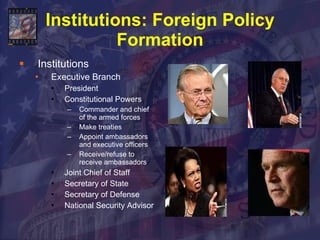
Institutions: Foreign Policy Formation Institutions  Executive Branch President Constitutional Powers   Commander and chief of the armed forces Make treaties Appoint ambassadors and executive officers Receive/refuse to receive ambassadors Joint Chief of Staff Secretary of State Secretary of Defense National Security Advisor
Institutions: Policy Formation Institutions Bureaucratic politics model  “ Where you stand depends on where you sit”  Competition for power and influence  Pentagon CIA FBI Intelligence community Department of Defense Department of State
Institutions: Policy Formation Institutions  Congress Constitutional Powers Power to declare war Power of the purse Responsible for raising and supporting the armed forces Legislative power
Interest
Interests: Policy Formation Increasing voice of domestic and foreign interest groups Domestic and foreign policy issues are related  Increasingly interconnected  Military Industrial Complex Defence industry Peace Groups The Quakers The Raging Grannies
Interests: Defense Industry Influence 109% (Fortune 500 website) 871 Raytheon 37% 2,572 Boeing 44% 1,825 Lockheed Martin Percentage Change From 2004 Profits in 2006 (in millions) Company
Ideas: Policy Formation Moral Idealism “ American National Style”  Moralistic Moral mission  Immorality of communism Liberalism America as a unique state Europe and War; U.S. and Peace Advocate of Middle-Class Capitalism  Consent of the majority
Ideas: Policy Formation Realism Nations act in own interest  World is a dangerous place Act to survive  Policy based on basic cold calculations without regards to morals Must be militarily prepared because other nations are also self interested
Ideas: Policy Formation Neo-realism  (Structural realism) The international structure constrains state behavior. The structure then limits cooperation among states through fears of relative gains made by other states, and the possibility of dependence on other states. Violence is part of the structure of the international system it is likely to continue in the future.
Ideas: Policy Formation The sources of ideology Individual (personality) Source Personal makeup makes a difference  in the kinds of decisions that are made Clinton Doctrine- national interest partly in terms of humanitarian interventions Bush Doctrine- National interest may require pre-emption However, “individuals’ influence [over] foreign policy outcomes are likely to be much subtler than popular impressions would have us believe” (K/W)
Bush’s Personality  Political Cartoon
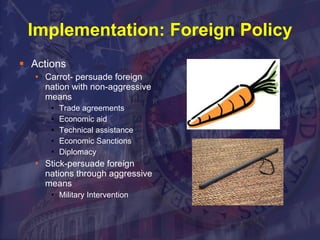
Implementation: Foreign Policy  Actions Carrot- persuade foreign nation with non-aggressive means Trade agreements Economic aid Technical assistance Economic Sanctions Diplomacy Stick-persuade foreign nations through aggressive means Military Intervention
Quiz Which most greatly influences foreign policy creation, institution, ideas, or interest?

Foreign Policy

  • 1.
    US Foreign Policy:Part I Who is involved in formulating US foreign policy? What ideas are fundamental in foreign policy creation?
  • 2.
  • 3.
    Definition Foreign Policy-A nation’s external goals and the techniques and strategies used to achieve them. (Schmidt et. al)
  • 4.
    Policymaking Process Implementation Policy Formation Policy Evaluation Agenda Setting Policy Adoption
  • 5.
    Foreign Policy ChangeSource of policy change is external “ Geographical ‘realities’ and ideological challenges from potential aggressors” (Kegley and Wittkopf) Includes all factors “of America’s external environment or any actions occurring abroad that…influence the choices made by its officials” (Rosenau)
  • 6.
  • 7.
    Institutions: Policy FormationGovernment Institutions in Policy Formation Invitation to Struggle “ America’s unique constitutional system creates an ‘invitation to struggle’ between the president and Congress in the foreign policy process” (Crabb and Holt) Federal structure of national, state and local levels Three branches of government Competing bureaucratic agencies
  • 8.
    Institutions: Struggle forInfluence Executive/Congressional relations may be described as exhibiting a “pendulum or cyclical effect” Phases of Executive / Congressional Relations: Up until WW II: Congress played limited role 1945 – late 1950s: Collaboration 1960s – early 1970s: Imperial Presidency Gulf of Tonkin Resolution 1964 1973 – 1980s: Congress re-asserts itself War Powers Act- 60 day limit 1980- present: Tense Sharing of Responsibility
  • 9.
    Institutions: Foreign PolicyFormation Institutions Executive Branch President Constitutional Powers Commander and chief of the armed forces Make treaties Appoint ambassadors and executive officers Receive/refuse to receive ambassadors Joint Chief of Staff Secretary of State Secretary of Defense National Security Advisor
  • 10.
    Institutions: Policy FormationInstitutions Bureaucratic politics model “ Where you stand depends on where you sit” Competition for power and influence Pentagon CIA FBI Intelligence community Department of Defense Department of State
  • 11.
    Institutions: Policy FormationInstitutions Congress Constitutional Powers Power to declare war Power of the purse Responsible for raising and supporting the armed forces Legislative power
  • 12.
  • 13.
    Interests: Policy FormationIncreasing voice of domestic and foreign interest groups Domestic and foreign policy issues are related Increasingly interconnected Military Industrial Complex Defence industry Peace Groups The Quakers The Raging Grannies
  • 14.
    Interests: Defense IndustryInfluence 109% (Fortune 500 website) 871 Raytheon 37% 2,572 Boeing 44% 1,825 Lockheed Martin Percentage Change From 2004 Profits in 2006 (in millions) Company
  • 15.
    Ideas: Policy FormationMoral Idealism “ American National Style” Moralistic Moral mission Immorality of communism Liberalism America as a unique state Europe and War; U.S. and Peace Advocate of Middle-Class Capitalism Consent of the majority
  • 16.
    Ideas: Policy FormationRealism Nations act in own interest World is a dangerous place Act to survive Policy based on basic cold calculations without regards to morals Must be militarily prepared because other nations are also self interested
  • 17.
    Ideas: Policy FormationNeo-realism (Structural realism) The international structure constrains state behavior. The structure then limits cooperation among states through fears of relative gains made by other states, and the possibility of dependence on other states. Violence is part of the structure of the international system it is likely to continue in the future.
  • 18.
    Ideas: Policy FormationThe sources of ideology Individual (personality) Source Personal makeup makes a difference in the kinds of decisions that are made Clinton Doctrine- national interest partly in terms of humanitarian interventions Bush Doctrine- National interest may require pre-emption However, “individuals’ influence [over] foreign policy outcomes are likely to be much subtler than popular impressions would have us believe” (K/W)
  • 19.
    Bush’s Personality Political Cartoon
  • 20.
    Implementation: Foreign Policy Actions Carrot- persuade foreign nation with non-aggressive means Trade agreements Economic aid Technical assistance Economic Sanctions Diplomacy Stick-persuade foreign nations through aggressive means Military Intervention
  • 21.
    Quiz Which mostgreatly influences foreign policy creation, institution, ideas, or interest?