Chapter 6: Nonstate Actors and the Challenge of Global Governance
Copyright 2010 Cengage Learning.IGOs and NGOsIGOs: Intergovernmental organizations; members are states; have authority from state governments to make decisions regarding particular problems246 in 200734 universal membershipNGOs: Nongovernmental organizations; members are private individuals or groups who focus on specific aspects of the global agenda2
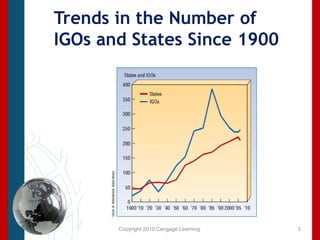
Copyright 2010 Cengage Learning.Trends in the Number of IGOs and States Since 19003
Copyright 2010 Cengage Learning.The United NationsFounded in 1945; successor to League of Nations192 membersMaintain international peace and securityPromote peaceful relations between statesPromote cooperation for solving international problemsEncourage human rights and freedomsCollective security—paralyzed during the Cold War4
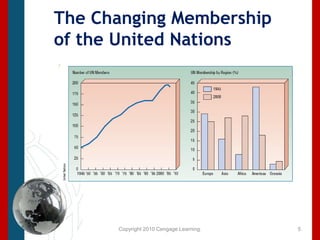
Copyright 2010 Cengage Learning.The Changing Membership of the United Nations5
Copyright 2010 Cengage Learning.UN’s AgendaSix fundamental values FreedomEqualitySolidarityToleranceRespect for natureSense of shared responsibility Expansive issues, from security to desertification6
Copyright 2010 Cengage Learning.Organization of the UNThe General Assembly (GA)192 members, all with an equal voteResolutions not considered law Power over the small UN budget The Secretariat 8,900 employees Secretary General The UN Security Council 15 members, “permanent five” have veto powers7
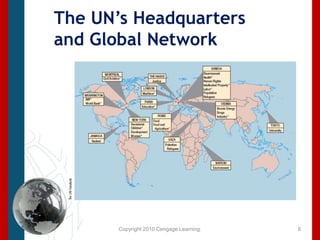
Copyright 2010 Cengage Learning.The UN’s Headquarters and Global Network8
Copyright 2010 Cengage Learning.Aspects of the United NationsGeneral Assembly dominated by the Global SouthControversy over size and nature of UN budgetDominance of U.S.Collaborate with NGOsBudget problemsNorth–South differences over perceived priorities Controversy over dues amountsControversy over inefficiency of UN bureaucracies9
Copyright 2010 Cengage Learning.The United Nations Great Powers Great Britain, China, France, the Soviet Union, and the United StatesOne State/One Vote scheme in the General Assembly10
Copyright 2010 Cengage Learning.Important Functions of the UN Deterring and Countering Aggression Peacekeeping11
Copyright 2010 Cengage Learning.The Specialized Agencies Economic and Social Council (ECOSOC)The International Court of Justice (ICJ)12
Copyright 2010 Cengage Learning.Four Views of the UN UN as world government The UN as irrelevantThe UN as a tool for statesThe UN as a source of norms 13
Copyright 2010 Cengage Learning.World Trade OrganizationSuccessor to GATT (1947)Promotes stable international economic order and smooth international tradeFormal decision-making powers over trade disputesDecreases state sovereignty Dominated by major powers14
Copyright 2010 Cengage Learning.World BankCreated at 1944 Bretton Woods conferenceInternational Bank for Reconstruction and Development (IBRD)Private and governmental loans to developing countriesUpholds international economic systemPromotes economic/political development and environmental sustainability15
Copyright 2010 Cengage Learning.International Monetary Fund1944 Bretton Woods; now a UN agencyStabilizes international monetary exchange ratesLender of last resort; balance of payments problemsDominated by wealthier states: weighted votingConditionalityTension with Global South16
Copyright 2010 Cengage Learning.European Union27 membersNeoliberal theory: promote peace and prosperity through IGOs1951 European Coal and Steel Community Single economy with a common currencyMost western European states; most east European states alsoThird Way17
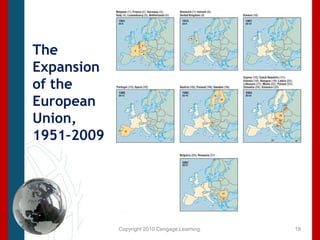
Copyright 2010 Cengage Learning.The Expansion of the European Union, 1951–200918
Copyright 2010 Cengage Learning.FunctionalismRemove the rationale for war through political integration Peace by piecesUse IGOs, shared sovereigntyCollaborate to solve technical transnational problems Cooperation in one area would spill over into other areasCooperation based on self-interest19
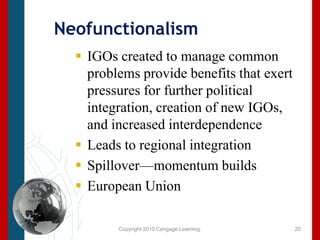
Copyright 2010 Cengage Learning.NeofunctionalismIGOs created to manage common problems provide benefits that exert pressures for further political integration, creation of new IGOs, and increased interdependenceLeads to regional integrationSpillover—momentum buildsEuropean Union20
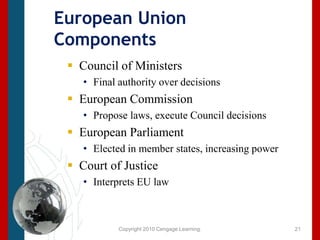
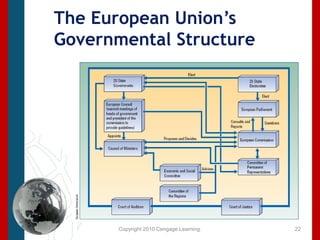
Copyright 2010 Cengage Learning.European Union ComponentsCouncil of MinistersFinal authority over decisionsEuropean Commission Propose laws, execute Council decisionsEuropean ParliamentElected in member states, increasing powerCourt of Justice Interprets EU law21
Copyright 2010 Cengage Learning.The European Union’s Governmental Structure22
Copyright 2010 Cengage Learning.Accomplishments of the EU Common foreign and security policyThe single currency The European Constitution 23
Copyright 2010 Cengage Learning.EU Decision-Making Challenges Two decision-making procedures: consultation and cooperation How far and how fast should a process of pooled sovereignty proceed?How much should the EU’s membership expand?24
Copyright 2010 Cengage Learning.Other Regional IGOsNATO: North Atlantic Treaty OrganizationAPEC: Asia Pacific Economic CooperationASEAN: Association of Southeast Asian NationsCARICOM: Caribbean Community and Common MarketCAEU: Council of Arab Economic UnityOIC: Organization of the Islamic Conference25
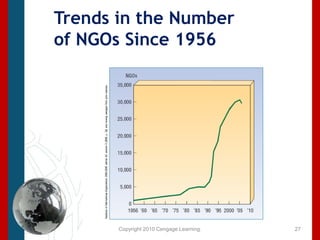
Copyright 2010 Cengage Learning.Nongovernmental OrganizationsPrivate interest groupsAllow individuals to participate in global affairsAbout 30,000 totalOften work with IGOs such as the UNChallenge state sovereignty26
Copyright 2010 Cengage Learning.Trends in the Number of NGOs Since 195627
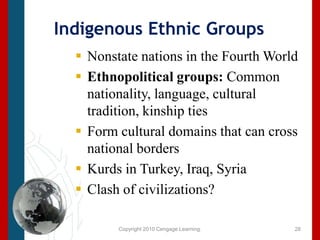
Copyright 2010 Cengage Learning.Indigenous Ethnic GroupsNonstate nations in the Fourth WorldEthnopolitical groups: Common nationality, language, cultural tradition, kinship tiesForm cultural domains that can cross national bordersKurds in Turkey, Iraq, SyriaClash of civilizations?28
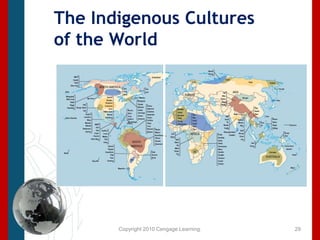
Copyright 2010 Cengage Learning.The Indigenous Cultures of the World29
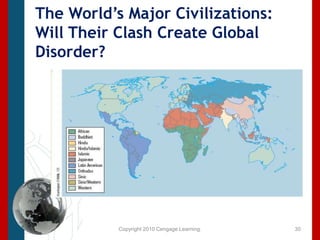
Copyright 2010 Cengage Learning.The World’s Major Civilizations: Will Their Clash Create Global Disorder?30
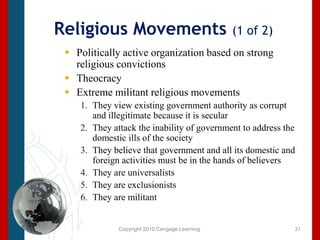
Copyright 2010 Cengage Learning.Religious Movements (1 of 2)Politically active organization based on strong religious convictions Theocracy Extreme militant religious movements They view existing government authority as corrupt and illegitimate because it is secularThey attack the inability of government to address the domestic ills of the societyThey believe that government and all its domestic and foreign activities must be in the hands of believersThey are universalistsThey are exclusionistsThey are militant 31
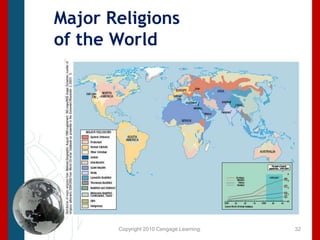
Copyright 2010 Cengage Learning.Major Religions of the World32
Copyright 2010 Cengage Learning.Religious Movements (2 of 2)Militant religious movements tend to stimulate five specific types of international activities: IrredentismSecession or separative revoltsMigrationDiasporasInternational terrorism33
Copyright 2010 Cengage Learning.Transnational Terrorist Groups Terrorism today very different from the pastMore lethalWaged by civilians TechnologyPostmodern terrorismWar in Lebanon and HezbollahDifficulty in defining terrorism34
Copyright 2010 Cengage Learning.Multinational CorporationsPrimary agents of globalization of productionForeign direct investmentTransnational banksReduce political bordersDistributed wealth unevenlyImpact domestic politicsGlobally integrated enterpriseStrategic corporate alliances35
Copyright 2010 Cengage Learning.Transnational Advocacy Networks (TANs)Lobbying governmentsSetting agendasProviding services36
Copyright 2010 Cengage Learning.Issue-Advocacy and Global Civil Society: Can NGOs Transform World Politics?NGOs as a democratic force Networks of NGOs have contributed to the emergence of global civil society Low politicsSingle issue NGOs more influentialNGOs compete with one another to influence decision makers 37

Kegley Chapter 6

  • 1.
    Chapter 6: NonstateActors and the Challenge of Global Governance
  • 2.
    Copyright 2010 CengageLearning.IGOs and NGOsIGOs: Intergovernmental organizations; members are states; have authority from state governments to make decisions regarding particular problems246 in 200734 universal membershipNGOs: Nongovernmental organizations; members are private individuals or groups who focus on specific aspects of the global agenda2
  • 3.
    Copyright 2010 CengageLearning.Trends in the Number of IGOs and States Since 19003
  • 4.
    Copyright 2010 CengageLearning.The United NationsFounded in 1945; successor to League of Nations192 membersMaintain international peace and securityPromote peaceful relations between statesPromote cooperation for solving international problemsEncourage human rights and freedomsCollective security—paralyzed during the Cold War4
  • 5.
    Copyright 2010 CengageLearning.The Changing Membership of the United Nations5
  • 6.
    Copyright 2010 CengageLearning.UN’s AgendaSix fundamental values FreedomEqualitySolidarityToleranceRespect for natureSense of shared responsibility Expansive issues, from security to desertification6
  • 7.
    Copyright 2010 CengageLearning.Organization of the UNThe General Assembly (GA)192 members, all with an equal voteResolutions not considered law Power over the small UN budget The Secretariat 8,900 employees Secretary General The UN Security Council 15 members, “permanent five” have veto powers7
  • 8.
    Copyright 2010 CengageLearning.The UN’s Headquarters and Global Network8
  • 9.
    Copyright 2010 CengageLearning.Aspects of the United NationsGeneral Assembly dominated by the Global SouthControversy over size and nature of UN budgetDominance of U.S.Collaborate with NGOsBudget problemsNorth–South differences over perceived priorities Controversy over dues amountsControversy over inefficiency of UN bureaucracies9
  • 10.
    Copyright 2010 CengageLearning.The United Nations Great Powers Great Britain, China, France, the Soviet Union, and the United StatesOne State/One Vote scheme in the General Assembly10
  • 11.
    Copyright 2010 CengageLearning.Important Functions of the UN Deterring and Countering Aggression Peacekeeping11
  • 12.
    Copyright 2010 CengageLearning.The Specialized Agencies Economic and Social Council (ECOSOC)The International Court of Justice (ICJ)12
  • 13.
    Copyright 2010 CengageLearning.Four Views of the UN UN as world government The UN as irrelevantThe UN as a tool for statesThe UN as a source of norms 13
  • 14.
    Copyright 2010 CengageLearning.World Trade OrganizationSuccessor to GATT (1947)Promotes stable international economic order and smooth international tradeFormal decision-making powers over trade disputesDecreases state sovereignty Dominated by major powers14
  • 15.
    Copyright 2010 CengageLearning.World BankCreated at 1944 Bretton Woods conferenceInternational Bank for Reconstruction and Development (IBRD)Private and governmental loans to developing countriesUpholds international economic systemPromotes economic/political development and environmental sustainability15
  • 16.
    Copyright 2010 CengageLearning.International Monetary Fund1944 Bretton Woods; now a UN agencyStabilizes international monetary exchange ratesLender of last resort; balance of payments problemsDominated by wealthier states: weighted votingConditionalityTension with Global South16
  • 17.
    Copyright 2010 CengageLearning.European Union27 membersNeoliberal theory: promote peace and prosperity through IGOs1951 European Coal and Steel Community Single economy with a common currencyMost western European states; most east European states alsoThird Way17
  • 18.
    Copyright 2010 CengageLearning.The Expansion of the European Union, 1951–200918
  • 19.
    Copyright 2010 CengageLearning.FunctionalismRemove the rationale for war through political integration Peace by piecesUse IGOs, shared sovereigntyCollaborate to solve technical transnational problems Cooperation in one area would spill over into other areasCooperation based on self-interest19
  • 20.
    Copyright 2010 CengageLearning.NeofunctionalismIGOs created to manage common problems provide benefits that exert pressures for further political integration, creation of new IGOs, and increased interdependenceLeads to regional integrationSpillover—momentum buildsEuropean Union20
  • 21.
    Copyright 2010 CengageLearning.European Union ComponentsCouncil of MinistersFinal authority over decisionsEuropean Commission Propose laws, execute Council decisionsEuropean ParliamentElected in member states, increasing powerCourt of Justice Interprets EU law21
  • 22.
    Copyright 2010 CengageLearning.The European Union’s Governmental Structure22
  • 23.
    Copyright 2010 CengageLearning.Accomplishments of the EU Common foreign and security policyThe single currency The European Constitution 23
  • 24.
    Copyright 2010 CengageLearning.EU Decision-Making Challenges Two decision-making procedures: consultation and cooperation How far and how fast should a process of pooled sovereignty proceed?How much should the EU’s membership expand?24
  • 25.
    Copyright 2010 CengageLearning.Other Regional IGOsNATO: North Atlantic Treaty OrganizationAPEC: Asia Pacific Economic CooperationASEAN: Association of Southeast Asian NationsCARICOM: Caribbean Community and Common MarketCAEU: Council of Arab Economic UnityOIC: Organization of the Islamic Conference25
  • 26.
    Copyright 2010 CengageLearning.Nongovernmental OrganizationsPrivate interest groupsAllow individuals to participate in global affairsAbout 30,000 totalOften work with IGOs such as the UNChallenge state sovereignty26
  • 27.
    Copyright 2010 CengageLearning.Trends in the Number of NGOs Since 195627
  • 28.
    Copyright 2010 CengageLearning.Indigenous Ethnic GroupsNonstate nations in the Fourth WorldEthnopolitical groups: Common nationality, language, cultural tradition, kinship tiesForm cultural domains that can cross national bordersKurds in Turkey, Iraq, SyriaClash of civilizations?28
  • 29.
    Copyright 2010 CengageLearning.The Indigenous Cultures of the World29
  • 30.
    Copyright 2010 CengageLearning.The World’s Major Civilizations: Will Their Clash Create Global Disorder?30
  • 31.
    Copyright 2010 CengageLearning.Religious Movements (1 of 2)Politically active organization based on strong religious convictions Theocracy Extreme militant religious movements They view existing government authority as corrupt and illegitimate because it is secularThey attack the inability of government to address the domestic ills of the societyThey believe that government and all its domestic and foreign activities must be in the hands of believersThey are universalistsThey are exclusionistsThey are militant 31
  • 32.
    Copyright 2010 CengageLearning.Major Religions of the World32
  • 33.
    Copyright 2010 CengageLearning.Religious Movements (2 of 2)Militant religious movements tend to stimulate five specific types of international activities: IrredentismSecession or separative revoltsMigrationDiasporasInternational terrorism33
  • 34.
    Copyright 2010 CengageLearning.Transnational Terrorist Groups Terrorism today very different from the pastMore lethalWaged by civilians TechnologyPostmodern terrorismWar in Lebanon and HezbollahDifficulty in defining terrorism34
  • 35.
    Copyright 2010 CengageLearning.Multinational CorporationsPrimary agents of globalization of productionForeign direct investmentTransnational banksReduce political bordersDistributed wealth unevenlyImpact domestic politicsGlobally integrated enterpriseStrategic corporate alliances35
  • 36.
    Copyright 2010 CengageLearning.Transnational Advocacy Networks (TANs)Lobbying governmentsSetting agendasProviding services36
  • 37.
    Copyright 2010 CengageLearning.Issue-Advocacy and Global Civil Society: Can NGOs Transform World Politics?NGOs as a democratic force Networks of NGOs have contributed to the emergence of global civil society Low politicsSingle issue NGOs more influentialNGOs compete with one another to influence decision makers 37

Editor's Notes

  • #3 IGOs are established by treaties requiring member ratification, and which act as the charter for the group. They are distinct from task groups or simple coalitions such as the G8. Well-known IGOs include the United Nations, Interpol, the European Union and the African Union.
  • #4 The seeming decline in the number of IGOs in the late 1980s is the result of the merger of several previously independent IGOs.
  • #5 The official languages of the United Nations are Arabic, Chinese, English, French, Russian, and Spanish.
  • #12 There are currently 16 official UN peacekeeping missions throughout the world.
  • #13 The International Court of Justice is the primary judicial organ of the United Nations. It is located in the Peace Palace in The Hague (Netherlands). The court is composed of fifteen judges elected for nine year terms by the UN General Assembly and the Security Council.
  • #15 The WTO is headquartered in Geneva, and has 153 members. It functions primarily as a negotiating forum on trade for member nations.
  • #16 The World Bank functions as a cooperative, with 186 member countries. Shareholders are represented by a board of governors who meet annually. The five largest shareholders are France, Germany, Japan, the United Kingdom and the United States.
  • #18 The European Union is both an economic and a political partnership. Its goal is increased peace, prosperity and freedom for its citizens.
  • #19 From few, to many. Expansion of the European Union has allowed it to emerge as a superpower.
  • #22 Members of the European Parliament do not sit in national blocks, but in Europe-wide political groups.
  • #25 Three candidate countries are Croatia, the Former Yugoslav Republic of Macedonia and Turkey.
  • #29 There are an estimated 650 million indigenous people worldwide, scattered in more than seventy countries.