Chapter Twenty Foreign and Military Policy
Kinds of Foreign Policy Majoritarian politics : foreign policy is perceived to confer widespread benefits, impose widespread costs (war, alliances) Interest group politics : identifiable groups are pitted against one another for costs, benefits (tariffs) Client politics : Benefits go to an identifiable group, without apparent costs to any distinct group (policy toward Israel)
The President and Congress The president is the commander-in-chief  but Congress appropriates the money The president appoints ambassadors  but Senate confirms them The president negotiates treaties  but the Senate must ratify them with a two-thirds vote
The President and Congress Only Congress can regulate commerce with other nations and declare war But Americans think that the president is in charge and history confirms that belief
Presidential Power Presidents have been relatively strong in foreign affairs And yet presidents have been comparatively weak in foreign affairs by the standards of other nations Treaties signed by the president are little more than a promise to try to get the Senate to act
The Courts and Foreign Policy The Supreme Court has ruled that the federal government has foreign and military policy powers beyond those specifically mentioned in the Constitution The Supreme Court is reluctant to intervene in Congress-president disputes about war powers
Checks on Presidential Power Congress has control of the purse strings Congress also limits the president’s ability to give military or economic aid to other countries Oversight: House and Senate intelligence committees must be fully informed; including covert operations
War Powers Act of 1973 All commitments of troops in hostile situations must be reported within forty-eight hours Only a sixty-day commitment of troops can be made unless there is a declaration of war or a specific statutory authorization Every president since the passage of the War Powers Act has sent troops abroad without congressional approval Presidents deny that the War Powers Act is constitutional
National Security Council (NSC) Chaired by the president and includes the vice president, secretaries of state and defense usually includes the director of the CIA, chair of Joint Chiefs of Staff,and attorney general The goal is to present various perspectives, facilitate presidential decision making, and implement presidential decisions
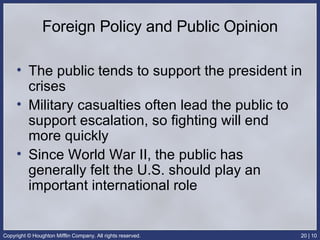
Foreign Policy and Public Opinion The public tends to support the president in crises Military casualties often lead the public to support escalation, so fighting will end more quickly Since World War II, the public has generally felt the U.S. should play an important international role
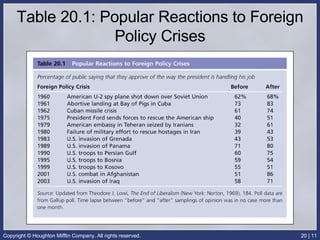
Table 20.1: Popular Reactions to Foreign Policy Crises
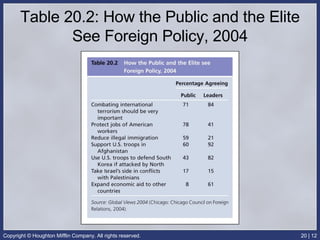
Table 20.2: How the Public and the Elite See Foreign Policy, 2004
Worldviews Worldview  (or paradigm): comprehensive mental picture of world issues  Isolationism paradigm  (1920s–1930s): opposes getting involved in wars Containment  (anti-appeasement)  paradigm  (1940s–1960s): postwar policy to resist Soviet expansionism
Worldviews Disengagement  (Vietnam)  paradigm  (1970s, continuing): reaction to military defeat and the political disaster of Vietnam Human rights: prevent genocide--the mass murder of people, usually because of their race or ethnicity
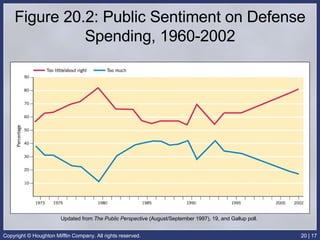
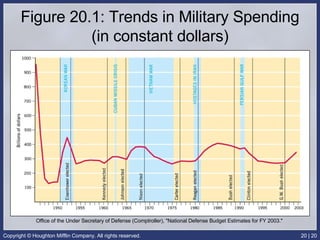
The Defense Budget Changes in spending reflect public opinion and general support for a large military The demise of the U.S.S.R. generated a debate about cutting costs Desert Storm (1991) and Kosovo (1999) demonstrated that the U.S. would have to use military force With Kosovo, it also became clear that cuts had impaired the military’s ability to conduct a sustained campaign
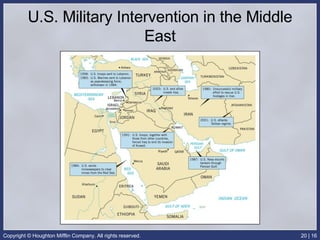
U.S. Military Intervention in the Middle East
Figure 20.2: Public Sentiment on Defense Spending, 1960-2002 Updated from  The Public Perspective  (August/September 1997), 19, and Gallup poll.
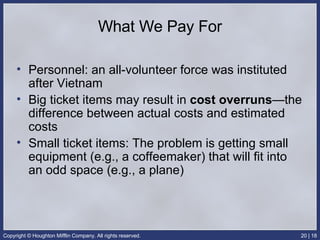
What We Pay For Personnel: an all-volunteer force was instituted after Vietnam Big ticket items may result in  cost overruns —the difference between actual costs and estimated costs Small ticket items: The problem is getting small equipment (e.g., a coffeemaker) that will fit into an odd space (e.g., a plane)
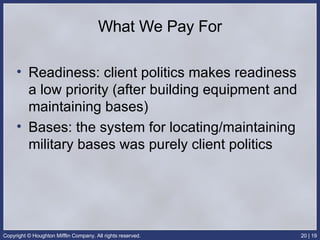
What We Pay For Readiness: client politics makes readiness a low priority (after building equipment and maintaining bases) Bases: the system for locating/maintaining military bases was purely client politics
Figure 20.1: Trends in Military Spending (in constant dollars) Office of the Under Secretary of Defense (Comptroller), "National Defense Budget Estimates for FY 2003."
Decision Making Department of Defense: Secretary of Defense is a civilian, as are secretaries of army, navy, air force Joint Chiefs of Staff (JCS): composed of uniformed head of each service The chain of command runs from the president to the Secretary of Defense to unified and specified commands
Terrorism Since 9/11, foreign policy has had to focus on terrorism and what to do with nations that have harbored terrorists Superpower status in a unipolar world still leaves the U.S. vulnerable both here and abroad to terrorist attacks

ap gov chap 20

  • 1.
    Chapter Twenty Foreignand Military Policy
  • 2.
    Kinds of ForeignPolicy Majoritarian politics : foreign policy is perceived to confer widespread benefits, impose widespread costs (war, alliances) Interest group politics : identifiable groups are pitted against one another for costs, benefits (tariffs) Client politics : Benefits go to an identifiable group, without apparent costs to any distinct group (policy toward Israel)
  • 3.
    The President andCongress The president is the commander-in-chief but Congress appropriates the money The president appoints ambassadors but Senate confirms them The president negotiates treaties but the Senate must ratify them with a two-thirds vote
  • 4.
    The President andCongress Only Congress can regulate commerce with other nations and declare war But Americans think that the president is in charge and history confirms that belief
  • 5.
    Presidential Power Presidentshave been relatively strong in foreign affairs And yet presidents have been comparatively weak in foreign affairs by the standards of other nations Treaties signed by the president are little more than a promise to try to get the Senate to act
  • 6.
    The Courts andForeign Policy The Supreme Court has ruled that the federal government has foreign and military policy powers beyond those specifically mentioned in the Constitution The Supreme Court is reluctant to intervene in Congress-president disputes about war powers
  • 7.
    Checks on PresidentialPower Congress has control of the purse strings Congress also limits the president’s ability to give military or economic aid to other countries Oversight: House and Senate intelligence committees must be fully informed; including covert operations
  • 8.
    War Powers Actof 1973 All commitments of troops in hostile situations must be reported within forty-eight hours Only a sixty-day commitment of troops can be made unless there is a declaration of war or a specific statutory authorization Every president since the passage of the War Powers Act has sent troops abroad without congressional approval Presidents deny that the War Powers Act is constitutional
  • 9.
    National Security Council(NSC) Chaired by the president and includes the vice president, secretaries of state and defense usually includes the director of the CIA, chair of Joint Chiefs of Staff,and attorney general The goal is to present various perspectives, facilitate presidential decision making, and implement presidential decisions
  • 10.
    Foreign Policy andPublic Opinion The public tends to support the president in crises Military casualties often lead the public to support escalation, so fighting will end more quickly Since World War II, the public has generally felt the U.S. should play an important international role
  • 11.
    Table 20.1: PopularReactions to Foreign Policy Crises
  • 12.
    Table 20.2: Howthe Public and the Elite See Foreign Policy, 2004
  • 13.
    Worldviews Worldview (or paradigm): comprehensive mental picture of world issues Isolationism paradigm (1920s–1930s): opposes getting involved in wars Containment (anti-appeasement) paradigm (1940s–1960s): postwar policy to resist Soviet expansionism
  • 14.
    Worldviews Disengagement (Vietnam) paradigm (1970s, continuing): reaction to military defeat and the political disaster of Vietnam Human rights: prevent genocide--the mass murder of people, usually because of their race or ethnicity
  • 15.
    The Defense BudgetChanges in spending reflect public opinion and general support for a large military The demise of the U.S.S.R. generated a debate about cutting costs Desert Storm (1991) and Kosovo (1999) demonstrated that the U.S. would have to use military force With Kosovo, it also became clear that cuts had impaired the military’s ability to conduct a sustained campaign
  • 16.
    U.S. Military Interventionin the Middle East
  • 17.
    Figure 20.2: PublicSentiment on Defense Spending, 1960-2002 Updated from The Public Perspective (August/September 1997), 19, and Gallup poll.
  • 18.
    What We PayFor Personnel: an all-volunteer force was instituted after Vietnam Big ticket items may result in cost overruns —the difference between actual costs and estimated costs Small ticket items: The problem is getting small equipment (e.g., a coffeemaker) that will fit into an odd space (e.g., a plane)
  • 19.
    What We PayFor Readiness: client politics makes readiness a low priority (after building equipment and maintaining bases) Bases: the system for locating/maintaining military bases was purely client politics
  • 20.
    Figure 20.1: Trendsin Military Spending (in constant dollars) Office of the Under Secretary of Defense (Comptroller), "National Defense Budget Estimates for FY 2003."
  • 21.
    Decision Making Departmentof Defense: Secretary of Defense is a civilian, as are secretaries of army, navy, air force Joint Chiefs of Staff (JCS): composed of uniformed head of each service The chain of command runs from the president to the Secretary of Defense to unified and specified commands
  • 22.
    Terrorism Since 9/11,foreign policy has had to focus on terrorism and what to do with nations that have harbored terrorists Superpower status in a unipolar world still leaves the U.S. vulnerable both here and abroad to terrorist attacks