https://muhammadchoirulrosiqin.wordpress.com/
Created by: Muhammad Choirul Rosiqin | International Relations Student of UMM
Book Source: Fifty Key Thinkers in International Relations [Martin Griffiths]
Relations among states take place in the
absence of a world government.
For realists, this means that the international
system is anarchical. International relations
are best understood by focusing on the distribution
of power among states.
Despite their formal legal equality, the uneven
distribution of power means that the arena of
international relations is a form of ‘power politics’.
https://muhammadchoirulrosiqin.wordpress.com/
Power is hard to measure; its distribution among
states changes over time and there is no consensus
among states about how it should be distributed.
International relations is therefore a
realm of necessity (states must seek power to
survive in a competitive environment) and
continuity over time.
When realists contemplate change in the
international system, they focus on changes in the
balance of power among states, and tend to
discount the possibility of fundamental change in
the dynamics of the system itself.
https://muhammadchoirulrosiqin.wordpress.com/
The following key thinkers all subscribe to these basic
assumptions in their explorations of the following
questions:
1) What are the main sources of stability and
instability in the international system?
2) What is the actual and preferred balance of
power among states?
3) How should the great powers behave
toward one another and toward weaker states?
4) What are the sources and dynamics
of contemporary changes in the balance of
power?
https://muhammadchoirulrosiqin.wordpress.com/
Despite some shared assumptions about
the nature of international relations,
realists are not all of one voice in
answering these questions, and it would be
wrong to believe that shared assumptions
lead to similar conclusions among them.
https://muhammadchoirulrosiqin.wordpress.com/
In fact, there is sharp disagreement over the
relative merits of particular balances of power
(unipolarity, bipolarity and multipolarity).
There is also much debate over
the causal relationshipbetween
states and the international pressures upon
them, and the relative importance of different
kinds of power in contemporary international
relations.
https://muhammadchoirulrosiqin.wordpress.com/
RAYMOND ARON wrote in 1978
• [t]he rise of National Socialism . . . and the
revelation of politics in its dialogical essence forced
me to argue against myself, against my intimate
preferences; it inspired in me a sort of revolt against the
instruction I had received at the university, against the
spirituality of philosophers, and against the tendency of
certain sociologists to misconstrue the impact of regimes
with the pretext of focusing on permanent realities.
https://muhammadchoirulrosiqin.wordpress.com/
Raymond Aron (1905) argument “realism”:
• International relations was in some respects a
struggle for power among states, the
concept of power was too nebulous to serve
as a master key for understanding
international relations.
• The milieu of international relations was a
unique structured environment, the
latter did not determine state goals.
https://muhammadchoirulrosiqin.wordpress.com/
State ‘goals’ could not be reduced to a
simple formula at all:
• Security, power, glory, ideas, are essentially
heterogeneous objectives which can be reduced
to a single term only by distorting the human
meaning of diplomatic strategic action.
• If the rivalry of states is comparable to a game,
what is ‘at stake’ cannot be designated by a single
concept, valid for all civilisations at all periods.
• Diplomacy is a game in which the players
sometimes risk losing their lives, sometimes
prefer victory to the advantages that would result
from it.
https://muhammadchoirulrosiqin.wordpress.com/
• Peace and War may be
disappointing for those in search
of a historical generalisations,
since it is at best a collection of
partial hypotheses based on the
ways in which states influence
one another in light of
a) different historical eras;
b) the ‘material’ constraints of space (geography), population
(demography) and resources (economics); and
c) the ‘moral’ determinants arising from states’ ‘styles of
being and behaving’.
https://muhammadchoirulrosiqin.wordpress.com/
• Bipolar and multipolar configurations of
power, hypotheses concerning their relevant
stability could only be tentative in light of the fact
that one cannot ignore the character of particular
states within a distinct era.
• The ‘excess capital’ of France – which according to
the theory would require overseas colonies to be
invested in – usually went to South America and
Russia rather than North Africa.
• The main ‘cause of war’ is traditional interstate rivalry.
• Nuclear weapons were fundamentally different from
conventional weapons in that their destructiveness,
speed of delivery and limited military utility required
that they be used to deter war rather than fight one.
https://muhammadchoirulrosiqin.wordpress.com/
Further reading
• ‘Raymond Aron: a critical retrospective and prospective’,
special edition of International Studies Quarterly 29 (1985).
• Baverez, Nicolas, Raymond Aron, Lyon, Manufacture, 1986
• Colquhoun, Robert, Raymond Aron: Volume One: The
Philosopher in History, 1905–1955, Beverly Hills, California,
Sage Publications, 1986
• Colquhoun, Robert, Raymond Aron: Volume Two: The
Sociologist in Society, 1955–1983, Beverly Hills, California,
Sage Publications, 1986
• Mahony, Daniel J., The Liberal Political Science of Raymond
Aron, Oxford, Rowman & Littlefield, 1991
See also in this book (Hoffmann, Morgenthau, Waltz)
https://muhammadchoirulrosiqin.wordpress.com/
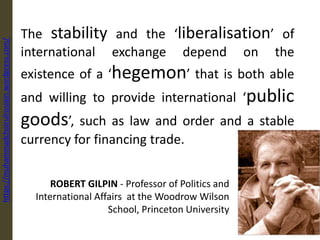
ROBERT GILPIN - Professor of Politics and
International Affairs at the Woodrow Wilson
School, Princeton University
The stability and the ‘liberalisation’ of
international exchange depend on the
existence of a ‘hegemon’ that is both able
and willing to provide international ‘public
goods’, such as law and order and a stable
currency for financing trade.
https://muhammadchoirulrosiqin.wordpress.com/
Gilpin’s distinguishes between three kinds
of change in international relations:
1. Interaction change simply refers to changing
interstate relations within a given balance of
power.
2. Systemic change refers to the overall governance of
the system, the number of great powers within it, and
the shift in identity of
predominant powers, usually after a systemic war
involving challenges to, and attempts to maintain, the
existing distribution of power.
3. Systems change refers to a fundamental
transformation of the actors and thus the nature of
the system per se.
https://muhammadchoirulrosiqin.wordpress.com/
Gilpin’s model of systemic change
is based on a number of
assumptions about states that he
derives from microeconomic,
rational choice theory. This is used
to postulate a cyclical theory of
change in the international system.
https://muhammadchoirulrosiqin.wordpress.com/
Here the five key propositions:
1. An international system is stable (i.e., in a state of equilibrium) if
no state believes it profitable to change the system.
2. A state will attempt to change the international system if the
expected benefits exceed the expected costs.
3. A state will seek to change the international system through
territorial, political and economic expansion until the marginal costs
of further change are equal to or greater than the expected
benefits.
4. Once equilibrium between the costs and benefits of further change
and expansion is reached, the tendency is for the economic costs of
maintaining the status quo to rise faster than the economic
capacity to sustain the status quo.
5. If the disequilibrium in the international system is not resolved,
then the system will be changed, and a new equilibrium reflecting
the redistribution of power will be established.
https://muhammadchoirulrosiqin.wordpress.com/
Further reading
• Gowa, Joanne, ‘Rational hegemons, excludable
goods, and small groups: an epitaph for
hegemonic stability theory’, World Politics 41
(1989), pp. 307–24
• Grundberg, Isabelle, ‘Exploring the “myth” of
hegemonic stability’, International
Organisation 44 (1990), pp. 431–77
• Rogowski, Roger, ‘Structure, growth, power:
three rationalist accounts’, International
Organization 37 (1993), pp. 713–38
See also in this book (Cox, Keohane, Krasner, Strange)
https://muhammadchoirulrosiqin.wordpress.com/
Terima Kasih. . .
If you wanna chat me, you may contact me via:
Facebook : mcrosiqin@facebook.com
Twitter : @mcrosiqin
Gmail : google.com/+MuhammadChoirulRosiqin
LinkedIn : id.linkedin.com/pub/muhammad-choirul-
rosiqin/89/95/523/
Tumblr : mcrosiqin.tumblr.com
https://muhammadchoirulrosiqin.wordpress.com/

REALISM

  • 1.
    https://muhammadchoirulrosiqin.wordpress.com/ Created by: MuhammadChoirul Rosiqin | International Relations Student of UMM Book Source: Fifty Key Thinkers in International Relations [Martin Griffiths]
  • 2.
    Relations among statestake place in the absence of a world government. For realists, this means that the international system is anarchical. International relations are best understood by focusing on the distribution of power among states. Despite their formal legal equality, the uneven distribution of power means that the arena of international relations is a form of ‘power politics’. https://muhammadchoirulrosiqin.wordpress.com/
  • 3.
    Power is hardto measure; its distribution among states changes over time and there is no consensus among states about how it should be distributed. International relations is therefore a realm of necessity (states must seek power to survive in a competitive environment) and continuity over time. When realists contemplate change in the international system, they focus on changes in the balance of power among states, and tend to discount the possibility of fundamental change in the dynamics of the system itself. https://muhammadchoirulrosiqin.wordpress.com/
  • 4.
    The following keythinkers all subscribe to these basic assumptions in their explorations of the following questions: 1) What are the main sources of stability and instability in the international system? 2) What is the actual and preferred balance of power among states? 3) How should the great powers behave toward one another and toward weaker states? 4) What are the sources and dynamics of contemporary changes in the balance of power? https://muhammadchoirulrosiqin.wordpress.com/
  • 5.
    Despite some sharedassumptions about the nature of international relations, realists are not all of one voice in answering these questions, and it would be wrong to believe that shared assumptions lead to similar conclusions among them. https://muhammadchoirulrosiqin.wordpress.com/
  • 6.
    In fact, thereis sharp disagreement over the relative merits of particular balances of power (unipolarity, bipolarity and multipolarity). There is also much debate over the causal relationshipbetween states and the international pressures upon them, and the relative importance of different kinds of power in contemporary international relations. https://muhammadchoirulrosiqin.wordpress.com/
  • 7.
    RAYMOND ARON wrotein 1978 • [t]he rise of National Socialism . . . and the revelation of politics in its dialogical essence forced me to argue against myself, against my intimate preferences; it inspired in me a sort of revolt against the instruction I had received at the university, against the spirituality of philosophers, and against the tendency of certain sociologists to misconstrue the impact of regimes with the pretext of focusing on permanent realities. https://muhammadchoirulrosiqin.wordpress.com/
  • 8.
    Raymond Aron (1905)argument “realism”: • International relations was in some respects a struggle for power among states, the concept of power was too nebulous to serve as a master key for understanding international relations. • The milieu of international relations was a unique structured environment, the latter did not determine state goals. https://muhammadchoirulrosiqin.wordpress.com/
  • 9.
    State ‘goals’ couldnot be reduced to a simple formula at all: • Security, power, glory, ideas, are essentially heterogeneous objectives which can be reduced to a single term only by distorting the human meaning of diplomatic strategic action. • If the rivalry of states is comparable to a game, what is ‘at stake’ cannot be designated by a single concept, valid for all civilisations at all periods. • Diplomacy is a game in which the players sometimes risk losing their lives, sometimes prefer victory to the advantages that would result from it. https://muhammadchoirulrosiqin.wordpress.com/
  • 10.
    • Peace andWar may be disappointing for those in search of a historical generalisations, since it is at best a collection of partial hypotheses based on the ways in which states influence one another in light of a) different historical eras; b) the ‘material’ constraints of space (geography), population (demography) and resources (economics); and c) the ‘moral’ determinants arising from states’ ‘styles of being and behaving’. https://muhammadchoirulrosiqin.wordpress.com/
  • 11.
    • Bipolar andmultipolar configurations of power, hypotheses concerning their relevant stability could only be tentative in light of the fact that one cannot ignore the character of particular states within a distinct era. • The ‘excess capital’ of France – which according to the theory would require overseas colonies to be invested in – usually went to South America and Russia rather than North Africa. • The main ‘cause of war’ is traditional interstate rivalry. • Nuclear weapons were fundamentally different from conventional weapons in that their destructiveness, speed of delivery and limited military utility required that they be used to deter war rather than fight one. https://muhammadchoirulrosiqin.wordpress.com/
  • 12.
    Further reading • ‘RaymondAron: a critical retrospective and prospective’, special edition of International Studies Quarterly 29 (1985). • Baverez, Nicolas, Raymond Aron, Lyon, Manufacture, 1986 • Colquhoun, Robert, Raymond Aron: Volume One: The Philosopher in History, 1905–1955, Beverly Hills, California, Sage Publications, 1986 • Colquhoun, Robert, Raymond Aron: Volume Two: The Sociologist in Society, 1955–1983, Beverly Hills, California, Sage Publications, 1986 • Mahony, Daniel J., The Liberal Political Science of Raymond Aron, Oxford, Rowman & Littlefield, 1991 See also in this book (Hoffmann, Morgenthau, Waltz) https://muhammadchoirulrosiqin.wordpress.com/
  • 13.
    ROBERT GILPIN -Professor of Politics and International Affairs at the Woodrow Wilson School, Princeton University The stability and the ‘liberalisation’ of international exchange depend on the existence of a ‘hegemon’ that is both able and willing to provide international ‘public goods’, such as law and order and a stable currency for financing trade. https://muhammadchoirulrosiqin.wordpress.com/
  • 14.
    Gilpin’s distinguishes betweenthree kinds of change in international relations: 1. Interaction change simply refers to changing interstate relations within a given balance of power. 2. Systemic change refers to the overall governance of the system, the number of great powers within it, and the shift in identity of predominant powers, usually after a systemic war involving challenges to, and attempts to maintain, the existing distribution of power. 3. Systems change refers to a fundamental transformation of the actors and thus the nature of the system per se. https://muhammadchoirulrosiqin.wordpress.com/
  • 15.
    Gilpin’s model ofsystemic change is based on a number of assumptions about states that he derives from microeconomic, rational choice theory. This is used to postulate a cyclical theory of change in the international system. https://muhammadchoirulrosiqin.wordpress.com/
  • 16.
    Here the fivekey propositions: 1. An international system is stable (i.e., in a state of equilibrium) if no state believes it profitable to change the system. 2. A state will attempt to change the international system if the expected benefits exceed the expected costs. 3. A state will seek to change the international system through territorial, political and economic expansion until the marginal costs of further change are equal to or greater than the expected benefits. 4. Once equilibrium between the costs and benefits of further change and expansion is reached, the tendency is for the economic costs of maintaining the status quo to rise faster than the economic capacity to sustain the status quo. 5. If the disequilibrium in the international system is not resolved, then the system will be changed, and a new equilibrium reflecting the redistribution of power will be established. https://muhammadchoirulrosiqin.wordpress.com/
  • 17.
    Further reading • Gowa,Joanne, ‘Rational hegemons, excludable goods, and small groups: an epitaph for hegemonic stability theory’, World Politics 41 (1989), pp. 307–24 • Grundberg, Isabelle, ‘Exploring the “myth” of hegemonic stability’, International Organisation 44 (1990), pp. 431–77 • Rogowski, Roger, ‘Structure, growth, power: three rationalist accounts’, International Organization 37 (1993), pp. 713–38 See also in this book (Cox, Keohane, Krasner, Strange) https://muhammadchoirulrosiqin.wordpress.com/
  • 18.
    Terima Kasih. .. If you wanna chat me, you may contact me via: Facebook : mcrosiqin@facebook.com Twitter : @mcrosiqin Gmail : google.com/+MuhammadChoirulRosiqin LinkedIn : id.linkedin.com/pub/muhammad-choirul- rosiqin/89/95/523/ Tumblr : mcrosiqin.tumblr.com https://muhammadchoirulrosiqin.wordpress.com/

Editor's Notes

  • #8 ‘On the historical condition of the sociologist’, reprinted in a collection of Aron’s essays, History and Politics, M.B. Conant (ed.), New York, Free Press, 1978, p. 65.
  • #10 Raymond Aron, Peace and War, New York, Praeger, 1968, p. 91.
  • #11 Raymond Aron, Peace and War, New York, Praeger, 1968, p. 279.
  • #12 Raymond Aron, Peace and War, New York, Praeger, 1968, p. 585.
  • #13 Aron’s major writings The Century of Total War, London, Derek Verschoyle, 1954 The Opium of the Intellectuals, trans. Terence Kilmartin, London, Secker & Warburg, 1957 Diversity of Worlds: France and the United States Look at Their Common Problems, Westport, Connecticut, The Greenwood Press, 1957 France: The New Republic, New York, Oceana Publications, 1960 Introduction to the Philosophy of History: An Essay on the Limits of Historical Objectivity, trans. George J. Irwin, London, Weidenfeld & Nicolson, 1961 The Dawn of Universal History, trans. Dorothy Pickles, London, Weidenfeld & Nicolson, 1961 The Great Debate: Theories of Nuclear Strategy, trans. Ernst Pawel, Garden City, New York, Doubleday, 1965 ‘What is a theory of international relations?’, Journal of International Affairs 21 (1967), pp. 185–206 On War, trans. Terence Kilmartin, New York, W.W. Norton, 1968 Peace and War, trans. Richard Howard and Annette Baker-Fox, New York, Praeger, 1968 Progress and Disillusion: The Dialectics of Modern Society, London, Pall Mall Publishers, 1968 Democracy and Totalitarianism, trans. Valence Ionescu, London, Weidenfeld & Nicolson, 1968 Marxism and the Existentialists, New York, Harper & Row, 1969 The Imperial Republic: The United States and the World, 1945–1973, trans. Frank Jellinek, London, Weidenfeld & Nicolson, 1975 Politics and History, ed. Miriam Bernheim, London, The Free Press, 1978 Memoires, Paris, Julliard, 1983 Clausewitz: Philosopher of War, trans. Christine Booker and Norman Stone, London, Routledge & Kegan Paul, 1983 History, Truth, Liberty: Selected Writings of Raymond Aron, ed. Franciszek Draus, with a memoir by Edward Shils, Chicago, University of Chicago Press, 1985 Power, Modernity, and Sociology: Selected Sociological Writings, ed. Dominique Schnapper and trans. Peter Morris, Aldershot, Hants, England, Gower, 1988
  • #17 Robert Gilpin, War and Change in World Politics, Cambridge, Cambridge University Press, 1981, pp. 10–11.
  • #18 Gilpin’s major writings Scientists and National Policy-Making, New York, Columbia University Press, 1964 France in the Age of the Scientific State, Princeton, New Jersey, Princeton University Press, 1968 ‘The politics of transnational economic relations’, International Organization 25 (1971), pp. 398– 419. Also in Robert O. Keohane and Joseph S. Nye (eds), Transnational Relations and World Politics, Cambridge, Massachusetts, Harvard University Press, 1970, pp. 48–69 US Power and the Multinational Corporation: The Political Economy of Direct Foreign Investment, New York, Basic Books, 1975 ‘Three models of the future’, International Organization 29 (1975), pp. 30–67 ‘Economic interdependence and national security in historical perspective’, in Klaus Knorr and Frank N. Trager (eds), Economic Issues and National Security, Lawrence, Kansas, Regents Press of Kansas, 1977, pp. 19–66 War and Change in World Politics, Cambridge, Cambridge University Press, 1981 ‘The richness of the tradition of political realism’, International Organization 38 (1984), pp. 287–304 The Political Economy of International Relations, Princeton, New Jersey, Princeton University Press, 1987 ‘The theory of hegemonic war’, Journal of Interdisciplinary History 18 (1988), pp. 591–613 ‘The cycle of great powers: has it finally been broken?’, in Geir Lundestad (ed.), The Fall of Great Powers: Peace, Stability, and Legitimacy, Oslo, Scandinavian University Press, 1994