Theories of International
Relations
Bilal Aslam
Department of Politics & IR
Lahore Leads University
Defining International Relations
 IR means the diplomatic-strategic relations of
states
 Focus of study are issues of war and peace
 IR is the study of cross-broader transactions of
all kinds, political, economic and social
 Focus is on trade negotiations and operations of non-
state institutions
 IR is the study of globalization.
 Focus of study is on World communication, transport
and financial system.
Why IR has no single definition?
Interplay between real world and the world of
knowledge
IR subject matter is not self defining
Nature of politics is also contested
Definitions reflect the interests of scholars.
Definitions are not politically neutral
Features of Conventional Definitions
State sovereignty
Anarchy- No centralized authority at global level
Study issues of war, peace and security
Main focus is on International Politics
Assessment
Each definition has its particular take
Limiting principle: IR is the study of cross-border
transactions in general
The nature of these transactions to be interpreted by
scholars
Summarized Definition
Study of foreign affairs and global issues among
states within the international system, including the
roles of States, Inter-governmental Organizations
(IGO’s), Non-governmental Organizations
(NGO’s), and Multinational Corporations (MNCs)
Role of Theory
Theory: Thinking in-depth in an abstract way to
express reflective thought.
Questions for theory
 How things work?
 Why things happen?
 What something or other mean?
 What we should do?
How Theory Helps?
Obvious/unobvious phenomena
 People run out of a burning building
 Why people run into burning building?
 Wars are fought on the basis of cost-benefit analysis
(self defence, security)
 Why wars are fought when costs are more than
benefits?
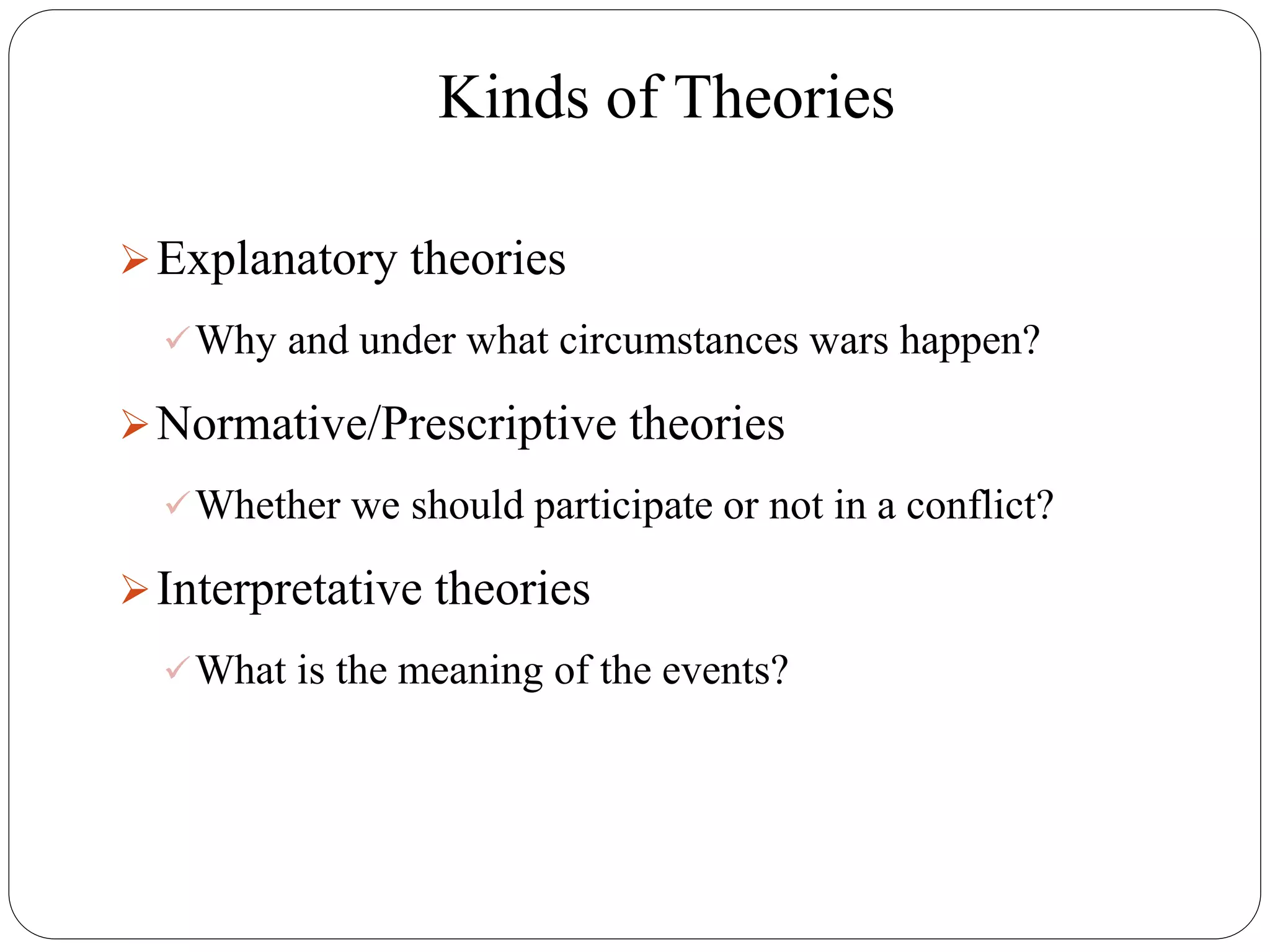
Kinds of Theories
Explanatory theories
Why and under what circumstances wars happen?
Normative/Prescriptive theories
Whether we should participate or not in a conflict?
Interpretative theories
What is the meaning of the events?
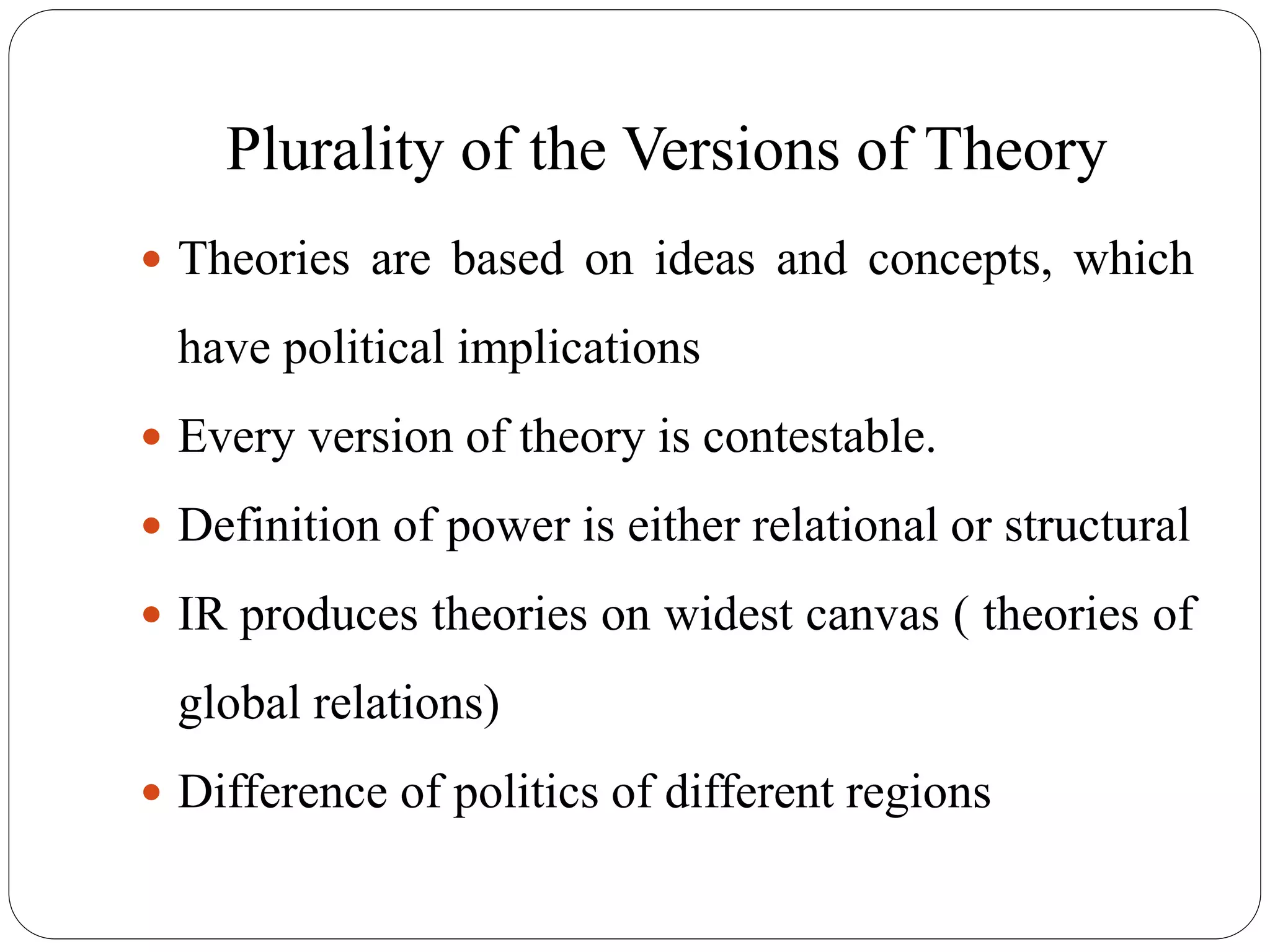
Plurality of the Versions of Theory
 Theories are based on ideas and concepts, which
have political implications
 Every version of theory is contestable.
 Definition of power is either relational or structural
 IR produces theories on widest canvas ( theories of
global relations)
 Difference of politics of different regions
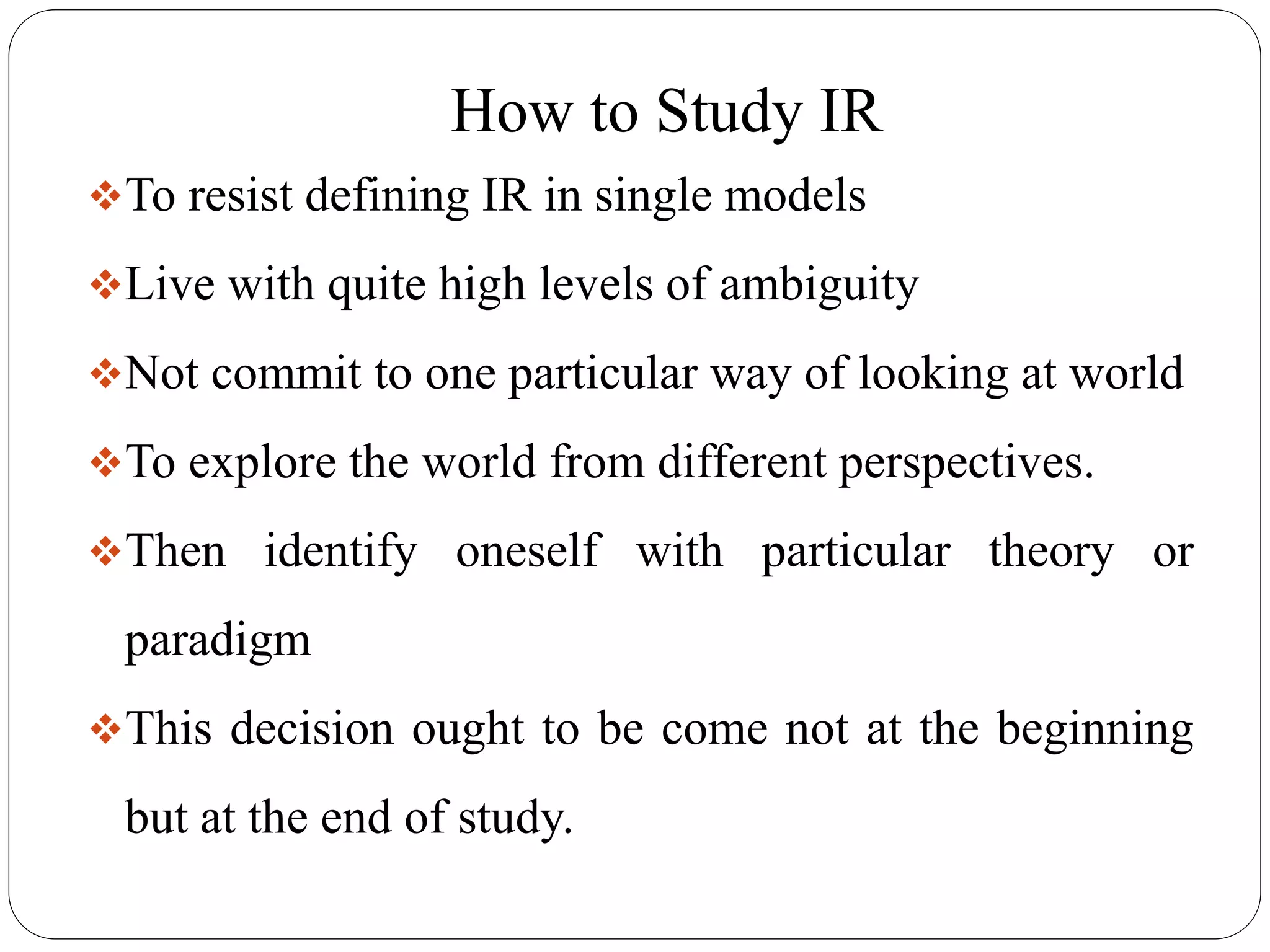
How to Study IR
To resist defining IR in single models
Live with quite high levels of ambiguity
Not commit to one particular way of looking at world
To explore the world from different perspectives.
Then identify oneself with particular theory or
paradigm
This decision ought to be come not at the beginning
but at the end of study.
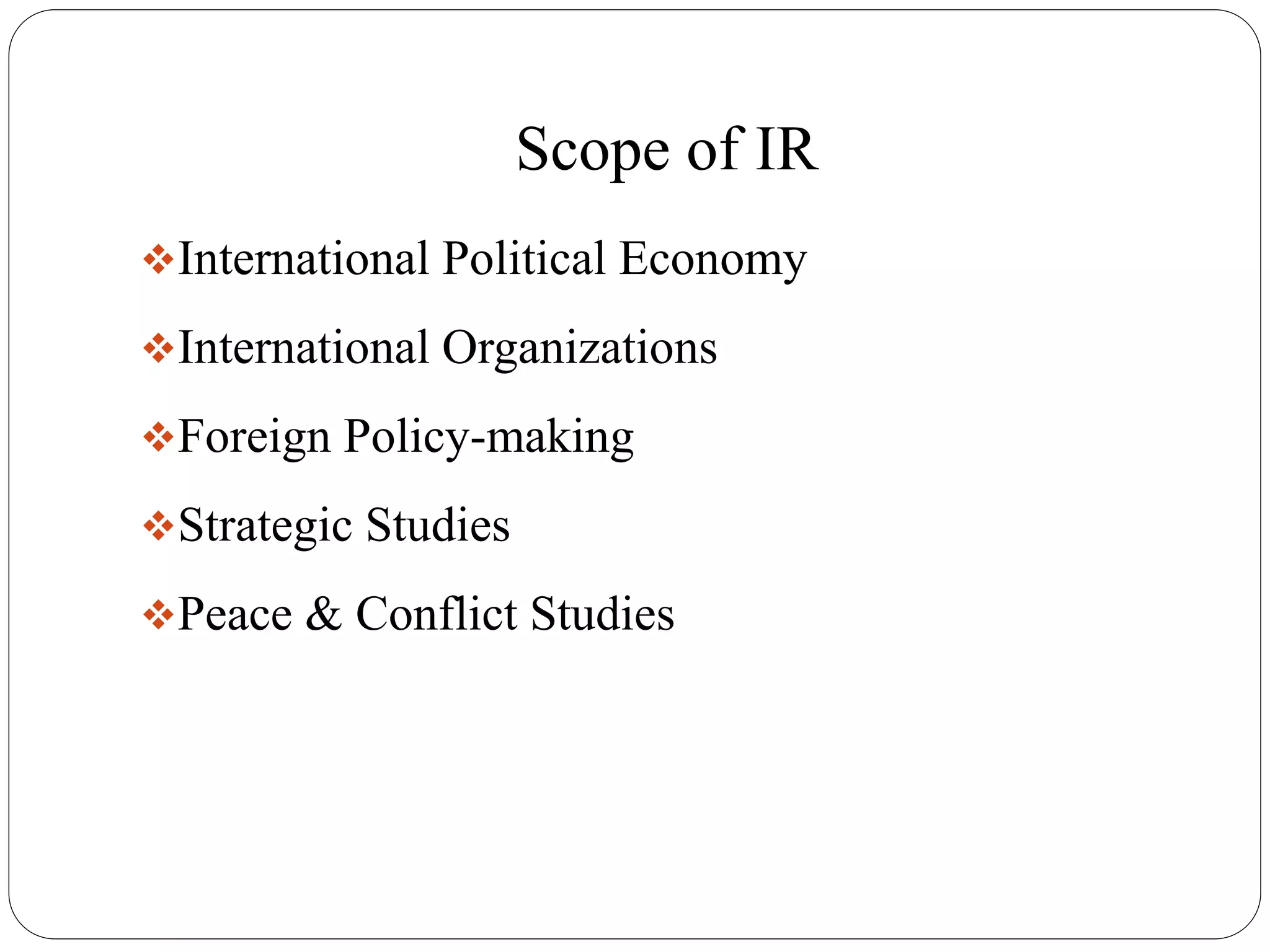
Scope of IR
International Political Economy
International Organizations
Foreign Policy-making
Strategic Studies
Peace & Conflict Studies
Historical Development
“international relations”
Traced back to the peace of Westphalia of 1648
Development of Modern State system
Institution of legal concept of Sovereignty
Rise of independent Nation States
Institutionalization of Diplomacy and Army
Exported to Africa, Americas and Asia via Colonialism &
“Standards of Civilizations”
Theoretical Development
“International Relations-IR”
IR as distinct field of study is entirely British-
centered
IR theorizing begins in early 20th century
The great Illusion by Norman Angell (1909)
1919: Chair in International Politics at the
University of Wales
1920’s: First IR department established at the
London School of Economics

Introduction to INTERNATIONAL RELATIONS

  • 1.
    Theories of International Relations BilalAslam Department of Politics & IR Lahore Leads University
  • 2.
    Defining International Relations IR means the diplomatic-strategic relations of states  Focus of study are issues of war and peace  IR is the study of cross-broader transactions of all kinds, political, economic and social  Focus is on trade negotiations and operations of non- state institutions  IR is the study of globalization.  Focus of study is on World communication, transport and financial system.
  • 3.
    Why IR hasno single definition? Interplay between real world and the world of knowledge IR subject matter is not self defining Nature of politics is also contested Definitions reflect the interests of scholars. Definitions are not politically neutral
  • 4.
    Features of ConventionalDefinitions State sovereignty Anarchy- No centralized authority at global level Study issues of war, peace and security Main focus is on International Politics
  • 5.
    Assessment Each definition hasits particular take Limiting principle: IR is the study of cross-border transactions in general The nature of these transactions to be interpreted by scholars
  • 6.
    Summarized Definition Study offoreign affairs and global issues among states within the international system, including the roles of States, Inter-governmental Organizations (IGO’s), Non-governmental Organizations (NGO’s), and Multinational Corporations (MNCs)
  • 7.
    Role of Theory Theory:Thinking in-depth in an abstract way to express reflective thought. Questions for theory  How things work?  Why things happen?  What something or other mean?  What we should do?
  • 8.
    How Theory Helps? Obvious/unobviousphenomena  People run out of a burning building  Why people run into burning building?  Wars are fought on the basis of cost-benefit analysis (self defence, security)  Why wars are fought when costs are more than benefits?
  • 9.
    Kinds of Theories Explanatorytheories Why and under what circumstances wars happen? Normative/Prescriptive theories Whether we should participate or not in a conflict? Interpretative theories What is the meaning of the events?
  • 10.
    Plurality of theVersions of Theory  Theories are based on ideas and concepts, which have political implications  Every version of theory is contestable.  Definition of power is either relational or structural  IR produces theories on widest canvas ( theories of global relations)  Difference of politics of different regions
  • 11.
    How to StudyIR To resist defining IR in single models Live with quite high levels of ambiguity Not commit to one particular way of looking at world To explore the world from different perspectives. Then identify oneself with particular theory or paradigm This decision ought to be come not at the beginning but at the end of study.
  • 12.
    Scope of IR InternationalPolitical Economy International Organizations Foreign Policy-making Strategic Studies Peace & Conflict Studies
  • 13.
    Historical Development “international relations” Tracedback to the peace of Westphalia of 1648 Development of Modern State system Institution of legal concept of Sovereignty Rise of independent Nation States Institutionalization of Diplomacy and Army Exported to Africa, Americas and Asia via Colonialism & “Standards of Civilizations”
  • 14.
    Theoretical Development “International Relations-IR” IRas distinct field of study is entirely British- centered IR theorizing begins in early 20th century The great Illusion by Norman Angell (1909) 1919: Chair in International Politics at the University of Wales 1920’s: First IR department established at the London School of Economics