GENETIC MARKERS
IN PLANT BREEDING
Marker
 Gene of known function and location
 Gene that allows studying the inheritance of that gene
 Genetic information resides in the genome
Genetic Marker
Any phenotypic difference controlled by genes, that can be
used for studying recombination processes or selection of a more
or less closely associated target gene
Anything in the genome that is variable and can be used to
compare individuals
Detectable allelic variation on a chromosome can be a
phenotype, can also be a unique detectable sequence of DNA
Genetic Marker
 Morphological marker
 Molecular marker
1. Protein marker
2. DNA marker
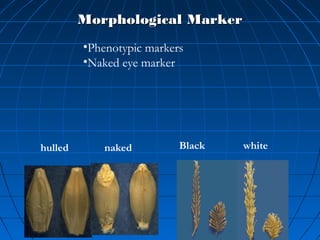
Morphological MarkerMorphological Marker
hulled naked Black white
•Phenotypic markers
•Naked eye marker
Readily detectable sequence of protein or DNA that are closely
linked to a gene locus and/or a morphological or other characters
of a plant
Readily detectable sequence of protein or DNA whose inheritance
can be monitored and associated with the trait inheritance
independently from the environment
Molecular Markers
Types:
a) protein polymorphisms
b) DNA polymorphisms
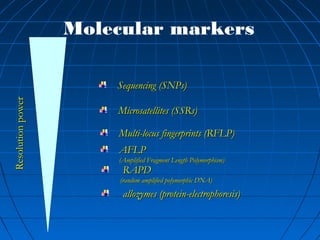
Molecular markers
ResolutionResolutionpowerpower
allozymes (protein-electrophoresis)allozymes (protein-electrophoresis)
RAPDRAPD
(random amplified polymorphic DNA)(random amplified polymorphic DNA)
AFLPAFLP
(Amplified Fragment Length Polymorphism)(Amplified Fragment Length Polymorphism)
Multi-locus fingerprints (RFLP)Multi-locus fingerprints (RFLP)
Microsatellites (SSRs)Microsatellites (SSRs)
SequencingSequencing (SNPs)(SNPs)
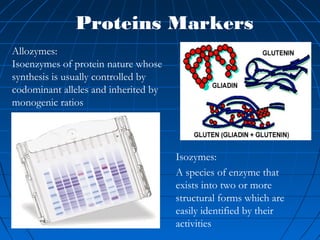
Allozymes:
Isoenzymes of protein nature whose
synthesis is usually controlled by
codominant alleles and inherited by
monogenic ratios
Isozymes:
A species of enzyme that
exists into two or more
structural forms which are
easily identified by their
activities
Proteins Markers
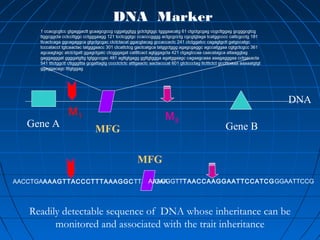
DNA
Gene A Gene B
AACCTGAAAAGTTACCCTTTAAAGGCTTAAGGAAAAAGGGTTTAACCAAGGAATTCCATCGGGAATTCCG
MFG
1 ccacgcgtcc gtgaggactt gcaagcgccg cggatggtgg gctctgtggc tgggaacatg 61 ctgctgcgag ccgcttggag gcgggcgtcg
ttggcggcta cctccttggc cctgggaagg 121 tcctcggtgc ccacccgggg actgcgcctg cgcgtgtaga tcatggcccc cattcgcctg 181
ttcactcaga ggcagaggca gtgctgcgac ctctctacat ggacgtacag gccaccactc 241 ctctggatcc cagagtgctt gatgccatgc
tcccatacct tgtcaactac tatgggaacc 301 ctcattctcg gactcatgca tatggctggg agagcgaggc agccatggaa cgtgctcgcc 361
agcaagtagc atctctgatt ggagctgatc ctcgggagat cattttcact agtggagcta 421 ctgagtccaa caacatagca attaaggtag
gaggagggat ggggatgttg tgtggccgac 481 agttgtgagg ggttgtggga agatggaagc cagaagcaaa aaagagggaa cctgacacta
541 tttctggctt cttgggttta gcgattagtg cccctctctc atttgaactc aactacccat 601 gtctccctag ttctttctct gcctttaaaa aaaaatgtgt
ggaggacagc tttgtggag
MFG
DNA Marker
M1 M2
Readily detectable sequence of DNA whose inheritance can be
monitored and associated with the trait inheritance
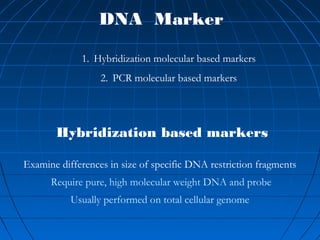
Hybridization based markers
Examine differences in size of specific DNA restriction fragments
Usually performed on total cellular genome
Require pure, high molecular weight DNA and probe
DNA Marker
1. Hybridization molecular based markers
2. PCR molecular based markers
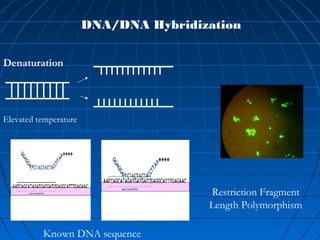
DNA/DNA Hybridization
Denaturation
Elevated temperature
Known DNA sequence
Restriction Fragment
Length Polymorphism
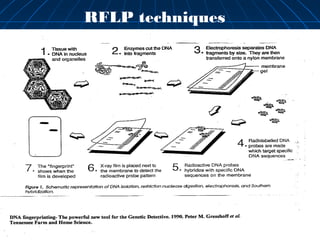
RFLP techniques
3
6
2
61 2 43 5
4
5
1
MFG
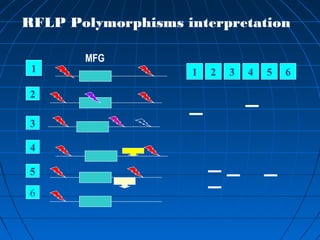
RFLP Polymorphisms interpretation
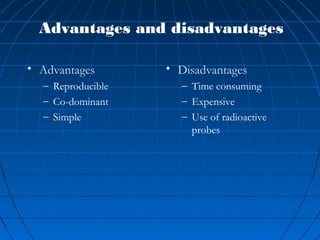
Advantages and disadvantages
• Advantages
– Reproducible
– Co-dominant
– Simple
• Disadvantages
– Time consuming
– Expensive
– Use of radioactive
probes
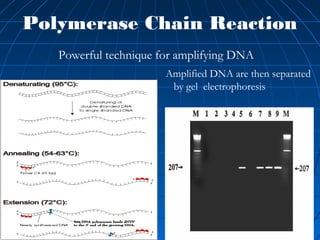
Polymerase Chain Reaction
Powerful technique for amplifying DNA
Amplified DNA are then separated
by gel electrophoresis
PCR Based markersPCR Based markers
Sequencing (SNPs)
Microsatellites (SSR)
AFLP (Amplified Fragment Length
Polymorphism)
RAPD (random amplified polymorphic DNA)
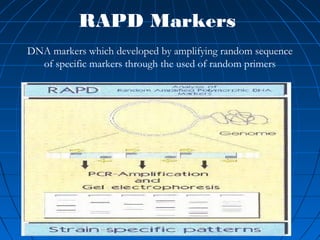
RAPD Markers
DNA markers which developed by amplifying random sequence
of specific markers through the used of random primers
RAPD
Disadvantages:
 Dominant markers
 Reproducibility problems
Advantages:
Amplifies anonymous stretches of DNA using arbitrary primers
Fast and easy method for detecting polymorphisms
RAPD Markers
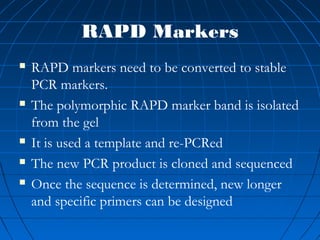
 RAPD markers need to be converted to stable
PCR markers.
 The polymorphic RAPD marker band is isolated
from the gel
 It is used a template and re-PCRed
 The new PCR product is cloned and sequenced
 Once the sequence is determined, new longer
and specific primers can be designed
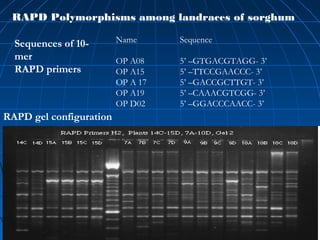
RAPD Polymorphisms among landraces of sorghum
M
Sequences of 10-
mer
RAPD primers
Name Sequence
OP A08 5’ –GTGACGTAGG- 3’
OP A15 5’ –TTCCGAACCC- 3’
OP A 17 5’ –GACCGCTTGT- 3’
OP A19 5’ –CAAACGTCGG- 3’
OP D02 5’ –GGACCCAACC- 3’
RAPD gel configuration
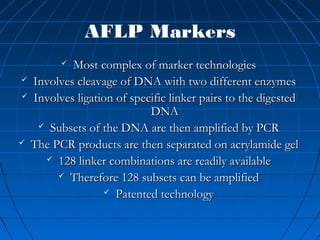
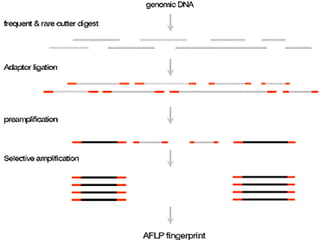
AFLP Markers
 Most complex of marker technologiesMost complex of marker technologies
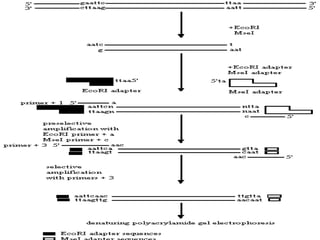
 Involves cleavage of DNA with two different enzymesInvolves cleavage of DNA with two different enzymes
 Involves ligation of specific linker pairs to the digestedInvolves ligation of specific linker pairs to the digested
DNADNA
 Subsets of the DNA are then amplified by PCRSubsets of the DNA are then amplified by PCR
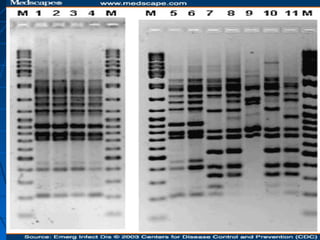
 The PCR products are then separated on acrylamide gelThe PCR products are then separated on acrylamide gel
 128 linker combinations are readily available128 linker combinations are readily available
 Therefore 128 subsets can be amplifiedTherefore 128 subsets can be amplified
 Patented technologyPatented technology
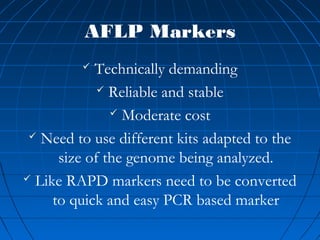
AFLP Markers
 Technically demanding
 Reliable and stable
 Moderate cost
 Need to use different kits adapted to the
size of the genome being analyzed.
 Like RAPD markers need to be converted
to quick and easy PCR based marker
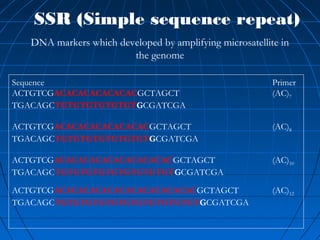
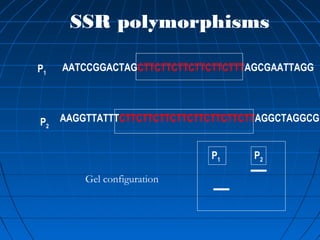
SSR (Simple sequence repeat)
DNA markers which developed by amplifying microsatellite in
the genome
Sequence Primer
ACTGTCGACACACACACACACGCTAGCT (AC)7
TGACAGCTGTGTGTGTGTGTGCGATCGA
ACTGTCGACACACACACACACACGCTAGCT (AC)8
TGACAGCTGTGTGTGTGTGTGTGCGATCGA
ACTGTCGACACACACACACACACACACGCTAGCT (AC)10
TGACAGCTGTGTGTGTGTGTGTGTGTGCGATCGA
ACTGTCGACACACACACACACACACACACACGCTAGCT (AC)12
TGACAGCTGTGTGTGTGTGTGTGTGTGTGTGCGATCGA
AATCCGGACTAGCTTCTTCTTCTTCTTCTTTAGCGAATTAGGP1
AAGGTTATTTCTTCTTCTTCTTCTTCTTCTTCTTAGGCTAGGCGP2
P1 P2
SSR polymorphisms
Gel configuration
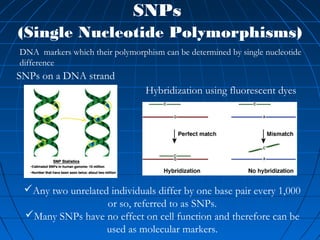
SNPs
(Single Nucleotide Polymorphisms)
Any two unrelated individuals differ by one base pair every 1,000
or so, referred to as SNPs.
Many SNPs have no effect on cell function and therefore can be
used as molecular markers.
Hybridization using fluorescent dyes
SNPs on a DNA strand
DNA markers which their polymorphism can be determined by single nucleotide
difference
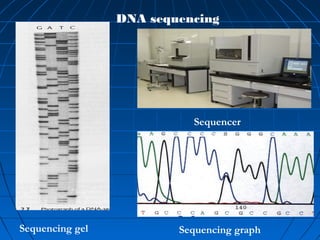
DNA sequencing
Sequencing gel
Sequencer
Sequencing graph
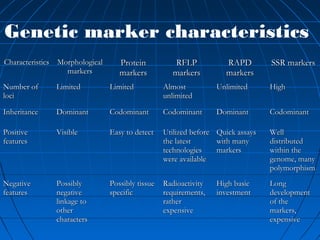
Genetic marker characteristics
CharacteristicsCharacteristics MorphologicalMorphological
markersmarkers
ProteinProtein
markersmarkers
RFLPRFLP
markersmarkers
RAPDRAPD
markersmarkers
SSR markersSSR markers
Number ofNumber of
lociloci
LimitedLimited LimitedLimited AlmostAlmost
unlimitedunlimited
UnlimitedUnlimited HighHigh
InheritanceInheritance DominantDominant CodominantCodominant CodominantCodominant DominantDominant CodominantCodominant
PositivePositive
featuresfeatures
VisibleVisible Easy to detectEasy to detect Utilized beforeUtilized before
the latestthe latest
technologiestechnologies
were availablewere available
Quick assaysQuick assays
with manywith many
markersmarkers
WellWell
distributeddistributed
within thewithin the
genome, manygenome, many
polymorphismpolymorphism
NegativeNegative
featuresfeatures
PossiblyPossibly
negativenegative
linkage tolinkage to
otherother
characterscharacters
Possibly tissuePossibly tissue
specificspecific
RadioactivityRadioactivity
requirements,requirements,
ratherrather
expensiveexpensive
High basicHigh basic
investmentinvestment
LongLong
developmentdevelopment
of theof the
markers,markers,
expensiveexpensive
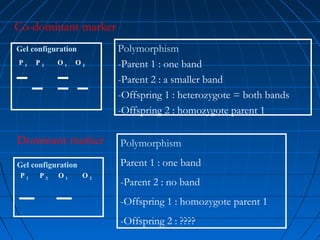
Polymorphism
-Parent 1 : one band
-Parent 2 : a smaller band
-Offspring 1 : heterozygote = both bands
-Offspring 2 : homozygote parent 1
Polymorphism
Parent 1 : one band
-Parent 2 : no band
-Offspring 1 : homozygote parent 1
-Offspring 2 : ????
P 2P 1 O 2O 1
Gel configuration
Co-dominant marker
P 2
Gel configuration
P 1 O 1 O 2
Dominant marker
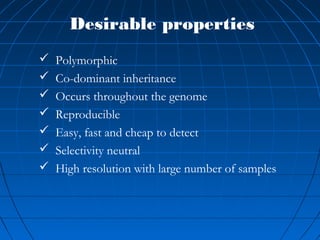
 Polymorphic
 Co-dominant inheritance
 Occurs throughout the genome
 Reproducible
 Easy, fast and cheap to detect
 Selectivity neutral
 High resolution with large number of samples
Desirable properties

Molecular markers

  • 1.
  • 2.
    Marker  Gene ofknown function and location  Gene that allows studying the inheritance of that gene  Genetic information resides in the genome Genetic Marker Any phenotypic difference controlled by genes, that can be used for studying recombination processes or selection of a more or less closely associated target gene Anything in the genome that is variable and can be used to compare individuals Detectable allelic variation on a chromosome can be a phenotype, can also be a unique detectable sequence of DNA
  • 3.
    Genetic Marker  Morphologicalmarker  Molecular marker 1. Protein marker 2. DNA marker
  • 4.
    Morphological MarkerMorphological Marker hullednaked Black white •Phenotypic markers •Naked eye marker
  • 5.
    Readily detectable sequenceof protein or DNA that are closely linked to a gene locus and/or a morphological or other characters of a plant Readily detectable sequence of protein or DNA whose inheritance can be monitored and associated with the trait inheritance independently from the environment Molecular Markers Types: a) protein polymorphisms b) DNA polymorphisms
  • 6.
    Molecular markers ResolutionResolutionpowerpower allozymes (protein-electrophoresis)allozymes(protein-electrophoresis) RAPDRAPD (random amplified polymorphic DNA)(random amplified polymorphic DNA) AFLPAFLP (Amplified Fragment Length Polymorphism)(Amplified Fragment Length Polymorphism) Multi-locus fingerprints (RFLP)Multi-locus fingerprints (RFLP) Microsatellites (SSRs)Microsatellites (SSRs) SequencingSequencing (SNPs)(SNPs)
  • 7.
    Allozymes: Isoenzymes of proteinnature whose synthesis is usually controlled by codominant alleles and inherited by monogenic ratios Isozymes: A species of enzyme that exists into two or more structural forms which are easily identified by their activities Proteins Markers
  • 8.
    DNA Gene A GeneB AACCTGAAAAGTTACCCTTTAAAGGCTTAAGGAAAAAGGGTTTAACCAAGGAATTCCATCGGGAATTCCG MFG 1 ccacgcgtcc gtgaggactt gcaagcgccg cggatggtgg gctctgtggc tgggaacatg 61 ctgctgcgag ccgcttggag gcgggcgtcg ttggcggcta cctccttggc cctgggaagg 121 tcctcggtgc ccacccgggg actgcgcctg cgcgtgtaga tcatggcccc cattcgcctg 181 ttcactcaga ggcagaggca gtgctgcgac ctctctacat ggacgtacag gccaccactc 241 ctctggatcc cagagtgctt gatgccatgc tcccatacct tgtcaactac tatgggaacc 301 ctcattctcg gactcatgca tatggctggg agagcgaggc agccatggaa cgtgctcgcc 361 agcaagtagc atctctgatt ggagctgatc ctcgggagat cattttcact agtggagcta 421 ctgagtccaa caacatagca attaaggtag gaggagggat ggggatgttg tgtggccgac 481 agttgtgagg ggttgtggga agatggaagc cagaagcaaa aaagagggaa cctgacacta 541 tttctggctt cttgggttta gcgattagtg cccctctctc atttgaactc aactacccat 601 gtctccctag ttctttctct gcctttaaaa aaaaatgtgt ggaggacagc tttgtggag MFG DNA Marker M1 M2 Readily detectable sequence of DNA whose inheritance can be monitored and associated with the trait inheritance
  • 9.
    Hybridization based markers Examinedifferences in size of specific DNA restriction fragments Usually performed on total cellular genome Require pure, high molecular weight DNA and probe DNA Marker 1. Hybridization molecular based markers 2. PCR molecular based markers
  • 10.
    DNA/DNA Hybridization Denaturation Elevated temperature KnownDNA sequence Restriction Fragment Length Polymorphism
  • 11.
  • 12.
    3 6 2 61 2 435 4 5 1 MFG RFLP Polymorphisms interpretation
  • 13.
    Advantages and disadvantages •Advantages – Reproducible – Co-dominant – Simple • Disadvantages – Time consuming – Expensive – Use of radioactive probes
  • 14.
    Polymerase Chain Reaction Powerfultechnique for amplifying DNA Amplified DNA are then separated by gel electrophoresis
  • 15.
    PCR Based markersPCRBased markers Sequencing (SNPs) Microsatellites (SSR) AFLP (Amplified Fragment Length Polymorphism) RAPD (random amplified polymorphic DNA)
  • 16.
    RAPD Markers DNA markerswhich developed by amplifying random sequence of specific markers through the used of random primers
  • 17.
    RAPD Disadvantages:  Dominant markers Reproducibility problems Advantages: Amplifies anonymous stretches of DNA using arbitrary primers Fast and easy method for detecting polymorphisms
  • 18.
    RAPD Markers  RAPDmarkers need to be converted to stable PCR markers.  The polymorphic RAPD marker band is isolated from the gel  It is used a template and re-PCRed  The new PCR product is cloned and sequenced  Once the sequence is determined, new longer and specific primers can be designed
  • 19.
    RAPD Polymorphisms amonglandraces of sorghum M Sequences of 10- mer RAPD primers Name Sequence OP A08 5’ –GTGACGTAGG- 3’ OP A15 5’ –TTCCGAACCC- 3’ OP A 17 5’ –GACCGCTTGT- 3’ OP A19 5’ –CAAACGTCGG- 3’ OP D02 5’ –GGACCCAACC- 3’ RAPD gel configuration
  • 20.
    AFLP Markers  Mostcomplex of marker technologiesMost complex of marker technologies  Involves cleavage of DNA with two different enzymesInvolves cleavage of DNA with two different enzymes  Involves ligation of specific linker pairs to the digestedInvolves ligation of specific linker pairs to the digested DNADNA  Subsets of the DNA are then amplified by PCRSubsets of the DNA are then amplified by PCR  The PCR products are then separated on acrylamide gelThe PCR products are then separated on acrylamide gel  128 linker combinations are readily available128 linker combinations are readily available  Therefore 128 subsets can be amplifiedTherefore 128 subsets can be amplified  Patented technologyPatented technology
  • 24.
    AFLP Markers  Technicallydemanding  Reliable and stable  Moderate cost  Need to use different kits adapted to the size of the genome being analyzed.  Like RAPD markers need to be converted to quick and easy PCR based marker
  • 25.
    SSR (Simple sequencerepeat) DNA markers which developed by amplifying microsatellite in the genome Sequence Primer ACTGTCGACACACACACACACGCTAGCT (AC)7 TGACAGCTGTGTGTGTGTGTGCGATCGA ACTGTCGACACACACACACACACGCTAGCT (AC)8 TGACAGCTGTGTGTGTGTGTGTGCGATCGA ACTGTCGACACACACACACACACACACGCTAGCT (AC)10 TGACAGCTGTGTGTGTGTGTGTGTGTGCGATCGA ACTGTCGACACACACACACACACACACACACGCTAGCT (AC)12 TGACAGCTGTGTGTGTGTGTGTGTGTGTGTGCGATCGA
  • 26.
  • 27.
    SNPs (Single Nucleotide Polymorphisms) Anytwo unrelated individuals differ by one base pair every 1,000 or so, referred to as SNPs. Many SNPs have no effect on cell function and therefore can be used as molecular markers. Hybridization using fluorescent dyes SNPs on a DNA strand DNA markers which their polymorphism can be determined by single nucleotide difference
  • 28.
  • 29.
    Genetic marker characteristics CharacteristicsCharacteristicsMorphologicalMorphological markersmarkers ProteinProtein markersmarkers RFLPRFLP markersmarkers RAPDRAPD markersmarkers SSR markersSSR markers Number ofNumber of lociloci LimitedLimited LimitedLimited AlmostAlmost unlimitedunlimited UnlimitedUnlimited HighHigh InheritanceInheritance DominantDominant CodominantCodominant CodominantCodominant DominantDominant CodominantCodominant PositivePositive featuresfeatures VisibleVisible Easy to detectEasy to detect Utilized beforeUtilized before the latestthe latest technologiestechnologies were availablewere available Quick assaysQuick assays with manywith many markersmarkers WellWell distributeddistributed within thewithin the genome, manygenome, many polymorphismpolymorphism NegativeNegative featuresfeatures PossiblyPossibly negativenegative linkage tolinkage to otherother characterscharacters Possibly tissuePossibly tissue specificspecific RadioactivityRadioactivity requirements,requirements, ratherrather expensiveexpensive High basicHigh basic investmentinvestment LongLong developmentdevelopment of theof the markers,markers, expensiveexpensive
  • 30.
    Polymorphism -Parent 1 :one band -Parent 2 : a smaller band -Offspring 1 : heterozygote = both bands -Offspring 2 : homozygote parent 1 Polymorphism Parent 1 : one band -Parent 2 : no band -Offspring 1 : homozygote parent 1 -Offspring 2 : ???? P 2P 1 O 2O 1 Gel configuration Co-dominant marker P 2 Gel configuration P 1 O 1 O 2 Dominant marker
  • 31.
     Polymorphic  Co-dominantinheritance  Occurs throughout the genome  Reproducible  Easy, fast and cheap to detect  Selectivity neutral  High resolution with large number of samples Desirable properties