‫الرحیم‬ ‫الرحمن‬ ‫هللا‬ ‫بسم‬
NORMAL WAVE PATTERNS
OF JVP AND THEIR
VARIATIONS
PATTERN AND MECHANISM
JUGULAR VENOUS PRESSURE (JVP)
Definition
• Jugular venous pulse is the oscillating top of a height of venous blood in the internal
jugular vein that faithfully reflects the pressure and hemodynamic changes in the right
side of heart in all phases of the cardiac cycle.
Significance
• Two main objectives of examining the JVP are the following:
• Estimation of jugular venous pressure
• Study the waveform
JUGULAR VENOUS PRESSURE
• Jugular venous pressure is expressed as the vertical distance in centimeters between the top of the
venous column and the sternal angle, regardless of the body position. Normally, it is less than 3 cm. By
convention, jugular venous pressure is measured from the sternal angle with the patient reclining at 45°.
• Central venous pressure can be accurately estimated from the jugular venous pressure. For this, the
sternal angle is taken as the reference point. The center of the right atrium lies 5 cm below the sternal
angle, regardless of body position. The central venous pressure is calculated as 5 + jugular venous pressure
in centimeters (e.g. if jugular venous pressure is 6 cm, the central venous pressure = 5 + 6 = 11 cm of
blood).
• In other words, jugular venous pressure reflects the central venous pressure and also the mean right
atrial pressure.
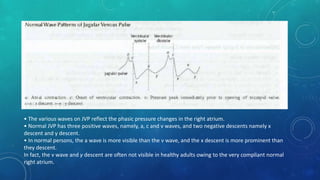
• The various waves on JVP reflect the phasic pressure changes in the right atrium.
• Normal JVP has three positive waves, namely, a, c and v waves, and two negative descents namely x
descent and y descent.
• In normal persons, the a wave is more visible than the v wave, and the x descent is more prominent than
they descent.
In fact, the v wave and y descent are often not visible in healthy adults owing to the very compliant normal
right atrium.
MECHANISM
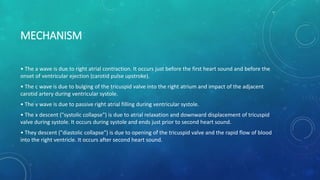
• The a wave is due to right atrial contraction. It occurs just before the first heart sound and before the
onset of ventricular ejection (carotid pulse upstroke).
• The c wave is due to bulging of the tricuspid valve into the right atrium and impact of the adjacent
carotid artery during ventricular systole.
• The v wave is due to passive right atrial filling during ventricular systole.
• The x descent ("systolic collapse") is due to atrial relaxation and downward displacement of tricuspid
valve during systole. It occurs during systole and ends just prior to second heart sound.
• They descent ("diastolic collapse") is due to opening of the tricuspid valve and the rapid flow of blood
into the right ventricle. It occurs after second heart sound.
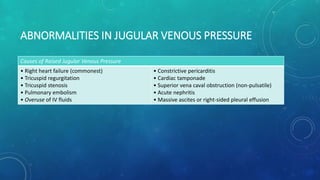
ABNORMALITIES IN JUGULAR VENOUS PRESSURE
Causes of Raised Jugular Venous Pressure
• Right heart failure (commonest)
• Tricuspid regurgitation
• Tricuspid stenosis
• Pulmonary embolism
• Overuse of IV fluids
• Constrictive pericarditis
• Cardiac tamponade
• Superior vena caval obstruction (non-pulsatile)
• Acute nephritis
• Massive ascites or right-sided pleural effusion
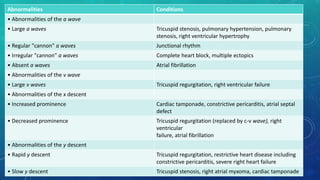
ABNORMALITIES IN WAVE FORMAbnormalities Conditions
• Abnormalities of the a wave
• Large a waves Tricuspid stenosis, pulmonary hypertension, pulmonary
stenosis, right ventricular hypertrophy
• Regular "cannon" a waves Junctional rhythm
• Irregular "cannon" a waves Complete heart block, multiple ectopics
• Absent a waves Atrial fibrillation
• Abnormalities of the v wave
• Large v waves Tricuspid regurgitation, right ventricular failure
• Abnormalities of the x descent
• Increased prominence Cardiac tamponade, constrictive pericarditis, atrial septal
defect
• Decreased prominence Tricuspid regurgitation (replaced by c-v wave), right
ventricular
failure, atrial fibrillation
• Abnormalities of the y descent
• Rapid y descent Tricuspid regurgitation, restrictive heart disease including
constrictive pericarditis, severe right heart failure
• Slow y descent Tricuspid stenosis, right atrial myxoma, cardiac tamponade
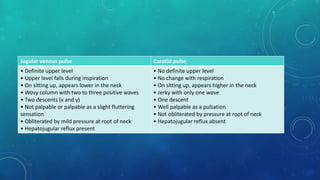
Jugular venous pulse Carotid pulse
• Definite upper level
• Upper level falls during inspiration
• On sitting up, appears lower in the neck
• Wavy column with two to three positive waves
• Two descents (x and y)
• Not palpable or palpable as a slight fluttering
sensation
• Obliterated by mild pressure at root of neck
• Hepatojugular reflux present
• No definite upper level
• No change with respiration
• On sitting up, appears higher in the neck
• Jerky with only one wave
• One descent
• Well palpable as a pulsation
• Not obliterated by pressure at root of neck
• Hepatojugular reflux absent
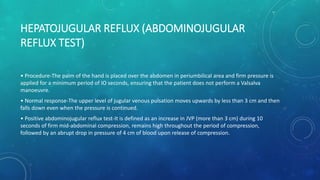
HEPATOJUGULAR REFLUX (ABDOMINOJUGULAR
REFLUX TEST)
• Procedure-The palm of the hand is placed over the abdomen in periumbilical area and firm pressure is
applied for a minimum period of IO seconds, ensuring that the patient does not perform a Valsalva
manoeuvre.
• Normal response-The upper level of jugular venous pulsation moves upwards by less than 3 cm and then
falls down even when the pressure is continued.
• Positive abdominojugular reflux test-It is defined as an increase in JVP (more than 3 cm) during 10
seconds of firm mid-abdominal compression, remains high throughout the period of compression,
followed by an abrupt drop in pressure of 4 cm of blood upon release of compression.
CLINICAL SIGNIFICANCE
• It is positive in early or incipient right heart failure.
• Abdominojugular reflux test is positive in right heart failure, secondary to elevated left heart filling
pressures.
• With hepatojugular reflux, the typical JVP of tricuspid regurgitation can be elicited even when the resting
pulse wave is normal
• During abdominojugular reflux testing, the upper level of JVP does not move upward at all in inferior
vena caval obstruction and Budd---Chiari syndrome (hepatic vein occlusion).
KUSSMAUL'S SIGN
• Normally, there is a decrease in the height of jugular venous pulsations and a drop in jugular venous pressure
during inspiration.
• Kussmaul's sign is an increase in the height of jugular venous pulsations and hence a rise in jugular venous
pressure (central venous pressure) during inspiration.
• Kussmaul's sign is seen in the following conditions:
• Constrictive pericarditis
• Restrictive cardiomyopathy
• Severe right-sided heart failure
• Right ventricular infarction
• Acute severe asthma
• Pulmonary embolism

JVP

  • 1.
  • 2.
    NORMAL WAVE PATTERNS OFJVP AND THEIR VARIATIONS PATTERN AND MECHANISM
  • 3.
    JUGULAR VENOUS PRESSURE(JVP) Definition • Jugular venous pulse is the oscillating top of a height of venous blood in the internal jugular vein that faithfully reflects the pressure and hemodynamic changes in the right side of heart in all phases of the cardiac cycle. Significance • Two main objectives of examining the JVP are the following: • Estimation of jugular venous pressure • Study the waveform
  • 4.
    JUGULAR VENOUS PRESSURE •Jugular venous pressure is expressed as the vertical distance in centimeters between the top of the venous column and the sternal angle, regardless of the body position. Normally, it is less than 3 cm. By convention, jugular venous pressure is measured from the sternal angle with the patient reclining at 45°. • Central venous pressure can be accurately estimated from the jugular venous pressure. For this, the sternal angle is taken as the reference point. The center of the right atrium lies 5 cm below the sternal angle, regardless of body position. The central venous pressure is calculated as 5 + jugular venous pressure in centimeters (e.g. if jugular venous pressure is 6 cm, the central venous pressure = 5 + 6 = 11 cm of blood). • In other words, jugular venous pressure reflects the central venous pressure and also the mean right atrial pressure.
  • 5.
    • The variouswaves on JVP reflect the phasic pressure changes in the right atrium. • Normal JVP has three positive waves, namely, a, c and v waves, and two negative descents namely x descent and y descent. • In normal persons, the a wave is more visible than the v wave, and the x descent is more prominent than they descent. In fact, the v wave and y descent are often not visible in healthy adults owing to the very compliant normal right atrium.
  • 6.
    MECHANISM • The awave is due to right atrial contraction. It occurs just before the first heart sound and before the onset of ventricular ejection (carotid pulse upstroke). • The c wave is due to bulging of the tricuspid valve into the right atrium and impact of the adjacent carotid artery during ventricular systole. • The v wave is due to passive right atrial filling during ventricular systole. • The x descent ("systolic collapse") is due to atrial relaxation and downward displacement of tricuspid valve during systole. It occurs during systole and ends just prior to second heart sound. • They descent ("diastolic collapse") is due to opening of the tricuspid valve and the rapid flow of blood into the right ventricle. It occurs after second heart sound.
  • 7.
    ABNORMALITIES IN JUGULARVENOUS PRESSURE Causes of Raised Jugular Venous Pressure • Right heart failure (commonest) • Tricuspid regurgitation • Tricuspid stenosis • Pulmonary embolism • Overuse of IV fluids • Constrictive pericarditis • Cardiac tamponade • Superior vena caval obstruction (non-pulsatile) • Acute nephritis • Massive ascites or right-sided pleural effusion
  • 8.
    ABNORMALITIES IN WAVEFORMAbnormalities Conditions • Abnormalities of the a wave • Large a waves Tricuspid stenosis, pulmonary hypertension, pulmonary stenosis, right ventricular hypertrophy • Regular "cannon" a waves Junctional rhythm • Irregular "cannon" a waves Complete heart block, multiple ectopics • Absent a waves Atrial fibrillation • Abnormalities of the v wave • Large v waves Tricuspid regurgitation, right ventricular failure • Abnormalities of the x descent • Increased prominence Cardiac tamponade, constrictive pericarditis, atrial septal defect • Decreased prominence Tricuspid regurgitation (replaced by c-v wave), right ventricular failure, atrial fibrillation • Abnormalities of the y descent • Rapid y descent Tricuspid regurgitation, restrictive heart disease including constrictive pericarditis, severe right heart failure • Slow y descent Tricuspid stenosis, right atrial myxoma, cardiac tamponade
  • 9.
    Jugular venous pulseCarotid pulse • Definite upper level • Upper level falls during inspiration • On sitting up, appears lower in the neck • Wavy column with two to three positive waves • Two descents (x and y) • Not palpable or palpable as a slight fluttering sensation • Obliterated by mild pressure at root of neck • Hepatojugular reflux present • No definite upper level • No change with respiration • On sitting up, appears higher in the neck • Jerky with only one wave • One descent • Well palpable as a pulsation • Not obliterated by pressure at root of neck • Hepatojugular reflux absent
  • 10.
    HEPATOJUGULAR REFLUX (ABDOMINOJUGULAR REFLUXTEST) • Procedure-The palm of the hand is placed over the abdomen in periumbilical area and firm pressure is applied for a minimum period of IO seconds, ensuring that the patient does not perform a Valsalva manoeuvre. • Normal response-The upper level of jugular venous pulsation moves upwards by less than 3 cm and then falls down even when the pressure is continued. • Positive abdominojugular reflux test-It is defined as an increase in JVP (more than 3 cm) during 10 seconds of firm mid-abdominal compression, remains high throughout the period of compression, followed by an abrupt drop in pressure of 4 cm of blood upon release of compression.
  • 11.
    CLINICAL SIGNIFICANCE • Itis positive in early or incipient right heart failure. • Abdominojugular reflux test is positive in right heart failure, secondary to elevated left heart filling pressures. • With hepatojugular reflux, the typical JVP of tricuspid regurgitation can be elicited even when the resting pulse wave is normal • During abdominojugular reflux testing, the upper level of JVP does not move upward at all in inferior vena caval obstruction and Budd---Chiari syndrome (hepatic vein occlusion).
  • 12.
    KUSSMAUL'S SIGN • Normally,there is a decrease in the height of jugular venous pulsations and a drop in jugular venous pressure during inspiration. • Kussmaul's sign is an increase in the height of jugular venous pulsations and hence a rise in jugular venous pressure (central venous pressure) during inspiration. • Kussmaul's sign is seen in the following conditions: • Constrictive pericarditis • Restrictive cardiomyopathy • Severe right-sided heart failure • Right ventricular infarction • Acute severe asthma • Pulmonary embolism