Dr. IHTISHAM SAHIL
BS RADIOLOGY
HIMS PESHAWAR
Dr. IHTISHAM SAHIL
BS RADIOLOGY
HIMS PESHAWAR
Mr. IHTISHAM UL
HAQ
BS Radiology
HAFEEZ INSTITUTE OF MEDICAL SCIENCE PESHAWAR
ECHO
CARDIOGRAPHY
Dr. IHTISHAM SAHIL
BS RADIOLOGY
HIMS PESHAWAR
Description
 It is a type of ultrasound test that uses high
pitched sound waves to produce an image of the
heart.
 The sound waves are sent through a device called
a transducer and are reflected off the various
structures of the heart.
 These echoes are converted into pictures of the
heart that can be seen on a video monitor.
Dr. IHTISHAM SAHIL
BS RADIOLOGY
HIMS PESHAWAR
COMPONENETS
 Pulse generator - applies high amplitude voltage
to energize the crystals.
 Transducer - converts electrical energy to
mechanical (ultrasound) energy and vice versa.
 Receiver - detects and amplifies weak signals.
 Display - displays ultrasound signals in a variety
of modes.
 Memory - stores video display .
Dr. IHTISHAM SAHIL
BS RADIOLOGY
HIMS PESHAWAR
INDICATION
 Heart Murmurs
 Native Valvular Stenosis
 Native Valvular Regurgitation
 Prosthetic Valve Assessment
 Infective Endocarditis
 Ischaemic Heart Disease - Known or
Suspected
Dr. IHTISHAM SAHIL
BS RADIOLOGY
HIMS PESHAWAR
INDICATIONS
 Cardiomyopathy
 Pericardial Disease
 Cardiac Masses
 Pulmonary Disease
 Neurological Disease
 Arrhythmia, Palpitations and Syncope
 Echocardiography Before Cardioversion
Dr. IHTISHAM SAHIL
BS RADIOLOGY
HIMS PESHAWAR
INDICATIONS
 Hypertension
 Aortic and Major Arterial Disease
 Pre-Operative Echocardiography for Elective
and Semi-urgent Surgery
 Ejection fraction
Dr. IHTISHAM SAHIL
BS RADIOLOGY
HIMS PESHAWAR
CONTRAINDICATIONS
 Echocardiography has no contraindications. It
should be kept in mind, however, that this
modality may yield only limited information in
patients at the extremes of adult body weight,
because a thick chest wall (in markedly obese
patients) or overcrowded ribs (in severely
underweight patients) may limit the penetration
of ultrasound waves.
Dr. IHTISHAM SAHIL
BS RADIOLOGY
HIMS PESHAWAR
Standard Echo Windows
 Standard positions on the chest wall
are used for placement of the
transducer called “echo windows
1. Suprasternal
2. Right parasternal
3. Left parasternal
4. Apical
5. Sub costal
Dr. IHTISHAM SAHIL
BS RADIOLOGY
HIMS PESHAWAR
Dr. IHTISHAM SAHIL
BS RADIOLOGY
HIMS PESHAWAR
Parasternal long-axis
view (PLAX)
 Pt Positioning: left lateral decubitus.
 transducer  positioning: placed near
the sternum in the left third or fourth intercostal
space .
 Marker dot direction: points towards
right shoulder.
 Closest structure to the
transducer.
The right ventricular outflow tract (RVOT),in
the upper site of the image. Dr. IHTISHAM SAHIL
BS RADIOLOGY
HIMS PESHAWAR
Parasternal long-axis
view (PLAX)
 Structures seen :
 – proximal aorta
 – aortic valve
 – left atrium
 – mitral valve
 – left ventricle
 – IV septum
 – posterior wall
 – right ventricle
 – pericardium.
Dr. IHTISHAM SAHIL
BS RADIOLOGY
HIMS PESHAWAR
Parasternal long-axis
view (PLAX)
 Most echo studies begin with this view. It sets the
stage for subsequent echo views.
Parasternal Short Axis View
(PSAX)
 Transducer position: left sternal edge;
2nd–4th space
 Marker dot direction: points towards left
shoulder (90° clockwise from PLAX).
 By tilting the transducer on an axis between
the left hip and right shoulder, short-axis cuts
are obtained at different levels, from the aorta
to the LV apex .
 This angulations of the transducer from the
base to apex of the heart for short-axis views
is known as “bread-loafing”.
Dr. IHTISHAM SAHIL
BS RADIOLOGY
HIMS PESHAWAR
Parasternal Short Axis View
(PSAX)
 Structure seen:
1. pulmonary artery
2. aortic valve level
3. mitral valve level
4. papillary muscle
5. left ventricle.
Dr. IHTISHAM SAHIL
BS RADIOLOGY
HIMS PESHAWAR
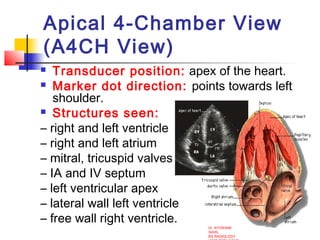
Apical 4-Chamber View
(A4CH View)
 Transducer position: apex of the heart.
 Marker dot direction: points towards left
shoulder.
 Structures seen:
– right and left ventricle
– right and left atrium
– mitral, tricuspid valves
– IA and IV septum
– left ventricular apex
– lateral wall left ventricle
– free wall right ventricle.
Dr. IHTISHAM
SAHIL
BS RADIOLOGY
Dr. IHTISHAM SAHIL
BS RADIOLOGY
HIMS PESHAWAR
Apical 5-Chamber View
(A5CH view)
 The A5CH view is obtained after the A4CH
view by slight downward tilting of the
transducer. The 5th chamber added is the left
ventricular outflow tract (LVOT).
 Transducer position: as in A4CH view.
 Marker dot direction: as in A4CH view.
 Structures seen:
— LV outflow tract
— aortic valve
— proximal aorta.
Dr. IHTISHAM SAHIL
BS RADIOLOGY
HIMS PESHAWAR
Dr. IHTISHAM SAHIL
BS RADIOLOGY
HIMS PESHAWAR
Sub costal View
 Pt position:
 The subject lies supine with the head held
slightly low, feet planted on the couch and the
knees slightly flexed.
 Better images are obtained with the abdomen
relaxed and during the phase of inspiration.
 Transducer position: under the
xiphisternum
 Marker dot position: points towards left
shoulder.
Dr. IHTISHAM SAHIL
BS RADIOLOGY
HIMS PESHAWAR
Sub costal View
 Structures seen:
 As in A4CH view.
The subcostal view is particularly useful when transthoracic E is
technically difficult because of the following reasons:
– severe morbid obesity
– chest wall deformity
– pulmonary emphysema.
 The following structures are better seen from the subcostal
view than from the apical 4-chamber view:
– inferior vena cava
– descending aorta
– interatrial septum
– pericardial effusion.
Dr. IHTISHAM SAHIL
BS RADIOLOGY
HIMS PESHAWAR
Dr. IHTISHAM SAHIL
BS RADIOLOGY
HIMS PESHAWAR
Suprasternal View
 Pt Position: he subject lies supine with the
neck hyperextended by placing a pillow under
the shoulders. The head is rotated slightly
towards the left. The position of arms or legs
and the phase of respiration have no bearing on
this echo window.
 Transducer position:suprasternal notch.
 Marker dot direction: points towards left jaw.
Dr. IHTISHAM SAHIL
BS RADIOLOGY
HIMS PESHAWAR
Suprasternal View
 Structures seen:
– ascending aorta
– pulmonary artery.
Dr. IHTISHAM SAHIL
BS RADIOLOGY
HIMS PESHAWAR
Echocardiography Types
Transthoracic echocardiogram
 Conventional echocardiography is performed from the anterior chest
wall (precordium) and is known as transthoracic echo.
 Echocardiography can also be performed from the esophagus which
is known as transesophageal echo.
 For transthoracic echo, the subject is asked to lie in the
semirecumbent position on his or her left side with the head slightly
elevated.
 The left arm is tucked under the head and the right arm lies along
the right side of the body.
 This position opens the intercostal spaces through which
echocardiography can be performed, while most of the heart is
masked from the ultrasound beam by the ribs.
Dr. IHTISHAM SAHIL
BS RADIOLOGY
HIMS PESHAWAR
 Better images are obtained during expiration when there is least
‘air-tissue’ interface.
 Ultrasound is transmitted from a transducer having a frequency
of 2.5 to 3.5 MHz for echo in adults.
 This frequency is used to study deep seated structures because
of better penetration. A transducer frequency of 5.0 MHz is
suitable for pediatric echo, since the heart is more superficial in
children.
 Ultrasound jelly is applied on the transducer and it is placed on
the chest at the site of an “echo window”.
 Most of the time, the left parasternal and apical windows are
routinely used.
 The transducer has a reference line or dot on one side, in order
to orient it in the correct direction, for obtaining various echo
views.
 The transducer is variably positioned, in terms of location and
direction, for different echo images.
 It can be tilted (superiorly or inferiorly), to bring into focus the
structure of interest and rotated (clockwise or anticlockwise), to
fine-tune the image.
Dr. IHTISHAM SAHIL
BS RADIOLOGY
HIMS PESHAWAR
Apical four chamber
Subcostal  
Various transthoracic
echocardiogram views
Dr. IHTISHAM SAHIL
BS RADIOLOGY
HIMS PESHAWAR
Left parasternal long axis
Apical two chamber
Dr. IHTISHAM SAHIL
BS RADIOLOGY
HIMS PESHAWAR
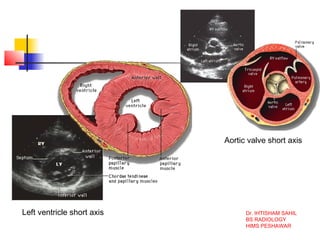
Left ventricle short axis
Aortic valve short axis
Dr. IHTISHAM SAHIL
BS RADIOLOGY
HIMS PESHAWAR
TRANSESOPHAGEAL
ECHO
Principle
 Anatomically speaking, the esophagus in its
mid-course is strategically located posterior to
the heart and anterior to the descending
aorta. This provides an opportunity to
interrogate the heart and related mediastinal
structures with a high frequency transducer
positioned in the esophagus for better image
resolution.
Dr. IHTISHAM SAHIL
BS RADIOLOGY
HIMS PESHAWAR
Technique
 A miniature transducer is mounted onto a probe or
gastroscope similar to the one employed for upper
gastrointestinal endoscopy. The scope is advanced
to various depths in the esophagus to examine
cardiac and related structures. By manoeuvring the
transducer and the angle of beam from controls on
the handle, different views of the heart are
obtained.
 This ‘back-door’ approach to echocardiography
has both advantages and disadvantages. Dr. IHTISHAM SAHIL
BS RADIOLOGY
HIMS PESHAWAR
Advantages
 Useful alternative to transthoracic echo if the latter is technically
difficult due to obesity, chest wall deformity, emphysema or
pulmonary fibrosis.
 Useful complement to transthoracic echo because of better
image quality and resolution due to two reasons:
– absence of acoustic barrier between the ultrasound beam and
the rib cage, chest wall and lung tissue.
– greater proximity to the heart and therefore the ability to use
higher frequency probe with vastly improved image quality and
precise spatial resolution.
 Useful supplement to transthoracic echo, which cannot
examine the posterior aspect of the heart. Structures suc as left
atrial appendage, descending aorta and pulmonary veins can
only be visualized by TEE.
Dr. IHTISHAM SAHIL
BS RADIOLOGY
HIMS PESHAWAR
Disadvantages
 The transesophageal echo (TEE) views are
significantly different from standard
transthoracic echo views. Novel TEE images
require a comprehensive understanding of
the spatial relationship between cardiac
structures.
 It requires short-term sedation, oxygen
administration and ECG monitoring since,
there are chances of hypoxia, arrhythmia and
angina. Rarely, respiratory depression or
allergic reactions may occur.
Dr. IHTISHAM SAHIL
BS RADIOLOGY
HIMS PESHAWAR
Complications with TEE
 Major
• Esophageal rupture or perforation
• Laryngospasm or bronchopasm
• Sustained ventricular tachycardia
 Minor
• Retching and vomiting
• Sore-throat and hoarseness
• Blood-tinged sputum
• Tachycardia or bradycardia
• Hypoxia and ischemia
• Transient BP rise or fall
Dr. IHTISHAM SAHIL
BS RADIOLOGY
HIMS PESHAWAR
Contraindications to TEE
 Absolute
• Uncooperative patient
• Poor cardiorespiratory status
• Esophageal obstruction
• Tracheoesophageal fistula
• Active bleed or coagulopathy
 Relative
• Large esophageal varices• Prior esophageal surgery
• Unstable cervical arthritis
• Atlantoaxial dislocation
Dr. IHTISHAM SAHIL
BS RADIOLOGY
HIMS PESHAWAR
Dr. IHTISHAM SAHIL
BS RADIOLOGY
HIMS PESHAWAR
Stress Echocardiography
 A stress echocardiography, also called an echocardiography
stress test or stress echo, is a procedure that determines 
how well your heart and blood vessels are working. During 
a stress echocardiography, you'll exercise on a treadmill or 
stationary bike while your doctor monitors your blood 
pressure and heart rhythm.
Technique:
 The echocardiogram is performed just prior and just
after the exercise. NPO for four hours before the test.
 Do not drink or eat caffeine products (cola, chocolate,
coffee, tea) for 24 hours before the test.
 Do not take any over-the-counter medications that
contain caffeine for 24 hours before the test.
Dr. IHTISHAM SAHIL
BS RADIOLOGY
HIMS PESHAWAR
 Do not take the following heart medications
for 24 hour before the test unless doctor tells
 Beta-blockers (for example, Tenormin,
Lopressor, Toprol, or Inderal) Isosorbide
dinitrate (for example, Isordil, Sorbitrate)
Isosorbide mononitrate (for example, Ismo,
Indur, Monoket) Nitroglycerin (for example,
Deponit, Nitrostat, Nitropatches)
 Do not discontinue any medication without
talking with doctor.
Continue
Dr. IHTISHAM SAHIL
BS RADIOLOGY
HIMS PESHAWAR
Dobutamine stress
echocardiogram
 A form of stress echocardiogram.
 Instead of exercising to stress the heart, the stress is obtained
by giving a drug that stimulates the heart an makes it "think" it is
exercising.
 The test is used to evaluate heart and valve function when
unable to exercise on a treadmill or stationary bike.
 It is also used to determine how well heart tolerate activity and
likelihood of having coronary artery disease, as well as
evaluating the effectiveness of cardiac treatment plan.
 Most dobutamine stress protocols start at an infusio rate of
5microgram/kg/mt and increase to a peak dose of 40 or 50 ug /
kg / min
 To further increase heart rate, a bolus injection of 0.25—1 .0
mg atropine is added
Dr. IHTISHAM SAHIL
BS RADIOLOGY
HIMS PESHAWAR
PREPARATION
 Wear comfortable clothing.
 Do not eat for a minimum of 4 hours before the test.
 Drinking water is allowed before the test.
 If diabetic, juice is allowed in the morning with insulin
(1/2 dose). If on pills ,do not take medication until after
the test is complete.
 Do not drink caffiene (coffee or tea) the day of the test.
 Stop taking all medications including beta blockers,
calcium channel blockers, nitrates and digoxin for 24
hours prior to test
 ECG electrodes will be placed to monitor
electrocardiogram
 Blood pressure and ECG will be monitored throughout
the test.
 Lie on left side on an exam table.
Dr. IHTISHAM SAHIL
BS RADIOLOGY
HIMS PESHAWAR
 An intravenous line (IV) will be inserted and
dobutamine is administered . While the infusion of
dobutamine is going on continous echo images will
be taken. The medication will cause heart to react as
if exercising.
 The dobutamine may give a warm, flushing feeling
and some patients experience a mild headache.
 Report if there is chest pain, arm or jaw pain ,short of
breath, dizzy or feel lightheaded.
 The IV line will be removed once all of the
medication has entered bloodstream.
 Intravascular ultrasound:
 A form of echocardiography performed during
cardiac catheterization.
 During this procedure, the transducer is threaded
into the heart blood vessels via a femoral catheter
 Used to provide detailed information about the
atherosclerosis (blockage) inside the blood vessels.
Dr. IHTISHAM SAHIL
BS RADIOLOGY
HIMS PESHAWAR
The Modalities of Echo
The following modalities of echo are used clinically:
1 Conventional echo
 Two-Dimensional echo (2-D echo)
 Motion- mode echo (M-mode echo)
2 Doppler Echo
 Continuous wave (CW) Doppler
 Pulsed wave (PW) Doppler
 Colour flow(CF) Doppler
 All modalities follow the same principle of ultrasound
 Differ in how reflected sound waves are collected
and analyzed
Dr. IHTISHAM SAHIL
BS RADIOLOGY
HIMS PESHAWAR
TWO-DIMENSIONAL (2-
D) ECHO
 This technique is used to "see“ the actual
structures and motion of the heart structures
at work.
 Ultrasound is transmitted along several scan
lines(90-120), over a wide arc(about 900) and
many times per second.
 The combination of reflected ultrasound
signals builds up an image on the display
screen.
 A 2-D echo view appears coneshaped on the
monitor.
Dr. IHTISHAM SAHIL
BS RADIOLOGY
HIMS PESHAWAR
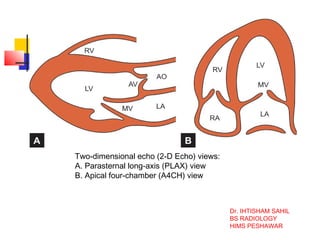
Two-dimensional echo (2-D Echo) views:
A. Parasternal long-axis (PLAX) view
B. Apical four-chamber (A4CH) view
Dr. IHTISHAM SAHIL
BS RADIOLOGY
HIMS PESHAWAR
MOTION-MODE (M-
MODE) ECHO
 In the M-mode tracing, ultrasound is transmitted and received along
only one scan line.
 This line is obtained by applying the cursor to the 2-D image and
aligning it perpendicular to the structure being studied. The transducer
is finely angulated until the cursor line is exactly perpendicular to the
image.
 M-mode is displayed as a continuous tracing with two axes. The
vertical axis represents distance between the moving structure and the
transducer. The horizontal axis represents time.
 Since only one scan line is imaged, M-mode echo provides greater
sensitivity than 2-D echo for studying the motion of moving cardiac
structures.
 Motion and thickness of ventricular walls, changing size of cardiac
chambers and opening and closure of valves is better displayed on M-
mode.
 Simultaneous ECG recording facilitates accurate timing of cardiac
events. Similarly, the flow pattern on color flow mapping can be timed in
relation to the cardiac cycle.
Dr. IHTISHAM SAHIL
BS RADIOLOGY
HIMS PESHAWAR
Motion-mode echo (M-mode Echo) levels:
A. Mitral valve (MV) level
B. Aortic valve (AV) level
Dr. IHTISHAM SAHIL
BS RADIOLOGY
HIMS PESHAWAR
Doppler
echocardiography
 Doppler echocardiography is a method for detecting
the direction and velocity of moving blood within the
heart.
Pulsed Wave (PW):
 useful for low velocity flow e.g. MV flow.
 PW Doppler transmits ultrasound in pulses and waits
to receive the returning ultrasound after each pulse.
 However, PW Doppler provides a better spectral
tracing than CW Doppler, which is used for
calculations.
 PW Doppler modality is used to localize velocity
signals and
 abnormal flow patterns picked up by CW Doppler and
color flow mapping, respectively.
Dr. IHTISHAM SAHIL
BS RADIOLOGY
HIMS PESHAWAR
Pulsed wave (PW) Doppler signal of a stenotic aortic valve
from a single view; maximum velocity is 2 m/sec
Dr. IHTISHAM SAHIL
BS RADIOLOGY
HIMS PESHAWAR
Continuous Wave (CW)
 Useful for high velocity flow e.g aortic stenosis
 CW Doppler transmits and receives ultrasound continuously. It
can measure high velocities without any upper limit and is not
hindered by the phenomenon of aliasing.
 This Doppler modality is used for rapid scanning of the heart in
search of high velocity signals and abnormal flow patterns.
 CW Doppler display forms the basis for placement of “sample
volume” to obtain PW Doppler spectral tracing.
 CW Doppler is used for grading the severity of valvular stenosis
and assessing the degree of valvular regurgitation.
 An intracardiac left-to-right shunt such as a ventricular septal
defect can be quantified.
 By using CW Doppler signal of the tricuspid valve, pulmonary
artery pressure can be calculated.
Dr. IHTISHAM
SAHIL
BS RADIOLOGY
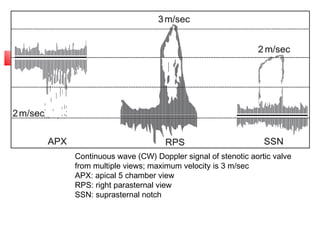
Continuous wave (CW) Doppler signal of stenotic aortic valve
from multiple views; maximum velocity is 3 m/sec
APX: apical 5 chamber view
RPS: right parasternal view
SSN: suprasternal notch
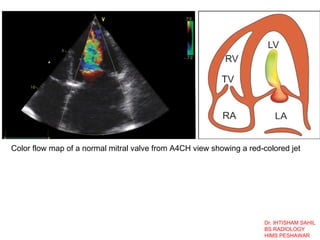
Color Flow (CF)
 It is also known as real-time Doppler imaging.
 Color Doppler provides a visual display of
blood flow within the heart, in the form of a
color flow map.
 Different colors are used to designate the
direction of blood flow. Red is flow toward,
and Blue is flow away from the transducer
with turbulent flow shown as a mosaic
pattern.
Dr. IHTISHAM SAHIL
BS RADIOLOGY
HIMS PESHAWAR
Color flow map of a normal mitral valve from A4CH view showing a red-colored jet
Dr. IHTISHAM SAHIL
BS RADIOLOGY
HIMS PESHAWAR
Color flow map of ventricular outflow tract from A5CH view
showing a blue jet
Dr. IHTISHAM SAHIL
BS RADIOLOGY
HIMS PESHAWAR
APPLICATIONS OF
COLOR DOPPLER
 Stenotic Lesions:
 Color Doppler can identify, localize and quantitate
stenotic lesions of the cardiac valves. It visually
displays the stenotic area and the resultant jet as
distinc from normal flow.
 Regurgitant Lesions:
 Color Doppler can diagnose and estimate the severity
of regurgitant lesions of the valves. It displays the
regurgitant jet as a flow-map distinct from the normal
flow pattern.
 Intracardiac Shunts:
Dr. IHTISHAM
SAHIL
BS RADIOLOGY
REFERENCE
 https://sites.google.com/site/doctorkitcha/echo
 https://www.bsecho.org/indications-for-echocardiography/
 http://www.wikiecho.org/wiki/Transducer_positions_and_views
 www.cambodiamed.blogspot.com
 http://www.fpnotebook.com
 https://en.wikipedia.org/wiki/Echocardiography#Indications
Echocardiography

Echocardiography

  • 1.
    Dr. IHTISHAM SAHIL BSRADIOLOGY HIMS PESHAWAR
  • 2.
    Dr. IHTISHAM SAHIL BSRADIOLOGY HIMS PESHAWAR
  • 3.
    Mr. IHTISHAM UL HAQ BSRadiology HAFEEZ INSTITUTE OF MEDICAL SCIENCE PESHAWAR
  • 4.
  • 5.
    Description  It isa type of ultrasound test that uses high pitched sound waves to produce an image of the heart.  The sound waves are sent through a device called a transducer and are reflected off the various structures of the heart.  These echoes are converted into pictures of the heart that can be seen on a video monitor. Dr. IHTISHAM SAHIL BS RADIOLOGY HIMS PESHAWAR
  • 6.
    COMPONENETS  Pulse generator- applies high amplitude voltage to energize the crystals.  Transducer - converts electrical energy to mechanical (ultrasound) energy and vice versa.  Receiver - detects and amplifies weak signals.  Display - displays ultrasound signals in a variety of modes.  Memory - stores video display . Dr. IHTISHAM SAHIL BS RADIOLOGY HIMS PESHAWAR
  • 7.
    INDICATION  Heart Murmurs Native Valvular Stenosis  Native Valvular Regurgitation  Prosthetic Valve Assessment  Infective Endocarditis  Ischaemic Heart Disease - Known or Suspected Dr. IHTISHAM SAHIL BS RADIOLOGY HIMS PESHAWAR
  • 8.
    INDICATIONS  Cardiomyopathy  PericardialDisease  Cardiac Masses  Pulmonary Disease  Neurological Disease  Arrhythmia, Palpitations and Syncope  Echocardiography Before Cardioversion Dr. IHTISHAM SAHIL BS RADIOLOGY HIMS PESHAWAR
  • 9.
    INDICATIONS  Hypertension  Aorticand Major Arterial Disease  Pre-Operative Echocardiography for Elective and Semi-urgent Surgery  Ejection fraction Dr. IHTISHAM SAHIL BS RADIOLOGY HIMS PESHAWAR
  • 10.
    CONTRAINDICATIONS  Echocardiography hasno contraindications. It should be kept in mind, however, that this modality may yield only limited information in patients at the extremes of adult body weight, because a thick chest wall (in markedly obese patients) or overcrowded ribs (in severely underweight patients) may limit the penetration of ultrasound waves. Dr. IHTISHAM SAHIL BS RADIOLOGY HIMS PESHAWAR
  • 11.
    Standard Echo Windows Standard positions on the chest wall are used for placement of the transducer called “echo windows 1. Suprasternal 2. Right parasternal 3. Left parasternal 4. Apical 5. Sub costal Dr. IHTISHAM SAHIL BS RADIOLOGY HIMS PESHAWAR
  • 12.
    Dr. IHTISHAM SAHIL BSRADIOLOGY HIMS PESHAWAR
  • 13.
    Parasternal long-axis view (PLAX) Pt Positioning: left lateral decubitus.  transducer  positioning: placed near the sternum in the left third or fourth intercostal space .  Marker dot direction: points towards right shoulder.  Closest structure to the transducer. The right ventricular outflow tract (RVOT),in the upper site of the image. Dr. IHTISHAM SAHIL BS RADIOLOGY HIMS PESHAWAR
  • 14.
    Parasternal long-axis view (PLAX) Structures seen :  – proximal aorta  – aortic valve  – left atrium  – mitral valve  – left ventricle  – IV septum  – posterior wall  – right ventricle  – pericardium. Dr. IHTISHAM SAHIL BS RADIOLOGY HIMS PESHAWAR
  • 15.
    Parasternal long-axis view (PLAX) Most echo studies begin with this view. It sets the stage for subsequent echo views.
  • 17.
    Parasternal Short AxisView (PSAX)  Transducer position: left sternal edge; 2nd–4th space  Marker dot direction: points towards left shoulder (90° clockwise from PLAX).  By tilting the transducer on an axis between the left hip and right shoulder, short-axis cuts are obtained at different levels, from the aorta to the LV apex .  This angulations of the transducer from the base to apex of the heart for short-axis views is known as “bread-loafing”. Dr. IHTISHAM SAHIL BS RADIOLOGY HIMS PESHAWAR
  • 18.
    Parasternal Short AxisView (PSAX)  Structure seen: 1. pulmonary artery 2. aortic valve level 3. mitral valve level 4. papillary muscle 5. left ventricle. Dr. IHTISHAM SAHIL BS RADIOLOGY HIMS PESHAWAR
  • 20.
    Apical 4-Chamber View (A4CHView)  Transducer position: apex of the heart.  Marker dot direction: points towards left shoulder.  Structures seen: – right and left ventricle – right and left atrium – mitral, tricuspid valves – IA and IV septum – left ventricular apex – lateral wall left ventricle – free wall right ventricle. Dr. IHTISHAM SAHIL BS RADIOLOGY
  • 21.
    Dr. IHTISHAM SAHIL BSRADIOLOGY HIMS PESHAWAR
  • 22.
    Apical 5-Chamber View (A5CHview)  The A5CH view is obtained after the A4CH view by slight downward tilting of the transducer. The 5th chamber added is the left ventricular outflow tract (LVOT).  Transducer position: as in A4CH view.  Marker dot direction: as in A4CH view.  Structures seen: — LV outflow tract — aortic valve — proximal aorta. Dr. IHTISHAM SAHIL BS RADIOLOGY HIMS PESHAWAR
  • 23.
    Dr. IHTISHAM SAHIL BSRADIOLOGY HIMS PESHAWAR
  • 24.
    Sub costal View Pt position:  The subject lies supine with the head held slightly low, feet planted on the couch and the knees slightly flexed.  Better images are obtained with the abdomen relaxed and during the phase of inspiration.  Transducer position: under the xiphisternum  Marker dot position: points towards left shoulder. Dr. IHTISHAM SAHIL BS RADIOLOGY HIMS PESHAWAR
  • 25.
    Sub costal View Structures seen:  As in A4CH view. The subcostal view is particularly useful when transthoracic E is technically difficult because of the following reasons: – severe morbid obesity – chest wall deformity – pulmonary emphysema.  The following structures are better seen from the subcostal view than from the apical 4-chamber view: – inferior vena cava – descending aorta – interatrial septum – pericardial effusion. Dr. IHTISHAM SAHIL BS RADIOLOGY HIMS PESHAWAR
  • 26.
    Dr. IHTISHAM SAHIL BSRADIOLOGY HIMS PESHAWAR
  • 27.
    Suprasternal View  PtPosition: he subject lies supine with the neck hyperextended by placing a pillow under the shoulders. The head is rotated slightly towards the left. The position of arms or legs and the phase of respiration have no bearing on this echo window.  Transducer position:suprasternal notch.  Marker dot direction: points towards left jaw. Dr. IHTISHAM SAHIL BS RADIOLOGY HIMS PESHAWAR
  • 28.
    Suprasternal View  Structuresseen: – ascending aorta – pulmonary artery. Dr. IHTISHAM SAHIL BS RADIOLOGY HIMS PESHAWAR
  • 30.
    Echocardiography Types Transthoracic echocardiogram Conventional echocardiography is performed from the anterior chest wall (precordium) and is known as transthoracic echo.  Echocardiography can also be performed from the esophagus which is known as transesophageal echo.  For transthoracic echo, the subject is asked to lie in the semirecumbent position on his or her left side with the head slightly elevated.  The left arm is tucked under the head and the right arm lies along the right side of the body.  This position opens the intercostal spaces through which echocardiography can be performed, while most of the heart is masked from the ultrasound beam by the ribs. Dr. IHTISHAM SAHIL BS RADIOLOGY HIMS PESHAWAR
  • 31.
     Better imagesare obtained during expiration when there is least ‘air-tissue’ interface.  Ultrasound is transmitted from a transducer having a frequency of 2.5 to 3.5 MHz for echo in adults.  This frequency is used to study deep seated structures because of better penetration. A transducer frequency of 5.0 MHz is suitable for pediatric echo, since the heart is more superficial in children.  Ultrasound jelly is applied on the transducer and it is placed on the chest at the site of an “echo window”.  Most of the time, the left parasternal and apical windows are routinely used.  The transducer has a reference line or dot on one side, in order to orient it in the correct direction, for obtaining various echo views.  The transducer is variably positioned, in terms of location and direction, for different echo images.  It can be tilted (superiorly or inferiorly), to bring into focus the structure of interest and rotated (clockwise or anticlockwise), to fine-tune the image. Dr. IHTISHAM SAHIL BS RADIOLOGY HIMS PESHAWAR
  • 32.
    Apical four chamber Subcostal  Various transthoracic echocardiogram views Dr. IHTISHAM SAHIL BS RADIOLOGY HIMS PESHAWAR
  • 33.
    Left parasternal longaxis Apical two chamber Dr. IHTISHAM SAHIL BS RADIOLOGY HIMS PESHAWAR
  • 34.
    Left ventricle shortaxis Aortic valve short axis Dr. IHTISHAM SAHIL BS RADIOLOGY HIMS PESHAWAR
  • 35.
    TRANSESOPHAGEAL ECHO Principle  Anatomically speaking,the esophagus in its mid-course is strategically located posterior to the heart and anterior to the descending aorta. This provides an opportunity to interrogate the heart and related mediastinal structures with a high frequency transducer positioned in the esophagus for better image resolution. Dr. IHTISHAM SAHIL BS RADIOLOGY HIMS PESHAWAR
  • 36.
    Technique  A miniaturetransducer is mounted onto a probe or gastroscope similar to the one employed for upper gastrointestinal endoscopy. The scope is advanced to various depths in the esophagus to examine cardiac and related structures. By manoeuvring the transducer and the angle of beam from controls on the handle, different views of the heart are obtained.  This ‘back-door’ approach to echocardiography has both advantages and disadvantages. Dr. IHTISHAM SAHIL BS RADIOLOGY HIMS PESHAWAR
  • 37.
    Advantages  Useful alternativeto transthoracic echo if the latter is technically difficult due to obesity, chest wall deformity, emphysema or pulmonary fibrosis.  Useful complement to transthoracic echo because of better image quality and resolution due to two reasons: – absence of acoustic barrier between the ultrasound beam and the rib cage, chest wall and lung tissue. – greater proximity to the heart and therefore the ability to use higher frequency probe with vastly improved image quality and precise spatial resolution.  Useful supplement to transthoracic echo, which cannot examine the posterior aspect of the heart. Structures suc as left atrial appendage, descending aorta and pulmonary veins can only be visualized by TEE. Dr. IHTISHAM SAHIL BS RADIOLOGY HIMS PESHAWAR
  • 38.
    Disadvantages  The transesophagealecho (TEE) views are significantly different from standard transthoracic echo views. Novel TEE images require a comprehensive understanding of the spatial relationship between cardiac structures.  It requires short-term sedation, oxygen administration and ECG monitoring since, there are chances of hypoxia, arrhythmia and angina. Rarely, respiratory depression or allergic reactions may occur. Dr. IHTISHAM SAHIL BS RADIOLOGY HIMS PESHAWAR
  • 39.
    Complications with TEE Major • Esophageal rupture or perforation • Laryngospasm or bronchopasm • Sustained ventricular tachycardia  Minor • Retching and vomiting • Sore-throat and hoarseness • Blood-tinged sputum • Tachycardia or bradycardia • Hypoxia and ischemia • Transient BP rise or fall Dr. IHTISHAM SAHIL BS RADIOLOGY HIMS PESHAWAR
  • 40.
    Contraindications to TEE Absolute • Uncooperative patient • Poor cardiorespiratory status • Esophageal obstruction • Tracheoesophageal fistula • Active bleed or coagulopathy  Relative • Large esophageal varices• Prior esophageal surgery • Unstable cervical arthritis • Atlantoaxial dislocation Dr. IHTISHAM SAHIL BS RADIOLOGY HIMS PESHAWAR
  • 42.
    Dr. IHTISHAM SAHIL BSRADIOLOGY HIMS PESHAWAR
  • 43.
    Stress Echocardiography  A stressechocardiography, also called an echocardiography stress test or stress echo, is a procedure that determines  how well your heart and blood vessels are working. During  a stress echocardiography, you'll exercise on a treadmill or  stationary bike while your doctor monitors your blood  pressure and heart rhythm. Technique:  The echocardiogram is performed just prior and just after the exercise. NPO for four hours before the test.  Do not drink or eat caffeine products (cola, chocolate, coffee, tea) for 24 hours before the test.  Do not take any over-the-counter medications that contain caffeine for 24 hours before the test. Dr. IHTISHAM SAHIL BS RADIOLOGY HIMS PESHAWAR
  • 44.
     Do nottake the following heart medications for 24 hour before the test unless doctor tells  Beta-blockers (for example, Tenormin, Lopressor, Toprol, or Inderal) Isosorbide dinitrate (for example, Isordil, Sorbitrate) Isosorbide mononitrate (for example, Ismo, Indur, Monoket) Nitroglycerin (for example, Deponit, Nitrostat, Nitropatches)  Do not discontinue any medication without talking with doctor. Continue Dr. IHTISHAM SAHIL BS RADIOLOGY HIMS PESHAWAR
  • 46.
    Dobutamine stress echocardiogram  Aform of stress echocardiogram.  Instead of exercising to stress the heart, the stress is obtained by giving a drug that stimulates the heart an makes it "think" it is exercising.  The test is used to evaluate heart and valve function when unable to exercise on a treadmill or stationary bike.  It is also used to determine how well heart tolerate activity and likelihood of having coronary artery disease, as well as evaluating the effectiveness of cardiac treatment plan.  Most dobutamine stress protocols start at an infusio rate of 5microgram/kg/mt and increase to a peak dose of 40 or 50 ug / kg / min  To further increase heart rate, a bolus injection of 0.25—1 .0 mg atropine is added Dr. IHTISHAM SAHIL BS RADIOLOGY HIMS PESHAWAR
  • 47.
    PREPARATION  Wear comfortableclothing.  Do not eat for a minimum of 4 hours before the test.  Drinking water is allowed before the test.  If diabetic, juice is allowed in the morning with insulin (1/2 dose). If on pills ,do not take medication until after the test is complete.  Do not drink caffiene (coffee or tea) the day of the test.  Stop taking all medications including beta blockers, calcium channel blockers, nitrates and digoxin for 24 hours prior to test  ECG electrodes will be placed to monitor electrocardiogram  Blood pressure and ECG will be monitored throughout the test.  Lie on left side on an exam table. Dr. IHTISHAM SAHIL BS RADIOLOGY HIMS PESHAWAR
  • 48.
     An intravenousline (IV) will be inserted and dobutamine is administered . While the infusion of dobutamine is going on continous echo images will be taken. The medication will cause heart to react as if exercising.  The dobutamine may give a warm, flushing feeling and some patients experience a mild headache.  Report if there is chest pain, arm or jaw pain ,short of breath, dizzy or feel lightheaded.  The IV line will be removed once all of the medication has entered bloodstream.  Intravascular ultrasound:  A form of echocardiography performed during cardiac catheterization.  During this procedure, the transducer is threaded into the heart blood vessels via a femoral catheter  Used to provide detailed information about the atherosclerosis (blockage) inside the blood vessels. Dr. IHTISHAM SAHIL BS RADIOLOGY HIMS PESHAWAR
  • 50.
    The Modalities ofEcho The following modalities of echo are used clinically: 1 Conventional echo  Two-Dimensional echo (2-D echo)  Motion- mode echo (M-mode echo) 2 Doppler Echo  Continuous wave (CW) Doppler  Pulsed wave (PW) Doppler  Colour flow(CF) Doppler  All modalities follow the same principle of ultrasound  Differ in how reflected sound waves are collected and analyzed Dr. IHTISHAM SAHIL BS RADIOLOGY HIMS PESHAWAR
  • 51.
    TWO-DIMENSIONAL (2- D) ECHO This technique is used to "see“ the actual structures and motion of the heart structures at work.  Ultrasound is transmitted along several scan lines(90-120), over a wide arc(about 900) and many times per second.  The combination of reflected ultrasound signals builds up an image on the display screen.  A 2-D echo view appears coneshaped on the monitor. Dr. IHTISHAM SAHIL BS RADIOLOGY HIMS PESHAWAR
  • 52.
    Two-dimensional echo (2-DEcho) views: A. Parasternal long-axis (PLAX) view B. Apical four-chamber (A4CH) view Dr. IHTISHAM SAHIL BS RADIOLOGY HIMS PESHAWAR
  • 53.
    MOTION-MODE (M- MODE) ECHO In the M-mode tracing, ultrasound is transmitted and received along only one scan line.  This line is obtained by applying the cursor to the 2-D image and aligning it perpendicular to the structure being studied. The transducer is finely angulated until the cursor line is exactly perpendicular to the image.  M-mode is displayed as a continuous tracing with two axes. The vertical axis represents distance between the moving structure and the transducer. The horizontal axis represents time.  Since only one scan line is imaged, M-mode echo provides greater sensitivity than 2-D echo for studying the motion of moving cardiac structures.  Motion and thickness of ventricular walls, changing size of cardiac chambers and opening and closure of valves is better displayed on M- mode.  Simultaneous ECG recording facilitates accurate timing of cardiac events. Similarly, the flow pattern on color flow mapping can be timed in relation to the cardiac cycle. Dr. IHTISHAM SAHIL BS RADIOLOGY HIMS PESHAWAR
  • 54.
    Motion-mode echo (M-modeEcho) levels: A. Mitral valve (MV) level B. Aortic valve (AV) level Dr. IHTISHAM SAHIL BS RADIOLOGY HIMS PESHAWAR
  • 55.
    Doppler echocardiography  Doppler echocardiographyis a method for detecting the direction and velocity of moving blood within the heart. Pulsed Wave (PW):  useful for low velocity flow e.g. MV flow.  PW Doppler transmits ultrasound in pulses and waits to receive the returning ultrasound after each pulse.  However, PW Doppler provides a better spectral tracing than CW Doppler, which is used for calculations.  PW Doppler modality is used to localize velocity signals and  abnormal flow patterns picked up by CW Doppler and color flow mapping, respectively. Dr. IHTISHAM SAHIL BS RADIOLOGY HIMS PESHAWAR
  • 56.
    Pulsed wave (PW)Doppler signal of a stenotic aortic valve from a single view; maximum velocity is 2 m/sec Dr. IHTISHAM SAHIL BS RADIOLOGY HIMS PESHAWAR
  • 57.
    Continuous Wave (CW) Useful for high velocity flow e.g aortic stenosis  CW Doppler transmits and receives ultrasound continuously. It can measure high velocities without any upper limit and is not hindered by the phenomenon of aliasing.  This Doppler modality is used for rapid scanning of the heart in search of high velocity signals and abnormal flow patterns.  CW Doppler display forms the basis for placement of “sample volume” to obtain PW Doppler spectral tracing.  CW Doppler is used for grading the severity of valvular stenosis and assessing the degree of valvular regurgitation.  An intracardiac left-to-right shunt such as a ventricular septal defect can be quantified.  By using CW Doppler signal of the tricuspid valve, pulmonary artery pressure can be calculated. Dr. IHTISHAM SAHIL BS RADIOLOGY
  • 58.
    Continuous wave (CW)Doppler signal of stenotic aortic valve from multiple views; maximum velocity is 3 m/sec APX: apical 5 chamber view RPS: right parasternal view SSN: suprasternal notch
  • 59.
    Color Flow (CF) It is also known as real-time Doppler imaging.  Color Doppler provides a visual display of blood flow within the heart, in the form of a color flow map.  Different colors are used to designate the direction of blood flow. Red is flow toward, and Blue is flow away from the transducer with turbulent flow shown as a mosaic pattern. Dr. IHTISHAM SAHIL BS RADIOLOGY HIMS PESHAWAR
  • 60.
    Color flow mapof a normal mitral valve from A4CH view showing a red-colored jet Dr. IHTISHAM SAHIL BS RADIOLOGY HIMS PESHAWAR
  • 61.
    Color flow mapof ventricular outflow tract from A5CH view showing a blue jet Dr. IHTISHAM SAHIL BS RADIOLOGY HIMS PESHAWAR
  • 62.
    APPLICATIONS OF COLOR DOPPLER Stenotic Lesions:  Color Doppler can identify, localize and quantitate stenotic lesions of the cardiac valves. It visually displays the stenotic area and the resultant jet as distinc from normal flow.  Regurgitant Lesions:  Color Doppler can diagnose and estimate the severity of regurgitant lesions of the valves. It displays the regurgitant jet as a flow-map distinct from the normal flow pattern.  Intracardiac Shunts: Dr. IHTISHAM SAHIL BS RADIOLOGY
  • 64.
    REFERENCE  https://sites.google.com/site/doctorkitcha/echo  https://www.bsecho.org/indications-for-echocardiography/ http://www.wikiecho.org/wiki/Transducer_positions_and_views  www.cambodiamed.blogspot.com  http://www.fpnotebook.com  https://en.wikipedia.org/wiki/Echocardiography#Indications