Approach To A Patient With
Elevated JVP
Definition
 Oscillating top of vertical column of blood in
the right internal jugular vein that reflects
the pressure changes in the right atrium in
cardiac cycle
Why Internal Jugular Vein instead
of External Jugular Vein?
 The internal jugular vein, SVC and RA are in
continuity
(height of jugular venous pulsation = right atrial
pressure)
Normally,right atria pressure < 7mmHg
 External jugular vein :
- has valve & not directly align with SVC and
RA
- passes through fascial planes = extrinsic
compression can alter the blood flow
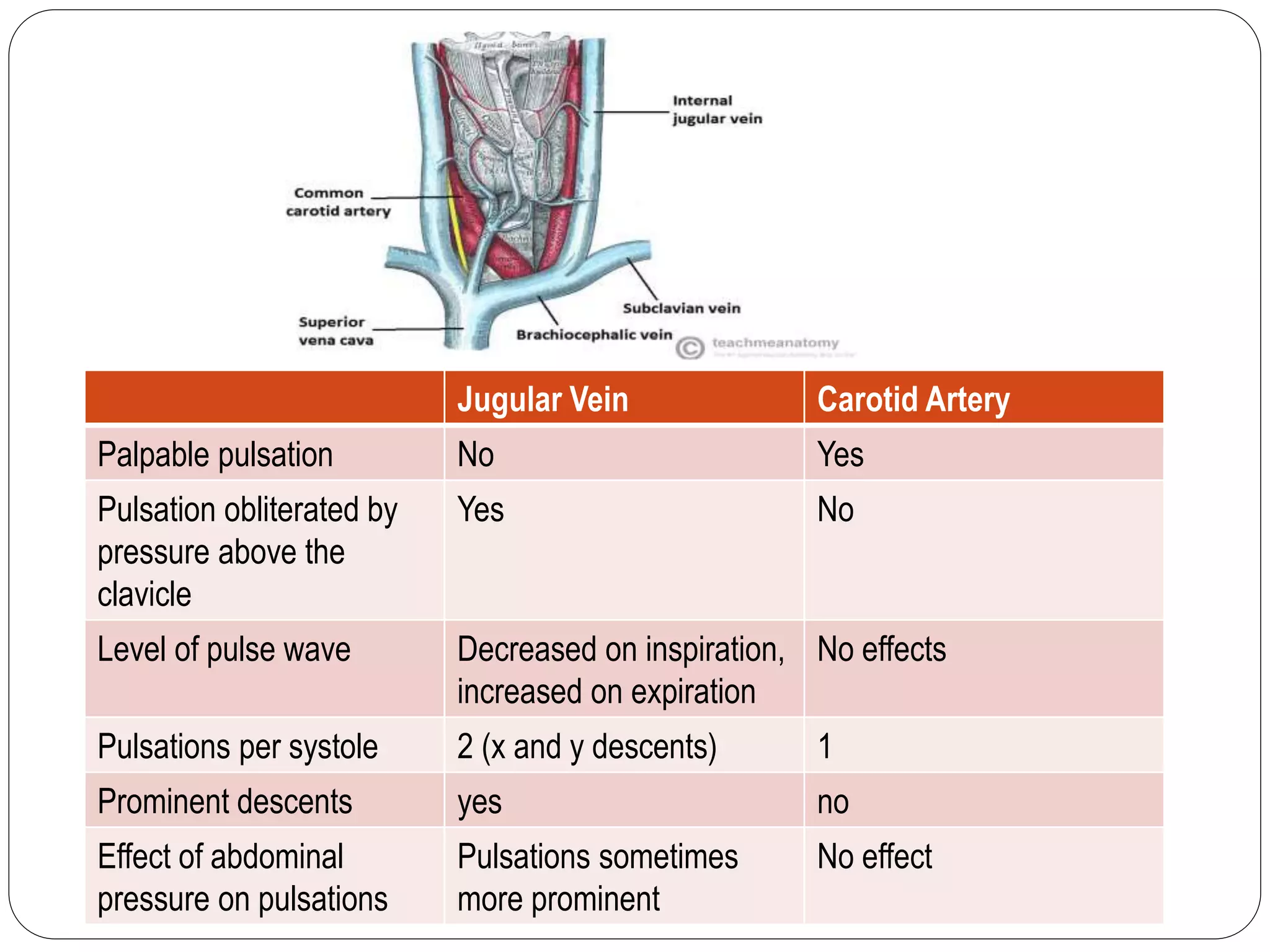
Jugular Vein Carotid Artery
Palpable pulsation No Yes
Pulsation obliterated by
pressure above the
clavicle
Yes No
Level of pulse wave Decreased on inspiration,
increased on expiration
No effects
Pulsations per systole 2 (x and y descents) 1
Prominent descents yes no
Effect of abdominal
pressure on pulsations
Pulsations sometimes
more prominent
No effect
Common cases of elevated JVP
CARDIAC CAUSES NON CARDIAC CAUSES
Congestive heart failure Superior vena caval obstruction
Right ventricular infarction Massive ascites
Pericardial effusion Pleural effusion
Constrictive pericarditis Iatrogenic fluid overload (
surgical and renal patients )
Pulmonary embolism
Tricuspid valve disease ( tricuspid
regurgitation and tricuspid
stenosis )
Cardiac tamponade
Restrictive/hypertrophic
cardiomyopathy
Cor pulmonale
HISTORY TAKING
Patient profile
• Name
• Age
• Gender
• Occupation
• Address
• Date of Admission
Chief complaints
1) Breathlessness
2) Palpitation
3) Pitting edema
4) Abdominal distension
5) Syncope (transient loss of consciousness
with postural collapse due to hypoperfusion
of brain)
6) Fatigue
History of presenting illness
Breathlessness
- Paroxysmal nocturnal
dyspnoea (PND),
Exertional dyspnoea,
Orthopnea
• Onset
• Duration
• Description
• Progression
• Aggravating factor:
sleep, exertion, posture
• Relieving factor: Drugs
• Associated symptoms:
Nausea, Vomiting,
Dizziness
Palpitation
- Onset : -sudden
(cardiac
arrhythmias)
- gradual (sinus
tachycardia)
Pitting Edema
- usually symmetrical
- worse in the evenings
with improvement
during the night
- may be symptom of
biventricular failure/RVF
secondary to other
causes
Past history:
Hypertension, diabetes mellitus, heart problems, fits,
collapses, angina, cardiac procedures/surgeries (type and
date of intervention and outcome), RF or heart problems
as a child, cardiac tamponade, constrictive pericarditis
Personal history:
Smoking (pack years), alcohol intake, obesity, weight loss,
diet, bowel and micturition habits
Family history:
Genetic disorders, cardiomyopathy, congenital heart
diseases, MI, mitral valve prolapse, relative with similar
problems, death among relatives
Social history:
Economic status, income, type of house, travel history,
sanitary facilities
Drug history :
 Diuretics
 Anti- hypertensive
 Sublingual medications
 Aspirin
 Anti-coagulants
 Beta-blockers
 Digoxin
Abnormalities in patient with
elevated JVP on physical
examination
Examination of JVP
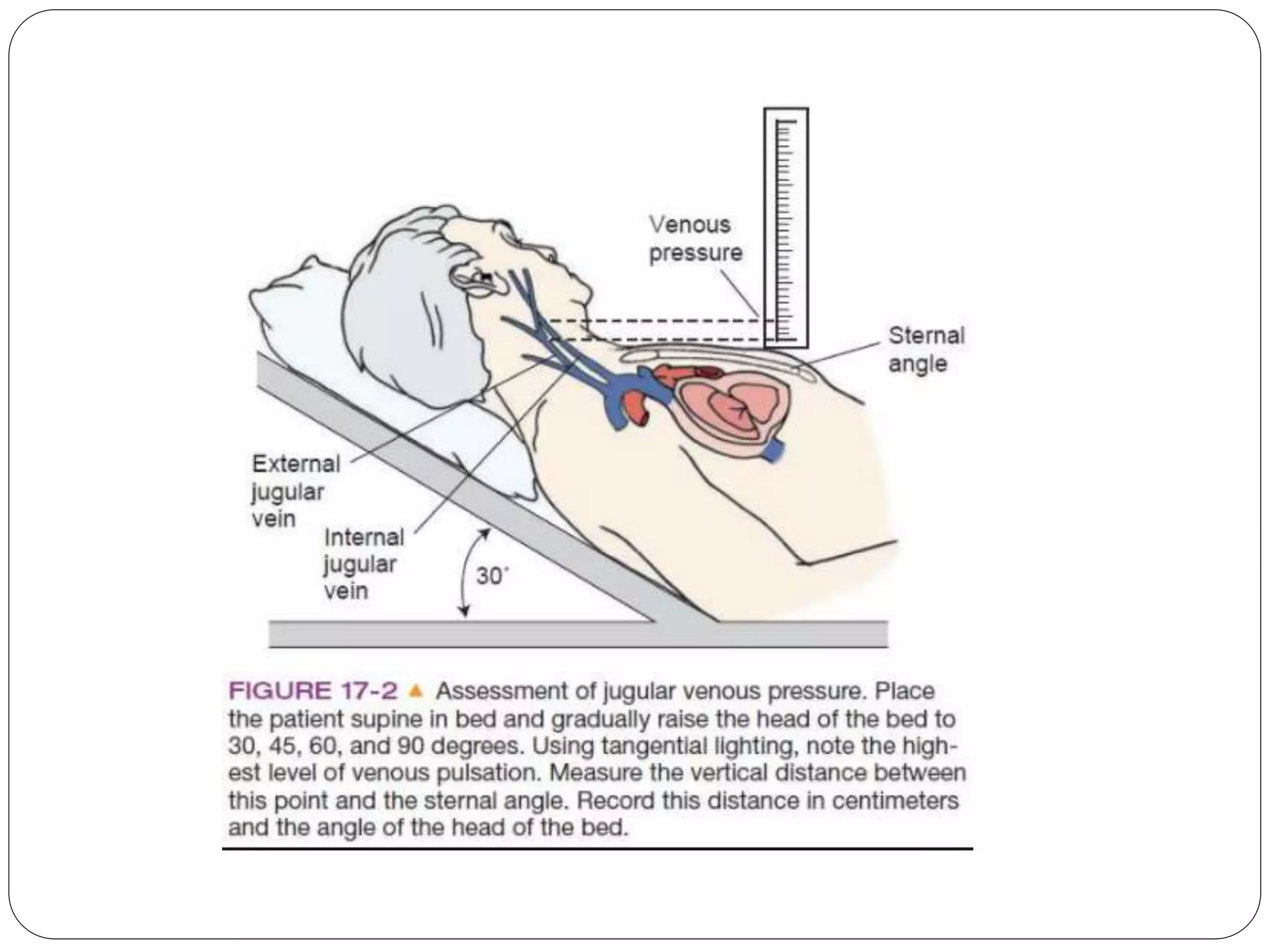
 Position the patient supine, reclined at 45° with
the head on a pillow to relax sternocleidomastoid
muscles
 Look across the patient’s neck from the right side.
Use oblique lighting if the JVP is difficult to see.
 Identify the jugular vein pulsation in the
suprasternal notch/behind the
sternocleidomastoid muscle
 Use the abdomino-jugular test /occlusion to
confirm the JVP
 The JVP is the vertical height in cm between the
upper limit of pulsation and sternal angle
 Identify the timing and waveform of the pulsation
and note any abnormality.
- ‘a’ wave- atrial systole
- ‘c’ wave- closure of tricuspid valve
- ‘x’ wave- atrial relaxation and due to
downward movement of tricuspid valve
during early right ventricular systole
- ‘v’ wave- venous filling right atrium and
when tricuspid valve is closed
- ‘y’ wave- tricuspid valve opening with right
atrial pressure decrease
JVP is elevated in states of fluid overload-
heart failure & in conditions with right heart
dilatation :eg- acute pulmonary embolism,
cor pulmonale
 Extreme, non pulsatile elevation of JVP-
mechanical obstruction of superior vena
cava-lung cancer
 Kussmaul’s sign: paradoxical rise of JVP
on inspiration- Pericardial constriction or
tamponade, congestive cardiac failure
 Prominent ‘a’ wave: delayed or restricted
right ventricular filling - tricuspid stenosis,
pulmonary hypertension
 Cannon waves : giant ‘a’ waves – right
atrium contracts against a closed tricuspid
valve.
a)Irregular canon waves are seen in
complete heart block and are due to
atrio-ventricular dissociation.
b) Regular cannon waves
- during junctional rhythm
- ventricular and supraventricular
tachycardia
• ‘cv’ wave -fusion of the ‘c’ and ‘v’ wave-
- Seen in tricuspid regurgitation
Abnormalities of the jugular venous pulse
Condition Abnormalities
Heart failure Elevation, sustained
abdominojugular reflux > 10
seconds
Pulmonary embolism Elevation
Pericardial effusion Elevation, prominent ‘y’ descent
Pericardial constriction Elevation, Kussmaul’s sign
Superior vena cava obstruction Elevation, loss of pulsation
Atrial fibrillation Absent ‘a’ waves
Tricuspid stenosis Giant ‘a’ waves
Tricuspid regurgitation Giant ‘v’ waves
Complete heart block Cannon waves
Differential diagnosis in a
patient with elevated JVP
Elevated JVP seen in
Cardiac causes: -Right ventricular failure
-Pericardial effusion
-Constrictive pericarditis
-Superior vena cava obstruction
 Congested states: -Volume overload conditions
 Non cardiac cause: -Massive ascites
-Pleural effusion
 Infective endocarditis
 Rheumatic fever
 Chronic aortic regurgitation
Right ventricular failure
 Increased JVP (pulsating elevation)
 Congestive hepatomegaly
 Ascites
 Cardiac cachexia
 Pedal edema
Pericardial Effusion
 Increased JVP (pulsating)
 Apex beat not palpable
 Cardiac dullness increases outside
apex
 Heart sounds muffled
 Ewart’s sign
Constrictive Pericarditis
 Increased JVP (pulsating)
 Kussmaul’s sign
 Failure in the appropriate fall of JVP
with inspiration indicates limited right
ventricular filling
 Pericardial knock (early diastolic
sound)
 Pericardial rub
SVC obstruction
 Increased JVP (NON pulsating)
 Difficulty in breathing
 Edema of face and upper limb
 Edema of neck (Collar of Stokes)
 Distended veins in neck, upper chest
and arms
 Pemberton’s sign
Endocarditis
1) Fever
2) Pallor
3) Clubbing
4) Petechial hemorrhages
5) Splinter hemorrhage
6) Osler’s nodes
7) Janeway lesion
8) Roth spots
9) Splenomegaly
Rheumatic Fever
- Arthritis
- Erythema marginatum
- Subcutaneous nodules
- Jaccoud’s arthritis (in repeated
attacks)
CHRONIC SEVERE AORTIC
REGURGITATION
 Collapsing pulse
(Watson’s water
hammer pulse)
 Corrigan’s sign
 De Musset’s sign
 Quincke’s sign
 Traube’s sign (pistol
shot sound)
 Duroziez’s sign
 Hill’s sign
 Less prominent signs
 Muller’s sign (uvula)
 Becker’s sign (retinal
artery)
 Lighthouse sign (face)
 Rosenbach’s sign
(liver)
 Gerhardt’s sign
(spleen)
Plan initial investigations and basic
management based on the differential
diagnosis
NON-PULSATILE ELEVATION
OF JVP
Diagnosis of venous obstruction can be confirmed
by :
 Doppler ultrasound
 Venography
 Chest X-ray supplemented by CT-scan or MRI
PULSATILE ELEVATION OF JVP
Analysis of the venous waveform
1. Heart failure (right-sided)
 Biomarkers - BNP
 ECG-abnormal, often shows Q wave
 Echocardiograph
 Serum urea, creatinine, electrolytes
 Thyroid function
 Chest X-ray - left ventricular dilatation
with regional or global contractile
impairment
MANAGEMENT
1. General Measure
 Diet - good general nutrition and weight reduction for
the obese. Avoidance of high-salt foods and added salt,
especially for patients with severe congestive heart
failure
 Alcohol - moderation or elimination of consumption.
Alcohol induced cardiomyopathy requires abstinence
 Smoking – cessation
 Exercise - regular moderate aerobic exercise within
limits of symptoms
2. Drug therapy
 Diuretic, ACEI, ARB, Vasodilators, Beta-blocker, Digoxin,
Amiodarone
3. Implantable cardiac defibrillator and resynchronization
therapy
4. Coronary revascularization
2.Tricuspid stenosis
-Raised JVP with prominent ‘a’ wave, and slow ‘y’
descent due to lost of normal rapid ventricular filling.
-Doppler echocardiography - the valve has similar
appearances to those of rheumatic mitral stenosis
-Raised JVP with ‘giant’ ‘v’ wave (a ‘cv’ wave replaces
the normal ‘x’ descent)
-Echocardiography may reveal dilatation of the RV.
3. Tricuspid regurgitation
MANAGEMENT:
 Valvotomy
 Replacing the valve
 Balloon valvuloplasty
 Diuretic
 Vasodilator
 Valve repair with annuloplasty
 Valve replacement
4. Pericardial effusion(Cardiac
Tamponade)
INVESTIGATIONS:
 Echocardiograph for confirmation
 ECG - low voltage QRS complexes with alternating
electrical axis
 Tests for etiological diagnosis - Serology in SLE or
tuberculous disease
MANAGEMENT:
 Pericardiocentesis (pericardial aspiration)
 Surgical drainage
5. Constrictive
Pericarditis
INVESTIGATION:
 Chest X-ray - pericardial calcification on lateral film
 Echocardiography
 CT-scan or MRI - imaging the increased pericardial
thickness/calcification
 Cardiac catheterization - equalization of diastolic
pressures in 4 cardiac chambers
 Echo-Doppler studies
MANAGEMENT:
 Surgical resection of the diseased pericardium (morbidity
50%)
6.Pulmonary embolism
INVESTIGATION:
 D-dimer
 ECG - sinus tachycardia
 Chest X-ray - wedge-shaped peripheral opacification, absent of pulmonary
vascular marking
 Echocardiogram - dilated right heart in some cases of central PE
 CT pulmonary angiogram
MANAGEMENT:
 General measures - Oxygen, IV fluid or plasma expander, opiates, external
cardiac massage
 Anticoagulants
 Thrombolytic and surgical therapy
 Caval filter - for those contraindicated in using anticoagulant
7. Massive Ascites
INVESTIGATIONS:
 Ultrasonography - in obese or those with small
volume of fluid
 Paracentesis - for analysis
 Serum-ascites albumin gradient (SAAG)
MANAGEMENTS:
 Sodium and water restriction
 Diuretics
 Paracentesis
 Transjugular intrahepatic portosystemic stent
shunt
 Peritoneo-venous shunt
THANK YOU

Jugular Venous Pressure

  • 1.
    Approach To APatient With Elevated JVP
  • 2.
    Definition  Oscillating topof vertical column of blood in the right internal jugular vein that reflects the pressure changes in the right atrium in cardiac cycle
  • 3.
    Why Internal JugularVein instead of External Jugular Vein?  The internal jugular vein, SVC and RA are in continuity (height of jugular venous pulsation = right atrial pressure) Normally,right atria pressure < 7mmHg  External jugular vein : - has valve & not directly align with SVC and RA - passes through fascial planes = extrinsic compression can alter the blood flow
  • 4.
    Jugular Vein CarotidArtery Palpable pulsation No Yes Pulsation obliterated by pressure above the clavicle Yes No Level of pulse wave Decreased on inspiration, increased on expiration No effects Pulsations per systole 2 (x and y descents) 1 Prominent descents yes no Effect of abdominal pressure on pulsations Pulsations sometimes more prominent No effect
  • 5.
    Common cases ofelevated JVP CARDIAC CAUSES NON CARDIAC CAUSES Congestive heart failure Superior vena caval obstruction Right ventricular infarction Massive ascites Pericardial effusion Pleural effusion Constrictive pericarditis Iatrogenic fluid overload ( surgical and renal patients ) Pulmonary embolism Tricuspid valve disease ( tricuspid regurgitation and tricuspid stenosis ) Cardiac tamponade Restrictive/hypertrophic cardiomyopathy Cor pulmonale
  • 6.
  • 7.
    Patient profile • Name •Age • Gender • Occupation • Address • Date of Admission
  • 8.
    Chief complaints 1) Breathlessness 2)Palpitation 3) Pitting edema 4) Abdominal distension 5) Syncope (transient loss of consciousness with postural collapse due to hypoperfusion of brain) 6) Fatigue
  • 9.
    History of presentingillness Breathlessness - Paroxysmal nocturnal dyspnoea (PND), Exertional dyspnoea, Orthopnea • Onset • Duration • Description • Progression • Aggravating factor: sleep, exertion, posture • Relieving factor: Drugs • Associated symptoms: Nausea, Vomiting, Dizziness Palpitation - Onset : -sudden (cardiac arrhythmias) - gradual (sinus tachycardia) Pitting Edema - usually symmetrical - worse in the evenings with improvement during the night - may be symptom of biventricular failure/RVF secondary to other causes
  • 10.
    Past history: Hypertension, diabetesmellitus, heart problems, fits, collapses, angina, cardiac procedures/surgeries (type and date of intervention and outcome), RF or heart problems as a child, cardiac tamponade, constrictive pericarditis Personal history: Smoking (pack years), alcohol intake, obesity, weight loss, diet, bowel and micturition habits Family history: Genetic disorders, cardiomyopathy, congenital heart diseases, MI, mitral valve prolapse, relative with similar problems, death among relatives Social history: Economic status, income, type of house, travel history, sanitary facilities
  • 11.
    Drug history : Diuretics  Anti- hypertensive  Sublingual medications  Aspirin  Anti-coagulants  Beta-blockers  Digoxin
  • 12.
    Abnormalities in patientwith elevated JVP on physical examination
  • 13.
    Examination of JVP Position the patient supine, reclined at 45° with the head on a pillow to relax sternocleidomastoid muscles  Look across the patient’s neck from the right side. Use oblique lighting if the JVP is difficult to see.  Identify the jugular vein pulsation in the suprasternal notch/behind the sternocleidomastoid muscle  Use the abdomino-jugular test /occlusion to confirm the JVP  The JVP is the vertical height in cm between the upper limit of pulsation and sternal angle  Identify the timing and waveform of the pulsation and note any abnormality.
  • 15.
    - ‘a’ wave-atrial systole - ‘c’ wave- closure of tricuspid valve - ‘x’ wave- atrial relaxation and due to downward movement of tricuspid valve during early right ventricular systole - ‘v’ wave- venous filling right atrium and when tricuspid valve is closed - ‘y’ wave- tricuspid valve opening with right atrial pressure decrease
  • 16.
    JVP is elevatedin states of fluid overload- heart failure & in conditions with right heart dilatation :eg- acute pulmonary embolism, cor pulmonale  Extreme, non pulsatile elevation of JVP- mechanical obstruction of superior vena cava-lung cancer  Kussmaul’s sign: paradoxical rise of JVP on inspiration- Pericardial constriction or tamponade, congestive cardiac failure  Prominent ‘a’ wave: delayed or restricted right ventricular filling - tricuspid stenosis, pulmonary hypertension
  • 17.
     Cannon waves: giant ‘a’ waves – right atrium contracts against a closed tricuspid valve. a)Irregular canon waves are seen in complete heart block and are due to atrio-ventricular dissociation. b) Regular cannon waves - during junctional rhythm - ventricular and supraventricular tachycardia • ‘cv’ wave -fusion of the ‘c’ and ‘v’ wave- - Seen in tricuspid regurgitation
  • 18.
    Abnormalities of thejugular venous pulse Condition Abnormalities Heart failure Elevation, sustained abdominojugular reflux > 10 seconds Pulmonary embolism Elevation Pericardial effusion Elevation, prominent ‘y’ descent Pericardial constriction Elevation, Kussmaul’s sign Superior vena cava obstruction Elevation, loss of pulsation Atrial fibrillation Absent ‘a’ waves Tricuspid stenosis Giant ‘a’ waves Tricuspid regurgitation Giant ‘v’ waves Complete heart block Cannon waves
  • 19.
    Differential diagnosis ina patient with elevated JVP
  • 20.
    Elevated JVP seenin Cardiac causes: -Right ventricular failure -Pericardial effusion -Constrictive pericarditis -Superior vena cava obstruction  Congested states: -Volume overload conditions  Non cardiac cause: -Massive ascites -Pleural effusion  Infective endocarditis  Rheumatic fever  Chronic aortic regurgitation
  • 21.
    Right ventricular failure Increased JVP (pulsating elevation)  Congestive hepatomegaly  Ascites  Cardiac cachexia  Pedal edema
  • 22.
    Pericardial Effusion  IncreasedJVP (pulsating)  Apex beat not palpable  Cardiac dullness increases outside apex  Heart sounds muffled  Ewart’s sign
  • 23.
    Constrictive Pericarditis  IncreasedJVP (pulsating)  Kussmaul’s sign  Failure in the appropriate fall of JVP with inspiration indicates limited right ventricular filling  Pericardial knock (early diastolic sound)  Pericardial rub
  • 24.
    SVC obstruction  IncreasedJVP (NON pulsating)  Difficulty in breathing  Edema of face and upper limb  Edema of neck (Collar of Stokes)  Distended veins in neck, upper chest and arms  Pemberton’s sign
  • 25.
    Endocarditis 1) Fever 2) Pallor 3)Clubbing 4) Petechial hemorrhages 5) Splinter hemorrhage 6) Osler’s nodes 7) Janeway lesion 8) Roth spots 9) Splenomegaly
  • 26.
    Rheumatic Fever - Arthritis -Erythema marginatum - Subcutaneous nodules - Jaccoud’s arthritis (in repeated attacks)
  • 27.
    CHRONIC SEVERE AORTIC REGURGITATION Collapsing pulse (Watson’s water hammer pulse)  Corrigan’s sign  De Musset’s sign  Quincke’s sign  Traube’s sign (pistol shot sound)  Duroziez’s sign  Hill’s sign  Less prominent signs  Muller’s sign (uvula)  Becker’s sign (retinal artery)  Lighthouse sign (face)  Rosenbach’s sign (liver)  Gerhardt’s sign (spleen)
  • 28.
    Plan initial investigationsand basic management based on the differential diagnosis
  • 29.
    NON-PULSATILE ELEVATION OF JVP Diagnosisof venous obstruction can be confirmed by :  Doppler ultrasound  Venography  Chest X-ray supplemented by CT-scan or MRI
  • 30.
    PULSATILE ELEVATION OFJVP Analysis of the venous waveform
  • 31.
    1. Heart failure(right-sided)  Biomarkers - BNP  ECG-abnormal, often shows Q wave  Echocardiograph  Serum urea, creatinine, electrolytes  Thyroid function  Chest X-ray - left ventricular dilatation with regional or global contractile impairment
  • 32.
    MANAGEMENT 1. General Measure Diet - good general nutrition and weight reduction for the obese. Avoidance of high-salt foods and added salt, especially for patients with severe congestive heart failure  Alcohol - moderation or elimination of consumption. Alcohol induced cardiomyopathy requires abstinence  Smoking – cessation  Exercise - regular moderate aerobic exercise within limits of symptoms 2. Drug therapy  Diuretic, ACEI, ARB, Vasodilators, Beta-blocker, Digoxin, Amiodarone 3. Implantable cardiac defibrillator and resynchronization therapy 4. Coronary revascularization
  • 33.
    2.Tricuspid stenosis -Raised JVPwith prominent ‘a’ wave, and slow ‘y’ descent due to lost of normal rapid ventricular filling. -Doppler echocardiography - the valve has similar appearances to those of rheumatic mitral stenosis -Raised JVP with ‘giant’ ‘v’ wave (a ‘cv’ wave replaces the normal ‘x’ descent) -Echocardiography may reveal dilatation of the RV. 3. Tricuspid regurgitation
  • 34.
    MANAGEMENT:  Valvotomy  Replacingthe valve  Balloon valvuloplasty  Diuretic  Vasodilator  Valve repair with annuloplasty  Valve replacement
  • 35.
    4. Pericardial effusion(Cardiac Tamponade) INVESTIGATIONS: Echocardiograph for confirmation  ECG - low voltage QRS complexes with alternating electrical axis  Tests for etiological diagnosis - Serology in SLE or tuberculous disease MANAGEMENT:  Pericardiocentesis (pericardial aspiration)  Surgical drainage
  • 36.
    5. Constrictive Pericarditis INVESTIGATION:  ChestX-ray - pericardial calcification on lateral film  Echocardiography  CT-scan or MRI - imaging the increased pericardial thickness/calcification  Cardiac catheterization - equalization of diastolic pressures in 4 cardiac chambers  Echo-Doppler studies MANAGEMENT:  Surgical resection of the diseased pericardium (morbidity 50%)
  • 37.
    6.Pulmonary embolism INVESTIGATION:  D-dimer ECG - sinus tachycardia  Chest X-ray - wedge-shaped peripheral opacification, absent of pulmonary vascular marking  Echocardiogram - dilated right heart in some cases of central PE  CT pulmonary angiogram MANAGEMENT:  General measures - Oxygen, IV fluid or plasma expander, opiates, external cardiac massage  Anticoagulants  Thrombolytic and surgical therapy  Caval filter - for those contraindicated in using anticoagulant
  • 38.
    7. Massive Ascites INVESTIGATIONS: Ultrasonography - in obese or those with small volume of fluid  Paracentesis - for analysis  Serum-ascites albumin gradient (SAAG) MANAGEMENTS:  Sodium and water restriction  Diuretics  Paracentesis  Transjugular intrahepatic portosystemic stent shunt  Peritoneo-venous shunt
  • 39.