By: Dr./ SAHAR H. MOSTAFA
Consultant of internal medicine
El-MatariaTeaching Hospital-Cairo- Egypt
November,2016
Persistent elevation of BP above
normal values ≥ (140 / 90), on three
different occasions, under mental and
physical rest
Question: Why above these values..?
Answer:  Because this the value above which the
benefits of treating hypertension(HTN), appear to
outweigh the risks
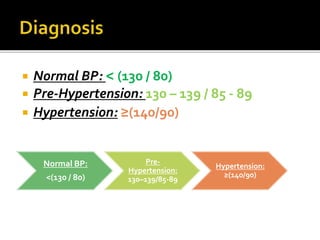
 Normal BP: < (130 / 80)
 Pre-Hypertension: 130 – 139 / 85 - 89
 Hypertension: ≥(140/90)
Normal BP:
<(130 / 80)
Pre-
Hypertension:
130–139/85-89
Hypertension:
≥(140/90)
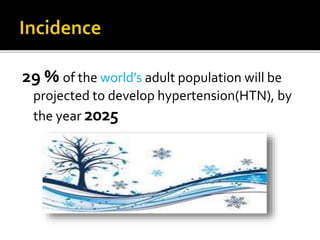
29 % of the world’s adult population will be
projected to develop hypertension(HTN), by
the year 2025
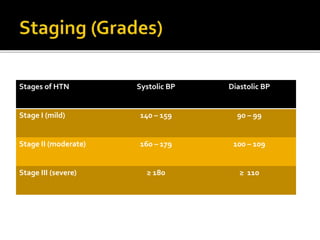
Stages of HTN Systolic BP Diastolic BP
Stage I (mild) 140 – 159 90 – 99
Stage II (moderate) 160 – 179 100 – 109
Stage III (severe) ≥ 180 ≥ 110
 Question: when a person’s systolic and diastolic BP fall
into different categories, which stage would be
defined..?
 Answer:The higher one
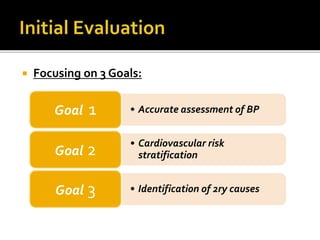
 Focusing on 3 Goals:
• Accurate assessment of BPGoal 1
• Cardiovascular risk
stratificationGoal 2
• Identification of 2ry causesGoal 3
 Goals would be achieved through:
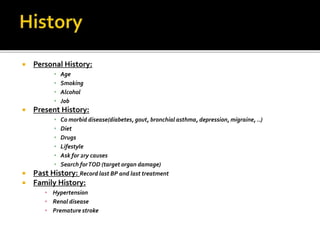
 Personal History:
• Age
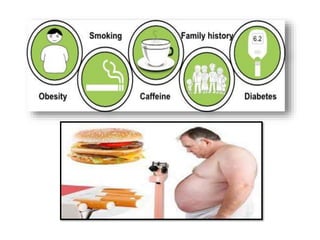
• Smoking
• Alcohol
• Job
 Present History:
• Co morbid disease(diabetes, gout, bronchial asthma, depression, migraine, ..)
• Diet
• Drugs
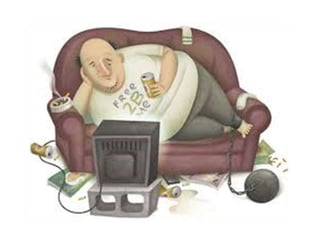
• Lifestyle
• Ask for 2ry causes
• Search forTOD (target organ damage)
 Past History: Record last BP and last treatment
 Family History:
• Hypertension
• Renal disease
• Premature stroke
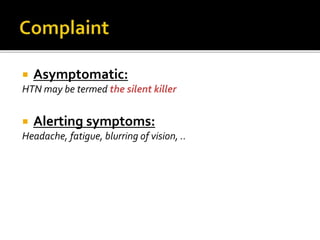
 Asymptomatic:
HTN may be termed the silent killer
 Alerting symptoms:
Headache, fatigue, blurring of vision, ..
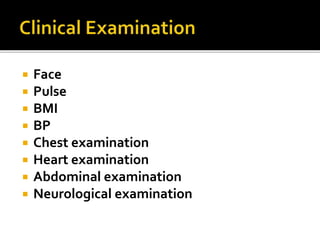
 Face
 Pulse
 BMI
 BP
 Chest examination
 Heart examination
 Abdominal examination
 Neurological examination
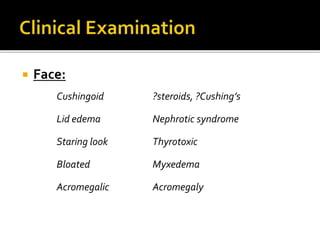
 Face:
Cushingoid ?steroids, ?Cushing’s
Lid edema Nephrotic syndrome
Staring look Thyrotoxic
Bloated Myxedema
Acromegalic Acromegaly
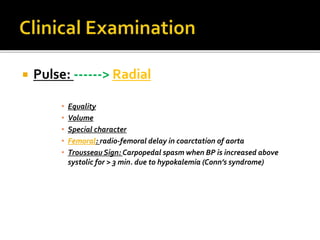
 Pulse: ------> Radial
• Equality
• Volume
• Special character
• Femoral: radio-femoral delay in coarctation of aorta
• Trousseau Sign: Carpopedal spasm when BP is increased above
systolic for > 3 min. due to hypokalemia (Conn’s syndrome)
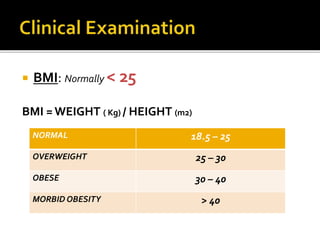
 BMI: Normally < 25
BMI = WEIGHT ( Kg) / HEIGHT (m2)
NORMAL 18.5 – 25
OVERWEIGHT 25 – 30
OBESE 30 – 40
MORBID OBESITY > 40
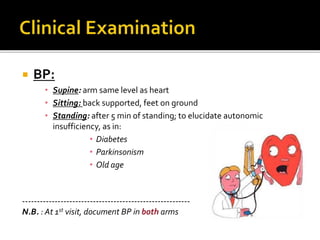
 BP:
• Supine: arm same level as heart
• Sitting: back supported, feet on ground
• Standing: after 5 min of standing; to elucidate autonomic
insufficiency, as in:
• Diabetes
• Parkinsonism
• Old age
---------------------------------------------------------
N.B. : At 1st visit, document BP in both arms
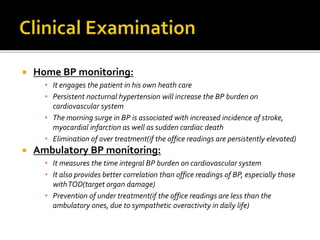
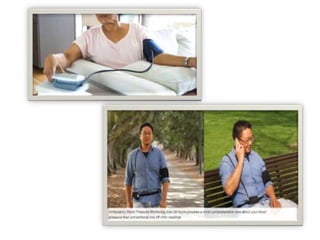
 Home BP monitoring:
• It engages the patient in his own heath care
• Persistent nocturnal hypertension will increase the BP burden on
cardiovascular system
• The morning surge in BP is associated with increased incidence of stroke,
myocardial infarction as well as sudden cardiac death
• Elimination of over treatment(if the office readings are persistently elevated)
 Ambulatory BP monitoring:
• It measures the time integral BP burden on cardiovascular system
• It also provides better correlation than office readings of BP, especially those
withTOD(target organ damage)
• Prevention of under treatment(if the office readings are less than the
ambulatory ones, due to sympathetic overactivity in daily life)
Both Home and ambulatory BP monitoring are useful in:
• Diagnosis of labile hypertension
• Diagnosis of white coat hypertension
• Diagnosis of intermittent hypertension(Fluctuations in
pheochromocytoma)
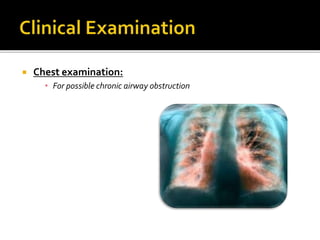
 Chest examination:
• For possible chronic airway obstruction
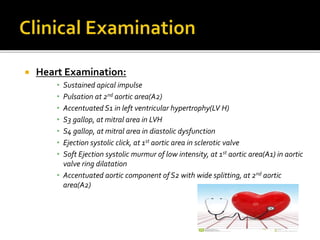
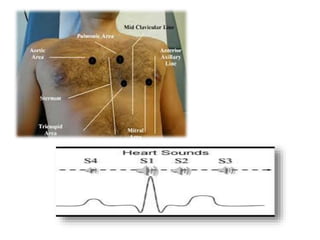
 Heart Examination:
• Sustained apical impulse
• Pulsation at 2nd aortic area(A2)
• Accentuated S1 in left ventricular hypertrophy(LV H)
• S3 gallop, at mitral area in LVH
• S4 gallop, at mitral area in diastolic dysfunction
• Ejection systolic click, at 1st aortic area in sclerotic valve
• Soft Ejection systolic murmur of low intensity, at 1st aortic area(A1) in aortic
valve ring dilatation
• Accentuated aortic component of S2 with wide splitting, at 2nd aortic
area(A2)
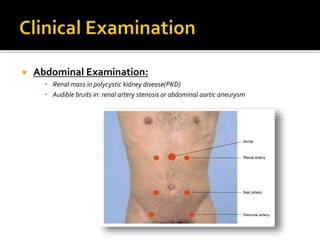
 Abdominal Examination:
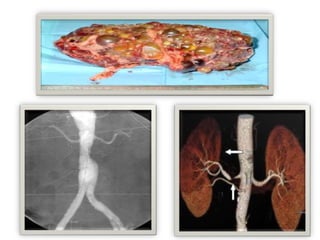
• Renal mass in polycystic kidney disease(PKD)
• Audible bruits in: renal artery stenosis or abdominal aortic aneurysm
 Neurological Examination:
• Speech
• Gait
• Reflexes
• Sensory and Motor affections
 Routine blood tests:
• Complete blood count(CBC)
• Erythrocyte sedimentation rate(ESR)
• Random blood sugar(RBS) ± Hb A1c
• Blood Urea
• Serum Creatinine
• Serum uric acid
• Liver enzymes(ALT / AST)
• Serum albumin
• Serum lipids(cholesterol and triglycerides)
 Urine analysis (?proteinuria)
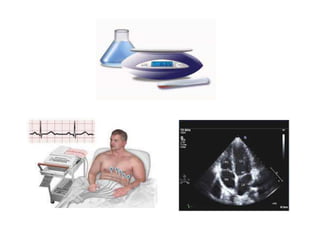
 Resting 12- ECG leads ± Ecchocardiography
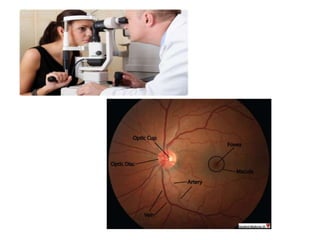
 Fundus examination
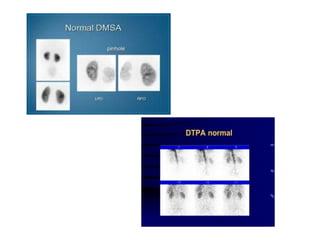
 Renal (ultrasonograhy ± isotope scanning)
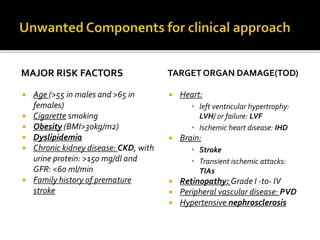
MAJOR RISK FACTORS
 Age (>55 in males and >65 in
females)
 Cigarette smoking
 Obesity (BMI>30kg/m2)
 Dyslipidemia
 Chronic kidney disease: CKD, with
urine protein: >150 mg/dl and
GFR: <60 ml/min
 Family history of premature
stroke
TARGET ORGAN DAMAGE(TOD)
 Heart:
• left ventricular hypertrophy:
LVH/ or failure: LVF
• Ischemic heart disease: IHD
 Brain:
• Stroke
• Transient ischemic attacks:
TIAs
 Retinopathy: Grade I -to- IV
 Peripheral vascular disease: PVD
 Hypertensive nephrosclerosis
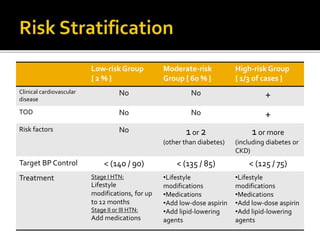
Low-risk Group
{ 2 % }
Moderate-risk
Group { 60 % }
High-risk Group
{ 1/3 of cases }
Clinical cardiovascular
disease
No No +
TOD No No +
Risk factors No 1 0r 2
(other than diabetes)
1 or more
(including diabetes or
CKD)
Target BP Control < (140 / 90) < (135 / 85) < (125 / 75)
Treatment Stage I HTN:
Lifestyle
modifications, for up
to 12 months
Stage II or III HTN:
Add medications
•Lifestyle
modifications
•Medications
•Add low-dose aspirin
•Add lipid-lowering
agents
•Lifestyle
modifications
•Medications
•Add low-dose aspirin
•Add lipid-lowering
agents
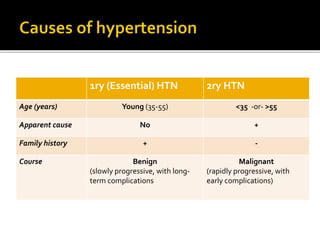
1ry (Essential) HTN 2ry HTN
Age (years) Young (35-55) <35 -or- >55
Apparent cause No +
Family history + -
Course Benign
(slowly progressive, with long-
term complications
Malignant
(rapidly progressive, with
early complications)
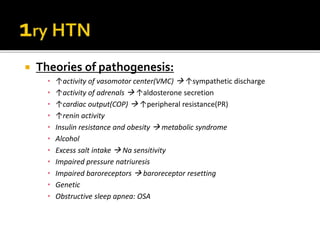
 Theories of pathogenesis:
• ↑activity of vasomotor center(VMC)  ↑sympathetic discharge
• ↑activity of adrenals  ↑aldosterone secretion
• ↑cardiac output(COP)  ↑peripheral resistance(PR)
• ↑renin activity
• Insulin resistance and obesity  metabolic syndrome
• Alcohol
• Excess salt intake  Na sensitivity
• Impaired pressure natriuresis
• Impaired baroreceptors  baroreceptor resetting
• Genetic
• Obstructive sleep apnea: OSA
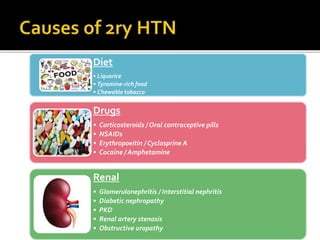
Diet
• Liquorice
• Tyramine-rich food
• Chewable tobacco
Drugs
• Corticosteroids / Oral contraceptive pills
• NSAIDs
• Erythropoeitin / Cyclosprine A
• Cocaine / Amphetamine
Renal
• Glomerulonephritis / Interstitial nephritis
• Diabetic nephropathy
• PKD
• Renal artery stenosis
• Obstructive uropathy
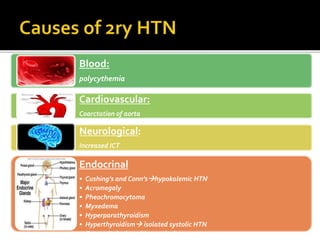
Blood:
polycythemia
Cardiovascular:
Coarctation of aorta
Neurological:
Increased ICT
Endocrinal
• Cushing’s and Conn’shypokalemic HTN
• Acromegaly
• Pheochromocytoma
• Myxedema
• Hyperparathyroidism
• Hyperthyroidism isolated systolic HTN
• Congenital adrenal hyperplasia
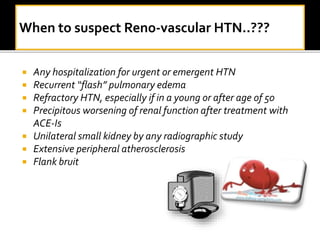
 Any hospitalization for urgent or emergent HTN
 Recurrent “flash” pulmonary edema
 Refractory HTN, especially if in a young or after age of 50
 Precipitous worsening of renal function after treatment with
ACE-Is
 Unilateral small kidney by any radiographic study
 Extensive peripheral atherosclerosis
 Flank bruit
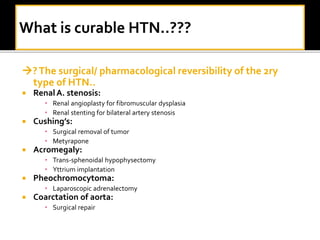
?The surgical/ pharmacological reversibility of the 2ry
type of HTN..
 RenalA. stenosis:
• Renal angioplasty for fibromuscular dysplasia
• Renal stenting for bilateral artery stenosis
 Cushing’s:
• Surgical removal of tumor
• Metyrapone
 Acromegaly:
• Trans-sphenoidal hypophysectomy
• Yttrium implantation
 Pheochromocytoma:
• Laparoscopic adrenalectomy
 Coarctation of aorta:
• Surgical repair
  When BP is often, but not always, in the hypertensive
range..
It is usually border-line HTN
 Cushing’s disease
 Conn’s syndrome
 Renal artery stenosis
 Glucocorticoid-remediable aldosteronism(GRA)
 Liddle’s syndrome
 Bartter’s syndrome
 Gitelman’s syndrome
 Congenital adrenal hyperplasia
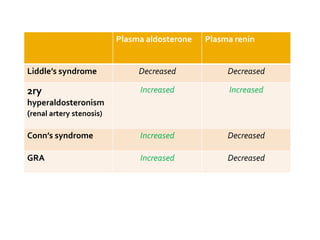
Plasma aldosterone Plasma renin
Liddle’s syndrome Decreased Decreased
2ry
hyperaldosteronism
(renal artery stenosis)
Increased Increased
Conn’s syndrome Increased Decreased
GRA Increased Decreased
  Isolated rise in systolic BP(SBP) with normal diastolic BP
(< 90 mmHg) also called: Isolated systolic hypertension
(ISH)
 Grades:
• Grade I: SBP = 140 – 159 mmHg
• Grade II: SBP = ≥ 160 mmHg
 Causes:
• Fever / anxiety
• Atherosclerosis
• Thyrotoxicosis
• Aortic regurge(AR)
• Coarctation of aorta
• Patent ductus arteriosus(PDA)
• Complete heart block(CHB)
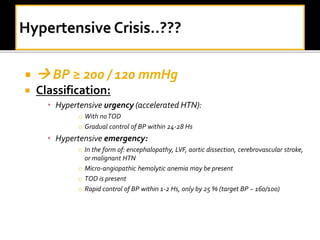
  BP ≥ 200 / 120 mmHg
 Classification:
• Hypertensive urgency (accelerated HTN):
o With noTOD
o Gradual control of BP within 24-28 Hs
• Hypertensive emergency:
o In the form of: encephalopathy, LVF, aortic dissection, cerebrovascular stroke,
or malignant HTN
o Micro-angiopathic hemolytic anemia may be present
o TOD is present
o Rapid control of BP within 1-2 Hs, only by 25 % (target BP ~ 160/100)
 Patient dialogue and patient
education
▪Lifestyle modifications
Medications
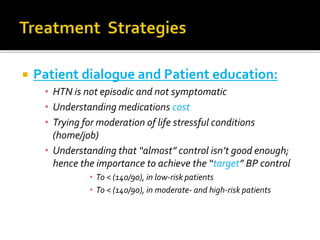
 Patient dialogue and Patient education:
• HTN is not episodic and not symptomatic
• Understanding medications cost
• Trying for moderation of life stressful conditions
(home/job)
• Understanding that “almost” control isn’t good enough;
hence the importance to achieve the “target” BP control
• To < (140/90), in low-risk patients
• To < (140/90), in moderate- and high-risk patients
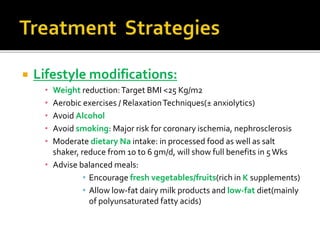
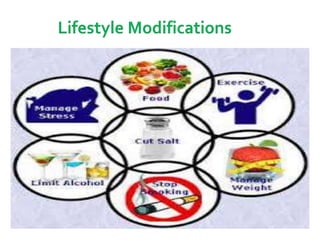
 Lifestyle modifications:
• Weight reduction:Target BMI <25 Kg/m2
• Aerobic exercises / RelaxationTechniques(± anxiolytics)
• Avoid Alcohol
• Avoid smoking: Major risk for coronary ischemia, nephrosclerosis
• Moderate dietary Na intake: in processed food as well as salt
shaker, reduce from 10 to 6 gm/d, will show full benefits in 5Wks
• Advise balanced meals:
• Encourage fresh vegetables/fruits(rich in K supplements)
• Allow low-fat dairy milk products and low-fat diet(mainly
of polyunsaturated fatty acids)
 Medications:
Some Considerations:
• Use long-acting preparations
• Use combinations (synergism)
• Avoid dose-dependent side effects
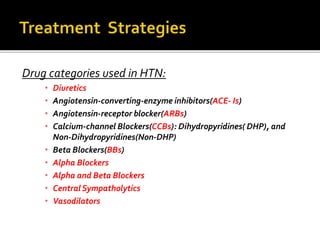
Drug categories used in HTN:
• Diuretics
• Angiotensin-converting-enzyme inhibitors(ACE- Is)
• Angiotensin-receptor blocker(ARBs)
• Calcium-channel Blockers(CCBs): Dihydropyridines( DHP), and
Non-Dihydropyridines(Non-DHP)
• Beta Blockers(BBs)
• Alpha Blockers
• Alpha and Beta Blockers
• Central Sympatholytics
• Vasodilators
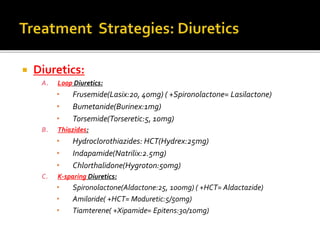
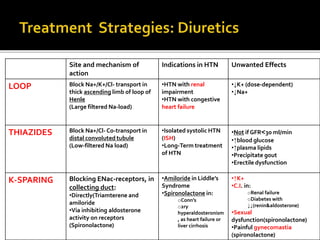
 Diuretics:
A. Loop Diuretics:
• Frusemide(Lasix:20, 40mg) ( +Spironolactone= Lasilactone)
• Bumetanide(Burinex:1mg)
• Torsemide(Torseretic:5, 10mg)
B. Thiazides:
• Hydroclorothiazides: HCT(Hydrex:25mg)
• Indapamide(Natrilix:2.5mg)
• Chlorthalidone(Hygroton:50mg)
C. K-sparing Diuretics:
• Spironolactone(Aldactone:25, 100mg) ( +HCT= Aldactazide)
• Amiloride( +HCT= Moduretic:5/50mg)
• Tiamterene( +Xipamide= Epitens:30/10mg)
Site and mechanism of
action
Indications in HTN Unwanted Effects
LOOP Block Na+/K+/Cl- transport in
thick ascending limb of loop of
Henle
(Large filtered Na-load)
•HTN with renal
impairment
•HTN with congestive
heart failure
•↓K+ (dose-dependent)
•↓Na+
THIAZIDES Block Na+/Cl- Co-transport in
distal convoluted tubule
(Low-filtered Na load)
•Isolated systolic HTN
(ISH)
•Long-Term treatment
of HTN
•Not if GFR<30 ml/min
•↑blood glucose
•↑plasma lipids
•Precipitate gout
•Erectile dysfunction
K-SPARING Blocking ENac-receptors, in
collecting duct:
•Directly(Triamterene and
amiloride
•Via inhibiting aldosterone
activity on receptors
(Spironolactone)
•Amiloride in Liddle’s
Syndrome
•Spironolactone in:
oConn’s
o2ry
hyperaldosteronism
, as heart failure or
liver cirrhosis
•↑K+
•C.I. in:
oRenal failure
oDiabetes with
↓↓(renin&aldosterone)
•Sexual
dysfunction(spironolactone)
•Painful gynecomastia
(spironolactone)
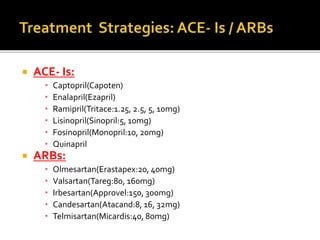
 ACE- Is:
• Captopril(Capoten)
• Enalapril(Ezapril)
• Ramipril(Tritace:1.25, 2.5, 5, 10mg)
• Lisinopril(Sinopril:5, 10mg)
• Fosinopril(Monopril:10, 20mg)
• Quinapril
 ARBs:
• Olmesartan(Erastapex:20, 40mg)
• Valsartan(Tareg:80, 160mg)
• Irbesartan(Approvel:150, 300mg)
• Candesartan(Atacand:8, 16, 32mg)
• Telmisartan(Micardis:40, 80mg)
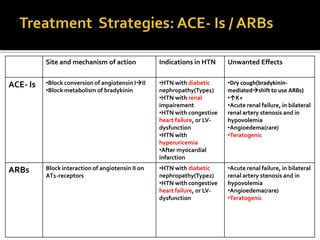
Site and mechanism of action Indications in HTN Unwanted Effects
ACE- Is •Block conversion of angiotensin III
•Block metabolism of bradykinin
•HTN with diabetic
nephropathy(Type1)
•HTN with renal
impairement
•HTN with congestive
heart failure, or LV-
dysfunction
•HTN with
hyperuricemia
•After myocardial
infarction
•Dry cough(bradykinin-
mediatedshift to use ARBs)
•↑K+
•Acute renal failure, in bilateral
renal artery stenosis and in
hypovolemia
•Angioedema(rare)
•Teratogenic
ARBs Block interaction of angiotensin II on
AT1-receptors
•HTN with diabetic
nephropathy(Type2)
•HTN with congestive
heart failure, or LV-
dysfunction
•Acute renal failure, in bilateral
renal artery stenosis and in
hypovolemia
•Angioedema(rare)
•Teratogenic
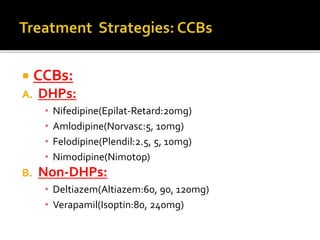
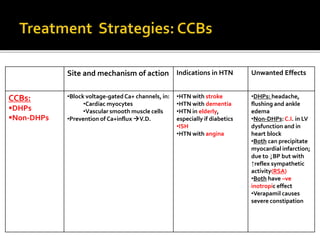
 CCBs:
A. DHPs:
• Nifedipine(Epilat-Retard:20mg)
• Amlodipine(Norvasc:5, 10mg)
• Felodipine(Plendil:2.5, 5, 10mg)
• Nimodipine(Nimotop)
B. Non-DHPs:
• Deltiazem(Altiazem:60, 90, 120mg)
• Verapamil(Isoptin:80, 240mg)
Site and mechanism of action Indications in HTN Unwanted Effects
CCBs:
DHPs
Non-DHPs
•Block voltage-gated Ca+ channels, in:
•Cardiac myocytes
•Vascular smooth muscle cells
•Prevention of Ca+influx V.D.
•HTN with stroke
•HTN with dementia
•HTN in elderly,
especially if diabetics
•ISH
•HTN with angina
•DHPs: headache,
flushing and ankle
edema
•Non-DHPs:C.I. in LV
dysfunction and in
heart block
•Both can precipitate
myocardial infarction;
due to ↓BP but with
↑reflex sympathetic
activity(RSA)
•Both have –ve
inotropic effect
•Verapamil causes
severe constipation
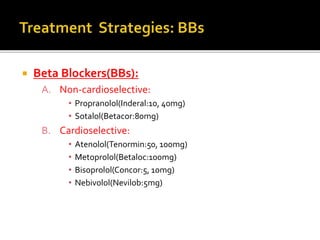
 Beta Blockers(BBs):
A. Non-cardioselective:
• Propranolol(Inderal:10, 40mg)
• Sotalol(Betacor:80mg)
B. Cardioselective:
• Atenolol(Tenormin:50, 100mg)
• Metoprolol(Betaloc:100mg)
• Bisoprolol(Concor:5, 10mg)
• Nebivolol(Nevilob:5mg)
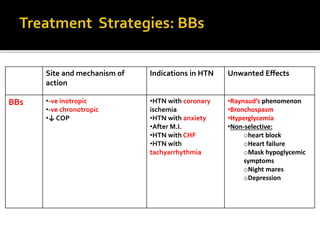
Site and mechanism of
action
Indications in HTN Unwanted Effects
BBs •-ve inotropic
•-ve chronotropic
•↓ COP
•HTN with coronary
ischemia
•HTN with anxiety
•After M.I.
•HTN with CHF
•HTN with
tachyarrhythmia
•Raynaud’s phenomenon
•Bronchospasm
•Hyperglycemia
•Non-selective:
oheart block
oHeart failure
oMask hypoglycemic
symptoms
oNight mares
oDepression
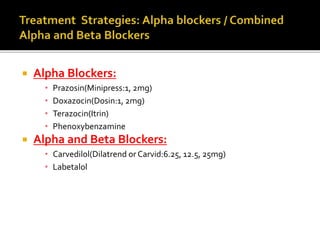
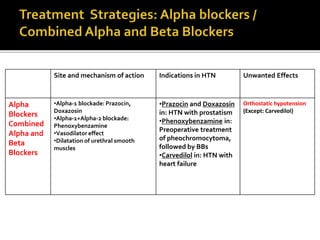
 Alpha Blockers:
• Prazosin(Minipress:1, 2mg)
• Doxazocin(Dosin:1, 2mg)
• Terazocin(Itrin)
• Phenoxybenzamine
 Alpha and Beta Blockers:
• Carvedilol(Dilatrend or Carvid:6.25, 12.5, 25mg)
• Labetalol
Site and mechanism of action Indications in HTN Unwanted Effects
Alpha
Blockers
Combined
Alpha and
Beta
Blockers
•Alpha-1 blockade: Prazocin,
Doxazosin
•Alpha-1+Alpha-2 blockade:
Phenoxybenzamine
•Vasodilator effect
•Dilatation of urethral smooth
muscles
•Prazocin and Doxazosin
in: HTN with prostatism
•Phenoxybenzamine in:
Preoperative treatment
of pheochromocytoma,
followed by BBs
•Carvedilol in: HTN with
heart failure
Orthostatic hypotension
(Except: Carvedilol)
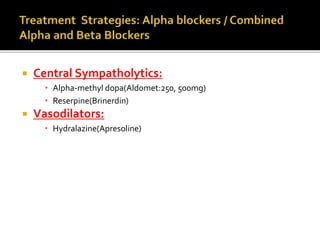
 Central Sympatholytics:
• Alpha-methyl dopa(Aldomet:250, 500mg)
• Reserpine(Brinerdin)
 Vasodilators:
• Hydralazine(Apresoline)
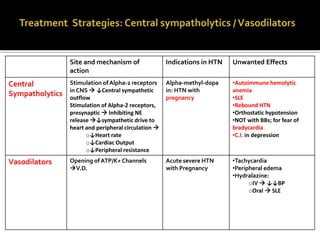
Site and mechanism of
action
Indications in HTN Unwanted Effects
Central
Sympatholytics
Stimulation of Alpha-2 receptors
in CNS  ↓Central sympathetic
outflow
Stimulation of Alpha-2 receptors,
presynaptic  Inhibiting NE
release ↓sympathetic drive to
heart and peripheral circulation 
o↓Heart rate
o↓Cardiac Output
o↓Peripheral resistance
Alpha-methyl-dopa
in: HTN with
pregnancy
•Autoimmune hemolytic
anemia
•SLE
•Rebound HTN
•Orthostatic hypotension
•NOT with BBs; for fear of
bradycardia
•C.I. in depression
Vasodilators Opening of ATP/K+ Channels
V.D.
Acute severe HTN
with Pregnancy
•Tachycardia
•Peripheral edema
•Hydralazine:
oIV  ↓↓BP
oOral  SLE
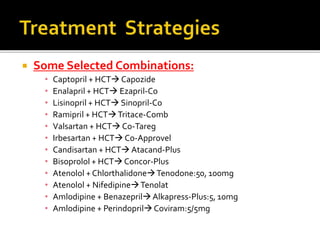
 Some Selected Combinations:
• Captopril + HCT Capozide
• Enalapril + HCT Ezapril-Co
• Lisinopril + HCT Sinopril-Co
• Ramipril + HCTTritace-Comb
• Valsartan + HCT Co-Tareg
• Irbesartan + HCT Co-Approvel
• Candisartan + HCT Atacand-Plus
• Bisoprolol + HCT Concor-Plus
• Atenolol + ChlorthalidoneTenodone:50, 100mg
• Atenolol + NifedipineTenolat
• Amlodipine + BenazeprilAlkapress-Plus:5, 10mg
• Amlodipine + PerindoprilCoviram:5/5mg
 Consider Some Precautions:
• Initial treatment Low-dose combination therapy, then additional drug
for every 10mmHg(SBP) above the target goal
• Medications-induced sexual dysfunction, as:Thiazides,BBs
• Ankle edema of CCBs (DHPs), can be treated by addition of venodilators as:
ACE-Is or ARBs, not a diuretic
• CCBs, better not to be combined with a diuretic in coronary ischemia
• Grapefruit juice increase bioavailability of CCBs
• BBs shouldn’t be combined with non-DHPs, for fear of bradycardia,
especially in elderly
• NSAIDs and ASA >325mgDecrease effect of ACE-Is based treatment
• Consider HTN in Special Situations
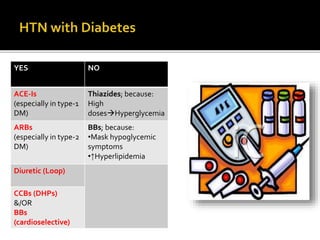
YES NO
ACE-Is
(especially in type-1
DM)
Thiazides; because:
High
dosesHyperglycemia
ARBs
(especially in type-2
DM)
BBs; because:
•Mask hypoglycemic
symptoms
•↑Hyperlipidemia
Diuretic (Loop)
CCBs (DHPs)
&/OR
BBs
(cardioselective)
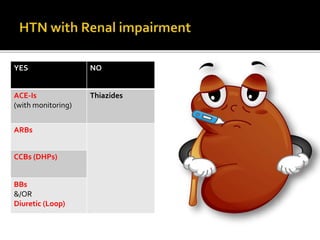
YES NO
ACE-Is
(with monitoring)
Thiazides
ARBs
CCBs (DHPs)
BBs
&/OR
Diuretic (Loop)
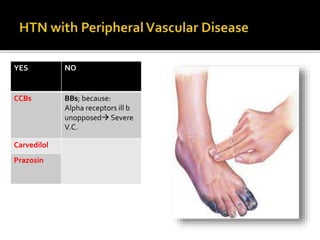
YES NO
CCBs BBs; because:
Alpha receptors ill b
unopposed Severe
V.C.
Carvedilol
Prazosin
YES NO
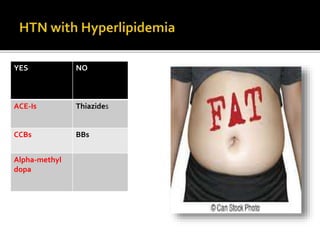
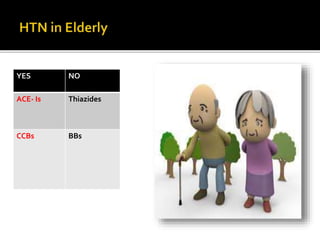
ACE-Is Thiazides
CCBs BBs
Alpha-methyl
dopa
YES NO
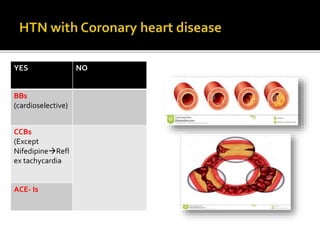
BBs
(cardioselective)
CCBs
(Except
NifedipineRefl
ex tachycardia
ACE- Is
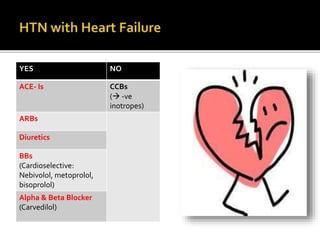
YES NO
ACE- Is CCBs
( -ve
inotropes)
ARBs
Diuretics
BBs
(Cardioselective:
Nebivolol, metoprolol,
bisoprolol)
Alpha & Beta Blocker
(Carvedilol)
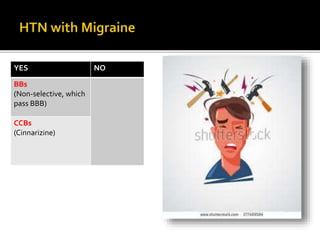
YES NO
BBs
(Non-selective, which
pass BBB)
CCBs
(Cinnarizine)
YES NO
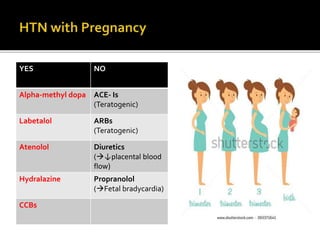
Alpha-methyl dopa ACE- Is
(Teratogenic)
Labetalol ARBs
(Teratogenic)
Atenolol Diuretics
(↓placental blood
flow)
Hydralazine Propranolol
(Fetal bradycardia)
CCBs
YES NO
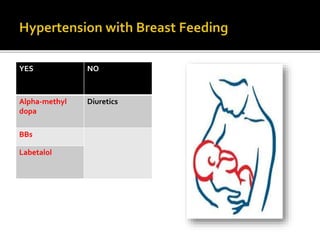
Alpha-methyl
dopa
Diuretics
BBs
Labetalol
YES NO
ACE- Is Thiazides
CCBs BBs
YES NO
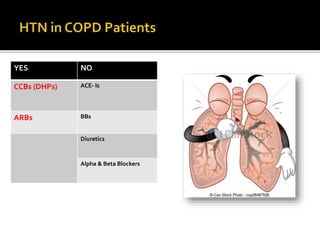
CCBs (DHPs) ACE- Is
ARBs BBs
Diuretics
Alpha & Beta Blockers
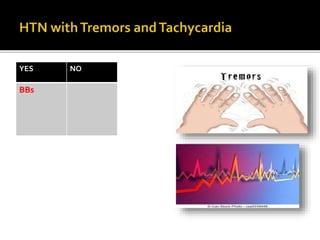
YES NO
BBs
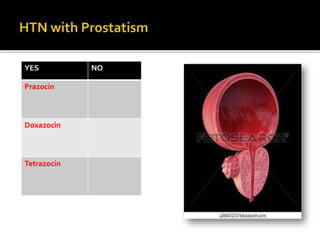
YES NO
Prazocin
Doxazocin
Tetrazocin
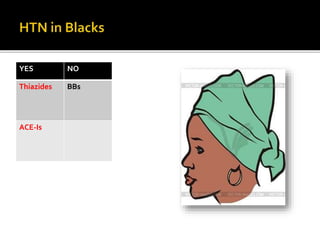
YES NO
Thiazides BBs
ACE-Is
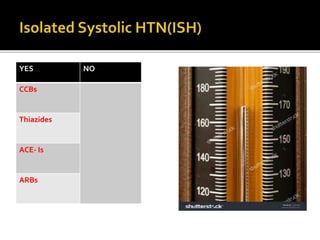
YES NO
CCBs
Thiazides
ACE- Is
ARBs
SYSTEMIC HYPERTENSION

SYSTEMIC HYPERTENSION

  • 1.
    By: Dr./ SAHARH. MOSTAFA Consultant of internal medicine El-MatariaTeaching Hospital-Cairo- Egypt November,2016
  • 2.
    Persistent elevation ofBP above normal values ≥ (140 / 90), on three different occasions, under mental and physical rest
  • 3.
    Question: Why abovethese values..? Answer:  Because this the value above which the benefits of treating hypertension(HTN), appear to outweigh the risks
  • 4.
     Normal BP:< (130 / 80)  Pre-Hypertension: 130 – 139 / 85 - 89  Hypertension: ≥(140/90) Normal BP: <(130 / 80) Pre- Hypertension: 130–139/85-89 Hypertension: ≥(140/90)
  • 5.
    29 % ofthe world’s adult population will be projected to develop hypertension(HTN), by the year 2025
  • 6.
    Stages of HTNSystolic BP Diastolic BP Stage I (mild) 140 – 159 90 – 99 Stage II (moderate) 160 – 179 100 – 109 Stage III (severe) ≥ 180 ≥ 110
  • 7.
     Question: whena person’s systolic and diastolic BP fall into different categories, which stage would be defined..?  Answer:The higher one
  • 8.
     Focusing on3 Goals: • Accurate assessment of BPGoal 1 • Cardiovascular risk stratificationGoal 2 • Identification of 2ry causesGoal 3
  • 9.
     Goals wouldbe achieved through:
  • 10.
     Personal History: •Age • Smoking • Alcohol • Job  Present History: • Co morbid disease(diabetes, gout, bronchial asthma, depression, migraine, ..) • Diet • Drugs • Lifestyle • Ask for 2ry causes • Search forTOD (target organ damage)  Past History: Record last BP and last treatment  Family History: • Hypertension • Renal disease • Premature stroke
  • 12.
     Asymptomatic: HTN maybe termed the silent killer  Alerting symptoms: Headache, fatigue, blurring of vision, ..
  • 14.
     Face  Pulse BMI  BP  Chest examination  Heart examination  Abdominal examination  Neurological examination
  • 16.
     Face: Cushingoid ?steroids,?Cushing’s Lid edema Nephrotic syndrome Staring look Thyrotoxic Bloated Myxedema Acromegalic Acromegaly
  • 17.
     Pulse: ------>Radial • Equality • Volume • Special character • Femoral: radio-femoral delay in coarctation of aorta • Trousseau Sign: Carpopedal spasm when BP is increased above systolic for > 3 min. due to hypokalemia (Conn’s syndrome)
  • 18.
     BMI: Normally< 25 BMI = WEIGHT ( Kg) / HEIGHT (m2) NORMAL 18.5 – 25 OVERWEIGHT 25 – 30 OBESE 30 – 40 MORBID OBESITY > 40
  • 19.
     BP: • Supine:arm same level as heart • Sitting: back supported, feet on ground • Standing: after 5 min of standing; to elucidate autonomic insufficiency, as in: • Diabetes • Parkinsonism • Old age --------------------------------------------------------- N.B. : At 1st visit, document BP in both arms
  • 20.
     Home BPmonitoring: • It engages the patient in his own heath care • Persistent nocturnal hypertension will increase the BP burden on cardiovascular system • The morning surge in BP is associated with increased incidence of stroke, myocardial infarction as well as sudden cardiac death • Elimination of over treatment(if the office readings are persistently elevated)  Ambulatory BP monitoring: • It measures the time integral BP burden on cardiovascular system • It also provides better correlation than office readings of BP, especially those withTOD(target organ damage) • Prevention of under treatment(if the office readings are less than the ambulatory ones, due to sympathetic overactivity in daily life)
  • 22.
    Both Home andambulatory BP monitoring are useful in: • Diagnosis of labile hypertension • Diagnosis of white coat hypertension • Diagnosis of intermittent hypertension(Fluctuations in pheochromocytoma)
  • 23.
     Chest examination: •For possible chronic airway obstruction
  • 24.
     Heart Examination: •Sustained apical impulse • Pulsation at 2nd aortic area(A2) • Accentuated S1 in left ventricular hypertrophy(LV H) • S3 gallop, at mitral area in LVH • S4 gallop, at mitral area in diastolic dysfunction • Ejection systolic click, at 1st aortic area in sclerotic valve • Soft Ejection systolic murmur of low intensity, at 1st aortic area(A1) in aortic valve ring dilatation • Accentuated aortic component of S2 with wide splitting, at 2nd aortic area(A2)
  • 26.
     Abdominal Examination: •Renal mass in polycystic kidney disease(PKD) • Audible bruits in: renal artery stenosis or abdominal aortic aneurysm
  • 28.
     Neurological Examination: •Speech • Gait • Reflexes • Sensory and Motor affections
  • 29.
     Routine bloodtests: • Complete blood count(CBC) • Erythrocyte sedimentation rate(ESR) • Random blood sugar(RBS) ± Hb A1c • Blood Urea • Serum Creatinine • Serum uric acid • Liver enzymes(ALT / AST) • Serum albumin • Serum lipids(cholesterol and triglycerides)  Urine analysis (?proteinuria)  Resting 12- ECG leads ± Ecchocardiography  Fundus examination  Renal (ultrasonograhy ± isotope scanning)
  • 33.
    MAJOR RISK FACTORS Age (>55 in males and >65 in females)  Cigarette smoking  Obesity (BMI>30kg/m2)  Dyslipidemia  Chronic kidney disease: CKD, with urine protein: >150 mg/dl and GFR: <60 ml/min  Family history of premature stroke TARGET ORGAN DAMAGE(TOD)  Heart: • left ventricular hypertrophy: LVH/ or failure: LVF • Ischemic heart disease: IHD  Brain: • Stroke • Transient ischemic attacks: TIAs  Retinopathy: Grade I -to- IV  Peripheral vascular disease: PVD  Hypertensive nephrosclerosis
  • 34.
    Low-risk Group { 2% } Moderate-risk Group { 60 % } High-risk Group { 1/3 of cases } Clinical cardiovascular disease No No + TOD No No + Risk factors No 1 0r 2 (other than diabetes) 1 or more (including diabetes or CKD) Target BP Control < (140 / 90) < (135 / 85) < (125 / 75) Treatment Stage I HTN: Lifestyle modifications, for up to 12 months Stage II or III HTN: Add medications •Lifestyle modifications •Medications •Add low-dose aspirin •Add lipid-lowering agents •Lifestyle modifications •Medications •Add low-dose aspirin •Add lipid-lowering agents
  • 35.
    1ry (Essential) HTN2ry HTN Age (years) Young (35-55) <35 -or- >55 Apparent cause No + Family history + - Course Benign (slowly progressive, with long- term complications Malignant (rapidly progressive, with early complications)
  • 36.
     Theories ofpathogenesis: • ↑activity of vasomotor center(VMC)  ↑sympathetic discharge • ↑activity of adrenals  ↑aldosterone secretion • ↑cardiac output(COP)  ↑peripheral resistance(PR) • ↑renin activity • Insulin resistance and obesity  metabolic syndrome • Alcohol • Excess salt intake  Na sensitivity • Impaired pressure natriuresis • Impaired baroreceptors  baroreceptor resetting • Genetic • Obstructive sleep apnea: OSA
  • 37.
    Diet • Liquorice • Tyramine-richfood • Chewable tobacco Drugs • Corticosteroids / Oral contraceptive pills • NSAIDs • Erythropoeitin / Cyclosprine A • Cocaine / Amphetamine Renal • Glomerulonephritis / Interstitial nephritis • Diabetic nephropathy • PKD • Renal artery stenosis • Obstructive uropathy
  • 38.
    Blood: polycythemia Cardiovascular: Coarctation of aorta Neurological: IncreasedICT Endocrinal • Cushing’s and Conn’shypokalemic HTN • Acromegaly • Pheochromocytoma • Myxedema • Hyperparathyroidism • Hyperthyroidism isolated systolic HTN • Congenital adrenal hyperplasia
  • 39.
     Any hospitalizationfor urgent or emergent HTN  Recurrent “flash” pulmonary edema  Refractory HTN, especially if in a young or after age of 50  Precipitous worsening of renal function after treatment with ACE-Is  Unilateral small kidney by any radiographic study  Extensive peripheral atherosclerosis  Flank bruit
  • 40.
    ?The surgical/ pharmacologicalreversibility of the 2ry type of HTN..  RenalA. stenosis: • Renal angioplasty for fibromuscular dysplasia • Renal stenting for bilateral artery stenosis  Cushing’s: • Surgical removal of tumor • Metyrapone  Acromegaly: • Trans-sphenoidal hypophysectomy • Yttrium implantation  Pheochromocytoma: • Laparoscopic adrenalectomy  Coarctation of aorta: • Surgical repair
  • 41.
      WhenBP is often, but not always, in the hypertensive range.. It is usually border-line HTN
  • 42.
     Cushing’s disease Conn’s syndrome  Renal artery stenosis  Glucocorticoid-remediable aldosteronism(GRA)  Liddle’s syndrome  Bartter’s syndrome  Gitelman’s syndrome  Congenital adrenal hyperplasia
  • 43.
    Plasma aldosterone Plasmarenin Liddle’s syndrome Decreased Decreased 2ry hyperaldosteronism (renal artery stenosis) Increased Increased Conn’s syndrome Increased Decreased GRA Increased Decreased
  • 44.
      Isolatedrise in systolic BP(SBP) with normal diastolic BP (< 90 mmHg) also called: Isolated systolic hypertension (ISH)  Grades: • Grade I: SBP = 140 – 159 mmHg • Grade II: SBP = ≥ 160 mmHg  Causes: • Fever / anxiety • Atherosclerosis • Thyrotoxicosis • Aortic regurge(AR) • Coarctation of aorta • Patent ductus arteriosus(PDA) • Complete heart block(CHB)
  • 45.
      BP≥ 200 / 120 mmHg  Classification: • Hypertensive urgency (accelerated HTN): o With noTOD o Gradual control of BP within 24-28 Hs • Hypertensive emergency: o In the form of: encephalopathy, LVF, aortic dissection, cerebrovascular stroke, or malignant HTN o Micro-angiopathic hemolytic anemia may be present o TOD is present o Rapid control of BP within 1-2 Hs, only by 25 % (target BP ~ 160/100)
  • 46.
     Patient dialogueand patient education ▪Lifestyle modifications Medications
  • 47.
     Patient dialogueand Patient education: • HTN is not episodic and not symptomatic • Understanding medications cost • Trying for moderation of life stressful conditions (home/job) • Understanding that “almost” control isn’t good enough; hence the importance to achieve the “target” BP control • To < (140/90), in low-risk patients • To < (140/90), in moderate- and high-risk patients
  • 48.
     Lifestyle modifications: •Weight reduction:Target BMI <25 Kg/m2 • Aerobic exercises / RelaxationTechniques(± anxiolytics) • Avoid Alcohol • Avoid smoking: Major risk for coronary ischemia, nephrosclerosis • Moderate dietary Na intake: in processed food as well as salt shaker, reduce from 10 to 6 gm/d, will show full benefits in 5Wks • Advise balanced meals: • Encourage fresh vegetables/fruits(rich in K supplements) • Allow low-fat dairy milk products and low-fat diet(mainly of polyunsaturated fatty acids)
  • 50.
     Medications: Some Considerations: •Use long-acting preparations • Use combinations (synergism) • Avoid dose-dependent side effects
  • 51.
    Drug categories usedin HTN: • Diuretics • Angiotensin-converting-enzyme inhibitors(ACE- Is) • Angiotensin-receptor blocker(ARBs) • Calcium-channel Blockers(CCBs): Dihydropyridines( DHP), and Non-Dihydropyridines(Non-DHP) • Beta Blockers(BBs) • Alpha Blockers • Alpha and Beta Blockers • Central Sympatholytics • Vasodilators
  • 52.
     Diuretics: A. LoopDiuretics: • Frusemide(Lasix:20, 40mg) ( +Spironolactone= Lasilactone) • Bumetanide(Burinex:1mg) • Torsemide(Torseretic:5, 10mg) B. Thiazides: • Hydroclorothiazides: HCT(Hydrex:25mg) • Indapamide(Natrilix:2.5mg) • Chlorthalidone(Hygroton:50mg) C. K-sparing Diuretics: • Spironolactone(Aldactone:25, 100mg) ( +HCT= Aldactazide) • Amiloride( +HCT= Moduretic:5/50mg) • Tiamterene( +Xipamide= Epitens:30/10mg)
  • 53.
    Site and mechanismof action Indications in HTN Unwanted Effects LOOP Block Na+/K+/Cl- transport in thick ascending limb of loop of Henle (Large filtered Na-load) •HTN with renal impairment •HTN with congestive heart failure •↓K+ (dose-dependent) •↓Na+ THIAZIDES Block Na+/Cl- Co-transport in distal convoluted tubule (Low-filtered Na load) •Isolated systolic HTN (ISH) •Long-Term treatment of HTN •Not if GFR<30 ml/min •↑blood glucose •↑plasma lipids •Precipitate gout •Erectile dysfunction K-SPARING Blocking ENac-receptors, in collecting duct: •Directly(Triamterene and amiloride •Via inhibiting aldosterone activity on receptors (Spironolactone) •Amiloride in Liddle’s Syndrome •Spironolactone in: oConn’s o2ry hyperaldosteronism , as heart failure or liver cirrhosis •↑K+ •C.I. in: oRenal failure oDiabetes with ↓↓(renin&aldosterone) •Sexual dysfunction(spironolactone) •Painful gynecomastia (spironolactone)
  • 54.
     ACE- Is: •Captopril(Capoten) • Enalapril(Ezapril) • Ramipril(Tritace:1.25, 2.5, 5, 10mg) • Lisinopril(Sinopril:5, 10mg) • Fosinopril(Monopril:10, 20mg) • Quinapril  ARBs: • Olmesartan(Erastapex:20, 40mg) • Valsartan(Tareg:80, 160mg) • Irbesartan(Approvel:150, 300mg) • Candesartan(Atacand:8, 16, 32mg) • Telmisartan(Micardis:40, 80mg)
  • 55.
    Site and mechanismof action Indications in HTN Unwanted Effects ACE- Is •Block conversion of angiotensin III •Block metabolism of bradykinin •HTN with diabetic nephropathy(Type1) •HTN with renal impairement •HTN with congestive heart failure, or LV- dysfunction •HTN with hyperuricemia •After myocardial infarction •Dry cough(bradykinin- mediatedshift to use ARBs) •↑K+ •Acute renal failure, in bilateral renal artery stenosis and in hypovolemia •Angioedema(rare) •Teratogenic ARBs Block interaction of angiotensin II on AT1-receptors •HTN with diabetic nephropathy(Type2) •HTN with congestive heart failure, or LV- dysfunction •Acute renal failure, in bilateral renal artery stenosis and in hypovolemia •Angioedema(rare) •Teratogenic
  • 56.
     CCBs: A. DHPs: •Nifedipine(Epilat-Retard:20mg) • Amlodipine(Norvasc:5, 10mg) • Felodipine(Plendil:2.5, 5, 10mg) • Nimodipine(Nimotop) B. Non-DHPs: • Deltiazem(Altiazem:60, 90, 120mg) • Verapamil(Isoptin:80, 240mg)
  • 57.
    Site and mechanismof action Indications in HTN Unwanted Effects CCBs: DHPs Non-DHPs •Block voltage-gated Ca+ channels, in: •Cardiac myocytes •Vascular smooth muscle cells •Prevention of Ca+influx V.D. •HTN with stroke •HTN with dementia •HTN in elderly, especially if diabetics •ISH •HTN with angina •DHPs: headache, flushing and ankle edema •Non-DHPs:C.I. in LV dysfunction and in heart block •Both can precipitate myocardial infarction; due to ↓BP but with ↑reflex sympathetic activity(RSA) •Both have –ve inotropic effect •Verapamil causes severe constipation
  • 58.
     Beta Blockers(BBs): A.Non-cardioselective: • Propranolol(Inderal:10, 40mg) • Sotalol(Betacor:80mg) B. Cardioselective: • Atenolol(Tenormin:50, 100mg) • Metoprolol(Betaloc:100mg) • Bisoprolol(Concor:5, 10mg) • Nebivolol(Nevilob:5mg)
  • 59.
    Site and mechanismof action Indications in HTN Unwanted Effects BBs •-ve inotropic •-ve chronotropic •↓ COP •HTN with coronary ischemia •HTN with anxiety •After M.I. •HTN with CHF •HTN with tachyarrhythmia •Raynaud’s phenomenon •Bronchospasm •Hyperglycemia •Non-selective: oheart block oHeart failure oMask hypoglycemic symptoms oNight mares oDepression
  • 60.
     Alpha Blockers: •Prazosin(Minipress:1, 2mg) • Doxazocin(Dosin:1, 2mg) • Terazocin(Itrin) • Phenoxybenzamine  Alpha and Beta Blockers: • Carvedilol(Dilatrend or Carvid:6.25, 12.5, 25mg) • Labetalol
  • 61.
    Site and mechanismof action Indications in HTN Unwanted Effects Alpha Blockers Combined Alpha and Beta Blockers •Alpha-1 blockade: Prazocin, Doxazosin •Alpha-1+Alpha-2 blockade: Phenoxybenzamine •Vasodilator effect •Dilatation of urethral smooth muscles •Prazocin and Doxazosin in: HTN with prostatism •Phenoxybenzamine in: Preoperative treatment of pheochromocytoma, followed by BBs •Carvedilol in: HTN with heart failure Orthostatic hypotension (Except: Carvedilol)
  • 62.
     Central Sympatholytics: •Alpha-methyl dopa(Aldomet:250, 500mg) • Reserpine(Brinerdin)  Vasodilators: • Hydralazine(Apresoline)
  • 63.
    Site and mechanismof action Indications in HTN Unwanted Effects Central Sympatholytics Stimulation of Alpha-2 receptors in CNS  ↓Central sympathetic outflow Stimulation of Alpha-2 receptors, presynaptic  Inhibiting NE release ↓sympathetic drive to heart and peripheral circulation  o↓Heart rate o↓Cardiac Output o↓Peripheral resistance Alpha-methyl-dopa in: HTN with pregnancy •Autoimmune hemolytic anemia •SLE •Rebound HTN •Orthostatic hypotension •NOT with BBs; for fear of bradycardia •C.I. in depression Vasodilators Opening of ATP/K+ Channels V.D. Acute severe HTN with Pregnancy •Tachycardia •Peripheral edema •Hydralazine: oIV  ↓↓BP oOral  SLE
  • 64.
     Some SelectedCombinations: • Captopril + HCT Capozide • Enalapril + HCT Ezapril-Co • Lisinopril + HCT Sinopril-Co • Ramipril + HCTTritace-Comb • Valsartan + HCT Co-Tareg • Irbesartan + HCT Co-Approvel • Candisartan + HCT Atacand-Plus • Bisoprolol + HCT Concor-Plus • Atenolol + ChlorthalidoneTenodone:50, 100mg • Atenolol + NifedipineTenolat • Amlodipine + BenazeprilAlkapress-Plus:5, 10mg • Amlodipine + PerindoprilCoviram:5/5mg
  • 65.
     Consider SomePrecautions: • Initial treatment Low-dose combination therapy, then additional drug for every 10mmHg(SBP) above the target goal • Medications-induced sexual dysfunction, as:Thiazides,BBs • Ankle edema of CCBs (DHPs), can be treated by addition of venodilators as: ACE-Is or ARBs, not a diuretic • CCBs, better not to be combined with a diuretic in coronary ischemia • Grapefruit juice increase bioavailability of CCBs • BBs shouldn’t be combined with non-DHPs, for fear of bradycardia, especially in elderly • NSAIDs and ASA >325mgDecrease effect of ACE-Is based treatment • Consider HTN in Special Situations
  • 66.
    YES NO ACE-Is (especially intype-1 DM) Thiazides; because: High dosesHyperglycemia ARBs (especially in type-2 DM) BBs; because: •Mask hypoglycemic symptoms •↑Hyperlipidemia Diuretic (Loop) CCBs (DHPs) &/OR BBs (cardioselective)
  • 67.
  • 68.
    YES NO CCBs BBs;because: Alpha receptors ill b unopposed Severe V.C. Carvedilol Prazosin
  • 69.
    YES NO ACE-Is Thiazides CCBsBBs Alpha-methyl dopa
  • 70.
  • 71.
    YES NO ACE- IsCCBs ( -ve inotropes) ARBs Diuretics BBs (Cardioselective: Nebivolol, metoprolol, bisoprolol) Alpha & Beta Blocker (Carvedilol)
  • 72.
  • 73.
    YES NO Alpha-methyl dopaACE- Is (Teratogenic) Labetalol ARBs (Teratogenic) Atenolol Diuretics (↓placental blood flow) Hydralazine Propranolol (Fetal bradycardia) CCBs
  • 74.
  • 75.
    YES NO ACE- IsThiazides CCBs BBs
  • 76.
    YES NO CCBs (DHPs)ACE- Is ARBs BBs Diuretics Alpha & Beta Blockers
  • 77.
  • 78.
  • 79.
  • 80.