AV BLOCKS
Why they don’t occur normally?
• The atria and ventricles are contiguous structures separated by a dense mass of
fibrous tissues that are electrically inert.
• This prevents the direct spread of electrical impulses between the atria and
ventricles.
• The only pathway by which the sinus impulse can reach the ventricles is through
the normal atrioventricular (AV) conduction system.
• The normal AV conduction system consists of the
• AV node,
• bundle of His,
• bundle branches, and
• fascicular branches of the left bundle branch.
• The sinus impulse can be delayed or interrupted anywhere along this
conduction pathway, resulting in varying degrees of AV block.
• There are three types of AV block based on the severity of the conduction
abnormality:
• First-degree AV block
• Second-degree AV block
• Mobitz type I or AV Wenckebach
• Mobitz type II
• Advanced or high grade
• Third-degree or complete AV block
First degree AV block
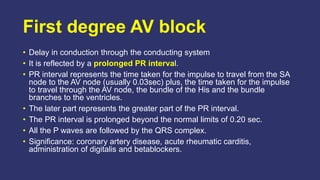
• Delay in conduction through the conducting system
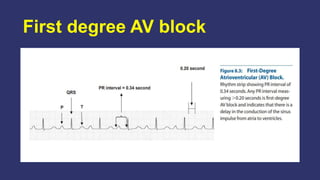
• It is reflected by a prolonged PR interval.
• PR interval represents the time taken for the impulse to travel from the SA
node to the AV node (usually 0.03sec) plus, the time taken for the impulse
to travel through the AV node, the bundle of the His and the bundle
branches to the ventricles.
• The later part represents the greater part of the PR interval.
• The PR interval is prolonged beyond the normal limits of 0.20 sec.
• All the P waves are followed by the QRS complex.
• Significance: coronary artery disease, acute rheumatic carditis,
administration of digitalis and betablockers.
First degree AV block
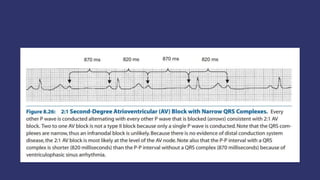
Second degree AV block
• Intermittent failure or interruption of AV conduction.
• The sinus impulse is blocked within the AV conducting system.
• The P wave is therefore not followed by a QRS complex and a ventricular
beat – dropped.
• Regularly occurring P waves not followed by QRS complexes.
• AV conduction ratio.
• The number of sinus impulses to the number of QRS complexes in any one
sequence.
Mobitz type I AV block
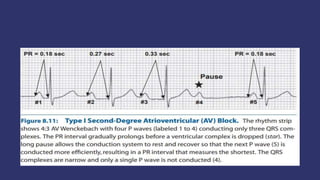
• Type I second-degree AV block is also called AV Wenckebach.
• The following features characterize type I second-degree AV block.
• Two or more consecutive P waves are conducted.
• Only single P waves are blocked.
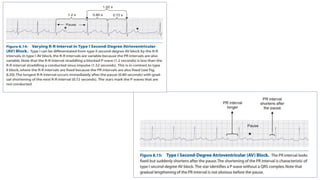
• There is gradual prolongation of the PR interval before a ventricular
complex is dropped.
• The PR interval always shortens immediately after the pause.
• The QRS complexes may be narrow or wide but are typically narrow.
• Group beating is present.
• The R-R intervals (distance between two R waves) are variable.
• The R-R interval straddling a blocked P wave is less than the R-R interval
straddling a conducted sinus impulse.
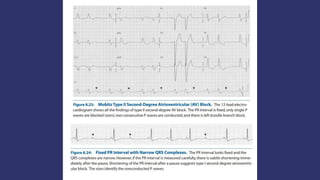
Mobitz type II AV block
• Two or more consecutive P waves are conducted.
• Only single P wave is blocked.
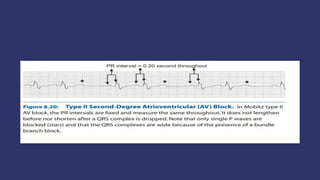
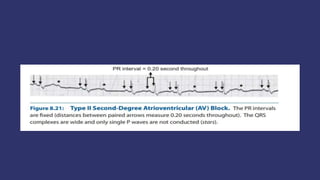
• All PR intervals measure the same throughout.
• The PR interval is fixed and does not prolong before or shorten after a
pause.
• The QRS complexes are usually because of the presence of bundle branch
block.
• The R-R intervals (distance between R waves) are constant and measure
the same throughout as long as the sinus rhythm is stable—that is, the
heart rate or P-P intervals are regular.
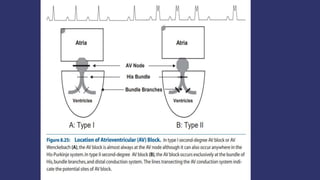
• In Mobitz type II second-degree AV block, one bundle branch has a fixed
block and the other bundle branch is intermittently blocked, resulting in P
waves that are not conducted.
• The PR interval remains constant throughout. The PR interval immediately
after the pause should not shorten and should measure the same as the
PR interval before the pause.
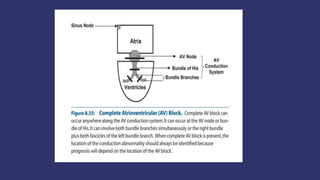
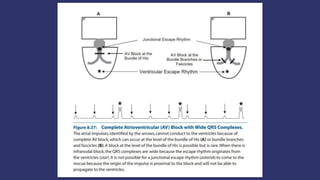
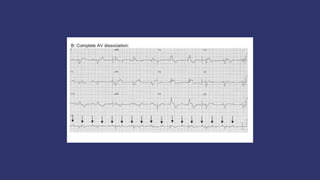
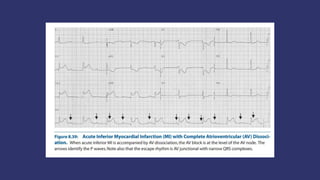
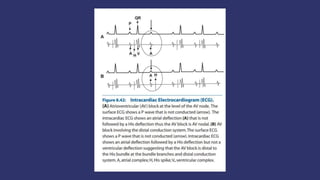
Third degree AV block
• Complete or permanent interruption of AV conduction
• AV dissociation
• Slow ventricular rate
• QRS configuration.
High grade AV block
• Intermittent block of two or more consecutive supraventricular impulses.
ATRIOVENTRICULAR BLOCKS.pptx

ATRIOVENTRICULAR BLOCKS.pptx

  • 1.
  • 2.
    Why they don’toccur normally? • The atria and ventricles are contiguous structures separated by a dense mass of fibrous tissues that are electrically inert. • This prevents the direct spread of electrical impulses between the atria and ventricles. • The only pathway by which the sinus impulse can reach the ventricles is through the normal atrioventricular (AV) conduction system. • The normal AV conduction system consists of the • AV node, • bundle of His, • bundle branches, and • fascicular branches of the left bundle branch.
  • 5.
    • The sinusimpulse can be delayed or interrupted anywhere along this conduction pathway, resulting in varying degrees of AV block. • There are three types of AV block based on the severity of the conduction abnormality: • First-degree AV block • Second-degree AV block • Mobitz type I or AV Wenckebach • Mobitz type II • Advanced or high grade • Third-degree or complete AV block
  • 6.
    First degree AVblock • Delay in conduction through the conducting system • It is reflected by a prolonged PR interval. • PR interval represents the time taken for the impulse to travel from the SA node to the AV node (usually 0.03sec) plus, the time taken for the impulse to travel through the AV node, the bundle of the His and the bundle branches to the ventricles. • The later part represents the greater part of the PR interval. • The PR interval is prolonged beyond the normal limits of 0.20 sec. • All the P waves are followed by the QRS complex. • Significance: coronary artery disease, acute rheumatic carditis, administration of digitalis and betablockers.
  • 7.
  • 8.
    Second degree AVblock • Intermittent failure or interruption of AV conduction. • The sinus impulse is blocked within the AV conducting system. • The P wave is therefore not followed by a QRS complex and a ventricular beat – dropped. • Regularly occurring P waves not followed by QRS complexes. • AV conduction ratio. • The number of sinus impulses to the number of QRS complexes in any one sequence.
  • 9.
    Mobitz type IAV block • Type I second-degree AV block is also called AV Wenckebach. • The following features characterize type I second-degree AV block. • Two or more consecutive P waves are conducted. • Only single P waves are blocked. • There is gradual prolongation of the PR interval before a ventricular complex is dropped. • The PR interval always shortens immediately after the pause. • The QRS complexes may be narrow or wide but are typically narrow.
  • 12.
    • Group beatingis present. • The R-R intervals (distance between two R waves) are variable. • The R-R interval straddling a blocked P wave is less than the R-R interval straddling a conducted sinus impulse.
  • 15.
    Mobitz type IIAV block • Two or more consecutive P waves are conducted. • Only single P wave is blocked. • All PR intervals measure the same throughout. • The PR interval is fixed and does not prolong before or shorten after a pause. • The QRS complexes are usually because of the presence of bundle branch block. • The R-R intervals (distance between R waves) are constant and measure the same throughout as long as the sinus rhythm is stable—that is, the heart rate or P-P intervals are regular.
  • 19.
    • In Mobitztype II second-degree AV block, one bundle branch has a fixed block and the other bundle branch is intermittently blocked, resulting in P waves that are not conducted. • The PR interval remains constant throughout. The PR interval immediately after the pause should not shorten and should measure the same as the PR interval before the pause.
  • 23.
    Third degree AVblock • Complete or permanent interruption of AV conduction • AV dissociation • Slow ventricular rate • QRS configuration.
  • 31.
    High grade AVblock • Intermittent block of two or more consecutive supraventricular impulses.