Seminar on JVP
By Dr Sumedh S Ramteke
“INTRODUCTION”
 JVP- reflects Rt side of heart , Rt atrial
pressure during systole and Rt ventricular
filling pressure during diastole.
 Bedside examination is done-
to estimate CVP
assess the waveform
JUGULAR VENOUS PULSE:
DEFINED AS THE OSCILLATING TOP OF
VERTICAL COLUMN OF BLOOD IN RIGHT
IJV THAT REFLECTS PRESSURE
CHANGES IN RIGHT ATRIUM IN
CARDIAC CYCLE.
JUGULAR VENOUS PRESSURE:
VERTICAL HEIGHT OF OSCILLATING
COLOUMN OF BLOOD.
Why IJV over EJV ?
 IJV are close to RA, direct course from
innominate vein to SVC & RA.
 Valves at prox part of EJV are more than IJV.
 EJV passes through more fascial plane,
hence, affected by extrinsic compression.
 symp activity(CHF) vasoconstriction of
EJV pulsations barely visible.
Rt IJV preferred than Lf IJV..
 Rt IJV & IV – in straight line from SVC & RA
 Lf IJV & IV – not in straight line
 Lf IJV may get compressed by variety of
normal structures, dilated aorta or aneurysm.
If difficulty on Rt side , look for Lf side also.
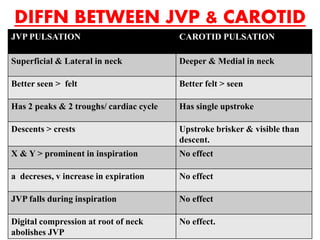
DIFFN BETWEEN JVP & CAROTID
JVP PULSATION CAROTID PULSATION
Superficial & Lateral in neck Deeper & Medial in neck
Better seen > felt Better felt > seen
Has 2 peaks & 2 troughs/ cardiac cycle Has single upstroke
Descents > crests Upstroke brisker & visible than
descent.
X & Y > prominent in inspiration No effect
a decreses, v increase in expiration No effect
JVP falls during inspiration No effect
Digital compression at root of neck
abolishes JVP
No effect.
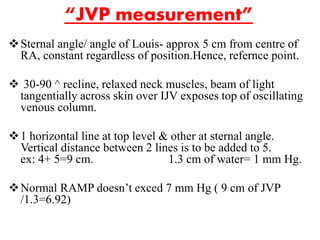
“JVP measurement”
Sternal angle/ angle of Louis- approx 5 cm from centre of
RA, constant regardless of position.Hence, refernce point.
 30-90 ^ recline, relaxed neck muscles, beam of light
tangentially across skin over IJV exposes top of oscillating
venous column.
1 horizontal line at top level & other at sternal angle.
Vertical distance between 2 lines is to be added to 5.
ex: 4+ 5=9 cm. 1.3 cm of water= 1 mm Hg.
Normal RAMP doesn’t exced 7 mm Hg ( 9 cm of JVP
/1.3=6.92)
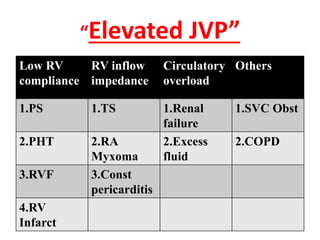
“Elevated JVP”
Low RV
compliance
RV inflow
impedance
Circulatory
overload
Others
1.PS 1.TS 1.Renal
failure
1.SVC Obst
2.PHT 2.RA
Myxoma
2.Excess
fluid
2.COPD
3.RVF 3.Const
pericarditis
4.RV
Infarct
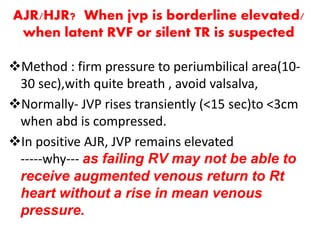
AJR/HJR? When jvp is borderline elevated/
when latent RVF or silent TR is suspected
Method : firm pressure to periumbilical area(10-
30 sec),with quite breath , avoid valsalva,
Normally- JVP rises transiently (<15 sec)to <3cm
when abd is compressed.
In positive AJR, JVP remains elevated
-----why--- as failing RV may not be able to
receive augmented venous return to Rt
heart without a rise in mean venous
pressure.
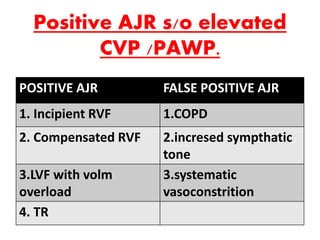
Positive AJR s/o elevated
CVP /PAWP.
POSITIVE AJR FALSE POSITIVE AJR
1. Incipient RVF 1.COPD
2. Compensated RVF 2.incresed sympthatic
tone
3.LVF with volm
overload
3.systematic
vasoconstrition
4. TR
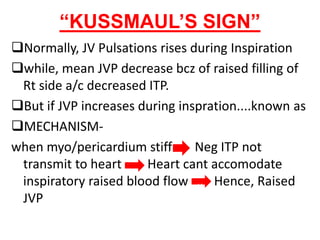
“KUSSMAUL’S SIGN”
Normally, JV Pulsations rises during Inspiration
while, mean JVP decrease bcz of raised filling of
Rt side a/c decreased ITP.
But if JVP increases during inspration....known as
MECHANISM-
when myo/pericardium stiff Neg ITP not
transmit to heart Heart cant accomodate
inspiratory raised blood flow Hence, Raised
JVP
H
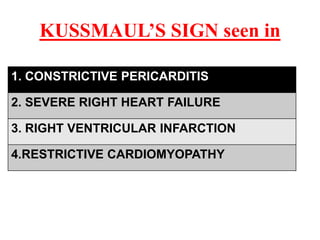
KUSSMAUL’S SIGN seen in
1. CONSTRICTIVE PERICARDITIS
2. SEVERE RIGHT HEART FAILURE
3. RIGHT VENTRICULAR INFARCTION
4.RESTRICTIVE CARDIOMYOPATHY
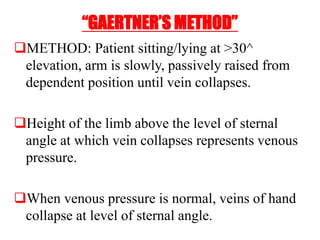
“GAERTNER’S METHOD”
METHOD: Patient sitting/lying at >30^
elevation, arm is slowly, passively raised from
dependent position until vein collapses.
Height of the limb above the level of sternal
angle at which vein collapses represents venous
pressure.
When venous pressure is normal, veins of hand
collapse at level of sternal angle.
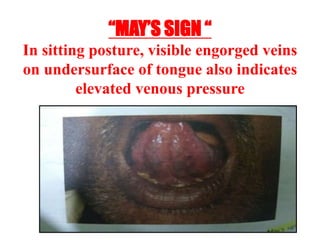
“MAY’S SIGN “
In sitting posture, visible engorged veins
on undersurface of tongue also indicates
elevated venous pressure
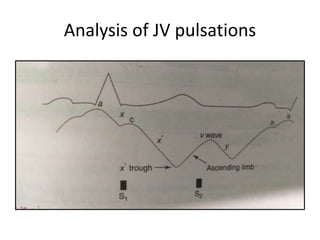
Analysis of JV pulsations
“a”wave
First positive presystolic wave.
D/t RAC which results in retrograde blood
flow into SVC & JV during RA systole.
Normally, it is dominant during inspiration,
larger than v wave.
Synchronous with S1 , follows P wave of ECG.
“x” descent( systolic collapse)
a is followed by x
d/t RA relaxation during atrial diastole
often, it is the most prominent motion of normal
JVP which begins during systole, ends just before
S2.
larger than y descent.
“c wave”
2nd positive venous wave.
produced d/t- impact of carotid artery
which is adjacent to the IJV
- -upward bulging of the closed
TV into RA during RV Isovolumetric
contraction.
“ x’ descent “
It is x descent below the c wave .
more often, it is interrupted by 2nd positive
wave.
it is d/t-fall in RAP during early RV systole
- descent of the floor of RA
- downward pulling of TV by contracting
RV.
“v wave”
3rd positive wave , begins in late systole and
ends in early diastole.
d/t RAP d/t continued RA filling during
ventricular systole when TV is closed.
synchronous with carotid upstroke.
peaks after S2.
“y descent ( diastolic collapse)”
its downslope of v wave.
d/t decline in RAP d/t RA emptying and RV
filling when TV opens in early diastole.
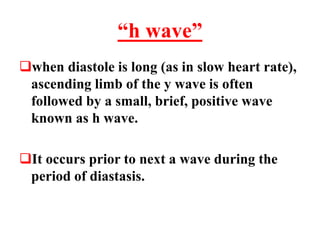
“h wave”
when diastole is long (as in slow heart rate),
ascending limb of the y wave is often
followed by a small, brief, positive wave
known as h wave.
It occurs prior to next a wave during the
period of diastasis.
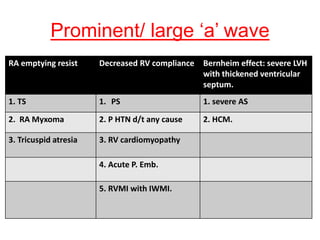
Prominent/ large ‘a’ wave
RA emptying resist Decreased RV compliance Bernheim effect: severe LVH
with thickened ventricular
septum.
1. TS 1. PS 1. severe AS
2. RA Myxoma 2. P HTN d/t any cause 2. HCM.
3. Tricuspid atresia 3. RV cardiomyopathy
4. Acute P. Emb.
5. RVMI with IWMI.
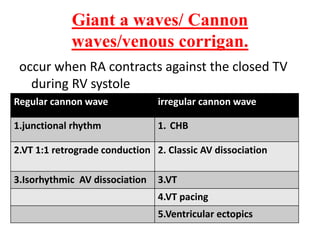
Giant a waves/ Cannon
waves/venous corrigan.
occur when RA contracts against the closed TV
during RV systole
Regular cannon wave irregular cannon wave
1.junctional rhythm 1. CHB
2.VT 1:1 retrograde conduction 2. Classic AV dissociation
3.Isorhythmic AV dissociation 3.VT
4.VT pacing
5.Ventricular ectopics
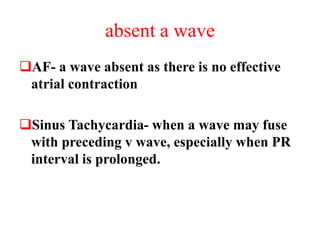
absent a wave
AF- a wave absent as there is no effective
atrial contraction
Sinus Tachycardia- when a wave may fuse
with preceding v wave, especially when PR
interval is prolonged.
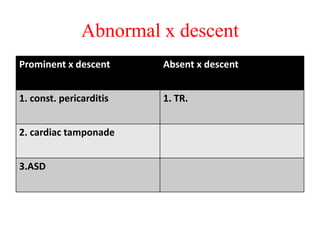
Abnormal x descent
Prominent x descent Absent x descent
1. const. pericarditis 1. TR.
2. cardiac tamponade
3.ASD
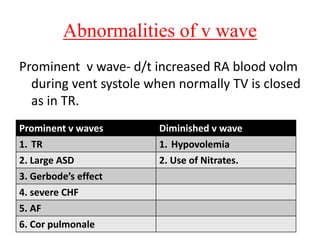
Abnormalities of v wave
Prominent v wave- d/t increased RA blood volm
during vent systole when normally TV is closed
as in TR.
Prominent v waves Diminished v wave
1. TR 1. Hypovolemia
2. Large ASD 2. Use of Nitrates.
3. Gerbode’s effect
4. severe CHF
5. AF
6. Cor pulmonale
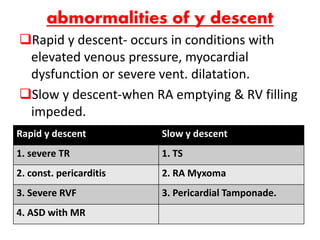
abmormalities of y descent
Rapid y descent- occurs in conditions with
elevated venous pressure, myocardial
dysfunction or severe vent. dilatation.
Slow y descent-when RA emptying & RV filling
impeded.
Rapid y descent Slow y descent
1. severe TR 1. TS
2. const. pericarditis 2. RA Myxoma
3. Severe RVF 3. Pericardial Tamponade.
4. ASD with MR
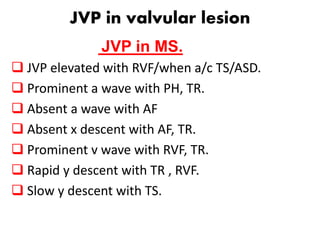
JVP in valvular lesion
JVP in MS.
 JVP elevated with RVF/when a/c TS/ASD.
 Prominent a wave with PH, TR.
 Absent a wave with AF
 Absent x descent with AF, TR.
 Prominent v wave with RVF, TR.
 Rapid y descent with TR , RVF.
 Slow y descent with TS.
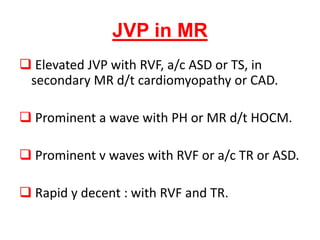
JVP in MR
 Elevated JVP with RVF, a/c ASD or TS, in
secondary MR d/t cardiomyopathy or CAD.
 Prominent a wave with PH or MR d/t HOCM.
 Prominent v waves with RVF or a/c TR or ASD.
 Rapid y decent : with RVF and TR.
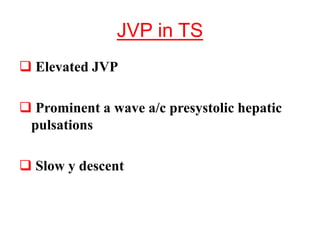
JVP in TS
 Elevated JVP
 Prominent a wave a/c presystolic hepatic
pulsations
 Slow y descent
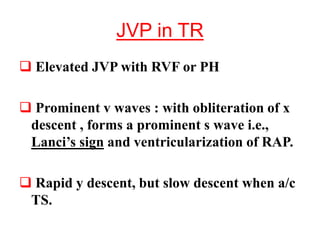
JVP in TR
 Elevated JVP with RVF or PH
 Prominent v waves : with obliteration of x
descent , forms a prominent s wave i.e.,
Lanci’s sign and ventricularization of RAP.
 Rapid y descent, but slow descent when a/c
TS.
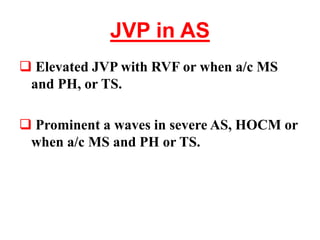
JVP in AS
 Elevated JVP with RVF or when a/c MS
and PH, or TS.
 Prominent a waves in severe AS, HOCM or
when a/c MS and PH or TS.
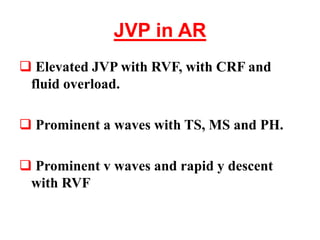
JVP in AR
 Elevated JVP with RVF, with CRF and
fluid overload.
 Prominent a waves with TS, MS and PH.
 Prominent v waves and rapid y descent
with RVF
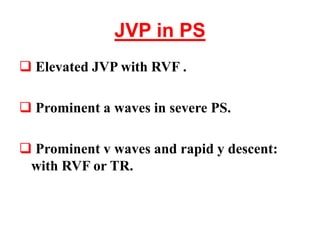
JVP in PS
 Elevated JVP with RVF .
 Prominent a waves in severe PS.
 Prominent v waves and rapid y descent:
with RVF or TR.
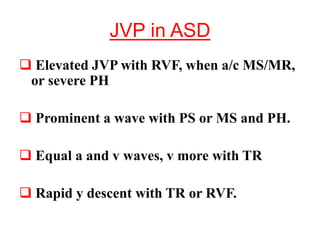
JVP in ASD
 Elevated JVP with RVF, when a/c MS/MR,
or severe PH
 Prominent a wave with PS or MS and PH.
 Equal a and v waves, v more with TR
 Rapid y descent with TR or RVF.
JVP in VSD
 Elevated JVP in CHF, in AV canal defect (VSD
with MR/TR), VSD with LV to RA
shunt(Gerbode’s)
 Prominent a waves with severe PS.
 Prominent v waves and rapid y descent with
CHF,TR and in Gerbode’s defect.
 Absent x descent with TR and in Gerbode’s.
JVP in Eisenmenger complex
 In VSD with Rt to Lf shunt, JVP is usually
normal with normal a and v waves.
 In Eisenmenger synd with ASD and PDA,
JVP may be elevated with prominent v
waves.
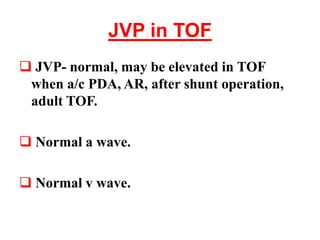
JVP in TOF
 JVP- normal, may be elevated in TOF
when a/c PDA, AR, after shunt operation,
adult TOF.
 Normal a wave.
 Normal v wave.
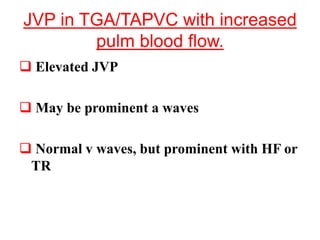
JVP in TGA/TAPVC with increased
pulm blood flow.
 Elevated JVP
 May be prominent a waves
 Normal v waves, but prominent with HF or
TR
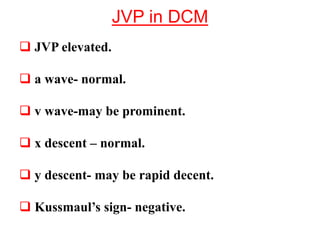
JVP in DCM
 JVP elevated.
 a wave- normal.
 v wave-may be prominent.
 x descent – normal.
 y descent- may be rapid decent.
 Kussmaul’s sign- negative.
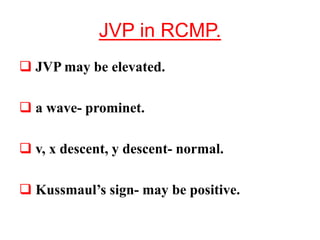
JVP in RCMP.
 JVP may be elevated.
 a wave- prominet.
 v, x descent, y descent- normal.
 Kussmaul’s sign- may be positive.
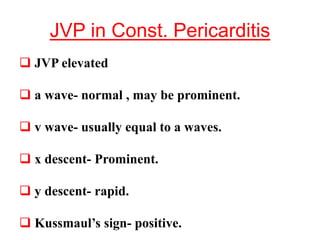
JVP in Const. Pericarditis
 JVP elevated
 a wave- normal , may be prominent.
 v wave- usually equal to a waves.
 x descent- Prominent.
 y descent- rapid.
 Kussmaul’s sign- positive.
JVP in Cardiac Tamponade
 JVP elevated
 a wave- never prominent
 v wave – normal
 x decent – normal
 y descent- reduced/absent
 Kussmaul’s sign-negative, may be positive.
JVP in Arrhytmias
 Sinus Brady: slow normal regular sequence
of a & v waves maintained.
 AF : JVP simulates TR as v wave is prominent
d/t absenceof a wave & diminution of x
descent.
 APC : normal sequence of a wave, carotid
pulse and v wave is maintained.
 SVT : with HR > 160, a & v waves merge into
a single venous crest which resemble cannon
wave of JT.
 VT, JT : cannon waves are characteristic.
JVP in Conduction defect
 PR interval can be estimated- interval between
a wave & carotid pulse(C).
 Increased a-C, indicates prolonged PR.
 1 ^ AV Block, complete LBBB : a-C prolongs.
 Mobitz type I: gradual lengthening of a-C ,
ending with an a wave i.e., not follwed by a
carotid.
 Mobitz type II block: a-C doesnt vary,
but suddenly interrupted by isolated a
waves that are not followed by a carotid
pulse.
 2:1 AV Block: 2 a waves for every one
carotid.
 CHB: intermittent cannon waves.

jugular venous pressure

  • 1.
    Seminar on JVP ByDr Sumedh S Ramteke
  • 2.
    “INTRODUCTION”  JVP- reflectsRt side of heart , Rt atrial pressure during systole and Rt ventricular filling pressure during diastole.  Bedside examination is done- to estimate CVP assess the waveform
  • 3.
    JUGULAR VENOUS PULSE: DEFINEDAS THE OSCILLATING TOP OF VERTICAL COLUMN OF BLOOD IN RIGHT IJV THAT REFLECTS PRESSURE CHANGES IN RIGHT ATRIUM IN CARDIAC CYCLE. JUGULAR VENOUS PRESSURE: VERTICAL HEIGHT OF OSCILLATING COLOUMN OF BLOOD.
  • 4.
    Why IJV overEJV ?  IJV are close to RA, direct course from innominate vein to SVC & RA.  Valves at prox part of EJV are more than IJV.  EJV passes through more fascial plane, hence, affected by extrinsic compression.  symp activity(CHF) vasoconstriction of EJV pulsations barely visible.
  • 5.
    Rt IJV preferredthan Lf IJV..  Rt IJV & IV – in straight line from SVC & RA  Lf IJV & IV – not in straight line  Lf IJV may get compressed by variety of normal structures, dilated aorta or aneurysm. If difficulty on Rt side , look for Lf side also.
  • 6.
    DIFFN BETWEEN JVP& CAROTID JVP PULSATION CAROTID PULSATION Superficial & Lateral in neck Deeper & Medial in neck Better seen > felt Better felt > seen Has 2 peaks & 2 troughs/ cardiac cycle Has single upstroke Descents > crests Upstroke brisker & visible than descent. X & Y > prominent in inspiration No effect a decreses, v increase in expiration No effect JVP falls during inspiration No effect Digital compression at root of neck abolishes JVP No effect.
  • 7.
    “JVP measurement” Sternal angle/angle of Louis- approx 5 cm from centre of RA, constant regardless of position.Hence, refernce point.  30-90 ^ recline, relaxed neck muscles, beam of light tangentially across skin over IJV exposes top of oscillating venous column. 1 horizontal line at top level & other at sternal angle. Vertical distance between 2 lines is to be added to 5. ex: 4+ 5=9 cm. 1.3 cm of water= 1 mm Hg. Normal RAMP doesn’t exced 7 mm Hg ( 9 cm of JVP /1.3=6.92)
  • 8.
    “Elevated JVP” Low RV compliance RVinflow impedance Circulatory overload Others 1.PS 1.TS 1.Renal failure 1.SVC Obst 2.PHT 2.RA Myxoma 2.Excess fluid 2.COPD 3.RVF 3.Const pericarditis 4.RV Infarct
  • 9.
    AJR/HJR? When jvpis borderline elevated/ when latent RVF or silent TR is suspected Method : firm pressure to periumbilical area(10- 30 sec),with quite breath , avoid valsalva, Normally- JVP rises transiently (<15 sec)to <3cm when abd is compressed. In positive AJR, JVP remains elevated -----why--- as failing RV may not be able to receive augmented venous return to Rt heart without a rise in mean venous pressure.
  • 10.
    Positive AJR s/oelevated CVP /PAWP. POSITIVE AJR FALSE POSITIVE AJR 1. Incipient RVF 1.COPD 2. Compensated RVF 2.incresed sympthatic tone 3.LVF with volm overload 3.systematic vasoconstrition 4. TR
  • 11.
    “KUSSMAUL’S SIGN” Normally, JVPulsations rises during Inspiration while, mean JVP decrease bcz of raised filling of Rt side a/c decreased ITP. But if JVP increases during inspration....known as MECHANISM- when myo/pericardium stiff Neg ITP not transmit to heart Heart cant accomodate inspiratory raised blood flow Hence, Raised JVP H
  • 12.
    KUSSMAUL’S SIGN seenin 1. CONSTRICTIVE PERICARDITIS 2. SEVERE RIGHT HEART FAILURE 3. RIGHT VENTRICULAR INFARCTION 4.RESTRICTIVE CARDIOMYOPATHY
  • 13.
    “GAERTNER’S METHOD” METHOD: Patientsitting/lying at >30^ elevation, arm is slowly, passively raised from dependent position until vein collapses. Height of the limb above the level of sternal angle at which vein collapses represents venous pressure. When venous pressure is normal, veins of hand collapse at level of sternal angle.
  • 14.
    “MAY’S SIGN “ Insitting posture, visible engorged veins on undersurface of tongue also indicates elevated venous pressure
  • 15.
    Analysis of JVpulsations
  • 16.
    “a”wave First positive presystolicwave. D/t RAC which results in retrograde blood flow into SVC & JV during RA systole. Normally, it is dominant during inspiration, larger than v wave. Synchronous with S1 , follows P wave of ECG.
  • 17.
    “x” descent( systoliccollapse) a is followed by x d/t RA relaxation during atrial diastole often, it is the most prominent motion of normal JVP which begins during systole, ends just before S2. larger than y descent.
  • 18.
    “c wave” 2nd positivevenous wave. produced d/t- impact of carotid artery which is adjacent to the IJV - -upward bulging of the closed TV into RA during RV Isovolumetric contraction.
  • 19.
    “ x’ descent“ It is x descent below the c wave . more often, it is interrupted by 2nd positive wave. it is d/t-fall in RAP during early RV systole - descent of the floor of RA - downward pulling of TV by contracting RV.
  • 20.
    “v wave” 3rd positivewave , begins in late systole and ends in early diastole. d/t RAP d/t continued RA filling during ventricular systole when TV is closed. synchronous with carotid upstroke. peaks after S2.
  • 21.
    “y descent (diastolic collapse)” its downslope of v wave. d/t decline in RAP d/t RA emptying and RV filling when TV opens in early diastole.
  • 22.
    “h wave” when diastoleis long (as in slow heart rate), ascending limb of the y wave is often followed by a small, brief, positive wave known as h wave. It occurs prior to next a wave during the period of diastasis.
  • 23.
    Prominent/ large ‘a’wave RA emptying resist Decreased RV compliance Bernheim effect: severe LVH with thickened ventricular septum. 1. TS 1. PS 1. severe AS 2. RA Myxoma 2. P HTN d/t any cause 2. HCM. 3. Tricuspid atresia 3. RV cardiomyopathy 4. Acute P. Emb. 5. RVMI with IWMI.
  • 24.
    Giant a waves/Cannon waves/venous corrigan. occur when RA contracts against the closed TV during RV systole Regular cannon wave irregular cannon wave 1.junctional rhythm 1. CHB 2.VT 1:1 retrograde conduction 2. Classic AV dissociation 3.Isorhythmic AV dissociation 3.VT 4.VT pacing 5.Ventricular ectopics
  • 25.
    absent a wave AF-a wave absent as there is no effective atrial contraction Sinus Tachycardia- when a wave may fuse with preceding v wave, especially when PR interval is prolonged.
  • 26.
    Abnormal x descent Prominentx descent Absent x descent 1. const. pericarditis 1. TR. 2. cardiac tamponade 3.ASD
  • 27.
    Abnormalities of vwave Prominent v wave- d/t increased RA blood volm during vent systole when normally TV is closed as in TR. Prominent v waves Diminished v wave 1. TR 1. Hypovolemia 2. Large ASD 2. Use of Nitrates. 3. Gerbode’s effect 4. severe CHF 5. AF 6. Cor pulmonale
  • 28.
    abmormalities of ydescent Rapid y descent- occurs in conditions with elevated venous pressure, myocardial dysfunction or severe vent. dilatation. Slow y descent-when RA emptying & RV filling impeded. Rapid y descent Slow y descent 1. severe TR 1. TS 2. const. pericarditis 2. RA Myxoma 3. Severe RVF 3. Pericardial Tamponade. 4. ASD with MR
  • 29.
    JVP in valvularlesion JVP in MS.  JVP elevated with RVF/when a/c TS/ASD.  Prominent a wave with PH, TR.  Absent a wave with AF  Absent x descent with AF, TR.  Prominent v wave with RVF, TR.  Rapid y descent with TR , RVF.  Slow y descent with TS.
  • 30.
    JVP in MR Elevated JVP with RVF, a/c ASD or TS, in secondary MR d/t cardiomyopathy or CAD.  Prominent a wave with PH or MR d/t HOCM.  Prominent v waves with RVF or a/c TR or ASD.  Rapid y decent : with RVF and TR.
  • 31.
    JVP in TS Elevated JVP  Prominent a wave a/c presystolic hepatic pulsations  Slow y descent
  • 32.
    JVP in TR Elevated JVP with RVF or PH  Prominent v waves : with obliteration of x descent , forms a prominent s wave i.e., Lanci’s sign and ventricularization of RAP.  Rapid y descent, but slow descent when a/c TS.
  • 33.
    JVP in AS Elevated JVP with RVF or when a/c MS and PH, or TS.  Prominent a waves in severe AS, HOCM or when a/c MS and PH or TS.
  • 34.
    JVP in AR Elevated JVP with RVF, with CRF and fluid overload.  Prominent a waves with TS, MS and PH.  Prominent v waves and rapid y descent with RVF
  • 35.
    JVP in PS Elevated JVP with RVF .  Prominent a waves in severe PS.  Prominent v waves and rapid y descent: with RVF or TR.
  • 36.
    JVP in ASD Elevated JVP with RVF, when a/c MS/MR, or severe PH  Prominent a wave with PS or MS and PH.  Equal a and v waves, v more with TR  Rapid y descent with TR or RVF.
  • 37.
    JVP in VSD Elevated JVP in CHF, in AV canal defect (VSD with MR/TR), VSD with LV to RA shunt(Gerbode’s)  Prominent a waves with severe PS.  Prominent v waves and rapid y descent with CHF,TR and in Gerbode’s defect.  Absent x descent with TR and in Gerbode’s.
  • 38.
    JVP in Eisenmengercomplex  In VSD with Rt to Lf shunt, JVP is usually normal with normal a and v waves.  In Eisenmenger synd with ASD and PDA, JVP may be elevated with prominent v waves.
  • 39.
    JVP in TOF JVP- normal, may be elevated in TOF when a/c PDA, AR, after shunt operation, adult TOF.  Normal a wave.  Normal v wave.
  • 40.
    JVP in TGA/TAPVCwith increased pulm blood flow.  Elevated JVP  May be prominent a waves  Normal v waves, but prominent with HF or TR
  • 41.
    JVP in DCM JVP elevated.  a wave- normal.  v wave-may be prominent.  x descent – normal.  y descent- may be rapid decent.  Kussmaul’s sign- negative.
  • 42.
    JVP in RCMP. JVP may be elevated.  a wave- prominet.  v, x descent, y descent- normal.  Kussmaul’s sign- may be positive.
  • 43.
    JVP in Const.Pericarditis  JVP elevated  a wave- normal , may be prominent.  v wave- usually equal to a waves.  x descent- Prominent.  y descent- rapid.  Kussmaul’s sign- positive.
  • 44.
    JVP in CardiacTamponade  JVP elevated  a wave- never prominent  v wave – normal  x decent – normal  y descent- reduced/absent  Kussmaul’s sign-negative, may be positive.
  • 45.
    JVP in Arrhytmias Sinus Brady: slow normal regular sequence of a & v waves maintained.  AF : JVP simulates TR as v wave is prominent d/t absenceof a wave & diminution of x descent.  APC : normal sequence of a wave, carotid pulse and v wave is maintained.
  • 46.
     SVT :with HR > 160, a & v waves merge into a single venous crest which resemble cannon wave of JT.  VT, JT : cannon waves are characteristic.
  • 47.
    JVP in Conductiondefect  PR interval can be estimated- interval between a wave & carotid pulse(C).  Increased a-C, indicates prolonged PR.  1 ^ AV Block, complete LBBB : a-C prolongs.  Mobitz type I: gradual lengthening of a-C , ending with an a wave i.e., not follwed by a carotid.
  • 48.
     Mobitz typeII block: a-C doesnt vary, but suddenly interrupted by isolated a waves that are not followed by a carotid pulse.  2:1 AV Block: 2 a waves for every one carotid.  CHB: intermittent cannon waves.

Editor's Notes

  • #11 copd- sudden disproportionate increase in ITP, impedes venous return, elevates venous pressure. false positive. condition with increased sympathatic tone, syst vasoconstriction, results in decreased distensibility of venous bed may also show positive AJR.