Joints/Articulations
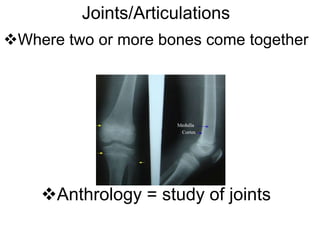
Where two or more bones come together


    Anthrology = study of joints
Three types of Joints

A. Fibrous joint or Synarthrosis –
immovable to slightly moveable
   • Two adjacent edges separated with a
     small amount of fibrous tissue or a thin
     layer of cartilage
   Examples
 1. Skull – joints called sutures
Three types of Joints

A. Fibrous joint or Synarthrosis – immovable to slightly moveable
      • Two adjacent edges separate with a small amount of fibrous tissue or a thin layer of cartilage
                                                 Examples
      1. Skull – joints called sutures


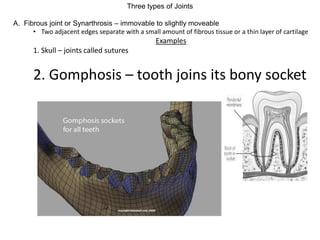
      2. Gomphosis – tooth joins its bony socket
Three types of Joints

A. Fibrous joint or Synarthrosis – immovable to slightly moveable
      • Two adjacent edges separate with a small amount of fibrous tissue or a thin layer of cartilage
                                                 Examples
      1. Skull – joints called sutures
      2. Gomphosis – tooth joins its bony socket


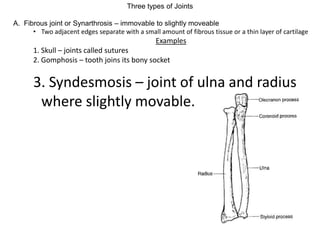
      3. Syndesmosis – joint of ulna and radius
       where slightly movable.
Three types of Joints

A. Fibrous joint or Synarthrosis


B. Cartilaginous joints or Amphiarthrosis
Two adjacent bones are separated by a
substantial amount of fibrocartilage or hyaline
which gives them mobility
Slightly movable

                  Examples
1. Vertebrae with disk cartilage
Three types of Joints

A. Fibrous joint or Synarthrosis

B. Cartilaginous joints or Amphiarthrosis
Two adjacent bones are separated by a substantial amount of fibrocartilage or hyaline which
gives them mobility
                                          Examples
Vertebrae with disk cartilage


2. Pubic symphysis – pubic portions of pelvic
bone
Three types of Joints

A. Fibrous joint or Synarthrosis

B. Cartilaginous joints or Amphiarthrosis
Two adjacent bones are separated by a substantial amount of fibrocartilage or hyaline which
gives them mobility
                                             Examples
1. Vertebrae with disk cartilage
2. Pubic symphysis – pubic portions of pelvic bone


3. Sacroiliac joint – where sacrum joins the
illium
c. Synovial joints or Diarthrosis

   Freely movable

   There are 6 kinds of synovial joints

   Characteristic – ends of bones
    covered with articular cartilage
c.   Synovial joints or Diathrosis
     Freely movable
     There are 6 kinds of synovial joints
     Characteristic – ends of bones covered with articular cartilage


        Anatomy of the Synovial Joint
Joint is surrounded by an outer joint capsule
called the fibrous capsule which is an
extension of the periosteum which forms
ligaments.
Anatomy of the Synovial Joint

Joint is surrounded by an outer joint capsule called the fibrous capsule which is an
extension of the periosteum which forms ligaments

Bursa = articular capsule extends way beyond
the joint and is filled with fluid to cushion

Bursitis = inflammation of the bursa
Anatomy of the Synovial Joint


Synovial Membrane – inner membrane that
   produces the synovial fluid which is a
   slipper liquid to reduce friction
Six major types of synovial joints:

1. Ball and socket joint:

Has most freedom of movement
can move in all directions and
also rotate
Example – hip and shoulder
Six major types of synovial joints:

1. Ball and socket joint


2. Hinge joint
 The convex surface of one bone
   fits into the concave surface of
   another
 Permits movement in one
   plane only
 Ex. Elbow, phalanges, knee
Six major types of synovial joints:
1. Ball and socket joint
2. Hinge joint

3.Saddle joint
 Both bones have articulating concave
  and convex regions
 One bone fits the complementary
  surface of the other
 Variety of movement in two planes, all
  but rotation
 Examples: Carpal and Metacarpel of
  thumb
 More motion than hinge, less ball/socket
Six major types of synovial joints:
1. Ball and socket joint
2. Hinge joint
3. Saddle joint

4. Ellipsoid
 Ovoid condyle of one bone fits into the
   elliptical cavity of another
 Movement forward and backwards,
   left and right, but no rotation
 Ex. Metacarpals to phalanges,
   mandible to temporal bone
Six major types of synovial joints:
1. Ball and socket joint
2. Hinge joint
3. Saddle joint
4. Ellipsoid

5. Pivot
 The cylindrical surface of one bone
   rotates within a ring of bone and
   fibrous tissue of a ligament
 Permits rotational movement only
 Ex. Atlas and axis of neck and radius
   and ulna
Six major types of synovial joints:
1. Ball and socket joint
2. Hinge joint
3. Saddle joint
4. Ellipsoid
5. Pivot

6. Gliding
 The articulating surfaces are flat or
   nearly curved.
 Allows bones to move a little bit in all
   directions by sliding over each other.
 Ex. Wrist, ankle, vertebra
gliding
Anatomical terms:
Anatomical position – the body is
assumed to be standing, the feet together,
the arms to the side, and the head and
eyes and palms of the hands facing
forwards.

Anterior = front
Posterior = back
Motion and terms of motion:
Midline – imaginary line that runs down
center of the body

Midsagital plane – runs through the body
at the midline

Lateral – way from the midline

Medial – toward the midline
anterior


posterior
Terms of Movement of joints:

Extension – straighten joint –
increasing the angle between the two
bones

Flexion – decreasing the angle
between the two bones
Extension and Flexion
Movement of joints


Plantar flexion –movement of the ankle
so that you can stand on your toes.

Dorsiflexion – movement of the ankle to
decrease the angle between your foot
and tibia.
Terms of Movement of joints


Abduction - moving body part
away from the midline of the body

Adduction – moving the body part
toward the midline of the body
Terms of Movement of joints   :

Circumduction – circular rotation of a ball
and socket joint
:
Terms of Movement of joints

Rotation – movement in which a body
part moves about an axis

Medial rotation – rotation towards the
midline

Lateral rotation – rotation away from
the midline
Movement of joints   :
Pronation - rotating the palm of the hand
backward or opposite the anatomical
position

Supination – rotating the palm of the hand
forward or into anatomical position
pronation
            supination
Movement of joints:


Inversion – rotation of the sole of the foot
inward
Eversion- rotation of the sole of the foot
outward

Anatomy and Physiology 6 joints

  • 1.
    Joints/Articulations Where two ormore bones come together Anthrology = study of joints
  • 2.
    Three types ofJoints A. Fibrous joint or Synarthrosis – immovable to slightly moveable • Two adjacent edges separated with a small amount of fibrous tissue or a thin layer of cartilage Examples 1. Skull – joints called sutures
  • 3.
    Three types ofJoints A. Fibrous joint or Synarthrosis – immovable to slightly moveable • Two adjacent edges separate with a small amount of fibrous tissue or a thin layer of cartilage Examples 1. Skull – joints called sutures 2. Gomphosis – tooth joins its bony socket
  • 4.
    Three types ofJoints A. Fibrous joint or Synarthrosis – immovable to slightly moveable • Two adjacent edges separate with a small amount of fibrous tissue or a thin layer of cartilage Examples 1. Skull – joints called sutures 2. Gomphosis – tooth joins its bony socket 3. Syndesmosis – joint of ulna and radius where slightly movable.
  • 5.
    Three types ofJoints A. Fibrous joint or Synarthrosis B. Cartilaginous joints or Amphiarthrosis Two adjacent bones are separated by a substantial amount of fibrocartilage or hyaline which gives them mobility Slightly movable Examples 1. Vertebrae with disk cartilage
  • 6.
    Three types ofJoints A. Fibrous joint or Synarthrosis B. Cartilaginous joints or Amphiarthrosis Two adjacent bones are separated by a substantial amount of fibrocartilage or hyaline which gives them mobility Examples Vertebrae with disk cartilage 2. Pubic symphysis – pubic portions of pelvic bone
  • 7.
    Three types ofJoints A. Fibrous joint or Synarthrosis B. Cartilaginous joints or Amphiarthrosis Two adjacent bones are separated by a substantial amount of fibrocartilage or hyaline which gives them mobility Examples 1. Vertebrae with disk cartilage 2. Pubic symphysis – pubic portions of pelvic bone 3. Sacroiliac joint – where sacrum joins the illium
  • 8.
    c. Synovial jointsor Diarthrosis  Freely movable  There are 6 kinds of synovial joints  Characteristic – ends of bones covered with articular cartilage
  • 9.
    c. Synovial joints or Diathrosis  Freely movable  There are 6 kinds of synovial joints  Characteristic – ends of bones covered with articular cartilage Anatomy of the Synovial Joint Joint is surrounded by an outer joint capsule called the fibrous capsule which is an extension of the periosteum which forms ligaments.
  • 10.
    Anatomy of theSynovial Joint Joint is surrounded by an outer joint capsule called the fibrous capsule which is an extension of the periosteum which forms ligaments Bursa = articular capsule extends way beyond the joint and is filled with fluid to cushion Bursitis = inflammation of the bursa
  • 11.
    Anatomy of theSynovial Joint Synovial Membrane – inner membrane that produces the synovial fluid which is a slipper liquid to reduce friction
  • 12.
    Six major typesof synovial joints: 1. Ball and socket joint: Has most freedom of movement can move in all directions and also rotate Example – hip and shoulder
  • 14.
    Six major typesof synovial joints: 1. Ball and socket joint 2. Hinge joint  The convex surface of one bone fits into the concave surface of another  Permits movement in one plane only  Ex. Elbow, phalanges, knee
  • 16.
    Six major typesof synovial joints: 1. Ball and socket joint 2. Hinge joint 3.Saddle joint  Both bones have articulating concave and convex regions  One bone fits the complementary surface of the other  Variety of movement in two planes, all but rotation  Examples: Carpal and Metacarpel of thumb  More motion than hinge, less ball/socket
  • 18.
    Six major typesof synovial joints: 1. Ball and socket joint 2. Hinge joint 3. Saddle joint 4. Ellipsoid  Ovoid condyle of one bone fits into the elliptical cavity of another  Movement forward and backwards, left and right, but no rotation  Ex. Metacarpals to phalanges, mandible to temporal bone
  • 20.
    Six major typesof synovial joints: 1. Ball and socket joint 2. Hinge joint 3. Saddle joint 4. Ellipsoid 5. Pivot  The cylindrical surface of one bone rotates within a ring of bone and fibrous tissue of a ligament  Permits rotational movement only  Ex. Atlas and axis of neck and radius and ulna
  • 22.
    Six major typesof synovial joints: 1. Ball and socket joint 2. Hinge joint 3. Saddle joint 4. Ellipsoid 5. Pivot 6. Gliding  The articulating surfaces are flat or nearly curved.  Allows bones to move a little bit in all directions by sliding over each other.  Ex. Wrist, ankle, vertebra
  • 23.
  • 24.
    Anatomical terms: Anatomical position– the body is assumed to be standing, the feet together, the arms to the side, and the head and eyes and palms of the hands facing forwards. Anterior = front Posterior = back
  • 25.
    Motion and termsof motion: Midline – imaginary line that runs down center of the body Midsagital plane – runs through the body at the midline Lateral – way from the midline Medial – toward the midline
  • 26.
  • 27.
    Terms of Movementof joints: Extension – straighten joint – increasing the angle between the two bones Flexion – decreasing the angle between the two bones
  • 28.
  • 29.
    Movement of joints Plantarflexion –movement of the ankle so that you can stand on your toes. Dorsiflexion – movement of the ankle to decrease the angle between your foot and tibia.
  • 31.
    Terms of Movementof joints Abduction - moving body part away from the midline of the body Adduction – moving the body part toward the midline of the body
  • 33.
    Terms of Movementof joints : Circumduction – circular rotation of a ball and socket joint
  • 34.
    : Terms of Movementof joints Rotation – movement in which a body part moves about an axis Medial rotation – rotation towards the midline Lateral rotation – rotation away from the midline
  • 36.
    Movement of joints : Pronation - rotating the palm of the hand backward or opposite the anatomical position Supination – rotating the palm of the hand forward or into anatomical position
  • 37.
    pronation supination
  • 38.
    Movement of joints: Inversion– rotation of the sole of the foot inward Eversion- rotation of the sole of the foot outward