CONGENITAL DISLOCATION OF THE HIP
(CDH)
OR
DEVELOPMENTAL DYSPLASIA OF THE HIP
(DDH)
Presented by :
UPASANA AGARWAL
BPT 4TH YEAR
12/02/2021
DEFINITION :
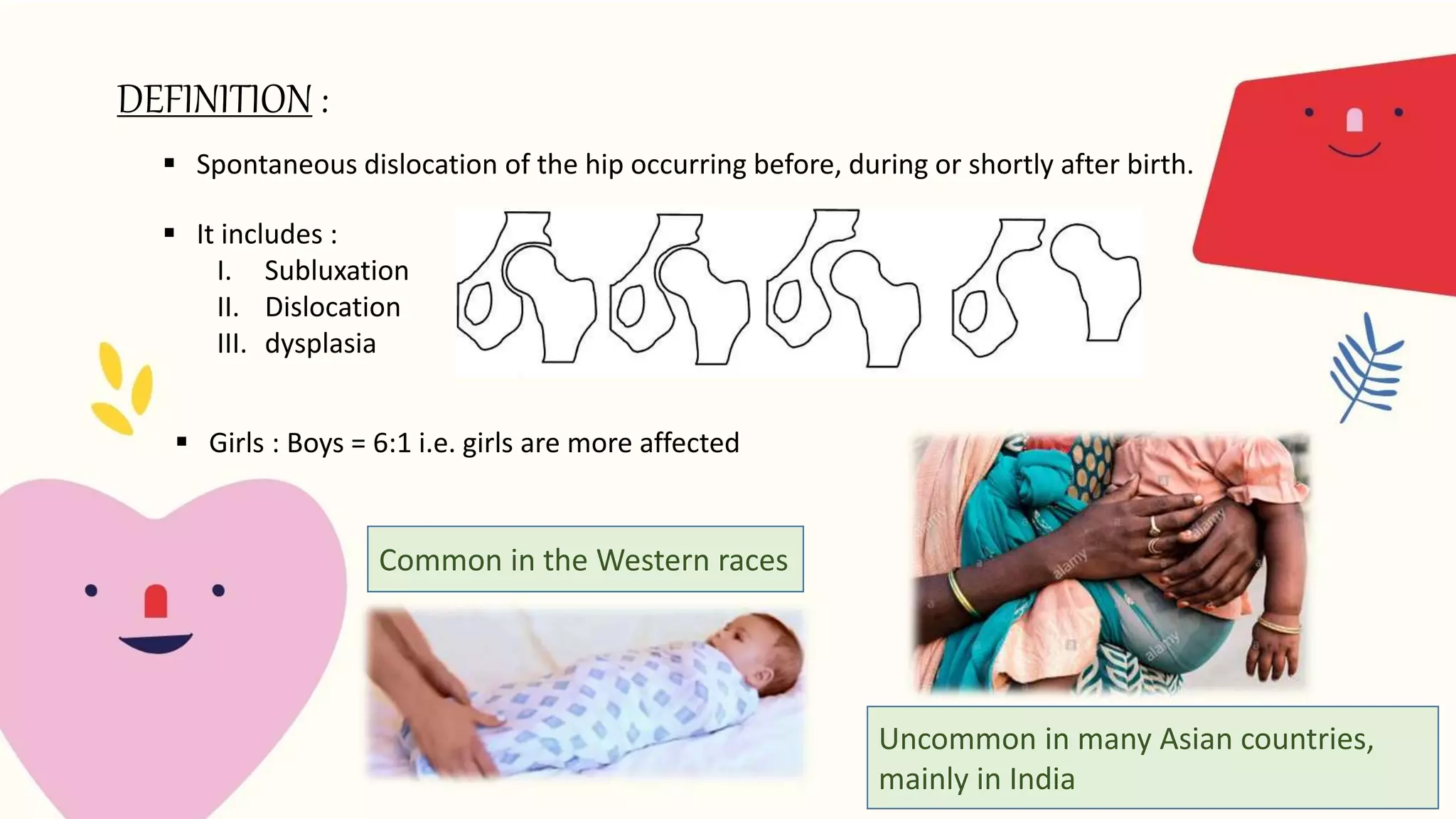
 It includes :
I. Subluxation
II. Dislocation
III. dysplasia
 Girls : Boys = 6:1 i.e. girls are more affected
 Spontaneous dislocation of the hip occurring before, during or shortly after birth.
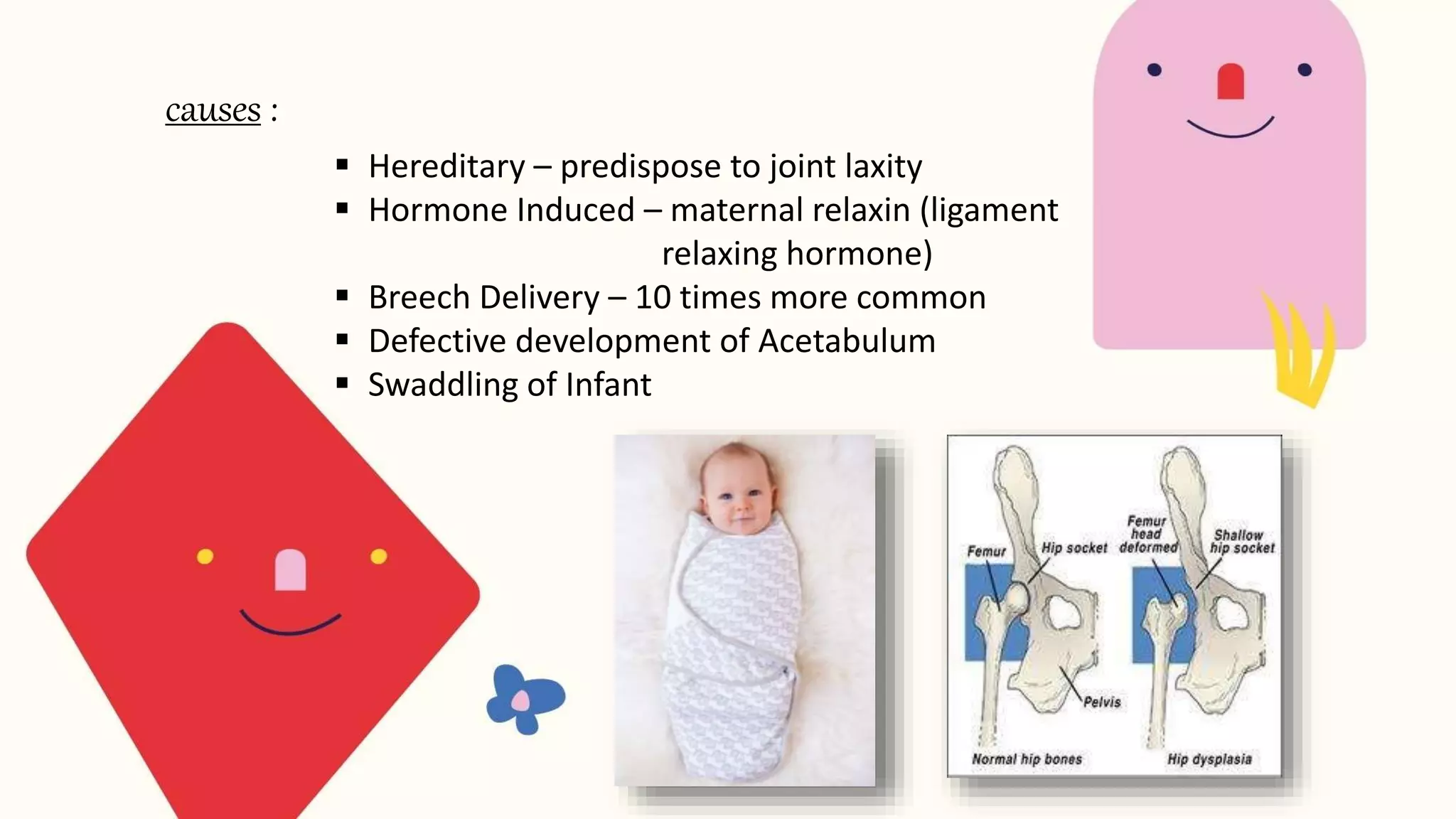
Common in the Western races
Uncommon in many Asian countries,
mainly in India
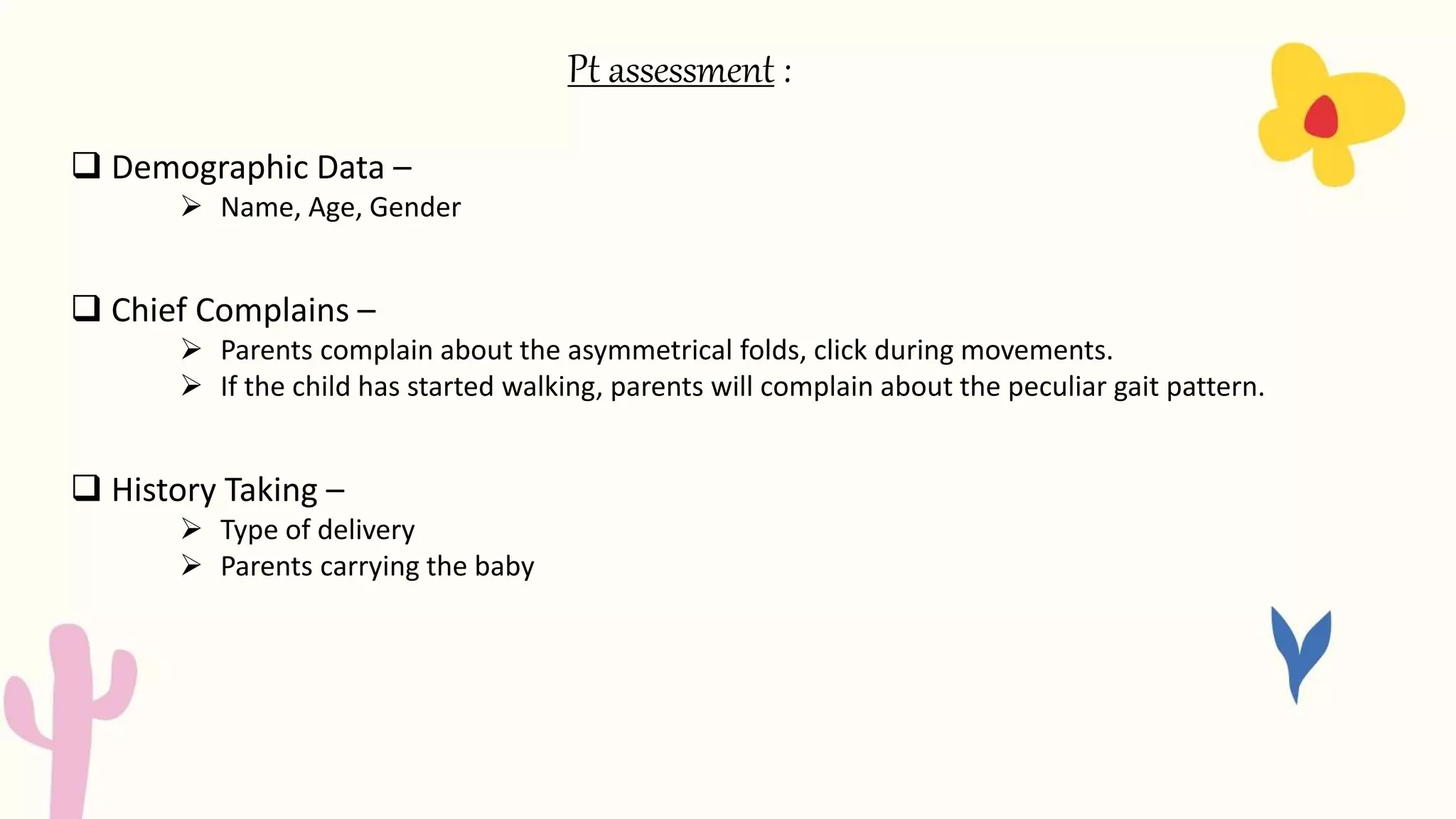
 Hereditary – predispose to joint laxity
 Hormone Induced – maternal relaxin (ligament
relaxing hormone)
 Breech Delivery – 10 times more common
 Defective development of Acetabulum
 Swaddling of Infant
causes :
pathology :
 BONES :
 Acetabulum
 Shallow acetabulum – upper part fails to
form horizontal roof
 Head of femur rides up on the ilium
 Bone form a pseudo-pocket
 Femoral Head
 Poor development
 Displaced backward - upward
 LIGAMENTS :
 Developmental laxity
 Stretched ligament (due to displacement of femoral head)
 Ligamentum Teres – absent or poorly developed
 MUSCLES :
 Changes from subluxation or dislocation
 Muscles shortening (hamstring, satorius, rectus femoris,
adductors)
Clinical presentations :
 In Early Childhood :
1) Not very clear until the child starts to walk.
2) Asymmetry in the buttock or thigh fold.
3) Limited hip movements.
4) A click everytimes the hip is moved.
 In Older Child :
1) Walking – delayed or limping(U/L) or waddling(B/L)
2) Postural Changes – scoliosis, lordosis
Pt assessment :
 Demographic Data –
 Name, Age, Gender
 Chief Complains –
 Parents complain about the asymmetrical folds, click during movements.
 If the child has started walking, parents will complain about the peculiar gait pattern.
 History Taking –
 Type of delivery
 Parents carrying the baby
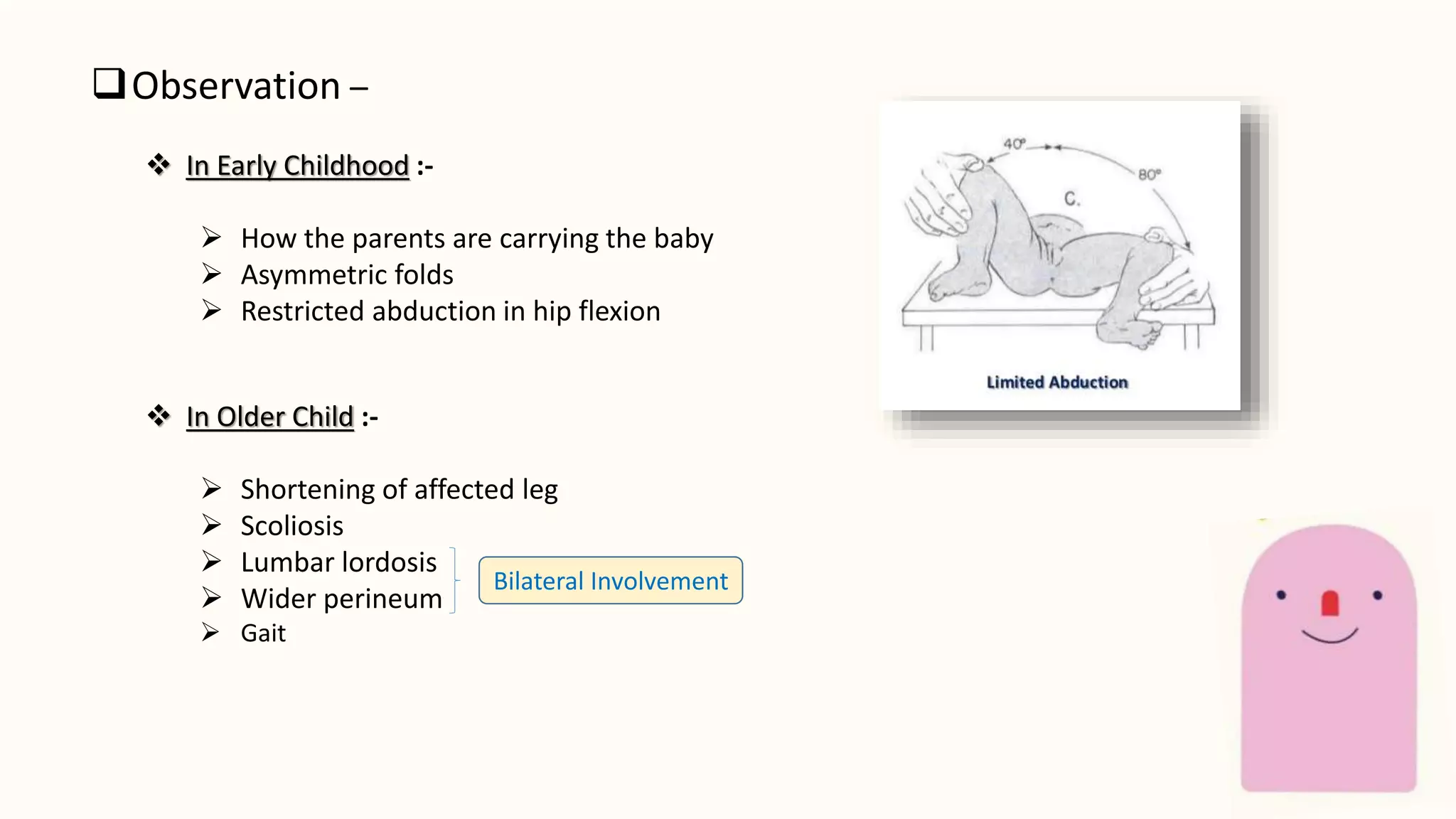
Observation –
 In Early Childhood :-
 How the parents are carrying the baby
 Asymmetric folds
 Restricted abduction in hip flexion
 In Older Child :-
 Shortening of affected leg
 Scoliosis
 Lumbar lordosis
 Wider perineum
 Gait
Bilateral Involvement
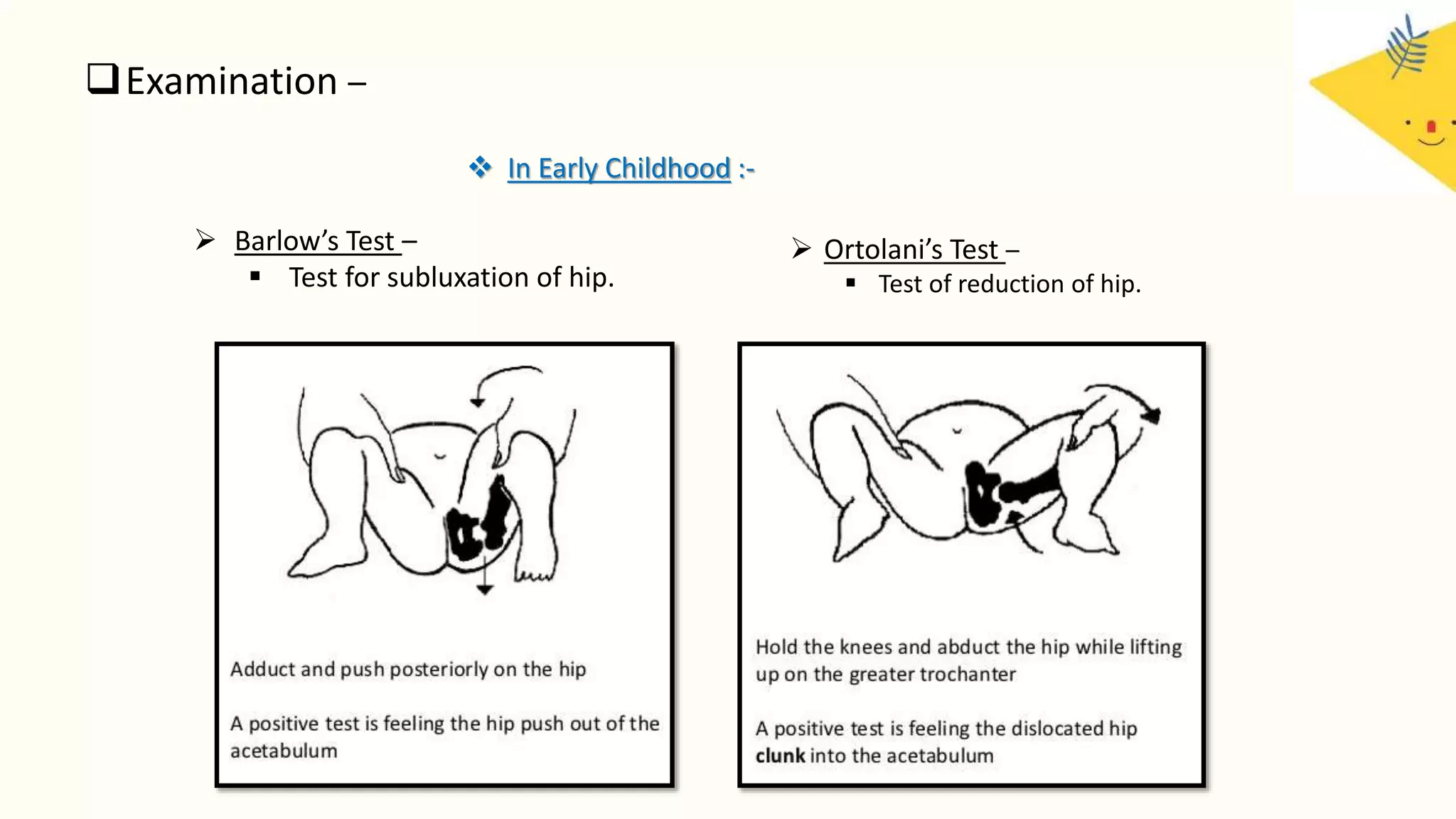
Examination –
 In Early Childhood :-
 Barlow’s Test –
 Test for subluxation of hip.
 Ortolani’s Test –
 Test of reduction of hip.
 In Older Childhood :-
 Galeazzi Sign –
 lowering of affected side knee
 Trendelenburg Test –
 Stand on affected side leg
 Opposite ASIS dips down
 Telescopy Sign –
 Test stability of hip
 Positive – piston like movement is present
 Gait –
 Trendelenburg Gait Pattern (U/L)
 Waddling Gait Pattern (B/L)
Investigations :
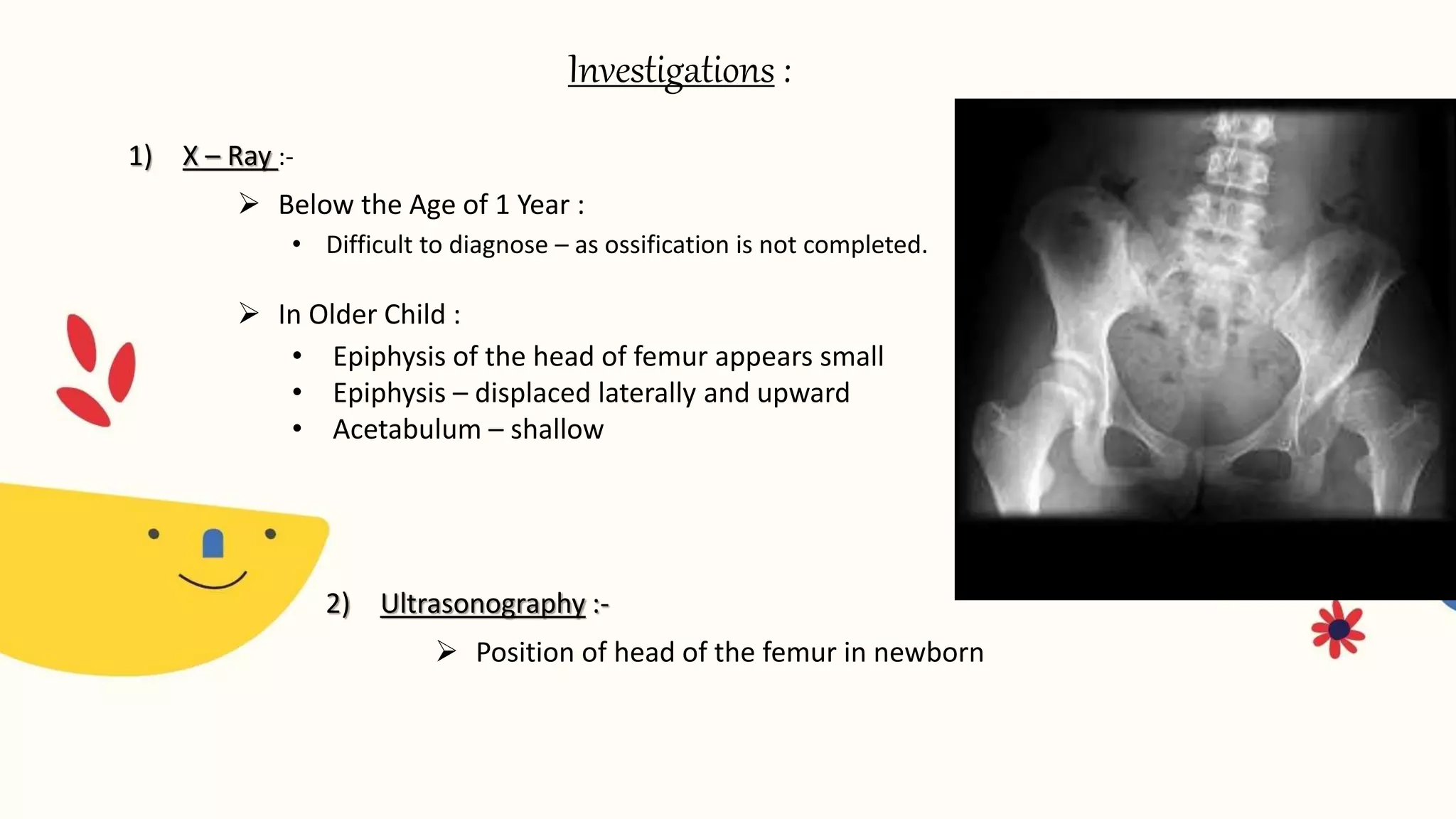
1) X – Ray :-
 Below the Age of 1 Year :
• Difficult to diagnose – as ossification is not completed.
 In Older Child :
• Epiphysis of the head of femur appears small
• Epiphysis – displaced laterally and upward
• Acetabulum – shallow
2) Ultrasonography :-
 Position of head of the femur in newborn
physiotherapy management :
 The treatment of CDH is age related.
 Divided into parts :-
1. Up to 6 months
2. 6 months to 2 years
3. 2 years to 8 years
4. Above 8 years
WHAT ARE THE AIMS ?
 to replace the femoral head in the acetabulum.
 To maintain it in position until normal acetabulum development occurs.
Up To 6 Months :-
 Splinting –
 Hip Flexion and Abduction maintain
 Pavlik harness
 von Rosen Splint
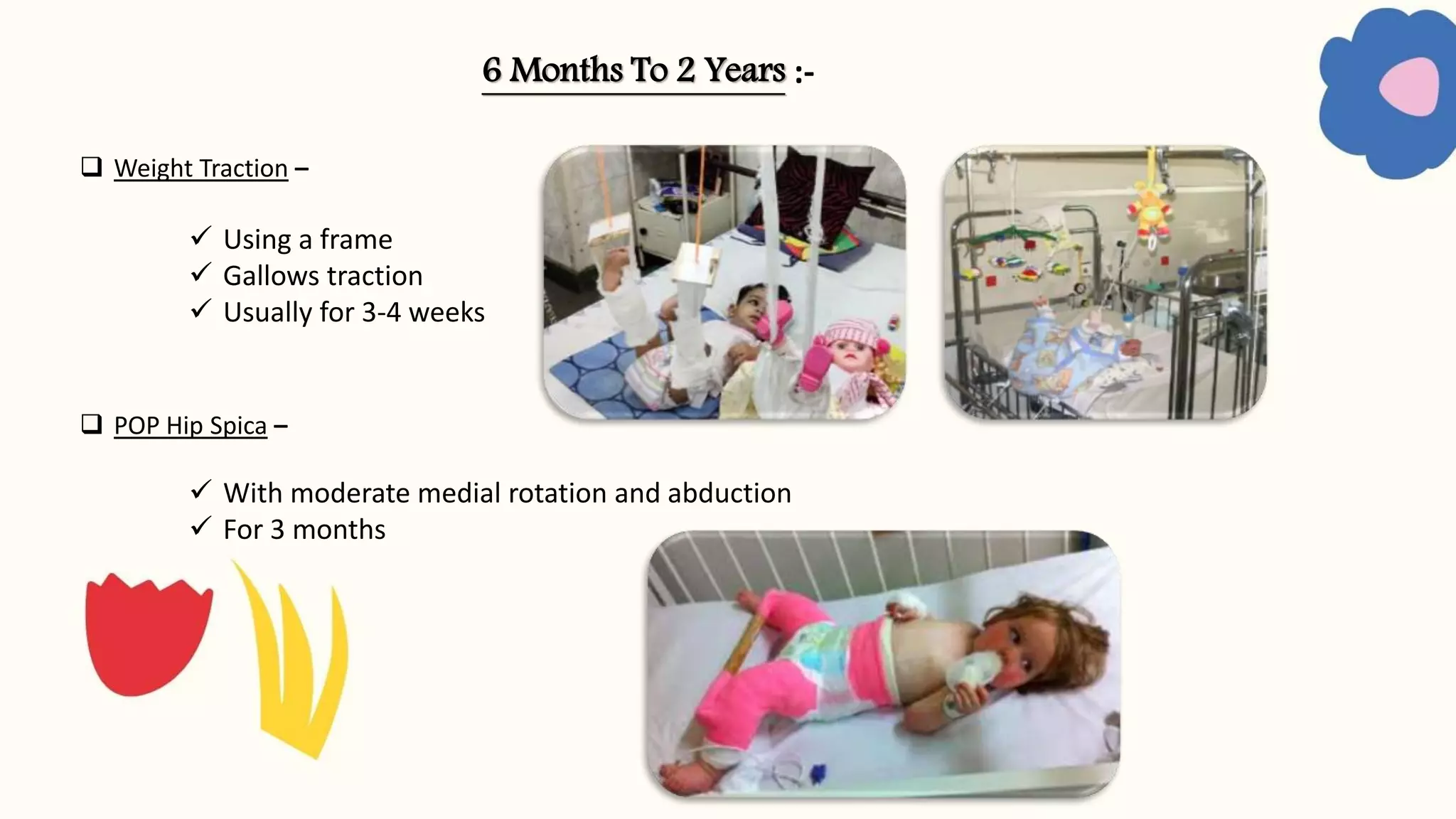
6 Months To 2 Years :-
 POP Hip Spica –
 With moderate medial rotation and abduction
 For 3 months
 Weight Traction –
 Using a frame
 Gallows traction
 Usually for 3-4 weeks
2 Years to 8 Years :-
 Surgery –
 Open reduction with or without osteotomy.
 Chiari Pelvic Osteotomy.
 Derotation Osteotomy
 Plaster Immobilization continued followed by Physiotherapy
After 8 Years :-
 Surgery –
 No treatment is effective.
 Total Hip Replacement - 2˚ OA followed by Physiotherapy
After 2 years of age, conservative management is not effective.
It requires surgical procedures.
Physiotherapy Management
Immobilization :-
1) Active movements to be encouraged
2) Isometrics – if possible
 Gluteal muscle
 Quadriceps
mobilization :-
1) Adduction limited due to immobilization - Relaxed Passive Adduction
2) Improve ROM of hip
3) Strengthening of the Glutei muscles
4) Quadruped knee standing to Kneeling
5) Improve Walking – with enough support.
Training the child from QUADRUPED POSITION to KNEELING
Walking Training
Physiotherapy Management
mobilization :-
6) Hydrotherapy – general leg activities
5) Hippotherapy
6) After THR –
• Re-educate Gait
• Regain Muscle Strength and Movements
• Regain Patient’s Confidence
Hippo Therapy
references :
 Essentials of Orthopedics and Applied Physiotherapy
– JAYANT JOSHI and PRAKASH KOTWAL
 Tidy’s Physiotherapy – ANN THOMAS, ALISON
SKINNER and JOAN PIERCY
 Essential Orthopedics – J. MAHESHWARI
 Physiopedia.com
Congenital Dislocation of the Hip - PHYSIOTHERAPY

Congenital Dislocation of the Hip - PHYSIOTHERAPY

  • 1.
    CONGENITAL DISLOCATION OFTHE HIP (CDH) OR DEVELOPMENTAL DYSPLASIA OF THE HIP (DDH) Presented by : UPASANA AGARWAL BPT 4TH YEAR 12/02/2021
  • 2.
    DEFINITION :  Itincludes : I. Subluxation II. Dislocation III. dysplasia  Girls : Boys = 6:1 i.e. girls are more affected  Spontaneous dislocation of the hip occurring before, during or shortly after birth. Common in the Western races Uncommon in many Asian countries, mainly in India
  • 3.
     Hereditary –predispose to joint laxity  Hormone Induced – maternal relaxin (ligament relaxing hormone)  Breech Delivery – 10 times more common  Defective development of Acetabulum  Swaddling of Infant causes :
  • 4.
    pathology :  BONES:  Acetabulum  Shallow acetabulum – upper part fails to form horizontal roof  Head of femur rides up on the ilium  Bone form a pseudo-pocket  Femoral Head  Poor development  Displaced backward - upward  LIGAMENTS :  Developmental laxity  Stretched ligament (due to displacement of femoral head)  Ligamentum Teres – absent or poorly developed  MUSCLES :  Changes from subluxation or dislocation  Muscles shortening (hamstring, satorius, rectus femoris, adductors)
  • 5.
    Clinical presentations : In Early Childhood : 1) Not very clear until the child starts to walk. 2) Asymmetry in the buttock or thigh fold. 3) Limited hip movements. 4) A click everytimes the hip is moved.  In Older Child : 1) Walking – delayed or limping(U/L) or waddling(B/L) 2) Postural Changes – scoliosis, lordosis
  • 6.
    Pt assessment : Demographic Data –  Name, Age, Gender  Chief Complains –  Parents complain about the asymmetrical folds, click during movements.  If the child has started walking, parents will complain about the peculiar gait pattern.  History Taking –  Type of delivery  Parents carrying the baby
  • 7.
    Observation –  InEarly Childhood :-  How the parents are carrying the baby  Asymmetric folds  Restricted abduction in hip flexion  In Older Child :-  Shortening of affected leg  Scoliosis  Lumbar lordosis  Wider perineum  Gait Bilateral Involvement
  • 8.
    Examination –  InEarly Childhood :-  Barlow’s Test –  Test for subluxation of hip.  Ortolani’s Test –  Test of reduction of hip.
  • 9.
     In OlderChildhood :-  Galeazzi Sign –  lowering of affected side knee  Trendelenburg Test –  Stand on affected side leg  Opposite ASIS dips down  Telescopy Sign –  Test stability of hip  Positive – piston like movement is present  Gait –  Trendelenburg Gait Pattern (U/L)  Waddling Gait Pattern (B/L)
  • 10.
    Investigations : 1) X– Ray :-  Below the Age of 1 Year : • Difficult to diagnose – as ossification is not completed.  In Older Child : • Epiphysis of the head of femur appears small • Epiphysis – displaced laterally and upward • Acetabulum – shallow 2) Ultrasonography :-  Position of head of the femur in newborn
  • 11.
    physiotherapy management : The treatment of CDH is age related.  Divided into parts :- 1. Up to 6 months 2. 6 months to 2 years 3. 2 years to 8 years 4. Above 8 years WHAT ARE THE AIMS ?  to replace the femoral head in the acetabulum.  To maintain it in position until normal acetabulum development occurs.
  • 12.
    Up To 6Months :-  Splinting –  Hip Flexion and Abduction maintain  Pavlik harness  von Rosen Splint
  • 13.
    6 Months To2 Years :-  POP Hip Spica –  With moderate medial rotation and abduction  For 3 months  Weight Traction –  Using a frame  Gallows traction  Usually for 3-4 weeks
  • 14.
    2 Years to8 Years :-  Surgery –  Open reduction with or without osteotomy.  Chiari Pelvic Osteotomy.  Derotation Osteotomy  Plaster Immobilization continued followed by Physiotherapy After 8 Years :-  Surgery –  No treatment is effective.  Total Hip Replacement - 2˚ OA followed by Physiotherapy After 2 years of age, conservative management is not effective. It requires surgical procedures.
  • 15.
    Physiotherapy Management Immobilization :- 1)Active movements to be encouraged 2) Isometrics – if possible  Gluteal muscle  Quadriceps mobilization :- 1) Adduction limited due to immobilization - Relaxed Passive Adduction 2) Improve ROM of hip 3) Strengthening of the Glutei muscles 4) Quadruped knee standing to Kneeling 5) Improve Walking – with enough support.
  • 16.
    Training the childfrom QUADRUPED POSITION to KNEELING Walking Training
  • 17.
    Physiotherapy Management mobilization :- 6)Hydrotherapy – general leg activities 5) Hippotherapy 6) After THR – • Re-educate Gait • Regain Muscle Strength and Movements • Regain Patient’s Confidence Hippo Therapy
  • 18.
    references :  Essentialsof Orthopedics and Applied Physiotherapy – JAYANT JOSHI and PRAKASH KOTWAL  Tidy’s Physiotherapy – ANN THOMAS, ALISON SKINNER and JOAN PIERCY  Essential Orthopedics – J. MAHESHWARI  Physiopedia.com