© Copyright 2013 Elsevier, Ltd. All rights reserved.
5 Principles of treatment
CHAPTER CONTENTS
Introduction .  .  .  .  .  .  .  .  .  .  .  .  .  .  .  .  .  .  .  .  .  .  .  .  . 83
Techniques  .  .  .  .  .  .  .  .  .  .  .  .  .  .  .  .  .  .  .  .  .  .  .  .  . 84
Deep transverse friction  .  .  .  .  .  .  .  .  .  .  .  .  .  .  .  .  .  . 84
Mode of action .  .  .  .  .  .  .  .  .  .  .  .  .  .  .  .  .  .  .  .  . 84
Relief of pain .  .  .  .  .  .  .  .  .  .  .  .  .  .  .  .  .  .  .  .  .  . 84
Effect on connective tissue repair .  .  .  .  .  .  .  .  .  .  . 85
Indications .  .  .  .  .  .  .  .  .  .  .  .  .  .  .  .  .  .  .  .  .  .  .  86
Contraindications .  .  .  .  .  .  .  .  .  .  .  .  .  .  .  .  .  .  .  87
Technique .  .  .  .  .  .  .  .  .  .  .  .  .  .  .  .  .  .  .  .  .  .  .  88
Passive movements  .  .  .  .  .  .  .  .  .  .  .  .  .  .  .  .  .  .  .  .  91
Indications .  .  .  .  .  .  .  .  .  .  .  .  .  .  .  .  .  .  .  .  .  .  .  92
Manipulation of the spine .  .  .  .  .  .  .  .  .  .  .  .  .  .  .  95
Active movements  .  .  .  .  .  .  .  .  .  .  .  .  .  .  .  .  .  .  .  . 102
Simple active movements to gain or preserve
normal range in a joint  .  .  .  .  .  .  .  .  .  .  .  .  .  .  .  . 102
Isometric contractions  .  .  .  .  .  .  .  .  .  .  .  .  .  .  .  . 102
Isotonic contractions  .  .  .  .  .  .  .  .  .  .  .  .  .  .  .  .  . 103
Electrical contractions  .  .  .  .  .  .  .  .  .  .  .  .  .  .  .  . 103
Coordination exercises  .  .  .  .  .  .  .  .  .  .  .  .  .  .  .  . 103
Injection and infiltration  .  .  .  .  .  .  .  .  .  .  .  .  .  .  .  .  .  . 104
General principles .  .  .  .  .  .  .  .  .  .  .  .  .  .  .  .  .  .  . 104
Local anaesthetics  .  .  .  .  .  .  .  .  .  .  .  .  .  .  .  .  .  . 106
Corticosteroids  .  .  .  .  .  .  .  .  .  .  .  .  .  .  .  .  .  .  .  . 110
Sclerosing agents .  .  .  .  .  .  .  .  .  .  .  .  .  .  .  .  .  .  . 114
Introduction
Cyriax had a straightforward opinion about treating orthopae-
dic problems:
•	 All pain arises from a source
•	 All treatment must reach the source
•	 All treatment must exert a beneficial effect on it.
It is obvious that the method of treatment will depend largely
on the existing type of disorder.
In orthopaedic medicine, disorders may be grossly catego-
rized as follows:
•	 Traumatic – an injury resulting either from one single
trauma or from multiple small traumas, the so-called
overuse injuries
•	 Inflammatory – rheumatoid: poly- or monoarticular,
infectious, traumatic
•	 Degenerative
•	 Internal derangement – loose bodies and displaced menisci
in peripheral joints and intervertebral disc displacements
in the spine
•	 Functional disorders – instability, weakness, proprioceptive
disturbances
•	 Psychogenic pain – there is no existing functional or
anatomical explanation for the pain.
However, most ‘disorders’ have a combined aetiology: trau-
matic inflammation or repetitive internal derangement may
lead to functional instability or to weakening of the propriocep-
tive reflexes; long-standing functional disorders may lead to
psychogenic decompensation.
Before any form of treatment is undertaken, precise diag-
nosis is mandatory; it is the type, extent and position of the
disorder present which determines treatment. Therefore train-
ing in orthopaedic medicine must put great emphasis on how
to reach a proper diagnosis. It is more difficult and requires
considerable delicacy of approach to teach and learn how to
diagnose and so to propose therapy chosen on logical grounds,
than it is to instruct and learn treatment techniques. Other
aspects must also be taken into account: how much pain can
the patient bear? To what extent does the lesion interfere with
normal activities? How eager is the patient to receive a quick
General Principles
84
Deep transverse friction
Deep transverse friction (although the word friction is techni-
cally incorrect and would be better replaced by ‘massage’) is a
specific type of connective tissue massage2
developed in an
empirical way by Cyriax.3
Transverse massage is applied by the finger(s) directly to the
lesion and transverse to the direction of the fibres. It can be
used after an injury and for mechanical overuse in muscular,
tendinous and ligamentous structures.4–6
In many instances the
friction massage is an alternative to infiltrations with steroids.
Friction is usually slower in effect than injections but leads to
a physically more fundamental resolution, resulting in more
permanent cure and less recurrence. Whereas steroid injection
is usually successful in 1–2 weeks, deep friction may require
up to 6 weeks to have its full effect.
The technique is often used before and in conjunction with
mobilization techniques. In minor muscular tears, friction is
usually followed by active movement, in ligamentous tears by
passive movement and in tendinous lesions by active unloaded
movements until full resolution has been achieved.
It is vital that transverse massage is performed only at the
site of the lesion. The effect is so local that, unless the finger
is applied to the exact site and friction given in the right direc-
tion, relief cannot be expected.
Over the years, and unfortunately enough, the technique
has developed a reputation for being very painful for the
patient. However, pain during friction massage is usually the
result of a wrong indication, a wrong technique or an unac-
customed amount of pressure. Friction massage applied cor-
rectly will quickly result in an analgesic effect over the treated
area and is seldom a painful experience for the patient.
Mode of action
Transverse massage should be used empirically for what it is
and what it achieves; there is no scientific proof for any pos-
tulates about the underlying mechanism of action.
Only a few studies exist,7,8,9
and more research is urgently
needed. However, experienced therapists know in what
kind of soft tissues they can expect good results with trans-
verse massage and where the technique does not work. Trans-
verse massage either is effective quickly (after 6–10 sessions)
or not at all. Advice on indications, contraindications and
modalities of the technique that are given in this book rely
solely on the experiences of the authors and not on scientific
research.
However, although the exact mode of action is not known,
some theoretical explanations have been put forward. It has
been hypothesized that friction has a local pain-diminishing
effect and results in better alignment of connective tissue
fibrils.
Relief of pain
It is a common clinical observation that application of local
transverse friction leads to immediate pain relief – the patient
cure? And what is the patient’s attitude towards certain thera-
peutic methods such as corticosteroids and manipulation?
Orthopaedic medicine based on a detailed functional exami-
nation requires more knowledge, skill, time and effort from
the physician than just to order technical investigations, but
leads to greater professional interest, more appropriate diagno-
sis and a higher degree of patient satisfaction. Clear diagnosis
and consequent selection of treatment on logical grounds also
leads to better understanding between doctors and therapists.
Because the two groups work with the same types of patient,
they must share a common approach. Therapists should no
longer be regarded purely as technicians who listen to the
physician and carry out orders. On the contrary, they should
be aware that they have diagnostic and therapeutic responsi-
bilities. Their opinion must be taken seriously and is important
to avoid unnecessary delay in achieving a satisfactory outcome.
Techniques
The treatment techniques used in orthopaedic medicine thus
depend entirely on the type of disorder. The different types
of treatment we describe are:
•	 Manipulation techniques (rapid, small-amplitude, thrusting
passive movement – also called ‘grade C mobilization’) are
used to reduce small cartilaginous displaced fragments
both in the spine and in peripheral joints (loose bodies).
Manipulation is also called for to restore normal mobility
in a joint restricted by ligamentous adhesion and in
subluxation of bones.
•	 Gentle passive mobilizations (grade A and B
mobilizations) are used to stretch capsular adhesions and
to improve the function of ligaments and tendons. In the
treatment of traumatic injuries they are often used in
combination with deep transverse massage.
•	 Active movements and proprioceptive training are needed
in the treatment of functional disorders and instability.
In the treatment of minor muscular tears they are very
useful in avoiding the formation of abnormal intralesional
adhesion formation.
•	 Injection and infiltration techniques are used to reduce
traumatic or rheumatoid inflammation. They are most
valuable in arthritis, bursitis, ligamentous and tendinous
lesions and in neurocompression syndromes.
•	 Deep friction is a very useful technique in treating
traumatic and overuse soft tissue lesions. The rationale for
using deep friction (which is in fact a form of soft tissue
mobilization) is supported by experimental studies of
the past several decades that confirm and explain the
beneficial effects of activity on the healing musculoskeletal
tissues (see Connective tissue).
Repair and remodelling of healing tissues respond to cyclic
loading and motion.1
Early motion and loading of injured
tissues is not without risk, however, and excessive loading can
inhibit or stop healing. Deep transverse friction imposes cyclic
loading without bringing too much tension on the healing lon-
gitudinal structures of tendon or ligament and can therefore
be considered as beneficial.
C H A P T E R 5Principles of treatment
85
It is now generally recognized that internal and external
mechanical stress applied to the repair tissue is the main stimu-
lus for remodelling immature and weak scar tissue – with fibres
that are oriented in all directions and through several planes
– into linearly rearranged bundles of connective tissues.16
Therefore, during the healing period, the affected structures
should be kept mobile by normal use. However, because of
pain, the tissues cannot be moved to their full extent. This
problem can be solved by friction. Transverse friction massage
imposes rhythmical stress transversely to the remodelling col-
lagenous structures of the connective tissue and thus reorients
the collagen in a longitudinal fashion. Friction is thus a useful
treatment to apply early in the repair cycle (granulation and
beginning of remodelling stage): the cyclic loading on and
motion of the healing connective tissues stimulates formation
and remodelling of the collagen.17
Friction prevents adhesion formation and
ruptures unwanted adhesions (Fig. 5.1)
In that transverse friction aims to achieve transverse movement
of the collagen structure of the connective tissue, crosslinks
and adhesion formation are prevented. In the early stages of
proliferation when crosslinks are absent or still weak, friction
must be very light so as to cause only minimal discomfort.
Therefore, in the first day or two following an injury, friction
is given with slight pressure only and over a short duration, e.g.
1 minute.
At a later stage when strong crosslinks or adhesions have
formed, more intense friction is needed to break these
experiences a numbing effect during the friction and reassess-
ment immediately after the session shows reduction in pain
and increase in strength and mobility. The time to produce
analgesia during the application of transverse friction is a few
minutes and the post-massage analgesic effect may last more
than 24 hours.10
The temporary relief at the end of a session
may prepare the patient for treatment with mobilization not
otherwise possible, such as selective rupture of unwanted
adhesions.
A number of hypotheses to explain the pain-relieving effect
of transverse massage have been put forward:
•	 Pain relief during and after friction massage may be the
result of modulation of the nociceptive impulses at spinal
cord level: the gate control theory (see Ch. 1). The
centripetal projection into the dorsal horn of the spinal
cord from the nociceptive receptor system is inhibited by
the concurrent activity of the mechanoreceptors located
in the same tissues. Selective stimulation of the
mechanoreceptors by rhythmical movements over the
affected area thus ‘closes the gate for pain afference’.
•	 According to Cyriax, friction also leads to increased
destruction of pain-provoking metabolites, such as Lewis’s
substances. This metabolite, if present in too high a
concentration, provokes ischaemia and pain.3
•	 It has also been suggested that prolonged deep friction of
a localized area may give rise to a lasting peripheral
disturbance of nerve tissue, with local anaesthetic effect.
•	 Another mechanism through which reduction in pain may
be achieved is through diffuse noxious inhibitory controls,
a pain-suppression mechanism that releases endogenous
opiates. The latter are inhibitory neurotransmitters that
diminish the intensity of the pain transmitted to higher
centres.11–13
Effect on connective tissue repair
Connective tissue regenerates largely as a consequence of the
action of inflammatory cells, vascular and lymphatic endothe-
lial cells and fibroblasts. Regeneration comprises three main
phases: inflammation, proliferation (granulation) and remodel-
ling. These events do not occur separately but form a continu-
ous sequence of changes (cell, matrix and vascular changes)
that begins with the release of inflammatory mediators and
ends with the remodelling of the repaired tissue (see Ch. 3).
Friction massage may have a beneficial effect on all three
phases of repair.
Friction stimulates phagocytosis
It has been suggested that gentle transverse friction, applied in
the early inflammatory phase enhances the mobilization of
tissue fluid and therefore increases the rate of phagocytosis.14
Friction stimulates fibre orientation  .
in regenerating connective tissue
During maturation, the scar tissue is reshaped and strength-
ened by removing, reorganizing and replacing cells and matrix.15
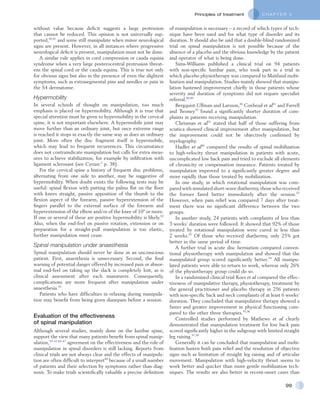
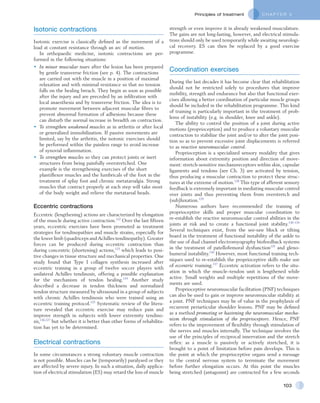
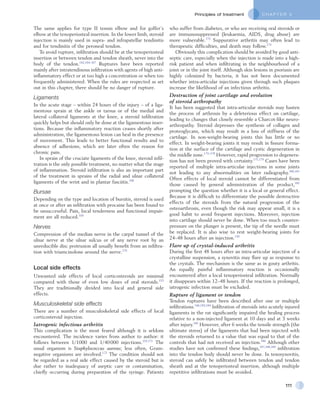
Fig 5.1 • Friction achieves a transverse movement between
longitudinally arranged collagenous fibres.
General Principles
86
prevent (in the early stage) or to break down (in the chronic
stage) adhesion formation between the individual fibres and
between individual fibres and the surrounding connective
tissue. It is obvious that to break down crosslinks in a chronic
stage, the friction can be given forcefully and for a duration of
15–20 minutes, whereas in more recent lesions the technique
must be applied more gently and for a shorter duration. Fric-
tion to a muscle belly is always given with the muscle well
relaxed.
In recent tears, especially in the large muscles of the lower
limb, friction is followed by active or electrical contractions
with the muscle in a position of maximal relaxation and without
weight bearing, so that tension does not fall on the healing
breach.
To avoid early recurrence, friction is given for 1 week after
all clinical tests have become negative. During the period of
treatment, all movements or activities that bring on pain should
be avoided by the patient.
Theoretically, friction can be used for all muscle belly
lesions. However, some lesions respond so well to local anaes-
thetic infiltration that friction is not used. This is the case in
type IV tennis elbow (lesion at the muscle belly of the extensor
carpi radialis). On the other hand, sometimes no alternatives
exist to treatment with deep transverse friction (Box 5.1). A
lesion of the subclavius or intercostal muscles for instance can
be treated only by deep transverse friction.
Musculotendinous junctions
It is a common clinical experience that all musculotendinous
junctions (containing both muscular and tendinous fibres)
throughout the whole body can be treated only by deep trans-
verse friction. It would seem that no alternatives exist: local
anaesthetics, so curative for some lesions of muscle bellies, and
steroids, so effective for tenoperiosteal lesions, have not the
slightest effect on musculotendinous lesions, whereas deep
transverse friction usually has.
Tendons
All overuse tendinitis can be treated by deep massage except
for the tenoperiosteal origin of the extensor carpi radialis brevis
(type II tennis elbow), which is best treated by an infiltration
with corticosteroid or, in refractory circumstances, sometimes
by manipulations.
down.18–21
The technique is then used to soften the scar tissue
and to mobilize the crosslinks between the collagen fibres and
the adhesions between healing connective tissue and surround-
ing tissues. This, together with the local anaesthesia produced,
prepares the structures for mobilizations that apply longitudi-
nal stress to the structures and rupture the larger adhesions.
Friction induces traumatic hyperaemia
Forceful deep friction produces vasodilatation and increased
blood flow to the area. It may be hypothesized that this facili-
tates the removal of chemical irritants and increases the trans-
portation of endogenous opiates, so causing a decrease in pain.
Such a forceful friction, resulting in hyperaemia is only desir-
able in chronic, self-perpetuating lesions.
Indications
Diagnosis
The reduction in pain achieved after a few minutes of localized
transverse friction may be very helpful to define the exact
location of the lesion. In muscular, tendinous or ligamentous
lesions, a few minutes of massage on the suspected area results
in diminished pain on testing immediately thereafter, so con-
firming the diagnosis as accurately as an infiltration with local
anaesthesia.
Preparation for mobilizations and manipulation
Transverse massage is often applied before and in conjunction
with other mobilizing techniques. In muscular lesions, friction
is given before active or electrical contractions on an unloaded
muscle. The purpose is to allow broadening of the muscle and
so the prevention of adhesion formation between adjacent
muscle fibres and/or bundles.
For reasons of pain relief, transverse massage is usually
required before manipulative breakage of ligamentous adhe-
sions is performed. This may be indicated in chronic ligamen-
tous lesions at knee and ankle.
Deep and thorough friction also precedes manipulation of
the elbow in type II tennis elbow. The technique is used for
its desensitizing and softening effect which makes the manipu-
lation more tolerable.
Therapy
Muscle bellies
Friction is given to a healing muscle belly after contusion, in
minor muscular tears and in so-called ‘myosynovitis’. In minor
muscular tears the friction is often part of combined treatment
because it is usually applied after an infiltration with local
anaesthesia and is followed by active contractions.
The aim of treatment in muscular tears is to allow the torn
fibres to heal in such a way that normal increase in breadth
on contraction remains possible, a characteristic that can be
disturbed by abnormal adhesion formation. Transverse friction
aims to achieve a transverse sweeping movement over the
longitudinal muscular fibres without pulling on the tear, so to
Box 5.1 
Muscle belly disorders that can be treated only
by deep transverse friction
Subclavius
Brachialis
Supinator
Adductors of the thumb
Interosseus muscles of the hand
Intercostal muscles
Oblique muscles of the abdomen
Interosseus muscles of the foot
C H A P T E R 5Principles of treatment
87
eases the pain and the tissue can be moved to and fro in an
imitation of its normal behaviour.
In recent cases the friction need not last long nor be very
vigorous – 1 or 2 minutes of daily gentle transverse sweeping
movement over the regenerating fibrils is enough. As pain
diminishes over subsequent days friction is progressively
increased to about 4–5 minutes for 2 or 3 days and finally to
a full duration of 15–20 minutes. From the third day, friction
is followed by passive and active movements within the limits
of pain to maintain normal gliding of the ligament over adjacent
bones. When the lower limb is involved, the patient should be
instructed to walk as normally as possible but without provok-
ing too much pain.
In chronic ligamentous lesions, frictions are also used but in
a totally different way. Here adherent scar tissue has formed
abnormal attachments as the result of healing during a period
of insufficient movement. As a result of the reduced mobility
of the ligament, vigorous use of the joint re-sprains the liga-
ment and in due course leads to recurrent sprains.
Treatment will consist of rupturing the adhesions by manip-
ulation, for which vigorous deep friction to the site of the
adhesions prepares the ligaments. The massage weakens and
desensitizes the structure, making the forced movement prac-
ticable and painless.
Experience has shown that particular ligamentous lesions
can be treated only by friction. This is the case for the posterior
carpal ligaments at the wrist and the tibiotalar ligaments.
Joint capsules
Deep transverse friction can be applied to the capsules of the
trapezium–first metacarpal joint, the temporomandibular joint
and the cervical facet joints. The indication is traumatic arthri-
tis or osteoarthrosis. Results are fair, provided the arthrosis is
not too advanced. Indications and contraindications to friction
are outlined in Table 5.1.
Contraindications
Ossification and calcification of soft tissues
Extensive ossification in muscles, tendons, ligaments or cap-
sules is a bar to all active treatment. However the minor cal-
cifications that may occur after a sprain can be managed by
Tenosynovitis also usually responds well to deep transverse
massage. In this condition, occurring in long tendons with a
sheath, inflammation and roughening of the gliding surfaces of
both tendon and sheath give rise to pain and sometimes to
crepitus. Friction rolls the sheath around the stretched tendon,
so facilitating functional movement between the tendon and
its sheath. The technique is useful in both acute and chronic
lesions.
Lesions at the tenoperiosteal insertion can be treated either
with corticosteroid infiltrations or with deep transverse
massage. Corticosteroid suspension quickly converts an
inflamed and painful scar into one free of inflammation.
However, the recurrence rate is rather high, between 20%
and 25%.3
The aim of the massage is to get rid of the self-
perpetuating inflammation by breaking up the disorderly scar
tissue and adhesion formation by converting it into properly
arranged longitudinal connective fibres. This takes longer but
once cure is achieved there will be less of a tendency towards
recurrence. It may therefore be a policy to start treatment with
infiltrations but if the trouble recurs after a few months to
substitute with massage.
As a rule, however, friction is always selected as the
treatment of choice in athletes or when the tendon is weak-
ened (partial rupture). It cannot be denied that repeated use
of corticosteroids, even in small doses and correctly applied,
temporarily weakens a tendinous structure. Steroids also take
away inflammation and pain, so giving the patient the false
impression of being cured. The combination of a weakened
tendon and abolition of pain can be disastrous – rupture
may ensue.
There exist also a few conditions that seem to respond only
to deep transverse friction. Steroid infiltrations are useless
here. This is so in tendinous lesions of the interosseus in the
hand and at the quadriceps expansion at the patella.
Lesions in the tendinous body, either traumatic or resulting
from overuse, are contraindications for infiltration with corti-
costeroids. Ruptures have been reported after intralesional
steroid infiltrations of long tendons and therefore deep fric-
tions are the treatment of choice here.22,23
It is obvious that during the whole period of treatment of
tendinitis, tenosynovitis or tenovaginitis, the patient must
avoid all activities that provoke the pain, especially the loading
of the affected contractile tissue.
Ligaments
Transverse massage is an excellent treatment in acutely sprained
ligaments, especially in ligaments of the knee and ankle. The
background, mode of action and technique differ considerably
and depend on the stage of the lesion.
It has been explained (see Ch. 3) that early mobilization is
extremely important for swift and full recovery of ligamentous
sprains. However, in advocating this, one main difficulty is
encountered: the intensity of the initial inflammatory reaction.
The slightest movement causes pain which forces the patient
to immobilize the joint and the ligaments. However, during
immobilization, regenerating fibrils quickly start to form ran-
domly organized scar tissue, leading to crosslinks and adhesion
formation. This problem can be solved by gentle transverse
frictions. Rhythmic movement across the inflamed ligament
Table 5.1  Indications and contraindications to friction
Indications Contraindications
Diagnostic difficulties
Preparative massage
Therapeutic massage:
•	 To muscle bellies
•	 To musculotendinous
junctions
•	 To tendons
•	 To ligaments
•	 To joint capsules
Ossification and calcification of soft tissues
Bacterial and rheumatoid-type tendinitis,
tenosynovitis and tenovaginitis
Skin problems such as ulcers, psoriasis or
blisters
Neighbouring bacterial infection
Bursitis and disorders of nerve structures
Haematoma, if large
General Principles
88
fingers are used, the amount of pressure, the duration and
frequency of the sessions. The patient’s skin and the therapist’s
finger must move as one, so that the deep layers of the skin
move over the affected fibres. Therefore all cream, ointments,
powder or any other procedure, such as previous heat, that
makes the skin sweat, must be avoided. Six to 12 treatments
are normally necessary. Except in acute ligamentous disorders
they are not given more often than every other day because
otherwise the site of the lesion may still be too tender from
the previous treatment to permit adequate massage.
Position of the patient
The patient’s position must be comfortable because it must
be maintained for up to 15–20 minutes. Sitting or lying is
preferable.
The lesion must be brought within finger’s reach. In some
structures this can be easily attained but others such as the
supraspinatus insertion and the anterior aspect of Achilles
tendon, require more specific positioning of the patient.
In addition, positioning must place the affected structure
under the required amount of tension. Full relaxation is neces-
sary for a muscle belly in order not only to treat its surface but
also to access a deeply seated lesion. Tendons with a sheath
must be kept taut otherwise friction will be ineffective between
tendon and sheath. The same applies in ligamentous lesions,
which are also placed in tension but within the limits of pain.
Position of the therapist and the hands
The bodily position of the patient should be the most comfort-
able and least tiring for the therapist. Working height is of chief
importance, so an adjustable high–low couch is ideal. To have
some economy of effort the therapist should adopt a position
that utilizes body weight to a maximum. Usually this is stand-
ing and with the patient on a slightly lower plane. The therapist
should avoid flexed positions. The shoulder should also not be
in abduction because this quickly leads to pain and cramp in
the neck and shoulder girdle.
Massage is performed by the whole arm and is not just an
activity of hand and digits. Movement is generated in the
shoulder and conducted via elbow and forearm to the digits.
One set of muscles is used to apply force and another to
provide movement, for example pressure with the fingers,
movement with the arms. Digits, hand and forearm should
generally form a straight line and are kept parallel to the direc-
tion of movement.
The majority of friction techniques are performed in two
phases: an active movement, usually as a result of flexor mus-
cular activity and a passive movement, when the arm and hand
are returned to the starting position. At the end of the passive
phase there should also be a moment of rest during which the
therapist fully relaxes the muscles.
The hands can be used in a variety of ways depending on
the tissues to be treated and the surface worked on. The wrist
and metacarpophalangeal joints should be kept in an almost
neutral position. The interphalangeal joints are slightly flexed
to avoid traumatic arthritis.
Three main techniques can be distinguished.
friction. In supraspinatus tendinitis, calcification is regarded as
responsible for complaints when the insertion is very tender to
touch and a radiograph shows calcification. These findings are
a contraindication to friction. In contrast, when calcification is
present in the absence of severe tenderness, transverse massage
can be given.
Bacterial and rheumatoid-type tendinitis,
tenosynovitis, tenovaginitis
All types of bacterial and rheumatoid disorders, no matter at
what stage of inflammation, are absolute contraindications to
friction.
Skin problems such as ulcers, psoriasis and blisters
When normal skin has been abraided – sometimes by friction
– massage should not be given. In skin disorders, it must be
abandoned when stable skin–finger contact becomes impossi-
ble and friction aggravates the skin problem.
Neighbouring bacterial infection
Because these may be reactivated by or may extend if
friction is used, it must be postponed until the infection
has resolved.
Bursitis and disorders of nerve structures
When bursitis is mistaken for a tendinous or ligamentous dis-
order and friction is given, the problem will either increase or,
at best, the pain will remain unchanged – it certainly will not
improve. Friction to a nerve is also harmful.
Haematoma
A haematoma in a muscle belly or after an ankle sprain is not
a contraindication to friction. Even if the haematoma is the
result of deep friction, treatment may be continued unless the
effusion is large.
Technique
Introduction
Transverse massage is not an easy technique. In order to
produce results, three conditions must be satisfied.
First, the therapeutic movement should be applied to the
exact site of the lesion which may occupy only a very small
volume of tissue. In other words, an identification of the site
to within 1 cm must be achieved which relies entirely on clini-
cal diagnosis and palpation of the lesion, based in turn on
anatomical knowledge. In some instances it will be necessary
to palpate carefully the entire structure at fault so as to find
the point that reproduces the patient’s pain.
Secondly, friction should be applied transversely across the
longitudinally orientated fibres, with sufficient sweep to reach
all the affected tissue and firmly enough to produce movement
between the individual connective tissue fibres of the affected
structure.
Third, the movement can only reach deeply seated struc-
tures if the deep friction technique of Cyriax is used; that
implies attention must be paid to different elements such as
the position of the patient and of the therapist’s hand, which
C H A P T E R 5Principles of treatment
89
middle finger or the middle finger aided by the index finger.
When the thumb does the massage, counterpressure is from
the fingers (Fig. 5.3). The most common way of applying fric-
tion around a round edge on a flat surface is to use the index
reinforced by the middle finger. Sometimes the opposite is
done: the middle finger is reinforced by the index. Sometimes
counterpressure is not given, for example in friction to the
quadriceps expansion or intercostal muscles.
Pronation–supination
This technique is often used where the lesion is difficult to
reach: the anterior aspect of the Achilles tendon, popliteus
tendon and the dorsal interossei of the metacarpals. Massage
To-and-fro movements
These are used in the treatment of dense, round or flat colla-
genous bundles (tendons or ligaments) and in the treatment of
tenosynovitis. The active phase is a sweep with the tip(s) of
one or two digits across the tendinous structure. During the
passive relaxation phase the finger is returned to the starting
position, without losing contact between finger and skin.
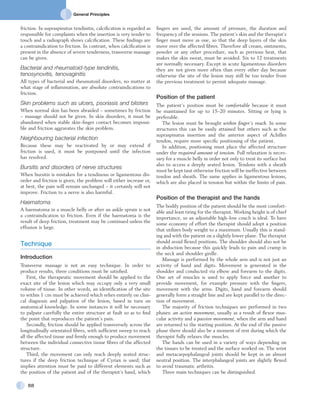
Movement is with the arm; friction is given by use of the pulpy
part of the finger (Fig. 5.2). In large lesions, as in peroneal
tendinitis, two or three adjacent fingers are used together.
In deep-seated lesions as in tendinitis of the long head of
biceps in the bicipital groove or at its insertion on the
radius or in infraspinatus tendinitis, the thumb performs
friction.
Counterpressure is usually provided to enable a good sweep.
The finger(s) applying counterpressure and stabilization are
most important in bringing those applying friction into the
right position and also determining the direction of the friction.
The thumb is used (to give counterpressure) when the sweep
is performed by a movement of the index reinforced by the
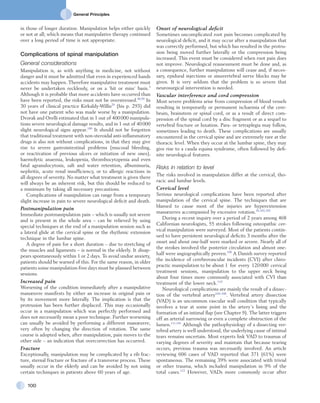
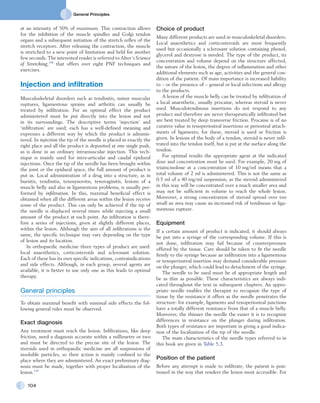
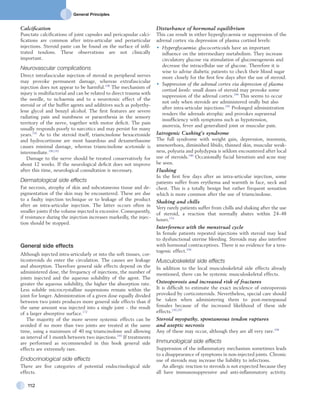
Fig 5.2 • Friction to the supraspinatus tendon: counterpressure is
by the thumb.
Fig 5.3 • Friction to the infraspinatus tendon: counterpressure is by
the fingers.
General Principles
90
Sometimes the same technique is used in tendinous lesions,
for example, at the sides of the Achilles tendon.
No movement between finger and skin  .
is allowed
Deep friction can only be effective when skin and subcutane-
ous fascia are moved over tendon ligaments or muscles. No
movement is allowed between the therapist’s finger and the
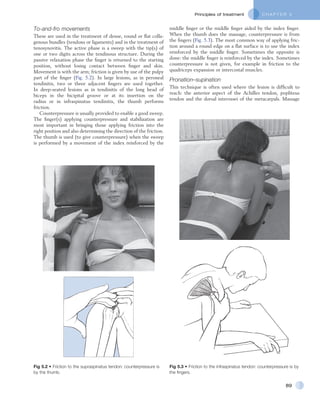
is performed with the pulpy part of the third finger (long
finger), reinforced by the index finger. The long finger is used
because its long axis is the prolongation of the axis of pronation–
supination rotation of the forearm (Fig. 5.4).
The active phase is usually on supination. No counterpres-
sure is given. Caution is taken not to move the finger on the
skin but rather to move the skin and the fingertip as a whole.
The passive phase is the pronation movement that brings the
frictioning finger back to the starting position without losing
contact with the skin.
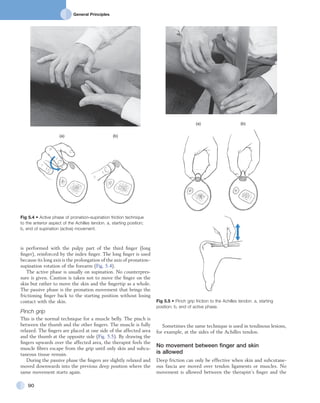
Pinch grip
This is the normal technique for a muscle belly. The pinch is
between the thumb and the other fingers. The muscle is fully
relaxed. The fingers are placed at one side of the affected area
and the thumb at the opposite side (Fig. 5.5). By drawing the
fingers upwards over the affected area, the therapist feels the
muscle fibres escape from the grip until only skin and subcu-
taneous tissue remain.
During the passive phase the fingers are slightly relaxed and
moved downwards into the previous deep position where the
same movement starts again.
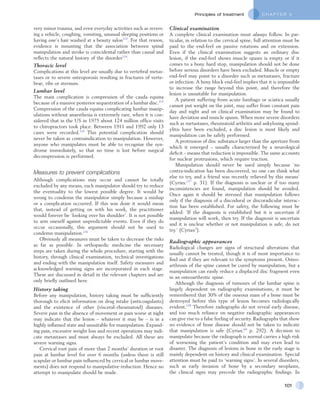
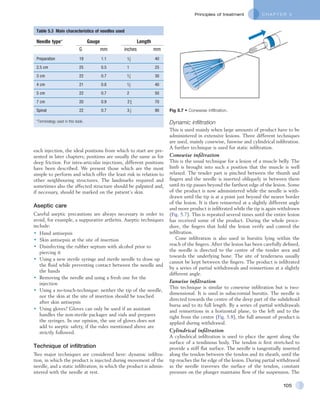
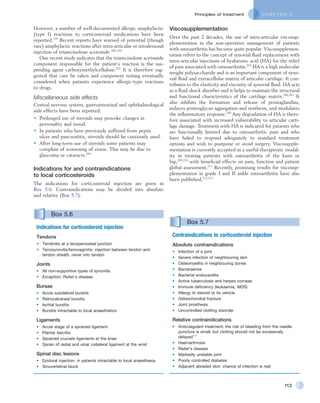
Fig 5.4 • Active phase of pronation–supination friction technique
to the anterior aspect of the Achilles tendon. a, starting position;
b, end of supination (active) movement.
(a) (b)
Fig 5.5 • Pinch grip friction to the Achilles tendon. a, starting
position; b, end of active phase.
(a) (b)
C H A P T E R 5Principles of treatment
91
have not had time to form. In long-standing cases more
pressure is needed to get rid of these. However, pressure
should always be associated with movement and should
not replace it because pressure alone is both painful and
ineffective.
•	 The tenderness of the lesion: in severely inflamed lesions
that are very tender to touch, friction with the usual
amount of force may be very painful. Pain can be avoided
by starting with a minimal amount of pressure – just
enough to reach the lesion – and progressively increasing
the force as treatment proceeds.
In order to avoid painful sessions of deep transverse friction it
is good practice to grade its application. Begin with a sweep
that is gentle and continue this for a few minutes; some numb-
ness of the treated area follows which allows slight intensifica-
tion of the amount of pressure, which in turn leads to more
numbness. Finally, it will be possible to give effective massage
that is practically painless to the patient.
Duration and frequency
Friction is usually given for about 10–20 minutes and, because
of tenderness, on every second day. The ideal timing of the
next treatment is when local tenderness caused by the previous
session has resolved. If tenderness persists after 2 days, the
pressure used during friction should not be diminished but the
interval between sessions must be increased.
Massage immediately after a ligamentous sprain or a minor
muscular rupture may be applied daily for the first week but
should be of very low intensity and short duration.
Treatment is stopped once the patient is pain-free during
daily activities and functional tests are totally negative. Local
tenderness may persist longer but disappears spontaneously
because it is the outcome of repetitive hard pressure. However,
in a minor lesion of a muscle belly, massage is continued for
1 week after full clinical recovery to prevent recurrence (see
Table 5.2; see also Box 5.2).
Passive movements
Treatment by passive movement is otherwise known as mobi-
lization. It cannot be performed by the patient and requires
the intervention of a therapist. Depending on its velocity and
the range of movement that is aimed for, it can be graded as
A, B and C mobilization:
•	 Grade A mobilization is a passive movement performed
within the pain-free range.
•	 Grade B mobilizations are passive movements performed
to the end of the possible range. The latter is indicated by
an end-feel. All stretching and traction techniques are
grade B mobilizations.
•	 Grade C mobilization is a minimal thrust with a high
velocity and over a small amplitude. It is performed at the
end of the possible range, i.e. the moment the therapist
has reached the end-feel. Another word for grade C
mobilization is manipulation.
patient’s skin. If movement occurs between finger and skin,
blistering soon takes place and usually indicates faulty tech-
nique. Sometimes it can be avoided by keeping the skin dry by
the use of 95% alcohol in water and/or by placing a piece of
cotton in between the finger and the skin.
In the obese, subcutaneous soreness and/or ecchymosis may
occasionally occur and sometimes a nodule may form. For this
reason the finger should not be in continuous contact with the
same area but should displace the skin slightly to one or other
side, before pressure is applied.
Direction of friction must be transverse  .
to the tissue fibres
Longitudinal massage improves the circulation of blood and
lymph but has no effect on musculoskeletal lesions. On the
contrary, because lesions of tendons, muscles and ligaments are
normally caused by a longitudinal force, longitudinal massage
can possibly be harmful in that it may separate the ruptured
ends further. To restore and/or maintain full mobility of a
lesion, massage must be given across the fibres, so moving all
fibres in relation to each other. To achieve this, the therapist
must have a good anatomical knowledge of the direction of the
fibres.
Sweep
The main goal of friction is to move fibres in relation to
each other and adjacent structures. Enough sweep must
be given to the friction for this purpose, so the frictioning
finger starts at the far side of the lesion, glides over it and ends
at the near edge. Pressure alone, however hard and painful it
may be, is totally ineffective. Adequate sweep is sometimes
limited by the amount and elasticity of the overlying skin.
Initial displacement of skin over the lesion from the near to
the far side may help increase sweep and reduce the risk
of blistering.
Amount of pressure
Over recent decades, friction has been held in some disrepute
in that it was perceived by some as synonymous with very
painful treatment. Though it cannot be claimed as wholly pain-
free, the pain should not be unbearable. When excessive pain
is provoked, this is usually the result of a failure to understand
the meaning of the term ‘deep’, which means ‘as deep as
needed to reach the lesion’. Many therapists misinterpret this
in such a way that they feel that they always have to work hard
physically, which obviously leads to pain and may do more
harm than good.
The amount of pressure applied depends on three
elements:
•	 The depth of the lesion: that friction must always reach
sufficient depth to move the affected fibres in relation to
their neighbours and sometimes the underlying bone or
capsule, increased pressure must be applied to deeper
structures.
•	 The ‘age’ of the lesion: recent sprains and injuries require
only preventive friction because crosslinks or adhesions
General Principles
92
Indications
Grade A mobilizations
To promote healing of injured connective tissue
Passive movements within the pain-free range are usually
called for in the treatment of injured connective tissue. A
comprehensive literature evaluation and meta-analysis of
experimental studies of the past several decades have demon-
strated that regeneration of injured connective tissue is signifi-
cantly better with the application of continuous passive motion.
If the healing tissues are not loaded, regeneration results in
unstructured scar tissue. Under functional load, the collagen
fibres are oriented in a longitudinal direction and the mechani-
cal properties are optimized.24
Grade A mobilizations are therefore applied early in the
treatment of sprained ligaments to promote orientation of the
regenerating fibres. They are given in conjunction with gentle
transverse massage and within the pain-free range. Care should
be taken not to bring the fibres under longitudinal stress in
order not to disrupt the healing breach. The movements are of
short duration but repeated often.
Distractions at the shoulder
Grade A mobilizations are also used on the capsule of the
shoulder in stage III arthritis when stretching and intra-articular
steroids are contraindicated (see Ch. 14). In this condition,
long-standing stimulation of the nociceptors has increased
neuro-sympathetic activity, giving rise to vasoconstriction,
muscle spasm and pain.
Gentle and rhythmical grade A movements are performed
in such a way that the fibres are stretched longitudinally, stimu-
lating the mechanosensor mechanisms in the joint and so
Table 5.2  Transverse massages/modalities
Indication Duration (min) Pressure Frequency Combined treatment
Diagnostic 15–20 High Once
Acute ligamentous 30 sec Very low Daily Effleurage before and active movement after the treatment
Subacute ligamentous 3–10 Low Daily–3 times/week Passive grade B movements after
Chronic ligamentous 15–20 High 3 times/week Passive grade B movements after
Ligamentous adhesions 15–20 High Once Before manipulation (grade C mobilization)
Tendinitis – tenoperiosteal 15–20 Grading 3 times/week Relative rest – unloaded active movement
Tenosynovitis 15–20 Grading 3 times/week Relative rest – unloaded active movement
Musculotendinous 15–20 Grading 3 times/week Relative rest – unloaded active movement
Myosynovitis 15–20 Grading 3 times/week Relative rest – unloaded active movement
Muscular tear – acute 5–10 Low Daily Procaine infiltration before and active unloaded
contractions after treatment
Muscular tear – chronic 10–15 High 3 times/week Active unloaded contractions after treatment
Capsular lesions 15–20 Grading 3 times/week
Box 5.2 
Summary of deep friction technique
1	 Position of the patient must:
be comfortable
bring lesion within finger’s reach
be appropriate for the type of structure at fault:
•	 tendon/ligament under tension
•	 muscle belly: relaxed
2	 Position of the therapist must:
be comfortable
facilitate economy of effort:
•	 alternating active and passive phases
•	 using large muscles
3	 Use of the hand:
To-and-fro movement
Pronation/supination
Pinch grip
4	 Use of the fingers:
Counterpressure
Friction using the fingers
5	 Other points:
Fingers and skin move as one unit
Direction of friction must be transverse
Sufficient sweep must be used
The pressure must be appropriate
Duration and frequency must be appropriate
C H A P T E R 5Principles of treatment
93
In the very beginning of arthritis, muscle spasm forces the joint
to be held in a position of ease, so restricting movement in
some directions more than in others (see Capsular pattern, Ch.
4). Immobilization and inflammation cause disordered deposi-
tion of collagen fibres in the joint capsule and lead to the
formation of capsular adhesions, which in turn are responsible
for more restriction of movement and pain. Stretching aims at
restoring mobility and function by breaking micro-adhesions
and producing elongation of the shortened capsule. To be appli-
cable, however, the ligamentous end-feel must be reached
before the protective muscle spasm begins. To be successful,
the therapist should therefore be able to differentiate between
an elastic and a spastic end-feel.
The technique is a slow and steady pressure, performed at
the end of range over about 30 seconds to 1 minute with as
much force as is reasonable for the patient to bear. Tension is
slightly diminished for a few seconds, so affording the patient
some respite, and then again increased. From time to time
the procedure is completely interrupted. If tension is released
too quickly, some pain may be felt and it is therefore wise
to bring the limb back into neutral position under traction.
The technique is not painless. The stretching causes some
micro-ruptures, which result in an inflammatory response and
after-pain that lasts for a few hours.
Normally, capsular stretching is given for 15–20 minutes,
three times a week. The therapeutic effect is slow.
Capsular stretching can be preceded by application of
heat, either through short-wave diathermy or ultrasound.
This can relieve some pain and seems to lower the viscosity
of the collagenous tissue, allowing more movement for less
force. In vivo studies on the effects of heat on ligament
extensibility have shown that sustained force applied after
elevating tissue temperature produced significantly greater
residual elongation.25,26
Manipulation of a joint capsule under anaesthesia is a grade
C mobilization and is only considered for postoperative intra-
articular adhesions. A joint that has been manipulated under
anaesthesia requires daily intensive mobilization immediately
afterwards in order to prevent the formation of new intra-
articular adhesions.
To stretch a muscle
Children with short calf muscles can be helped by sustained
stretching. The procedure consists of a series of alternating
passive stretchings and active contractions. Stretching is main-
tained for about 8–10 seconds and is followed by full relaxation
and active contraction of the muscle. These alternating move-
ments are performed six to eight times per session, preferably
daily but at a minimum of three times a week. The earlier the
stretching is started, the better the result. Above the age of 15
not much improvement can be expected.
Traction
Traction is used to separate articular surfaces from each other
and can be employed in two ways: as an accessory to manipula-
tion or as the sole treatment. Reducing a displaced fragment is
obviously easier when the bone ends between which it lies are
pulled apart. If the fragment projects beyond the articular
edge, tautening of the ligaments and capsule also provides a
inhibiting somatosympathetic reflexes that are co-responsible
for the increased inflammation of the joint.
Deformity correction
Some cases of lumbago show persistent spinal deviation even
after the pain has ceased. A quick thrust manipulation so effec-
tive in relief of pain is not effective in correcting the remaining
deformity, but sustained translatory gliding in the opposite
direction is most helpful. The movement is performed slowly
and care is taken to keep the gliding within the pain-free range
(see Ch. 40).
Reduction of an intra-articular displacement
in a peripheral joint
When a meniscus or some other piece of intra-articular carti-
lage (with or without an osseous nucleus) becomes displaced
and locks a joint, the logical treatment is either to remove it
or manœuvre it into such a position that the joint can again
move freely over a normal range. The technique needed for
the latter is usually a series of manipulative movements which
normally contain elements of traction combined with move-
ments of rotation and flexion or extension. In general, these
are first performed in the less painful direction of movement
and repeated several times with progressively increasing force.
Unlike manipulations in the spine, the manœuvre to reduce
an intra-articular loose body is not a grade C mobilization
because the movement is not performed at the end of range
nor does it contain a ‘thrust’ element. The flexion–extension
movement is over a wide range and stops before the end-feel
is reached. The rotation movements are performed to the
end of range where end-feel is sensed by the therapist. The
‘manipulation of an intra-articular displacement in a peripheral
joint’ is therefore a combination of grade A and grade B
mobilizations.
Grade B mobilizations
To maintain a normal range at the joint
Paralysed muscles may lead to a loss of normal range of motion
of the corresponding joint. This can be avoided by gently
stretching the capsule, starting as soon as possible after the
onset of paralysis. The approach should also be considered for
joints that have been injured or subjected to surgery. In such
circumstances, there may be the paradox that immobilization
is needed for a fracture to heal but that movement is required
to prevent loss of capsular elasticity. Often the problem can be
solved by adapting the technique of capsular stretching so that
it does not influence the site of the fracture.
To stretch the capsule of a joint
Grade B mobilizations may be required to stretch the joint
capsule in non-acute arthritis and in early osteoarthrosis. The
technique will be further referred to as capsular stretching.
Capsular stretching is particularly useful in shoulder and hip
joints but is applicable in all ‘non-irritable’ capsulitis. The con-
dition is characterized by:
•	 a limitation in the capsular pattern (see Ch. 4)
•	 demonstration of a hard-elastic end-feel to restricted
movements (see Ch. 4).
General Principles
94
Rupture of tenoperiosteal adhesions
In type II tennis elbow (tendinitis of the attachment of the
extensor carpi radialis brevis), adherent and disorganized scar
tissue causes a self-perpetuating inflammation. The manipula-
tion aims to rupture the adhesions and produce a permanent
elongation of the tendon. The high-velocity manœuvre is pre-
ceded by thorough deep transverse friction in order to numb
and to weaken the spot. The manipulation is performed only
once per session; 10–15 sessions may be required to achieve a
result.
To reduce a bony subluxation
A subluxation of one of the carpal bones or of the cuboid bone
can easily be reduced by digital pressure combined with trans-
latory movement during traction.
Manipulation of the spine
Spinal manipulative therapy is a major part of treatment tech-
niques in orthopaedic medicine and is discussed thoroughly
below.
Contraindications to forced movements
Contraindications to spinal manipulations are discussed later
in this chapter.
Capsular inflammation
Forced movements should not be performed when signs and
symptoms of capsular inflammatory activity are present. These
are spontaneous pain, pain especially at night, wide reference
of pain, inability to lie on the affected side at night or to bear
weight on the affected side. Local warmth and effusion are
other pointers of a highly inflamed joint. However, if these
symptoms and signs are present but the rest of the clinical
examination demonstrates internal derangement (e.g. knee,
hip, ankle), manipulation is indicated and can safely be
performed.
Muscle spasm
Grade C mobilizations should never be applied to a joint that
is protected by a muscle spasm. Grade B mobilizations may be
used unless the end-feel of the movement that is intended to
be forced through is also spastic.
Severe osteoporosis
Grade B mobilizations, for instance stretching of the shoulder
or hip joint in elderly people, should always be carried out with
caution for fear of fracturing the humerus or the neck of the
femur.
Joints and ligaments not under voluntary
tension control
Mobilization is also contraindicated for those joints and liga-
ments on which the tension is not under voluntary control.
This is the case for the acromioclavicular, the sternoclavicular
and the sacroiliac joints and the sacrococcygeal ligament.
centripetal force. In that traction diminishes the pressure on
the fragment, pain decreases, which allows the patient to relax
the muscles more.18
In the cervical and thoracic spines, traction
is a built-in safety measure for protecting the spinal cord during
manipulation (see below) although the use of traction for this
purpose and at these sites does not imply that manipulation
can be performed on a basis of ‘try and see what happens’
without a proper diagnosis.27
In the spine, traction is used as the sole treatment only in
nuclear disc protrusions, which are rare at the cervical and
thoracic levels but are more common in the lumbar area. Spinal
traction is always mechanical and is performed with the help
of a harness (lumbar or low thoracic) or a sling (cervical or
upper thoracic). Spinal traction distracts the intervertebral disc
spaces. It also pulls the apophysial joints apart and slightly
widens the intervertebral foramina.27–31
At the same time,
negative intradiscal pressure is produced with centripetal
‘suction’ on any protrusion. The posterior longitudinal ligament
is tightened, which may help reduce a displaced fragment. All
these elements are helpful in the progressive reduction of a
nuclear disc protrusion. Reduction of herniated bulges has been
demonstrated on epidurography31–33
and on CT scan34
during
and after traction. The effect of traction depends on the
amount of force applied, the length of time per session, the
interval between each session and the total number of
sessions.35
Grade C mobilizations
Grade C mobilizations or manipulations are forceful passive
movements, performed at the end of range. Spinal manipula-
tions are mainly to interrupt discodural or discoradicular
contact. At the peripheral joints the purpose of a manipulation
is to rupture unwanted adhesions between bone and ligament
or bone and tendon or to reduce small bony subluxations in
the wrist or foot.
Rupture of ligamentous adhesions
Small ligamentous adhesions sometimes develop between a
healing ligament and bone. They usually result from a sprained
ligament that has been immobilized during the healing process.
The usual presentation is at the lateral ligaments of the ankle
and at the medial collateral ligament of the knee. The clinical
features are local pain during exertion and a small limitation
of movement in one direction only. The adhesions can be rup-
tured by a high-velocity, small-amplitude thrust manipulation,
after preparation of the affected ligament with intensive deep
transverse friction.
The joint is stretched as far as possible in the limited direc-
tion and manipulated with a single firm thrust, during which a
typical ‘snap’ is often heard. Harm is not caused to the liga-
ment nor to the other parts of the joint because the adhesions
bear the brunt of the force. The manipulation is almost painless
and after-pain is not to be expected. A successful manipulation
should achieve an immediate result. Active movements during
the following days to maintain function should be highly
encouraged.
C H A P T E R 5Principles of treatment
95
Diagnosis is mainly based on palpation for restricted spinal
mobility and treatment consists of a manipulative system in
which joints are forced by a distant leverage. Cure is sought
for all kinds of visceral and musculoskeletal disorders.27
Chiropraxy
This method was started in 1885 by D. Palmer. It is based on
a revision of techniques that originated with Hippocrates and
is also influenced by osteopathy. Chiropraxy was long regarded
as maintaining osteopathic dogma in its most primitive form
and having a strong commercial character.
Chiropractors also claim to cure visceral diseases via the
musculoskeletal system. Diagnosis is made on palpation for
vertebral displacement and manipulative pressure is applied
directly to the bone.
Orthopaedic medicine
This term describes the system of diagnosis and treatment of
musculoskeletal lesions introduced by J.H. Cyriax. It is the
system on which this book is based. Diagnosis rests on careful
history and functional examination. Treatment depends mainly
on the type of lesion, and manipulation is applied only when
indicated. In spinal manipulation, Cyriax proposed a fixed set
of high-velocity, small-amplitude thrusts performed at a certain
distance from the lesion and, characteristically for this method,
usually under strong traction. The objective of Cyriax’s spinal
manipulative techniques is to alter the discodural or disco-
radicular interaction by moving a displaced cartilaginous frag-
ment away from the sensitive dura mater and dural nerve
sleeve. Spinal rotation manipulations apply a torsion stress
throughout a whole part of the spine, not at just one level.
With an intact posterior longitudinal ligament and annulus
fibrosus, some of this torsion force exerts a centripetal force
by suction on the protruding disc material.42
This effect is not
confined to one level and full reduction is not absolutely neces-
sary for pain relief, in that when contact between dura and disc
has ceased the problem is frequently solved.
Manual therapy
Treatment is characterized by rhythmic repeated movements
within the physiological range. Oscillatory techniques had
already been used by E. Cyriax (father of J.H. Cyriax) but
were more widely employed by Maitland and later slightly
changed by the different schools of manual therapy (Cyriax:3
p. 40). Pressure is applied to what is believed to be the appro-
priate level.
Orthopaedic medicine technique
Before any manipulation is done an exact diagnosis must be
made. The decision to manipulate is followed by choice of the
correct manœuvre. The patient is put in a comfortable position
and the manipulator adopts a stable stance. The floor and shoes
should not be slippery, so that there is no risk of inappropriate
movement.
Attention must be given to the following general matters,
which are important for all manipulations.
Manipulation of the spine
Introduction
Spinal manipulative therapy includes all procedures of mobiliz-
ing or adjusting the spine by means of the hands. As in the
peripheral joints, grade A and B mobilizations are movements
of low velocity with varying amplitude but remaining within
physiological limits and within the patient’s tolerance and
control.
A manipulation or grade C mobilization usually implies a
single thrust of high velocity performed at the end of a passive
movement after the ‘slack’ has been taken up, and over a small
amplitude. It goes beyond the physiological limit but remains
within the anatomical range. Precision of the movement and
control of the applied force are required.36
Spinal manipulative
therapy is a valuable method in the treatment of mechanical
spinal disorders. Although it has not been scientifically vali-
dated, some studies have shown beneficial effect.37–40
However,
its potential benefit should not be overestimated and the indi-
cations must be well defined and based on a sound clinical
diagnosis. It must never be done as a test to see if it is effec-
tive. Therefore it should not be used on all those with back
and neck pain although it may well cure a proportion who
actually require it. To use McKenzie’s words:
Even if you have a hammer in your hand not everything you see
is a nail. Therefore indiscriminate use of spinal manipulative
therapy must not be made if the criticisms that have been
justifiably levelled at chiropractice and osteopathy are to be
avoided. The development of postgraduate courses in
manipulation is welcome, although some have overvalued the
benefits of manipulative therapy. All who undertake
manipulation have experienced the feeling of pride and joy in
producing cure. It is the duty of those who have more experience
of the benefits and limitations of manipulative therapy to
moderate the understandable enthusiasm of those entering the
field – a few successes may quickly lead to the temptation to
manipulate every patient for any disorder.41
Manipulation either helps quickly or not at all. Therefore if
improvement does not occur after one or two sessions, manip-
ulation is not likely to be successful and it is pointless to
continue with it.
Historical note
Manipulation is as old as medicine and embraces both
medicine and mankind in general. In recent times, the
medical aspect has become structured and different methods
have been developed which are subject to controversy and
competition.
Osteopathy
The concept of osteopathy was introduced by A. T. Still
(1828–1917) and developed out of frustration with traditional
medicine. His ideas were based on two principles: (1) the body
has within itself the processes to combat all disease, and (2)
the cause of all disease is dislocated bones, abnormal ligaments
or contracted muscles with consequent mechanical pressure on
blood vessels and nerves.
General Principles
96
pain-free movement. The patient and not the manipulator is
the arbiter.49
Depending on the immediate outcome, the thera-
pist decides whether to repeat the same manipulation, prob-
ably with increased strength, to try another manœuvre or to
refrain from further manipulation.
It should be appreciated that after successful manipulation
the anatomical lesion is still present: a piece of cartilage,
although put back in place or into a neutral position, persists
and may redisplace. For this reason, those who undertake
manipulation should note the results obtained and what
manipulations were used, in case of recurrence.
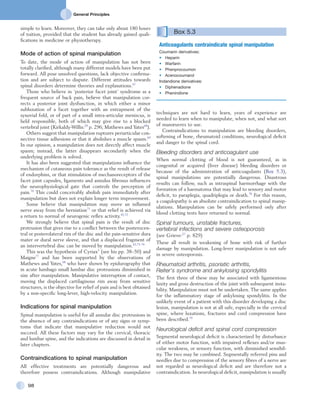
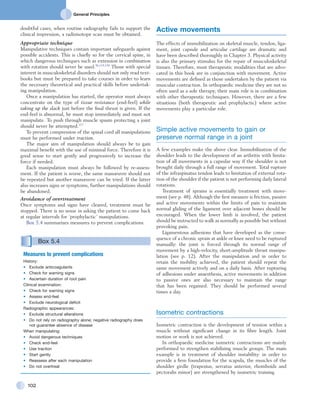
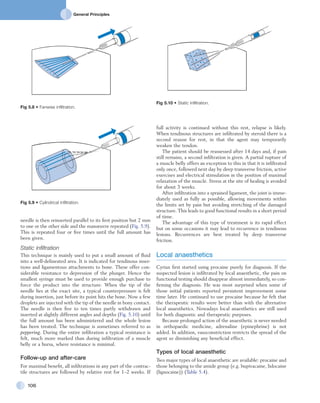
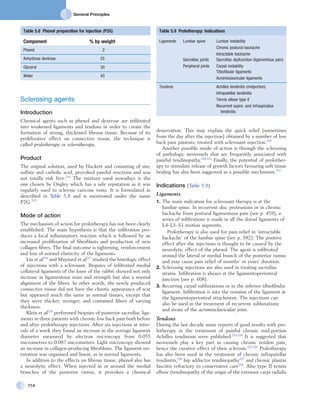
Figure 5.6 outlines the assessment of spinal lesions and their
manipulation.
Selectivity of a manipulative treatment
Selectivity must be considered both in diagnosis and therapy.
Selectivity of diagnosis
Osteopaths and manual therapists claim to have developed the
clinical skills to localize by palpation the exact site of fixation,
and are therefore able to perform the manipulation at the
required level. Diagnosis is mainly based on segmental mobility
tests: joint play, springing test or tests of passive physiological
movements. Movement can be tested by exerting local pres-
sure at one side of a vertebra while counterpressure is applied
to the contralateral side of the vertebra above or below. For
the lumbar spine, it can be done with the patient on the side
with both hips flexed to 90°. Small movements of the thighs
cause the lumbar spine to flex or extend which can be detected
by palpation of the spinous processes.
Other practitioners look mainly for palpable soft tissue
changes, such as local subcutaneous thickening or exquisite
tender spots (trigger points) in muscles, ligaments (iliolumbar,
Traction during manipulation
Most types of spinal manipulation in orthopaedic medicine are
performed under traction. For the cervical and thoracic spine,
traction is applied by the manipulator with the help of a fixing
belt or by one or two assistants. At the lumbar level, traction
is usually already built into the manœuvre. Traction facilitates
the reduction of a displaced fragment and provides an impor-
tant safety element against the possibility of a protrusion con-
tacting the spinal cord during manipulation.
End-feel on taking up the ‘slack’
All spinal manipulations are performed over only a small ampli-
tude. Therefore all ‘slack’ must be taken up by moving the
vertebral joints passively to the end of the normal passive range
of movement. At this stage it is absolutely necessary to have a
clear idea of the end-feel, which is nominally elastic for the
entire spine. An end-feel that does not correspond with this
– muscle spasm, or hard or empty end-feel – is an absolute
contraindication to any manipulation and the manœuvre is not
continued.
Final thrust
Immediately after the slack has been taken up in the surround-
ing tissues, a minimal amplitude, high-velocity thrust is given
to affect the target tissue. The velocity is of great importance
because tissues loaded quickly are stiffer so that the manœuvre
will affect only the displaced fragment of disc and will not
damage the surrounding structures.43
The amount of force used for the final thrust depends
mainly on the patient and manipulator in that a tall manipula-
tor will have to use less force in a small patient and vice versa.44
The length of the lever (see later) is also important. The force
should always be kept reasonable and may be progressively
increased, according to the immediate result.
The manipulation thrust is often accompanied by an audible
‘pop’.29,45
Although it is a common belief that pops or clicks
are provoked by the formation of a temporary vacuum, as
occurs in small peripheral joints put under traction,46–48
this is
not definitely established for the spine. An alternative and more
likely explanation is movement of cartilaginous fragments, as
may be heard during manipulation for a loose body in the knee
or hip. If the clicks were simply the result of the collapse of a
vacuum they should also be – but are not – heard during
mechanical traction, in which the traction force is much higher.
Leverage
The amount of force used depends on the length of the lever.
If for example a rotation of the lumbar spine is forced via the
shoulder and pelvis, the lever offered by the shoulder is the
same length as that offered by the pelvis, so an equal amount
of force must be used by both hands. But if the femur is used
instead of the pelvis, the length of the pelvic lever doubles.
The hand on the shoulder must apply double the amount of
force that is used on the knee. The longer the lever, the less
force is needed.
Reassessment
After each manœuvre the patient is assessed, the criteria of
success being the absence of symptoms and the restoration of
Fig 5.6 • Spinal manipulation.
Is the lesion discodural or discoradicular?
Is the lesion an indication for manipulation?
Are there contraindications?
Does the patient have a positive attitude?
Decision to manipulate
Choice of manœuvre
Positions of patient and
manipulator determined
Technique
Take up the slack
Check end-feel
Thrust
Reassess
C H A P T E R 5Principles of treatment
97
In orthopaedic medicine most manœuvres used are non-
specific long-lever manipulations. These include all procedures
in which a force is exerted on a part of the body some distance
away from the area where it is expected to have its beneficial
effect. Levers may include the shoulder, transverse processes
and parts of the skull, pelvis or thigh (Frymoyer et al:45
p. 1594). Although some criticize the crudity of long-lever
high-velocity manipulation it should be realized that it is not
elegance, impressiveness, specificity or technical difficulty
which count but effectiveness and safety. Furthermore, the use
of a lever enables the manipulator to reach the lesion more
effectively. During the preparative phase – on taking up the
slack – all the normal joints are brought to their anatomical
end position except for the joint that is blocked. When the
additional thrust is given, the final extra pressure falls inevita-
bly first and to the greatest degree on the deranged joint. The
manœuvre thus becomes specific even though in general the
techniques are regarded as non-specific.
Long-lever manipulations are in full contrast to what are
called ‘specific’ short-lever high-velocity manipulations. Here
the goal is to act specifically at what is believed to be the level
of the lesion. The spinal segment and the facet joints adjacent
to the lesion are locked by moving the spine to the physiologi-
cal limit of passive movement and a high-velocity small-
amplitude thrust is given to the short vertebral lever (transverse
process or spinous process) in the specific direction that will
liberate the restricted movement. However, it is technically
not possible to lock all other joints and then to manipulate at
just one level (Cyriax:64
p. 108). It was even demonstrated that
by mobilizing the sacroiliac joints after locking of the lumbar
spine, the largest movement took place between L4 and L5.66
Furthermore, if diagnosis fails to be absolutely right, how can
there be certainty as to the exact level of the lesion to work
on? Fortunately for those who employ ‘specific’ short-lever
manipulations, these are much less specific than they think,
because the manipulations actually cover a much larger part of
the spine and so unintentionally also include the lesion.
Specificity is a false attribute. The methods that claim to
lead to specific localization in both diagnosis and treatment are
scientifically unacceptable. Claims of specificity are made in
order to give prestige to manipulators who claim to feel some-
thing that cannot be felt. Manual therapists, chiropractors and
osteopaths over-complicate their teaching and often create
excessive patient dependency, instead of providing the patient
with independence. Indeed, patients are encouraged to return
at regular intervals for pointless prophylactic adjustment.41
We
support R. McKenzie’s conclusion that demystification of
spinal manipulative therapy is an urgent priority.41
Chiropraxy,
manual therapy and osteopathy, however, thrive by creating the
impression that there is something complex and exclusive
about the practice of passive end-range motion that only
experts in these practices can understand or have the skills to
feel. The belief is strong that expertise in the understanding
and delivery of spinal manipulative therapy requires 3 or 4
years’ training. The main advantages of the methods discussed
in this book are that the manipulations are much simpler and
at least as effective as those advocated by chiropractors, osteo-
paths and manual therapists. Non-specific long-lever manipula-
tions are quickly effective, do not take long to perform and are
sacroiliac) and over bony prominences. All these are consid-
ered to be important diagnostic and therapeutic factors.
The great variability in the extent of spinal stiffness between
subjects, or at different levels within the one subject, makes
the determination of areas of abnormally increased stiffness
difficult. Increased stiffness may in fact be a normal variant
and bear no relationship to the patient’s presenting symptoms.
Few of those advocating segmental mobility tests have seri-
ously examined the value of their tests. They have generally
presumed that the tests were useful because their patients got
better.50
However, several studies have failed to demonstrate
the reliability of these tests.51–62
Therefore it must be made
clear that judgement of small changes in the range of move-
ment of a segment, in the absence of full restriction of move-
ment, remains a very subjective finding, which depends mainly
on the personal conviction of the examiner rather than on
objective measurements. Moreover, in soundly based tests,
findings must be reproducible and must show correspondence
when performed by other investigators. In the establishment
of ‘joint play’ the inter-observer discrepancy is too large to be
acceptable.63
In 1973, Cyriax attended a demonstration in
which five therapists, all of whom specialized in mobility
testing, examined over a period of a few minutes a patient
with a neck problem. There was no agreement between these
specialists about the level of the lesion (C2, C3, C4, C5, C6
or T2), or about the direction of restriction (see Cyriax:64
p. 108). Similarly, a patient who had congenital fusion of
the sacroiliac joints was examined by 10 manipulators. Each
had his own diagnosis, such as left anterior sacrum, right ante-
rior sacrum and bilateral posterior sacrum, although ‘the tests
were very positive’ for all of them (see Maigne65
and Cyriax:64
p. 363).
Even if it were possible to identify with certainty localiza-
tion of the hypomobile segment, the question remains as to
whether this is also the site of the lesion. Studies have shown
that frequently the lesion does not lie at the joint where
motion is restricted but at one which appears to be normal.55
Moreover, other disorders such as osteophytosis, congenital
fusion and ankylosing spondylitis all give rise to restricted
movement which is usually painless.
Selectivity of manipulation
Manipulation is often accompanied by immediate relief of
symptoms and signs which, since success has been obtained, is
logically taken as absolute confirmation of the precision of
diagnosis and treatment. Such a deduction may be – and often
is – totally wrong. The only thing proved is that the manipula-
tion was efficacious. The erroneous reasoning that successful
manipulation necessarily confirms the diagnosis has been and
is still today an important argument for the false belief of some
schools that manipulation can cure all kinds of disorders even
including visceral diseases. A typical example is pectoral pain,
resulting from a thoracic discodural interaction which is mis-
diagnosed as angina. The patient goes to an osteopath who
manipulates the thoracic spine and the pectoral pain ceases
immediately. Both patient and manipulator, misled by the
wrong diagnosis, will believe that the manipulation has altered
autonomic tone and cured the angina, whereas what it actually
did was interrupt the discodural interaction.
General Principles
98
techniques are not hard to learn, years of experience are
needed to learn when to manipulate, when not, and what sort
of manœuvres to use.
Contraindications to manipulation are bleeding disorders,
softening of bone, rheumatoid conditions, neurological deficit
and danger to the spinal cord.
Bleeding disorders and anticoagulant use
When normal clotting of blood is not guaranteed, as in
congenital or acquired (liver disease) bleeding disorders or
because of the administration of anticoagulants (Box 5.3),
spinal manipulations are potentially dangerous. Disastrous
results can follow, such as intraspinal haemorrhage with the
formation of a haematoma that may lead to sensory and motor
deficit, to paraplegia, quadriplegia or death.78
For this reason,
a coagulopathy is an absolute contraindication to spinal manip-
ulations. Manipulation can be safely performed only after
blood clotting tests have returned to normal.
Spinal tumours, unstable fractures,
vertebral infections and severe osteoporosis
(see Grieve:27
p. 829)
These all result in weakening of bone with risk of further
damage by manipulation. Long-lever manipulation is not safe
in severe osteoporosis.
Rheumatoid arthritis, psoriatic arthritis,
Reiter’s syndrome and ankylosing spondylitis
The first three of these may be associated with ligamentous
laxity and gross destruction of the joint with subsequent insta-
bility. Manipulation must not be undertaken. The same applies
for the inflammatory stage of ankylosing spondylitis. In the
unlikely event of a patient with this disorder developing a disc
lesion, manipulation is not at all safe, especially in the cervical
spine, where luxations, fractures and cord compression have
been described.79
Neurological deficit and spinal cord compression
Segmental neurological deficit is characterized by disturbance
of either motor function, with impaired reflexes and/or mus-
cular weakness, or sensory function, with diminished sensibil-
ity. The two may be combined. Segmentally referred pins and
needles due to compression of the sensory fibres of a nerve are
not regarded as neurological deficit and are therefore not a
contraindication. In neurological deficit, manipulation is usually
simple to learn. Moreover, they can take only about 180 hours
of tuition, provided that the student has already gained quali-
fications in medicine or physiotherapy.
Mode of action of spinal manipulation
To date, the mode of action of manipulation has not been
totally clarified, although many different models have been put
forward. All pose unsolved questions, lack objective confirma-
tion and are subject to dispute. Different attitudes towards
spinal disorders determine theories and explanations.67
Those who believe in ‘posterior facet joint’ syndrome as a
frequent source of back pain, believe that manipulation cor-
rects a posterior joint dysfunction, in which either a minor
subluxation of a facet together with an entrapment of the
synovial fold, or of part of a small intra-articular meniscus, is
held responsible, both of which may give rise to a blocked
vertebral joint (Kirkaldy-Willis:29
p. 296; Mathews and Yates68
).
Others suggest that manipulation ruptures periarticular con-
nective tissue adhesions or that it abolishes a muscle spasm.69
In our opinion, a manipulation does not directly affect muscle
spasm; instead, the latter disappears secondarily when the
underlying problem is solved.
It has also been suggested that manipulations influence the
mechanism of cutaneous pain tolerance as the result of release
of endorphins, or that stimulation of mechanoreceptors of the
facet joint capsules, ligaments and annulus fibrosus influences
the neurophysiological gate that controls the perception of
pain.70
This could conceivably abolish pain immediately after
manipulation but does not explain longer term improvement.
Some believe that manipulation may move an inflamed
nerve away from the herniation71
or that relief is achieved via
a return to normal of neurogenic reflex activity.42,72
We strongly believe that spinal pain is the result of disc
protrusion that gives rise to a conflict between the posterocen-
tral or posterolateral rim of the disc and the pain-sensitive dura
mater or dural nerve sleeve, and that a displaced fragment of
an intervertebral disc can be moved by manipulation.42,73–76
This was the hypothesis of Cyriax3
(see his pp. 38–50) and
Maigne77
and has been supported by the observations of
Mathews and Yates,68
who have shown by epidurography that
in acute lumbago small lumbar disc protrusions diminished in
size after manipulation. Manipulative interruption of contact,
moving the displaced cartilaginous rim away from sensitive
structures, is the objective for relief of pain and is best obtained
by a non-specific long-lever, high-velocity manipulation.
Indications for spinal manipulation
Spinal manipulation is useful for all annular disc protrusions in
the absence of any contraindications or of any signs or symp-
toms that indicate that manipulative reduction would not
succeed. All these factors may vary for the cervical, thoracic
and lumbar spine, and the indications are discussed in detail in
later chapters.
Contraindications to spinal manipulation
All effective treatments are potentially dangerous and
therefore possess contraindications. Although manipulative
Box 5.3 
Anticoagulants contraindicate spinal manipulation
Coumarin derivatives:
•	 Heparin
•	 Warfarin
•	 Phenprocoumon
•	 Acenocoumarol
Indandione derivatives:
•	 Diphenadione
•	 Phenindione
C H A P T E R 5Principles of treatment
99
of manipulation is necessary – a record of which types of tech-
nique have been used and for what type of disorder and its
duration. It should also be said that a double-blind randomized
trial on spinal manipulation is not possible because of the
absence of a placebo and the obvious knowledge by the patient
and operator of what is being done.
Sims-Williams published a clinical trial on 94 patients
with non-specific lumbar pain, who took part in a trial in
which placebo physiotherapy was compared to Maitland mobi-
lization and manipulation. Studies mainly showed that manipu-
lation hastened improvement chiefly in those patients whose
severity and duration of symptoms did not require specialist
referral.80,89
Bergquist-Ullman and Larsson,90
Coxhead et al81
and Farrell
and Twoney39
found a significantly shorter duration of com-
plaints in patients receiving manipulation.
Chrisman et al91
stated that half of those suffering from
sciatica showed clinical improvement after manipulation, but
the improvement could not be objectively confirmed by
myelography.
Hadler et al86
compared the results of spinal mobilization
to high-velocity thrust manipulation in patients with acute,
uncomplicated low back pain and tried to exclude all elements
of chronicity or compensation insurance. Patients treated by
manipulation improved to a significantly greater degree and
more rapidly than those treated by mobilization.
In one study, in which rotational manipulation was com-
pared with simulated short-wave diathermy, those who received
the former fared better immediately after the session.92
However, when pain relief was compared 7 days after treat-
ment there was no significant difference between the two
groups.
In another study, 24 patients with complaints of less than
3 weeks’ duration were followed. It showed that 92% of those
treated by rotational manipulation were cured in less than
2 weeks.93
Of those who received diathermy, only 25% got
better in the same period of time.
A further trial in acute disc herniation compared conven-
tional physiotherapy with manipulation and showed that the
manipulated group scored significantly better.94
All manipu-
lated patients were able to return to work, whereas only 26%
of the physiotherapy group could do so.
In a randomized clinical trial Koes et al compared the effec-
tiveness of manipulative therapy, physiotherapy, treatment by
the general practitioner and placebo therapy in 256 patients
with non-specific back and neck complaints of at least 6 weeks’
duration. They concluded that manipulative therapy showed a
faster and greater improvement in physical functioning com-
pared to the other three therapies.95,96
Controlled studies performed by Mathews et al clearly
demonstrated that manipulation treatment for low back pain
scored significantly higher in the subgroup with limited straight
leg raising.97,98
Generally it can he concluded that manipulation and mobi-
lization hasten both pain relief and the resolution of objective
signs such as limitation of straight leg raising and of articular
movement. Manipulation with high-velocity thrust seems to
work better and quicker than more gentle mobilization tech-
niques. The results are also better in recent-onset cases than
without value because deficit suggests a large protrusion
that cannot be reduced. This opinion is not universally sup-
ported,80,81
and some still manipulate when minor neurological
signs are present. However, in all instances where progressive
neurological deficit is present, manipulation must not be done.
A similar rule applies in cord compression or cauda equina
syndrome when a very large posterocentral protrusion threat-
ens the spinal cord or the cauda equina. This is true not only
for obvious signs but also in the presence of even the slightest
symptoms, such as extrasegmental pins and needles or pain in
the S4 dermatome.
Hypermobility
In several schools of thought on manipulation, too much
emphasis is placed on hypermobility. Although it is true that
special attention must be given to hypermobility in the cervical
spine, it is not important elsewhere. A hypermobile joint may
move further than an ordinary joint, but once extreme range
is reached it stops in exactly the same way as does an ordinary
joint. More often the disc fragment itself is hypermobile,
which may lead to frequent recurrences. This circumstance
does not contraindicate manipulation but calls for extra meas-
ures to achieve stabilization, for example by infiltration with
ligament sclerosant (see Cyriax:3
p. 38).
For the cervical spine a history of frequent disc problems,
alternating from one side to another, may be suggestive of
hypermobility. When doubt exists the following tests may be
useful: spinal flexion with putting the palms flat on the floor
with knees straight, passive apposition of the thumb to the
flexion aspect of the forearm, passive hyperextension of the
fingers parallel to the external surface of the forearm and
hyperextension of the elbow and/or of the knee of 10° or more.
If one or several of these are positive hypermobility is likely.82
Also, when the end-feel on passive rotation, extension or on
preparation for a straight-pull manipulation is too elastic,
further manipulation must cease.
Spinal manipulation under anaesthesia
Spinal manipulation should never be done in an unconscious
patient. First, anaesthesia is unnecessary. Second, the final
warning of potential danger offered by increased pain or abnor-
mal end-feel on taking up the slack is completely lost, as is
clinical assessment after each manœuvre. Consequently,
complications are more frequent after manipulation under
anaesthesia.83
Patients who have difficulties in relaxing during manipula-
tion may benefit from being given diazepam before a session.
Evaluation of the effectiveness  .
of spinal manipulation
Although several studies, mainly done on the lumbar spine,
support the view that many patients benefit from spinal manip-
ulation,39–41,84–87
agreement on the effectiveness and the role of
manipulation in spinal disorders is still lacking. Reports from
clinical trials are not always clear and the effects of manipula-
tion are often difficult to interpret88
because of a small number
of patients and their selection by symptoms rather than diag-
nosis. To make trials scientifically valuable a precise definition
General Principles
100
Onset of neurological deficit
Sometimes uncomplicated root pain becomes complicated by
neurological deficit, and it may occur after a manipulation that
was correctly performed, but which has resulted in the protru-
sion being moved further laterally or the compression being
increased. This event must be considered when root pain does
not improve. Neurological reassessment must be done and, as
a consequence, further manipulations will cease and, if neces-
sary, epidural injections or sinuvertebral nerve blocks may be
given. It is very seldom that the problem is so severe that
neurosurgical intervention is needed.
Vascular interference and cord compression
Most severe problems arise from compression of blood vessels
resulting in temporarily or permanent ischaemia of the cere-
brum, brainstem or spinal cord, or as a result of direct com-
pression of the spinal cord by a disc fragment or as a sequel to
vertebral fracture or luxation. Para- or tetraplegia may follow,
sometimes leading to death. These complications are usually
encountered in the cervical spine and are extremely rare at the
thoracic level. When they occur at the lumbar spine, they may
give rise to a cauda equina syndrome, often followed by defi-
nite neurological features.
Risks in relation to level
The risks involved in manipulation differ at the cervical, tho-
racic and lumbar levels.
Cervical level
Serious neurological complications have been reported after
manipulation of the cervical spine. The techniques that are
blamed to cause most of the injuries are hyperextension
manœuvres accompanied by excessive rotation.45,102,103
During a recent inquiry over a period of 2 years among 468
Californian neurologists, 55 strokes following osteopathic cer-
vical manipulation were surveyed. Most of the patients contin-
ued to have persistent neurological deficits 3 months after the
onset and about one-half were marked or severe. Nearly all of
the strokes involved the posterior circulation and almost one-
half were angiographically proven.109
A Danish survey reported
the incidence of cerebrovascular incidents (CVI) after chiro-
practic manipulation to be about 1 for every 120 000 cervical
treatment sessions, mani­pulation to the upper neck being
about four times more commonly associated with CVI than
treatment of the lower neck.110
Neurological complications are mainly the result of a dissec-
tion of the vertebral artery104–108
. Vertebral artery dissection
(VAD) is an uncommon vascular wall condition that typically
involves a tear at some point in the artery’s lining and the
formation of an intimal flap (see Chapter 9). The latter triggers
off an arterial narrowing or even a complete obstruction of the
lumen.111,101
Although the pathophysiology of a dissecting ver-
tebral artery is well understood, the underlying cause of intimal
tears remains uncertain. Most experts link VAD to traumas of
varying degrees of severity and maintain that because tearing
occurs, previous trauma was necessarily involved. An article
reviewing 606 cases of VAD reported that 371 (61%) were
spontaneous. The remaining 39% were associated with trivial
or other trauma, which included manipulation in 9% of the
total cases.112
However, VADs more commonly occur after
in those of longer duration. Manipulation helps either quickly
or not at all; which means that manipulative therapy continued
over a long period of time is not appropriate.
Complications of spinal manipulation
General considerations
Manipulation is, as with anything in medicine, not without
danger and it must be admitted that even in experienced hands
accidents may happen. Therefore manipulative treatment must
never be undertaken recklessly, or on a ‘hit or miss’ basis.3
Although it is probable that more accidents have occurred than
have been reported, the risks must not be overstressed.40,99
In
30 years of clinical practice Kirkaldy-Willis29
(his p. 293) did
not have one patient who was made worse by a manipulation.
Dvorak and Orelli estimated that in 1 out of 400 000 manipula-
tions severe neurological damage results, and in 1 out of 40 000
slight neurological signs appear.100
It should not be forgotten
that traditional treatment with non-steroidal anti-inflammatory
drugs is also not without complications, in that they may give
rise to severe gastrointestinal problems (mucosal bleeding,
or reactivation of previous ulcers or initiation of new ones),
haemolytic anaemia, leukopenia, thrombocytopenia and even
fatal agranulocytosis, salt and water retention, albuminuria,
nephritis, acute renal insufficiency, or to allergic reactions in
all degrees of severity. No matter what treatment is given there
will always be an inherent risk, but this should be reduced to
a minimum by taking all necessary precautions.
Complications of manipulation can range from a temporary
slight increase in pain to severe neurological deficit and death.
Postmanipulation pain
Immediate postmanipulation pain – which is usually not severe
and is present in the whole area – can be relieved by using
special techniques at the end of a manipulation session such as
a lateral glide at the cervical spine or the rhythmic extension
technique in the lumbar spine.
A degree of pain for a short duration – due to stretching of
the muscles and ligaments – is normal in the elderly. It disap-
pears spontaneously within 1 or 2 days. To avoid undue anxiety,
patients should be warned of this. For the same reason, in older
patients some manipulation-free days must be planned between
sessions.
Increased pain
Worsening of the condition immediately after a manipulative
manœuvre manifests by either an increase in original pain or
by its movement more laterally. The implication is that the
protrusion has been further displaced. This may occasionally
occur in a manipulation which was perfectly performed and
does not necessarily mean a poor technique. Further worsening
can usually be avoided by performing a different manœuvre,
very often by changing the direction of rotation. The same
course is adopted when, after manipulation, pain moves to the
other side – an indication that overcorrection has occurred.
Fracture
Exceptionally, manipulation may be complicated by a rib frac-
ture, sternal fracture or fracture of a transverse process. These
usually occur in the elderly and can be avoided by not using
certain techniques in patients above 60 years of age.
C H A P T E R 5Principles of treatment
101
Clinical examination
A complete clinical examination must always follow. In par-
ticular, in relation to the cervical spine, full attention must be
paid to the end-feel on passive rotations and on extension.
Even if the clinical examination suggests an ordinary disc
lesion, if the end-feel shows muscle spasm is empty or if it
comes to a bony hard stop, manipulation should not be done
before serious disorders have been excluded. Muscle or empty
end-feel may point to a disorder such as metastases, fracture
or infection. A bony block end-feel implies that it is impossible
to increase the range beyond this point, and therefore the
lesion is unsuitable for manipulation.
A patient suffering from acute lumbago or sciatica usually
cannot put weight on the joint, may suffer from constant pain
day and night and on clinical examination may be found to
have deviation and muscle spasm. When more severe disorders
such as metastases, rheumatoid arthritis and ankylosing spond-
ylitis have been excluded, a disc lesion is most likely and
manipulation can be safely performed.
A protrusion of disc substance larger than the aperture from
which it emerged – usually characterized by a neurological
deficit – means that reduction is impossible. The same accounts
for nuclear protrusions, which require traction.
Manipulation should never be used simply because ‘no
contra-indication has been discovered, no one can think what
else to try, and a friend was recently relieved by this means’
(Cyriax:117
p. 31). If the diagnosis is unclear or if too many
inconsistencies are found, manipulation should be avoided.
Once again it should be stressed that manipulation follows
only if the diagnosis of a discodural or discoradicular interac-
tion has been established. For safety, the following must be
added: ‘If the diagnosis is established but it is uncertain if
manipulation will work, then try. If the diagnosis is uncertain
and it is unclear whether or not manipulation is safe, do not
try.’ (Cyriax3
).
Radiographic appearances
Radiological changes are signs of structural alterations that
usually cannot be treated, though it is of most importance to
find out if they are relevant to the symptoms present. Osteo­
arthrosis of the spine cannot be cured by manipulation, but a
manipulation can easily reduce a displaced disc fragment even
in an osteoarthrotic spine.
Although the diagnosis of tumours of the lumbar spine is
largely dependent on radiography examinations, it must be
remembered that 30% of the osseous mass of a bone must be
destroyed before this type of lesion becomes radiologically
evident.118
Therefore radiographs do not reveal early disease,
and too much reliance on negative radiographic appearances
can give rise to a false feeling of security. Radiographs that show
no evidence of bone disease should not be taken to indicate
that manipulation is safe (Cyriax:64
p. 292). A decision to
manipulate because the radiograph is normal carries a high risk
of worsening the patient’s condition and may even lead to
disaster. The diagnosis of lesions in bone in the early stage is
mainly dependent on history and clinical examination. Special
attention must be paid to ‘warning signs’. In several disorders,
such as early invasion of bone by a secondary neoplasm,
the clinical signs may precede the radiographic findings. In
very minor trauma, and even everyday activities such as revers-
ing a vehicle, coughing, vomiting, unusual sleeping positions or
having one’s hair washed at a beauty salon113
. For that reason,
evidence is mounting that the association between spinal
manipulation and stroke is coincidental rather than causal and
reflects the natural history of the disorder114
.
Thoracic level
Complications at this level are usually due to vertebral metas-
tases or to severe osteoporosis resulting in fractures of verte-
brae, ribs or sternum.
Lumbar level
The main complication is compression of the cauda equina
because of a massive posterior sequestration of a lumbar disc.115
Compression of the cauda equina complicating lumbar manip-
ulations without anaesthesia is extremely rare, when it is con-
sidered that in the US in 1975 about 124 million office visits
to chiropractors took place. Between 1911 and 1992 only 13
cases were recorded.116
This potential complication should
never be taken as contraindication to manipulation. However,
anyone who manipulates must be able to recognize the syn-
drome immediately, so that no time is lost before surgical
decompression is performed.
Measures to prevent complications
Although complications may occur and cannot be totally
excluded by any means, each manipulator should try to reduce
the eventuality to the lowest possible degree. It would be
wrong to condemn the manipulator simply because a mishap
or a complication occurred. If this was done it would mean
that, instead of getting on with his work, the practitioner
would forever be ‘looking over his shoulder’. It is not possible
to arm oneself against unpredictable events. Even if they do
occur occasionally, this argument should not be used to
condemn manipulation.116
Obviously all measures must be taken to decrease the risks
as far as possible. In orthopaedic medicine the necessary
steps are taken during the whole procedure, starting with the
history, through clinical examination, technical investigations
and ending with the manipulation itself. Safety measures and
acknowledged warning signs are incorporated in each stage.
These are discussed in detail in the relevant chapters and are
only briefly outlined here.
History taking
Before any manipulation, history taking must be sufficiently
thorough to elicit information on drug intake (anticoagulants)
and the existence of other (visceral–rheumatoid) diseases.
Severe pain in the absence of movement or pain worse at night
may indicate that the lesion – whatever it may be – is in a
highly inflamed state and unsuitable for manipulation. Expand-
ing pain, excessive weight loss and recent operations may indi-
cate metastases and must always be excluded. All these are
severe warning signs.
Cervical root pain of more than 2 months’ duration or root
pain at lumbar level for over 6 months (unless there is still
scapular or lumbar pain influenced by cervical or lumbar move-
ments) does not respond to manipulative reduction. Hence no
attempt to manipulate should be made.
General Principles
102
Active movements
The effects of immobilization on skeletal muscle, tendon, liga-
ment, joint capsule and articular cartilage are dramatic and
have been described thoroughly in Chapter 3. Physical activity
is also the primary stimulus for the repair of musculoskeletal
tissues. Therefore, most therapeutic modalities that are advo-
cated in this book are in conjunction with movement. Active
movements are defined as those undertaken by the patient via
muscular contraction. In orthopaedic medicine they are not so
often used as a sole therapy; their main role is in combination
with other therapeutic techniques. However, there are a few
situations (both therapeutic and prophylactic) where active
movements play a particular role.
Simple active movements to gain or
preserve normal range in a joint
A few examples make the above clear. Immobilization of the
shoulder leads to the development of an arthritis with limita-
tion of all movements in a capsular way if the shoulder is not
brought daily through a full range of movement. Total rupture
of the infraspinatus tendon leads to limitation of external rota-
tion of the shoulder if the patient is not performing daily lateral
rotations.
Treatment of sprains is essentially treatment with move-
ment (see p. 48). Although the first measure is friction, passive
and active movements within the limits of pain to maintain
normal gliding of the ligament over adjacent bones should be
encouraged. When the lower limb is involved, the patient
should be instructed to walk as normally as possible but without
provoking pain.
Ligamentous adhesions that have developed as the conse-
quence of a chronic sprain at ankle or knee need to be ruptured
manually: the joint is forced through its normal range of
movement by a high-velocity, short-amplitude thrust manipu-
lation (see p. 12). After the manipulation and in order to
retain the mobility achieved, the patient should repeat the
same movement actively and on a daily basis. After rupturing
of adhesions under anaesthesia, active movements in addition
to passive ones are also necessary to maintain the range
that has been regained. They should be performed several
times a day.
Isometric contractions
Isometric contraction is the development of tension within a
muscle without significant change in its fibre length. Joint
motion or work is not achieved.
In orthopaedic medicine isometric contractions are mainly
performed to strengthen stabilizing muscle groups. The main
example is in treatment of shoulder instability: in order to
provide a firm foundation for the scapula, the muscles of the
shoulder girdle (trapezius, serratus anterior, rhomboids and
pectoralis minor) are strengthened by isometric training.
doubtful cases, when routine radiography fails to support the
clinical impression, a radioisotope scan must be obtained.
Appropriate technique
Manipulative techniques contain important safeguards against
possible accidents. This is chiefly so for the cervical spine, in
which dangerous techniques such as extension in combination
with rotation should never be used.36,119,120
Those with special
interest in musculoskeletal disorders should not only read text-
books but must be prepared to take courses in order to learn
the necessary theoretical and practical skills before undertak-
ing manipulation.
Once a manipulation has started, the operator must always
concentrate on the type of tissue resistance (end-feel) while
taking up the slack just before the final thrust is given. If the
end-feel is abnormal, he must stop immediately and must not
manipulate. To push through muscle spasm protecting a joint
should never be attempted.117
To prevent compression of the spinal cord all manipulations
must he performed under traction.
The major aim of manipulation should always be to gain
maximal benefit with the use of minimal force. Therefore it is
good sense to start gently and progressively to increase the
force if needed.
Each manipulation must always be followed by re-assess-
ment. If the patient is worse, the same manœuvre should not
be repeated but another manœuvre can be tried. If the latter
also increases signs or symptoms, further manipulations should
be abandoned.
Avoidance of overtreatment
Once symptoms and signs have cleared, treatment must be
stopped. There is no sense in asking the patient to come back
at regular intervals for ‘prophylactic’ manipulations.
Box 5.4 summarizes measures to prevent complications.
Box 5.4 
Measures to prevent complications
History:
•	 Exclude anticoagulants
•	 Check for warning signs
•	 Ascertain duration of root pain
Clinical examination:
•	 Check for warning signs
•	 Assess end-feel
•	 Exclude neurological deficit
Radiographic appearances:
•	 Exclude structural alterations
•	 Do not rely on radiography alone; negative radiography does
not guarantee absence of disease
When manipulating:
•	 Avoid dangerous techniques
•	 Check end-feel
•	 Use traction
•	 Start gently
•	 Reassess after each manipulation
•	 Do not overtreat
C H A P T E R 5Principles of treatment
103
strength or even improve it in already weakened musculature.
The gains are not long-lasting, however, and electrical stimula-
tions should only be used temporarily while awaiting neurologi-
cal recovery. ES can then be replaced by a good exercise
programme.
Coordination exercises
During the last decades it has become clear that rehabilitation
should not be restricted solely to procedures that improve
mobility, strength and endurance but also that functional exer-
cises allowing a better coordination of particular muscle groups
should be included in the rehabilitation programme. This kind
of training is particularly important in the treatment of prob-
lems of instability (e.g. in shoulder, knee and ankle).
The ability to control the position of a joint during active
motions (proprioception) and to produce a voluntary muscular
contraction to stabilize the joint and/or to alter the joint posi-
tion so as to prevent excessive joint displacements is referred
to as reactive neuromuscular control.
Proprioception is a specialized sensory modality that gives
information about extremity position and direction of move-
ment: stretch-sensitive mechanoreceptors within skin, capsular
ligaments and tendons (see Ch. 3) are activated by tension,
thus producing a muscular contraction to protect these struc-
tures at the extreme of motion.128
This type of afferent sensory
feedback is extremely important in mediating muscular control
over joints and thus preventing them from overstretch and
(sub)luxation.129
Numerous authors have recommended the training of
proprioceptive skills and proper muscular coordination to
re-establish the reactive neuromuscular control abilities in the
joints at risk and to create a functional joint stability.130–134
Several techniques exist, from the see-saw block or tilting
board in the treatment of functional instability of the ankle to
the use of dual channel electromyography biofeedback systems
in the treatment of patellofemoral dysfunction135
and gleno-
humeral instability.136
However, most functional training tech-
niques used to re-establish the proprioceptive skills make use
of eccentric training.137
Eccentric activation refers to the situ-
ation in which the muscle–tendon unit is lengthened while
active. Small weights and multiple repetitions of the move-
ments are used.
Proprioceptive neuromuscular facilitation (PNF) techniques
can also be used to gain or improve neuromuscular stability at
a joint. PNF techniques may be of value in the prophylaxis of
recurrent periarticular shoulder lesions. PNF may be defined
as a method promoting or hastening the neuromuscular mecha-
nism through stimulation of the proprioceptors. Hence, PNF
refers to the improvement of flexibility through stimulation of
the nerves and muscles internally. The technique involves the
use of the principles of reciprocal innervation and the stretch
reflex: as a muscle is passively or actively stretched, it is
brought to a point of limitation before pain develops. This is
the point at which the proprioceptive organs send a message
to the central nervous system to terminate the movement
before further elongation occurs. At this point the muscles
being stretched (antagonist) are contracted for a few seconds
Isotonic contractions
Isotonic exercise is classically defined as the movement of a
load at constant resistance through an arc of motion.
In orthopaedic medicine, isotonic contractions are per-
formed in the following situations:
•	 In minor muscular tears after the lesion has been prepared
by gentle transverse friction (see p. 4). The contractions
are carried out with the muscle in a position of maximal
relaxation and with minimal resistance so that no tension
falls on the healing breach. They begin as soon as possible
after the injury and are preceded by an infiltration with
local anaesthesia and by transverse friction. The idea is to
promote movement between adjacent muscular fibres to
prevent abnormal formation of adhesions because these
can disturb the normal increase in breadth on contraction.
•	 To strengthen weakened muscles as in arthritis or after local
or generalized immobilization. If passive movements are
limited, say by the arthritis, the isotonic exercises should
be performed within the painless range to avoid increase
of synovial inflammation.
•	 To strengthen muscles so they can protect joints or inert
structures from being painfully overstretched. One
example is the strengthening exercises of the short
plantiflexor muscles and the lumbricals of the foot in the
treatment of splay foot and chronic metatarsalgia. Strong
muscles that contract properly at each step will take most
of the body weight and relieve the metatarsal heads.
Eccentric contractions
Eccentric (lengthening) actions are characterized by elongation
of the muscle during active contraction.122
Over the last fifteen
years, eccentric exercises have been promoted as treatment
strategies for tendinopathies and muscle strains, especially for
the lower limb (quadriceps and Achilles tendinopathy). Greater
forces can be produced during eccentric contraction than
during concentric (shortening) actions,123
which leads to posi-
tive changes in tissue structure and mechanical properties. One
study found that Type I collagen synthesis increased after
eccentric training in a group of twelve soccer players with
unilateral Achilles tendinosis, offering a possible explanation
for the mechanism of tendon healing.124
Another study
described a decrease in tendon thickness and normalized
tendon structure measured by ultrasound in a group of subjects
with chronic Achilles tendinosis who were trained using an
eccentric training protocol.125
Systematic review of the litera-
ture revealed that eccentric exercise may reduce pain and
improve strength in subjects with lower extremity tendino-
sis,126,127
but whether it is better than other forms of rehabilita-
tion has yet to be determined.
Electrical contractions
In some circumstances a strong voluntary muscle contraction
is not possible. Muscles can be (temporarily) paralysed or they
are affected by severe injury. In such a situation, daily applica-
tion of electrical stimulation (ES) may retard the loss of muscle
General Principles
104
Choice of product
Many different products are used in musculoskeletal disorders.
Local anaesthetics and corticosteroids are most frequently
used but occasionally a sclerosant solution containing phenol,
glycerol and dextrose is needed. The type of the product, its
concentration and volume depend on the structure affected,
the nature of the lesion, the degree of inflammation and other
additional elements such as age, activities and the general con-
dition of the patient. Of main importance is increased liability
to – or the presence of – general or local infections and allergy
to the products.
A lesion of the muscle belly can be treated by infiltration of
a local anaesthetic, usually procaine, whereas steroid is never
used. Musculotendinous insertions do not respond to any
product and therefore are never therapeutically infiltrated but
are best treated by deep transverse friction. Procaine is of no
curative value in tenoperiosteal insertions or periosteal attach-
ments of ligaments; for these, steroid is used or friction is
given. In lesions of the body of a tendon, steroid is never infil-
trated into the tendon itself, but is put at the surface along the
tendon.
For optimal results the appropriate agent at the indicated
dose and concentration must be used. For example, 20 mg of
triamcinolone at a concentration of 10 mg/ml means that a
total volume of 2 ml is administered. This is not the same as
0.5 ml of a 40 mg/ml suspension, as the steroid administered
in this way will be concentrated over a much smaller area and
may not be sufficient in volume to reach the whole lesion.
Moreover, a strong concentration of steroid spread over too
small an area may cause an increased risk of tendinous or liga-
mentous rupture.
Equipment
If a certain amount of product is indicated, it should always
be put into a syringe of the corresponding volume. If this is
not done, infiltration may fail because of counterpressure
offered by the tissue. Care should be taken to fit the needle
firmly to the syringe because an infiltration into a ligamentous
or tenoperiosteal insertion may demand considerable pressure
on the plunger, which could lead to detachment of the syringe.
The needle to be used must be of appropriate length and
be as thin as possible. These characteristics are always indi-
cated throughout the text in subsequent chapters. An appro-
priate needle enables the therapist to recognize the type of
tissue by the resistance it offers as the needle penetrates the
structure: for example, ligaments and tenoperiosteal junctions
have a totally different resistance from that of a muscle belly.
Moreover, the thinner the needle the easier it is to recognize
differences in resistance on the plunger during infiltration.
Both types of resistance are important in giving a good indica-
tion of the localization of the tip of the needle.
The main characteristics of the needle types referred to in
this book are given in Table 5.3.
Position of the patient
Before any attempt is made to infiltrate, the patient is posi-
tioned in the way that renders the lesion most accessible. For
at an intensity of 50% of maximum. This contraction allows
for the inhibition of the muscle spindles and Golgi tendon
organs and a subsequent initiation of the stretch reflex of the
stretch receptors. After releasing the contraction, the muscle
is stretched to a new point of limitation and held for another
few seconds. The interested reader is referred to Alter’s Science
of Stretching,138
that offers over eight PNF techniques and
exercises.
Injection and infiltration
Musculoskeletal disorders such as tendinitis, minor muscular
ruptures, ligamentous sprains and arthritis can usually be
treated by infiltration. For an optimal effect the product
administered must he put directly into the lesion and not
in its surroundings. The descriptive terms ‘injection’ and
‘infiltration’ are used; each has a well-defined meaning and
expresses a different way by which the product is adminis-
tered. In injection the tip of the needle is placed in exactly the
right place and all the product is deposited at one single push,
as is done in an ordinary intramuscular injection. This tech-
nique is mainly used for intra-articular and caudal epidural
injections. Once the tip of the needle has been brought within
the joint or the epidural space, the full amount of product is
put in. Local administration of a drug into a structure, as in
bursitis, tendinitis, tenosynovitis, tenovaginitis, lesions of a
muscle belly and also in ligamentous problems, is usually per-
formed by infiltration. In this, maximal beneficial effect is
obtained when all the different areas within the lesion receive
some of the product. This can only be achieved if the tip of
the needle is displaced several times while injecting a small
amount of the product at each point. An infiltration is there-
fore a series of injections, given at slightly different places,
within the lesion. Although the aim of all infiltrations is the
same, the specific technique may vary depending on the type
of lesion and its location.
In orthopaedic medicine three types of product are used:
local anaesthetics, corticosteroids and sclerosant solution.
Each of these has its own specific indications, contraindications
and side effects. Although, in each group, several agents are
available, it is better to use only one as this leads to optimal
therapy.
General principles
To obtain maximal benefit with minimal side effects the fol-
lowing general rules must be observed.
Exact diagnosis
Any treatment must reach the lesion. Infiltrations, like deep
friction, need a diagnosis accurate within a millimetre or two
and must be directed to the precise site of the lesion. The
steroids used in orthopaedic medicine are all suspensions of
insoluble particles, so their action is mainly confined to the
place where they are administered. An exact preliminary diag-
nosis must be made, together with proper localization of the
lesion.139
C H A P T E R 5Principles of treatment
105
Table 5.3  Main characteristics of needles used
Needle type* Gauge Length
G mm inches mm
Preparation 19 1.1 40
2.5 cm 25 0.5 1 25
3 cm 22 0.7 30
4 cm 21 0.8 40
5 cm 22 0.7 2 50
7 cm 20 0.9 70
Spinal 22 0.7 90
11
2
11
4
11
2
2 3
4
3 1
2
*Terminology used in this book.
each injection, the ideal positions from which to start are pre-
sented in later chapters; positions are usually the same as for
deep friction. For intra-articular injections, different positions
have been described. We present those which are the most
simple to perform and which offer the least risk in relation to
other neighbouring structures. The landmarks required and
sometimes also the affected structure should be palpated and,
if necessary, should be marked on the patient’s skin.
Aseptic care
Careful aseptic precautions are always necessary in order to
avoid, for example, a suppurative arthritis. Aseptic techniques
include:
•	 Hand antisepsis
•	 Skin antisepsis at the site of insertion
•	 Disinfecting the rubber septum with alcohol prior to
piercing it
•	 Using a new sterile syringe and sterile needle to draw up
the fluid while preventing contact between the needle and
the hands
•	 Removing the needle and using a fresh one for the
injection
•	 Using a no-touch-technique: neither the tip of the needle,
nor the skin at the site of insertion should be touched
after skin antisepsis
•	 Using gloves? Gloves can only be used if an assistant
handles the non-sterile packages and vials and prepares
the syringes. In our opinion, the use of gloves does not
add to aseptic safety, if the rules mentioned above are
strictly followed.
Technique of infiltration
Two major techniques are considered here: dynamic infiltra-
tion, in which the product is injected during movement of the
needle, and a static infiltration, in which the product is admin-
istered with the needle at rest.
Dynamic infiltration
This is used mainly when large amounts of product have to be
administered in extensive lesions. Three different techniques
are used, mainly conewise, fanwise and cylindrical infiltration.
A further technique is used for static infiltration.
Conewise infiltration
This is the usual technique for a lesion of a muscle belly. The
limb is brought into such a position that the muscle is well
relaxed. The tender part is pinched between the thumb and
fingers and the needle is inserted obliquely in between them
until its tip passes beyond the farthest edge of the lesion. Some
of the product is now administered while the needle is with-
drawn until the tip is at a point just beyond the nearer border
of the lesion. It is then reinserted at a slightly different angle
and more product is infiltrated while the tip is again withdrawn
(Fig. 5.7). This is repeated several times until the entire lesion
has received some of the product. During the whole proce-
dure, the fingers that hold the lesion verify and control the
infiltration.
Cone infiltration is also used in bursitis lying within the
reach of the fingers. After the lesion has been carefully defined,
the needle is directed to the centre of the tender area and
towards the underlying bone. The site of tenderness usually
cannot be kept between the fingers. The product is infiltrated
by a series of partial withdrawals and reinsertions at a slightly
different angle.
Fanwise infiltration
This technique is similar to conewise infiltration but is two-
dimensional. It is used in subacromial bursitis. The needle is
directed towards the centre of the deep part of the subdeltoid
bursa and to its full length. By a series of partial withdrawals
and reinsertions in a horizontal plane, to the left and to the
right from the centre (Fig. 5.8), the full amount of product is
applied during withdrawal.
Cylindrical infiltration
A cylindrical infiltration is used to place the agent along the
surface of a tendinous body. The tendon is first stretched to
provide a stiff flat surface. The needle is tangentially inserted
along the tendon between the tendon and its sheath, until the
tip reaches the far edge of the lesion. During partial withdrawal
as the needle traverses the surface of the tendon, constant
pressure on the plunger maintains flow of the suspension. The
Fig 5.7 • Conewise infiltration.
General Principles
106
full activity is continued without this rest, relapse is likely.
When tendinous structures are infiltrated by steroid there is a
second reason for rest, in that the agent may temporarily
weaken the tendon.
The patient should be reassessed after 14 days and, if pain
still remains, a second infiltration is given. A partial rupture of
a muscle belly offers an exception to this in that it is infiltrated
only once, followed next day by deep transverse friction, active
exercises and electrical stimulation in the position of maximal
relaxation of the muscle. Stress at the site of healing is avoided
for about 3 weeks.
After infiltration into a sprained ligament, the joint is imme-
diately used as fully as possible, allowing movements within
the limits set by pain but avoiding stretching of the damaged
structure. This leads to good functional results in a short period
of time.
The advantage of this type of treatment is its rapid effect
but on some occasions it may lead to recurrence in tendinous
lesions. Recurrences are best treated by deep transverse
friction.
Local anaesthetics
Cyriax first started using procaine purely for diagnosis. If the
suspected lesion is infiltrated by local anaesthetic, the pain on
functional testing should disappear almost immediately, so con-
firming the diagnosis. He was most surprised when some of
those initial patients reported persistent improvement some
time later. He continued to use procaine because he felt that
the therapeutic results were better than with the alternative
local anaesthetics. Nowadays local anaesthetics are still used
for both diagnostic and therapeutic purposes.
Because prolonged action of the anaesthetic is never needed
in orthopaedic medicine, adrenaline (epinephrine) is not
added. In addition, vasoconstriction restricts the spread of the
agent so diminishing any beneficial effect.
Types of local anaesthetic
Two major types of local anaesthetic are available: procaine and
those belonging to the amide group (e.g. bupivacaine, lidocaine
(lignocaine)) (Table 5.4).
needle is then reinserted parallel to its first position but 2 mm
to one or the other side and the manœuvre repeated (Fig. 5.9).
This is repeated four or five times until the full amount has
been given.
Static infiltration
This technique is mainly used to put a small amount of fluid
into a well-delineated area. It is indicated for tendinous inser-
tions and ligamentous attachments to bone. These offer con-
siderable resistance to depression of the plunger. Hence the
smallest syringe must be used to provide enough purchase to
force the product into the structure. When the tip of the
needle lies at the exact site, a typical counterpressure is felt
during insertion, just before its point hits the bone. Now a few
droplets are injected with the tip of the needle in bony contact.
The needle is then five to ten times partly withdrawn and
inserted at slightly different angles and depths (Fig. 5.10) until
the full amount has been administered and the whole lesion
has been treated. The technique is sometimes referred to as
peppering. During the entire infiltration a typical resistance is
felt, much more marked than during infiltration of a muscle
belly or a bursa, where resistance is minimal.
Follow-up and after-care
For maximal benefit, all infiltrations in any part of the contrac-
tile structures are followed by relative rest for 1–2 weeks. If
Fig 5.8 • Fanwise infiltration.
Fig 5.9 • Cylindrical infiltration.
Fig 5.10 • Static infiltration.
C H A P T E R 5Principles of treatment
107
Table 5.4  Local anaesthetics and their effects141
Name Strength Toxicity Maximum dose (mg) Latency (min) Duration (min)
Procaine 1 1 500 5–10 45
Lidocaine (lignocaine) 4 2 200 2 60
Prilocaine 4 1, 5/4 400 2 60
Mepivacaine 4 2 350 1 100
Bupivacaine 16 8 150 2–5 360
Procaine
Procaine is an ester of para-aminobenzoic acid and was first
synthesized in 1904 by Einhorn. Until 1943 it was the only
anaesthetic available.140
It is quickly and locally metabolized by
an esterase, giving rise to the acid itself, which may act as an
allergen. Its effect begins after 5–10 minutes and lasts approxi-
mately 45 minutes. The maximum dose used is 250 mg, which
corresponds to 50 ml of a 0.5% concentration.
Although classical texts emphasize the hazard of allergic
reactions, we have used procaine several times daily for over
20 years without any problems. Cyriax estimated the risk as 1
per 500 000 administrations.
The usual concentrations employed are 0.5 and 2%. Indica-
tions for 0.5% procaine are lesions of muscle bellies, most cases
of chronic bursitis and caudal epidural injection. Procaine 2%
is used to dissolve calcifications in tendons and bursae, and in
sinuvertebral nerve blocks.
Amides
Newer local anaesthetics are the amides. They are metabolized
in the liver and seldom give rise to allergic reactions. We use
lidocaine (lignocaine) and prilocaine to anaesthetize only
certain structures so allowing other interventions. For this
reason, they are used to anaesthetize the skin and the intercor-
nual ligament before inserting an epidural needle, and for skin
and tenoperiosteal anaesthesia before a tenotomy in type II
tennis elbow. Because their local anaesthetic effect is stronger
and faster acting than that of procaine, they are also used for
diagnostic infiltrations around nerves and in tendons, ligaments
and bursae.
In countries where procaine is not available, or there is
patient allergy, bupivacaine 0.125% is an alternative. The
maximal dose used is 60 mg, which corresponds to about
50 ml of a concentration of 0.125%. The immediate effect
starts after 2–5 minutes and continues over 3–6 hours.
Side effects
Side effects of local anaesthetics are traditionally divided into
three groups:
•	 Psychogenic reactions
•	 Toxic side effects
•	 Allergy.
Psychogenic side effects
These minor side effects are mainly caused by somatosympa-
thetic reactions on pain and fear and are not related to the drug
as such. Nevertheless the symptoms may be quite similar to
those of real toxic reactions: pallor, cold sweating, dizziness,
nausea, yawnings, palpitations and vasovagal collapse with
syncope all may be present.142
They should be taken seriously
because if the patient is not placed supine quickly, cerebral
hypoxia may follow, with unconsciousness, tremor and
convulsions.
To avoid these effects, all patients who require an infiltration
should at least sit or lie down and be given a full explanation
of what is to happen. If symptoms do occur, the patient is
immediately placed in Trendelenburg’s position (head and
thorax low, legs up) and oxygen given. The patient usually
improves promptly after 1–2 minutes.
Toxic reactions
These are dose-dependent side effects related to the amount
of product that reaches the blood circulation.143
They may
be the result of unintentional intravascular injection, abso-
lute overdose, swift absorption or delayed elimination of
the drug.144
If local anaesthetics are used at the indicated dose, which
is usually less than half of the maximum dose allowed, and in
a proper way – taking care during the administration that it is
not directly intravascular – toxic reactions should never occur.
However, if they do occur during an injection, administration
must stop at once.
Types of reaction
Toxic side effects can be divided into two groups. They may
be related to the central nervous system or to the cardiovas-
cular system or to both.
Effects on the central nervous system
Although local anaesthetics may provoke stimulation or depres-
sion of both cortex and medulla, stimulation is the more fre-
quent but is less severe than depression. Normally the
depression period is preceded by a stimulation stage, but it
may come on at once without a prior stage of excitement.145
Some stimulation of the cerebral cortex and the upper
centres may sometimes occur even with a low dose. It is
General Principles
108
infiltration at once and to administer oxygen. These may be
sufficient to stop further development towards more severe
conditions. The rest of the treatment should be in relation to
the degree of toxic reaction:
•	 Fear or anxiety attacks are best treated by intravenous
diazepam (5–10 mg).
•	 Cerebral signs – tremor and convulsions – require
immediate administration of 100% oxygen via a mask.
Small intravenous doses (5–10 mg) of diazepam may be
given. Barbiturates and short-acting muscular relaxants
should only be used by the experienced and should always
be preceded by the administration of oxygen.144
•	 Hypotension: the patient is put into the Trendelenburg
position. If this is not sufficient, administration of
vasoactive drugs such as dopamine or noradrenaline
(norepinephrine) may be required.143
In circulatory
depression, intravenous fluid must also be given.
Bradycardia can be treated by atropine.
•	 Cardiac arrest: oxygen and external cardiac massage are
given.
•	 Respiratory depression is treated by oxygen and artificial
respiration (intubation) (see Box 5.5).
Allergic (anaphylactic) reactions
Side effects not related to dose can occur even after the admin-
istration of small amounts of the agent. Previous exposure and
sensitization to the active product or preservatives (methylpa-
raben) or any other accessory material present is an essential
precondition.
Two types of allergic reaction may occur: an anaphylactic
reaction, which may be life threatening, and a local reaction
characterized by anxiety, excitement, logorrhoea, hyperten-
sion, headache, dizziness, tinnitus, diminished hearing, dis-
turbed vision, metallic taste, muscular fasciculations around
the mouth and tremor. None of these symptoms is severe as
such, but they are all signs of the presence of a toxic reaction
that could lead to cardiovascular collapse. Further stimulation
may be followed by convulsions, which indicate that severe
cortical stimulation is present and may progress to postconvul-
sive depression.145
Stimulation of the emetic centre causes
nausea and vomiting. Stimulation of the cardiovascular centre
in the medulla may cause tachycardia and hypertension; respi-
ratory stimulation is characterized by an increased depth and
frequency of breathing.
The first feature that draws attention to depression of
the cortex is sleepiness, together with dysarthria and a
feeling of coldness. If injection is not stopped at once and the
necessary measures instituted, the outcome may be coma and
death. Depression of the medulla may suppress vasomotor
control resulting in pallor and hypotension, later followed by
syncope and cardiac arrest. Respiratory depression is first char-
acterized by irregular breathing with periods of apnoea and
dyspnoea and often cyanosis. Finally, total respiratory arrest
may result. A depressive effect is far more dangerous than
is stimulation.
Effects on the cardiovascular system
A direct peripheral effect on the blood vessels causes vasodila-
tation, leading to hypotension. Local anaesthetics have a
depressive effect on the myocardium, which can lead to brady-
cardia, arrhythmia and cardiac arrest. In patients with already
weakened myocardium, heart failure may result.
Local anaesthetics can alter the blood pressure in different
ways. Stimulation of the CNS leads to hypertension, depres-
sion to hypotension. Hypotension may be intensified via a
direct vasodilatory effect on the blood vessels and by direct
myocardial depression. Furthermore, in lumbar epidural injec-
tion, hypotension may be due to blockade of the sympathetic
nerves.146
Clinical appearance
Toxic side effects may clinically appear in two ways:147
•	 A delayed reaction may occur within 5–30 minutes after
the infiltration. This is the most frequent reaction and is
due to slow absorption until a toxic level is reached. It
usually first gives rise to stimulation of the cortex before
respiratory symptoms and cardiovascular collapse occur.
For this reason the patient should always remain under
supervision during the first half hour following an
injection.
•	 An immediate reaction may occur within seconds to
minutes of the administration, with all toxic reactions
coming on at once. It is usually the result of intravascular
injection or of swift absorption. Collapse may occur very
quickly and death may follow rapidly if resuscitation is
not begun at once.
Treatment
The most important measures, even if only minor signs of CNS
or cardiovascular involvement are present, are to stop further
Box 5.5 
Summary of treatment of side effects of local
anaesthetics
Always:
Stop further infiltration
Give oxygen at once
Tremors and convulsions:
100% oxygen via mask
Diazepam i.v. 5–10 mg
Vascular collapse:
Hypotension:
•	 Trendelenburg position
•	 Vasoactive drugs i.v. (dopamine, isuprenaline hydrochloride,
adrenaline (epinephrine))
•	 Fluid i.v.
Bradycardia:
•	 Atropine
Cardiac arrest:
External cardiac massage
Respiratory depression:
Give oxygen
Artificial respiration (intubation)
C H A P T E R 5Principles of treatment
109
presenting as dermatitis from local contact with the skin. The
latter is usually encountered only in professionals who use the
product, rather than in patients.
Although allergic reactions are frequently mentioned in rela-
tion to local anaesthetics they are in fact rare.147
According to
Cyriax, anaphylactic reactions occur in 1/50 000 procaine infil-
trations, though they are more frequently encountered with
procaine than with the amides.144,146,148
Since an anaphylactic
reaction may be very dramatic, with a mortality rate of about
3.4%, one must always be aware that it is possible.149
Before
local anaesthetics are administered the patient must always be
asked for evidence of an allergic constitution. If a patient
claims to be allergic to local anaesthetics, a careful and detailed
history must be taken because 99 out of 100 reactions are due
to toxic or psychogenic side effects and not to an allergy as
such.147
An intradermal test with a small amount of agent can
be useful but is not 100% reliable.147
An anaphylactic reaction may come on immediately after
the injection or some time later, up to about 30 minutes. It is
the immediate type which is often dramatic. The initial feature
of an anaphylactic reaction is often flushing occurring within
20 minutes after administration. This may be quickly followed
by dyspnoea due to bronchiolar constriction and localized
oedema of the larynx and glottis. It may end in respiratory
obstruction which is the main cause of death.
The respiratory symptoms are accompanied by vasodilata-
tion which leads to hypotension and shock. Occasionally other
anaphylactic reactions such as urticaria and angioneurotic
oedema may also present immediately, but are far less
dramatic.
Treatment
Treatment is different for immediate and delayed allergic reac-
tions. The treatment is outlined in Tables 5.5 and 5.6.
Immediate reaction
Even when only minor signs of anaphylactic reaction are
present 0.3–0.5 ml of adrenaline (epinephrine) 1/1000 (0.3–
0.5 mg) is immediately administered by the subcutaneous
Table 5.5  Classification of anaphylactic reactions of increasing
severity and their treatment
Severity Symptoms Treatment
I Urticaria Antihistamine
Red conjunctivae
Fever
II Hypotension Trendelenburg position
Dyspnoea 100% oxygen
Tachycardia Adrenaline (epinephrine)
Nausea Antihistamine
Diarrhoea Corticosteroid
Aminophylline
III Shock: circulatory
collapse and
angioneurotic oedema
Trendelenburg position
100% oxygen
Intubation
Life-threatening spasms
of the bronchi
Infuse:
  Adrenaline (epinephrine)
  Antihistamine
  Corticosteroid
  Aminophylline
IV Cardiac arrest Heart massage
Respiratory arrest Artificial breathing
Table 5.6  Medication used in anaphylactic reactions
Drug Dose Notes
Adrenaline (epinephrine)
Adults
  Normal blood pressure 1/1000, 0.3–0.5 ml s.c. To be repeated every 20 min
  Severe hypotension 1/10 000, 3–5 ml i.v. 1 ml per shot
Children 1/1000, 0.01–0.03 ml/kg s.c.
Antihistamine (clemastine) 2 mg i.m./i.v. Every 6 h for up to 24 h
Corticosteroids (dexamethasone) 4–8 mg i.v. Every 6 h for up to 24 h
Aminophylline
Adults, initial dose 240 mg i.v.
Children
  Initial dose 5 mg/kg i.v./i.m.
  Follow-up dose 0.4 mg/kg/h i.v.
route to provoke vasoconstriction, bronchiolar dilatation and
resorption of oedema. Since adrenaline (epinephrine) is broken
down quickly, it should be repeated every 20 minutes. Subcu-
taneous administration of adrenaline can only be done if the
general circulation is intact. When blood pressure is too low it
must be carefully administered intravenously. In this event
3–5 ml of adrenaline (epinephrine) 1/10 000 must be admin-
istered in repeated shots of 1 ml (0.1 mg) until effect has been
attained.150
Small repeated shots are necessary to avoid ven-
tricular fibrillation. Some also advise inhalation of a 1/10 000
adrenaline (epinephrine) solution via aerosol in case of laryn-
geal oedema. Steroids inhibit allergic reactions but act too
General Principles
110
slowly in this situation. Oxygen should also be given but may
be of little value if the airway is severely obstructed. In the
latter case, aminophylline should also be injected.
The patient should remain under supervision during the first
few hours after the anaphylactic reaction.
Delayed reaction
If the allergic reaction comes on only after 30 minutes, admin-
istration of an antihistamine drug is sufficient.
Corticosteroids
The adrenal corticosteroids are classified into two groups: min-
eralocorticoids such as aldosterone, with sodium-retaining
activity, and glucocorticoids, which influence the intermediary
metabolism (nitrogen catabolism, increased glucogenesis) and
have a strong anti-inflammatory and anti-allergic effect. The
ability to suppress inflammation has made the glucocorticoids
very useful but also potentially harmful. Administered in high
doses, they may cause Cushing’s syndrome.151
All corticosteroids used in orthopaedic medicine are gluco-
corticoids. The first was hydrocortisone, extracted from the
adrenal cortex by Kendall in 1936, and first intra-articularly
injected by Thorn in 1950.152
Since then many other steroids
have been synthesized. Efforts to increase the anti-inflammatory
effect and to diminish the influence on metabolism have
remained largely unsuccessful so far. Thus, unnecessary use
should be avoided.
The ideal steroid should meet the following criteria: little
discomfort to the patient during and after injection, a low
level of absorption into the systemic circulation (if absorption
does occur, it should be slow), together with a prolonged local
effect without general and local side effects.153
Some prepara-
tions are formulated specifically for local use and are available
as a crystalline suspension. The less water soluble they are,
the less they are absorbed into the general circulation. As
a consequence they have a more prolonged local effect and
fewer general side effects. Intrasynovial administration has the
advantage of a maximal local benefit with minimum systemic
side effect.154
The agent we use most often is triamcinolone acetonide,
in a concentration of 10 mg/ml. Throughout this book, this
is the product and concentration intended, unless indicated
otherwise in the text. It has a mean duration of activity of
about 14 days, whereas triamcinolone hexacetonide has more
prolonged activity.155
Normal doses used are 5 mg for small
joints, 20 mg for medium-sized joints and 50 mg for the hip
and knee.
Therapists who prefer another type of corticosteroid should
always administer the dose equivalent to the one indicated in
the text (see Table 5.7).
Effects of local corticosteroids
Corticosteroid injected locally has a local anti-inflammatory
effect due to stabilization of the lysosomal membrane with
decreased liberation of cytotoxic enzymes. Steroids also impair
the proliferation of fibroblasts and decrease the rate of produc-
tion of mature collagen. They decrease plasma fibrinogen as
well and have an increased fibrinolytic activity.156
Furthermore,
corticosteroids reduce oedema formation and the escape of
plasma protein across the capillary membrane, and diminish
the number of leukocytes in exudate at an inflammatory site.
All these effects lead to reduction of pain and fibrosis.157–161
When injected into a joint, steroid is partly broken down by
enzymes from the synovial membrane and is partly resorbed
into cells of the synovial fluid and cells of the synovium. A
small amount enters the general circulation.
Indications for local corticosteroids
Joints
Beneficial effects occur in traumatic arthritis, monoarticular
steroid-sensitive arthritis, rheumatoid arthritis, crystal-induced
arthritis (gout and pseudogout), ankylosing spondylitis, lupus
erythematosus and psoriasis.153
Steroids are ineffective in
Reiter’s disease (Cyriax:3
p. 52).
Monoarticular steroid-sensitive arthritis is of spontaneous
onset without any other signs of rheumatological disorders and
resolves equally spontaneously over months or years. The joints
affected are the glenohumeral, the elbow, the knee, the hip,
the ankle and the temporomandibular. The treatment of choice
is intra-articular steroids. Usually, the joint must be kept under
continuous anti-inflammatory influence for some time. Hence
a specific sequence of injections must be observed.
Improvement is subjectively felt by the patient in that pain
and stiffness diminishes, and objectively shown by a decrease
of local heat and effusion together with improved function.
Patients should be warned against overactivity at weight-
bearing joints for the first days after injection to avoid further
destruction of cartilage.162
Moreover, the efficacy of an injec-
tion is greater with relative rest.
In arthrosis, lasting improvement is not to be expected.163
Some authors even suggest, although this has never been
scientifically proven, that it may accelerate the degenerative
process.162
If synovitis complicates arthrosis, intra-articular
injection may well be beneficial.
Tendons
Steroids may be indicated in tendinitis, tenosynovitis and teno-
vaginitis. It is often used in tendinitis of the supra- and infra-
spinatus tendons and the subscapularis tendon at the shoulder.
Table 5.7  Corticosteroids
Product Anti-inflammatory effect
Hydrocortisone 1
  Cortisone 0.8
  Prednisone 2.5
  Prednisolone 4
  Methylprednisolone 4
Triamcinolone 5
Betamethasone 28
Dexamethasone 28
Beclometasone 40
C H A P T E R 5Principles of treatment
111
who suffer from diabetes, or who are receiving oral steroids or
are immunosuppressed (leukaemia, AIDS, drug abuse) are
more vulnerable.173
Suppurative arthritis may often lead to
therapeutic difficulties, and death may follow.174
Obviously this complication should be avoided by good anti-
septic care, especially when the injection is made into a high-
risk patient and when infiltrating in the neighbourhood of a
joint or in the joint itself. Although skin lesions in psoriasis are
highly colonized by bacteria, it has not been documented
whether intra-articular injections given through such plaques
increase the likelihood of an infectious arthritis.
Destruction of joint cartilage and evolution
of steroid arthropathy
It has been suggested that intra-articular steroids may hasten
the process of arthrosis by a deleterious effect on cartilage,
leading to changes that closely resemble a Charcot-like neuro­
arthropathy. Steroid depresses the synthesis of collagen and
proteoglycans, which may result in a loss of stiffness of the
cartilage. In non-weight-bearing joints this has little or no
effect. In weight-bearing joints it may result in fissure forma-
tion at the surface of the cartilage and cystic degeneration in
the middle zone.175–178
However, rapid progression to degenera-
tion has not been proved with certainty.171,179
Cases have been
reported of multiple intra-articular injections in some joints
not leading to any abnormalities on later radiography.180,181
Often effects of local steroid cannot be differentiated from
those caused by general administration of the product,182
prompting the question whether it is a local or general effect.
Because it is difficult to differentiate the possible destructive
effects of the steroids from the natural progression of the
osteoarthrosis, even though the risk may appear small, it is a
good habit to avoid frequent injections. Moreover, injection
into cartilage should never be done. When too much counter-
pressure on the plunger is present, the tip of the needle must
be replaced. It is also wise to rest weight-bearing joints for
24–48 hours after an injection.139
Flare up of crystal-induced arthritis
During the first 48 hours after an intra-articular injection of a
crystalline suspension, a synovitis may flare up as response to
the crystals. The mechanism is the same as in gouty arthritis.
An equally painful inflammatory reaction is occasionally
encountered after a local tenoperiosteal infiltration. Normally
it disappears within 12–48 hours. If the reaction is prolonged,
iatrogenic infection must be excluded.
Rupture of ligament or tendon
Tendon ruptures have been described after one or multiple
infiltrations.166,183,184
Infiltration of steroids into acutely injured
ligaments in the rat significantly impaired the healing process
relative to a non-injected ligament at 10 days and at 3 weeks
after injury.185
However, after 6 weeks the tensile strength (the
ultimate stress) of the ligaments that had been injected with
the steroids returned to a value that was equal to that of the
controls that had not received an injection.186
Although other
studies have not confirmed these findings,187,188,189
infiltration
into the tendon body should never be done. In tenosynovitis,
steroid can safely be infiltrated between tendon and tendon
sheath and at the tenoperiosteal insertion, although multiple
repetitive infiltrations must be avoided.
The same applies for type II tennis elbow and for golfer’s
elbow at the tenoperiosteal insertion. In the lower limb, steroid
injection is mainly used in supra- and infrapatellar tendinitis
and for tendinitis of the peroneal tendon.
To avoid rupture, infiltration should be at the tenoperiosteal
insertion or between tendon and tendon sheath, never into the
body of the tendon.162,164–167
Ruptures have been reported
mainly after intratendinous infiltration with agents of high anti-
inflammatory effect or at too high a concentration or when too
frequently administered. When the rules are respected as set
out in this chapter, there should be no danger of rupture.
Ligaments
In the acute stage – within 24 hours of the injury – of a liga-
mentous sprain at the ankle or tarsus or of the medial and
lateral collateral ligaments at the knee, a steroid infiltration
quickly helps but should only be done at the ligamentous inser-
tions. Because the inflammatory reaction ceases shortly after
administration, the ligamentous lesion can heal in the presence
of movement. This leads to better functional results and to
absence of adhesions, which are later often the reason for
chronic pain.
In sprain of the cruciate ligaments of the knee, steroid infil-
tration is the only possible treatment, no matter what the stage
of inflammation. Steroid infiltration is also an important part
of the treatment in sprains of the radial and ulnar collateral
ligaments of the wrist and in plantar fasciitis.168
Bursae
Depending on the type and location of bursitis, steroid is used
at once or after an infiltration with procaine has been found to
be unsuccessful. Pain, local tenderness and functional impair-
ment are all reduced.169
Nerves
Compression of the median nerve in the carpal tunnel of the
ulnar nerve at the ulnar sulcus or of any nerve root by an
unreducible disc protrusion all usually benefit from an infiltra-
tion with triamcinolone around the nerve.170
Local side effects
Unwanted side effects of local corticosteroids are minimal
compared with those of even low doses of oral steroids.153
They are traditionally divided into local and general side
effects.
Musculoskeletal side effects
There are a number of musculoskeletal side effects of local
corticosteroid injection.
Iatrogenic infectious arthritis
This complication is the most feared although it is seldom
encountered. The incidence varies from author to author: it
follows between 1/1000 and 1/40 000 injections.153,171
The
usual organism is Staphylococcus aureus; less often, Gram-
negative organisms are involved.172
The condition should not
be regarded as a real side effect caused by the steroid but is
due rather to inadequacy of aseptic care or contamination,
chiefly occurring during preparation of the syringe. Patients
General Principles
112
Disturbance of hormonal equilibrium
This can result in either hyperglycaemia or suppression of the
adrenal cortex via depression of plasma cortisol levels:
•	 Hyperglycaemia: glucocorticoids have an important
influence on the intermediary metabolism. They increase
circulatory glucose via stimulation of gluconeogenesis and
decrease the intracellular use of glucose. Therefore it is
wise to advise diabetic patients to check their blood sugar
more closely for the first few days after the use of steroid.
•	 Suppression of the adrenal cortex via depression of plasma
cortisol levels: small doses of steroid may provoke some
suppression of the adrenal cortex.194
This seems to occur
not only when steroids are administered orally but also
after intra-articular injections.195
Prolonged administration
renders the adrenals atrophic and provokes suprarenal
insufficiency with symptoms such as hypotension,
anorexia, fever and generalized joint or muscular pain.
Iatrogenic Cushing’s syndrome
The full syndrome with weight gain, depression, insomnia,
amenorrhoea, diminished libido, thinned skin, muscular weak-
ness, polyuria and polydypsia is seldom encountered after local
use of steroids.180
Occasionally facial hirsutism and acne may
be seen.
Flushing
In the first few days after an intra-articular injection, some
patients suffer from erythema and warmth in face, neck and
chest. This is a totally benign but rather frequent sensation
which is more common after the use of triamcinolone.
Shaking and chills
Very rarely patients suffer from chills and shaking after the use
of steroid, a reaction that normally abates within 24–48
hours.154
Interference with the menstrual cycle
In female patients repeated injections with steroid may lead
to dysfunctional uterine bleeding. Steroids may also interfere
with hormonal contraceptives. There is no evidence for a tera-
togenic effect.196
Musculoskeletal side effects
In addition to the local musculoskeletal side effects already
mentioned, there can be systemic musculoskeletal effects.
Osteoporosis and increased risk of fractures
It is difficult to estimate the exact incidence of osteoporosis
provoked by corticosteroids. Nevertheless, special care should
be taken when administering them to post-menopausal
females because of the increased likelihood of these side
effects.193,197
Steroid myopathy, spontaneous tendon ruptures
and aseptic necrosis
Any of these may occur, although they are all very rare.198
Immunological side effects
Suppression of the inflammatory mechanism sometimes leads
to a disappearance of symptoms in non-injected joints. Chronic
use of steroids may increase the liability to infections.
An allergic reaction to steroids is not expected because they
all have immunosuppressive and anti-inflammatory activity.
Calcification
Punctate calcifications of joint capsules and pericapsular calci-
fications are common after intra-articular and periarticular
injections. Steroid paste can be found on the surface of infil-
trated tendons. These observations are not clinically
important.
Neurovascular complications
Direct intrafascicular injection of steroid in peripheral nerves
may provoke permanent damage, whereas extrafascicular
injection does not appear to be harmful.190
The mechanism of
injury is multifactorial and can be related to direct trauma with
the needle, to ischaemia and to a neurotoxic effect of the
steroid or of the buffer agents and additives such as polyethy­
lene glycol and benzyl alcohol. The first features are severe
radiating pain and numbness or paraesthesia in the sensory
territory of the nerve, together with motor deficit. The pain
usually responds poorly to narcotics and may persist for many
years.191
As to the steroid itself, triamcinolone hexacetonide
and hydrocortisone are most hazardous and dexamethasone
causes minimal damage, whereas triamcinolone acetonide is
intermediate.190,192
Damage to the nerve should be treated conservatively for
about 12 weeks. If the neurological deficit does not improve
after this time, neurological consultation is necessary.
Dermatological side effects
Fat necrosis, atrophy of skin and subcutaneous tissue and de­­
pigmentation of the skin may be encountered. These are due
to a faulty injection technique or to leakage of the product
after an intra-articular injection. The latter occurs often in
smaller joints if the volume injected is excessive. Consequently,
if resistance during the injection increases markedly, the injec-
tion should be stopped.
General side effects
Although injected intra-articularly or into the soft tissues, cor-
ticosteroids do enter the circulation. The causes are leakage
and absorption. Therefore general side effects depend on the
administered dose, the frequency of injections, the number of
joints injected and the aqueous solubility of the agent. The
greater the aqueous solubility, the higher the absorption rate.
Less soluble microcrystalline suspensions remain within the
joint for longer. Administration of a given dose equally divided
between two joints produces more general side effects than if
the same amount was injected into a single joint – the result
of a larger absorptive surface.172
The majority of the more severe systemic effects can be
avoided if no more than two joints are treated at the same
time, using a maximum of 40 mg triamcinolone and allowing
an interval of 1 month between two injections.193
If treatments
are performed as recommended in this book general side
effects are extremely rare.
Endocrinological side effects
There are five categories of potential endocrinological side
effects.
C H A P T E R 5Principles of treatment
113
However, a number of well-documented allergic anaphylactic
(type I) reactions to corticosteroid medications have been
reported.199
Recent reports have warned of potential (though
rare) anaphylactic reactions after intra-articular or intralesional
injection of triamcinolone acetonide.200–202
One recent study indicates that the triamcinolone acetonide
component responsible for the patient’s reaction is the sus-
pending agent carboxymethylcellulose.203
It is therefore sug-
gested that care be taken and component testing eventually
considered when patients experience allergic-type reactions
to drugs.
Miscellaneous side effects
Central nervous system, gastrointestinal and ophthalmological
side effects have been reported:
•	 Prolonged use of steroids may provoke changes in
personality and mood.
•	 In patients who have previously suffered from peptic
ulcer and pancreatitis, steroids should he cautiously used.
•	 After long-term use of steroids some patients may
complain of worsening of vision. This may be due to
glaucoma or cataracts.204
Indications for and contraindications  .
to local corticosteroids
The indications for corticosteroid injection are given in
Box 5.6. Contraindications may be divided into absolute
and relative (Box 5.7).
Box 5.7 
Contraindications to corticosteroid injection
Absolute contraindications
•	 Infection of a joint
•	 Severe infection of neighbouring skin
•	 Osteomyelitis in neighbouring bones
•	 Bacteraemia
•	 Bacterial endocarditis
•	 Active tuberculosis and herpes corneae
•	 Immune deficiency (leukaemia, AIDS)
•	 Allergy to steroid or its vehicle
•	 Osteochondral fracture
•	 Joint prosthesis
•	 Uncontrolled clotting disorder
Relative contraindications
•	 Anticoagulant treatment: the risk of bleeding from the needle
puncture is small, but clotting should not be excessively
delayed171
•	 Haemarthrosis
•	 Reiter’s disease
•	 Markedly unstable joint
•	 Poorly controlled diabetes
•	 Adjacent abraded skin: chance of infection is real
Box 5.6 
Indications for corticosteroid injection
Tendons
•	 Tendinitis at a tenoperiosteal junction
•	 Tenosynovitis/tenovaginitis: injection between tendon and
tendon sheath, never into tendon
Joints
•	 All non-supportive types of synovitis
•	 Exception: Reiter’s disease
Bursae
•	 Acute subdeltoid bursitis
•	 Retrocalcaneal bursitis
•	 Ischial bursitis
•	 Bursitis intractable to local anaesthetics
Ligaments
•	 Acute stage of a sprained ligament
•	 Plantar fasciitis
•	 Sprained cruciate ligaments at the knee
•	 Sprain of radial and ulnar collateral ligament at the wrist
Spinal disc lesions
•	 Epidural injection: in patients intractable to local anaesthesia
•	 Sinuvertebral block
Viscosupplementation
Over the past 2 decades, the use of intra-articular viscosup-
plementation in the non-operative management of patients
with osteoarthritis has become quite popular. Viscosupplemen-
tation refers to the concept of synovial fluid replacement with
intra-articular injections of hyaluronic acid (HA) for the relief
of pain associated with osteoarthritis.205
HA is a high molecular
weight polysaccharide and is an important component of syno-
vial fluid and extracellular matrix of articular cartilage. It con-
tributes to the elasticity and viscosity of synovial fluid. HA acts
as a fluid shock absorber and it helps to maintain the structural
and functional characteristics of the cartilage matrix.206,207
It
also inhibits the formation and release of prostaglandins,
induces proteoglycan aggregation and synthesis, and modulates
the inflammatory response.208
Any degradation of HA is there-
fore associated with increased vulnerability to articular carti-
lage damage. Treatment with HA is indicated for patients who
are functionally limited due to osteoarthritic pain and who
have failed to respond adequately to standard treatment
options and wish to postpone or avoid surgery. Viscosupple-
mentation is currently accepted as a useful therapeutic modal-
ity in treating patients with osteoarthritis of the knee or
hip,209,210
with beneficial effects on pain, function and patient
global assessment.211
Recently, promising results for viscosup-
plementation in grade I and II ankle osteoarthritis have also
been published.212,213
General Principles
114
denervation. This may explain the quick relief (sometimes
from the day after the injection) obtained by a number of low
back pain patients, treated with sclerosant injection.219
Another possible mode of action is through the sclerosing
of pathologic neovessels that are frequently associated with
painful tendinopathy.220,221
Finally, the potential of prolother-
apy to stimulate release of growth factors favouring soft tissue
healing has also been suggested as a possible mechanism.222
Indications (Table 5.9)
Ligaments
1.	The main indication for sclerosant therapy is at the
lumbar spine. In recurrent disc protrusions or in chronic
backache from postural ligamentous pain (see p. 459), a
series of infiltrations is made in all the dorsal ligaments of
L4–L5–S1 motion segments.
Prolotherapy is also used for pain relief in ‘intractable
backache’ of the lumbar spine (see p. 582). The positive
effect after the injections is thought to be caused by the
neurolytic effect of the phenol. The agent is infiltrated
around the lateral or medial branch of the posterior ramus
and may cause pain relief of months’ or years’ duration.
2.	Sclerosing injections are also used in treating sacroiliac
strains. Infiltration is always at the ligamentoperiosteal
junction (see p. 608).
3.	Recurring carpal subluxations or in the inferior tibiofibular
ligament. Infiltration is into the remains of the ligament at
the ligamentoperiosteal attachment. The injections can
also be used in the treatment of recurrent subluxations
and strain of the acromioclavicular joint.
Tendons
During the last decade some reports of good results with pro-
lotherapy in the treatment of painful chronic mid-portion
Achilles tendinosis were published.223,224
It is suggested that
neovessels play a key part in causing chronic tendon pain,
hence the curative effect of their sclerosis.225,226
Prolotherapy
has also been used in the treatment of chronic infrapatellar
tendinitis,220
hip adductor tendinopathy227
and chronic plantar
fasciitis refractory to conservative care228
. Also type II tennis
elbow (tendinopathy of the origin of the extensor carpi radialis
Table 5.8  Phenol preparation for injection (P2G)
Component % by weight
Phenol 2
Anhydrous dextrose 25
Glycerol 30
Water 43
Sclerosing agents
Introduction
Chemical agents such as phenol and dextrose are infiltrated
into weakened ligaments and tendons in order to create the
formation of strong, thickened fibrous tissue. Because of its
proliferative effect on connective tissue, the technique is
called prolotherapy or sclerotherapy.
Product
The original solution, used by Hackett and consisting of zinc
sulfate and carbolic acid, provoked painful reactions and was
not totally risk free.214
The mixture used nowadays is the
one chosen by Ongley which has a safe reputation as it was
regularly used to sclerose varicose veins. It is formulated as
described in Table 5.8 and is mentioned under the name
P2G.215
Mode of action
The mechanism of action for prolotherapy has not been clearly
established. The main hypothesis is that the infiltration pro-
duces a local inflammatory reaction which is followed by an
increased proliferation of fibroblasts and production of new
collagen fibres. The final outcome is tightening, reinforcement
and loss of normal elasticity of the ligaments.
Liu et al216
and Maynard et al217
studied the histologic effect
of injections with a sclerosant. Biopsies of infiltrated medial
collateral ligaments of the knee of the rabbit showed not only
increase in ligamentous mass and strength but also a normal
alignment of the fibres. In other words, the newly produced
connective tissue did not have the chaotic appearance of scar
but appeared much the same as normal tissues, except that
they were thicker, stronger, and contained fibres of varying
thickness.
Klein et al218
performed biopsies of posterior sacroiliac liga-
ments in three patients with chronic low back pain both before
and after prolotherapy injections. After six injections at inter-
vals of a week they found an increase in the average ligament
diameter measured by electron microscopy from 0.055
micrometres to 0.087 micrometres. Light microscopy showed
an increase in collagen-producing fibroblasts. The ligament ori-
entation was organized and linear, as in normal ligaments.
In addition to the effects on fibrous tissue, phenol also has
a neurolytic effect. When injected in or around the medial
branches of the posterior ramus, it provokes a chemical
Table 5.9  Prolotherapy: Indications
Ligaments Lumbar spine Lumbar instability
Chronic postural backache
Intractable backache
Sacroiliac joints
Peripheral joints
Sacroiliac dysfunction (ligamentous pain)
Carpal instability
Tibiofibular ligaments
Acromioclavicular ligaments
Tendons Achilles tendinitis (midportion)
Infrapatellar tendinitis
Tennis elbow type II
Recurrent supra- and infraspinatus
tendinitis
C H A P T E R 5Principles of treatment
115
Results
A double-blind controlled study of prolotherapy was published
in The Lancet in 1987.215
The investigators used a strict set of
criteria (such as no litigation, long-standing pain, no severe
medical illnesses and a diagnosis of ligamentous back pain).
One half of a group of 81 patients received prolotherapy injec-
tions with a solution of dextrose, phenol, lidocaine (lignocaine)
and glycerin, while the others were injected with saline. The
average length of time of symptoms was 8.98 years in the
treatment group and 10.72 years in the placebo group.
The results showed a statistically significant difference in the
two groups, with the prolotherapy group showing a marked
decrease in subjective pain as compared to the saline groups
(p < 0.00l at 6 months). A later double-blind study in 1993
showed similar results.232
  Access the complete reference list online at
www.orthopaedicmedicineonline.com
brevis) in which previous infiltrations with steroid have given
poor or only temporary relief is a good indication for sclerosing
injections.229,230
Finally, proliferant infiltrations may also be required in
recurrent supra- or infraspinatus tendinitis. Again the injec-
tions should be given tenoperiosteally.
Side effects and complications
Infiltration of a sclerosant is quite painful. Therefore 25% of a
strong local anaesthetic should always be added to the sclero-
sant solution. After an hour and up to 2 days thereafter there
is considerable after-pain, sometimes to such an extent that
the patient needs strong analgesics. Apart from the after-pain
there are very few reported side effects.
In 1993 Dorman published a survey of prolotherapy injec-
tions performed on a total of 494 845 patients.231
Of these,
343 897 were treated for low back pain. Only 66 minor com-
plications were reported. These included 24 reports of allergic
reactions and 29 instances of pneumothorax. All of these
resolved without serious problems. There were also 14 reports
of major complications, defined as the patient needing hospi-
talization or having transient or permanent nerve damage.
C H A P T E R 5Principles of treatment
115.e1
© Copyright 2013 Elsevier, Ltd. All rights reserved.
References
1.	 Buckwalter JA. Effects of early motion on
healing of musculoskeletal tissues. Hand
Clin 1996;12(1):13–24.
2.	 Carreck A. The effect of massage on pain
perception threshold. Manip Physiother
1994;26:10–6.
3.	 Cyriax J. Textbook of Orthopaedic
Medicine, vol II. 11th ed. London:
Baillière Tindall; 1984.
4.	 Gobelet C, Rostan A, Mourre R. Tendinite
chez le sportif: traitement par massage
transverse profond et glace. Schweiz Ztschr
Sportmed 1982;30:21–3.
5.	 Woodman R, Pare L. Evaluation and
treatment of soft tissue lesions of the
ankle and forefoot using the Cyriax
approach. Phys Ther 1982;62:1144–7.
6.	 Cyriax J. Deep massage. Physiotherapy
1977;63:60–1.
7.	 Houbben R. La tendinite du tendon
rotulien chez le sportif par le massage
transversal profond. Mém Fin d’Étude,
Fléron, 1989.
8.	 Van Lauwe L. Diepe dwarse fricties bij
weke delen letsels. Stedelijk hoger instituut
voor paramedische beroepen stad Gent
1988.
9.	 Nagrale AV, Herd CR, Ganvir S, Ramteke
G. Cyriax physiotherapy versus
phonophoresis with supervised exercise in
subjects with lateral epicondylalgia: a
randomized clinical trial. J Man Manip
Ther 2009;17(3):171–78.
10.	 De Bruijn R. Deep transverse friction: its
analgesic effect. Int J Sports Med
1984;5:35–6.
11.	 Kaada B, Torsteinbo O. Increase of plasma
beta-endorphins in connective tissue
massage. Gen Pharmacol 1989;29(4):487–
9.
12.	 Field TM. Massage therapy effects. Am
Psychol 1998;53(12):1270–81.
13.	 Goats GC. Massage – the scientific basis
of an ancient art: Part 2. Physiological and
therapeutic effects. Br J Sports Med
1994;28(3):153–6.
14.	 Evans P. The healing process at cellular
level, a review. Physiotherapy
1980;66:256–9.
15.	 Buckwalter JA, Crues R. Healing of
musculoskeletal tissues. In: Rockwood CA,
Green DP, editors. Fractures. Philadelphia:
Lippincott; 1991.
16.	 Hardy MA. The biology of scar formation.
Phys Ther 1989;69:1014–23.
17.	 Buckwalter JA. Effects of early motion on
healing of musculoskeletal tissues. Hand
Clin 1996;12(1):13–24.
18.	 Walker H. Deep transverse frictions in
ligament healing. J Orthop Sports Phys
Ther 1984;6(2):89–94.
19.	 Winter B. Transverse frictions. S Afr J
Physiother 1968;24:5–7.
20.	 MacGregor M. Manual treatment at the
knee. Physiotherapy 1971;57:207–11.
21.	 Chamberlain G. Cyriax’s friction massage:
A review. J Orth Sports Phys Ther
1982;4:16–22.
22.	 Stannard JP, Bucknell AL. Rupture of the
triceps tendon associated with steroid
injections. Am J Sports Med
1993;21(3):482–5.
23.	 Clark SC, Jones MW, Choudhury RR,
Smith EN. Bilateral patellar tendon
rupture secondary to repeated local
steroid injections. J Accid Emerg Med
1995;12(4):300–1.
24.	 Lynch SA, Renstrom PA. Treatment of
acute lateral ankle ligament rupture in the
athlete. Conservative versus surgical
treatment. Sports Med 1999;27(1):61–71.
25.	 Warren CG, Lehmann JF, Koblanski JN.
Heat and stretch procedures: an evaluation
using rat tail tendon. Arch Phys Med
Rehabil 1976;57(3):122–6.
26.	 Reed B, Ashikaga T. The effects of heating
with ultrasound on knee joint
displacement. Orthop Sports Phys Ther
1997;26(3):131–7.
27.	 Grieve G. Moderne Manuele Therapie Van
de Wervelkolom, vol II, editor, Lochem,
1988.
28.	 Yates D. Indications and contra-indications
for spinal traction. Physiotherapy
1972;53:55–7.
29.	 Kirkaldy-Willis W. Managing Low Back
Pain. 2nd ed. London: Churchill
Livingstone; 1988.
30.	 Harris P. Cervical traction. Review of
literature and treatment guidelines. Phys
Ther 1977;57(8):910–4.
31.	 Deets D, Hands K, Hopp S. Cervical
traction: a comparison of sitting and
supine positions. Phys Ther
1977;57(3):255–61.
32.	 Mathews J. The effects of spinal traction.
Physiotherapy 1972;53:696–7.
33.	 Gupta R. Epidurography in reduction of
lumbar disc prolapse by traction. Arch
Phys Med Rehab 1978;59:322–7.
34.	 Onel D, Tuzlaci M, Sari H, Demir K.
Computed tomographic investigation of
the effect of traction on lumbar disc
herniations. Spine 1989;14:82–90.
35.	 Hickling J. Spinal traction technique.
Physiotherapy 1972;58:58–63.
36.	 Grieve G. Contra-indications to spinal
manipulation and allied treatments.
Physiotherapy 1989;75(3):445–53.
37.	 Spitzer WO. Scientific approach to the
assessment and management of activity-
related spinal disorders: a monograph for
clinicians. Report of the Quebec Task
Force on Spinal Disorders. Spine
1987;12:1–59.
38.	 Hoehler F, Tobis J, Buerger A. Spinal
manipulation for low back pain. JAMA
1981;245:1835–8.
39.	 Farrell JP, Twomey LT. Acute low back
pain. Comparison of two conservative
treatment approaches. Med J Austr
1982;1:160–4.
40.	 Haldeman S, Rubinstein S. Cauda equina
syndrome in patients undergoing
manipulation of the lumbar spine. Spine
1992;17(12):1469–73.
41.	 McKenzie R. A perspective on
manipulative therapy. Physiotherapy
1989;75(8).
42.	 Sandoz R. Some physical mechanisms and
effects of spinal adjustments. Ann Swiss
Chiro Assoc 1976;6:91–141.
43.	 Threlkeld AJ. The effects of manual
therapy on connective tissue. Phys Ther
1992;72:893–902.
44.	 Triano J, Schultz AB. Loads transmitted
during lumbosacral spinal manipulative
therapy. Spine 1997;22(17):1955–64.
45.	 Frymoyer J, Ducker T, Hadler N, Kostuik
J, Weinstein J, Whitecloud T. The Adult
Spine. New York: Raven Press; 1991.
46.	 Roston J, Wheeler Haines R. Cracking in
the metacarpophalangeal joint. J Anat
1947;81:165.
47.	 Unsworth A, Dowson D, Wright V.
Cracking joints, a bioengineering study of
cavitation in the metacarpophalangeal
joint. Ann Rheum Dis 1971;30:348.
48.	 Herzog W, Zhang YT, Conway PJ,
Kawchuk GN. Cavitation sounds during
spinal manipulative treatments. J Manip
Physiol Ther 1993;16(8):523–6.
49.	 Cyriax J. Textbook of Orthopaedic
Medicine, vol 1. 11th ed. London: Baillière
Tindall; 1984. p. 41.
50.	 Maher C, Latimer J. Pain or resistance
– the manual therapist’s dilemma. Aust
Physiother 1992;38(4):257–60.
51.	 Binkley J, Stratford P, Gill C. Inter-
therapist reliability of lumbar accessory
motion mobility testing. Proceedings
IFOMT, Vail, 1993.
52.	 Potter N, Rothstain J. Intertester
reliability for selected clinical tests of the
sacro-iliac joint. Phys Ther 1994;6:2.
53.	 Matyas T, Bach T. The reliability in
selected techniques in clinical
arthrometrics. Aust J Physiother
1985;1:175.
54.	 Gonella C, Paris S, Kutner M. Reliability
in evaluating passive intervertebral motion.
Phys Ther 1982;62:437.
55.	 Panzar D. The reliability of lumbar motion
palpation. J Manip Physiol Ther
1992;15(8):518–24.
56.	 Keating J, Bergman T, Jacobs G, et al.
Inter-examiner reliability of eight
evaluative dimensions of lumbar segmental
abnormality. J Manip Physiol Ther
1990;13:463–70.
57.	 Potter N, Rothstein J. Intertester
reliability for selected clinical tests of the
sacroiliac joint. Phys Ther 1985;65:1671–
5.
58.	 Mann M, Glashee-Whray M, Nyber R.
Therapist agreement for palpation and
observation of iliac crest heights. Phys
Ther 1984;64:334–8.
59.	 Hardy G, Napier J. Inter- and
intratherapist reliability of passive
accessory movement technique. J
Physiother 1991:22–4.
60.	 Van Deurson L, Patijn J, Ockhusyen A,
Vortman B. The value of some clinical
General Principles
115.e2
© Copyright 2013 Elsevier, Ltd. All rights reserved.
tests of the sacroiliac joint. J Manual Med
1990;5:96–9.
61.	 Carmichael J. Inter- and intraexaminer
reliability of palpation for sacroiliac joint
dysfunction. J Manip Physiol Ther
1987;10:164–71.
62.	 Hellsing A, Nordgren B, Schele R, Ahlborg
B. Predictability of back pain around the
age of 20. Reproducibility of examination
variables. Proceedings of the Tenth
International Conference of the World
Confederation for Physical Therapy.
Sydney, 1987. p. 185–9.
63.	 Haldemann S. Functional and palpatory
examination. Presented to the International
Society for the Study of the Lumber Spine.
Zürich, 11 May 1991.
64.	 Cyriax JH. Textbook of Orthopaedic
Medicine, vol I. 8th ed. London: Baillière
Tindall; 1982.
65.	 Maigne P. Newsletter of North American
Academy of Manipulative. Medicine
1972;3(2).
66.	 Winkel D. Orthopedische Geneeskunde en
Manuele Therapie, vol 4a, Wervekolom.
Van Loghum: Bohn Stafleu; 1991. p. 79.
67.	 Rahlmann J. Mechanisms of intervertebral
joint fixation: a literature review. J Manip
Physiol Ther 1987;10(4):177–87.
68.	 Mathews JA, Yates AH. Reduction of
lumbar disc prolapse by manipulation.
BMJ 1969;3:695.
69.	 Paris SV. Spinal manipulative therapy. Clin
Orthop Rel Res 1983;179:119–231.
70.	 Vernon HT, Dami MSI, Howley TP,
Annett R. Spinal manipulation and
beta-endorphin: a controlled study of the
effect of a spinal manipulation on plasma
beta-endorphin levels in normal males. J
Manip Physiol Ther 1986;9(2):115–23.
71.	 Troisier O. Techniques. Paris: Masson;
1973. p. 282, 290.
72.	 Armstrong JR. Lumbar Disc Lesions.
Edinburgh: Churchill Livingstone; 1965.
73.	 De Sèze S. Les accidents de la
déterioration structurale du disque. Semin
Hop Paris 1955;1:2267.
74.	 De Sèze S. Les attitudes antalgique dans
la sciatique sicoradiculaire commune.
Semin Hop Paris 1955;1:2291.
75.	 Sandoz R. Newer trends in the
pathogenesis of spinal disorders. Ann Swiss
Chiro Assoc 1971;5:93–180.
76.	 Troisier O. Sémiologie et Traitement des
Algies Discales et Ligamentaires du
Rachis. Paris: Masson; 1973. p. 290.
77.	 Maigne R. Douleurs d’Origine Vertébrale
et Traitements par Manipulations. 3rd ed.
1974.
78.	 Dabbert O, Freeman D, Weis A. Spinal
meningeal hematome, warfarin therapy,
and chiropractic adjustment. JAMA
1970;214(11):2058.
79.	 Schmidley J, Koch TH. The
noncerebrovascular complications of
chiropractic manipulation. Neurology
1984;34:684–5.
80.	 Sims-Williams H, Jayson M, Young S,
Baddely H, Collins E. Controlled trial of
mobilisation and manipulation for patients
with low back pain in general practice.
BMJ 1978;11:703–6.
81.	 Coxhead C, Meade T, Inskip H, North W.
Multicentre trial of physiotherapy in the
management of sciatic symptoms. Lancet
16 May, 1981.
82.	 Larsson L-G, Baum J, Mudholkar G,
Srivastava D. Hypermobility: prevalence
and features in a Swedish population. Brit
J Rheum 1993;32:116–9.
83.	 Haldeman S, Rubinstein S. Cauda equina
syndrome in patients undergoing
manipulation of the lumbar spine. Spine
1992;17(12):1469–73.
84.	 Hoehler F, Tobis J, Buerger A. Spinal
manipulation for low back pain. JAMA
1981;245:1835–8.
85.	 Lankhorst GJ. Manuele therapie, capita
selecta. Ned Tijdschr Geneeskd
1987;131(21).
86.	 Hadler N, Curtis P, Gillings D, Stinnet S.
A benefit of spinal manipulation as
adjunctive therapy for acute low back
pain: a stratified controlled trial. Spine
1987;12(7):702–6.
87.	 Haldeman S. Manipulation and massage
for the relief of pain. In: Wall PD,
Melzack R, editors. Textbook of Pain. 2nd
ed. New York: Churchill Livingstone;
1989. p. 942–51.
88.	 Nachemson A. A critical look at the
treatment for low back pain. In: Goldstein
M, editor. The Research Status of Spinal
Manipulation Therapy, 1975.
89.	 Sims-Williams H, Jayson M, Young S,
Baddely H, Collins E. Controlled trial of
mobilisation and manipulation for low
back pain: hospital patients. BMJ
1979;24:1318–20.
90.	 Bergquist-Ullman M, Larsson U. Acute
low back pain in industry: a controlled
prospective study with special reference to
therapy and confounding factors. Acta
Orthop Med 1973;5:191–6.
91.	 Chrisman OD, Mittnacht A, Snook GA. A
study of the results following rotatory
manipulation in the lumbar intervertebral
disc syndrome. J Bone Joint Surg
1964;46A:517.
92.	 Glover J, Morris J, Khosla T. Back pain: a
randomized clinical trial of rotational
manipulation of the trunk. Br J Industr
Med 1974;31:59–64.
93.	 Ramussen G. A randomized clinical trial
of manipulation: diagnostic criteria and
treatment techniques. In: Buerger AA,
Greenman PE, editors. Empirical
Approaches to the Validation of Spinal
Manipulation. Springfield: Thomas; 1985.
p. 174–8.
94.	 Nuruga V. Relative therapeutic efficacy of
vertebral manipulation and conventional
treatment in back pain management. Am J
Phys Med 1982;61:273.
95.	 Koes BW, Bouter LM, van Mameren H,
et al. Randomised clinical trial of
manipulative therapy and physiotherapy
for persistent back and neck complaints:
results of one year follow up. BMJ
1992;304(6827):601–5.
96.	 Koes BW, Bouter LM, van Mameren H,
et al. The effectiveness of manual therapy,
physiotherapy, and treatment by the
general practitioner for nonspecific back
and neck complaints. A randomized
clinical trial. Spine 1992;17(1):28–35.
97.	 Mathews J, Mills SB, Jenkins VM, et al.
Back pain and sciatica: controlled trials of
manipulation, traction, sclerosant and
epidural injections. Br J Rheumatol
1987;26:416–23.
98.	 Mathews W, Morkel M, Mathews J.
Manipulation and traction for lumbago and
sciatica. Physiotherapeutic techniques
used in two controlled trials. Physiother
Pract 1988;4:201–6.
99.	 Gorman P. Cardiac arrest after cervical
spine mobilization. Med J Aust
1978;12(2):169–70.
100.	 Dvorak J, Orelli F. Wie gefährlich ist die
Manipulation der Halswirbelsaüle?
Fallbericht und Ergebnisse einer Umfrage.
Manuelle Medizin 1982;20:44.
101.	 Parkin P, Wallis W, Wislon J. Vertebral
artery occlusion following manipulation of
the neck. NZ Med J 1978;88:441–3.
102.	 Schellhas KP, Latchaw R, Wendling L,
Gold L. Vertebrobasilar injuries following
cervical manipulation. JAMA
1980;244(13):1450–3.
103.	 Mueller S, Sahs A. Brain stem dysfunction
related to cervical manipulation. Neurology
1976;26:547–50.
104.	 Nyberg-Hansen P, Loken A, Tenstad O.
Brainstem lesion with coma for five years
following manipulation of the cervical
spine. J Neurol 1978;218:97–105.
105.	 Daneshmend T, Langton Hewer R,
Bradshaw J. Acute brain stem stroke
during neck manipulation. BMJ
1984;288:189.
106.	 Simmons K, Soo Y, Walker G, Harvey P.
Trauma to the vertebral artery related to
neck manipulation. Med J Aust
1982;20:187–8.
107.	 Lyness S, Simeone F. Vascular
complications of upper cervical spine
injuries. Orthop Clin North Am
1978;9(4):1029–38.
108.	 Hufnagel A, Hammers A, Schonle PW,
Bohm KD, Leonhardt G. Stroke following
chiropractic manipulation of the cervical
spine. J Neurol 1999;246(8):683–8.
109.	 Lee KP, Carlini WG, McCormick GF,
Albers GW. Neurologic complications
following chiropractic manipulation: a
survey of California neurologists.
Neurology 1995;45(6):1213–5.
110.	 Klougart N, Leboeuf Y de C, Rasmussen
LR. Safety in chiropractic practice. Part II:
Treatment to the upper neck and the rate
of cerebrovascular incidents. J
Manipulative Physiol Ther
1996;19(9):563–9.
111.	 Benninger DH, Georgiadis D, Kremer C,
et al. Mechanism of ischemic infarct in
spontaneous carotid dissection. Stroke
2004;35(2):482–85.
112.	 Haneline MT, Lewkovich GN. An analysis
of the etiology of cervical artery
dissections: 1994 to 2003. J Manipulative
Physiol Ther 2005;28(8):617–22.
113.	 Foye PM, Najar MP, Camme AA. Pain,
dizziness, and central nervous system
blood flow in cervical extension: vascular
correlations to beauty parlor stroke
syndrome and salon sink radiculopathy.
C H A P T E R 5Principles of treatment
115.e3
© Copyright 2013 Elsevier, Ltd. All rights reserved.
Am J Phys Med Rehabil 2002;81(6):395–
99.
114.	 Cassidy JD, Boyle E, Cote P. Risk of
vertebrobasilar stroke and chiropractic
care: results of a population-based
case-control and case-crossover study.
Spine (Phila Pa 1976) 2008;33(4 Suppl)
:S176–83.
115.	 Hooper J. Low back pain and
manipulation. Paraparesis after treatment
of low back pain by physical methods.
Med J Aust 1973;17:549–57.
116.	 Schiötz E, Cyriax J. Manipulation: Past
and Present. London: Heinemann; 1975.
p. 129.
117.	 Cyriax J. Textbook of Orthopaedic
Medicine, vol II, Treatment by
Manipulation, Massage and Injection. 10th
ed. London: Baillière Tindall; 1984.
118.	 Edelstyn G, Gillespie P, Grebbel F. The
radiological demonstration of skeletal
metastases: experimental observations.
Clin Radiol 1967;18:158.
119.	 De Kleyn A, Versteegh C. Uber
verschiedene formen von Menière’s
syndrome. Deutsche Zschr Nerventh
1933;132:57.
120.	 De Kleyn A, Nieuwenhuyse P.
Schwindelanfälle und Nystagmus bei einer
bestimmten Stellung des Kopfes. Acta
Otolaryng 1927;11:155–7.
121.	 Maigne G. Manipulatie van de
Wervelkolom editor De Tijdstroom,
Lochem-Poperinge, 1981. p. 209.
122.	 Shalabi A, Kristoffersen-Wilberg M,
Svensson L, et al. Eccentric training of the
gastrocnemius -soleus complex in chronic
Achilles tendinopathy results in decreased
tendon volume and intratendinous signal
as evaluated by magnetic resonance
imaging. Am J Sports Med 2004;32:1286–
96.
123.	 Alfredson H, Pietila T, Jonsson P,
Lorentzon R. Heavy-load eccentric calf
muscle training for treatment of chronic
Achilles tendinosis. Am J Sports Med
1998;26:360–66.
124.	 Langberg H, Ellingsgaard H, Madsen T,
et al. Eccentric rehabilitation exercise
increases peritendinous type I collagen
synthesis in humans with Achilles
tendinosis. Scand J Med Sci Sports
2007;17:61–6.
125.	 Ohberg L, Lorentzon R, Alfredson H.
Eccentric training in patients with chronic
Achilles tendinosis: normalized tendon
structure and decreased thickness at
follow-up. Br J Sports Med 2004;38:8–11.
126.	 Wasielewski NJ, Kotsko DM. Does
eccentric exercise reduce pain and
improve strength in physically active
adults with symptomatic lower extremity
tendinosis? A systematic review. J Ath
Train 2007;42:409–21.
127.	 Kingma JJ, de Knikker R, Wittink HM,
Takken T. Eccentric overload training in
patients with chronic Achilles
tendinopathy: a systematic review. Br J
Sports Med 2007;41: e3Epub 11 Oct
2006.
128.	 Terry GS, Hammon D, France P, Norwood
LA. The stabilizing function of passive
shoulder restraints. Am J Sports Med
1991;19:26–34.
129.	 Warner JJ, Lephart S, Fu FH. Role of
proprioception in pathoetiology of
shoulder instability. Clin Orthop
1996;330:35–9.
130.	 Barrack RL, Skinner HB, Brunet DW.
Joint laxity and proprioception in the
knee. Physician Sports Med
1983;11(6):130–5.
131.	 Freedman L, Munro RL. Abduction of the
arm in the scapular plane. J Bone Joint
Surg 1966;48A:1503–10.
132.	 Kennedy JC, Alexander IJ, Hayes KC.
Nerve supply of the knee and its
functional significance. Am J Sports Med
1982;10:329–35.
133.	 Newton RA. Joint receptor contributions
to reflexive and kinesthetic response. Phys
Ther 1982;62:22–9.
134.	 Rowinski MJ. Afferent neurobiology of the
joint. In: Gould JA, Davies GJ, editors.
Orthopaedic and Sports Physical Therapy.
2nd ed. St Louis: CV Mosby; 1985. p.
50–64.
135.	 Le Veau B, Rogers C. Selective training of
the vastus medialis muscle using EMG
biofeedback. Phys Ther
1980;60(11):1410–5.
136.	 Beall MS Jr, Diefenbach G, Allen A.
Electromyographic biofeedback in the
treatment of voluntary posterior instability
of the shoulder. Am J Sports Med
1987;15(2):175–8.
137.	 Fyfe I, Stanish WD. The use of eccentric
training and stretching in the treatment
and prevention of tendon injuries. Clin
Sports Med 1992;11(3):601–24.
138.	 Alter MJ. Science of Stretching.
Champaign, IL: Human Kinetics; 1988.
p. 90–120.
139.	 Brand C. Intra-articular and soft tissue
injections. Aust Fam Physician
1990;19(5):671–5, 678, 680–2.
140.	 Jenkner F. Nervenblockaden auf
Pharmakologischem Weg, auf Elektrischem
Weg, Nervenblockaden. 3rd ed. Wien:
Springer Verlag; 1980.
141.	 Deconinck R, Bisschop P, Ombregt L, Van
de Velde A. Workbook in Orthopaedic
Medicine. De Haan, Belgium: Belgian
Scientific Society of Orthopaedic
Medicine; 1989.
142.	 Eriksson E. Illustrated Handbook in Local
Anaesthesia. 2nd ed. Sweden: Schultz
Forlag, Denmark and AB Astra Läke-
medel; 1979. p. 17.
143.	 Kerkkamp H, Hasenbos M, Crul J.
Ongewenste reacties op lokale
anaesthetica en de behandeling daarvan.
Ned Tydsch Geneeskd
1985;49(129):2353–8.
144.	 Van Kleef J. Lokale anesthetica,
fundamentele werkingsmechanismen en
klinisch gebruik. Ned Tydsch Geneeskd
1982;42(126):1816–21.
145.	 Meyers F, Jawetz E, Goldfien A. Review of
Medical Pharmacology. 2nd ed. Los Altos,
California: Lange Medical; 1974. p. 194.
146.	 Sitsen J, Besse T. Toepassing van middelen
voor plaatselijke verdoving anno 1985.
Geneesmiddelenbulletin
1985;19(14):61–6.
147.	 Rolly G. Nevenwerkingen en gevaren van
locale anesthetica. Tijdschr v Geneeskd
1978;3.
148.	 Fisher M, Pennington J. Allergy to local
anaesthesia. Br J Anaesth 1982;54:577–
603.
149.	 Fisher M, More D. The epidemiology and
clinical features of anaphylactic reactions
in anaesthesia. Anaesth Intensive Care
1981;9:226–34.
150.	 Fisher M. Treating anaphylaxis with
sympathomimetic drugs. BMJ
1992;305:1107–8.
151.	 Schwarz F. Klinische toepassing van
cortico-steroiden. Stafleu’s wet uitg
maatsch 1968.
152.	 Cyriax J. Hydrocortisone in Orthopaedic
Medicine. Diagnostic Criteria and
Technique. London: Cassell; 1956.
153.	 Strandberg B. Intra-articular steroid
therapy. Acta Rheumatol Scand
1964;10:29–54.
154.	 Gottlieb N, Riskin W. Complications of
local corticosteroid injections. JAMA
1980;243(15):235–63.
155.	 Glick E, Rigby P. Intra-articular use of
triamcinolone hexacetonide. Arthritis
Rheum 1971;14(3):383–4.
156.	 De Schaepdryver A. Medische
Farmakologie. Gent; 1976.
157.	 Blacow N, editor. Martindale: The Extra
Pharmacopoeia. 26th ed. London: The
Pharmaceutical Press; 1975. p. 496.
158.	 Crisp E, Kendall P. Treatment of
periarthritis of shoulder with
hydrocortisone. BMJ 1955;1:1500–1.
159.	 Weiss J, Ming Ting Y. Arthrography-
assisted intra-articular injection of steroids
in treatment of adhesive capsulitis. Arch
Phys Med Rehab 1978;59:285–7.
160.	 Steinbrocker O, Argyros T. Frozen
shoulder: treatment by local injections of
depot corticosteroids. Arch Phys Med
Rehab 1974;55:209–13.
161.	 McCarty D. Treatment of rheumatoid
joint inflammation with triamcinolone
hexacetonide. Arthritis Rheum
1972;15(2):157–73.
162.	 Fitzgerald R. Intra-synovial injection of
steroids. Use and abuses. Mayo Clin Proc
1976;51.
163.	 Curran J, Ellman M, Brown N.
Rheumatologic aspects of painful
conditions affecting the shoulder. Clin
Orthop Rel Res 1983;173:27–37.
164.	 Kolind-Sörensen V. Treatment of trigger
fingers. Acta Orthop Scand 1970;41:428–
32.
165.	 Lapidus P, Guidotti F. Stenosing
tenovaginitis of the wrist and fingers. Clin
Orthop Rel Res 1972;83:87–90.
166.	 Freiberg R, Weinstein A. The scallop sign
and spontaneous rupture of finger extensor
tendons in rheumatoid arthritis. Clin
Orthop Rel Res 1972;83.
167.	 Clark D, Ricker J, McCollum M. The
efficacy of local steroid injection in the
treatment of stenosing tenovaginitis.
Plastic Reconstr Surg 1973;179–80.
168.	 Furey G. Plantar fasciitis. J Bone Joint
Surg 1975;57A(5):672–3.
General Principles
115.e4
© Copyright 2013 Elsevier, Ltd. All rights reserved.
169.	 Valtonen E. Triamcinolone hexacetonide
and methylprednisolone. Scand J
Rheumatol 1978;(suppl 16):3–13.
170.	 Schuchmann J, Melvin J, Duran R,
Coleman C. Evaluation of local steroid
injection for carpal tunnel syndrome. Arch
Phys Med Rehab 1971.
171.	 Gray R, Gottlieb N. Intra-articular
corticosteroids. An updated assessment.
Clin Orthop Rel Res 1983;177:235–63.
172.	 Leslie B, Harris J, Driscoll D. Septic
arthritis of the shoulder in adults. J Bone
Joint Surg 1989;71A(10):1516–22.
173.	 Hughes RA, Rowe IF, Shanson D, Keat
AC. Septic bone, joint and muscle lesions
associated with human immunodeficency
virus infection. Br J Rheumatol
1992;31(6):381–3.
174.	 Gardner GC, Weisman MH. Pyarthrosis
in patients with rheumatoid arthritis: a
report of 13 cases and a review of the
literature from the past 40 years. Am J
Med 1990;88(5):503–11.
175.	 Behrens F, Shepard N, Mitchell N.
Alteration of rabbit articular cartilage by
intra-articular injections of glucocorticoids.
J Bone Joint Surg 1975;57A(1):1157–60.
176.	 Anderton JM, Orth MCH, Helm R.
Multiple joint osteonecrosis following
short-term steroid therapy. J Bone Joint
Surg 1982;64A(1):139–41.
177.	 Sweetnam DR, Mason RM, Murray RO.
Steroid arthropathy of the hip. BMJ
1960:1392–4.
178.	 Bentley G, Goodfellow W. Disorganisation
of the knees following intra-articular
hydrocortisone injections. J Bone Joint
Surg 1969;51B:498–502.
179.	 Van der Korst JK. Intra-articulaire
toediening van corticosteroiden: een
poging tot herwaarding. Ned Tijdschr
Geneeskd 1984;128(47):22–34.
180.	 Gray R, Tenenbaum J, Gottlieb N. Local
corticosteroid injection treatment in
rheumatic disorders. Semin Arthrit Rheum
1981;10:231.
181.	 Gibson T, Burry H, Poswillo D, Glass J.
Effect of intraarticular corticosteroid
injections on primate cartilage. Ann Rheum
Diseases 1976;36:74–9.
182.	 Shaw N, Lacey E. The influence of
corticosteroids on joint tissues. J Bone
Joint Surg 1970;52B(1).
183.	 Clark SC, Jones MW, Choudhury RR,
Smith EJ. Bilateral patellar tendon rupture
secondary to repeated local steroid
injections. Accid Emerg Med
1995;12(4):300–1.
184.	 Stannard JP, Bucknell AL. Rupture of the
triceps tendon associated with steroid
injections. Am J Sports Med
1993;21(3):482–5.
185.	 Wiggins ME, Fadale PD, Barrach H,
Ehrlich MG, Walsh WR. Healing
characteristics of a type I collagenous
structure treated with corticosteroids. Am
J Sports Med 1994;22(2):279–88.
186.	 Wiggins ME, Fadale PD, Ehrlich MG,
Walsh WR. Effects of local injection of
corticosteroids on the healing of ligaments.
A follow-up report. J Bone Joint Surg
1995;77A:1682–91.
187.	 Noyes F, Nussbaum N, Torvik P, Cooper
S. Biomechanical and ultrastructural
changes in ligaments and tendons after
local corticosteroid injections. J Bone Joint
Surg 1975;57A:876.
188.	 Kennedy J, Willis B. The effects of local
steroid injections on tendons: a
biomechanical and microscopic correlative
study. Amer J Sports Med 1976;4(1).
189.	 Coonrad R, Hooper R. Tennis elbow: its
course, natural history, conservative and
surgical management. J Bone Joint Surg
1973;55A:1177–82.
190.	 Mackinnon S, Hudson A, Gentili F, et al.
Peripheral nerve injection injury with
steroid agents. Plastic Reconstr Surg
1982;69(3):482–9.
191.	 Preston D, Logigian E. Iatrogenic
needle-induced peroneal neuropathy in the
foot. Ann Intern Med 1988;109(11):921–
2.
192.	 McFarland R, Dugdale T, Gerbino P,
Nielsen R. Neurovascular complications
resulting from corticosteroid injections.
Physician Sports Med 1990;18(7):89–91.
193.	 Geusens P, Dequeker J. Locomotor side
effects of corticosteroids. Baillière’s Clin
Rheumatol 1991;5(1):99–118.
194.	 Meikle W, Tyler F. Potency and duration
of action of glucocorticoids: effect of
hydrocortisone, prednisone,
dexamethasone on human pituitary–
adrenal function. Am J Med 1977:63.
195.	 Shuster S, Williams I. Adrenal suspension
due to intra-articular corticosteroid
therapy. Lancet 1961:171–2.
196.	 Thierry M. Gynecologie. Obstetrica. Gent:
Omega; 1984. p. 563.
197.	 Lems W, Jacobs J, Raymakers J, Bijlsma J.
Botontkalking door corticosteroiden. Ned
Tijdschr Geneeskd 1992;136:1595–9.
198.	 Veys E, Mielants H, Verbruggen G.
Reumatologie. Gent: Omega; 1985.
199.	 Murrieta-Aguttes M, Michelen V,
Leynadier F, et al. Systemic allergic
reactions to corticosteroids. J Asthma
1991;28(5):329–39.
200.	 Gonzalo FE, Montagut LB, Vecina ST.
Anaphylactic shock caused by
triamcinolone acetonide. Ann
Pharmacother 1994;28(11):1310.
201.	 Larsson LG. Anaphylactic shock after i.a.
administration of triamcinolone acetonide
in a 35-year-old female. Scand J
Rheumatol 1989;18(6):441–2.
202.	 Downs AM, Lear JT, Kennedy CT.
Anaphylaxis to intradermal triamcinolone
acetonide. Arch Dermatol
1998;134(9):1163–4.
203.	 Patterson DL, Yunginger JW, Dunn WF, et
al. Anaphylaxis induced by the
carboxymethylcellulose component of
injectable triamcinolone acetonide
suspension (Kenalog). Ann Allergy Asthma
Immunol 1995;74(2):163–6.
204.	 Vaughan D, Asbury T, Cook R. General
Ophthalmology. 6th ed. Los Altos: Lange
Medical; 1971. p. 255.
205.	 Creamer P, Hochberg MC. Osteoarthritis.
Lancet 1997;350:503–08.
206.	 Frizziero L, Govoni E, Bachin P.
Intraarticular hyaluronic acid in the
treatment of osteoarthritis of the knee:
clinical and morphological study. Clin Exp
Rheumatol 1998;16:441–49.
207.	 Adams ME, Atkinson MH, Lussier AJ,
et al. The role of viscosupplementation
with hylan G -F 20 (Synvisc) in the
treatment of osteoarthritis of the knee:
a Canadian multicenter trial comparing
hylan G -F 20 alone, hylan G-F 20
with non-steroidal anti-inflammatory
drugs (NSAIDs) and NSAIDs alone.
Osteoarthritis Cartilage 1995;3(4):
213–25.
208.	 Brockmeier SF, Shaffer BS.
Viscosupplementation therapy for
osteoarthritis. Sports Med Arthrosc Rev
2006;14(3):155–62.
209.	 Kelly MA, Goldberg VM, Healy WL,
et al. Osteoarthritis and beyond: a
consensus on the past, present, and future
of hyaluronans in orthopedics. Orthopedics
2003;26:1064–81.
210.	 Zhang W, Moskowitz RW, Nuki G, et al.
OARSI recommendations for the
management of hip and knee osteoarthritis,
Part II: OARSI evidence-based, expert
consensus guidelines. Osteoarthritis
Cartilage 2008;16(2):137–62.
211.	 Bellamy N, Campbell J, Robinson V, et al.
Viscosupplementation for the treatment of
osteoarthritis of the knee. Cochrane
Database Syst Rev 2005;(2).
212.	 Salk RS, Chang TJ, D’Costa WF, et al.
Sodium hyaluronate in the treatment of
osteoarthritis of the ankle: a controlled,
randomized, double-blind pilot study. J
Bone Jt Surg Am 2006;88:295–302.
213.	 Sun SF, Chou YJ, Hsu CW, Chen WL.
Hyaluronic acid as a treatment for ankle
osteoarthritis. Curr Rev Musculoskelet
Med 2009;2(2):78–82.
214.	 Hackett G. Ligament and Tendon
Relaxation Treated by Prolotheraphy. 3rd
ed. Springfield: Thomas; 1958.
215.	 Ongley M, Klein R, Thomas A. A new
approach to the treatment of chronic low
back pain. Lancet 1987;2:143–6.
216.	 Liu Y, Tipton C, Matthes R, et al. An in
situ study of the influence of a sclerosing
solution in rabbit medial collateral
ligaments and its junction strength.
Connect Tissue Res 1983;11:95–102.
217.	 Maynard J, Pedrini V, Pedrini-Mille A,
Romanus B, Ohlerking F. Morphological
and biochemical effects of sodium
morrhuate on tendons. J Orthop Res
1985;3:236–48.
218.	 Klein R, Dorman T, Johnson C. Proliferant
injections for low back pain: histologic
changes of injected ligaments and
objective measurements of lumbar spinal
mobility before and after treatment. J
Neurol Orthop Med Surg 1989;10:123–6.
219.	 Silvers H. Lumbar percutaneous facet
rhizotomy. Spine 1990;15:36–40.
220.	 Hoksrud A, Ohberg L, Alfredson H, Bahr
R. Ultrasound-guided sclerosis of
neovessels in painful chronic patellar
tendinopathy: a randomized controlled
trial. Am J Sports Med 2006;34(11):1738–
46.
221.	 Zeisig E, Fahlström M, Ohberg L,
Alfredson H. A two-year sonographic
C H A P T E R 5Principles of treatment
115.e5
© Copyright 2013 Elsevier, Ltd. All rights reserved.
follow-up after intratendinous injection
therapy in patients with tennis elbow. Br J
Sports Med 2010;44(8):584–87.
222.	 Kim SR, Stitik TP, Foye PM. Critical
review of prolotherapy for osteoarthritis,
low back pain, and other musculoskeletal
conditions: a physiatric perspective.
Journal of Physical Medicine and
Rehabilitation 2004;83(5):379–89.
223.	 Maxwell NJ, Ryan MB, Taunton JE, et al.
Sonographically guided intratendinous
injection of hyperosmolar dextrose to treat
chronic tendinosis of the Achilles tendon:
a pilot study. AJR Am J Roentgenol
2007;189(4):W215–20.
224.	 Ryan M, Wong A, Taunton J. Favorable
outcomes after sonographically guided
intratendinous injection of hyperosmolar
dextrose for chronic insertional and
midportion achilles tendinosis. Am J
Roentgenol 2010;194(4):1047–53.
225.	 Ohberg L, Alfredson H. Ultrasound
guided sclerosis of neovessels in painful
chronic Achilles tendinosis: pilot study of
a new treatment. Br J Sports Med
2002;36(3):173–75; discussion 176–77.
226.	 Alfredson H, Lorentzon R. Sclerosing
polidocanol injections of small vessels to
treat the chronic painful tendon.
Cardiovasc Hematol Agents Med Chem
2007;5(2):97–100. Review.
227.	 Topol GA, Reeves KD, Hassanein KM.
Efficacy of dextrose prolotherapy in elite
male kicking-sport athletes with groin
pain. Arch Phys Rehabil 2005;86:697–702.
228.	 Ryan MB, Wong AD, Gillies JH, et al.
Sonographically guided intratendinous
injections of hyperosmolar dextrose/
lidocaine: a pilot study for the treatment
of chronic plantar fasciitis. Br J Sports
Med 2009;43:303–06.
229.	 Zeisig E, Fahlström M, Ohberg L,
Alfredson H. Pain relief after
intratendinous injections in patients with
tennis elbow: results of a randomised
study. Br J Sports Med 2008;42(4):267–
71.
230.	 Rabago D, Best TM, Zgierska AE, et al.
A systematic review of four injection
therapies for lateral epicondylosis:
prolotherapy, polidocanol, whole blood
and platelet-rich plasma. Br J Sports Med
2009;43(7):471–81.
231.	 Dorman T. Prolotherapy. A survey. J
Orthop Med 1993;15:28–32.
232.	 Klein R, Eek B, DeLong B, Mooney V. A
randomized double-blind trial of dextrose-
glycerine-phenol injections for chronic,
low back pain. J Spinal Disord 1993;6:23–
33.

Cyriax Approach

  • 1.
    © Copyright 2013Elsevier, Ltd. All rights reserved. 5 Principles of treatment CHAPTER CONTENTS Introduction . . . . . . . . . . . . . . . . . . . . . . . . . 83 Techniques . . . . . . . . . . . . . . . . . . . . . . . . . 84 Deep transverse friction . . . . . . . . . . . . . . . . . . 84 Mode of action . . . . . . . . . . . . . . . . . . . . . 84 Relief of pain . . . . . . . . . . . . . . . . . . . . . . 84 Effect on connective tissue repair . . . . . . . . . . . 85 Indications . . . . . . . . . . . . . . . . . . . . . . . 86 Contraindications . . . . . . . . . . . . . . . . . . . 87 Technique . . . . . . . . . . . . . . . . . . . . . . . 88 Passive movements . . . . . . . . . . . . . . . . . . . . 91 Indications . . . . . . . . . . . . . . . . . . . . . . . 92 Manipulation of the spine . . . . . . . . . . . . . . . 95 Active movements . . . . . . . . . . . . . . . . . . . . 102 Simple active movements to gain or preserve normal range in a joint . . . . . . . . . . . . . . . . 102 Isometric contractions . . . . . . . . . . . . . . . . 102 Isotonic contractions . . . . . . . . . . . . . . . . . 103 Electrical contractions . . . . . . . . . . . . . . . . 103 Coordination exercises . . . . . . . . . . . . . . . . 103 Injection and infiltration . . . . . . . . . . . . . . . . . . 104 General principles . . . . . . . . . . . . . . . . . . . 104 Local anaesthetics . . . . . . . . . . . . . . . . . . 106 Corticosteroids . . . . . . . . . . . . . . . . . . . . 110 Sclerosing agents . . . . . . . . . . . . . . . . . . . 114 Introduction Cyriax had a straightforward opinion about treating orthopae- dic problems: • All pain arises from a source • All treatment must reach the source • All treatment must exert a beneficial effect on it. It is obvious that the method of treatment will depend largely on the existing type of disorder. In orthopaedic medicine, disorders may be grossly catego- rized as follows: • Traumatic – an injury resulting either from one single trauma or from multiple small traumas, the so-called overuse injuries • Inflammatory – rheumatoid: poly- or monoarticular, infectious, traumatic • Degenerative • Internal derangement – loose bodies and displaced menisci in peripheral joints and intervertebral disc displacements in the spine • Functional disorders – instability, weakness, proprioceptive disturbances • Psychogenic pain – there is no existing functional or anatomical explanation for the pain. However, most ‘disorders’ have a combined aetiology: trau- matic inflammation or repetitive internal derangement may lead to functional instability or to weakening of the propriocep- tive reflexes; long-standing functional disorders may lead to psychogenic decompensation. Before any form of treatment is undertaken, precise diag- nosis is mandatory; it is the type, extent and position of the disorder present which determines treatment. Therefore train- ing in orthopaedic medicine must put great emphasis on how to reach a proper diagnosis. It is more difficult and requires considerable delicacy of approach to teach and learn how to diagnose and so to propose therapy chosen on logical grounds, than it is to instruct and learn treatment techniques. Other aspects must also be taken into account: how much pain can the patient bear? To what extent does the lesion interfere with normal activities? How eager is the patient to receive a quick
  • 2.
    General Principles 84 Deep transversefriction Deep transverse friction (although the word friction is techni- cally incorrect and would be better replaced by ‘massage’) is a specific type of connective tissue massage2 developed in an empirical way by Cyriax.3 Transverse massage is applied by the finger(s) directly to the lesion and transverse to the direction of the fibres. It can be used after an injury and for mechanical overuse in muscular, tendinous and ligamentous structures.4–6 In many instances the friction massage is an alternative to infiltrations with steroids. Friction is usually slower in effect than injections but leads to a physically more fundamental resolution, resulting in more permanent cure and less recurrence. Whereas steroid injection is usually successful in 1–2 weeks, deep friction may require up to 6 weeks to have its full effect. The technique is often used before and in conjunction with mobilization techniques. In minor muscular tears, friction is usually followed by active movement, in ligamentous tears by passive movement and in tendinous lesions by active unloaded movements until full resolution has been achieved. It is vital that transverse massage is performed only at the site of the lesion. The effect is so local that, unless the finger is applied to the exact site and friction given in the right direc- tion, relief cannot be expected. Over the years, and unfortunately enough, the technique has developed a reputation for being very painful for the patient. However, pain during friction massage is usually the result of a wrong indication, a wrong technique or an unac- customed amount of pressure. Friction massage applied cor- rectly will quickly result in an analgesic effect over the treated area and is seldom a painful experience for the patient. Mode of action Transverse massage should be used empirically for what it is and what it achieves; there is no scientific proof for any pos- tulates about the underlying mechanism of action. Only a few studies exist,7,8,9 and more research is urgently needed. However, experienced therapists know in what kind of soft tissues they can expect good results with trans- verse massage and where the technique does not work. Trans- verse massage either is effective quickly (after 6–10 sessions) or not at all. Advice on indications, contraindications and modalities of the technique that are given in this book rely solely on the experiences of the authors and not on scientific research. However, although the exact mode of action is not known, some theoretical explanations have been put forward. It has been hypothesized that friction has a local pain-diminishing effect and results in better alignment of connective tissue fibrils. Relief of pain It is a common clinical observation that application of local transverse friction leads to immediate pain relief – the patient cure? And what is the patient’s attitude towards certain thera- peutic methods such as corticosteroids and manipulation? Orthopaedic medicine based on a detailed functional exami- nation requires more knowledge, skill, time and effort from the physician than just to order technical investigations, but leads to greater professional interest, more appropriate diagno- sis and a higher degree of patient satisfaction. Clear diagnosis and consequent selection of treatment on logical grounds also leads to better understanding between doctors and therapists. Because the two groups work with the same types of patient, they must share a common approach. Therapists should no longer be regarded purely as technicians who listen to the physician and carry out orders. On the contrary, they should be aware that they have diagnostic and therapeutic responsi- bilities. Their opinion must be taken seriously and is important to avoid unnecessary delay in achieving a satisfactory outcome. Techniques The treatment techniques used in orthopaedic medicine thus depend entirely on the type of disorder. The different types of treatment we describe are: • Manipulation techniques (rapid, small-amplitude, thrusting passive movement – also called ‘grade C mobilization’) are used to reduce small cartilaginous displaced fragments both in the spine and in peripheral joints (loose bodies). Manipulation is also called for to restore normal mobility in a joint restricted by ligamentous adhesion and in subluxation of bones. • Gentle passive mobilizations (grade A and B mobilizations) are used to stretch capsular adhesions and to improve the function of ligaments and tendons. In the treatment of traumatic injuries they are often used in combination with deep transverse massage. • Active movements and proprioceptive training are needed in the treatment of functional disorders and instability. In the treatment of minor muscular tears they are very useful in avoiding the formation of abnormal intralesional adhesion formation. • Injection and infiltration techniques are used to reduce traumatic or rheumatoid inflammation. They are most valuable in arthritis, bursitis, ligamentous and tendinous lesions and in neurocompression syndromes. • Deep friction is a very useful technique in treating traumatic and overuse soft tissue lesions. The rationale for using deep friction (which is in fact a form of soft tissue mobilization) is supported by experimental studies of the past several decades that confirm and explain the beneficial effects of activity on the healing musculoskeletal tissues (see Connective tissue). Repair and remodelling of healing tissues respond to cyclic loading and motion.1 Early motion and loading of injured tissues is not without risk, however, and excessive loading can inhibit or stop healing. Deep transverse friction imposes cyclic loading without bringing too much tension on the healing lon- gitudinal structures of tendon or ligament and can therefore be considered as beneficial.
  • 3.
    C H AP T E R 5Principles of treatment 85 It is now generally recognized that internal and external mechanical stress applied to the repair tissue is the main stimu- lus for remodelling immature and weak scar tissue – with fibres that are oriented in all directions and through several planes – into linearly rearranged bundles of connective tissues.16 Therefore, during the healing period, the affected structures should be kept mobile by normal use. However, because of pain, the tissues cannot be moved to their full extent. This problem can be solved by friction. Transverse friction massage imposes rhythmical stress transversely to the remodelling col- lagenous structures of the connective tissue and thus reorients the collagen in a longitudinal fashion. Friction is thus a useful treatment to apply early in the repair cycle (granulation and beginning of remodelling stage): the cyclic loading on and motion of the healing connective tissues stimulates formation and remodelling of the collagen.17 Friction prevents adhesion formation and ruptures unwanted adhesions (Fig. 5.1) In that transverse friction aims to achieve transverse movement of the collagen structure of the connective tissue, crosslinks and adhesion formation are prevented. In the early stages of proliferation when crosslinks are absent or still weak, friction must be very light so as to cause only minimal discomfort. Therefore, in the first day or two following an injury, friction is given with slight pressure only and over a short duration, e.g. 1 minute. At a later stage when strong crosslinks or adhesions have formed, more intense friction is needed to break these experiences a numbing effect during the friction and reassess- ment immediately after the session shows reduction in pain and increase in strength and mobility. The time to produce analgesia during the application of transverse friction is a few minutes and the post-massage analgesic effect may last more than 24 hours.10 The temporary relief at the end of a session may prepare the patient for treatment with mobilization not otherwise possible, such as selective rupture of unwanted adhesions. A number of hypotheses to explain the pain-relieving effect of transverse massage have been put forward: • Pain relief during and after friction massage may be the result of modulation of the nociceptive impulses at spinal cord level: the gate control theory (see Ch. 1). The centripetal projection into the dorsal horn of the spinal cord from the nociceptive receptor system is inhibited by the concurrent activity of the mechanoreceptors located in the same tissues. Selective stimulation of the mechanoreceptors by rhythmical movements over the affected area thus ‘closes the gate for pain afference’. • According to Cyriax, friction also leads to increased destruction of pain-provoking metabolites, such as Lewis’s substances. This metabolite, if present in too high a concentration, provokes ischaemia and pain.3 • It has also been suggested that prolonged deep friction of a localized area may give rise to a lasting peripheral disturbance of nerve tissue, with local anaesthetic effect. • Another mechanism through which reduction in pain may be achieved is through diffuse noxious inhibitory controls, a pain-suppression mechanism that releases endogenous opiates. The latter are inhibitory neurotransmitters that diminish the intensity of the pain transmitted to higher centres.11–13 Effect on connective tissue repair Connective tissue regenerates largely as a consequence of the action of inflammatory cells, vascular and lymphatic endothe- lial cells and fibroblasts. Regeneration comprises three main phases: inflammation, proliferation (granulation) and remodel- ling. These events do not occur separately but form a continu- ous sequence of changes (cell, matrix and vascular changes) that begins with the release of inflammatory mediators and ends with the remodelling of the repaired tissue (see Ch. 3). Friction massage may have a beneficial effect on all three phases of repair. Friction stimulates phagocytosis It has been suggested that gentle transverse friction, applied in the early inflammatory phase enhances the mobilization of tissue fluid and therefore increases the rate of phagocytosis.14 Friction stimulates fibre orientation . in regenerating connective tissue During maturation, the scar tissue is reshaped and strength- ened by removing, reorganizing and replacing cells and matrix.15 Fig 5.1 • Friction achieves a transverse movement between longitudinally arranged collagenous fibres.
  • 4.
    General Principles 86 prevent (inthe early stage) or to break down (in the chronic stage) adhesion formation between the individual fibres and between individual fibres and the surrounding connective tissue. It is obvious that to break down crosslinks in a chronic stage, the friction can be given forcefully and for a duration of 15–20 minutes, whereas in more recent lesions the technique must be applied more gently and for a shorter duration. Fric- tion to a muscle belly is always given with the muscle well relaxed. In recent tears, especially in the large muscles of the lower limb, friction is followed by active or electrical contractions with the muscle in a position of maximal relaxation and without weight bearing, so that tension does not fall on the healing breach. To avoid early recurrence, friction is given for 1 week after all clinical tests have become negative. During the period of treatment, all movements or activities that bring on pain should be avoided by the patient. Theoretically, friction can be used for all muscle belly lesions. However, some lesions respond so well to local anaes- thetic infiltration that friction is not used. This is the case in type IV tennis elbow (lesion at the muscle belly of the extensor carpi radialis). On the other hand, sometimes no alternatives exist to treatment with deep transverse friction (Box 5.1). A lesion of the subclavius or intercostal muscles for instance can be treated only by deep transverse friction. Musculotendinous junctions It is a common clinical experience that all musculotendinous junctions (containing both muscular and tendinous fibres) throughout the whole body can be treated only by deep trans- verse friction. It would seem that no alternatives exist: local anaesthetics, so curative for some lesions of muscle bellies, and steroids, so effective for tenoperiosteal lesions, have not the slightest effect on musculotendinous lesions, whereas deep transverse friction usually has. Tendons All overuse tendinitis can be treated by deep massage except for the tenoperiosteal origin of the extensor carpi radialis brevis (type II tennis elbow), which is best treated by an infiltration with corticosteroid or, in refractory circumstances, sometimes by manipulations. down.18–21 The technique is then used to soften the scar tissue and to mobilize the crosslinks between the collagen fibres and the adhesions between healing connective tissue and surround- ing tissues. This, together with the local anaesthesia produced, prepares the structures for mobilizations that apply longitudi- nal stress to the structures and rupture the larger adhesions. Friction induces traumatic hyperaemia Forceful deep friction produces vasodilatation and increased blood flow to the area. It may be hypothesized that this facili- tates the removal of chemical irritants and increases the trans- portation of endogenous opiates, so causing a decrease in pain. Such a forceful friction, resulting in hyperaemia is only desir- able in chronic, self-perpetuating lesions. Indications Diagnosis The reduction in pain achieved after a few minutes of localized transverse friction may be very helpful to define the exact location of the lesion. In muscular, tendinous or ligamentous lesions, a few minutes of massage on the suspected area results in diminished pain on testing immediately thereafter, so con- firming the diagnosis as accurately as an infiltration with local anaesthesia. Preparation for mobilizations and manipulation Transverse massage is often applied before and in conjunction with other mobilizing techniques. In muscular lesions, friction is given before active or electrical contractions on an unloaded muscle. The purpose is to allow broadening of the muscle and so the prevention of adhesion formation between adjacent muscle fibres and/or bundles. For reasons of pain relief, transverse massage is usually required before manipulative breakage of ligamentous adhe- sions is performed. This may be indicated in chronic ligamen- tous lesions at knee and ankle. Deep and thorough friction also precedes manipulation of the elbow in type II tennis elbow. The technique is used for its desensitizing and softening effect which makes the manipu- lation more tolerable. Therapy Muscle bellies Friction is given to a healing muscle belly after contusion, in minor muscular tears and in so-called ‘myosynovitis’. In minor muscular tears the friction is often part of combined treatment because it is usually applied after an infiltration with local anaesthesia and is followed by active contractions. The aim of treatment in muscular tears is to allow the torn fibres to heal in such a way that normal increase in breadth on contraction remains possible, a characteristic that can be disturbed by abnormal adhesion formation. Transverse friction aims to achieve a transverse sweeping movement over the longitudinal muscular fibres without pulling on the tear, so to Box 5.1  Muscle belly disorders that can be treated only by deep transverse friction Subclavius Brachialis Supinator Adductors of the thumb Interosseus muscles of the hand Intercostal muscles Oblique muscles of the abdomen Interosseus muscles of the foot
  • 5.
    C H AP T E R 5Principles of treatment 87 eases the pain and the tissue can be moved to and fro in an imitation of its normal behaviour. In recent cases the friction need not last long nor be very vigorous – 1 or 2 minutes of daily gentle transverse sweeping movement over the regenerating fibrils is enough. As pain diminishes over subsequent days friction is progressively increased to about 4–5 minutes for 2 or 3 days and finally to a full duration of 15–20 minutes. From the third day, friction is followed by passive and active movements within the limits of pain to maintain normal gliding of the ligament over adjacent bones. When the lower limb is involved, the patient should be instructed to walk as normally as possible but without provok- ing too much pain. In chronic ligamentous lesions, frictions are also used but in a totally different way. Here adherent scar tissue has formed abnormal attachments as the result of healing during a period of insufficient movement. As a result of the reduced mobility of the ligament, vigorous use of the joint re-sprains the liga- ment and in due course leads to recurrent sprains. Treatment will consist of rupturing the adhesions by manip- ulation, for which vigorous deep friction to the site of the adhesions prepares the ligaments. The massage weakens and desensitizes the structure, making the forced movement prac- ticable and painless. Experience has shown that particular ligamentous lesions can be treated only by friction. This is the case for the posterior carpal ligaments at the wrist and the tibiotalar ligaments. Joint capsules Deep transverse friction can be applied to the capsules of the trapezium–first metacarpal joint, the temporomandibular joint and the cervical facet joints. The indication is traumatic arthri- tis or osteoarthrosis. Results are fair, provided the arthrosis is not too advanced. Indications and contraindications to friction are outlined in Table 5.1. Contraindications Ossification and calcification of soft tissues Extensive ossification in muscles, tendons, ligaments or cap- sules is a bar to all active treatment. However the minor cal- cifications that may occur after a sprain can be managed by Tenosynovitis also usually responds well to deep transverse massage. In this condition, occurring in long tendons with a sheath, inflammation and roughening of the gliding surfaces of both tendon and sheath give rise to pain and sometimes to crepitus. Friction rolls the sheath around the stretched tendon, so facilitating functional movement between the tendon and its sheath. The technique is useful in both acute and chronic lesions. Lesions at the tenoperiosteal insertion can be treated either with corticosteroid infiltrations or with deep transverse massage. Corticosteroid suspension quickly converts an inflamed and painful scar into one free of inflammation. However, the recurrence rate is rather high, between 20% and 25%.3 The aim of the massage is to get rid of the self- perpetuating inflammation by breaking up the disorderly scar tissue and adhesion formation by converting it into properly arranged longitudinal connective fibres. This takes longer but once cure is achieved there will be less of a tendency towards recurrence. It may therefore be a policy to start treatment with infiltrations but if the trouble recurs after a few months to substitute with massage. As a rule, however, friction is always selected as the treatment of choice in athletes or when the tendon is weak- ened (partial rupture). It cannot be denied that repeated use of corticosteroids, even in small doses and correctly applied, temporarily weakens a tendinous structure. Steroids also take away inflammation and pain, so giving the patient the false impression of being cured. The combination of a weakened tendon and abolition of pain can be disastrous – rupture may ensue. There exist also a few conditions that seem to respond only to deep transverse friction. Steroid infiltrations are useless here. This is so in tendinous lesions of the interosseus in the hand and at the quadriceps expansion at the patella. Lesions in the tendinous body, either traumatic or resulting from overuse, are contraindications for infiltration with corti- costeroids. Ruptures have been reported after intralesional steroid infiltrations of long tendons and therefore deep fric- tions are the treatment of choice here.22,23 It is obvious that during the whole period of treatment of tendinitis, tenosynovitis or tenovaginitis, the patient must avoid all activities that provoke the pain, especially the loading of the affected contractile tissue. Ligaments Transverse massage is an excellent treatment in acutely sprained ligaments, especially in ligaments of the knee and ankle. The background, mode of action and technique differ considerably and depend on the stage of the lesion. It has been explained (see Ch. 3) that early mobilization is extremely important for swift and full recovery of ligamentous sprains. However, in advocating this, one main difficulty is encountered: the intensity of the initial inflammatory reaction. The slightest movement causes pain which forces the patient to immobilize the joint and the ligaments. However, during immobilization, regenerating fibrils quickly start to form ran- domly organized scar tissue, leading to crosslinks and adhesion formation. This problem can be solved by gentle transverse frictions. Rhythmic movement across the inflamed ligament Table 5.1  Indications and contraindications to friction Indications Contraindications Diagnostic difficulties Preparative massage Therapeutic massage: • To muscle bellies • To musculotendinous junctions • To tendons • To ligaments • To joint capsules Ossification and calcification of soft tissues Bacterial and rheumatoid-type tendinitis, tenosynovitis and tenovaginitis Skin problems such as ulcers, psoriasis or blisters Neighbouring bacterial infection Bursitis and disorders of nerve structures Haematoma, if large
  • 6.
    General Principles 88 fingers areused, the amount of pressure, the duration and frequency of the sessions. The patient’s skin and the therapist’s finger must move as one, so that the deep layers of the skin move over the affected fibres. Therefore all cream, ointments, powder or any other procedure, such as previous heat, that makes the skin sweat, must be avoided. Six to 12 treatments are normally necessary. Except in acute ligamentous disorders they are not given more often than every other day because otherwise the site of the lesion may still be too tender from the previous treatment to permit adequate massage. Position of the patient The patient’s position must be comfortable because it must be maintained for up to 15–20 minutes. Sitting or lying is preferable. The lesion must be brought within finger’s reach. In some structures this can be easily attained but others such as the supraspinatus insertion and the anterior aspect of Achilles tendon, require more specific positioning of the patient. In addition, positioning must place the affected structure under the required amount of tension. Full relaxation is neces- sary for a muscle belly in order not only to treat its surface but also to access a deeply seated lesion. Tendons with a sheath must be kept taut otherwise friction will be ineffective between tendon and sheath. The same applies in ligamentous lesions, which are also placed in tension but within the limits of pain. Position of the therapist and the hands The bodily position of the patient should be the most comfort- able and least tiring for the therapist. Working height is of chief importance, so an adjustable high–low couch is ideal. To have some economy of effort the therapist should adopt a position that utilizes body weight to a maximum. Usually this is stand- ing and with the patient on a slightly lower plane. The therapist should avoid flexed positions. The shoulder should also not be in abduction because this quickly leads to pain and cramp in the neck and shoulder girdle. Massage is performed by the whole arm and is not just an activity of hand and digits. Movement is generated in the shoulder and conducted via elbow and forearm to the digits. One set of muscles is used to apply force and another to provide movement, for example pressure with the fingers, movement with the arms. Digits, hand and forearm should generally form a straight line and are kept parallel to the direc- tion of movement. The majority of friction techniques are performed in two phases: an active movement, usually as a result of flexor mus- cular activity and a passive movement, when the arm and hand are returned to the starting position. At the end of the passive phase there should also be a moment of rest during which the therapist fully relaxes the muscles. The hands can be used in a variety of ways depending on the tissues to be treated and the surface worked on. The wrist and metacarpophalangeal joints should be kept in an almost neutral position. The interphalangeal joints are slightly flexed to avoid traumatic arthritis. Three main techniques can be distinguished. friction. In supraspinatus tendinitis, calcification is regarded as responsible for complaints when the insertion is very tender to touch and a radiograph shows calcification. These findings are a contraindication to friction. In contrast, when calcification is present in the absence of severe tenderness, transverse massage can be given. Bacterial and rheumatoid-type tendinitis, tenosynovitis, tenovaginitis All types of bacterial and rheumatoid disorders, no matter at what stage of inflammation, are absolute contraindications to friction. Skin problems such as ulcers, psoriasis and blisters When normal skin has been abraided – sometimes by friction – massage should not be given. In skin disorders, it must be abandoned when stable skin–finger contact becomes impossi- ble and friction aggravates the skin problem. Neighbouring bacterial infection Because these may be reactivated by or may extend if friction is used, it must be postponed until the infection has resolved. Bursitis and disorders of nerve structures When bursitis is mistaken for a tendinous or ligamentous dis- order and friction is given, the problem will either increase or, at best, the pain will remain unchanged – it certainly will not improve. Friction to a nerve is also harmful. Haematoma A haematoma in a muscle belly or after an ankle sprain is not a contraindication to friction. Even if the haematoma is the result of deep friction, treatment may be continued unless the effusion is large. Technique Introduction Transverse massage is not an easy technique. In order to produce results, three conditions must be satisfied. First, the therapeutic movement should be applied to the exact site of the lesion which may occupy only a very small volume of tissue. In other words, an identification of the site to within 1 cm must be achieved which relies entirely on clini- cal diagnosis and palpation of the lesion, based in turn on anatomical knowledge. In some instances it will be necessary to palpate carefully the entire structure at fault so as to find the point that reproduces the patient’s pain. Secondly, friction should be applied transversely across the longitudinally orientated fibres, with sufficient sweep to reach all the affected tissue and firmly enough to produce movement between the individual connective tissue fibres of the affected structure. Third, the movement can only reach deeply seated struc- tures if the deep friction technique of Cyriax is used; that implies attention must be paid to different elements such as the position of the patient and of the therapist’s hand, which
  • 7.
    C H AP T E R 5Principles of treatment 89 middle finger or the middle finger aided by the index finger. When the thumb does the massage, counterpressure is from the fingers (Fig. 5.3). The most common way of applying fric- tion around a round edge on a flat surface is to use the index reinforced by the middle finger. Sometimes the opposite is done: the middle finger is reinforced by the index. Sometimes counterpressure is not given, for example in friction to the quadriceps expansion or intercostal muscles. Pronation–supination This technique is often used where the lesion is difficult to reach: the anterior aspect of the Achilles tendon, popliteus tendon and the dorsal interossei of the metacarpals. Massage To-and-fro movements These are used in the treatment of dense, round or flat colla- genous bundles (tendons or ligaments) and in the treatment of tenosynovitis. The active phase is a sweep with the tip(s) of one or two digits across the tendinous structure. During the passive relaxation phase the finger is returned to the starting position, without losing contact between finger and skin. Movement is with the arm; friction is given by use of the pulpy part of the finger (Fig. 5.2). In large lesions, as in peroneal tendinitis, two or three adjacent fingers are used together. In deep-seated lesions as in tendinitis of the long head of biceps in the bicipital groove or at its insertion on the radius or in infraspinatus tendinitis, the thumb performs friction. Counterpressure is usually provided to enable a good sweep. The finger(s) applying counterpressure and stabilization are most important in bringing those applying friction into the right position and also determining the direction of the friction. The thumb is used (to give counterpressure) when the sweep is performed by a movement of the index reinforced by the Fig 5.2 • Friction to the supraspinatus tendon: counterpressure is by the thumb. Fig 5.3 • Friction to the infraspinatus tendon: counterpressure is by the fingers.
  • 8.
    General Principles 90 Sometimes thesame technique is used in tendinous lesions, for example, at the sides of the Achilles tendon. No movement between finger and skin . is allowed Deep friction can only be effective when skin and subcutane- ous fascia are moved over tendon ligaments or muscles. No movement is allowed between the therapist’s finger and the is performed with the pulpy part of the third finger (long finger), reinforced by the index finger. The long finger is used because its long axis is the prolongation of the axis of pronation– supination rotation of the forearm (Fig. 5.4). The active phase is usually on supination. No counterpres- sure is given. Caution is taken not to move the finger on the skin but rather to move the skin and the fingertip as a whole. The passive phase is the pronation movement that brings the frictioning finger back to the starting position without losing contact with the skin. Pinch grip This is the normal technique for a muscle belly. The pinch is between the thumb and the other fingers. The muscle is fully relaxed. The fingers are placed at one side of the affected area and the thumb at the opposite side (Fig. 5.5). By drawing the fingers upwards over the affected area, the therapist feels the muscle fibres escape from the grip until only skin and subcu- taneous tissue remain. During the passive phase the fingers are slightly relaxed and moved downwards into the previous deep position where the same movement starts again. Fig 5.4 • Active phase of pronation–supination friction technique to the anterior aspect of the Achilles tendon. a, starting position; b, end of supination (active) movement. (a) (b) Fig 5.5 • Pinch grip friction to the Achilles tendon. a, starting position; b, end of active phase. (a) (b)
  • 9.
    C H AP T E R 5Principles of treatment 91 have not had time to form. In long-standing cases more pressure is needed to get rid of these. However, pressure should always be associated with movement and should not replace it because pressure alone is both painful and ineffective. • The tenderness of the lesion: in severely inflamed lesions that are very tender to touch, friction with the usual amount of force may be very painful. Pain can be avoided by starting with a minimal amount of pressure – just enough to reach the lesion – and progressively increasing the force as treatment proceeds. In order to avoid painful sessions of deep transverse friction it is good practice to grade its application. Begin with a sweep that is gentle and continue this for a few minutes; some numb- ness of the treated area follows which allows slight intensifica- tion of the amount of pressure, which in turn leads to more numbness. Finally, it will be possible to give effective massage that is practically painless to the patient. Duration and frequency Friction is usually given for about 10–20 minutes and, because of tenderness, on every second day. The ideal timing of the next treatment is when local tenderness caused by the previous session has resolved. If tenderness persists after 2 days, the pressure used during friction should not be diminished but the interval between sessions must be increased. Massage immediately after a ligamentous sprain or a minor muscular rupture may be applied daily for the first week but should be of very low intensity and short duration. Treatment is stopped once the patient is pain-free during daily activities and functional tests are totally negative. Local tenderness may persist longer but disappears spontaneously because it is the outcome of repetitive hard pressure. However, in a minor lesion of a muscle belly, massage is continued for 1 week after full clinical recovery to prevent recurrence (see Table 5.2; see also Box 5.2). Passive movements Treatment by passive movement is otherwise known as mobi- lization. It cannot be performed by the patient and requires the intervention of a therapist. Depending on its velocity and the range of movement that is aimed for, it can be graded as A, B and C mobilization: • Grade A mobilization is a passive movement performed within the pain-free range. • Grade B mobilizations are passive movements performed to the end of the possible range. The latter is indicated by an end-feel. All stretching and traction techniques are grade B mobilizations. • Grade C mobilization is a minimal thrust with a high velocity and over a small amplitude. It is performed at the end of the possible range, i.e. the moment the therapist has reached the end-feel. Another word for grade C mobilization is manipulation. patient’s skin. If movement occurs between finger and skin, blistering soon takes place and usually indicates faulty tech- nique. Sometimes it can be avoided by keeping the skin dry by the use of 95% alcohol in water and/or by placing a piece of cotton in between the finger and the skin. In the obese, subcutaneous soreness and/or ecchymosis may occasionally occur and sometimes a nodule may form. For this reason the finger should not be in continuous contact with the same area but should displace the skin slightly to one or other side, before pressure is applied. Direction of friction must be transverse . to the tissue fibres Longitudinal massage improves the circulation of blood and lymph but has no effect on musculoskeletal lesions. On the contrary, because lesions of tendons, muscles and ligaments are normally caused by a longitudinal force, longitudinal massage can possibly be harmful in that it may separate the ruptured ends further. To restore and/or maintain full mobility of a lesion, massage must be given across the fibres, so moving all fibres in relation to each other. To achieve this, the therapist must have a good anatomical knowledge of the direction of the fibres. Sweep The main goal of friction is to move fibres in relation to each other and adjacent structures. Enough sweep must be given to the friction for this purpose, so the frictioning finger starts at the far side of the lesion, glides over it and ends at the near edge. Pressure alone, however hard and painful it may be, is totally ineffective. Adequate sweep is sometimes limited by the amount and elasticity of the overlying skin. Initial displacement of skin over the lesion from the near to the far side may help increase sweep and reduce the risk of blistering. Amount of pressure Over recent decades, friction has been held in some disrepute in that it was perceived by some as synonymous with very painful treatment. Though it cannot be claimed as wholly pain- free, the pain should not be unbearable. When excessive pain is provoked, this is usually the result of a failure to understand the meaning of the term ‘deep’, which means ‘as deep as needed to reach the lesion’. Many therapists misinterpret this in such a way that they feel that they always have to work hard physically, which obviously leads to pain and may do more harm than good. The amount of pressure applied depends on three elements: • The depth of the lesion: that friction must always reach sufficient depth to move the affected fibres in relation to their neighbours and sometimes the underlying bone or capsule, increased pressure must be applied to deeper structures. • The ‘age’ of the lesion: recent sprains and injuries require only preventive friction because crosslinks or adhesions
  • 10.
    General Principles 92 Indications Grade Amobilizations To promote healing of injured connective tissue Passive movements within the pain-free range are usually called for in the treatment of injured connective tissue. A comprehensive literature evaluation and meta-analysis of experimental studies of the past several decades have demon- strated that regeneration of injured connective tissue is signifi- cantly better with the application of continuous passive motion. If the healing tissues are not loaded, regeneration results in unstructured scar tissue. Under functional load, the collagen fibres are oriented in a longitudinal direction and the mechani- cal properties are optimized.24 Grade A mobilizations are therefore applied early in the treatment of sprained ligaments to promote orientation of the regenerating fibres. They are given in conjunction with gentle transverse massage and within the pain-free range. Care should be taken not to bring the fibres under longitudinal stress in order not to disrupt the healing breach. The movements are of short duration but repeated often. Distractions at the shoulder Grade A mobilizations are also used on the capsule of the shoulder in stage III arthritis when stretching and intra-articular steroids are contraindicated (see Ch. 14). In this condition, long-standing stimulation of the nociceptors has increased neuro-sympathetic activity, giving rise to vasoconstriction, muscle spasm and pain. Gentle and rhythmical grade A movements are performed in such a way that the fibres are stretched longitudinally, stimu- lating the mechanosensor mechanisms in the joint and so Table 5.2  Transverse massages/modalities Indication Duration (min) Pressure Frequency Combined treatment Diagnostic 15–20 High Once Acute ligamentous 30 sec Very low Daily Effleurage before and active movement after the treatment Subacute ligamentous 3–10 Low Daily–3 times/week Passive grade B movements after Chronic ligamentous 15–20 High 3 times/week Passive grade B movements after Ligamentous adhesions 15–20 High Once Before manipulation (grade C mobilization) Tendinitis – tenoperiosteal 15–20 Grading 3 times/week Relative rest – unloaded active movement Tenosynovitis 15–20 Grading 3 times/week Relative rest – unloaded active movement Musculotendinous 15–20 Grading 3 times/week Relative rest – unloaded active movement Myosynovitis 15–20 Grading 3 times/week Relative rest – unloaded active movement Muscular tear – acute 5–10 Low Daily Procaine infiltration before and active unloaded contractions after treatment Muscular tear – chronic 10–15 High 3 times/week Active unloaded contractions after treatment Capsular lesions 15–20 Grading 3 times/week Box 5.2  Summary of deep friction technique 1 Position of the patient must: be comfortable bring lesion within finger’s reach be appropriate for the type of structure at fault: • tendon/ligament under tension • muscle belly: relaxed 2 Position of the therapist must: be comfortable facilitate economy of effort: • alternating active and passive phases • using large muscles 3 Use of the hand: To-and-fro movement Pronation/supination Pinch grip 4 Use of the fingers: Counterpressure Friction using the fingers 5 Other points: Fingers and skin move as one unit Direction of friction must be transverse Sufficient sweep must be used The pressure must be appropriate Duration and frequency must be appropriate
  • 11.
    C H AP T E R 5Principles of treatment 93 In the very beginning of arthritis, muscle spasm forces the joint to be held in a position of ease, so restricting movement in some directions more than in others (see Capsular pattern, Ch. 4). Immobilization and inflammation cause disordered deposi- tion of collagen fibres in the joint capsule and lead to the formation of capsular adhesions, which in turn are responsible for more restriction of movement and pain. Stretching aims at restoring mobility and function by breaking micro-adhesions and producing elongation of the shortened capsule. To be appli- cable, however, the ligamentous end-feel must be reached before the protective muscle spasm begins. To be successful, the therapist should therefore be able to differentiate between an elastic and a spastic end-feel. The technique is a slow and steady pressure, performed at the end of range over about 30 seconds to 1 minute with as much force as is reasonable for the patient to bear. Tension is slightly diminished for a few seconds, so affording the patient some respite, and then again increased. From time to time the procedure is completely interrupted. If tension is released too quickly, some pain may be felt and it is therefore wise to bring the limb back into neutral position under traction. The technique is not painless. The stretching causes some micro-ruptures, which result in an inflammatory response and after-pain that lasts for a few hours. Normally, capsular stretching is given for 15–20 minutes, three times a week. The therapeutic effect is slow. Capsular stretching can be preceded by application of heat, either through short-wave diathermy or ultrasound. This can relieve some pain and seems to lower the viscosity of the collagenous tissue, allowing more movement for less force. In vivo studies on the effects of heat on ligament extensibility have shown that sustained force applied after elevating tissue temperature produced significantly greater residual elongation.25,26 Manipulation of a joint capsule under anaesthesia is a grade C mobilization and is only considered for postoperative intra- articular adhesions. A joint that has been manipulated under anaesthesia requires daily intensive mobilization immediately afterwards in order to prevent the formation of new intra- articular adhesions. To stretch a muscle Children with short calf muscles can be helped by sustained stretching. The procedure consists of a series of alternating passive stretchings and active contractions. Stretching is main- tained for about 8–10 seconds and is followed by full relaxation and active contraction of the muscle. These alternating move- ments are performed six to eight times per session, preferably daily but at a minimum of three times a week. The earlier the stretching is started, the better the result. Above the age of 15 not much improvement can be expected. Traction Traction is used to separate articular surfaces from each other and can be employed in two ways: as an accessory to manipula- tion or as the sole treatment. Reducing a displaced fragment is obviously easier when the bone ends between which it lies are pulled apart. If the fragment projects beyond the articular edge, tautening of the ligaments and capsule also provides a inhibiting somatosympathetic reflexes that are co-responsible for the increased inflammation of the joint. Deformity correction Some cases of lumbago show persistent spinal deviation even after the pain has ceased. A quick thrust manipulation so effec- tive in relief of pain is not effective in correcting the remaining deformity, but sustained translatory gliding in the opposite direction is most helpful. The movement is performed slowly and care is taken to keep the gliding within the pain-free range (see Ch. 40). Reduction of an intra-articular displacement in a peripheral joint When a meniscus or some other piece of intra-articular carti- lage (with or without an osseous nucleus) becomes displaced and locks a joint, the logical treatment is either to remove it or manœuvre it into such a position that the joint can again move freely over a normal range. The technique needed for the latter is usually a series of manipulative movements which normally contain elements of traction combined with move- ments of rotation and flexion or extension. In general, these are first performed in the less painful direction of movement and repeated several times with progressively increasing force. Unlike manipulations in the spine, the manœuvre to reduce an intra-articular loose body is not a grade C mobilization because the movement is not performed at the end of range nor does it contain a ‘thrust’ element. The flexion–extension movement is over a wide range and stops before the end-feel is reached. The rotation movements are performed to the end of range where end-feel is sensed by the therapist. The ‘manipulation of an intra-articular displacement in a peripheral joint’ is therefore a combination of grade A and grade B mobilizations. Grade B mobilizations To maintain a normal range at the joint Paralysed muscles may lead to a loss of normal range of motion of the corresponding joint. This can be avoided by gently stretching the capsule, starting as soon as possible after the onset of paralysis. The approach should also be considered for joints that have been injured or subjected to surgery. In such circumstances, there may be the paradox that immobilization is needed for a fracture to heal but that movement is required to prevent loss of capsular elasticity. Often the problem can be solved by adapting the technique of capsular stretching so that it does not influence the site of the fracture. To stretch the capsule of a joint Grade B mobilizations may be required to stretch the joint capsule in non-acute arthritis and in early osteoarthrosis. The technique will be further referred to as capsular stretching. Capsular stretching is particularly useful in shoulder and hip joints but is applicable in all ‘non-irritable’ capsulitis. The con- dition is characterized by: • a limitation in the capsular pattern (see Ch. 4) • demonstration of a hard-elastic end-feel to restricted movements (see Ch. 4).
  • 12.
    General Principles 94 Rupture oftenoperiosteal adhesions In type II tennis elbow (tendinitis of the attachment of the extensor carpi radialis brevis), adherent and disorganized scar tissue causes a self-perpetuating inflammation. The manipula- tion aims to rupture the adhesions and produce a permanent elongation of the tendon. The high-velocity manœuvre is pre- ceded by thorough deep transverse friction in order to numb and to weaken the spot. The manipulation is performed only once per session; 10–15 sessions may be required to achieve a result. To reduce a bony subluxation A subluxation of one of the carpal bones or of the cuboid bone can easily be reduced by digital pressure combined with trans- latory movement during traction. Manipulation of the spine Spinal manipulative therapy is a major part of treatment tech- niques in orthopaedic medicine and is discussed thoroughly below. Contraindications to forced movements Contraindications to spinal manipulations are discussed later in this chapter. Capsular inflammation Forced movements should not be performed when signs and symptoms of capsular inflammatory activity are present. These are spontaneous pain, pain especially at night, wide reference of pain, inability to lie on the affected side at night or to bear weight on the affected side. Local warmth and effusion are other pointers of a highly inflamed joint. However, if these symptoms and signs are present but the rest of the clinical examination demonstrates internal derangement (e.g. knee, hip, ankle), manipulation is indicated and can safely be performed. Muscle spasm Grade C mobilizations should never be applied to a joint that is protected by a muscle spasm. Grade B mobilizations may be used unless the end-feel of the movement that is intended to be forced through is also spastic. Severe osteoporosis Grade B mobilizations, for instance stretching of the shoulder or hip joint in elderly people, should always be carried out with caution for fear of fracturing the humerus or the neck of the femur. Joints and ligaments not under voluntary tension control Mobilization is also contraindicated for those joints and liga- ments on which the tension is not under voluntary control. This is the case for the acromioclavicular, the sternoclavicular and the sacroiliac joints and the sacrococcygeal ligament. centripetal force. In that traction diminishes the pressure on the fragment, pain decreases, which allows the patient to relax the muscles more.18 In the cervical and thoracic spines, traction is a built-in safety measure for protecting the spinal cord during manipulation (see below) although the use of traction for this purpose and at these sites does not imply that manipulation can be performed on a basis of ‘try and see what happens’ without a proper diagnosis.27 In the spine, traction is used as the sole treatment only in nuclear disc protrusions, which are rare at the cervical and thoracic levels but are more common in the lumbar area. Spinal traction is always mechanical and is performed with the help of a harness (lumbar or low thoracic) or a sling (cervical or upper thoracic). Spinal traction distracts the intervertebral disc spaces. It also pulls the apophysial joints apart and slightly widens the intervertebral foramina.27–31 At the same time, negative intradiscal pressure is produced with centripetal ‘suction’ on any protrusion. The posterior longitudinal ligament is tightened, which may help reduce a displaced fragment. All these elements are helpful in the progressive reduction of a nuclear disc protrusion. Reduction of herniated bulges has been demonstrated on epidurography31–33 and on CT scan34 during and after traction. The effect of traction depends on the amount of force applied, the length of time per session, the interval between each session and the total number of sessions.35 Grade C mobilizations Grade C mobilizations or manipulations are forceful passive movements, performed at the end of range. Spinal manipula- tions are mainly to interrupt discodural or discoradicular contact. At the peripheral joints the purpose of a manipulation is to rupture unwanted adhesions between bone and ligament or bone and tendon or to reduce small bony subluxations in the wrist or foot. Rupture of ligamentous adhesions Small ligamentous adhesions sometimes develop between a healing ligament and bone. They usually result from a sprained ligament that has been immobilized during the healing process. The usual presentation is at the lateral ligaments of the ankle and at the medial collateral ligament of the knee. The clinical features are local pain during exertion and a small limitation of movement in one direction only. The adhesions can be rup- tured by a high-velocity, small-amplitude thrust manipulation, after preparation of the affected ligament with intensive deep transverse friction. The joint is stretched as far as possible in the limited direc- tion and manipulated with a single firm thrust, during which a typical ‘snap’ is often heard. Harm is not caused to the liga- ment nor to the other parts of the joint because the adhesions bear the brunt of the force. The manipulation is almost painless and after-pain is not to be expected. A successful manipulation should achieve an immediate result. Active movements during the following days to maintain function should be highly encouraged.
  • 13.
    C H AP T E R 5Principles of treatment 95 Diagnosis is mainly based on palpation for restricted spinal mobility and treatment consists of a manipulative system in which joints are forced by a distant leverage. Cure is sought for all kinds of visceral and musculoskeletal disorders.27 Chiropraxy This method was started in 1885 by D. Palmer. It is based on a revision of techniques that originated with Hippocrates and is also influenced by osteopathy. Chiropraxy was long regarded as maintaining osteopathic dogma in its most primitive form and having a strong commercial character. Chiropractors also claim to cure visceral diseases via the musculoskeletal system. Diagnosis is made on palpation for vertebral displacement and manipulative pressure is applied directly to the bone. Orthopaedic medicine This term describes the system of diagnosis and treatment of musculoskeletal lesions introduced by J.H. Cyriax. It is the system on which this book is based. Diagnosis rests on careful history and functional examination. Treatment depends mainly on the type of lesion, and manipulation is applied only when indicated. In spinal manipulation, Cyriax proposed a fixed set of high-velocity, small-amplitude thrusts performed at a certain distance from the lesion and, characteristically for this method, usually under strong traction. The objective of Cyriax’s spinal manipulative techniques is to alter the discodural or disco- radicular interaction by moving a displaced cartilaginous frag- ment away from the sensitive dura mater and dural nerve sleeve. Spinal rotation manipulations apply a torsion stress throughout a whole part of the spine, not at just one level. With an intact posterior longitudinal ligament and annulus fibrosus, some of this torsion force exerts a centripetal force by suction on the protruding disc material.42 This effect is not confined to one level and full reduction is not absolutely neces- sary for pain relief, in that when contact between dura and disc has ceased the problem is frequently solved. Manual therapy Treatment is characterized by rhythmic repeated movements within the physiological range. Oscillatory techniques had already been used by E. Cyriax (father of J.H. Cyriax) but were more widely employed by Maitland and later slightly changed by the different schools of manual therapy (Cyriax:3 p. 40). Pressure is applied to what is believed to be the appro- priate level. Orthopaedic medicine technique Before any manipulation is done an exact diagnosis must be made. The decision to manipulate is followed by choice of the correct manœuvre. The patient is put in a comfortable position and the manipulator adopts a stable stance. The floor and shoes should not be slippery, so that there is no risk of inappropriate movement. Attention must be given to the following general matters, which are important for all manipulations. Manipulation of the spine Introduction Spinal manipulative therapy includes all procedures of mobiliz- ing or adjusting the spine by means of the hands. As in the peripheral joints, grade A and B mobilizations are movements of low velocity with varying amplitude but remaining within physiological limits and within the patient’s tolerance and control. A manipulation or grade C mobilization usually implies a single thrust of high velocity performed at the end of a passive movement after the ‘slack’ has been taken up, and over a small amplitude. It goes beyond the physiological limit but remains within the anatomical range. Precision of the movement and control of the applied force are required.36 Spinal manipulative therapy is a valuable method in the treatment of mechanical spinal disorders. Although it has not been scientifically vali- dated, some studies have shown beneficial effect.37–40 However, its potential benefit should not be overestimated and the indi- cations must be well defined and based on a sound clinical diagnosis. It must never be done as a test to see if it is effec- tive. Therefore it should not be used on all those with back and neck pain although it may well cure a proportion who actually require it. To use McKenzie’s words: Even if you have a hammer in your hand not everything you see is a nail. Therefore indiscriminate use of spinal manipulative therapy must not be made if the criticisms that have been justifiably levelled at chiropractice and osteopathy are to be avoided. The development of postgraduate courses in manipulation is welcome, although some have overvalued the benefits of manipulative therapy. All who undertake manipulation have experienced the feeling of pride and joy in producing cure. It is the duty of those who have more experience of the benefits and limitations of manipulative therapy to moderate the understandable enthusiasm of those entering the field – a few successes may quickly lead to the temptation to manipulate every patient for any disorder.41 Manipulation either helps quickly or not at all. Therefore if improvement does not occur after one or two sessions, manip- ulation is not likely to be successful and it is pointless to continue with it. Historical note Manipulation is as old as medicine and embraces both medicine and mankind in general. In recent times, the medical aspect has become structured and different methods have been developed which are subject to controversy and competition. Osteopathy The concept of osteopathy was introduced by A. T. Still (1828–1917) and developed out of frustration with traditional medicine. His ideas were based on two principles: (1) the body has within itself the processes to combat all disease, and (2) the cause of all disease is dislocated bones, abnormal ligaments or contracted muscles with consequent mechanical pressure on blood vessels and nerves.
  • 14.
    General Principles 96 pain-free movement.The patient and not the manipulator is the arbiter.49 Depending on the immediate outcome, the thera- pist decides whether to repeat the same manipulation, prob- ably with increased strength, to try another manœuvre or to refrain from further manipulation. It should be appreciated that after successful manipulation the anatomical lesion is still present: a piece of cartilage, although put back in place or into a neutral position, persists and may redisplace. For this reason, those who undertake manipulation should note the results obtained and what manipulations were used, in case of recurrence. Figure 5.6 outlines the assessment of spinal lesions and their manipulation. Selectivity of a manipulative treatment Selectivity must be considered both in diagnosis and therapy. Selectivity of diagnosis Osteopaths and manual therapists claim to have developed the clinical skills to localize by palpation the exact site of fixation, and are therefore able to perform the manipulation at the required level. Diagnosis is mainly based on segmental mobility tests: joint play, springing test or tests of passive physiological movements. Movement can be tested by exerting local pres- sure at one side of a vertebra while counterpressure is applied to the contralateral side of the vertebra above or below. For the lumbar spine, it can be done with the patient on the side with both hips flexed to 90°. Small movements of the thighs cause the lumbar spine to flex or extend which can be detected by palpation of the spinous processes. Other practitioners look mainly for palpable soft tissue changes, such as local subcutaneous thickening or exquisite tender spots (trigger points) in muscles, ligaments (iliolumbar, Traction during manipulation Most types of spinal manipulation in orthopaedic medicine are performed under traction. For the cervical and thoracic spine, traction is applied by the manipulator with the help of a fixing belt or by one or two assistants. At the lumbar level, traction is usually already built into the manœuvre. Traction facilitates the reduction of a displaced fragment and provides an impor- tant safety element against the possibility of a protrusion con- tacting the spinal cord during manipulation. End-feel on taking up the ‘slack’ All spinal manipulations are performed over only a small ampli- tude. Therefore all ‘slack’ must be taken up by moving the vertebral joints passively to the end of the normal passive range of movement. At this stage it is absolutely necessary to have a clear idea of the end-feel, which is nominally elastic for the entire spine. An end-feel that does not correspond with this – muscle spasm, or hard or empty end-feel – is an absolute contraindication to any manipulation and the manœuvre is not continued. Final thrust Immediately after the slack has been taken up in the surround- ing tissues, a minimal amplitude, high-velocity thrust is given to affect the target tissue. The velocity is of great importance because tissues loaded quickly are stiffer so that the manœuvre will affect only the displaced fragment of disc and will not damage the surrounding structures.43 The amount of force used for the final thrust depends mainly on the patient and manipulator in that a tall manipula- tor will have to use less force in a small patient and vice versa.44 The length of the lever (see later) is also important. The force should always be kept reasonable and may be progressively increased, according to the immediate result. The manipulation thrust is often accompanied by an audible ‘pop’.29,45 Although it is a common belief that pops or clicks are provoked by the formation of a temporary vacuum, as occurs in small peripheral joints put under traction,46–48 this is not definitely established for the spine. An alternative and more likely explanation is movement of cartilaginous fragments, as may be heard during manipulation for a loose body in the knee or hip. If the clicks were simply the result of the collapse of a vacuum they should also be – but are not – heard during mechanical traction, in which the traction force is much higher. Leverage The amount of force used depends on the length of the lever. If for example a rotation of the lumbar spine is forced via the shoulder and pelvis, the lever offered by the shoulder is the same length as that offered by the pelvis, so an equal amount of force must be used by both hands. But if the femur is used instead of the pelvis, the length of the pelvic lever doubles. The hand on the shoulder must apply double the amount of force that is used on the knee. The longer the lever, the less force is needed. Reassessment After each manœuvre the patient is assessed, the criteria of success being the absence of symptoms and the restoration of Fig 5.6 • Spinal manipulation. Is the lesion discodural or discoradicular? Is the lesion an indication for manipulation? Are there contraindications? Does the patient have a positive attitude? Decision to manipulate Choice of manœuvre Positions of patient and manipulator determined Technique Take up the slack Check end-feel Thrust Reassess
  • 15.
    C H AP T E R 5Principles of treatment 97 In orthopaedic medicine most manœuvres used are non- specific long-lever manipulations. These include all procedures in which a force is exerted on a part of the body some distance away from the area where it is expected to have its beneficial effect. Levers may include the shoulder, transverse processes and parts of the skull, pelvis or thigh (Frymoyer et al:45 p. 1594). Although some criticize the crudity of long-lever high-velocity manipulation it should be realized that it is not elegance, impressiveness, specificity or technical difficulty which count but effectiveness and safety. Furthermore, the use of a lever enables the manipulator to reach the lesion more effectively. During the preparative phase – on taking up the slack – all the normal joints are brought to their anatomical end position except for the joint that is blocked. When the additional thrust is given, the final extra pressure falls inevita- bly first and to the greatest degree on the deranged joint. The manœuvre thus becomes specific even though in general the techniques are regarded as non-specific. Long-lever manipulations are in full contrast to what are called ‘specific’ short-lever high-velocity manipulations. Here the goal is to act specifically at what is believed to be the level of the lesion. The spinal segment and the facet joints adjacent to the lesion are locked by moving the spine to the physiologi- cal limit of passive movement and a high-velocity small- amplitude thrust is given to the short vertebral lever (transverse process or spinous process) in the specific direction that will liberate the restricted movement. However, it is technically not possible to lock all other joints and then to manipulate at just one level (Cyriax:64 p. 108). It was even demonstrated that by mobilizing the sacroiliac joints after locking of the lumbar spine, the largest movement took place between L4 and L5.66 Furthermore, if diagnosis fails to be absolutely right, how can there be certainty as to the exact level of the lesion to work on? Fortunately for those who employ ‘specific’ short-lever manipulations, these are much less specific than they think, because the manipulations actually cover a much larger part of the spine and so unintentionally also include the lesion. Specificity is a false attribute. The methods that claim to lead to specific localization in both diagnosis and treatment are scientifically unacceptable. Claims of specificity are made in order to give prestige to manipulators who claim to feel some- thing that cannot be felt. Manual therapists, chiropractors and osteopaths over-complicate their teaching and often create excessive patient dependency, instead of providing the patient with independence. Indeed, patients are encouraged to return at regular intervals for pointless prophylactic adjustment.41 We support R. McKenzie’s conclusion that demystification of spinal manipulative therapy is an urgent priority.41 Chiropraxy, manual therapy and osteopathy, however, thrive by creating the impression that there is something complex and exclusive about the practice of passive end-range motion that only experts in these practices can understand or have the skills to feel. The belief is strong that expertise in the understanding and delivery of spinal manipulative therapy requires 3 or 4 years’ training. The main advantages of the methods discussed in this book are that the manipulations are much simpler and at least as effective as those advocated by chiropractors, osteo- paths and manual therapists. Non-specific long-lever manipula- tions are quickly effective, do not take long to perform and are sacroiliac) and over bony prominences. All these are consid- ered to be important diagnostic and therapeutic factors. The great variability in the extent of spinal stiffness between subjects, or at different levels within the one subject, makes the determination of areas of abnormally increased stiffness difficult. Increased stiffness may in fact be a normal variant and bear no relationship to the patient’s presenting symptoms. Few of those advocating segmental mobility tests have seri- ously examined the value of their tests. They have generally presumed that the tests were useful because their patients got better.50 However, several studies have failed to demonstrate the reliability of these tests.51–62 Therefore it must be made clear that judgement of small changes in the range of move- ment of a segment, in the absence of full restriction of move- ment, remains a very subjective finding, which depends mainly on the personal conviction of the examiner rather than on objective measurements. Moreover, in soundly based tests, findings must be reproducible and must show correspondence when performed by other investigators. In the establishment of ‘joint play’ the inter-observer discrepancy is too large to be acceptable.63 In 1973, Cyriax attended a demonstration in which five therapists, all of whom specialized in mobility testing, examined over a period of a few minutes a patient with a neck problem. There was no agreement between these specialists about the level of the lesion (C2, C3, C4, C5, C6 or T2), or about the direction of restriction (see Cyriax:64 p. 108). Similarly, a patient who had congenital fusion of the sacroiliac joints was examined by 10 manipulators. Each had his own diagnosis, such as left anterior sacrum, right ante- rior sacrum and bilateral posterior sacrum, although ‘the tests were very positive’ for all of them (see Maigne65 and Cyriax:64 p. 363). Even if it were possible to identify with certainty localiza- tion of the hypomobile segment, the question remains as to whether this is also the site of the lesion. Studies have shown that frequently the lesion does not lie at the joint where motion is restricted but at one which appears to be normal.55 Moreover, other disorders such as osteophytosis, congenital fusion and ankylosing spondylitis all give rise to restricted movement which is usually painless. Selectivity of manipulation Manipulation is often accompanied by immediate relief of symptoms and signs which, since success has been obtained, is logically taken as absolute confirmation of the precision of diagnosis and treatment. Such a deduction may be – and often is – totally wrong. The only thing proved is that the manipula- tion was efficacious. The erroneous reasoning that successful manipulation necessarily confirms the diagnosis has been and is still today an important argument for the false belief of some schools that manipulation can cure all kinds of disorders even including visceral diseases. A typical example is pectoral pain, resulting from a thoracic discodural interaction which is mis- diagnosed as angina. The patient goes to an osteopath who manipulates the thoracic spine and the pectoral pain ceases immediately. Both patient and manipulator, misled by the wrong diagnosis, will believe that the manipulation has altered autonomic tone and cured the angina, whereas what it actually did was interrupt the discodural interaction.
  • 16.
    General Principles 98 techniques arenot hard to learn, years of experience are needed to learn when to manipulate, when not, and what sort of manœuvres to use. Contraindications to manipulation are bleeding disorders, softening of bone, rheumatoid conditions, neurological deficit and danger to the spinal cord. Bleeding disorders and anticoagulant use When normal clotting of blood is not guaranteed, as in congenital or acquired (liver disease) bleeding disorders or because of the administration of anticoagulants (Box 5.3), spinal manipulations are potentially dangerous. Disastrous results can follow, such as intraspinal haemorrhage with the formation of a haematoma that may lead to sensory and motor deficit, to paraplegia, quadriplegia or death.78 For this reason, a coagulopathy is an absolute contraindication to spinal manip- ulations. Manipulation can be safely performed only after blood clotting tests have returned to normal. Spinal tumours, unstable fractures, vertebral infections and severe osteoporosis (see Grieve:27 p. 829) These all result in weakening of bone with risk of further damage by manipulation. Long-lever manipulation is not safe in severe osteoporosis. Rheumatoid arthritis, psoriatic arthritis, Reiter’s syndrome and ankylosing spondylitis The first three of these may be associated with ligamentous laxity and gross destruction of the joint with subsequent insta- bility. Manipulation must not be undertaken. The same applies for the inflammatory stage of ankylosing spondylitis. In the unlikely event of a patient with this disorder developing a disc lesion, manipulation is not at all safe, especially in the cervical spine, where luxations, fractures and cord compression have been described.79 Neurological deficit and spinal cord compression Segmental neurological deficit is characterized by disturbance of either motor function, with impaired reflexes and/or mus- cular weakness, or sensory function, with diminished sensibil- ity. The two may be combined. Segmentally referred pins and needles due to compression of the sensory fibres of a nerve are not regarded as neurological deficit and are therefore not a contraindication. In neurological deficit, manipulation is usually simple to learn. Moreover, they can take only about 180 hours of tuition, provided that the student has already gained quali- fications in medicine or physiotherapy. Mode of action of spinal manipulation To date, the mode of action of manipulation has not been totally clarified, although many different models have been put forward. All pose unsolved questions, lack objective confirma- tion and are subject to dispute. Different attitudes towards spinal disorders determine theories and explanations.67 Those who believe in ‘posterior facet joint’ syndrome as a frequent source of back pain, believe that manipulation cor- rects a posterior joint dysfunction, in which either a minor subluxation of a facet together with an entrapment of the synovial fold, or of part of a small intra-articular meniscus, is held responsible, both of which may give rise to a blocked vertebral joint (Kirkaldy-Willis:29 p. 296; Mathews and Yates68 ). Others suggest that manipulation ruptures periarticular con- nective tissue adhesions or that it abolishes a muscle spasm.69 In our opinion, a manipulation does not directly affect muscle spasm; instead, the latter disappears secondarily when the underlying problem is solved. It has also been suggested that manipulations influence the mechanism of cutaneous pain tolerance as the result of release of endorphins, or that stimulation of mechanoreceptors of the facet joint capsules, ligaments and annulus fibrosus influences the neurophysiological gate that controls the perception of pain.70 This could conceivably abolish pain immediately after manipulation but does not explain longer term improvement. Some believe that manipulation may move an inflamed nerve away from the herniation71 or that relief is achieved via a return to normal of neurogenic reflex activity.42,72 We strongly believe that spinal pain is the result of disc protrusion that gives rise to a conflict between the posterocen- tral or posterolateral rim of the disc and the pain-sensitive dura mater or dural nerve sleeve, and that a displaced fragment of an intervertebral disc can be moved by manipulation.42,73–76 This was the hypothesis of Cyriax3 (see his pp. 38–50) and Maigne77 and has been supported by the observations of Mathews and Yates,68 who have shown by epidurography that in acute lumbago small lumbar disc protrusions diminished in size after manipulation. Manipulative interruption of contact, moving the displaced cartilaginous rim away from sensitive structures, is the objective for relief of pain and is best obtained by a non-specific long-lever, high-velocity manipulation. Indications for spinal manipulation Spinal manipulation is useful for all annular disc protrusions in the absence of any contraindications or of any signs or symp- toms that indicate that manipulative reduction would not succeed. All these factors may vary for the cervical, thoracic and lumbar spine, and the indications are discussed in detail in later chapters. Contraindications to spinal manipulation All effective treatments are potentially dangerous and therefore possess contraindications. Although manipulative Box 5.3  Anticoagulants contraindicate spinal manipulation Coumarin derivatives: • Heparin • Warfarin • Phenprocoumon • Acenocoumarol Indandione derivatives: • Diphenadione • Phenindione
  • 17.
    C H AP T E R 5Principles of treatment 99 of manipulation is necessary – a record of which types of tech- nique have been used and for what type of disorder and its duration. It should also be said that a double-blind randomized trial on spinal manipulation is not possible because of the absence of a placebo and the obvious knowledge by the patient and operator of what is being done. Sims-Williams published a clinical trial on 94 patients with non-specific lumbar pain, who took part in a trial in which placebo physiotherapy was compared to Maitland mobi- lization and manipulation. Studies mainly showed that manipu- lation hastened improvement chiefly in those patients whose severity and duration of symptoms did not require specialist referral.80,89 Bergquist-Ullman and Larsson,90 Coxhead et al81 and Farrell and Twoney39 found a significantly shorter duration of com- plaints in patients receiving manipulation. Chrisman et al91 stated that half of those suffering from sciatica showed clinical improvement after manipulation, but the improvement could not be objectively confirmed by myelography. Hadler et al86 compared the results of spinal mobilization to high-velocity thrust manipulation in patients with acute, uncomplicated low back pain and tried to exclude all elements of chronicity or compensation insurance. Patients treated by manipulation improved to a significantly greater degree and more rapidly than those treated by mobilization. In one study, in which rotational manipulation was com- pared with simulated short-wave diathermy, those who received the former fared better immediately after the session.92 However, when pain relief was compared 7 days after treat- ment there was no significant difference between the two groups. In another study, 24 patients with complaints of less than 3 weeks’ duration were followed. It showed that 92% of those treated by rotational manipulation were cured in less than 2 weeks.93 Of those who received diathermy, only 25% got better in the same period of time. A further trial in acute disc herniation compared conven- tional physiotherapy with manipulation and showed that the manipulated group scored significantly better.94 All manipu- lated patients were able to return to work, whereas only 26% of the physiotherapy group could do so. In a randomized clinical trial Koes et al compared the effec- tiveness of manipulative therapy, physiotherapy, treatment by the general practitioner and placebo therapy in 256 patients with non-specific back and neck complaints of at least 6 weeks’ duration. They concluded that manipulative therapy showed a faster and greater improvement in physical functioning com- pared to the other three therapies.95,96 Controlled studies performed by Mathews et al clearly demonstrated that manipulation treatment for low back pain scored significantly higher in the subgroup with limited straight leg raising.97,98 Generally it can he concluded that manipulation and mobi- lization hasten both pain relief and the resolution of objective signs such as limitation of straight leg raising and of articular movement. Manipulation with high-velocity thrust seems to work better and quicker than more gentle mobilization tech- niques. The results are also better in recent-onset cases than without value because deficit suggests a large protrusion that cannot be reduced. This opinion is not universally sup- ported,80,81 and some still manipulate when minor neurological signs are present. However, in all instances where progressive neurological deficit is present, manipulation must not be done. A similar rule applies in cord compression or cauda equina syndrome when a very large posterocentral protrusion threat- ens the spinal cord or the cauda equina. This is true not only for obvious signs but also in the presence of even the slightest symptoms, such as extrasegmental pins and needles or pain in the S4 dermatome. Hypermobility In several schools of thought on manipulation, too much emphasis is placed on hypermobility. Although it is true that special attention must be given to hypermobility in the cervical spine, it is not important elsewhere. A hypermobile joint may move further than an ordinary joint, but once extreme range is reached it stops in exactly the same way as does an ordinary joint. More often the disc fragment itself is hypermobile, which may lead to frequent recurrences. This circumstance does not contraindicate manipulation but calls for extra meas- ures to achieve stabilization, for example by infiltration with ligament sclerosant (see Cyriax:3 p. 38). For the cervical spine a history of frequent disc problems, alternating from one side to another, may be suggestive of hypermobility. When doubt exists the following tests may be useful: spinal flexion with putting the palms flat on the floor with knees straight, passive apposition of the thumb to the flexion aspect of the forearm, passive hyperextension of the fingers parallel to the external surface of the forearm and hyperextension of the elbow and/or of the knee of 10° or more. If one or several of these are positive hypermobility is likely.82 Also, when the end-feel on passive rotation, extension or on preparation for a straight-pull manipulation is too elastic, further manipulation must cease. Spinal manipulation under anaesthesia Spinal manipulation should never be done in an unconscious patient. First, anaesthesia is unnecessary. Second, the final warning of potential danger offered by increased pain or abnor- mal end-feel on taking up the slack is completely lost, as is clinical assessment after each manœuvre. Consequently, complications are more frequent after manipulation under anaesthesia.83 Patients who have difficulties in relaxing during manipula- tion may benefit from being given diazepam before a session. Evaluation of the effectiveness . of spinal manipulation Although several studies, mainly done on the lumbar spine, support the view that many patients benefit from spinal manip- ulation,39–41,84–87 agreement on the effectiveness and the role of manipulation in spinal disorders is still lacking. Reports from clinical trials are not always clear and the effects of manipula- tion are often difficult to interpret88 because of a small number of patients and their selection by symptoms rather than diag- nosis. To make trials scientifically valuable a precise definition
  • 18.
    General Principles 100 Onset ofneurological deficit Sometimes uncomplicated root pain becomes complicated by neurological deficit, and it may occur after a manipulation that was correctly performed, but which has resulted in the protru- sion being moved further laterally or the compression being increased. This event must be considered when root pain does not improve. Neurological reassessment must be done and, as a consequence, further manipulations will cease and, if neces- sary, epidural injections or sinuvertebral nerve blocks may be given. It is very seldom that the problem is so severe that neurosurgical intervention is needed. Vascular interference and cord compression Most severe problems arise from compression of blood vessels resulting in temporarily or permanent ischaemia of the cere- brum, brainstem or spinal cord, or as a result of direct com- pression of the spinal cord by a disc fragment or as a sequel to vertebral fracture or luxation. Para- or tetraplegia may follow, sometimes leading to death. These complications are usually encountered in the cervical spine and are extremely rare at the thoracic level. When they occur at the lumbar spine, they may give rise to a cauda equina syndrome, often followed by defi- nite neurological features. Risks in relation to level The risks involved in manipulation differ at the cervical, tho- racic and lumbar levels. Cervical level Serious neurological complications have been reported after manipulation of the cervical spine. The techniques that are blamed to cause most of the injuries are hyperextension manœuvres accompanied by excessive rotation.45,102,103 During a recent inquiry over a period of 2 years among 468 Californian neurologists, 55 strokes following osteopathic cer- vical manipulation were surveyed. Most of the patients contin- ued to have persistent neurological deficits 3 months after the onset and about one-half were marked or severe. Nearly all of the strokes involved the posterior circulation and almost one- half were angiographically proven.109 A Danish survey reported the incidence of cerebrovascular incidents (CVI) after chiro- practic manipulation to be about 1 for every 120 000 cervical treatment sessions, mani­pulation to the upper neck being about four times more commonly associated with CVI than treatment of the lower neck.110 Neurological complications are mainly the result of a dissec- tion of the vertebral artery104–108 . Vertebral artery dissection (VAD) is an uncommon vascular wall condition that typically involves a tear at some point in the artery’s lining and the formation of an intimal flap (see Chapter 9). The latter triggers off an arterial narrowing or even a complete obstruction of the lumen.111,101 Although the pathophysiology of a dissecting ver- tebral artery is well understood, the underlying cause of intimal tears remains uncertain. Most experts link VAD to traumas of varying degrees of severity and maintain that because tearing occurs, previous trauma was necessarily involved. An article reviewing 606 cases of VAD reported that 371 (61%) were spontaneous. The remaining 39% were associated with trivial or other trauma, which included manipulation in 9% of the total cases.112 However, VADs more commonly occur after in those of longer duration. Manipulation helps either quickly or not at all; which means that manipulative therapy continued over a long period of time is not appropriate. Complications of spinal manipulation General considerations Manipulation is, as with anything in medicine, not without danger and it must be admitted that even in experienced hands accidents may happen. Therefore manipulative treatment must never be undertaken recklessly, or on a ‘hit or miss’ basis.3 Although it is probable that more accidents have occurred than have been reported, the risks must not be overstressed.40,99 In 30 years of clinical practice Kirkaldy-Willis29 (his p. 293) did not have one patient who was made worse by a manipulation. Dvorak and Orelli estimated that in 1 out of 400 000 manipula- tions severe neurological damage results, and in 1 out of 40 000 slight neurological signs appear.100 It should not be forgotten that traditional treatment with non-steroidal anti-inflammatory drugs is also not without complications, in that they may give rise to severe gastrointestinal problems (mucosal bleeding, or reactivation of previous ulcers or initiation of new ones), haemolytic anaemia, leukopenia, thrombocytopenia and even fatal agranulocytosis, salt and water retention, albuminuria, nephritis, acute renal insufficiency, or to allergic reactions in all degrees of severity. No matter what treatment is given there will always be an inherent risk, but this should be reduced to a minimum by taking all necessary precautions. Complications of manipulation can range from a temporary slight increase in pain to severe neurological deficit and death. Postmanipulation pain Immediate postmanipulation pain – which is usually not severe and is present in the whole area – can be relieved by using special techniques at the end of a manipulation session such as a lateral glide at the cervical spine or the rhythmic extension technique in the lumbar spine. A degree of pain for a short duration – due to stretching of the muscles and ligaments – is normal in the elderly. It disap- pears spontaneously within 1 or 2 days. To avoid undue anxiety, patients should be warned of this. For the same reason, in older patients some manipulation-free days must be planned between sessions. Increased pain Worsening of the condition immediately after a manipulative manœuvre manifests by either an increase in original pain or by its movement more laterally. The implication is that the protrusion has been further displaced. This may occasionally occur in a manipulation which was perfectly performed and does not necessarily mean a poor technique. Further worsening can usually be avoided by performing a different manœuvre, very often by changing the direction of rotation. The same course is adopted when, after manipulation, pain moves to the other side – an indication that overcorrection has occurred. Fracture Exceptionally, manipulation may be complicated by a rib frac- ture, sternal fracture or fracture of a transverse process. These usually occur in the elderly and can be avoided by not using certain techniques in patients above 60 years of age.
  • 19.
    C H AP T E R 5Principles of treatment 101 Clinical examination A complete clinical examination must always follow. In par- ticular, in relation to the cervical spine, full attention must be paid to the end-feel on passive rotations and on extension. Even if the clinical examination suggests an ordinary disc lesion, if the end-feel shows muscle spasm is empty or if it comes to a bony hard stop, manipulation should not be done before serious disorders have been excluded. Muscle or empty end-feel may point to a disorder such as metastases, fracture or infection. A bony block end-feel implies that it is impossible to increase the range beyond this point, and therefore the lesion is unsuitable for manipulation. A patient suffering from acute lumbago or sciatica usually cannot put weight on the joint, may suffer from constant pain day and night and on clinical examination may be found to have deviation and muscle spasm. When more severe disorders such as metastases, rheumatoid arthritis and ankylosing spond- ylitis have been excluded, a disc lesion is most likely and manipulation can be safely performed. A protrusion of disc substance larger than the aperture from which it emerged – usually characterized by a neurological deficit – means that reduction is impossible. The same accounts for nuclear protrusions, which require traction. Manipulation should never be used simply because ‘no contra-indication has been discovered, no one can think what else to try, and a friend was recently relieved by this means’ (Cyriax:117 p. 31). If the diagnosis is unclear or if too many inconsistencies are found, manipulation should be avoided. Once again it should be stressed that manipulation follows only if the diagnosis of a discodural or discoradicular interac- tion has been established. For safety, the following must be added: ‘If the diagnosis is established but it is uncertain if manipulation will work, then try. If the diagnosis is uncertain and it is unclear whether or not manipulation is safe, do not try.’ (Cyriax3 ). Radiographic appearances Radiological changes are signs of structural alterations that usually cannot be treated, though it is of most importance to find out if they are relevant to the symptoms present. Osteo­ arthrosis of the spine cannot be cured by manipulation, but a manipulation can easily reduce a displaced disc fragment even in an osteoarthrotic spine. Although the diagnosis of tumours of the lumbar spine is largely dependent on radiography examinations, it must be remembered that 30% of the osseous mass of a bone must be destroyed before this type of lesion becomes radiologically evident.118 Therefore radiographs do not reveal early disease, and too much reliance on negative radiographic appearances can give rise to a false feeling of security. Radiographs that show no evidence of bone disease should not be taken to indicate that manipulation is safe (Cyriax:64 p. 292). A decision to manipulate because the radiograph is normal carries a high risk of worsening the patient’s condition and may even lead to disaster. The diagnosis of lesions in bone in the early stage is mainly dependent on history and clinical examination. Special attention must be paid to ‘warning signs’. In several disorders, such as early invasion of bone by a secondary neoplasm, the clinical signs may precede the radiographic findings. In very minor trauma, and even everyday activities such as revers- ing a vehicle, coughing, vomiting, unusual sleeping positions or having one’s hair washed at a beauty salon113 . For that reason, evidence is mounting that the association between spinal manipulation and stroke is coincidental rather than causal and reflects the natural history of the disorder114 . Thoracic level Complications at this level are usually due to vertebral metas- tases or to severe osteoporosis resulting in fractures of verte- brae, ribs or sternum. Lumbar level The main complication is compression of the cauda equina because of a massive posterior sequestration of a lumbar disc.115 Compression of the cauda equina complicating lumbar manip- ulations without anaesthesia is extremely rare, when it is con- sidered that in the US in 1975 about 124 million office visits to chiropractors took place. Between 1911 and 1992 only 13 cases were recorded.116 This potential complication should never be taken as contraindication to manipulation. However, anyone who manipulates must be able to recognize the syn- drome immediately, so that no time is lost before surgical decompression is performed. Measures to prevent complications Although complications may occur and cannot be totally excluded by any means, each manipulator should try to reduce the eventuality to the lowest possible degree. It would be wrong to condemn the manipulator simply because a mishap or a complication occurred. If this was done it would mean that, instead of getting on with his work, the practitioner would forever be ‘looking over his shoulder’. It is not possible to arm oneself against unpredictable events. Even if they do occur occasionally, this argument should not be used to condemn manipulation.116 Obviously all measures must be taken to decrease the risks as far as possible. In orthopaedic medicine the necessary steps are taken during the whole procedure, starting with the history, through clinical examination, technical investigations and ending with the manipulation itself. Safety measures and acknowledged warning signs are incorporated in each stage. These are discussed in detail in the relevant chapters and are only briefly outlined here. History taking Before any manipulation, history taking must be sufficiently thorough to elicit information on drug intake (anticoagulants) and the existence of other (visceral–rheumatoid) diseases. Severe pain in the absence of movement or pain worse at night may indicate that the lesion – whatever it may be – is in a highly inflamed state and unsuitable for manipulation. Expand- ing pain, excessive weight loss and recent operations may indi- cate metastases and must always be excluded. All these are severe warning signs. Cervical root pain of more than 2 months’ duration or root pain at lumbar level for over 6 months (unless there is still scapular or lumbar pain influenced by cervical or lumbar move- ments) does not respond to manipulative reduction. Hence no attempt to manipulate should be made.
  • 20.
    General Principles 102 Active movements Theeffects of immobilization on skeletal muscle, tendon, liga- ment, joint capsule and articular cartilage are dramatic and have been described thoroughly in Chapter 3. Physical activity is also the primary stimulus for the repair of musculoskeletal tissues. Therefore, most therapeutic modalities that are advo- cated in this book are in conjunction with movement. Active movements are defined as those undertaken by the patient via muscular contraction. In orthopaedic medicine they are not so often used as a sole therapy; their main role is in combination with other therapeutic techniques. However, there are a few situations (both therapeutic and prophylactic) where active movements play a particular role. Simple active movements to gain or preserve normal range in a joint A few examples make the above clear. Immobilization of the shoulder leads to the development of an arthritis with limita- tion of all movements in a capsular way if the shoulder is not brought daily through a full range of movement. Total rupture of the infraspinatus tendon leads to limitation of external rota- tion of the shoulder if the patient is not performing daily lateral rotations. Treatment of sprains is essentially treatment with move- ment (see p. 48). Although the first measure is friction, passive and active movements within the limits of pain to maintain normal gliding of the ligament over adjacent bones should be encouraged. When the lower limb is involved, the patient should be instructed to walk as normally as possible but without provoking pain. Ligamentous adhesions that have developed as the conse- quence of a chronic sprain at ankle or knee need to be ruptured manually: the joint is forced through its normal range of movement by a high-velocity, short-amplitude thrust manipu- lation (see p. 12). After the manipulation and in order to retain the mobility achieved, the patient should repeat the same movement actively and on a daily basis. After rupturing of adhesions under anaesthesia, active movements in addition to passive ones are also necessary to maintain the range that has been regained. They should be performed several times a day. Isometric contractions Isometric contraction is the development of tension within a muscle without significant change in its fibre length. Joint motion or work is not achieved. In orthopaedic medicine isometric contractions are mainly performed to strengthen stabilizing muscle groups. The main example is in treatment of shoulder instability: in order to provide a firm foundation for the scapula, the muscles of the shoulder girdle (trapezius, serratus anterior, rhomboids and pectoralis minor) are strengthened by isometric training. doubtful cases, when routine radiography fails to support the clinical impression, a radioisotope scan must be obtained. Appropriate technique Manipulative techniques contain important safeguards against possible accidents. This is chiefly so for the cervical spine, in which dangerous techniques such as extension in combination with rotation should never be used.36,119,120 Those with special interest in musculoskeletal disorders should not only read text- books but must be prepared to take courses in order to learn the necessary theoretical and practical skills before undertak- ing manipulation. Once a manipulation has started, the operator must always concentrate on the type of tissue resistance (end-feel) while taking up the slack just before the final thrust is given. If the end-feel is abnormal, he must stop immediately and must not manipulate. To push through muscle spasm protecting a joint should never be attempted.117 To prevent compression of the spinal cord all manipulations must he performed under traction. The major aim of manipulation should always be to gain maximal benefit with the use of minimal force. Therefore it is good sense to start gently and progressively to increase the force if needed. Each manipulation must always be followed by re-assess- ment. If the patient is worse, the same manœuvre should not be repeated but another manœuvre can be tried. If the latter also increases signs or symptoms, further manipulations should be abandoned. Avoidance of overtreatment Once symptoms and signs have cleared, treatment must be stopped. There is no sense in asking the patient to come back at regular intervals for ‘prophylactic’ manipulations. Box 5.4 summarizes measures to prevent complications. Box 5.4  Measures to prevent complications History: • Exclude anticoagulants • Check for warning signs • Ascertain duration of root pain Clinical examination: • Check for warning signs • Assess end-feel • Exclude neurological deficit Radiographic appearances: • Exclude structural alterations • Do not rely on radiography alone; negative radiography does not guarantee absence of disease When manipulating: • Avoid dangerous techniques • Check end-feel • Use traction • Start gently • Reassess after each manipulation • Do not overtreat
  • 21.
    C H AP T E R 5Principles of treatment 103 strength or even improve it in already weakened musculature. The gains are not long-lasting, however, and electrical stimula- tions should only be used temporarily while awaiting neurologi- cal recovery. ES can then be replaced by a good exercise programme. Coordination exercises During the last decades it has become clear that rehabilitation should not be restricted solely to procedures that improve mobility, strength and endurance but also that functional exer- cises allowing a better coordination of particular muscle groups should be included in the rehabilitation programme. This kind of training is particularly important in the treatment of prob- lems of instability (e.g. in shoulder, knee and ankle). The ability to control the position of a joint during active motions (proprioception) and to produce a voluntary muscular contraction to stabilize the joint and/or to alter the joint posi- tion so as to prevent excessive joint displacements is referred to as reactive neuromuscular control. Proprioception is a specialized sensory modality that gives information about extremity position and direction of move- ment: stretch-sensitive mechanoreceptors within skin, capsular ligaments and tendons (see Ch. 3) are activated by tension, thus producing a muscular contraction to protect these struc- tures at the extreme of motion.128 This type of afferent sensory feedback is extremely important in mediating muscular control over joints and thus preventing them from overstretch and (sub)luxation.129 Numerous authors have recommended the training of proprioceptive skills and proper muscular coordination to re-establish the reactive neuromuscular control abilities in the joints at risk and to create a functional joint stability.130–134 Several techniques exist, from the see-saw block or tilting board in the treatment of functional instability of the ankle to the use of dual channel electromyography biofeedback systems in the treatment of patellofemoral dysfunction135 and gleno- humeral instability.136 However, most functional training tech- niques used to re-establish the proprioceptive skills make use of eccentric training.137 Eccentric activation refers to the situ- ation in which the muscle–tendon unit is lengthened while active. Small weights and multiple repetitions of the move- ments are used. Proprioceptive neuromuscular facilitation (PNF) techniques can also be used to gain or improve neuromuscular stability at a joint. PNF techniques may be of value in the prophylaxis of recurrent periarticular shoulder lesions. PNF may be defined as a method promoting or hastening the neuromuscular mecha- nism through stimulation of the proprioceptors. Hence, PNF refers to the improvement of flexibility through stimulation of the nerves and muscles internally. The technique involves the use of the principles of reciprocal innervation and the stretch reflex: as a muscle is passively or actively stretched, it is brought to a point of limitation before pain develops. This is the point at which the proprioceptive organs send a message to the central nervous system to terminate the movement before further elongation occurs. At this point the muscles being stretched (antagonist) are contracted for a few seconds Isotonic contractions Isotonic exercise is classically defined as the movement of a load at constant resistance through an arc of motion. In orthopaedic medicine, isotonic contractions are per- formed in the following situations: • In minor muscular tears after the lesion has been prepared by gentle transverse friction (see p. 4). The contractions are carried out with the muscle in a position of maximal relaxation and with minimal resistance so that no tension falls on the healing breach. They begin as soon as possible after the injury and are preceded by an infiltration with local anaesthesia and by transverse friction. The idea is to promote movement between adjacent muscular fibres to prevent abnormal formation of adhesions because these can disturb the normal increase in breadth on contraction. • To strengthen weakened muscles as in arthritis or after local or generalized immobilization. If passive movements are limited, say by the arthritis, the isotonic exercises should be performed within the painless range to avoid increase of synovial inflammation. • To strengthen muscles so they can protect joints or inert structures from being painfully overstretched. One example is the strengthening exercises of the short plantiflexor muscles and the lumbricals of the foot in the treatment of splay foot and chronic metatarsalgia. Strong muscles that contract properly at each step will take most of the body weight and relieve the metatarsal heads. Eccentric contractions Eccentric (lengthening) actions are characterized by elongation of the muscle during active contraction.122 Over the last fifteen years, eccentric exercises have been promoted as treatment strategies for tendinopathies and muscle strains, especially for the lower limb (quadriceps and Achilles tendinopathy). Greater forces can be produced during eccentric contraction than during concentric (shortening) actions,123 which leads to posi- tive changes in tissue structure and mechanical properties. One study found that Type I collagen synthesis increased after eccentric training in a group of twelve soccer players with unilateral Achilles tendinosis, offering a possible explanation for the mechanism of tendon healing.124 Another study described a decrease in tendon thickness and normalized tendon structure measured by ultrasound in a group of subjects with chronic Achilles tendinosis who were trained using an eccentric training protocol.125 Systematic review of the litera- ture revealed that eccentric exercise may reduce pain and improve strength in subjects with lower extremity tendino- sis,126,127 but whether it is better than other forms of rehabilita- tion has yet to be determined. Electrical contractions In some circumstances a strong voluntary muscle contraction is not possible. Muscles can be (temporarily) paralysed or they are affected by severe injury. In such a situation, daily applica- tion of electrical stimulation (ES) may retard the loss of muscle
  • 22.
    General Principles 104 Choice ofproduct Many different products are used in musculoskeletal disorders. Local anaesthetics and corticosteroids are most frequently used but occasionally a sclerosant solution containing phenol, glycerol and dextrose is needed. The type of the product, its concentration and volume depend on the structure affected, the nature of the lesion, the degree of inflammation and other additional elements such as age, activities and the general con- dition of the patient. Of main importance is increased liability to – or the presence of – general or local infections and allergy to the products. A lesion of the muscle belly can be treated by infiltration of a local anaesthetic, usually procaine, whereas steroid is never used. Musculotendinous insertions do not respond to any product and therefore are never therapeutically infiltrated but are best treated by deep transverse friction. Procaine is of no curative value in tenoperiosteal insertions or periosteal attach- ments of ligaments; for these, steroid is used or friction is given. In lesions of the body of a tendon, steroid is never infil- trated into the tendon itself, but is put at the surface along the tendon. For optimal results the appropriate agent at the indicated dose and concentration must be used. For example, 20 mg of triamcinolone at a concentration of 10 mg/ml means that a total volume of 2 ml is administered. This is not the same as 0.5 ml of a 40 mg/ml suspension, as the steroid administered in this way will be concentrated over a much smaller area and may not be sufficient in volume to reach the whole lesion. Moreover, a strong concentration of steroid spread over too small an area may cause an increased risk of tendinous or liga- mentous rupture. Equipment If a certain amount of product is indicated, it should always be put into a syringe of the corresponding volume. If this is not done, infiltration may fail because of counterpressure offered by the tissue. Care should be taken to fit the needle firmly to the syringe because an infiltration into a ligamentous or tenoperiosteal insertion may demand considerable pressure on the plunger, which could lead to detachment of the syringe. The needle to be used must be of appropriate length and be as thin as possible. These characteristics are always indi- cated throughout the text in subsequent chapters. An appro- priate needle enables the therapist to recognize the type of tissue by the resistance it offers as the needle penetrates the structure: for example, ligaments and tenoperiosteal junctions have a totally different resistance from that of a muscle belly. Moreover, the thinner the needle the easier it is to recognize differences in resistance on the plunger during infiltration. Both types of resistance are important in giving a good indica- tion of the localization of the tip of the needle. The main characteristics of the needle types referred to in this book are given in Table 5.3. Position of the patient Before any attempt is made to infiltrate, the patient is posi- tioned in the way that renders the lesion most accessible. For at an intensity of 50% of maximum. This contraction allows for the inhibition of the muscle spindles and Golgi tendon organs and a subsequent initiation of the stretch reflex of the stretch receptors. After releasing the contraction, the muscle is stretched to a new point of limitation and held for another few seconds. The interested reader is referred to Alter’s Science of Stretching,138 that offers over eight PNF techniques and exercises. Injection and infiltration Musculoskeletal disorders such as tendinitis, minor muscular ruptures, ligamentous sprains and arthritis can usually be treated by infiltration. For an optimal effect the product administered must he put directly into the lesion and not in its surroundings. The descriptive terms ‘injection’ and ‘infiltration’ are used; each has a well-defined meaning and expresses a different way by which the product is adminis- tered. In injection the tip of the needle is placed in exactly the right place and all the product is deposited at one single push, as is done in an ordinary intramuscular injection. This tech- nique is mainly used for intra-articular and caudal epidural injections. Once the tip of the needle has been brought within the joint or the epidural space, the full amount of product is put in. Local administration of a drug into a structure, as in bursitis, tendinitis, tenosynovitis, tenovaginitis, lesions of a muscle belly and also in ligamentous problems, is usually per- formed by infiltration. In this, maximal beneficial effect is obtained when all the different areas within the lesion receive some of the product. This can only be achieved if the tip of the needle is displaced several times while injecting a small amount of the product at each point. An infiltration is there- fore a series of injections, given at slightly different places, within the lesion. Although the aim of all infiltrations is the same, the specific technique may vary depending on the type of lesion and its location. In orthopaedic medicine three types of product are used: local anaesthetics, corticosteroids and sclerosant solution. Each of these has its own specific indications, contraindications and side effects. Although, in each group, several agents are available, it is better to use only one as this leads to optimal therapy. General principles To obtain maximal benefit with minimal side effects the fol- lowing general rules must be observed. Exact diagnosis Any treatment must reach the lesion. Infiltrations, like deep friction, need a diagnosis accurate within a millimetre or two and must be directed to the precise site of the lesion. The steroids used in orthopaedic medicine are all suspensions of insoluble particles, so their action is mainly confined to the place where they are administered. An exact preliminary diag- nosis must be made, together with proper localization of the lesion.139
  • 23.
    C H AP T E R 5Principles of treatment 105 Table 5.3  Main characteristics of needles used Needle type* Gauge Length G mm inches mm Preparation 19 1.1 40 2.5 cm 25 0.5 1 25 3 cm 22 0.7 30 4 cm 21 0.8 40 5 cm 22 0.7 2 50 7 cm 20 0.9 70 Spinal 22 0.7 90 11 2 11 4 11 2 2 3 4 3 1 2 *Terminology used in this book. each injection, the ideal positions from which to start are pre- sented in later chapters; positions are usually the same as for deep friction. For intra-articular injections, different positions have been described. We present those which are the most simple to perform and which offer the least risk in relation to other neighbouring structures. The landmarks required and sometimes also the affected structure should be palpated and, if necessary, should be marked on the patient’s skin. Aseptic care Careful aseptic precautions are always necessary in order to avoid, for example, a suppurative arthritis. Aseptic techniques include: • Hand antisepsis • Skin antisepsis at the site of insertion • Disinfecting the rubber septum with alcohol prior to piercing it • Using a new sterile syringe and sterile needle to draw up the fluid while preventing contact between the needle and the hands • Removing the needle and using a fresh one for the injection • Using a no-touch-technique: neither the tip of the needle, nor the skin at the site of insertion should be touched after skin antisepsis • Using gloves? Gloves can only be used if an assistant handles the non-sterile packages and vials and prepares the syringes. In our opinion, the use of gloves does not add to aseptic safety, if the rules mentioned above are strictly followed. Technique of infiltration Two major techniques are considered here: dynamic infiltra- tion, in which the product is injected during movement of the needle, and a static infiltration, in which the product is admin- istered with the needle at rest. Dynamic infiltration This is used mainly when large amounts of product have to be administered in extensive lesions. Three different techniques are used, mainly conewise, fanwise and cylindrical infiltration. A further technique is used for static infiltration. Conewise infiltration This is the usual technique for a lesion of a muscle belly. The limb is brought into such a position that the muscle is well relaxed. The tender part is pinched between the thumb and fingers and the needle is inserted obliquely in between them until its tip passes beyond the farthest edge of the lesion. Some of the product is now administered while the needle is with- drawn until the tip is at a point just beyond the nearer border of the lesion. It is then reinserted at a slightly different angle and more product is infiltrated while the tip is again withdrawn (Fig. 5.7). This is repeated several times until the entire lesion has received some of the product. During the whole proce- dure, the fingers that hold the lesion verify and control the infiltration. Cone infiltration is also used in bursitis lying within the reach of the fingers. After the lesion has been carefully defined, the needle is directed to the centre of the tender area and towards the underlying bone. The site of tenderness usually cannot be kept between the fingers. The product is infiltrated by a series of partial withdrawals and reinsertions at a slightly different angle. Fanwise infiltration This technique is similar to conewise infiltration but is two- dimensional. It is used in subacromial bursitis. The needle is directed towards the centre of the deep part of the subdeltoid bursa and to its full length. By a series of partial withdrawals and reinsertions in a horizontal plane, to the left and to the right from the centre (Fig. 5.8), the full amount of product is applied during withdrawal. Cylindrical infiltration A cylindrical infiltration is used to place the agent along the surface of a tendinous body. The tendon is first stretched to provide a stiff flat surface. The needle is tangentially inserted along the tendon between the tendon and its sheath, until the tip reaches the far edge of the lesion. During partial withdrawal as the needle traverses the surface of the tendon, constant pressure on the plunger maintains flow of the suspension. The Fig 5.7 • Conewise infiltration.
  • 24.
    General Principles 106 full activityis continued without this rest, relapse is likely. When tendinous structures are infiltrated by steroid there is a second reason for rest, in that the agent may temporarily weaken the tendon. The patient should be reassessed after 14 days and, if pain still remains, a second infiltration is given. A partial rupture of a muscle belly offers an exception to this in that it is infiltrated only once, followed next day by deep transverse friction, active exercises and electrical stimulation in the position of maximal relaxation of the muscle. Stress at the site of healing is avoided for about 3 weeks. After infiltration into a sprained ligament, the joint is imme- diately used as fully as possible, allowing movements within the limits set by pain but avoiding stretching of the damaged structure. This leads to good functional results in a short period of time. The advantage of this type of treatment is its rapid effect but on some occasions it may lead to recurrence in tendinous lesions. Recurrences are best treated by deep transverse friction. Local anaesthetics Cyriax first started using procaine purely for diagnosis. If the suspected lesion is infiltrated by local anaesthetic, the pain on functional testing should disappear almost immediately, so con- firming the diagnosis. He was most surprised when some of those initial patients reported persistent improvement some time later. He continued to use procaine because he felt that the therapeutic results were better than with the alternative local anaesthetics. Nowadays local anaesthetics are still used for both diagnostic and therapeutic purposes. Because prolonged action of the anaesthetic is never needed in orthopaedic medicine, adrenaline (epinephrine) is not added. In addition, vasoconstriction restricts the spread of the agent so diminishing any beneficial effect. Types of local anaesthetic Two major types of local anaesthetic are available: procaine and those belonging to the amide group (e.g. bupivacaine, lidocaine (lignocaine)) (Table 5.4). needle is then reinserted parallel to its first position but 2 mm to one or the other side and the manœuvre repeated (Fig. 5.9). This is repeated four or five times until the full amount has been given. Static infiltration This technique is mainly used to put a small amount of fluid into a well-delineated area. It is indicated for tendinous inser- tions and ligamentous attachments to bone. These offer con- siderable resistance to depression of the plunger. Hence the smallest syringe must be used to provide enough purchase to force the product into the structure. When the tip of the needle lies at the exact site, a typical counterpressure is felt during insertion, just before its point hits the bone. Now a few droplets are injected with the tip of the needle in bony contact. The needle is then five to ten times partly withdrawn and inserted at slightly different angles and depths (Fig. 5.10) until the full amount has been administered and the whole lesion has been treated. The technique is sometimes referred to as peppering. During the entire infiltration a typical resistance is felt, much more marked than during infiltration of a muscle belly or a bursa, where resistance is minimal. Follow-up and after-care For maximal benefit, all infiltrations in any part of the contrac- tile structures are followed by relative rest for 1–2 weeks. If Fig 5.8 • Fanwise infiltration. Fig 5.9 • Cylindrical infiltration. Fig 5.10 • Static infiltration.
  • 25.
    C H AP T E R 5Principles of treatment 107 Table 5.4  Local anaesthetics and their effects141 Name Strength Toxicity Maximum dose (mg) Latency (min) Duration (min) Procaine 1 1 500 5–10 45 Lidocaine (lignocaine) 4 2 200 2 60 Prilocaine 4 1, 5/4 400 2 60 Mepivacaine 4 2 350 1 100 Bupivacaine 16 8 150 2–5 360 Procaine Procaine is an ester of para-aminobenzoic acid and was first synthesized in 1904 by Einhorn. Until 1943 it was the only anaesthetic available.140 It is quickly and locally metabolized by an esterase, giving rise to the acid itself, which may act as an allergen. Its effect begins after 5–10 minutes and lasts approxi- mately 45 minutes. The maximum dose used is 250 mg, which corresponds to 50 ml of a 0.5% concentration. Although classical texts emphasize the hazard of allergic reactions, we have used procaine several times daily for over 20 years without any problems. Cyriax estimated the risk as 1 per 500 000 administrations. The usual concentrations employed are 0.5 and 2%. Indica- tions for 0.5% procaine are lesions of muscle bellies, most cases of chronic bursitis and caudal epidural injection. Procaine 2% is used to dissolve calcifications in tendons and bursae, and in sinuvertebral nerve blocks. Amides Newer local anaesthetics are the amides. They are metabolized in the liver and seldom give rise to allergic reactions. We use lidocaine (lignocaine) and prilocaine to anaesthetize only certain structures so allowing other interventions. For this reason, they are used to anaesthetize the skin and the intercor- nual ligament before inserting an epidural needle, and for skin and tenoperiosteal anaesthesia before a tenotomy in type II tennis elbow. Because their local anaesthetic effect is stronger and faster acting than that of procaine, they are also used for diagnostic infiltrations around nerves and in tendons, ligaments and bursae. In countries where procaine is not available, or there is patient allergy, bupivacaine 0.125% is an alternative. The maximal dose used is 60 mg, which corresponds to about 50 ml of a concentration of 0.125%. The immediate effect starts after 2–5 minutes and continues over 3–6 hours. Side effects Side effects of local anaesthetics are traditionally divided into three groups: • Psychogenic reactions • Toxic side effects • Allergy. Psychogenic side effects These minor side effects are mainly caused by somatosympa- thetic reactions on pain and fear and are not related to the drug as such. Nevertheless the symptoms may be quite similar to those of real toxic reactions: pallor, cold sweating, dizziness, nausea, yawnings, palpitations and vasovagal collapse with syncope all may be present.142 They should be taken seriously because if the patient is not placed supine quickly, cerebral hypoxia may follow, with unconsciousness, tremor and convulsions. To avoid these effects, all patients who require an infiltration should at least sit or lie down and be given a full explanation of what is to happen. If symptoms do occur, the patient is immediately placed in Trendelenburg’s position (head and thorax low, legs up) and oxygen given. The patient usually improves promptly after 1–2 minutes. Toxic reactions These are dose-dependent side effects related to the amount of product that reaches the blood circulation.143 They may be the result of unintentional intravascular injection, abso- lute overdose, swift absorption or delayed elimination of the drug.144 If local anaesthetics are used at the indicated dose, which is usually less than half of the maximum dose allowed, and in a proper way – taking care during the administration that it is not directly intravascular – toxic reactions should never occur. However, if they do occur during an injection, administration must stop at once. Types of reaction Toxic side effects can be divided into two groups. They may be related to the central nervous system or to the cardiovas- cular system or to both. Effects on the central nervous system Although local anaesthetics may provoke stimulation or depres- sion of both cortex and medulla, stimulation is the more fre- quent but is less severe than depression. Normally the depression period is preceded by a stimulation stage, but it may come on at once without a prior stage of excitement.145 Some stimulation of the cerebral cortex and the upper centres may sometimes occur even with a low dose. It is
  • 26.
    General Principles 108 infiltration atonce and to administer oxygen. These may be sufficient to stop further development towards more severe conditions. The rest of the treatment should be in relation to the degree of toxic reaction: • Fear or anxiety attacks are best treated by intravenous diazepam (5–10 mg). • Cerebral signs – tremor and convulsions – require immediate administration of 100% oxygen via a mask. Small intravenous doses (5–10 mg) of diazepam may be given. Barbiturates and short-acting muscular relaxants should only be used by the experienced and should always be preceded by the administration of oxygen.144 • Hypotension: the patient is put into the Trendelenburg position. If this is not sufficient, administration of vasoactive drugs such as dopamine or noradrenaline (norepinephrine) may be required.143 In circulatory depression, intravenous fluid must also be given. Bradycardia can be treated by atropine. • Cardiac arrest: oxygen and external cardiac massage are given. • Respiratory depression is treated by oxygen and artificial respiration (intubation) (see Box 5.5). Allergic (anaphylactic) reactions Side effects not related to dose can occur even after the admin- istration of small amounts of the agent. Previous exposure and sensitization to the active product or preservatives (methylpa- raben) or any other accessory material present is an essential precondition. Two types of allergic reaction may occur: an anaphylactic reaction, which may be life threatening, and a local reaction characterized by anxiety, excitement, logorrhoea, hyperten- sion, headache, dizziness, tinnitus, diminished hearing, dis- turbed vision, metallic taste, muscular fasciculations around the mouth and tremor. None of these symptoms is severe as such, but they are all signs of the presence of a toxic reaction that could lead to cardiovascular collapse. Further stimulation may be followed by convulsions, which indicate that severe cortical stimulation is present and may progress to postconvul- sive depression.145 Stimulation of the emetic centre causes nausea and vomiting. Stimulation of the cardiovascular centre in the medulla may cause tachycardia and hypertension; respi- ratory stimulation is characterized by an increased depth and frequency of breathing. The first feature that draws attention to depression of the cortex is sleepiness, together with dysarthria and a feeling of coldness. If injection is not stopped at once and the necessary measures instituted, the outcome may be coma and death. Depression of the medulla may suppress vasomotor control resulting in pallor and hypotension, later followed by syncope and cardiac arrest. Respiratory depression is first char- acterized by irregular breathing with periods of apnoea and dyspnoea and often cyanosis. Finally, total respiratory arrest may result. A depressive effect is far more dangerous than is stimulation. Effects on the cardiovascular system A direct peripheral effect on the blood vessels causes vasodila- tation, leading to hypotension. Local anaesthetics have a depressive effect on the myocardium, which can lead to brady- cardia, arrhythmia and cardiac arrest. In patients with already weakened myocardium, heart failure may result. Local anaesthetics can alter the blood pressure in different ways. Stimulation of the CNS leads to hypertension, depres- sion to hypotension. Hypotension may be intensified via a direct vasodilatory effect on the blood vessels and by direct myocardial depression. Furthermore, in lumbar epidural injec- tion, hypotension may be due to blockade of the sympathetic nerves.146 Clinical appearance Toxic side effects may clinically appear in two ways:147 • A delayed reaction may occur within 5–30 minutes after the infiltration. This is the most frequent reaction and is due to slow absorption until a toxic level is reached. It usually first gives rise to stimulation of the cortex before respiratory symptoms and cardiovascular collapse occur. For this reason the patient should always remain under supervision during the first half hour following an injection. • An immediate reaction may occur within seconds to minutes of the administration, with all toxic reactions coming on at once. It is usually the result of intravascular injection or of swift absorption. Collapse may occur very quickly and death may follow rapidly if resuscitation is not begun at once. Treatment The most important measures, even if only minor signs of CNS or cardiovascular involvement are present, are to stop further Box 5.5  Summary of treatment of side effects of local anaesthetics Always: Stop further infiltration Give oxygen at once Tremors and convulsions: 100% oxygen via mask Diazepam i.v. 5–10 mg Vascular collapse: Hypotension: • Trendelenburg position • Vasoactive drugs i.v. (dopamine, isuprenaline hydrochloride, adrenaline (epinephrine)) • Fluid i.v. Bradycardia: • Atropine Cardiac arrest: External cardiac massage Respiratory depression: Give oxygen Artificial respiration (intubation)
  • 27.
    C H AP T E R 5Principles of treatment 109 presenting as dermatitis from local contact with the skin. The latter is usually encountered only in professionals who use the product, rather than in patients. Although allergic reactions are frequently mentioned in rela- tion to local anaesthetics they are in fact rare.147 According to Cyriax, anaphylactic reactions occur in 1/50 000 procaine infil- trations, though they are more frequently encountered with procaine than with the amides.144,146,148 Since an anaphylactic reaction may be very dramatic, with a mortality rate of about 3.4%, one must always be aware that it is possible.149 Before local anaesthetics are administered the patient must always be asked for evidence of an allergic constitution. If a patient claims to be allergic to local anaesthetics, a careful and detailed history must be taken because 99 out of 100 reactions are due to toxic or psychogenic side effects and not to an allergy as such.147 An intradermal test with a small amount of agent can be useful but is not 100% reliable.147 An anaphylactic reaction may come on immediately after the injection or some time later, up to about 30 minutes. It is the immediate type which is often dramatic. The initial feature of an anaphylactic reaction is often flushing occurring within 20 minutes after administration. This may be quickly followed by dyspnoea due to bronchiolar constriction and localized oedema of the larynx and glottis. It may end in respiratory obstruction which is the main cause of death. The respiratory symptoms are accompanied by vasodilata- tion which leads to hypotension and shock. Occasionally other anaphylactic reactions such as urticaria and angioneurotic oedema may also present immediately, but are far less dramatic. Treatment Treatment is different for immediate and delayed allergic reac- tions. The treatment is outlined in Tables 5.5 and 5.6. Immediate reaction Even when only minor signs of anaphylactic reaction are present 0.3–0.5 ml of adrenaline (epinephrine) 1/1000 (0.3– 0.5 mg) is immediately administered by the subcutaneous Table 5.5  Classification of anaphylactic reactions of increasing severity and their treatment Severity Symptoms Treatment I Urticaria Antihistamine Red conjunctivae Fever II Hypotension Trendelenburg position Dyspnoea 100% oxygen Tachycardia Adrenaline (epinephrine) Nausea Antihistamine Diarrhoea Corticosteroid Aminophylline III Shock: circulatory collapse and angioneurotic oedema Trendelenburg position 100% oxygen Intubation Life-threatening spasms of the bronchi Infuse:   Adrenaline (epinephrine)   Antihistamine   Corticosteroid   Aminophylline IV Cardiac arrest Heart massage Respiratory arrest Artificial breathing Table 5.6  Medication used in anaphylactic reactions Drug Dose Notes Adrenaline (epinephrine) Adults   Normal blood pressure 1/1000, 0.3–0.5 ml s.c. To be repeated every 20 min   Severe hypotension 1/10 000, 3–5 ml i.v. 1 ml per shot Children 1/1000, 0.01–0.03 ml/kg s.c. Antihistamine (clemastine) 2 mg i.m./i.v. Every 6 h for up to 24 h Corticosteroids (dexamethasone) 4–8 mg i.v. Every 6 h for up to 24 h Aminophylline Adults, initial dose 240 mg i.v. Children   Initial dose 5 mg/kg i.v./i.m.   Follow-up dose 0.4 mg/kg/h i.v. route to provoke vasoconstriction, bronchiolar dilatation and resorption of oedema. Since adrenaline (epinephrine) is broken down quickly, it should be repeated every 20 minutes. Subcu- taneous administration of adrenaline can only be done if the general circulation is intact. When blood pressure is too low it must be carefully administered intravenously. In this event 3–5 ml of adrenaline (epinephrine) 1/10 000 must be admin- istered in repeated shots of 1 ml (0.1 mg) until effect has been attained.150 Small repeated shots are necessary to avoid ven- tricular fibrillation. Some also advise inhalation of a 1/10 000 adrenaline (epinephrine) solution via aerosol in case of laryn- geal oedema. Steroids inhibit allergic reactions but act too
  • 28.
    General Principles 110 slowly inthis situation. Oxygen should also be given but may be of little value if the airway is severely obstructed. In the latter case, aminophylline should also be injected. The patient should remain under supervision during the first few hours after the anaphylactic reaction. Delayed reaction If the allergic reaction comes on only after 30 minutes, admin- istration of an antihistamine drug is sufficient. Corticosteroids The adrenal corticosteroids are classified into two groups: min- eralocorticoids such as aldosterone, with sodium-retaining activity, and glucocorticoids, which influence the intermediary metabolism (nitrogen catabolism, increased glucogenesis) and have a strong anti-inflammatory and anti-allergic effect. The ability to suppress inflammation has made the glucocorticoids very useful but also potentially harmful. Administered in high doses, they may cause Cushing’s syndrome.151 All corticosteroids used in orthopaedic medicine are gluco- corticoids. The first was hydrocortisone, extracted from the adrenal cortex by Kendall in 1936, and first intra-articularly injected by Thorn in 1950.152 Since then many other steroids have been synthesized. Efforts to increase the anti-inflammatory effect and to diminish the influence on metabolism have remained largely unsuccessful so far. Thus, unnecessary use should be avoided. The ideal steroid should meet the following criteria: little discomfort to the patient during and after injection, a low level of absorption into the systemic circulation (if absorption does occur, it should be slow), together with a prolonged local effect without general and local side effects.153 Some prepara- tions are formulated specifically for local use and are available as a crystalline suspension. The less water soluble they are, the less they are absorbed into the general circulation. As a consequence they have a more prolonged local effect and fewer general side effects. Intrasynovial administration has the advantage of a maximal local benefit with minimum systemic side effect.154 The agent we use most often is triamcinolone acetonide, in a concentration of 10 mg/ml. Throughout this book, this is the product and concentration intended, unless indicated otherwise in the text. It has a mean duration of activity of about 14 days, whereas triamcinolone hexacetonide has more prolonged activity.155 Normal doses used are 5 mg for small joints, 20 mg for medium-sized joints and 50 mg for the hip and knee. Therapists who prefer another type of corticosteroid should always administer the dose equivalent to the one indicated in the text (see Table 5.7). Effects of local corticosteroids Corticosteroid injected locally has a local anti-inflammatory effect due to stabilization of the lysosomal membrane with decreased liberation of cytotoxic enzymes. Steroids also impair the proliferation of fibroblasts and decrease the rate of produc- tion of mature collagen. They decrease plasma fibrinogen as well and have an increased fibrinolytic activity.156 Furthermore, corticosteroids reduce oedema formation and the escape of plasma protein across the capillary membrane, and diminish the number of leukocytes in exudate at an inflammatory site. All these effects lead to reduction of pain and fibrosis.157–161 When injected into a joint, steroid is partly broken down by enzymes from the synovial membrane and is partly resorbed into cells of the synovial fluid and cells of the synovium. A small amount enters the general circulation. Indications for local corticosteroids Joints Beneficial effects occur in traumatic arthritis, monoarticular steroid-sensitive arthritis, rheumatoid arthritis, crystal-induced arthritis (gout and pseudogout), ankylosing spondylitis, lupus erythematosus and psoriasis.153 Steroids are ineffective in Reiter’s disease (Cyriax:3 p. 52). Monoarticular steroid-sensitive arthritis is of spontaneous onset without any other signs of rheumatological disorders and resolves equally spontaneously over months or years. The joints affected are the glenohumeral, the elbow, the knee, the hip, the ankle and the temporomandibular. The treatment of choice is intra-articular steroids. Usually, the joint must be kept under continuous anti-inflammatory influence for some time. Hence a specific sequence of injections must be observed. Improvement is subjectively felt by the patient in that pain and stiffness diminishes, and objectively shown by a decrease of local heat and effusion together with improved function. Patients should be warned against overactivity at weight- bearing joints for the first days after injection to avoid further destruction of cartilage.162 Moreover, the efficacy of an injec- tion is greater with relative rest. In arthrosis, lasting improvement is not to be expected.163 Some authors even suggest, although this has never been scientifically proven, that it may accelerate the degenerative process.162 If synovitis complicates arthrosis, intra-articular injection may well be beneficial. Tendons Steroids may be indicated in tendinitis, tenosynovitis and teno- vaginitis. It is often used in tendinitis of the supra- and infra- spinatus tendons and the subscapularis tendon at the shoulder. Table 5.7  Corticosteroids Product Anti-inflammatory effect Hydrocortisone 1   Cortisone 0.8   Prednisone 2.5   Prednisolone 4   Methylprednisolone 4 Triamcinolone 5 Betamethasone 28 Dexamethasone 28 Beclometasone 40
  • 29.
    C H AP T E R 5Principles of treatment 111 who suffer from diabetes, or who are receiving oral steroids or are immunosuppressed (leukaemia, AIDS, drug abuse) are more vulnerable.173 Suppurative arthritis may often lead to therapeutic difficulties, and death may follow.174 Obviously this complication should be avoided by good anti- septic care, especially when the injection is made into a high- risk patient and when infiltrating in the neighbourhood of a joint or in the joint itself. Although skin lesions in psoriasis are highly colonized by bacteria, it has not been documented whether intra-articular injections given through such plaques increase the likelihood of an infectious arthritis. Destruction of joint cartilage and evolution of steroid arthropathy It has been suggested that intra-articular steroids may hasten the process of arthrosis by a deleterious effect on cartilage, leading to changes that closely resemble a Charcot-like neuro­ arthropathy. Steroid depresses the synthesis of collagen and proteoglycans, which may result in a loss of stiffness of the cartilage. In non-weight-bearing joints this has little or no effect. In weight-bearing joints it may result in fissure forma- tion at the surface of the cartilage and cystic degeneration in the middle zone.175–178 However, rapid progression to degenera- tion has not been proved with certainty.171,179 Cases have been reported of multiple intra-articular injections in some joints not leading to any abnormalities on later radiography.180,181 Often effects of local steroid cannot be differentiated from those caused by general administration of the product,182 prompting the question whether it is a local or general effect. Because it is difficult to differentiate the possible destructive effects of the steroids from the natural progression of the osteoarthrosis, even though the risk may appear small, it is a good habit to avoid frequent injections. Moreover, injection into cartilage should never be done. When too much counter- pressure on the plunger is present, the tip of the needle must be replaced. It is also wise to rest weight-bearing joints for 24–48 hours after an injection.139 Flare up of crystal-induced arthritis During the first 48 hours after an intra-articular injection of a crystalline suspension, a synovitis may flare up as response to the crystals. The mechanism is the same as in gouty arthritis. An equally painful inflammatory reaction is occasionally encountered after a local tenoperiosteal infiltration. Normally it disappears within 12–48 hours. If the reaction is prolonged, iatrogenic infection must be excluded. Rupture of ligament or tendon Tendon ruptures have been described after one or multiple infiltrations.166,183,184 Infiltration of steroids into acutely injured ligaments in the rat significantly impaired the healing process relative to a non-injected ligament at 10 days and at 3 weeks after injury.185 However, after 6 weeks the tensile strength (the ultimate stress) of the ligaments that had been injected with the steroids returned to a value that was equal to that of the controls that had not received an injection.186 Although other studies have not confirmed these findings,187,188,189 infiltration into the tendon body should never be done. In tenosynovitis, steroid can safely be infiltrated between tendon and tendon sheath and at the tenoperiosteal insertion, although multiple repetitive infiltrations must be avoided. The same applies for type II tennis elbow and for golfer’s elbow at the tenoperiosteal insertion. In the lower limb, steroid injection is mainly used in supra- and infrapatellar tendinitis and for tendinitis of the peroneal tendon. To avoid rupture, infiltration should be at the tenoperiosteal insertion or between tendon and tendon sheath, never into the body of the tendon.162,164–167 Ruptures have been reported mainly after intratendinous infiltration with agents of high anti- inflammatory effect or at too high a concentration or when too frequently administered. When the rules are respected as set out in this chapter, there should be no danger of rupture. Ligaments In the acute stage – within 24 hours of the injury – of a liga- mentous sprain at the ankle or tarsus or of the medial and lateral collateral ligaments at the knee, a steroid infiltration quickly helps but should only be done at the ligamentous inser- tions. Because the inflammatory reaction ceases shortly after administration, the ligamentous lesion can heal in the presence of movement. This leads to better functional results and to absence of adhesions, which are later often the reason for chronic pain. In sprain of the cruciate ligaments of the knee, steroid infil- tration is the only possible treatment, no matter what the stage of inflammation. Steroid infiltration is also an important part of the treatment in sprains of the radial and ulnar collateral ligaments of the wrist and in plantar fasciitis.168 Bursae Depending on the type and location of bursitis, steroid is used at once or after an infiltration with procaine has been found to be unsuccessful. Pain, local tenderness and functional impair- ment are all reduced.169 Nerves Compression of the median nerve in the carpal tunnel of the ulnar nerve at the ulnar sulcus or of any nerve root by an unreducible disc protrusion all usually benefit from an infiltra- tion with triamcinolone around the nerve.170 Local side effects Unwanted side effects of local corticosteroids are minimal compared with those of even low doses of oral steroids.153 They are traditionally divided into local and general side effects. Musculoskeletal side effects There are a number of musculoskeletal side effects of local corticosteroid injection. Iatrogenic infectious arthritis This complication is the most feared although it is seldom encountered. The incidence varies from author to author: it follows between 1/1000 and 1/40 000 injections.153,171 The usual organism is Staphylococcus aureus; less often, Gram- negative organisms are involved.172 The condition should not be regarded as a real side effect caused by the steroid but is due rather to inadequacy of aseptic care or contamination, chiefly occurring during preparation of the syringe. Patients
  • 30.
    General Principles 112 Disturbance ofhormonal equilibrium This can result in either hyperglycaemia or suppression of the adrenal cortex via depression of plasma cortisol levels: • Hyperglycaemia: glucocorticoids have an important influence on the intermediary metabolism. They increase circulatory glucose via stimulation of gluconeogenesis and decrease the intracellular use of glucose. Therefore it is wise to advise diabetic patients to check their blood sugar more closely for the first few days after the use of steroid. • Suppression of the adrenal cortex via depression of plasma cortisol levels: small doses of steroid may provoke some suppression of the adrenal cortex.194 This seems to occur not only when steroids are administered orally but also after intra-articular injections.195 Prolonged administration renders the adrenals atrophic and provokes suprarenal insufficiency with symptoms such as hypotension, anorexia, fever and generalized joint or muscular pain. Iatrogenic Cushing’s syndrome The full syndrome with weight gain, depression, insomnia, amenorrhoea, diminished libido, thinned skin, muscular weak- ness, polyuria and polydypsia is seldom encountered after local use of steroids.180 Occasionally facial hirsutism and acne may be seen. Flushing In the first few days after an intra-articular injection, some patients suffer from erythema and warmth in face, neck and chest. This is a totally benign but rather frequent sensation which is more common after the use of triamcinolone. Shaking and chills Very rarely patients suffer from chills and shaking after the use of steroid, a reaction that normally abates within 24–48 hours.154 Interference with the menstrual cycle In female patients repeated injections with steroid may lead to dysfunctional uterine bleeding. Steroids may also interfere with hormonal contraceptives. There is no evidence for a tera- togenic effect.196 Musculoskeletal side effects In addition to the local musculoskeletal side effects already mentioned, there can be systemic musculoskeletal effects. Osteoporosis and increased risk of fractures It is difficult to estimate the exact incidence of osteoporosis provoked by corticosteroids. Nevertheless, special care should be taken when administering them to post-menopausal females because of the increased likelihood of these side effects.193,197 Steroid myopathy, spontaneous tendon ruptures and aseptic necrosis Any of these may occur, although they are all very rare.198 Immunological side effects Suppression of the inflammatory mechanism sometimes leads to a disappearance of symptoms in non-injected joints. Chronic use of steroids may increase the liability to infections. An allergic reaction to steroids is not expected because they all have immunosuppressive and anti-inflammatory activity. Calcification Punctate calcifications of joint capsules and pericapsular calci- fications are common after intra-articular and periarticular injections. Steroid paste can be found on the surface of infil- trated tendons. These observations are not clinically important. Neurovascular complications Direct intrafascicular injection of steroid in peripheral nerves may provoke permanent damage, whereas extrafascicular injection does not appear to be harmful.190 The mechanism of injury is multifactorial and can be related to direct trauma with the needle, to ischaemia and to a neurotoxic effect of the steroid or of the buffer agents and additives such as polyethy­ lene glycol and benzyl alcohol. The first features are severe radiating pain and numbness or paraesthesia in the sensory territory of the nerve, together with motor deficit. The pain usually responds poorly to narcotics and may persist for many years.191 As to the steroid itself, triamcinolone hexacetonide and hydrocortisone are most hazardous and dexamethasone causes minimal damage, whereas triamcinolone acetonide is intermediate.190,192 Damage to the nerve should be treated conservatively for about 12 weeks. If the neurological deficit does not improve after this time, neurological consultation is necessary. Dermatological side effects Fat necrosis, atrophy of skin and subcutaneous tissue and de­­ pigmentation of the skin may be encountered. These are due to a faulty injection technique or to leakage of the product after an intra-articular injection. The latter occurs often in smaller joints if the volume injected is excessive. Consequently, if resistance during the injection increases markedly, the injec- tion should be stopped. General side effects Although injected intra-articularly or into the soft tissues, cor- ticosteroids do enter the circulation. The causes are leakage and absorption. Therefore general side effects depend on the administered dose, the frequency of injections, the number of joints injected and the aqueous solubility of the agent. The greater the aqueous solubility, the higher the absorption rate. Less soluble microcrystalline suspensions remain within the joint for longer. Administration of a given dose equally divided between two joints produces more general side effects than if the same amount was injected into a single joint – the result of a larger absorptive surface.172 The majority of the more severe systemic effects can be avoided if no more than two joints are treated at the same time, using a maximum of 40 mg triamcinolone and allowing an interval of 1 month between two injections.193 If treatments are performed as recommended in this book general side effects are extremely rare. Endocrinological side effects There are five categories of potential endocrinological side effects.
  • 31.
    C H AP T E R 5Principles of treatment 113 However, a number of well-documented allergic anaphylactic (type I) reactions to corticosteroid medications have been reported.199 Recent reports have warned of potential (though rare) anaphylactic reactions after intra-articular or intralesional injection of triamcinolone acetonide.200–202 One recent study indicates that the triamcinolone acetonide component responsible for the patient’s reaction is the sus- pending agent carboxymethylcellulose.203 It is therefore sug- gested that care be taken and component testing eventually considered when patients experience allergic-type reactions to drugs. Miscellaneous side effects Central nervous system, gastrointestinal and ophthalmological side effects have been reported: • Prolonged use of steroids may provoke changes in personality and mood. • In patients who have previously suffered from peptic ulcer and pancreatitis, steroids should he cautiously used. • After long-term use of steroids some patients may complain of worsening of vision. This may be due to glaucoma or cataracts.204 Indications for and contraindications . to local corticosteroids The indications for corticosteroid injection are given in Box 5.6. Contraindications may be divided into absolute and relative (Box 5.7). Box 5.7  Contraindications to corticosteroid injection Absolute contraindications • Infection of a joint • Severe infection of neighbouring skin • Osteomyelitis in neighbouring bones • Bacteraemia • Bacterial endocarditis • Active tuberculosis and herpes corneae • Immune deficiency (leukaemia, AIDS) • Allergy to steroid or its vehicle • Osteochondral fracture • Joint prosthesis • Uncontrolled clotting disorder Relative contraindications • Anticoagulant treatment: the risk of bleeding from the needle puncture is small, but clotting should not be excessively delayed171 • Haemarthrosis • Reiter’s disease • Markedly unstable joint • Poorly controlled diabetes • Adjacent abraded skin: chance of infection is real Box 5.6  Indications for corticosteroid injection Tendons • Tendinitis at a tenoperiosteal junction • Tenosynovitis/tenovaginitis: injection between tendon and tendon sheath, never into tendon Joints • All non-supportive types of synovitis • Exception: Reiter’s disease Bursae • Acute subdeltoid bursitis • Retrocalcaneal bursitis • Ischial bursitis • Bursitis intractable to local anaesthetics Ligaments • Acute stage of a sprained ligament • Plantar fasciitis • Sprained cruciate ligaments at the knee • Sprain of radial and ulnar collateral ligament at the wrist Spinal disc lesions • Epidural injection: in patients intractable to local anaesthesia • Sinuvertebral block Viscosupplementation Over the past 2 decades, the use of intra-articular viscosup- plementation in the non-operative management of patients with osteoarthritis has become quite popular. Viscosupplemen- tation refers to the concept of synovial fluid replacement with intra-articular injections of hyaluronic acid (HA) for the relief of pain associated with osteoarthritis.205 HA is a high molecular weight polysaccharide and is an important component of syno- vial fluid and extracellular matrix of articular cartilage. It con- tributes to the elasticity and viscosity of synovial fluid. HA acts as a fluid shock absorber and it helps to maintain the structural and functional characteristics of the cartilage matrix.206,207 It also inhibits the formation and release of prostaglandins, induces proteoglycan aggregation and synthesis, and modulates the inflammatory response.208 Any degradation of HA is there- fore associated with increased vulnerability to articular carti- lage damage. Treatment with HA is indicated for patients who are functionally limited due to osteoarthritic pain and who have failed to respond adequately to standard treatment options and wish to postpone or avoid surgery. Viscosupple- mentation is currently accepted as a useful therapeutic modal- ity in treating patients with osteoarthritis of the knee or hip,209,210 with beneficial effects on pain, function and patient global assessment.211 Recently, promising results for viscosup- plementation in grade I and II ankle osteoarthritis have also been published.212,213
  • 32.
    General Principles 114 denervation. Thismay explain the quick relief (sometimes from the day after the injection) obtained by a number of low back pain patients, treated with sclerosant injection.219 Another possible mode of action is through the sclerosing of pathologic neovessels that are frequently associated with painful tendinopathy.220,221 Finally, the potential of prolother- apy to stimulate release of growth factors favouring soft tissue healing has also been suggested as a possible mechanism.222 Indications (Table 5.9) Ligaments 1. The main indication for sclerosant therapy is at the lumbar spine. In recurrent disc protrusions or in chronic backache from postural ligamentous pain (see p. 459), a series of infiltrations is made in all the dorsal ligaments of L4–L5–S1 motion segments. Prolotherapy is also used for pain relief in ‘intractable backache’ of the lumbar spine (see p. 582). The positive effect after the injections is thought to be caused by the neurolytic effect of the phenol. The agent is infiltrated around the lateral or medial branch of the posterior ramus and may cause pain relief of months’ or years’ duration. 2. Sclerosing injections are also used in treating sacroiliac strains. Infiltration is always at the ligamentoperiosteal junction (see p. 608). 3. Recurring carpal subluxations or in the inferior tibiofibular ligament. Infiltration is into the remains of the ligament at the ligamentoperiosteal attachment. The injections can also be used in the treatment of recurrent subluxations and strain of the acromioclavicular joint. Tendons During the last decade some reports of good results with pro- lotherapy in the treatment of painful chronic mid-portion Achilles tendinosis were published.223,224 It is suggested that neovessels play a key part in causing chronic tendon pain, hence the curative effect of their sclerosis.225,226 Prolotherapy has also been used in the treatment of chronic infrapatellar tendinitis,220 hip adductor tendinopathy227 and chronic plantar fasciitis refractory to conservative care228 . Also type II tennis elbow (tendinopathy of the origin of the extensor carpi radialis Table 5.8  Phenol preparation for injection (P2G) Component % by weight Phenol 2 Anhydrous dextrose 25 Glycerol 30 Water 43 Sclerosing agents Introduction Chemical agents such as phenol and dextrose are infiltrated into weakened ligaments and tendons in order to create the formation of strong, thickened fibrous tissue. Because of its proliferative effect on connective tissue, the technique is called prolotherapy or sclerotherapy. Product The original solution, used by Hackett and consisting of zinc sulfate and carbolic acid, provoked painful reactions and was not totally risk free.214 The mixture used nowadays is the one chosen by Ongley which has a safe reputation as it was regularly used to sclerose varicose veins. It is formulated as described in Table 5.8 and is mentioned under the name P2G.215 Mode of action The mechanism of action for prolotherapy has not been clearly established. The main hypothesis is that the infiltration pro- duces a local inflammatory reaction which is followed by an increased proliferation of fibroblasts and production of new collagen fibres. The final outcome is tightening, reinforcement and loss of normal elasticity of the ligaments. Liu et al216 and Maynard et al217 studied the histologic effect of injections with a sclerosant. Biopsies of infiltrated medial collateral ligaments of the knee of the rabbit showed not only increase in ligamentous mass and strength but also a normal alignment of the fibres. In other words, the newly produced connective tissue did not have the chaotic appearance of scar but appeared much the same as normal tissues, except that they were thicker, stronger, and contained fibres of varying thickness. Klein et al218 performed biopsies of posterior sacroiliac liga- ments in three patients with chronic low back pain both before and after prolotherapy injections. After six injections at inter- vals of a week they found an increase in the average ligament diameter measured by electron microscopy from 0.055 micrometres to 0.087 micrometres. Light microscopy showed an increase in collagen-producing fibroblasts. The ligament ori- entation was organized and linear, as in normal ligaments. In addition to the effects on fibrous tissue, phenol also has a neurolytic effect. When injected in or around the medial branches of the posterior ramus, it provokes a chemical Table 5.9  Prolotherapy: Indications Ligaments Lumbar spine Lumbar instability Chronic postural backache Intractable backache Sacroiliac joints Peripheral joints Sacroiliac dysfunction (ligamentous pain) Carpal instability Tibiofibular ligaments Acromioclavicular ligaments Tendons Achilles tendinitis (midportion) Infrapatellar tendinitis Tennis elbow type II Recurrent supra- and infraspinatus tendinitis
  • 33.
    C H AP T E R 5Principles of treatment 115 Results A double-blind controlled study of prolotherapy was published in The Lancet in 1987.215 The investigators used a strict set of criteria (such as no litigation, long-standing pain, no severe medical illnesses and a diagnosis of ligamentous back pain). One half of a group of 81 patients received prolotherapy injec- tions with a solution of dextrose, phenol, lidocaine (lignocaine) and glycerin, while the others were injected with saline. The average length of time of symptoms was 8.98 years in the treatment group and 10.72 years in the placebo group. The results showed a statistically significant difference in the two groups, with the prolotherapy group showing a marked decrease in subjective pain as compared to the saline groups (p < 0.00l at 6 months). A later double-blind study in 1993 showed similar results.232   Access the complete reference list online at www.orthopaedicmedicineonline.com brevis) in which previous infiltrations with steroid have given poor or only temporary relief is a good indication for sclerosing injections.229,230 Finally, proliferant infiltrations may also be required in recurrent supra- or infraspinatus tendinitis. Again the injec- tions should be given tenoperiosteally. Side effects and complications Infiltration of a sclerosant is quite painful. Therefore 25% of a strong local anaesthetic should always be added to the sclero- sant solution. After an hour and up to 2 days thereafter there is considerable after-pain, sometimes to such an extent that the patient needs strong analgesics. Apart from the after-pain there are very few reported side effects. In 1993 Dorman published a survey of prolotherapy injec- tions performed on a total of 494 845 patients.231 Of these, 343 897 were treated for low back pain. Only 66 minor com- plications were reported. These included 24 reports of allergic reactions and 29 instances of pneumothorax. All of these resolved without serious problems. There were also 14 reports of major complications, defined as the patient needing hospi- talization or having transient or permanent nerve damage.
  • 34.
    C H AP T E R 5Principles of treatment 115.e1 © Copyright 2013 Elsevier, Ltd. All rights reserved. References 1. Buckwalter JA. Effects of early motion on healing of musculoskeletal tissues. Hand Clin 1996;12(1):13–24. 2. Carreck A. The effect of massage on pain perception threshold. Manip Physiother 1994;26:10–6. 3. Cyriax J. Textbook of Orthopaedic Medicine, vol II. 11th ed. London: Baillière Tindall; 1984. 4. Gobelet C, Rostan A, Mourre R. Tendinite chez le sportif: traitement par massage transverse profond et glace. Schweiz Ztschr Sportmed 1982;30:21–3. 5. Woodman R, Pare L. Evaluation and treatment of soft tissue lesions of the ankle and forefoot using the Cyriax approach. Phys Ther 1982;62:1144–7. 6. Cyriax J. Deep massage. Physiotherapy 1977;63:60–1. 7. Houbben R. La tendinite du tendon rotulien chez le sportif par le massage transversal profond. Mém Fin d’Étude, Fléron, 1989. 8. Van Lauwe L. Diepe dwarse fricties bij weke delen letsels. Stedelijk hoger instituut voor paramedische beroepen stad Gent 1988. 9. Nagrale AV, Herd CR, Ganvir S, Ramteke G. Cyriax physiotherapy versus phonophoresis with supervised exercise in subjects with lateral epicondylalgia: a randomized clinical trial. J Man Manip Ther 2009;17(3):171–78. 10. De Bruijn R. Deep transverse friction: its analgesic effect. Int J Sports Med 1984;5:35–6. 11. Kaada B, Torsteinbo O. Increase of plasma beta-endorphins in connective tissue massage. Gen Pharmacol 1989;29(4):487– 9. 12. Field TM. Massage therapy effects. Am Psychol 1998;53(12):1270–81. 13. Goats GC. Massage – the scientific basis of an ancient art: Part 2. Physiological and therapeutic effects. Br J Sports Med 1994;28(3):153–6. 14. Evans P. The healing process at cellular level, a review. Physiotherapy 1980;66:256–9. 15. Buckwalter JA, Crues R. Healing of musculoskeletal tissues. In: Rockwood CA, Green DP, editors. Fractures. Philadelphia: Lippincott; 1991. 16. Hardy MA. The biology of scar formation. Phys Ther 1989;69:1014–23. 17. Buckwalter JA. Effects of early motion on healing of musculoskeletal tissues. Hand Clin 1996;12(1):13–24. 18. Walker H. Deep transverse frictions in ligament healing. J Orthop Sports Phys Ther 1984;6(2):89–94. 19. Winter B. Transverse frictions. S Afr J Physiother 1968;24:5–7. 20. MacGregor M. Manual treatment at the knee. Physiotherapy 1971;57:207–11. 21. Chamberlain G. Cyriax’s friction massage: A review. J Orth Sports Phys Ther 1982;4:16–22. 22. Stannard JP, Bucknell AL. Rupture of the triceps tendon associated with steroid injections. Am J Sports Med 1993;21(3):482–5. 23. Clark SC, Jones MW, Choudhury RR, Smith EN. Bilateral patellar tendon rupture secondary to repeated local steroid injections. J Accid Emerg Med 1995;12(4):300–1. 24. Lynch SA, Renstrom PA. Treatment of acute lateral ankle ligament rupture in the athlete. Conservative versus surgical treatment. Sports Med 1999;27(1):61–71. 25. Warren CG, Lehmann JF, Koblanski JN. Heat and stretch procedures: an evaluation using rat tail tendon. Arch Phys Med Rehabil 1976;57(3):122–6. 26. Reed B, Ashikaga T. The effects of heating with ultrasound on knee joint displacement. Orthop Sports Phys Ther 1997;26(3):131–7. 27. Grieve G. Moderne Manuele Therapie Van de Wervelkolom, vol II, editor, Lochem, 1988. 28. Yates D. Indications and contra-indications for spinal traction. Physiotherapy 1972;53:55–7. 29. Kirkaldy-Willis W. Managing Low Back Pain. 2nd ed. London: Churchill Livingstone; 1988. 30. Harris P. Cervical traction. Review of literature and treatment guidelines. Phys Ther 1977;57(8):910–4. 31. Deets D, Hands K, Hopp S. Cervical traction: a comparison of sitting and supine positions. Phys Ther 1977;57(3):255–61. 32. Mathews J. The effects of spinal traction. Physiotherapy 1972;53:696–7. 33. Gupta R. Epidurography in reduction of lumbar disc prolapse by traction. Arch Phys Med Rehab 1978;59:322–7. 34. Onel D, Tuzlaci M, Sari H, Demir K. Computed tomographic investigation of the effect of traction on lumbar disc herniations. Spine 1989;14:82–90. 35. Hickling J. Spinal traction technique. Physiotherapy 1972;58:58–63. 36. Grieve G. Contra-indications to spinal manipulation and allied treatments. Physiotherapy 1989;75(3):445–53. 37. Spitzer WO. Scientific approach to the assessment and management of activity- related spinal disorders: a monograph for clinicians. Report of the Quebec Task Force on Spinal Disorders. Spine 1987;12:1–59. 38. Hoehler F, Tobis J, Buerger A. Spinal manipulation for low back pain. JAMA 1981;245:1835–8. 39. Farrell JP, Twomey LT. Acute low back pain. Comparison of two conservative treatment approaches. Med J Austr 1982;1:160–4. 40. Haldeman S, Rubinstein S. Cauda equina syndrome in patients undergoing manipulation of the lumbar spine. Spine 1992;17(12):1469–73. 41. McKenzie R. A perspective on manipulative therapy. Physiotherapy 1989;75(8). 42. Sandoz R. Some physical mechanisms and effects of spinal adjustments. Ann Swiss Chiro Assoc 1976;6:91–141. 43. Threlkeld AJ. The effects of manual therapy on connective tissue. Phys Ther 1992;72:893–902. 44. Triano J, Schultz AB. Loads transmitted during lumbosacral spinal manipulative therapy. Spine 1997;22(17):1955–64. 45. Frymoyer J, Ducker T, Hadler N, Kostuik J, Weinstein J, Whitecloud T. The Adult Spine. New York: Raven Press; 1991. 46. Roston J, Wheeler Haines R. Cracking in the metacarpophalangeal joint. J Anat 1947;81:165. 47. Unsworth A, Dowson D, Wright V. Cracking joints, a bioengineering study of cavitation in the metacarpophalangeal joint. Ann Rheum Dis 1971;30:348. 48. Herzog W, Zhang YT, Conway PJ, Kawchuk GN. Cavitation sounds during spinal manipulative treatments. J Manip Physiol Ther 1993;16(8):523–6. 49. Cyriax J. Textbook of Orthopaedic Medicine, vol 1. 11th ed. London: Baillière Tindall; 1984. p. 41. 50. Maher C, Latimer J. Pain or resistance – the manual therapist’s dilemma. Aust Physiother 1992;38(4):257–60. 51. Binkley J, Stratford P, Gill C. Inter- therapist reliability of lumbar accessory motion mobility testing. Proceedings IFOMT, Vail, 1993. 52. Potter N, Rothstain J. Intertester reliability for selected clinical tests of the sacro-iliac joint. Phys Ther 1994;6:2. 53. Matyas T, Bach T. The reliability in selected techniques in clinical arthrometrics. Aust J Physiother 1985;1:175. 54. Gonella C, Paris S, Kutner M. Reliability in evaluating passive intervertebral motion. Phys Ther 1982;62:437. 55. Panzar D. The reliability of lumbar motion palpation. J Manip Physiol Ther 1992;15(8):518–24. 56. Keating J, Bergman T, Jacobs G, et al. Inter-examiner reliability of eight evaluative dimensions of lumbar segmental abnormality. J Manip Physiol Ther 1990;13:463–70. 57. Potter N, Rothstein J. Intertester reliability for selected clinical tests of the sacroiliac joint. Phys Ther 1985;65:1671– 5. 58. Mann M, Glashee-Whray M, Nyber R. Therapist agreement for palpation and observation of iliac crest heights. Phys Ther 1984;64:334–8. 59. Hardy G, Napier J. Inter- and intratherapist reliability of passive accessory movement technique. J Physiother 1991:22–4. 60. Van Deurson L, Patijn J, Ockhusyen A, Vortman B. The value of some clinical
  • 35.
    General Principles 115.e2 © Copyright2013 Elsevier, Ltd. All rights reserved. tests of the sacroiliac joint. J Manual Med 1990;5:96–9. 61. Carmichael J. Inter- and intraexaminer reliability of palpation for sacroiliac joint dysfunction. J Manip Physiol Ther 1987;10:164–71. 62. Hellsing A, Nordgren B, Schele R, Ahlborg B. Predictability of back pain around the age of 20. Reproducibility of examination variables. Proceedings of the Tenth International Conference of the World Confederation for Physical Therapy. Sydney, 1987. p. 185–9. 63. Haldemann S. Functional and palpatory examination. Presented to the International Society for the Study of the Lumber Spine. Zürich, 11 May 1991. 64. Cyriax JH. Textbook of Orthopaedic Medicine, vol I. 8th ed. London: Baillière Tindall; 1982. 65. Maigne P. Newsletter of North American Academy of Manipulative. Medicine 1972;3(2). 66. Winkel D. Orthopedische Geneeskunde en Manuele Therapie, vol 4a, Wervekolom. Van Loghum: Bohn Stafleu; 1991. p. 79. 67. Rahlmann J. Mechanisms of intervertebral joint fixation: a literature review. J Manip Physiol Ther 1987;10(4):177–87. 68. Mathews JA, Yates AH. Reduction of lumbar disc prolapse by manipulation. BMJ 1969;3:695. 69. Paris SV. Spinal manipulative therapy. Clin Orthop Rel Res 1983;179:119–231. 70. Vernon HT, Dami MSI, Howley TP, Annett R. Spinal manipulation and beta-endorphin: a controlled study of the effect of a spinal manipulation on plasma beta-endorphin levels in normal males. J Manip Physiol Ther 1986;9(2):115–23. 71. Troisier O. Techniques. Paris: Masson; 1973. p. 282, 290. 72. Armstrong JR. Lumbar Disc Lesions. Edinburgh: Churchill Livingstone; 1965. 73. De Sèze S. Les accidents de la déterioration structurale du disque. Semin Hop Paris 1955;1:2267. 74. De Sèze S. Les attitudes antalgique dans la sciatique sicoradiculaire commune. Semin Hop Paris 1955;1:2291. 75. Sandoz R. Newer trends in the pathogenesis of spinal disorders. Ann Swiss Chiro Assoc 1971;5:93–180. 76. Troisier O. Sémiologie et Traitement des Algies Discales et Ligamentaires du Rachis. Paris: Masson; 1973. p. 290. 77. Maigne R. Douleurs d’Origine Vertébrale et Traitements par Manipulations. 3rd ed. 1974. 78. Dabbert O, Freeman D, Weis A. Spinal meningeal hematome, warfarin therapy, and chiropractic adjustment. JAMA 1970;214(11):2058. 79. Schmidley J, Koch TH. The noncerebrovascular complications of chiropractic manipulation. Neurology 1984;34:684–5. 80. Sims-Williams H, Jayson M, Young S, Baddely H, Collins E. Controlled trial of mobilisation and manipulation for patients with low back pain in general practice. BMJ 1978;11:703–6. 81. Coxhead C, Meade T, Inskip H, North W. Multicentre trial of physiotherapy in the management of sciatic symptoms. Lancet 16 May, 1981. 82. Larsson L-G, Baum J, Mudholkar G, Srivastava D. Hypermobility: prevalence and features in a Swedish population. Brit J Rheum 1993;32:116–9. 83. Haldeman S, Rubinstein S. Cauda equina syndrome in patients undergoing manipulation of the lumbar spine. Spine 1992;17(12):1469–73. 84. Hoehler F, Tobis J, Buerger A. Spinal manipulation for low back pain. JAMA 1981;245:1835–8. 85. Lankhorst GJ. Manuele therapie, capita selecta. Ned Tijdschr Geneeskd 1987;131(21). 86. Hadler N, Curtis P, Gillings D, Stinnet S. A benefit of spinal manipulation as adjunctive therapy for acute low back pain: a stratified controlled trial. Spine 1987;12(7):702–6. 87. Haldeman S. Manipulation and massage for the relief of pain. In: Wall PD, Melzack R, editors. Textbook of Pain. 2nd ed. New York: Churchill Livingstone; 1989. p. 942–51. 88. Nachemson A. A critical look at the treatment for low back pain. In: Goldstein M, editor. The Research Status of Spinal Manipulation Therapy, 1975. 89. Sims-Williams H, Jayson M, Young S, Baddely H, Collins E. Controlled trial of mobilisation and manipulation for low back pain: hospital patients. BMJ 1979;24:1318–20. 90. Bergquist-Ullman M, Larsson U. Acute low back pain in industry: a controlled prospective study with special reference to therapy and confounding factors. Acta Orthop Med 1973;5:191–6. 91. Chrisman OD, Mittnacht A, Snook GA. A study of the results following rotatory manipulation in the lumbar intervertebral disc syndrome. J Bone Joint Surg 1964;46A:517. 92. Glover J, Morris J, Khosla T. Back pain: a randomized clinical trial of rotational manipulation of the trunk. Br J Industr Med 1974;31:59–64. 93. Ramussen G. A randomized clinical trial of manipulation: diagnostic criteria and treatment techniques. In: Buerger AA, Greenman PE, editors. Empirical Approaches to the Validation of Spinal Manipulation. Springfield: Thomas; 1985. p. 174–8. 94. Nuruga V. Relative therapeutic efficacy of vertebral manipulation and conventional treatment in back pain management. Am J Phys Med 1982;61:273. 95. Koes BW, Bouter LM, van Mameren H, et al. Randomised clinical trial of manipulative therapy and physiotherapy for persistent back and neck complaints: results of one year follow up. BMJ 1992;304(6827):601–5. 96. Koes BW, Bouter LM, van Mameren H, et al. The effectiveness of manual therapy, physiotherapy, and treatment by the general practitioner for nonspecific back and neck complaints. A randomized clinical trial. Spine 1992;17(1):28–35. 97. Mathews J, Mills SB, Jenkins VM, et al. Back pain and sciatica: controlled trials of manipulation, traction, sclerosant and epidural injections. Br J Rheumatol 1987;26:416–23. 98. Mathews W, Morkel M, Mathews J. Manipulation and traction for lumbago and sciatica. Physiotherapeutic techniques used in two controlled trials. Physiother Pract 1988;4:201–6. 99. Gorman P. Cardiac arrest after cervical spine mobilization. Med J Aust 1978;12(2):169–70. 100. Dvorak J, Orelli F. Wie gefährlich ist die Manipulation der Halswirbelsaüle? Fallbericht und Ergebnisse einer Umfrage. Manuelle Medizin 1982;20:44. 101. Parkin P, Wallis W, Wislon J. Vertebral artery occlusion following manipulation of the neck. NZ Med J 1978;88:441–3. 102. Schellhas KP, Latchaw R, Wendling L, Gold L. Vertebrobasilar injuries following cervical manipulation. JAMA 1980;244(13):1450–3. 103. Mueller S, Sahs A. Brain stem dysfunction related to cervical manipulation. Neurology 1976;26:547–50. 104. Nyberg-Hansen P, Loken A, Tenstad O. Brainstem lesion with coma for five years following manipulation of the cervical spine. J Neurol 1978;218:97–105. 105. Daneshmend T, Langton Hewer R, Bradshaw J. Acute brain stem stroke during neck manipulation. BMJ 1984;288:189. 106. Simmons K, Soo Y, Walker G, Harvey P. Trauma to the vertebral artery related to neck manipulation. Med J Aust 1982;20:187–8. 107. Lyness S, Simeone F. Vascular complications of upper cervical spine injuries. Orthop Clin North Am 1978;9(4):1029–38. 108. Hufnagel A, Hammers A, Schonle PW, Bohm KD, Leonhardt G. Stroke following chiropractic manipulation of the cervical spine. J Neurol 1999;246(8):683–8. 109. Lee KP, Carlini WG, McCormick GF, Albers GW. Neurologic complications following chiropractic manipulation: a survey of California neurologists. Neurology 1995;45(6):1213–5. 110. Klougart N, Leboeuf Y de C, Rasmussen LR. Safety in chiropractic practice. Part II: Treatment to the upper neck and the rate of cerebrovascular incidents. J Manipulative Physiol Ther 1996;19(9):563–9. 111. Benninger DH, Georgiadis D, Kremer C, et al. Mechanism of ischemic infarct in spontaneous carotid dissection. Stroke 2004;35(2):482–85. 112. Haneline MT, Lewkovich GN. An analysis of the etiology of cervical artery dissections: 1994 to 2003. J Manipulative Physiol Ther 2005;28(8):617–22. 113. Foye PM, Najar MP, Camme AA. Pain, dizziness, and central nervous system blood flow in cervical extension: vascular correlations to beauty parlor stroke syndrome and salon sink radiculopathy.
  • 36.
    C H AP T E R 5Principles of treatment 115.e3 © Copyright 2013 Elsevier, Ltd. All rights reserved. Am J Phys Med Rehabil 2002;81(6):395– 99. 114. Cassidy JD, Boyle E, Cote P. Risk of vertebrobasilar stroke and chiropractic care: results of a population-based case-control and case-crossover study. Spine (Phila Pa 1976) 2008;33(4 Suppl) :S176–83. 115. Hooper J. Low back pain and manipulation. Paraparesis after treatment of low back pain by physical methods. Med J Aust 1973;17:549–57. 116. Schiötz E, Cyriax J. Manipulation: Past and Present. London: Heinemann; 1975. p. 129. 117. Cyriax J. Textbook of Orthopaedic Medicine, vol II, Treatment by Manipulation, Massage and Injection. 10th ed. London: Baillière Tindall; 1984. 118. Edelstyn G, Gillespie P, Grebbel F. The radiological demonstration of skeletal metastases: experimental observations. Clin Radiol 1967;18:158. 119. De Kleyn A, Versteegh C. Uber verschiedene formen von Menière’s syndrome. Deutsche Zschr Nerventh 1933;132:57. 120. De Kleyn A, Nieuwenhuyse P. Schwindelanfälle und Nystagmus bei einer bestimmten Stellung des Kopfes. Acta Otolaryng 1927;11:155–7. 121. Maigne G. Manipulatie van de Wervelkolom editor De Tijdstroom, Lochem-Poperinge, 1981. p. 209. 122. Shalabi A, Kristoffersen-Wilberg M, Svensson L, et al. Eccentric training of the gastrocnemius -soleus complex in chronic Achilles tendinopathy results in decreased tendon volume and intratendinous signal as evaluated by magnetic resonance imaging. Am J Sports Med 2004;32:1286– 96. 123. Alfredson H, Pietila T, Jonsson P, Lorentzon R. Heavy-load eccentric calf muscle training for treatment of chronic Achilles tendinosis. Am J Sports Med 1998;26:360–66. 124. Langberg H, Ellingsgaard H, Madsen T, et al. Eccentric rehabilitation exercise increases peritendinous type I collagen synthesis in humans with Achilles tendinosis. Scand J Med Sci Sports 2007;17:61–6. 125. Ohberg L, Lorentzon R, Alfredson H. Eccentric training in patients with chronic Achilles tendinosis: normalized tendon structure and decreased thickness at follow-up. Br J Sports Med 2004;38:8–11. 126. Wasielewski NJ, Kotsko DM. Does eccentric exercise reduce pain and improve strength in physically active adults with symptomatic lower extremity tendinosis? A systematic review. J Ath Train 2007;42:409–21. 127. Kingma JJ, de Knikker R, Wittink HM, Takken T. Eccentric overload training in patients with chronic Achilles tendinopathy: a systematic review. Br J Sports Med 2007;41: e3Epub 11 Oct 2006. 128. Terry GS, Hammon D, France P, Norwood LA. The stabilizing function of passive shoulder restraints. Am J Sports Med 1991;19:26–34. 129. Warner JJ, Lephart S, Fu FH. Role of proprioception in pathoetiology of shoulder instability. Clin Orthop 1996;330:35–9. 130. Barrack RL, Skinner HB, Brunet DW. Joint laxity and proprioception in the knee. Physician Sports Med 1983;11(6):130–5. 131. Freedman L, Munro RL. Abduction of the arm in the scapular plane. J Bone Joint Surg 1966;48A:1503–10. 132. Kennedy JC, Alexander IJ, Hayes KC. Nerve supply of the knee and its functional significance. Am J Sports Med 1982;10:329–35. 133. Newton RA. Joint receptor contributions to reflexive and kinesthetic response. Phys Ther 1982;62:22–9. 134. Rowinski MJ. Afferent neurobiology of the joint. In: Gould JA, Davies GJ, editors. Orthopaedic and Sports Physical Therapy. 2nd ed. St Louis: CV Mosby; 1985. p. 50–64. 135. Le Veau B, Rogers C. Selective training of the vastus medialis muscle using EMG biofeedback. Phys Ther 1980;60(11):1410–5. 136. Beall MS Jr, Diefenbach G, Allen A. Electromyographic biofeedback in the treatment of voluntary posterior instability of the shoulder. Am J Sports Med 1987;15(2):175–8. 137. Fyfe I, Stanish WD. The use of eccentric training and stretching in the treatment and prevention of tendon injuries. Clin Sports Med 1992;11(3):601–24. 138. Alter MJ. Science of Stretching. Champaign, IL: Human Kinetics; 1988. p. 90–120. 139. Brand C. Intra-articular and soft tissue injections. Aust Fam Physician 1990;19(5):671–5, 678, 680–2. 140. Jenkner F. Nervenblockaden auf Pharmakologischem Weg, auf Elektrischem Weg, Nervenblockaden. 3rd ed. Wien: Springer Verlag; 1980. 141. Deconinck R, Bisschop P, Ombregt L, Van de Velde A. Workbook in Orthopaedic Medicine. De Haan, Belgium: Belgian Scientific Society of Orthopaedic Medicine; 1989. 142. Eriksson E. Illustrated Handbook in Local Anaesthesia. 2nd ed. Sweden: Schultz Forlag, Denmark and AB Astra Läke- medel; 1979. p. 17. 143. Kerkkamp H, Hasenbos M, Crul J. Ongewenste reacties op lokale anaesthetica en de behandeling daarvan. Ned Tydsch Geneeskd 1985;49(129):2353–8. 144. Van Kleef J. Lokale anesthetica, fundamentele werkingsmechanismen en klinisch gebruik. Ned Tydsch Geneeskd 1982;42(126):1816–21. 145. Meyers F, Jawetz E, Goldfien A. Review of Medical Pharmacology. 2nd ed. Los Altos, California: Lange Medical; 1974. p. 194. 146. Sitsen J, Besse T. Toepassing van middelen voor plaatselijke verdoving anno 1985. Geneesmiddelenbulletin 1985;19(14):61–6. 147. Rolly G. Nevenwerkingen en gevaren van locale anesthetica. Tijdschr v Geneeskd 1978;3. 148. Fisher M, Pennington J. Allergy to local anaesthesia. Br J Anaesth 1982;54:577– 603. 149. Fisher M, More D. The epidemiology and clinical features of anaphylactic reactions in anaesthesia. Anaesth Intensive Care 1981;9:226–34. 150. Fisher M. Treating anaphylaxis with sympathomimetic drugs. BMJ 1992;305:1107–8. 151. Schwarz F. Klinische toepassing van cortico-steroiden. Stafleu’s wet uitg maatsch 1968. 152. Cyriax J. Hydrocortisone in Orthopaedic Medicine. Diagnostic Criteria and Technique. London: Cassell; 1956. 153. Strandberg B. Intra-articular steroid therapy. Acta Rheumatol Scand 1964;10:29–54. 154. Gottlieb N, Riskin W. Complications of local corticosteroid injections. JAMA 1980;243(15):235–63. 155. Glick E, Rigby P. Intra-articular use of triamcinolone hexacetonide. Arthritis Rheum 1971;14(3):383–4. 156. De Schaepdryver A. Medische Farmakologie. Gent; 1976. 157. Blacow N, editor. Martindale: The Extra Pharmacopoeia. 26th ed. London: The Pharmaceutical Press; 1975. p. 496. 158. Crisp E, Kendall P. Treatment of periarthritis of shoulder with hydrocortisone. BMJ 1955;1:1500–1. 159. Weiss J, Ming Ting Y. Arthrography- assisted intra-articular injection of steroids in treatment of adhesive capsulitis. Arch Phys Med Rehab 1978;59:285–7. 160. Steinbrocker O, Argyros T. Frozen shoulder: treatment by local injections of depot corticosteroids. Arch Phys Med Rehab 1974;55:209–13. 161. McCarty D. Treatment of rheumatoid joint inflammation with triamcinolone hexacetonide. Arthritis Rheum 1972;15(2):157–73. 162. Fitzgerald R. Intra-synovial injection of steroids. Use and abuses. Mayo Clin Proc 1976;51. 163. Curran J, Ellman M, Brown N. Rheumatologic aspects of painful conditions affecting the shoulder. Clin Orthop Rel Res 1983;173:27–37. 164. Kolind-Sörensen V. Treatment of trigger fingers. Acta Orthop Scand 1970;41:428– 32. 165. Lapidus P, Guidotti F. Stenosing tenovaginitis of the wrist and fingers. Clin Orthop Rel Res 1972;83:87–90. 166. Freiberg R, Weinstein A. The scallop sign and spontaneous rupture of finger extensor tendons in rheumatoid arthritis. Clin Orthop Rel Res 1972;83. 167. Clark D, Ricker J, McCollum M. The efficacy of local steroid injection in the treatment of stenosing tenovaginitis. Plastic Reconstr Surg 1973;179–80. 168. Furey G. Plantar fasciitis. J Bone Joint Surg 1975;57A(5):672–3.
  • 37.
    General Principles 115.e4 © Copyright2013 Elsevier, Ltd. All rights reserved. 169. Valtonen E. Triamcinolone hexacetonide and methylprednisolone. Scand J Rheumatol 1978;(suppl 16):3–13. 170. Schuchmann J, Melvin J, Duran R, Coleman C. Evaluation of local steroid injection for carpal tunnel syndrome. Arch Phys Med Rehab 1971. 171. Gray R, Gottlieb N. Intra-articular corticosteroids. An updated assessment. Clin Orthop Rel Res 1983;177:235–63. 172. Leslie B, Harris J, Driscoll D. Septic arthritis of the shoulder in adults. J Bone Joint Surg 1989;71A(10):1516–22. 173. Hughes RA, Rowe IF, Shanson D, Keat AC. Septic bone, joint and muscle lesions associated with human immunodeficency virus infection. Br J Rheumatol 1992;31(6):381–3. 174. Gardner GC, Weisman MH. Pyarthrosis in patients with rheumatoid arthritis: a report of 13 cases and a review of the literature from the past 40 years. Am J Med 1990;88(5):503–11. 175. Behrens F, Shepard N, Mitchell N. Alteration of rabbit articular cartilage by intra-articular injections of glucocorticoids. J Bone Joint Surg 1975;57A(1):1157–60. 176. Anderton JM, Orth MCH, Helm R. Multiple joint osteonecrosis following short-term steroid therapy. J Bone Joint Surg 1982;64A(1):139–41. 177. Sweetnam DR, Mason RM, Murray RO. Steroid arthropathy of the hip. BMJ 1960:1392–4. 178. Bentley G, Goodfellow W. Disorganisation of the knees following intra-articular hydrocortisone injections. J Bone Joint Surg 1969;51B:498–502. 179. Van der Korst JK. Intra-articulaire toediening van corticosteroiden: een poging tot herwaarding. Ned Tijdschr Geneeskd 1984;128(47):22–34. 180. Gray R, Tenenbaum J, Gottlieb N. Local corticosteroid injection treatment in rheumatic disorders. Semin Arthrit Rheum 1981;10:231. 181. Gibson T, Burry H, Poswillo D, Glass J. Effect of intraarticular corticosteroid injections on primate cartilage. Ann Rheum Diseases 1976;36:74–9. 182. Shaw N, Lacey E. The influence of corticosteroids on joint tissues. J Bone Joint Surg 1970;52B(1). 183. Clark SC, Jones MW, Choudhury RR, Smith EJ. Bilateral patellar tendon rupture secondary to repeated local steroid injections. Accid Emerg Med 1995;12(4):300–1. 184. Stannard JP, Bucknell AL. Rupture of the triceps tendon associated with steroid injections. Am J Sports Med 1993;21(3):482–5. 185. Wiggins ME, Fadale PD, Barrach H, Ehrlich MG, Walsh WR. Healing characteristics of a type I collagenous structure treated with corticosteroids. Am J Sports Med 1994;22(2):279–88. 186. Wiggins ME, Fadale PD, Ehrlich MG, Walsh WR. Effects of local injection of corticosteroids on the healing of ligaments. A follow-up report. J Bone Joint Surg 1995;77A:1682–91. 187. Noyes F, Nussbaum N, Torvik P, Cooper S. Biomechanical and ultrastructural changes in ligaments and tendons after local corticosteroid injections. J Bone Joint Surg 1975;57A:876. 188. Kennedy J, Willis B. The effects of local steroid injections on tendons: a biomechanical and microscopic correlative study. Amer J Sports Med 1976;4(1). 189. Coonrad R, Hooper R. Tennis elbow: its course, natural history, conservative and surgical management. J Bone Joint Surg 1973;55A:1177–82. 190. Mackinnon S, Hudson A, Gentili F, et al. Peripheral nerve injection injury with steroid agents. Plastic Reconstr Surg 1982;69(3):482–9. 191. Preston D, Logigian E. Iatrogenic needle-induced peroneal neuropathy in the foot. Ann Intern Med 1988;109(11):921– 2. 192. McFarland R, Dugdale T, Gerbino P, Nielsen R. Neurovascular complications resulting from corticosteroid injections. Physician Sports Med 1990;18(7):89–91. 193. Geusens P, Dequeker J. Locomotor side effects of corticosteroids. Baillière’s Clin Rheumatol 1991;5(1):99–118. 194. Meikle W, Tyler F. Potency and duration of action of glucocorticoids: effect of hydrocortisone, prednisone, dexamethasone on human pituitary– adrenal function. Am J Med 1977:63. 195. Shuster S, Williams I. Adrenal suspension due to intra-articular corticosteroid therapy. Lancet 1961:171–2. 196. Thierry M. Gynecologie. Obstetrica. Gent: Omega; 1984. p. 563. 197. Lems W, Jacobs J, Raymakers J, Bijlsma J. Botontkalking door corticosteroiden. Ned Tijdschr Geneeskd 1992;136:1595–9. 198. Veys E, Mielants H, Verbruggen G. Reumatologie. Gent: Omega; 1985. 199. Murrieta-Aguttes M, Michelen V, Leynadier F, et al. Systemic allergic reactions to corticosteroids. J Asthma 1991;28(5):329–39. 200. Gonzalo FE, Montagut LB, Vecina ST. Anaphylactic shock caused by triamcinolone acetonide. Ann Pharmacother 1994;28(11):1310. 201. Larsson LG. Anaphylactic shock after i.a. administration of triamcinolone acetonide in a 35-year-old female. Scand J Rheumatol 1989;18(6):441–2. 202. Downs AM, Lear JT, Kennedy CT. Anaphylaxis to intradermal triamcinolone acetonide. Arch Dermatol 1998;134(9):1163–4. 203. Patterson DL, Yunginger JW, Dunn WF, et al. Anaphylaxis induced by the carboxymethylcellulose component of injectable triamcinolone acetonide suspension (Kenalog). Ann Allergy Asthma Immunol 1995;74(2):163–6. 204. Vaughan D, Asbury T, Cook R. General Ophthalmology. 6th ed. Los Altos: Lange Medical; 1971. p. 255. 205. Creamer P, Hochberg MC. Osteoarthritis. Lancet 1997;350:503–08. 206. Frizziero L, Govoni E, Bachin P. Intraarticular hyaluronic acid in the treatment of osteoarthritis of the knee: clinical and morphological study. Clin Exp Rheumatol 1998;16:441–49. 207. Adams ME, Atkinson MH, Lussier AJ, et al. The role of viscosupplementation with hylan G -F 20 (Synvisc) in the treatment of osteoarthritis of the knee: a Canadian multicenter trial comparing hylan G -F 20 alone, hylan G-F 20 with non-steroidal anti-inflammatory drugs (NSAIDs) and NSAIDs alone. Osteoarthritis Cartilage 1995;3(4): 213–25. 208. Brockmeier SF, Shaffer BS. Viscosupplementation therapy for osteoarthritis. Sports Med Arthrosc Rev 2006;14(3):155–62. 209. Kelly MA, Goldberg VM, Healy WL, et al. Osteoarthritis and beyond: a consensus on the past, present, and future of hyaluronans in orthopedics. Orthopedics 2003;26:1064–81. 210. Zhang W, Moskowitz RW, Nuki G, et al. OARSI recommendations for the management of hip and knee osteoarthritis, Part II: OARSI evidence-based, expert consensus guidelines. Osteoarthritis Cartilage 2008;16(2):137–62. 211. Bellamy N, Campbell J, Robinson V, et al. Viscosupplementation for the treatment of osteoarthritis of the knee. Cochrane Database Syst Rev 2005;(2). 212. Salk RS, Chang TJ, D’Costa WF, et al. Sodium hyaluronate in the treatment of osteoarthritis of the ankle: a controlled, randomized, double-blind pilot study. J Bone Jt Surg Am 2006;88:295–302. 213. Sun SF, Chou YJ, Hsu CW, Chen WL. Hyaluronic acid as a treatment for ankle osteoarthritis. Curr Rev Musculoskelet Med 2009;2(2):78–82. 214. Hackett G. Ligament and Tendon Relaxation Treated by Prolotheraphy. 3rd ed. Springfield: Thomas; 1958. 215. Ongley M, Klein R, Thomas A. A new approach to the treatment of chronic low back pain. Lancet 1987;2:143–6. 216. Liu Y, Tipton C, Matthes R, et al. An in situ study of the influence of a sclerosing solution in rabbit medial collateral ligaments and its junction strength. Connect Tissue Res 1983;11:95–102. 217. Maynard J, Pedrini V, Pedrini-Mille A, Romanus B, Ohlerking F. Morphological and biochemical effects of sodium morrhuate on tendons. J Orthop Res 1985;3:236–48. 218. Klein R, Dorman T, Johnson C. Proliferant injections for low back pain: histologic changes of injected ligaments and objective measurements of lumbar spinal mobility before and after treatment. J Neurol Orthop Med Surg 1989;10:123–6. 219. Silvers H. Lumbar percutaneous facet rhizotomy. Spine 1990;15:36–40. 220. Hoksrud A, Ohberg L, Alfredson H, Bahr R. Ultrasound-guided sclerosis of neovessels in painful chronic patellar tendinopathy: a randomized controlled trial. Am J Sports Med 2006;34(11):1738– 46. 221. Zeisig E, Fahlström M, Ohberg L, Alfredson H. A two-year sonographic
  • 38.
    C H AP T E R 5Principles of treatment 115.e5 © Copyright 2013 Elsevier, Ltd. All rights reserved. follow-up after intratendinous injection therapy in patients with tennis elbow. Br J Sports Med 2010;44(8):584–87. 222. Kim SR, Stitik TP, Foye PM. Critical review of prolotherapy for osteoarthritis, low back pain, and other musculoskeletal conditions: a physiatric perspective. Journal of Physical Medicine and Rehabilitation 2004;83(5):379–89. 223. Maxwell NJ, Ryan MB, Taunton JE, et al. Sonographically guided intratendinous injection of hyperosmolar dextrose to treat chronic tendinosis of the Achilles tendon: a pilot study. AJR Am J Roentgenol 2007;189(4):W215–20. 224. Ryan M, Wong A, Taunton J. Favorable outcomes after sonographically guided intratendinous injection of hyperosmolar dextrose for chronic insertional and midportion achilles tendinosis. Am J Roentgenol 2010;194(4):1047–53. 225. Ohberg L, Alfredson H. Ultrasound guided sclerosis of neovessels in painful chronic Achilles tendinosis: pilot study of a new treatment. Br J Sports Med 2002;36(3):173–75; discussion 176–77. 226. Alfredson H, Lorentzon R. Sclerosing polidocanol injections of small vessels to treat the chronic painful tendon. Cardiovasc Hematol Agents Med Chem 2007;5(2):97–100. Review. 227. Topol GA, Reeves KD, Hassanein KM. Efficacy of dextrose prolotherapy in elite male kicking-sport athletes with groin pain. Arch Phys Rehabil 2005;86:697–702. 228. Ryan MB, Wong AD, Gillies JH, et al. Sonographically guided intratendinous injections of hyperosmolar dextrose/ lidocaine: a pilot study for the treatment of chronic plantar fasciitis. Br J Sports Med 2009;43:303–06. 229. Zeisig E, Fahlström M, Ohberg L, Alfredson H. Pain relief after intratendinous injections in patients with tennis elbow: results of a randomised study. Br J Sports Med 2008;42(4):267– 71. 230. Rabago D, Best TM, Zgierska AE, et al. A systematic review of four injection therapies for lateral epicondylosis: prolotherapy, polidocanol, whole blood and platelet-rich plasma. Br J Sports Med 2009;43(7):471–81. 231. Dorman T. Prolotherapy. A survey. J Orthop Med 1993;15:28–32. 232. Klein R, Eek B, DeLong B, Mooney V. A randomized double-blind trial of dextrose- glycerine-phenol injections for chronic, low back pain. J Spinal Disord 1993;6:23– 33.