SCOLIOSIS
“Scoliosis”
comes from
Greek word
“skolios”
means
crooked.
Scoliosis is a
deviation of the
spine viewed from
coronal or frontal
plane, causing a
curve, which is
accompanied by
abnormal lateral
and rotational
curvature (>10o) of
the spine.
10o - 20o of scoliosis
is “Mild”
20o - 40o of scoliosis
is “Moderate”
> 40o of scoliosis is
“Severe”
Scoliosis is a
neuro-
muscular
condition
influenced by
other factors,
although it
appears to be a
bone condition.
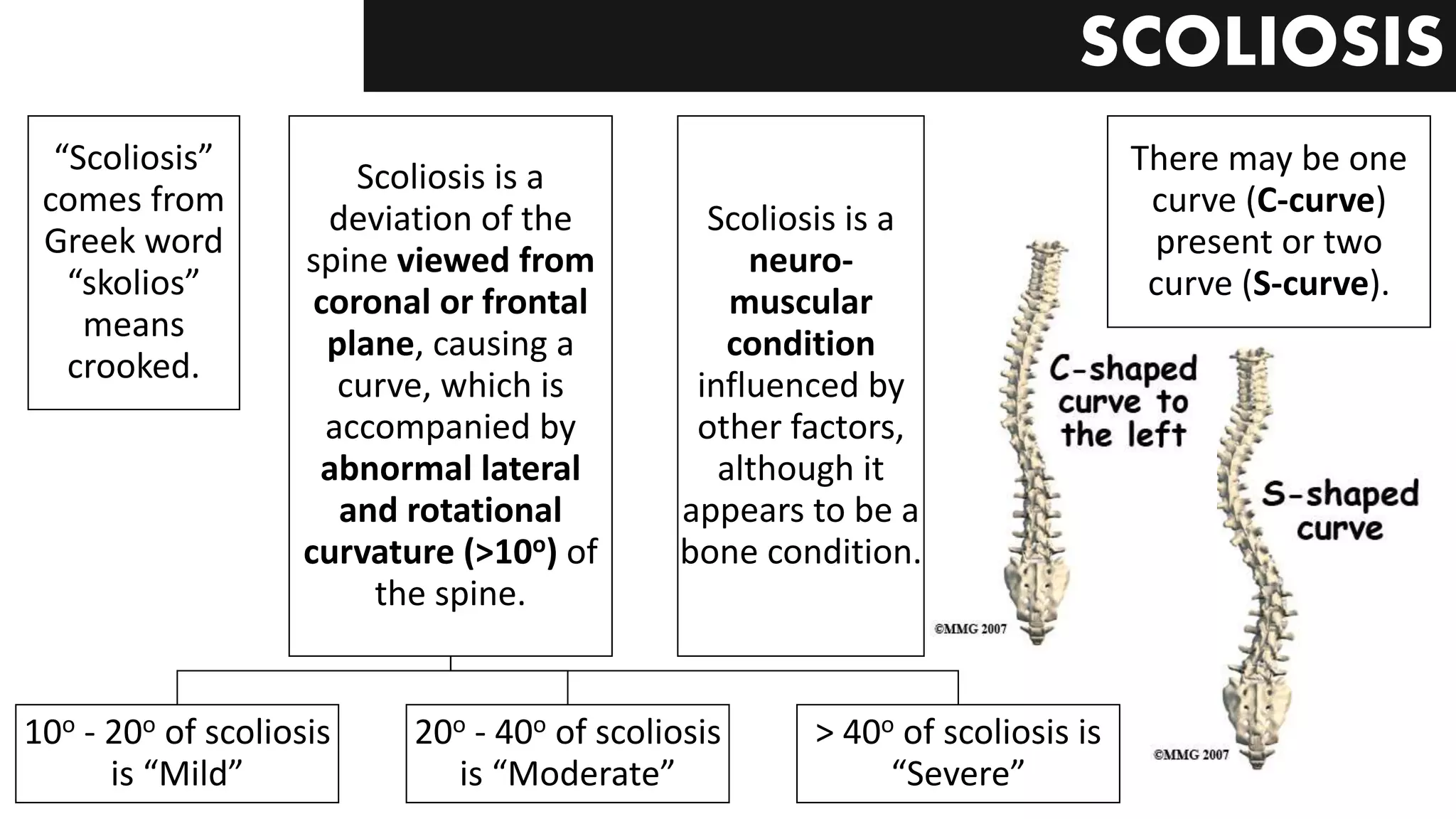
There may be one
curve (C-curve)
present or two
curve (S-curve).
SCOLIOSIS
Congenital
scoliosis
• Caused by a
bone
abnormality
present at
birth
Neuromuscular or
myopathic scoliosis
• Result of abnormal
muscles or nerves.
• Frequently seen in
people with spina
bifida or cerebral
palsy or in those
with various
conditions that are
accompanied by,
or result in,
paralysis.
Degenerative
scoliosis
• Result from
traumatic
(injury or illness)
bone collapse,
previous major
back surgery, or
osteoporosis.
• Adult scoliosis
that typically
occur after age
65
Idiopathic scoliosis
• Most common type and no
specific unidentified cause.
• There are 4 types of
scoliosis:-
• Infantile = affect at birth
and < 3 years old
• Juvenile = pre-puberty ( 3
– 9 years old)
• Adolescent = puberty to
maturity (10 – 18 years
old)
• Adult = after maturity
(after age of 18 years old)
CAUSES OF SCOLIOSIS
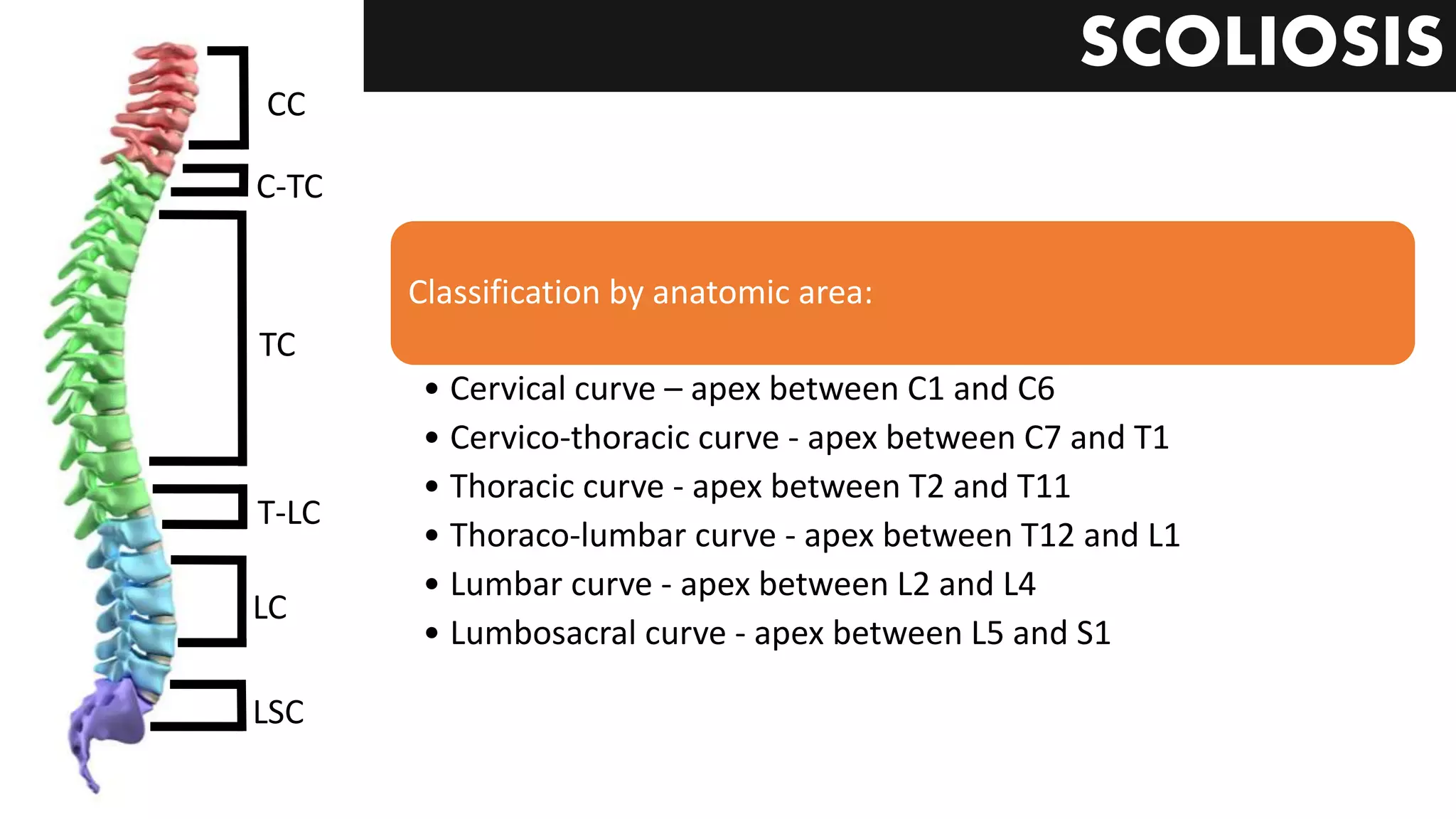
Classification by anatomic area:
• Cervical curve – apex between C1 and C6
• Cervico-thoracic curve - apex between C7 and T1
• Thoracic curve - apex between T2 and T11
• Thoraco-lumbar curve - apex between T12 and L1
• Lumbar curve - apex between L2 and L4
• Lumbosacral curve - apex between L5 and S1
SCOLIOSIS
CC
C-TC
TC
T-LC
LC
LSC
IDIOPATHIC
SCOLIOSIS
Infantile scoliosis
• Curve may disappear by itself as age increase
• Milwaukee brace full time (23 hours)
• Surgical correction
Juvenile scoliosis
• Milwaukee brace (18-24 months)
• With reduction of the curve, time of wearing also reduced from 20 hours to 6 hours
everyday
• Surgery
Adolescent scoliosis
• Curve under 45 degrees – exercise, bracing, electrical stimulation, manipulation,
biofeedback
• Curve over 45-50 degrees - surgical
TREATMENT
BRACES
Boston Brace Milwaukee Brace SpineCor Brace Cheneau Brace
44% of bracing attempts are considered failures
Research findings:-
• Less than 30 degrees, there were no significant differences between braced and non-
braced patients. Usually, brace is prescribed for scoliosis less than 20 degrees.
• 60% felt bracing handicapped their lives
• 14% considered bracing left a psychological scar
• Bracing significantly decrease lung function, causing respiratory distress (headaches,
anxiety, sleep problem, and cognitive dysfunction)
Facts
• Scoliosis braces cause the muscles to weaken or atrophy because not been used
• The joints around the spine need movement or other degenerative issues may develop
• The brace stress the ribs and often creates a rib hump
SCOLIOSIS BRACING NOT SUPPORTED ?
• To provide rapid pain relief and functional improvement
• To create a lifestyle habit for continued improvement and stability
• To prevent age and hormone-related declines in bone density and
strength
• To stabilize scoliotic curve
• Improve fitness, muscle strength and power.
• Improve proprioception
• Improve range of motion
• Improve tolerance for prolonged activities
THE BEST TREAMENT IS EXERCISE
Types of exercises for scoliosis
• Symmetrical exercises
• Goals – To strengthen back and abdominal
muscles and for functional improvement in ranges
of joint motion.
• Breathing exercises
• Goals – To increase lung volume and thorax
mobility and flexibility.
• Asymmetrical exercises
• Goals – For lengthening muscles on the shortened
side, and for contracting muscles on the
lengthened side.
• Static exercises body weight (hanging or traction
exercises)
• Goals – For releasing tension along the spine
THE BEST TREAMENT IS EXERCISE
Consist of a combination of stretching, strengthening, and breathing techniques
Halt curve progression, eliminate pain, and improve posture – for life
Can be done at home and part of daily life
Schroth Therapy Follows a 3-Step Exercise Process:
• 1. First make the proper pelvis position corrections
• 2. Do spinal elongation and then rotational angular breathing (RAB) techniques to move
spine and ribs into best possible posture
• 3. Tense the trunk muscles isometrically, in order to strengthen weak muscles and
preserve the corrected posture
The goal is to develop the inner muscles of the rib cage in order to change the shape of the
upper trunk and to correct any spinal abnormalities.
SCHROTH EXERCISE
Specific exercises are provided based on the curve
patterns and severity, as well as the patients function
and mobility.
The goal is create awareness of the new posture and
alignment through position, repetitions and
breathing.
Exercises are designed to reduce the flat back and rib
prominence and restore alignment of the pelvis.
Schroth program will be based on your individual
evaluation.
Treatment sessions are typically 45-55 min long and
can range from 5 sessions up to 20 sessions.
SCHROTH EXERCISE
• THE EFFECTIVENESS OF CONSERVATIVE TREATMENTS FOR THE IMPROVEMENT OF SCOLIOSIS
CURVES IN AN ADOLESCENT CHILD: A CASE REPORT
• Subject: 10 years old female suffer idiopathic scoliosis. Her initial Cobb angles were
measured to be 32° right thoracic curve, with a 19° left lumbar prominence.
• Methods:
• Initial : Schroth based method of physical therapy - 2 d/w for 6 weeks - 1 hour
duration. Home exercise program (HEP) - 15 min of Schroth based exercises per day, 6
d/w. 23 hours Rosenberger brace.
• Phase 2: Decreased frequency – 1d/w for 10 weeks (increased independence in
technique efficiency and accuracy). HEP continued - 15 min/d for 6 d/w. Thoracic Cobb
angle improved from 32° to 21°, her lumbar curve remained at 19°
• Phase 3: 1d/2 weeks for 20 weeks. Schroth based method postures were progressed
and accessory exercises for core and total body strengthening were further
progressed. Thoracic Cobb angle had improved to 17° and her lumbar curvature
improved to 15°.
• Conclusion: Schroth based physical therapy method and 23-hour bracing were found to
be successful in significantly reducing Cobb angles in this case.
SCOLIOSIS CASE STUDY

Scoliosis (Spine Disorder)

  • 1.
  • 2.
    “Scoliosis” comes from Greek word “skolios” means crooked. Scoliosisis a deviation of the spine viewed from coronal or frontal plane, causing a curve, which is accompanied by abnormal lateral and rotational curvature (>10o) of the spine. 10o - 20o of scoliosis is “Mild” 20o - 40o of scoliosis is “Moderate” > 40o of scoliosis is “Severe” Scoliosis is a neuro- muscular condition influenced by other factors, although it appears to be a bone condition. There may be one curve (C-curve) present or two curve (S-curve). SCOLIOSIS
  • 3.
    Congenital scoliosis • Caused bya bone abnormality present at birth Neuromuscular or myopathic scoliosis • Result of abnormal muscles or nerves. • Frequently seen in people with spina bifida or cerebral palsy or in those with various conditions that are accompanied by, or result in, paralysis. Degenerative scoliosis • Result from traumatic (injury or illness) bone collapse, previous major back surgery, or osteoporosis. • Adult scoliosis that typically occur after age 65 Idiopathic scoliosis • Most common type and no specific unidentified cause. • There are 4 types of scoliosis:- • Infantile = affect at birth and < 3 years old • Juvenile = pre-puberty ( 3 – 9 years old) • Adolescent = puberty to maturity (10 – 18 years old) • Adult = after maturity (after age of 18 years old) CAUSES OF SCOLIOSIS
  • 4.
    Classification by anatomicarea: • Cervical curve – apex between C1 and C6 • Cervico-thoracic curve - apex between C7 and T1 • Thoracic curve - apex between T2 and T11 • Thoraco-lumbar curve - apex between T12 and L1 • Lumbar curve - apex between L2 and L4 • Lumbosacral curve - apex between L5 and S1 SCOLIOSIS CC C-TC TC T-LC LC LSC
  • 6.
    IDIOPATHIC SCOLIOSIS Infantile scoliosis • Curvemay disappear by itself as age increase • Milwaukee brace full time (23 hours) • Surgical correction Juvenile scoliosis • Milwaukee brace (18-24 months) • With reduction of the curve, time of wearing also reduced from 20 hours to 6 hours everyday • Surgery Adolescent scoliosis • Curve under 45 degrees – exercise, bracing, electrical stimulation, manipulation, biofeedback • Curve over 45-50 degrees - surgical TREATMENT
  • 7.
    BRACES Boston Brace MilwaukeeBrace SpineCor Brace Cheneau Brace
  • 8.
    44% of bracingattempts are considered failures Research findings:- • Less than 30 degrees, there were no significant differences between braced and non- braced patients. Usually, brace is prescribed for scoliosis less than 20 degrees. • 60% felt bracing handicapped their lives • 14% considered bracing left a psychological scar • Bracing significantly decrease lung function, causing respiratory distress (headaches, anxiety, sleep problem, and cognitive dysfunction) Facts • Scoliosis braces cause the muscles to weaken or atrophy because not been used • The joints around the spine need movement or other degenerative issues may develop • The brace stress the ribs and often creates a rib hump SCOLIOSIS BRACING NOT SUPPORTED ?
  • 9.
    • To providerapid pain relief and functional improvement • To create a lifestyle habit for continued improvement and stability • To prevent age and hormone-related declines in bone density and strength • To stabilize scoliotic curve • Improve fitness, muscle strength and power. • Improve proprioception • Improve range of motion • Improve tolerance for prolonged activities THE BEST TREAMENT IS EXERCISE
  • 10.
    Types of exercisesfor scoliosis • Symmetrical exercises • Goals – To strengthen back and abdominal muscles and for functional improvement in ranges of joint motion. • Breathing exercises • Goals – To increase lung volume and thorax mobility and flexibility. • Asymmetrical exercises • Goals – For lengthening muscles on the shortened side, and for contracting muscles on the lengthened side. • Static exercises body weight (hanging or traction exercises) • Goals – For releasing tension along the spine THE BEST TREAMENT IS EXERCISE
  • 12.
    Consist of acombination of stretching, strengthening, and breathing techniques Halt curve progression, eliminate pain, and improve posture – for life Can be done at home and part of daily life Schroth Therapy Follows a 3-Step Exercise Process: • 1. First make the proper pelvis position corrections • 2. Do spinal elongation and then rotational angular breathing (RAB) techniques to move spine and ribs into best possible posture • 3. Tense the trunk muscles isometrically, in order to strengthen weak muscles and preserve the corrected posture The goal is to develop the inner muscles of the rib cage in order to change the shape of the upper trunk and to correct any spinal abnormalities. SCHROTH EXERCISE
  • 13.
    Specific exercises areprovided based on the curve patterns and severity, as well as the patients function and mobility. The goal is create awareness of the new posture and alignment through position, repetitions and breathing. Exercises are designed to reduce the flat back and rib prominence and restore alignment of the pelvis. Schroth program will be based on your individual evaluation. Treatment sessions are typically 45-55 min long and can range from 5 sessions up to 20 sessions. SCHROTH EXERCISE
  • 14.
    • THE EFFECTIVENESSOF CONSERVATIVE TREATMENTS FOR THE IMPROVEMENT OF SCOLIOSIS CURVES IN AN ADOLESCENT CHILD: A CASE REPORT • Subject: 10 years old female suffer idiopathic scoliosis. Her initial Cobb angles were measured to be 32° right thoracic curve, with a 19° left lumbar prominence. • Methods: • Initial : Schroth based method of physical therapy - 2 d/w for 6 weeks - 1 hour duration. Home exercise program (HEP) - 15 min of Schroth based exercises per day, 6 d/w. 23 hours Rosenberger brace. • Phase 2: Decreased frequency – 1d/w for 10 weeks (increased independence in technique efficiency and accuracy). HEP continued - 15 min/d for 6 d/w. Thoracic Cobb angle improved from 32° to 21°, her lumbar curve remained at 19° • Phase 3: 1d/2 weeks for 20 weeks. Schroth based method postures were progressed and accessory exercises for core and total body strengthening were further progressed. Thoracic Cobb angle had improved to 17° and her lumbar curvature improved to 15°. • Conclusion: Schroth based physical therapy method and 23-hour bracing were found to be successful in significantly reducing Cobb angles in this case. SCOLIOSIS CASE STUDY