Inventory Management
       System

      Job Thomas
     #8, MBA (PT)
Word meaning
Inventory = stock at a particular
 location
 classification of inventory

    • raw materials,
    • work-in-progress,
    • finished goods and
    • MRO (Maintenance, Repairs and
      Operating supplies)
Overview of development
   CARDEX (bin card)
    system
   MM (material
    management)
    module in ERP
    WMS (warehouses
    management
    system) in ERP
   RF tags IDs
Inventory decision rule
Q,R policy

Fixed quantity, variable time

                        Q


               Q


       T1          T2
S,T policy
Variable quantity, Fixed time


                    Q3
   Q1      Q2
S,R policy
Variable quantity, variable time
INVENTORY CLASSIFICATIONS
   ABC Classifications
   High, Medium and Low (HML)
    Classifications
   Vital, essential and Desirable (VED)
    Classifications
   Scare, Difficult and Easy to obtain (SDE)
    Classifications
   Fast moving. Slow moving and Non-
    moving (FSN) Classification
   Multi-criteria classification
ABC Classification
                   100
                                                                        C
                    80                   B
 Total Value ($)


                                                                                  N      $
                                                                              A 10%     70%
                    60
                                                                              B 20%     20%
                                                                              C 70%     10%
                    40       A

                    20

                     0
                                 100


                                        200


                                              300


                                                     400


                                                            500


                                                                  600
                         0


                                                                            700


                                                                                  800


                                                                                          900


                                                                                                1000
                                                    Number of items (N)


Classification based on relative importance
Risk of inventory in ABC
     classification
Controlling based on ABC inventory
            classification
Control     A             B           C


Ordering    Very careful Normal       Simple
control     and accurate

Type of     Very          Good        None or
inventory   accurate                  simple
control
Cycle       6-12 times    3-4 times   1-2 times
counting    per year      per year    per year
frequency
Priority    High priority Normal      Low priority
control                   priority
High, Medium and Low (HML)
           classification
 The items of the inventory are to be
  listed in the descending order of the
  unit value.
 The HML analysis is useful for

  keeping control over consumption at
  departmental levels, for deciding the
  frequency of physical verification,
  and for controlling purchases
Vital, Essential and Desirable
       (VED) Classifications.
  based on criticality of the items and
  its effect on other production
 For V items, a large stock of

  inventory is generally maintained,
  while for D items, minimum stock is
  enough
Scarce, Difficult and Easy to obtain
               (SDE)
 availability of items
 vital to lead time analysis of

  procurement
Fast-moving. Slow moving and
    Non-moving (FSN) Classification
 classification is based on the pattern
  of issues from stores
 In and out date of items are

  evaluated.
 The items are usually grouped in

  periods of 12 months
Multi-criteria Classification
Item      Value    Lead     Criticality Substitut Total
          (w1=0.2)   time   (w3=0.4)      able    (w=1.0)
                   (w2=0.2)             (w4=0.2)
101       A        B         C         C         B
          (100)    (50)      (10)      (10)      (36)
102       B        A         B         B         A
          (50)     (100)     (50)      (50)      (60)
103       B        B         A         C         A
          (50)     (50)      (100)     (10)      (62)
104       C        C         B         A         B
          (10)     (10)      (50)      (100)     (44)
105       C        A         C         C         C
          (10)     (100)     (10)      (10)      (28)
INVENTORY MODELS
   Deterministic models
    • Economic Order Quantity (EOQ) model
    • Sensitivity analysis
    • A price-break Model
   Probabilistic Inventory models
    • Single-period inventory models
    • A fixed order quantity model
    • A fixed time period model
Inventory fluctuations as a function
               of time

IDEAL


ACTUAL
Economic Order Quantity (EOQ)
           model
Economic Order Quantity (EOQ)
           model
Economic Order Quantity (EOQ)
           model
Economic order quantity
= (2 x setup cost x demand rate/
 carrying cost)^0.5

   Limitation of the economic order
    quantity model is that the demands
    remain constant throughout the year.
    It is also necessary that the
    inventory be delivered in full when
    the inventory levels reach zero
Re-order points and lead time
Safety stock in inventory
     management
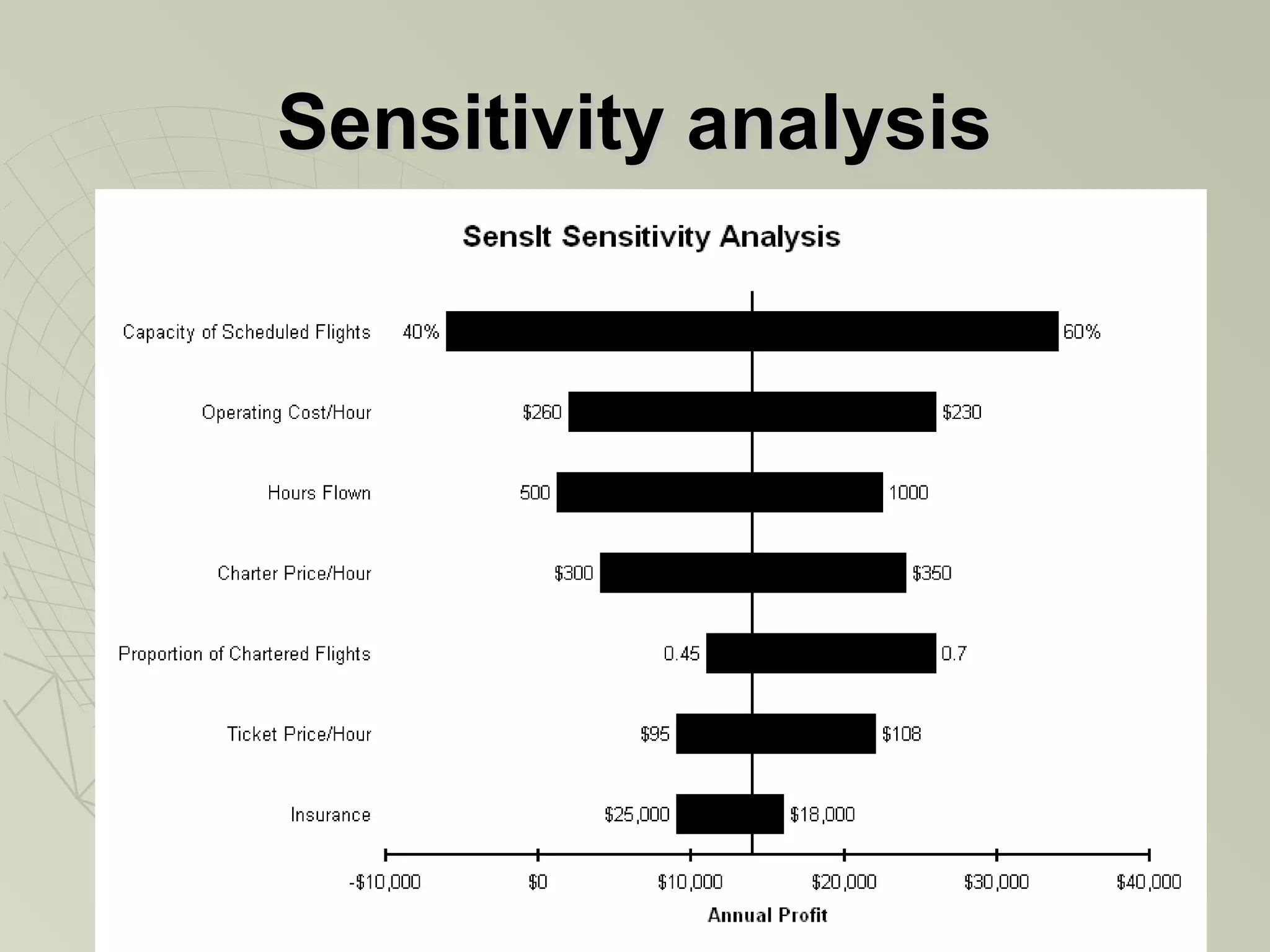
Sensitivity analysis
Production inventory model
Backorder inventory models
Price-break Model
EOQ Model with Price Breaks

 Incremental units: discount is
  applied to the additional units
  beyond the breakpoint
 All units: discount is applied to all

  units beyond the certain level of
  order
EOQ Model with Price Breaks
Total annual
cost
                             $3.2 /unit

                                 $2.9 /unit

                                 $2.8 /unit


                                 Feasible cost


                Order quantity
Single period inventory model
 Order seasonal
 The Newsboy Problem:
Fixed order quantity model
   Item must have a reasonable stable usage
   Lead time should not have radical variation
   Supplier should be able to accept
    irregularly timed and unscheduled orders
Fixed time period model
VENDOR MANAGED INVENTORY
          (VMI)
   the vendor (the Manufacturer) manages
    the inventory of the distributor.
   manufacturer has access to the
    distributor’s inventory data used for
    generating purchase orders
   The manufacturer reviews this information
    and decides when it is appropriate to
    generate a Purchase Order

        symbiotic relationship
INVENTORY ON WHEELS
  freight on board (FOB)
 Rule of ownership

    • FOB shipping point. If the shipment is
      designated as freight on board (FOB)
      shipping point, ownership transfers to
      the buyer as soon as the shipment
      departs the seller.
    • FOB destination. If the shipment is
      designated as freight on board (FOB)
      destination, ownership transfers to the
      buyer as soon as the shipment arrives at
      the buyer.
Thank you for your kind attention

Inventory management system

  • 1.
    Inventory Management System Job Thomas #8, MBA (PT)
  • 2.
    Word meaning Inventory =stock at a particular location  classification of inventory • raw materials, • work-in-progress, • finished goods and • MRO (Maintenance, Repairs and Operating supplies)
  • 3.
    Overview of development  CARDEX (bin card) system  MM (material management) module in ERP  WMS (warehouses management system) in ERP  RF tags IDs
  • 4.
  • 5.
    Q,R policy Fixed quantity,variable time Q Q T1 T2
  • 6.
    S,T policy Variable quantity,Fixed time Q3 Q1 Q2
  • 7.
  • 8.
    INVENTORY CLASSIFICATIONS  ABC Classifications  High, Medium and Low (HML) Classifications  Vital, essential and Desirable (VED) Classifications  Scare, Difficult and Easy to obtain (SDE) Classifications  Fast moving. Slow moving and Non- moving (FSN) Classification  Multi-criteria classification
  • 9.
    ABC Classification 100 C 80 B Total Value ($) N $ A 10% 70% 60 B 20% 20% C 70% 10% 40 A 20 0 100 200 300 400 500 600 0 700 800 900 1000 Number of items (N) Classification based on relative importance
  • 10.
    Risk of inventoryin ABC classification
  • 11.
    Controlling based onABC inventory classification Control A B C Ordering Very careful Normal Simple control and accurate Type of Very Good None or inventory accurate simple control Cycle 6-12 times 3-4 times 1-2 times counting per year per year per year frequency Priority High priority Normal Low priority control priority
  • 13.
    High, Medium andLow (HML) classification  The items of the inventory are to be listed in the descending order of the unit value.  The HML analysis is useful for keeping control over consumption at departmental levels, for deciding the frequency of physical verification, and for controlling purchases
  • 14.
    Vital, Essential andDesirable (VED) Classifications.  based on criticality of the items and its effect on other production  For V items, a large stock of inventory is generally maintained, while for D items, minimum stock is enough
  • 15.
    Scarce, Difficult andEasy to obtain (SDE)  availability of items  vital to lead time analysis of procurement
  • 16.
    Fast-moving. Slow movingand Non-moving (FSN) Classification  classification is based on the pattern of issues from stores  In and out date of items are evaluated.  The items are usually grouped in periods of 12 months
  • 17.
    Multi-criteria Classification Item Value Lead Criticality Substitut Total (w1=0.2) time (w3=0.4) able (w=1.0) (w2=0.2) (w4=0.2) 101 A B C C B (100) (50) (10) (10) (36) 102 B A B B A (50) (100) (50) (50) (60) 103 B B A C A (50) (50) (100) (10) (62) 104 C C B A B (10) (10) (50) (100) (44) 105 C A C C C (10) (100) (10) (10) (28)
  • 18.
    INVENTORY MODELS  Deterministic models • Economic Order Quantity (EOQ) model • Sensitivity analysis • A price-break Model  Probabilistic Inventory models • Single-period inventory models • A fixed order quantity model • A fixed time period model
  • 19.
    Inventory fluctuations asa function of time IDEAL ACTUAL
  • 20.
  • 21.
  • 22.
    Economic Order Quantity(EOQ) model Economic order quantity = (2 x setup cost x demand rate/ carrying cost)^0.5  Limitation of the economic order quantity model is that the demands remain constant throughout the year. It is also necessary that the inventory be delivered in full when the inventory levels reach zero
  • 23.
  • 24.
    Safety stock ininventory management
  • 25.
  • 26.
  • 27.
  • 28.
  • 29.
    EOQ Model withPrice Breaks  Incremental units: discount is applied to the additional units beyond the breakpoint  All units: discount is applied to all units beyond the certain level of order
  • 30.
    EOQ Model withPrice Breaks Total annual cost $3.2 /unit $2.9 /unit $2.8 /unit Feasible cost Order quantity
  • 31.
    Single period inventorymodel  Order seasonal  The Newsboy Problem:
  • 32.
    Fixed order quantitymodel  Item must have a reasonable stable usage  Lead time should not have radical variation  Supplier should be able to accept irregularly timed and unscheduled orders
  • 33.
  • 34.
    VENDOR MANAGED INVENTORY (VMI)  the vendor (the Manufacturer) manages the inventory of the distributor.  manufacturer has access to the distributor’s inventory data used for generating purchase orders  The manufacturer reviews this information and decides when it is appropriate to generate a Purchase Order symbiotic relationship
  • 35.
    INVENTORY ON WHEELS  freight on board (FOB)  Rule of ownership • FOB shipping point. If the shipment is designated as freight on board (FOB) shipping point, ownership transfers to the buyer as soon as the shipment departs the seller. • FOB destination. If the shipment is designated as freight on board (FOB) destination, ownership transfers to the buyer as soon as the shipment arrives at the buyer.
  • 36.
    Thank you foryour kind attention