
What does Bloom energy do?
A new way to generate clean energy
All you need to know about Bloom Energy
Presentation by Joshua Miranda
About Bloom energy
Bloom Energy is the company that develops, builds, and installs Bloom
Energy Servers.
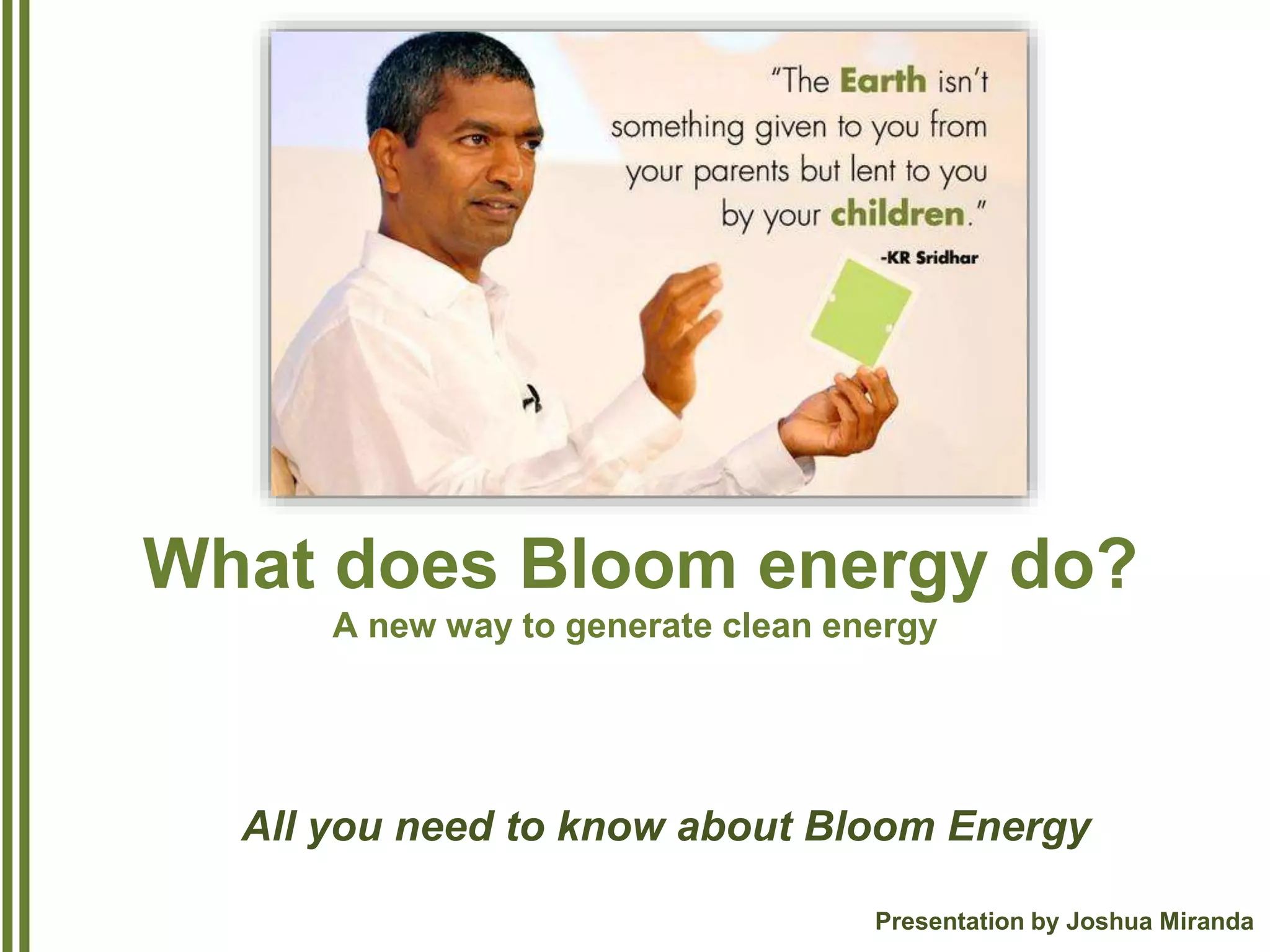
It was founded in 2001 by CEO K.R. Sridhar and is headquartered in
California.
Why Bloom?
Sridhar credited his nine-year-old son for the name, saying that his son
believed jobs, lives, environment, and children would bloom.
What does Bloom energy do?
Bloom's Energy Server is a new class of distributed power generator,
producing clean, reliable, affordable electricity at the customer site.
Each Bloom Energy Server provides 200kW of power, enough to meet the
baseload needs of 160 average homes or an office building... day and
night, in roughly the footprint of a standard parking space.
How did the Idea revolve?
Sridhar was the director of the Space Technologies Laboratory at the
University of Arizona.
The Space Technologies Laboratory was asked by NASA to undertake
research into how life could be made sustainable on Mars.
Sridhar led a project that built a Mars oxygen production.
After NASA canceled the Mars-2001 Surveyor Lander mission, Sridhar
started working on reversing the process, using oxygen and hydrogen to
create power.
In 2001, Sridhar was a co-founder of Ion America, later to become Bloom
Energy, with a mission to "make clean, reliable energy affordable for
everyone on earth". Sridhar became the chief executive officer. In 2002,
the company moved to the NASA Ames Research Center in Silicon Valley.
On 24 February 2010, Bloom Energy launched a new energy-efficient and
environmentally friendly fuel cell known as the Bloom Box.
How does Bloom energy technology work?
The Bloom Energy Server is made out of fuel cells, or electrochemical
cells. A single fuel cell consists of an anode, a cathode, and an electrolyte
stuck between the two. As fuel flows in through the anode side and an
oxidant comes in over the cathode, a reaction is triggered that causes
electrons to move into the fuel cell's circuit, producing electricity.
The Bloom Energy Server isn't actually a server—that's just a PR
buzzword. In actuality, it's a distributed power generator. Each "server"
produces 100 kW of power, consists of thousands of fuel cells.
Fuel cells are devices that convert fuel into electricity through a clean
electro-chemical process rather than dirty combustion. They are like
batteries except that they always run. This particular type of fuel cell
technology is different than legacy "hydrogen" fuel cells in three main
ways:
1. Low cost materials – The cells use a common sand-like powder
instead of precious metals like platinum or corrosive materials like
acids.
2. High electrical efficiency – It can convert fuel into electricity at
nearly twice the rate of some legacy technologies
3. Fuel flexibility – The systems are capable of using either
renewable or fossil fuels
Bloom cell
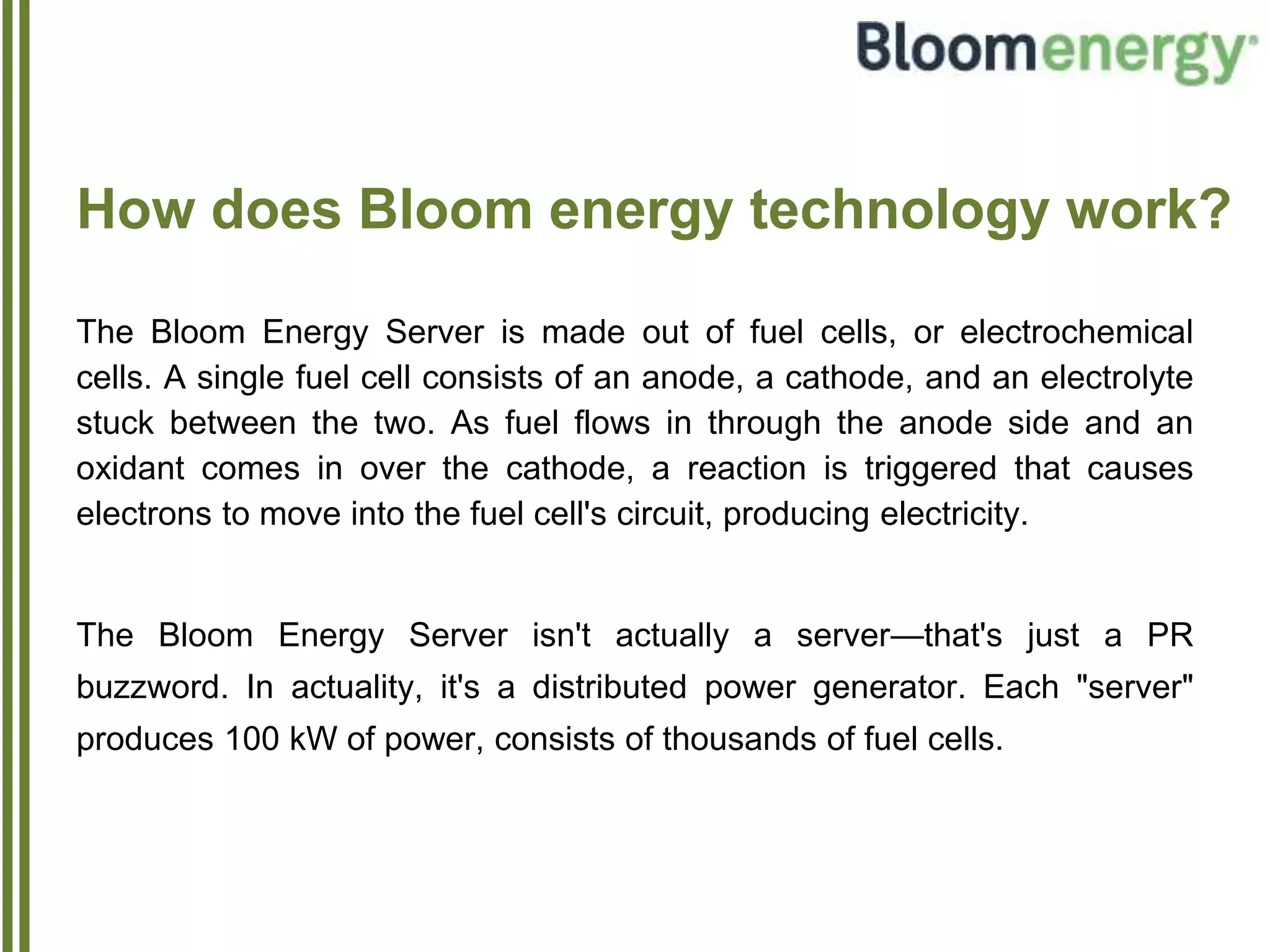
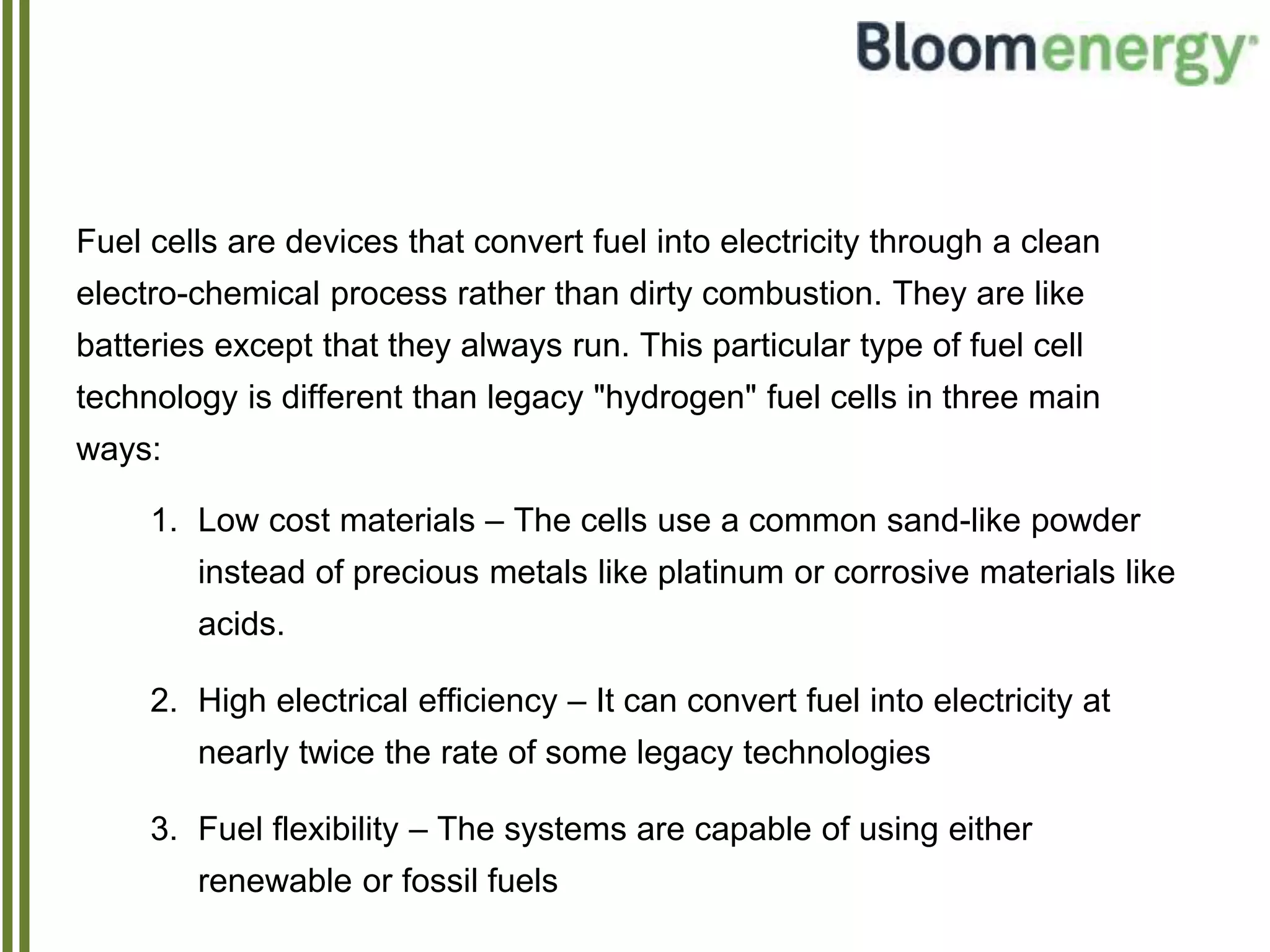
1 fuel cell = 25 watts (can power one light bulb)
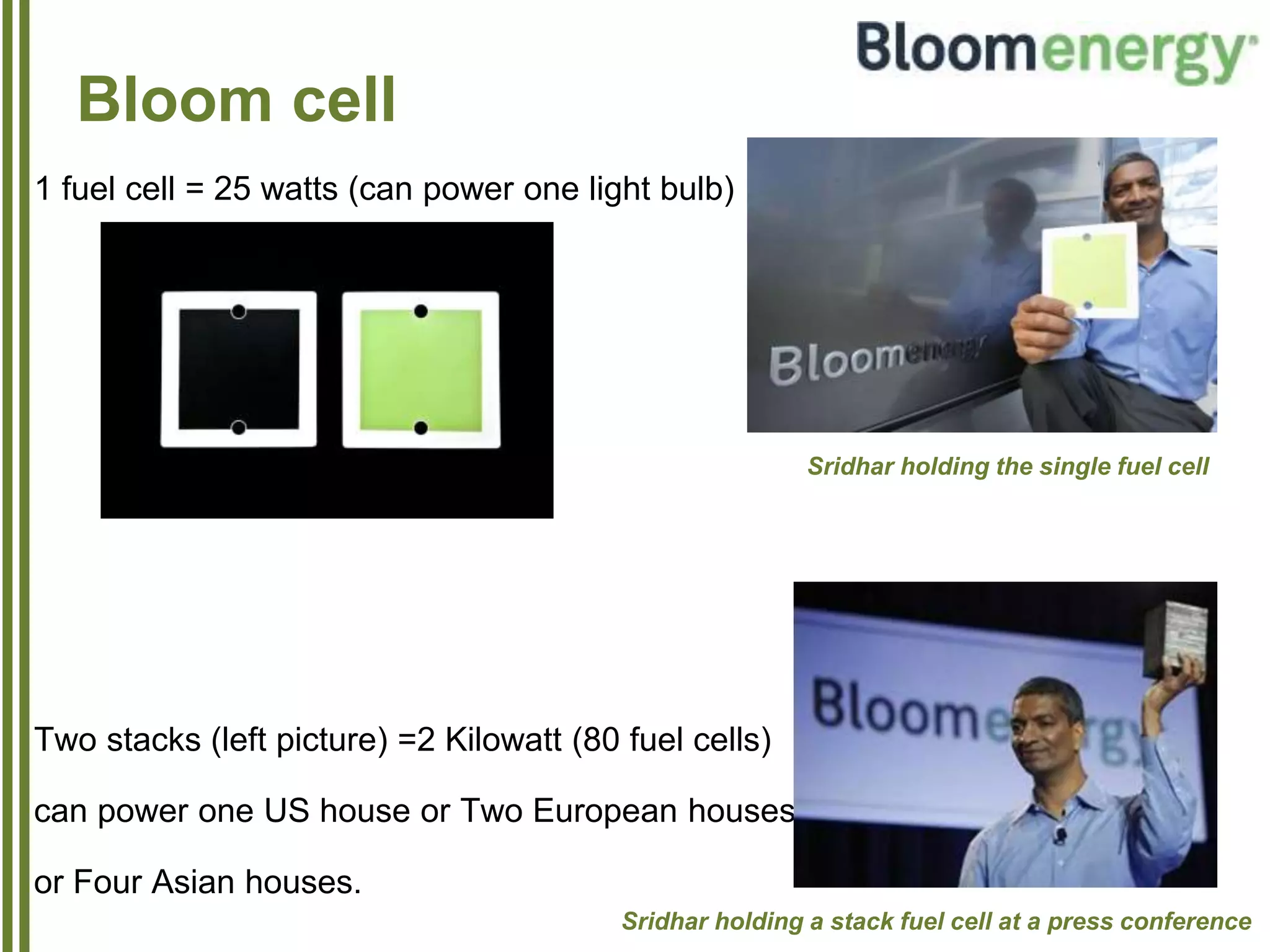
Two stacks (left picture) =2 Kilowatt (80 fuel cells)
can power one US house or Two European houses
or Four Asian houses.
Sridhar holding the single fuel cell
Sridhar holding a stack fuel cell at a press conference
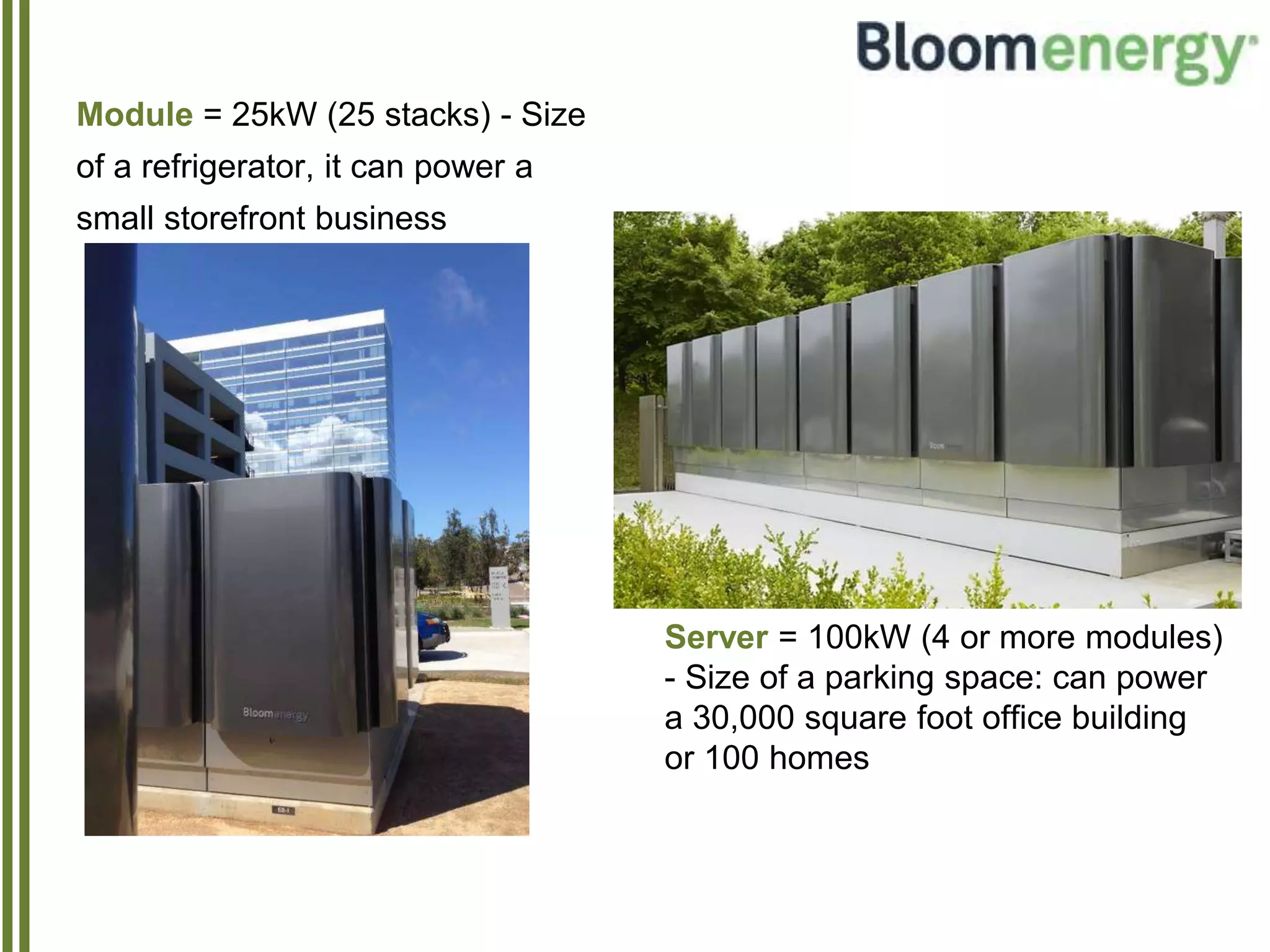
Module = 25kW (25 stacks) - Size
of a refrigerator, it can power a
small storefront business
Server = 100kW (4 or more modules)
- Size of a parking space: can power
a 30,000 square foot office building
or 100 homes
About the founder
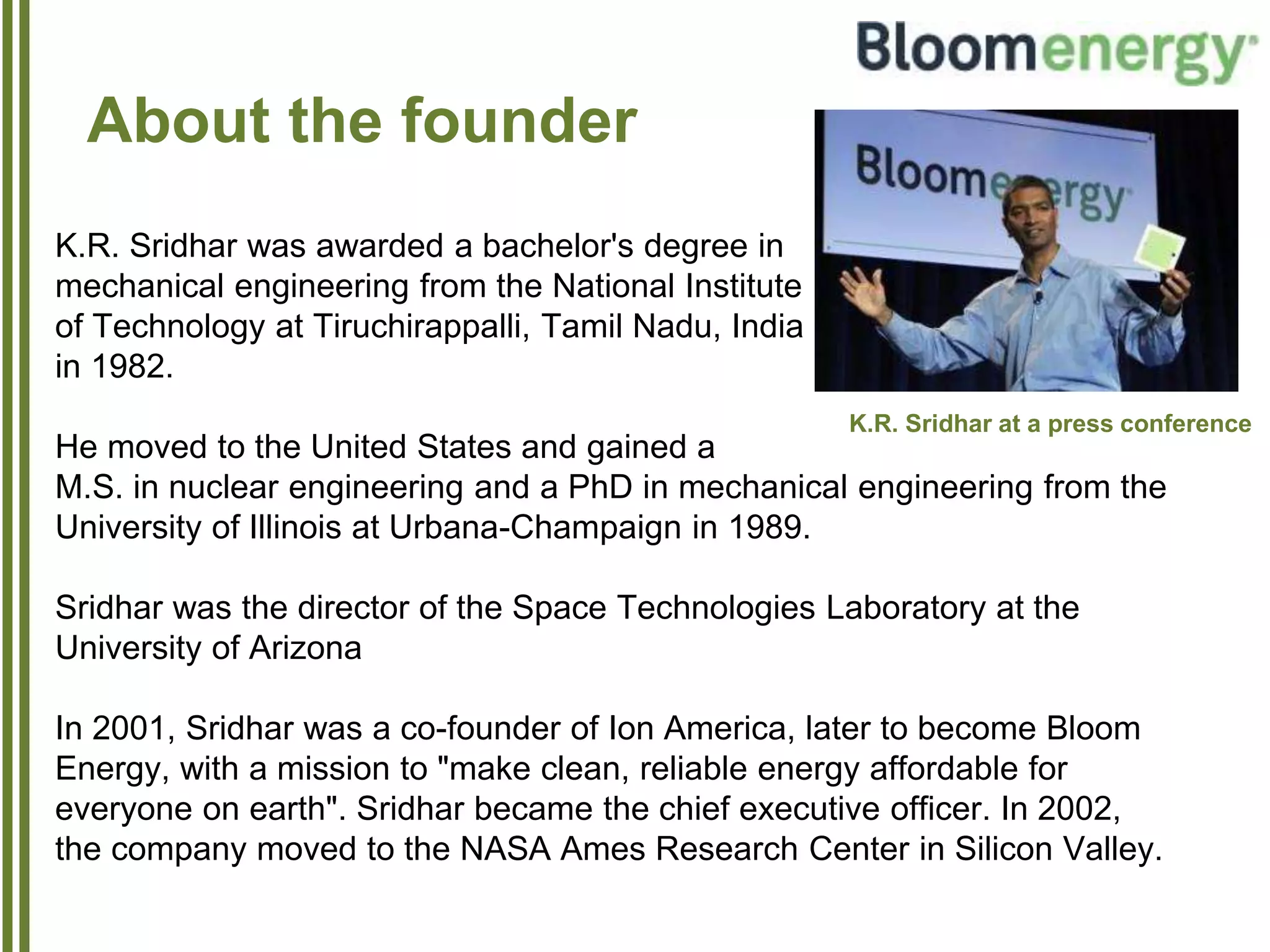
K.R. Sridhar was awarded a bachelor's degree in
mechanical engineering from the National Institute
of Technology at Tiruchirappalli, Tamil Nadu, India
in 1982.
He moved to the United States and gained a
M.S. in nuclear engineering and a PhD in mechanical engineering from the
University of Illinois at Urbana-Champaign in 1989.
Sridhar was the director of the Space Technologies Laboratory at the
University of Arizona
In 2001, Sridhar was a co-founder of Ion America, later to become Bloom
Energy, with a mission to "make clean, reliable energy affordable for
everyone on earth". Sridhar became the chief executive officer. In 2002,
the company moved to the NASA Ames Research Center in Silicon Valley.
K.R. Sridhar at a press conference
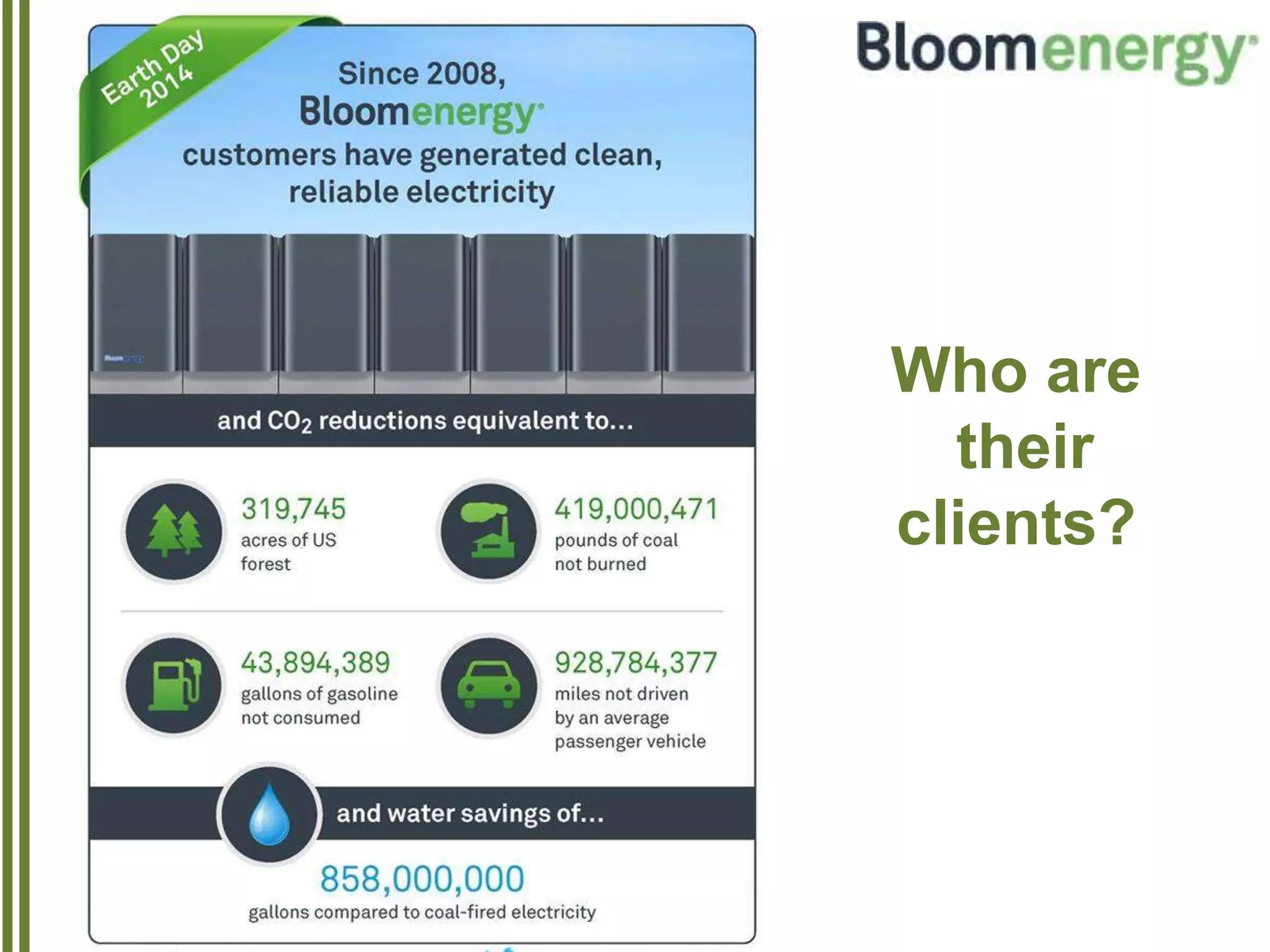
Who are
their
clients?
Thank you
Hope you enjoyed it!
For more presentations log on to
www.slideshare.net/joshuamirandaee

All you need to know about Bloom Energy

  • 1.
    What does Bloomenergy do? A new way to generate clean energy All you need to know about Bloom Energy Presentation by Joshua Miranda
  • 2.
    About Bloom energy BloomEnergy is the company that develops, builds, and installs Bloom Energy Servers. It was founded in 2001 by CEO K.R. Sridhar and is headquartered in California. Why Bloom? Sridhar credited his nine-year-old son for the name, saying that his son believed jobs, lives, environment, and children would bloom.
  • 3.
    What does Bloomenergy do? Bloom's Energy Server is a new class of distributed power generator, producing clean, reliable, affordable electricity at the customer site. Each Bloom Energy Server provides 200kW of power, enough to meet the baseload needs of 160 average homes or an office building... day and night, in roughly the footprint of a standard parking space.
  • 4.
    How did theIdea revolve? Sridhar was the director of the Space Technologies Laboratory at the University of Arizona. The Space Technologies Laboratory was asked by NASA to undertake research into how life could be made sustainable on Mars. Sridhar led a project that built a Mars oxygen production. After NASA canceled the Mars-2001 Surveyor Lander mission, Sridhar started working on reversing the process, using oxygen and hydrogen to create power.
  • 5.
    In 2001, Sridharwas a co-founder of Ion America, later to become Bloom Energy, with a mission to "make clean, reliable energy affordable for everyone on earth". Sridhar became the chief executive officer. In 2002, the company moved to the NASA Ames Research Center in Silicon Valley. On 24 February 2010, Bloom Energy launched a new energy-efficient and environmentally friendly fuel cell known as the Bloom Box.
  • 6.
    How does Bloomenergy technology work? The Bloom Energy Server is made out of fuel cells, or electrochemical cells. A single fuel cell consists of an anode, a cathode, and an electrolyte stuck between the two. As fuel flows in through the anode side and an oxidant comes in over the cathode, a reaction is triggered that causes electrons to move into the fuel cell's circuit, producing electricity. The Bloom Energy Server isn't actually a server—that's just a PR buzzword. In actuality, it's a distributed power generator. Each "server" produces 100 kW of power, consists of thousands of fuel cells.
  • 7.
    Fuel cells aredevices that convert fuel into electricity through a clean electro-chemical process rather than dirty combustion. They are like batteries except that they always run. This particular type of fuel cell technology is different than legacy "hydrogen" fuel cells in three main ways: 1. Low cost materials – The cells use a common sand-like powder instead of precious metals like platinum or corrosive materials like acids. 2. High electrical efficiency – It can convert fuel into electricity at nearly twice the rate of some legacy technologies 3. Fuel flexibility – The systems are capable of using either renewable or fossil fuels
  • 8.
    Bloom cell 1 fuelcell = 25 watts (can power one light bulb) Two stacks (left picture) =2 Kilowatt (80 fuel cells) can power one US house or Two European houses or Four Asian houses. Sridhar holding the single fuel cell Sridhar holding a stack fuel cell at a press conference
  • 9.
    Module = 25kW(25 stacks) - Size of a refrigerator, it can power a small storefront business Server = 100kW (4 or more modules) - Size of a parking space: can power a 30,000 square foot office building or 100 homes
  • 10.
    About the founder K.R.Sridhar was awarded a bachelor's degree in mechanical engineering from the National Institute of Technology at Tiruchirappalli, Tamil Nadu, India in 1982. He moved to the United States and gained a M.S. in nuclear engineering and a PhD in mechanical engineering from the University of Illinois at Urbana-Champaign in 1989. Sridhar was the director of the Space Technologies Laboratory at the University of Arizona In 2001, Sridhar was a co-founder of Ion America, later to become Bloom Energy, with a mission to "make clean, reliable energy affordable for everyone on earth". Sridhar became the chief executive officer. In 2002, the company moved to the NASA Ames Research Center in Silicon Valley. K.R. Sridhar at a press conference
  • 11.
  • 13.
    Thank you Hope youenjoyed it! For more presentations log on to www.slideshare.net/joshuamirandaee