Submitted by
STUDENT OF
VIDYA VIKAS UNIVERSAL COLLEGE OF BMS & BMM
STUDING IN T.Y.B.M.S DIV A
I am highly in debited to Prof. NAINA BISHT for
your guidance and constant supervision as well as
for providing necessary information regarding the
project & also for your support in completing the
project
I would like to express my gratitude towards my
parents & my friends for their kind co operation
and encouragement which helps me in completion
this project.
*
*
I VARMA ANKITA HEREBY DECLARE THAT THIS PROJECT
REPORT ENTITLED SUBMITTED BY ME UNDER THE
GUIDANC JOB ANALYSIS JOB DESIGN JOB EVALUATION OF
PROF. NAINA BISHT OF VIDYA VIKAS UNIVERSAL COLLEGE
IS MY OWN AND HAS NOT BEEN SUBMITTED TO ANY OTHER
UNIVERSITY OR INSTITUDE OR PUBLISHED EARLIER.
*
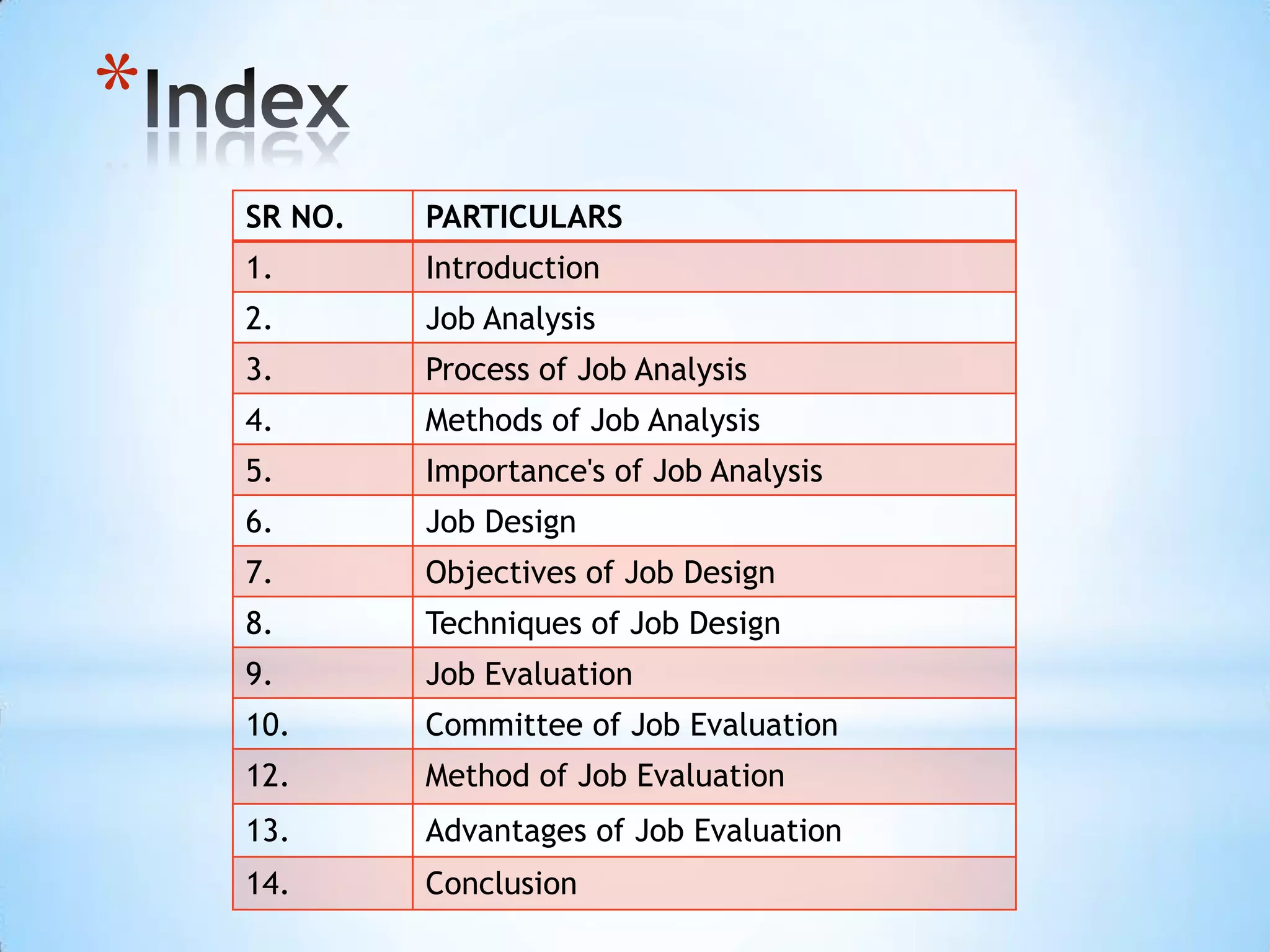
SR NO. PARTICULARS
1. Introduction
2. Job Analysis
3. Process of Job Analysis
4. Methods of Job Analysis
5. Importance's of Job Analysis
6. Job Design
7. Objectives of Job Design
8. Techniques of Job Design
9. Job Evaluation
10. Committee of Job Evaluation
12. Method of Job Evaluation
13. Advantages of Job Evaluation
14. Conclusion
*
*
 Job Analysis
“Job Analysis is the process of studying and collecting information
relating to the operations and responsibility of a specific job”.
Job Design
“Job Design involves systematic attempt to organize tasks ,duties
and responsibilities into a unit of work to achieve certain objective”.
 Job Evaluation
“Job Evaluation is a systematic and orderly process of determining
the worth of a job in relation to other jobs”.
*
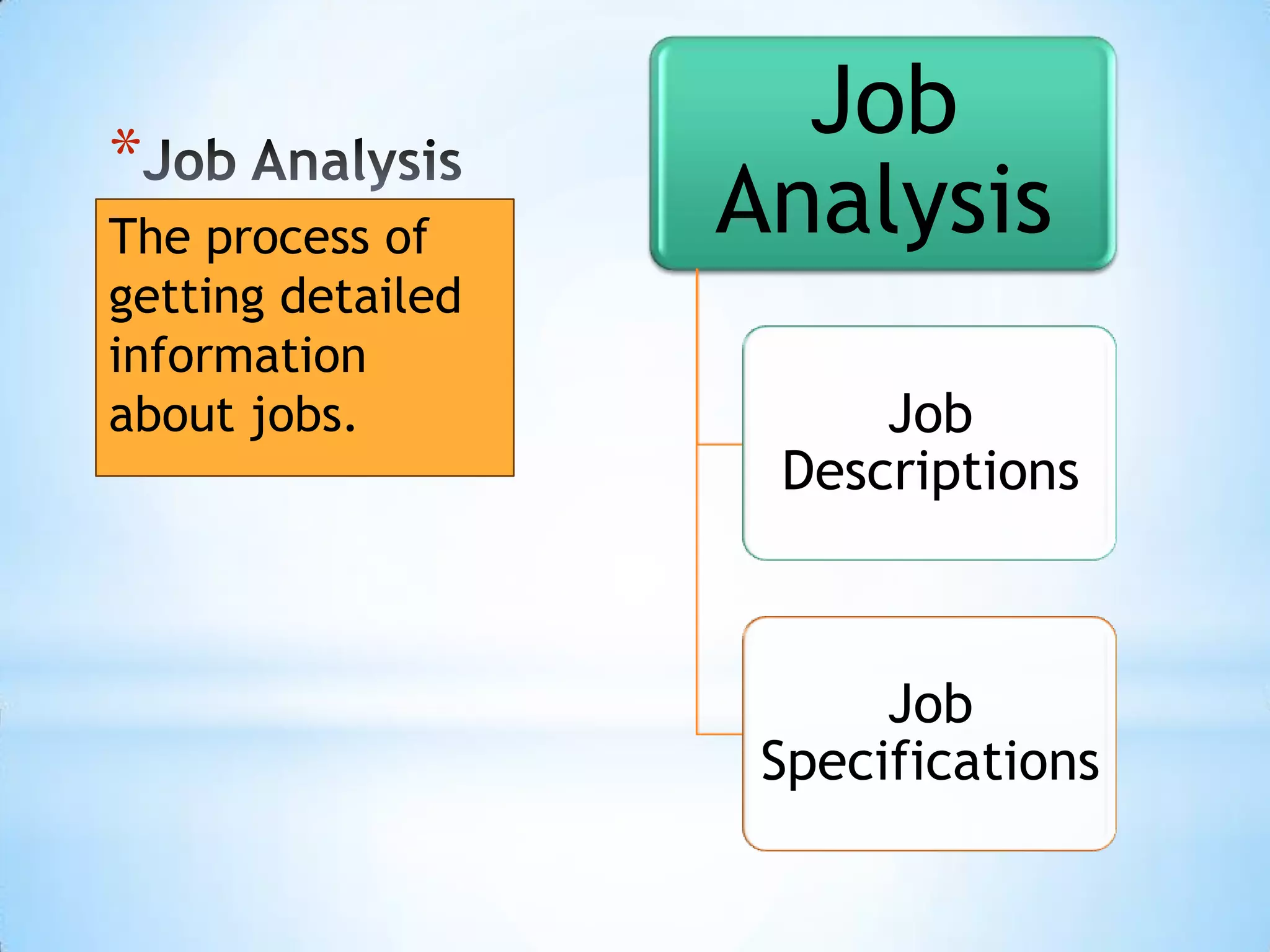
Job
Analysis
Job
Descriptions
Job
Specifications
The process of
getting detailed
information
about jobs.
*
JOB DESCRIPTION
•Job Identification
•Job summary
•Job duties and responsibilities
•Working conditions
•Machines tools and equipment's
•Social environment
•Supervision
•Related to other job.
*
•Qualifications
• Experience
•Physical characteristics
•Psychological characteristics
•Social characteristics
*
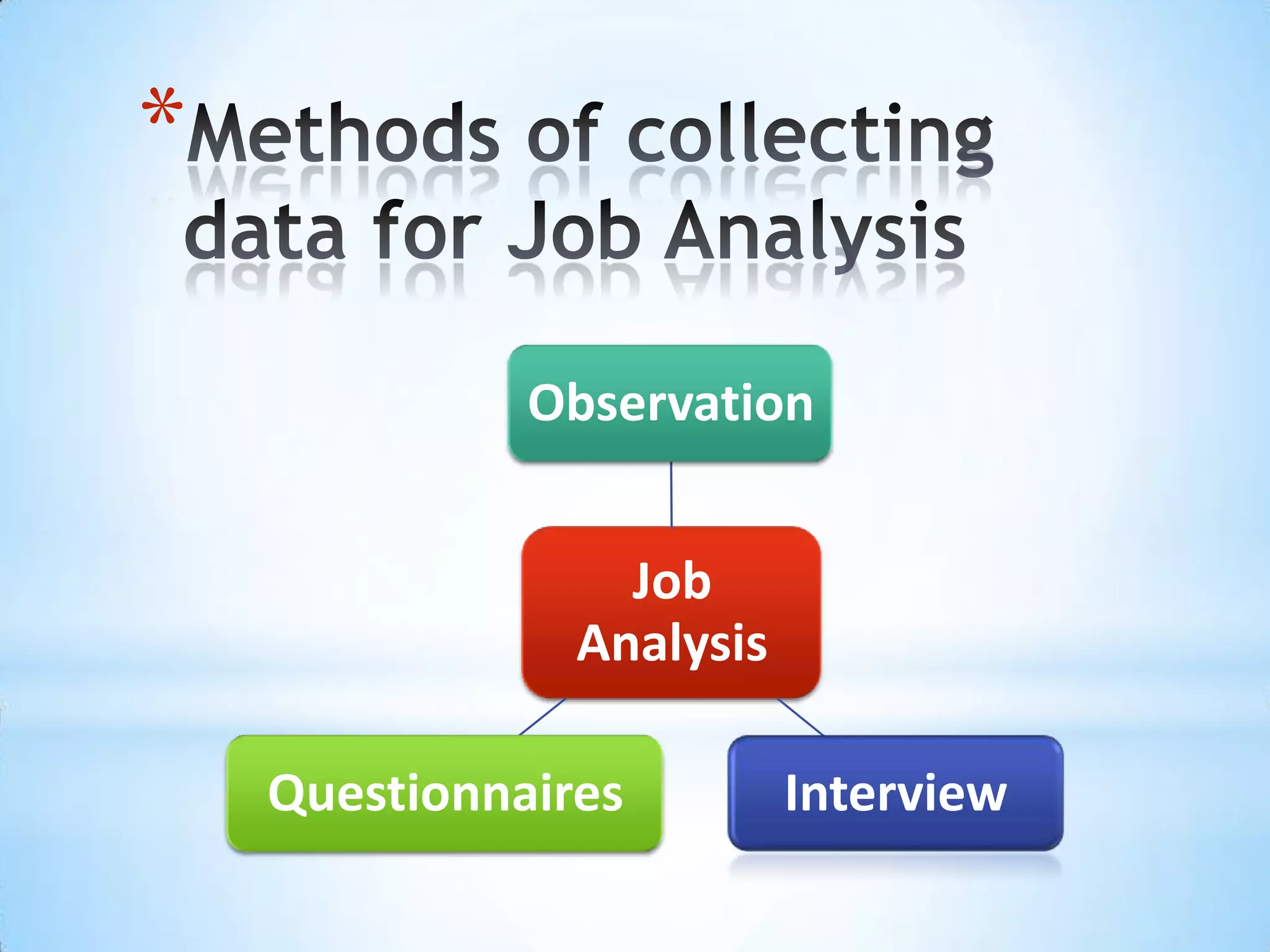
Job
Analysis
Observation
InterviewQuestionnaires
*
1.Facilitates proper publicity of job
2.Selection of psychological test
3.Facilitates purposeful interviews
4.Facilitates appropriate medical
examination
5.Facilitates scientific selection
placement and orientation
6.Facilitates scientific promotions and
transfers
*
 The process of defining how work will be performed
and what tasks will be required in a given job.
 Factors affecting job designing
 Organizational factors
 Environmental factors
 Behavioral factors
OBJECTIVES OF THE
ORGANIZATION
Greater Job Satisfaction
Increased Performance
Reduced Absenteeism & Turnover
Greater Profitability
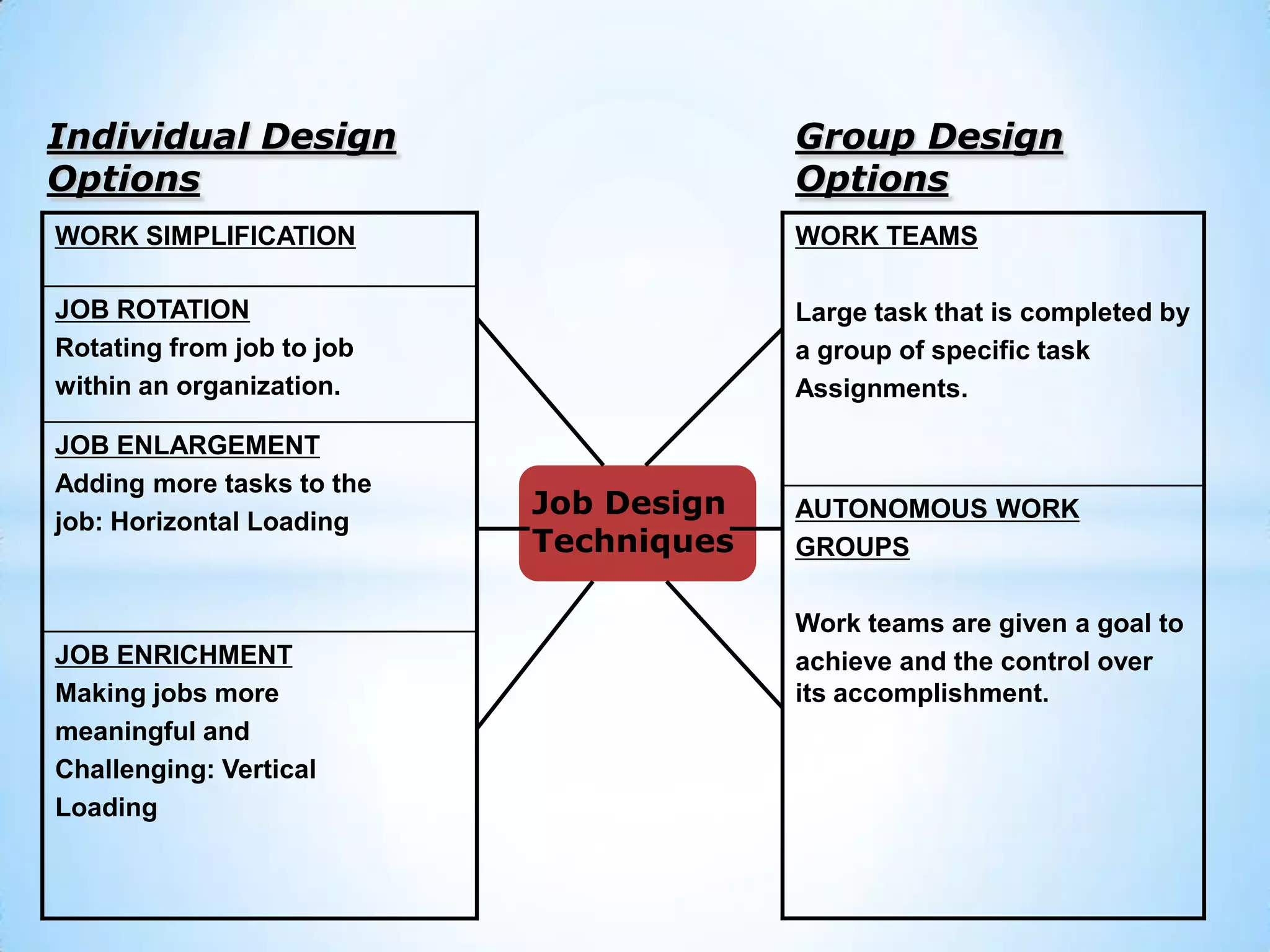
WORK SIMPLIFICATION
JOB ROTATION
Rotating from job to job
within an organization.
JOB ENLARGEMENT
Adding more tasks to the
job: Horizontal Loading
JOB ENRICHMENT
Making jobs more
meaningful and
Challenging: Vertical
Loading
WORK TEAMS
Large task that is completed by
a group of specific task
Assignments.
AUTONOMOUS WORK
GROUPS
Work teams are given a goal to
achieve and the control over
its accomplishment.
Job Design
Techniques
Individual Design
Options
Group Design
Options
*
The process of determining how much a job should
be paid, balancing two goals
 Internal Equity
 External Competitiveness
*
Performs 3 main functions:
*Identifies 10-15 key benchmarks
*Selects some compensable factors
*Evaluate the worth of each job via
one of the methods.
*
• Ranking or job comparison
• Grading or job
classification
Non-
quantitative
• Point rating
• Factor comparisonQuantitative
*Job Ranking
The importance of order of job
is judged in terms of
duties, responsibilities and
demands on the job holder.
For example,
*
 System of job evaluation by which jobs are classified and
grouped according to a series of predetermined wage
grades.
 For example,
Class I
Executives
Office Manager, Deputy
office
manager, Departmental
supervisor.
Class II
Skilled workers
Purchasing
assistant, Cashier, Receipts
clerk.
Class III
Semiskilled
workers
Machine-
operators, Switchboard
operator.
Class IV
Semiskilled
workers
File clerks, Office boys.
*
*
Reduction in inequalities in salary
Specialization
Helps in selection of employees
Standardization
Improvement, Selection and promotion procedures
*
Employee Satisfaction is Organization’s Success

Job Analysis, Job Design & Job Evaluation

  • 1.
    Submitted by STUDENT OF VIDYAVIKAS UNIVERSAL COLLEGE OF BMS & BMM STUDING IN T.Y.B.M.S DIV A
  • 2.
    I am highlyin debited to Prof. NAINA BISHT for your guidance and constant supervision as well as for providing necessary information regarding the project & also for your support in completing the project I would like to express my gratitude towards my parents & my friends for their kind co operation and encouragement which helps me in completion this project. *
  • 3.
    * I VARMA ANKITAHEREBY DECLARE THAT THIS PROJECT REPORT ENTITLED SUBMITTED BY ME UNDER THE GUIDANC JOB ANALYSIS JOB DESIGN JOB EVALUATION OF PROF. NAINA BISHT OF VIDYA VIKAS UNIVERSAL COLLEGE IS MY OWN AND HAS NOT BEEN SUBMITTED TO ANY OTHER UNIVERSITY OR INSTITUDE OR PUBLISHED EARLIER.
  • 4.
    * SR NO. PARTICULARS 1.Introduction 2. Job Analysis 3. Process of Job Analysis 4. Methods of Job Analysis 5. Importance's of Job Analysis 6. Job Design 7. Objectives of Job Design 8. Techniques of Job Design 9. Job Evaluation 10. Committee of Job Evaluation 12. Method of Job Evaluation 13. Advantages of Job Evaluation 14. Conclusion
  • 5.
  • 6.
    *  Job Analysis “JobAnalysis is the process of studying and collecting information relating to the operations and responsibility of a specific job”. Job Design “Job Design involves systematic attempt to organize tasks ,duties and responsibilities into a unit of work to achieve certain objective”.  Job Evaluation “Job Evaluation is a systematic and orderly process of determining the worth of a job in relation to other jobs”.
  • 7.
  • 8.
    * JOB DESCRIPTION •Job Identification •Jobsummary •Job duties and responsibilities •Working conditions •Machines tools and equipment's •Social environment •Supervision •Related to other job.
  • 9.
  • 10.
  • 11.
    * 1.Facilitates proper publicityof job 2.Selection of psychological test 3.Facilitates purposeful interviews 4.Facilitates appropriate medical examination 5.Facilitates scientific selection placement and orientation 6.Facilitates scientific promotions and transfers
  • 12.
    *  The processof defining how work will be performed and what tasks will be required in a given job.  Factors affecting job designing  Organizational factors  Environmental factors  Behavioral factors
  • 13.
    OBJECTIVES OF THE ORGANIZATION GreaterJob Satisfaction Increased Performance Reduced Absenteeism & Turnover Greater Profitability
  • 14.
    WORK SIMPLIFICATION JOB ROTATION Rotatingfrom job to job within an organization. JOB ENLARGEMENT Adding more tasks to the job: Horizontal Loading JOB ENRICHMENT Making jobs more meaningful and Challenging: Vertical Loading WORK TEAMS Large task that is completed by a group of specific task Assignments. AUTONOMOUS WORK GROUPS Work teams are given a goal to achieve and the control over its accomplishment. Job Design Techniques Individual Design Options Group Design Options
  • 15.
    * The process ofdetermining how much a job should be paid, balancing two goals  Internal Equity  External Competitiveness
  • 16.
    * Performs 3 mainfunctions: *Identifies 10-15 key benchmarks *Selects some compensable factors *Evaluate the worth of each job via one of the methods.
  • 17.
    * • Ranking orjob comparison • Grading or job classification Non- quantitative • Point rating • Factor comparisonQuantitative
  • 18.
    *Job Ranking The importanceof order of job is judged in terms of duties, responsibilities and demands on the job holder. For example,
  • 19.
    *  System ofjob evaluation by which jobs are classified and grouped according to a series of predetermined wage grades.  For example, Class I Executives Office Manager, Deputy office manager, Departmental supervisor. Class II Skilled workers Purchasing assistant, Cashier, Receipts clerk. Class III Semiskilled workers Machine- operators, Switchboard operator. Class IV Semiskilled workers File clerks, Office boys.
  • 20.
  • 21.
    * Reduction in inequalitiesin salary Specialization Helps in selection of employees Standardization Improvement, Selection and promotion procedures
  • 22.
    * Employee Satisfaction isOrganization’s Success

Editor's Notes

  • #8 To achieve high-quality performance, organizations have to understand and match job requirements and people.Analyzing jobs and understanding what is required to carry out a job provide essential knowledge for staffing, training, performance appraisal, and many other HR activities.Job analysis: the process of getting detailed information about jobs.The output of a job analysis are job descriptions and job specifications. Let’s discuss each of those in more detail.
  • #13 Although job analysis is important for an understanding of existing jobs, organizations must also plan for new jobs and periodically consider whether they should revise existing jobs.