HUMAN RESOURCE
MANAGEMENT
BM 368/BM 558
Definition
 Human resource management
(HRM) is the strategic and coherent
approach to the management of an
organization's most valued assets -
the people working there who
individually and collectively
contribute to the achievement of
the objectives of the business.
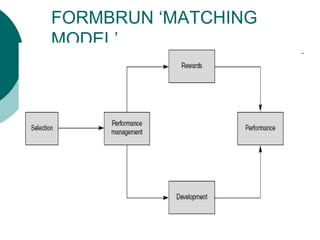
FORMBRUN ‘MATCHING
MODEL’
HRM Practices
Important HRM practices
include:
Impact of Human Resource Management
Responsibilities of HR Departments
Skills of HRM Professionals
HR Functions
HR Responsibilities of Supervisors
HR Management as a Career Field
 HR Generalist
 A person with responsibility for performing a
variety of HR activities.
 HR Specialist
 A person with in-depth knowledge and
expertise in a limited area of HR.
 Professional Organization
 Society for Human Resource Management
(SHRM)
JOB ANALYSIS
AND JOB DESIGN
•MEANING
•PURPOSE
•USES
•PROCESS (JOB DESCRIPTION & JOB
SPECIFICATION)
•METHODS OF COLLECTING JOB ANALYSIS DATA
•JOB DESIGN
•APPROACHES TO JOB DESIGN
Job Hierarchy
Decenzo and P.Robbins
ELEMENT
TASK
DUTY
POSITION
JOB
JOB FAMILY
OCCUPATION
CAREER
MEANING
 Job analysis is a formal and detailed analysis of
jobs. It is a systematic investigation of the tasks,
duties and responsibilities necessary to do a job.
 A ‘Task’ is an identifiable work activity carried
out for a specific purpose
 A ‘duty’ is a larger work segment consisting of a
several tasks that are performed by an individual.
 What people do in their jobs?
 What they require in order to do their jobs
satisfactorily?
 Job Analysis (JA)- A systematic
process of describing and recording
information about job behaviors,
activities, and work specifications.
•Purposes of a job
•Major duties or activities
•Conditions under which the job is
performed
•Competencies (skills, knowledge,
abilities, and other attributes) that
enable and enhance performance in a
job
PURPOSE
 The main purpose of conducting job
analysis is to prepare ‘Job Description’
and ‘Job Specification’ which in turn helps
to hire the right quality of workforce into
the organization.
USES OF JOB ANALYSIS
 Human Resource Planning
 Recruitment
 Selection
 Placement and Orientation
 Training
 Employee Safety
 Job Design and Redesign
 Job Evaluation
PROCESS OF JOB ANALYSIS
 Organizational Analysis
 Selection of representative positions to be
analyzed
 Collection of job analysis data
 Preparation of Job Description-(Job Description
describes contents of the job in terms of
functions, duties, responsibilities, operations etc.)
 Preparation of Job Specification-(It is a written
statement of personal attributes in terms of traits,
skills, training, experience needed to carry out the
job.
METHODS
 Job Performance
 Personal Observation
 Critical Incidents (Behaviorally focused descriptions
of work)
 Interview
 Panel of Experts
 Diary Method
 Questionnaire Method
 The best-known quantitative approach to job analysis is the
Position Analysis Questionnaire (PAQ). Developed by Dr.
Ernest J. McCormick and associates at Purdue University, the
position analysis questionnaire is a structured job analysis
questionnaire containing 194 items called job elements. These
elements are worker-oriented. They would be classified as
worker behaviors. The items are organized into six divisions:
 (1) information input
(2) mental processes
(3) work output (physical activities and tools)
(4) relationships with others
(5) job context (the physical and social environment)
(6) other job characteristics (such as pace and structure)
 Each job element is rated on six scales: extent of use,
importance, time, possibility of occurrence, applicability, and a
special code for certain jobs.
Position Analysis Questionnaire
(PAQ)
MPDQ
 Analyzing managerial Jobs
 It is a 274 item questionnaire
containing 13 sections.
Management Position Description
Questionnaire (MPDQ)
Job Descriptions & Specifications
 Job Description – what does the job consist
of?
 a list of the tasks, duties, and responsibilities
(TDRs) that a particular job entails.
 Job Specifications – what do the people in
the job need to have?
 A list of the knowledge, skill, abilities, and other
characteristics (KSAOs) that an individual must
have to perform a particular job
SAMPLE JOB DESCRIPTION
SAMPLE JOB SPECIFICATION
JOB DESIGN
 The process of defining how work
will be performed and what tasks
will be required in a given job
 It involves conscious efforts to
organize tasks, duties and
responsibilities into a unit of work
to achieve certain objectives.
 Job design follows job analysis.
JOB DESIGN-Motivation Techniques/
Approaches
 Job enlargement
 Job rotation
 Job enrichment

job analysis 1.ppt

  • 1.
  • 2.
    Definition  Human resourcemanagement (HRM) is the strategic and coherent approach to the management of an organization's most valued assets - the people working there who individually and collectively contribute to the achievement of the objectives of the business.
  • 3.
  • 4.
  • 5.
    Impact of HumanResource Management
  • 6.
  • 7.
    Skills of HRMProfessionals
  • 8.
  • 9.
  • 10.
    HR Management asa Career Field  HR Generalist  A person with responsibility for performing a variety of HR activities.  HR Specialist  A person with in-depth knowledge and expertise in a limited area of HR.  Professional Organization  Society for Human Resource Management (SHRM)
  • 11.
    JOB ANALYSIS AND JOBDESIGN •MEANING •PURPOSE •USES •PROCESS (JOB DESCRIPTION & JOB SPECIFICATION) •METHODS OF COLLECTING JOB ANALYSIS DATA •JOB DESIGN •APPROACHES TO JOB DESIGN
  • 12.
    Job Hierarchy Decenzo andP.Robbins ELEMENT TASK DUTY POSITION JOB JOB FAMILY OCCUPATION CAREER
  • 13.
    MEANING  Job analysisis a formal and detailed analysis of jobs. It is a systematic investigation of the tasks, duties and responsibilities necessary to do a job.  A ‘Task’ is an identifiable work activity carried out for a specific purpose  A ‘duty’ is a larger work segment consisting of a several tasks that are performed by an individual.  What people do in their jobs?  What they require in order to do their jobs satisfactorily?
  • 14.
     Job Analysis(JA)- A systematic process of describing and recording information about job behaviors, activities, and work specifications. •Purposes of a job •Major duties or activities •Conditions under which the job is performed •Competencies (skills, knowledge, abilities, and other attributes) that enable and enhance performance in a job
  • 15.
    PURPOSE  The mainpurpose of conducting job analysis is to prepare ‘Job Description’ and ‘Job Specification’ which in turn helps to hire the right quality of workforce into the organization.
  • 16.
    USES OF JOBANALYSIS  Human Resource Planning  Recruitment  Selection  Placement and Orientation  Training  Employee Safety  Job Design and Redesign  Job Evaluation
  • 17.
    PROCESS OF JOBANALYSIS  Organizational Analysis  Selection of representative positions to be analyzed  Collection of job analysis data  Preparation of Job Description-(Job Description describes contents of the job in terms of functions, duties, responsibilities, operations etc.)  Preparation of Job Specification-(It is a written statement of personal attributes in terms of traits, skills, training, experience needed to carry out the job.
  • 18.
    METHODS  Job Performance Personal Observation  Critical Incidents (Behaviorally focused descriptions of work)  Interview  Panel of Experts  Diary Method  Questionnaire Method
  • 19.
     The best-knownquantitative approach to job analysis is the Position Analysis Questionnaire (PAQ). Developed by Dr. Ernest J. McCormick and associates at Purdue University, the position analysis questionnaire is a structured job analysis questionnaire containing 194 items called job elements. These elements are worker-oriented. They would be classified as worker behaviors. The items are organized into six divisions:  (1) information input (2) mental processes (3) work output (physical activities and tools) (4) relationships with others (5) job context (the physical and social environment) (6) other job characteristics (such as pace and structure)  Each job element is rated on six scales: extent of use, importance, time, possibility of occurrence, applicability, and a special code for certain jobs. Position Analysis Questionnaire (PAQ)
  • 20.
    MPDQ  Analyzing managerialJobs  It is a 274 item questionnaire containing 13 sections.
  • 21.
  • 22.
    Job Descriptions &Specifications  Job Description – what does the job consist of?  a list of the tasks, duties, and responsibilities (TDRs) that a particular job entails.  Job Specifications – what do the people in the job need to have?  A list of the knowledge, skill, abilities, and other characteristics (KSAOs) that an individual must have to perform a particular job
  • 23.
  • 24.
  • 25.
    JOB DESIGN  Theprocess of defining how work will be performed and what tasks will be required in a given job  It involves conscious efforts to organize tasks, duties and responsibilities into a unit of work to achieve certain objectives.  Job design follows job analysis.
  • 27.
    JOB DESIGN-Motivation Techniques/ Approaches Job enlargement  Job rotation  Job enrichment