HRM 3131 Human Resource Planning & Staffing
Group : 02
Mr. E.M.M.K Edirisingha 2012/BAD/126
Mr. W. Parasuraman 2012/BAD/168
Mr. P.Arulrajhan 2012/BAD/018
Miss. Dinojah.S 2012/BAD/043
Miss. Elakkiya.A 2012/BAD/049
Miss. Gowsiga.K 2012/BAD/056
Miss. Puwanambegai.M 2012/BAD/187
Miss. Sinthuja.S 2012/BAD/244
Names Reg.No

Definition of Job analysis
 Job analysis steps
 Components of Job analysis
 Process of Job analysis
 Job analysis information
 Methods for data collection
 Job analysis method
 Uses of Job analysis


Contents
Advantages of Job analysis
 Disadvantages of Job analysis
 Problems with Job analysis
 Definition of Job design
 Approaches to Job design
 Job design process
 Job design methods
 Advantages of Job design
 Disadvantages of Job design
Contents Cont..
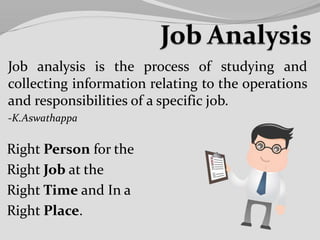
Job analysis is the process of studying and
collecting information relating to the operations
and responsibilities of a specific job.
-K.Aswathappa
Right Person for the
Right Job at the
Right Time and In a
Right Place.
Before discussing job analysis in more detail,
many related terms used in personnel should be
carefully defined:
TASK: A distinct work activity which has an
identifiable beginning and end.
Ex: post man sorting bag full of mails in
appropriate boxes
DUTY: Several tasks which are related by some
sequence of events.
Collecting and recording job information.
Checking the job information for accuracy.
Writing job description based on information.
Using the information to determine the skills,
abilities, and knowledge that are required on the
job.
Updating the information from time to time.
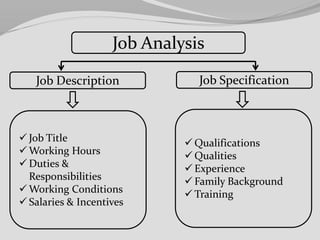
There are two components in job analysis.
1) Job description
2) Job specification
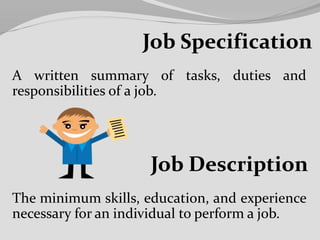
Job Specification
A written summary of tasks, duties and
responsibilities of a job.
The minimum skills, education, and experience
necessary for an individual to perform a job.
Job Description
Job Analysis
Job SpecificationJob Description
 Job Title
 Working Hours
 Duties &
Responsibilities
 Working Conditions
 Salaries & Incentives
 Qualifications
 Qualities
 Experience
 Family Background
 Training
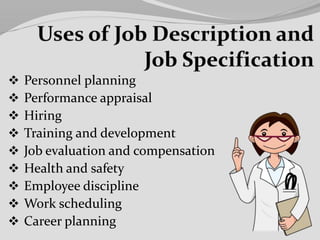
 Personnel planning
 Performance appraisal
 Hiring
 Training and development
 Job evaluation and compensation
 Health and safety
 Employee discipline
 Work scheduling
 Career planning
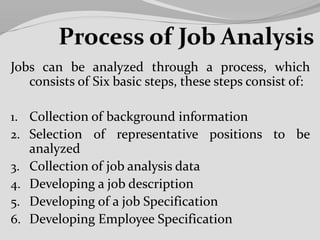
Jobs can be analyzed through a process, which
consists of Six basic steps, these steps consist of:
1. Collection of background information
2. Selection of representative positions to be
analyzed
3. Collection of job analysis data
4. Developing a job description
5. Developing of a job Specification
6. Developing Employee Specification
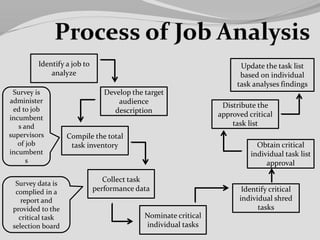
Identify a job to
analyze
Develop the target
audience
description
Compile the total
task inventory
Collect task
performance data
Update the task list
based on individual
task analyses findings
Distribute the
approved critical
task list
Obtain critical
individual task list
approval
Identify critical
individual shred
tasks
Nominate critical
individual tasks
Survey is
administer
ed to job
incumbent
s and
supervisors
of job
incumbent
s
Survey data is
complied in a
report and
provided to the
critical task
selection board
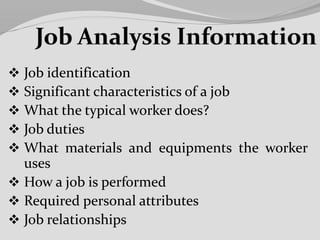
 Job identification
 Significant characteristics of a job
 What the typical worker does?
 Job duties
 What materials and equipments the worker
uses
 How a job is performed
 Required personal attributes
 Job relationships
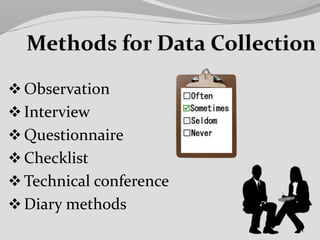
 Observation
 Interview
 Questionnaire
 Checklist
 Technical conference
 Diary methods
1) Interview method
2) Technical conference method
3) Questionnaire method
4) Observation method
5) Diary
 HR planning
 Recruitment and selection
 Orientation
 Job evaluation
 Training and development
 Performance Appraisal
 Compensation and Benefits
 Career planning and development
 Health and safety
 Present immediate information
 Assist in designing the requirements to perform
a job.
 Assist in the hiring process
 Helps in performing evaluation and appraisal
processes.
 Assists in delivering appropriate training.
 Assists in Deciding Compensation Package for a
Specific Job
 Subjective matters
 Lengthy projects
 Require lots of human efforts
 Source of Data is Extremely Small
 Unqualified Job Analyst
 Mental Abilities Cannot be Directly Observed
Support from top management
Single means and source
No training or motivation
Activities may be distorted
Job Design is the process of deciding on the
content of a job in terms of its duties and
responsibilities; on the methods to be used in
carrying out the job, in terms of techniques,
systems and procedures and on the relationships
that should exist between the job holder and the
superiors, subordinates and colleagues.
 To Meet the organizational requirements such
as higher productivity, operational efficiency,
quality of product/service etc
 To satisfy the needs of the individual
employees like interests, challenges,
achievement or accomplishment, etc.
 Integrate the needs of the individual with the
organizational requirements.
 Engineering Approach
 Human Approach
 Job Characteristics Approach
The work of every workman is fully planned out by
the management at least on day in advance and each
man receives in most cases complete written
instructions, describing in detail the task which
he/she has to accomplish. -FW Taylor
Problem with this approach:
Repetition-Mechanical pacing-no end product-little
social interaction-no input.
The Human relations approach recognized the need to
design jobs which are interesting and rewarding.
Herzberg’s research popularized “The notion of
enhancing need satisfaction through what is called job
enrichment”
Factors involved:
Motivators like achievement, recognition, work itself,
responsibility, advancement and growth and Hygienic
factors.
According to Herzberg. The Employee is dissatisfied
with the job if required maintenance factors to the
required degree are not introduced into the job.
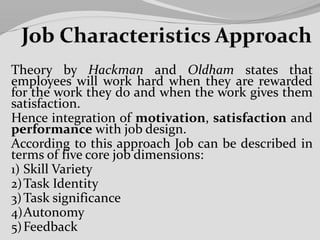
Theory by Hackman and Oldham states that
employees will work hard when they are rewarded
for the work they do and when the work gives them
satisfaction.
Hence integration of motivation, satisfaction and
performance with job design.
According to this approach Job can be described in
terms of five core job dimensions:
1) Skill Variety
2)Task Identity
3)Task significance
4)Autonomy
5)Feedback
Job Design Process has to start from what activity
needs to be done in order to achieve
organizational goals.
It requires use of techniques like work-study,
process planning, organizational methods and
organizational analysis and also technical
aspects.
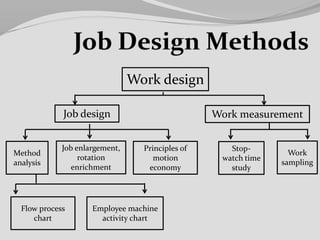
Work design
Work measurement
Work
sampling
Stop-
watch time
study
Job design
Principles of
motion
economy
Job enlargement,
rotation
enrichment
Method
analysis
Employee machine
activity chart
Flow process
chart
Job Rotation:
Refers to the movement of an employee from one Job to
another.
Note That jobs themselves are not actually Changed, only
employees are Rotated among various jobs.
Job Enlargement :
When a job is enlarged the tasks being performed are either
enlarged or several short tasks are given to on worker, thus the
scope of the Job is increased because there are many tasks to be
performed by the same worker.
Job Enrichment:
Job enrichment as is currently practiced all over the work is a
direct outgrowth of Herzberg’s Two factor theory of motivation.
Organizational Design
Structure Of Competent Employee
Motivation And Commitment Of Employees
Environmental Adaptation
Labor relation
Quality of work life
Organizational productivity
Lack of training
Increase work load
Conflict with non-participants
Poor performance
Employee Satisfaction Is
Organization's Success
HR Planning - K.Aswathappa
Managementstudyguide.com
Google.com
Youtube.com
References
Questions
Time
for
Job Analysis

Job Analysis

  • 1.
    HRM 3131 HumanResource Planning & Staffing Group : 02
  • 2.
    Mr. E.M.M.K Edirisingha2012/BAD/126 Mr. W. Parasuraman 2012/BAD/168 Mr. P.Arulrajhan 2012/BAD/018 Miss. Dinojah.S 2012/BAD/043 Miss. Elakkiya.A 2012/BAD/049 Miss. Gowsiga.K 2012/BAD/056 Miss. Puwanambegai.M 2012/BAD/187 Miss. Sinthuja.S 2012/BAD/244 Names Reg.No
  • 3.
    Definition of Jobanalysis  Job analysis steps  Components of Job analysis  Process of Job analysis  Job analysis information  Methods for data collection  Job analysis method  Uses of Job analysis Contents
  • 4.
    Advantages of Jobanalysis  Disadvantages of Job analysis  Problems with Job analysis  Definition of Job design  Approaches to Job design  Job design process  Job design methods  Advantages of Job design  Disadvantages of Job design Contents Cont..
  • 5.
    Job analysis isthe process of studying and collecting information relating to the operations and responsibilities of a specific job. -K.Aswathappa Right Person for the Right Job at the Right Time and In a Right Place.
  • 7.
    Before discussing jobanalysis in more detail, many related terms used in personnel should be carefully defined: TASK: A distinct work activity which has an identifiable beginning and end. Ex: post man sorting bag full of mails in appropriate boxes DUTY: Several tasks which are related by some sequence of events.
  • 8.
    Collecting and recordingjob information. Checking the job information for accuracy. Writing job description based on information. Using the information to determine the skills, abilities, and knowledge that are required on the job. Updating the information from time to time.
  • 9.
    There are twocomponents in job analysis. 1) Job description 2) Job specification
  • 10.
    Job Specification A writtensummary of tasks, duties and responsibilities of a job. The minimum skills, education, and experience necessary for an individual to perform a job. Job Description
  • 11.
    Job Analysis Job SpecificationJobDescription  Job Title  Working Hours  Duties & Responsibilities  Working Conditions  Salaries & Incentives  Qualifications  Qualities  Experience  Family Background  Training
  • 12.
     Personnel planning Performance appraisal  Hiring  Training and development  Job evaluation and compensation  Health and safety  Employee discipline  Work scheduling  Career planning
  • 13.
    Jobs can beanalyzed through a process, which consists of Six basic steps, these steps consist of: 1. Collection of background information 2. Selection of representative positions to be analyzed 3. Collection of job analysis data 4. Developing a job description 5. Developing of a job Specification 6. Developing Employee Specification
  • 14.
    Identify a jobto analyze Develop the target audience description Compile the total task inventory Collect task performance data Update the task list based on individual task analyses findings Distribute the approved critical task list Obtain critical individual task list approval Identify critical individual shred tasks Nominate critical individual tasks Survey is administer ed to job incumbent s and supervisors of job incumbent s Survey data is complied in a report and provided to the critical task selection board
  • 16.
     Job identification Significant characteristics of a job  What the typical worker does?  Job duties  What materials and equipments the worker uses  How a job is performed  Required personal attributes  Job relationships
  • 17.
     Observation  Interview Questionnaire  Checklist  Technical conference  Diary methods
  • 18.
    1) Interview method 2)Technical conference method 3) Questionnaire method 4) Observation method 5) Diary
  • 20.
     HR planning Recruitment and selection  Orientation  Job evaluation  Training and development  Performance Appraisal  Compensation and Benefits  Career planning and development  Health and safety
  • 21.
     Present immediateinformation  Assist in designing the requirements to perform a job.  Assist in the hiring process  Helps in performing evaluation and appraisal processes.  Assists in delivering appropriate training.  Assists in Deciding Compensation Package for a Specific Job
  • 22.
     Subjective matters Lengthy projects  Require lots of human efforts  Source of Data is Extremely Small  Unqualified Job Analyst  Mental Abilities Cannot be Directly Observed
  • 23.
    Support from topmanagement Single means and source No training or motivation Activities may be distorted
  • 25.
    Job Design isthe process of deciding on the content of a job in terms of its duties and responsibilities; on the methods to be used in carrying out the job, in terms of techniques, systems and procedures and on the relationships that should exist between the job holder and the superiors, subordinates and colleagues.
  • 26.
     To Meetthe organizational requirements such as higher productivity, operational efficiency, quality of product/service etc  To satisfy the needs of the individual employees like interests, challenges, achievement or accomplishment, etc.  Integrate the needs of the individual with the organizational requirements.
  • 27.
     Engineering Approach Human Approach  Job Characteristics Approach
  • 28.
    The work ofevery workman is fully planned out by the management at least on day in advance and each man receives in most cases complete written instructions, describing in detail the task which he/she has to accomplish. -FW Taylor Problem with this approach: Repetition-Mechanical pacing-no end product-little social interaction-no input.
  • 29.
    The Human relationsapproach recognized the need to design jobs which are interesting and rewarding. Herzberg’s research popularized “The notion of enhancing need satisfaction through what is called job enrichment” Factors involved: Motivators like achievement, recognition, work itself, responsibility, advancement and growth and Hygienic factors. According to Herzberg. The Employee is dissatisfied with the job if required maintenance factors to the required degree are not introduced into the job.
  • 30.
    Theory by Hackmanand Oldham states that employees will work hard when they are rewarded for the work they do and when the work gives them satisfaction. Hence integration of motivation, satisfaction and performance with job design. According to this approach Job can be described in terms of five core job dimensions: 1) Skill Variety 2)Task Identity 3)Task significance 4)Autonomy 5)Feedback
  • 31.
    Job Design Processhas to start from what activity needs to be done in order to achieve organizational goals. It requires use of techniques like work-study, process planning, organizational methods and organizational analysis and also technical aspects.
  • 32.
    Work design Work measurement Work sampling Stop- watchtime study Job design Principles of motion economy Job enlargement, rotation enrichment Method analysis Employee machine activity chart Flow process chart
  • 33.
    Job Rotation: Refers tothe movement of an employee from one Job to another. Note That jobs themselves are not actually Changed, only employees are Rotated among various jobs. Job Enlargement : When a job is enlarged the tasks being performed are either enlarged or several short tasks are given to on worker, thus the scope of the Job is increased because there are many tasks to be performed by the same worker. Job Enrichment: Job enrichment as is currently practiced all over the work is a direct outgrowth of Herzberg’s Two factor theory of motivation.
  • 34.
    Organizational Design Structure OfCompetent Employee Motivation And Commitment Of Employees Environmental Adaptation Labor relation Quality of work life Organizational productivity
  • 35.
    Lack of training Increasework load Conflict with non-participants Poor performance
  • 36.
  • 37.
    HR Planning -K.Aswathappa Managementstudyguide.com Google.com Youtube.com References
  • 38.