JOB ANALYSIS & DESIGN
GROUP MEMBERS :
 DURVANGI VAITY – PG04
 NIKITA KAMBLE – PG05
 SNEHA DALVI – PG06
CONTENT
• Meaning Of Job Analysis
• Process Of Job Analysis
• Purpose Of Job Analysis
• Functions Of Job Analysis
• Methods Of Collecting Job Data
• Problems Of Job Analysis
• Job Design
• Factors Affecting Job Design
• Job Design Approaches
• Issues In Job Design
4/25/2015 2
Job Analysis
• Process of collecting information
• Process of two sets of data :-
1.Job Description
2.Job Specification
4/25/2015 3
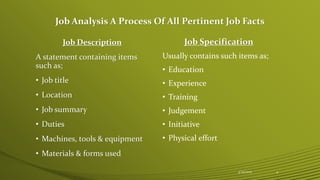
Job Analysis A Process Of All Pertinent Job Facts
Job Specification
Usually contains such items as;
• Education
• Experience
• Training
• Judgement
• Initiative
• Physical effort
Job Description
A statement containing items
such as;
• Job title
• Location
• Job summary
• Duties
• Machines, tools & equipment
• Materials & forms used
4/25/2015 4
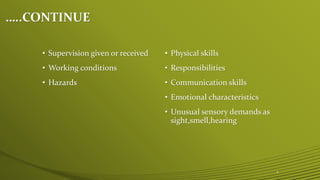
…..CONTINUE
• Physical skills
• Responsibilities
• Communication skills
• Emotional characteristics
• Unusual sensory demands as
sight,smell,hearing
• Supervision given or received
• Working conditions
• Hazards
5
Definition
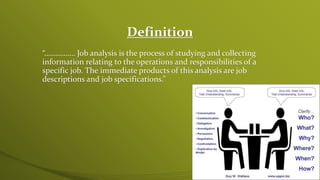
“……………. Job analysis is the process of studying and collecting
information relating to the operations and responsibilities of a
specific job. The immediate products of this analysis are job
descriptions and job specifications.”
4/25/2015 6
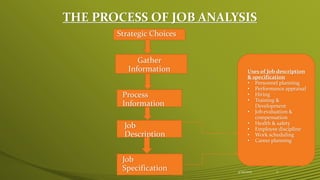
THE PROCESS OF JOB ANALYSIS
Strategic Choices
Gather
Information
Process
Information
Job
Description
Job
Specification
Uses of Job description
& specification
• Personnel planning
• Performance appraisal
• Hiring
• Training &
Development
• Job evaluation &
compensation
• Health & safety
• Employee discipline
• Work scheduling
• Career planning
4/25/2015 7
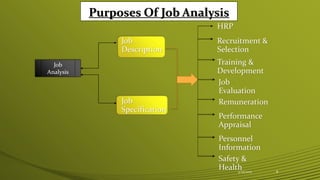
Purposes Of Job Analysis
Job
Analysis
Job
Description
Job
Specification
HRP
Recruitment &
Selection
Training &
Development
Job
Evaluation
Remuneration
Performance
Appraisal
Personnel
Information
Safety &
Health4/25/2015 8
Example With Reference To Synergy
Solutions
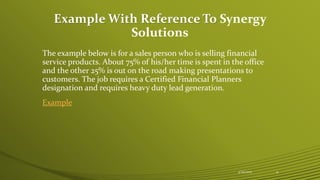
The example below is for a sales person who is selling financial
service products. About 75% of his/her time is spent in the office
and the other 25% is out on the road making presentations to
customers. The job requires a Certified Financial Planners
designation and requires heavy duty lead generation.
Example
4/25/2015 9
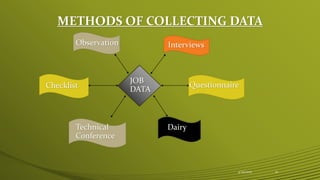
METHODS OF COLLECTING DATA
JOB
DATA
Observation Interviews
Questionnaire
DairyTechnical
Conference
Checklist
4/25/2015 10
Observation
• Job analyst carefully observes the job holder at work
• Has positive and negative sides
• Positive side –collected data accurate because of direct
observations
• Negative side-time consuming & inapplicable .
• Analyst need to be trained & training means additional cost
• Used for analysing repetitive, short cycle, unskilled & semi skilled
jobs.
4/25/2015 11
Interview
• Structured interview form
• Time consuming
• Positive feature – talking to the job holders
• Effectiveness of method depends on the interviewer & on the
ability of the job holder.
4/25/2015 12
Questionnaire
• Structured & Standard questionnaire
• Advantages & Limitations
• Major advantage – information of large number of jobs can
collected in Short period of time
• Accuracy of information
• Specialised knowledge and training requires
• Dependence on this method create some errors in the programme.
4/25/2015 13
Checklist
• Cover as many activities and job holders tick only those tasks that
are included in jobs.
• Preparation of checklist is challenging
• Advantage – useful in large organisation
• Enable to tabulation and recording on electronic data processing
equipment
• Technique is costly not suitable for small organisation
4/25/2015 14
Technical Conference Method
• Conference of supervisors is used
• Analyst initiates discussions
• Good method of data collection
• Lacks accuracy
4/25/2015 15
Dairy Method
• To record in detail activities each day
• If done faithfully it is accurate & eliminates errors
• Time consuming
• Not used much in practice
4/25/2015 16
Problems With Job Analysis
• Support from top mgmt.
• Single means & source
• No training or Motivation
• Activities may be Distorted
4/25/2015 17
Job Design
• Logical sequence to job analysis
• JD involves efforts to organise – tasks, duties & responsibilities into
a unit of work
• “It Integrates work content( tasks, functions, relationships),the
rewards(extrinsic & intrinsic),and the qualifications
required(skills , knowledge , abilities) for each job in a way that
meets the needs of employees and the organisations.”
4/25/2015 18
Steps In Job Design
• The Specification of individual task
• The Specification of the methods of performing each task
• The combination of tasks into specific jobs to be assigned to
individuals.
4/25/2015 19
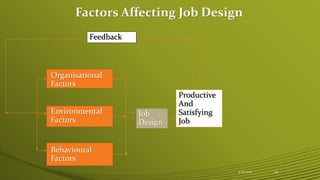
Factors Affecting Job Design
Organisational
Factors
Environmental
Factors
Behavioural
Factors
Feedback
Productive
And
Satisfying
Job
Job
Design
4/25/2015 20
Organisational Factors
• Characteristics of task
• Work Flow
• Ergonomics
• Work Practices
4/25/2015 21
Environmental Factors
• Employee abilities and availability
• Social and Cultural Expectations
4/25/2015 22
Behavioural Elements
• Feedback
• Autonomy
• Use of Abilities
• Variety
4/25/2015 23
Job Design Approaches
• Job Rotation
• Job Engineering
• Job Enlargement
• Job Enrichment
• Socio-technical systems
4/25/2015 24
Job Enlargement
An enlarged job can motivate an individual for five reason :
• Task variety
• Ability utilisation
• Worker-paced control
• Performance feedback
4/25/2015 25
Job Enrichment
The features of JE:
• Direct feedback
• Client relationship
• New learning
• Scheduling own work
• Unique experience
• Control over resources
• Direct communication authority
• Personal accountability
4/25/2015 26
Some Cautions About JE
• JE is not substitute for good mgmt.
• ‘enriched’ is relative term
• Enriching job may create a ‘Snow Ball’ Effect
• JE assumes that workers want more responsibility
• JE may have negative short –run effect
• JE may become static
• Participation can affect the enrichment process
• Change is difficult to implement
4/25/2015 27
Contemporary Issues In Job Design
• Telecommunicating
• Alternative work pattern
• Techno stress
• Task revision
• Skill development
4/25/2015 28
References
• http://www.staffing-and-recruiting-essentials.com
• Google.in
• Youtube.com
• HR & Personnel Mgmt. -K Aswathappa
4/25/2015 29
4/25/2015 30

Job analysis & design

  • 1.
    JOB ANALYSIS &DESIGN GROUP MEMBERS :  DURVANGI VAITY – PG04  NIKITA KAMBLE – PG05  SNEHA DALVI – PG06
  • 2.
    CONTENT • Meaning OfJob Analysis • Process Of Job Analysis • Purpose Of Job Analysis • Functions Of Job Analysis • Methods Of Collecting Job Data • Problems Of Job Analysis • Job Design • Factors Affecting Job Design • Job Design Approaches • Issues In Job Design 4/25/2015 2
  • 3.
    Job Analysis • Processof collecting information • Process of two sets of data :- 1.Job Description 2.Job Specification 4/25/2015 3
  • 4.
    Job Analysis AProcess Of All Pertinent Job Facts Job Specification Usually contains such items as; • Education • Experience • Training • Judgement • Initiative • Physical effort Job Description A statement containing items such as; • Job title • Location • Job summary • Duties • Machines, tools & equipment • Materials & forms used 4/25/2015 4
  • 5.
    …..CONTINUE • Physical skills •Responsibilities • Communication skills • Emotional characteristics • Unusual sensory demands as sight,smell,hearing • Supervision given or received • Working conditions • Hazards 5
  • 6.
    Definition “……………. Job analysisis the process of studying and collecting information relating to the operations and responsibilities of a specific job. The immediate products of this analysis are job descriptions and job specifications.” 4/25/2015 6
  • 7.
    THE PROCESS OFJOB ANALYSIS Strategic Choices Gather Information Process Information Job Description Job Specification Uses of Job description & specification • Personnel planning • Performance appraisal • Hiring • Training & Development • Job evaluation & compensation • Health & safety • Employee discipline • Work scheduling • Career planning 4/25/2015 7
  • 8.
    Purposes Of JobAnalysis Job Analysis Job Description Job Specification HRP Recruitment & Selection Training & Development Job Evaluation Remuneration Performance Appraisal Personnel Information Safety & Health4/25/2015 8
  • 9.
    Example With ReferenceTo Synergy Solutions The example below is for a sales person who is selling financial service products. About 75% of his/her time is spent in the office and the other 25% is out on the road making presentations to customers. The job requires a Certified Financial Planners designation and requires heavy duty lead generation. Example 4/25/2015 9
  • 10.
    METHODS OF COLLECTINGDATA JOB DATA Observation Interviews Questionnaire DairyTechnical Conference Checklist 4/25/2015 10
  • 11.
    Observation • Job analystcarefully observes the job holder at work • Has positive and negative sides • Positive side –collected data accurate because of direct observations • Negative side-time consuming & inapplicable . • Analyst need to be trained & training means additional cost • Used for analysing repetitive, short cycle, unskilled & semi skilled jobs. 4/25/2015 11
  • 12.
    Interview • Structured interviewform • Time consuming • Positive feature – talking to the job holders • Effectiveness of method depends on the interviewer & on the ability of the job holder. 4/25/2015 12
  • 13.
    Questionnaire • Structured &Standard questionnaire • Advantages & Limitations • Major advantage – information of large number of jobs can collected in Short period of time • Accuracy of information • Specialised knowledge and training requires • Dependence on this method create some errors in the programme. 4/25/2015 13
  • 14.
    Checklist • Cover asmany activities and job holders tick only those tasks that are included in jobs. • Preparation of checklist is challenging • Advantage – useful in large organisation • Enable to tabulation and recording on electronic data processing equipment • Technique is costly not suitable for small organisation 4/25/2015 14
  • 15.
    Technical Conference Method •Conference of supervisors is used • Analyst initiates discussions • Good method of data collection • Lacks accuracy 4/25/2015 15
  • 16.
    Dairy Method • Torecord in detail activities each day • If done faithfully it is accurate & eliminates errors • Time consuming • Not used much in practice 4/25/2015 16
  • 17.
    Problems With JobAnalysis • Support from top mgmt. • Single means & source • No training or Motivation • Activities may be Distorted 4/25/2015 17
  • 18.
    Job Design • Logicalsequence to job analysis • JD involves efforts to organise – tasks, duties & responsibilities into a unit of work • “It Integrates work content( tasks, functions, relationships),the rewards(extrinsic & intrinsic),and the qualifications required(skills , knowledge , abilities) for each job in a way that meets the needs of employees and the organisations.” 4/25/2015 18
  • 19.
    Steps In JobDesign • The Specification of individual task • The Specification of the methods of performing each task • The combination of tasks into specific jobs to be assigned to individuals. 4/25/2015 19
  • 20.
    Factors Affecting JobDesign Organisational Factors Environmental Factors Behavioural Factors Feedback Productive And Satisfying Job Job Design 4/25/2015 20
  • 21.
    Organisational Factors • Characteristicsof task • Work Flow • Ergonomics • Work Practices 4/25/2015 21
  • 22.
    Environmental Factors • Employeeabilities and availability • Social and Cultural Expectations 4/25/2015 22
  • 23.
    Behavioural Elements • Feedback •Autonomy • Use of Abilities • Variety 4/25/2015 23
  • 24.
    Job Design Approaches •Job Rotation • Job Engineering • Job Enlargement • Job Enrichment • Socio-technical systems 4/25/2015 24
  • 25.
    Job Enlargement An enlargedjob can motivate an individual for five reason : • Task variety • Ability utilisation • Worker-paced control • Performance feedback 4/25/2015 25
  • 26.
    Job Enrichment The featuresof JE: • Direct feedback • Client relationship • New learning • Scheduling own work • Unique experience • Control over resources • Direct communication authority • Personal accountability 4/25/2015 26
  • 27.
    Some Cautions AboutJE • JE is not substitute for good mgmt. • ‘enriched’ is relative term • Enriching job may create a ‘Snow Ball’ Effect • JE assumes that workers want more responsibility • JE may have negative short –run effect • JE may become static • Participation can affect the enrichment process • Change is difficult to implement 4/25/2015 27
  • 28.
    Contemporary Issues InJob Design • Telecommunicating • Alternative work pattern • Techno stress • Task revision • Skill development 4/25/2015 28
  • 29.
    References • http://www.staffing-and-recruiting-essentials.com • Google.in •Youtube.com • HR & Personnel Mgmt. -K Aswathappa 4/25/2015 29
  • 30.