JOB DESIGN
JOB ANALYSIS
&
DESIGNING OF JOBS
PRESENTED BY : ANGELA MARY GEORGE
S2, MBA (EVENING)
IMK,KARYAVATTOM.
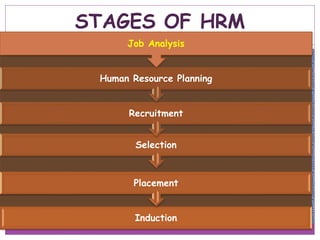
STAGES OF HRM
Induction
Placement
Selection
Recruitment
Human Resource Planning
Job Analysis
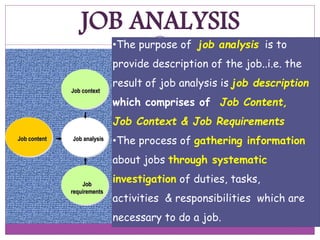
JOB ANALYSIS
Job context
Job content Job analysis
Job
requirements
•The purpose of job analysis is to
provide description of the job..i.e. the
result of job analysis is job description
which comprises of Job Content,
Job Context & Job Requirements
•The process of gathering information
about jobs through systematic
investigation of duties, tasks,
activities & responsibilities which are
necessary to do a job.
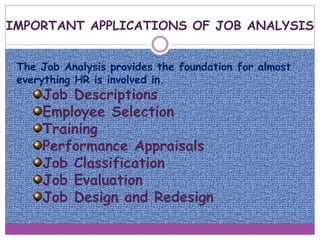
IMPORTANT APPLICATIONS OF JOB ANALYSIS
The Job Analysis provides the foundation for almost
everything HR is involved in.
Job Descriptions
Employee Selection
Training
Performance Appraisals
Job Classification
Job Evaluation
Job Design and Redesign
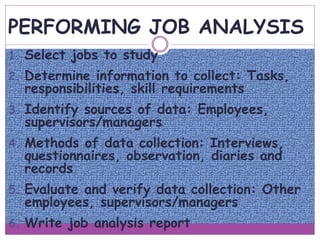
PERFORMING JOB ANALYSIS
1. Select jobs to study
2. Determine information to collect: Tasks,
responsibilities, skill requirements
3. Identify sources of data: Employees,
supervisors/managers
4. Methods of data collection: Interviews,
questionnaires, observation, diaries and
records
5. Evaluate and verify data collection: Other
employees, supervisors/managers
6. Write job analysis report
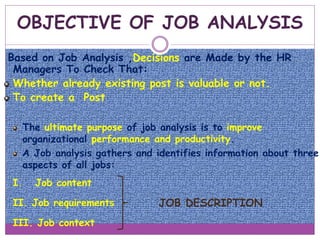
OBJECTIVE OF JOB ANALYSIS
Based on Job Analysis ,Decisions are Made by the HR
Managers To Check That:
Whether already existing post is valuable or not.
To create a Post
The ultimate purpose of job analysis is to improve
organizational performance and productivity.
A Job analysis gathers and identifies information about three
aspects of all jobs:
I. Job content
II. Job requirements
III. Job context
JOB DESCRIPTION
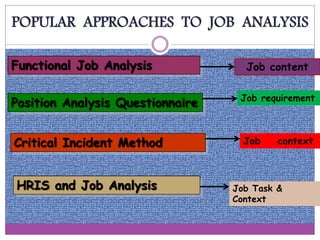
POPULAR APPROACHES TO JOB ANALYSIS
BBBBFunctional Job Analysis
Position Analysis Questionnaire
Critical Incident Method
HRIS and Job Analysis
Job requirement
Job content
Job context
Job Task &
Context
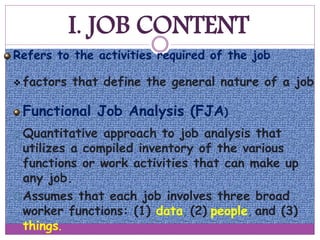
I. JOB CONTENT
Refers to the activities required of the job
 factors that define the general nature of a job
Functional Job Analysis (FJA)
 Quantitative approach to job analysis that
utilizes a compiled inventory of the various
functions or work activities that can make up
any job.
 Assumes that each job involves three broad
worker functions: (1) data, (2) people, and (3)
things.
FUNCTIONAL JOB ANALYSIS
Functional Job Analysis (FJA) describes job
content in terms of:
What the worker does in relation to data,
people, and jobs?
What methods and techniques the worker
uses?
What machines, tools, and equipment the
worker uses?
What materials, products, subject matter, or
services the worker produces?
II. JOB REQUIREMENTS
Refer to education, experience, licenses,
and other personal characteristics an
individual needs to perform the job
content.
2 Factors which defines Job Requirement
on JOB ANALYSIS ARE:-
1.JOB SPECIFICATION
2.JOB DESCRIPTION
II. JOB REQUIREMENTS
1.Job Specification
Statement of the needed Knowledge, Skills, and Abilities (KSAs)
of the person who is to perform the job.
2.Job Description Statement of the Tasks, Duties, and
Responsibilities (TDRs) of a job to be performed
This is a written statement of what the job holder does, how it is done,
under what conditions it is done and why it is done.
The job analysis approach used here for identifying
the job requirement is POSITION ANALYSIS
QUESTIONNAIRE (PAQ),
POSITION ANALYSIS QUESTIONNAIRE
(PAQ),
POSITION ANALYSIS QUESTIONNAIRE
(PAQ), takes into account human
characteristics as well as task and
technological factors of jobs and job classes.
 A questionnaire covering 194 different tasks
that, by means of a five-point scale, seeks
to determine the degree to which different
tasks are involved in performing a particular
job
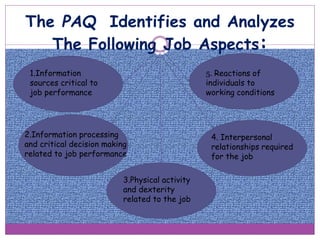
The PAQ Identifies and Analyzes
The Following Job Aspects:
1.Information
sources critical to
job performance
2.Information processing
and critical decision making
related to job performance
3.Physical activity
and dexterity
related to the job
4. Interpersonal
relationships required
for the job
5. Reactions of
individuals to
working conditions
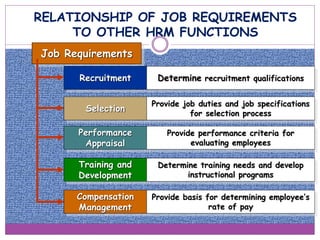
Job Requirements
Recruitment
Selection
Performance
Appraisal
Training and
Development
Compensation
Management
Determine recruitment qualifications
Provide job duties and job specifications
for selection process
Provide performance criteria for
evaluating employees
Determine training needs and develop
instructional programs
Provide basis for determining employee’s
rate of pay
RELATIONSHIP OF JOB REQUIREMENTS
TO OTHER HRM FUNCTIONS
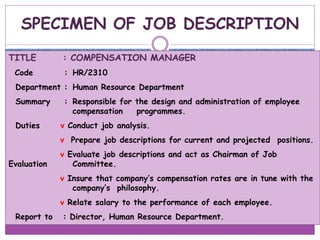
SPECIMEN OF JOB DESCRIPTION
TITLE : COMPENSATION MANAGER
Code : HR/2310
Department : Human Resource Department
Summary : Responsible for the design and administration of employee
compensation programmes.
Duties v Conduct job analysis.
v Prepare job descriptions for current and projected positions.
v Evaluate job descriptions and act as Chairman of Job
Evaluation Committee.
v Insure that company’s compensation rates are in tune with the
company’s philosophy.
v Relate salary to the performance of each employee.
Report to : Director, Human Resource Department.
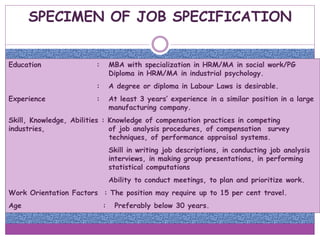
SPECIMEN OF JOB SPECIFICATION
Education : MBA with specialization in HRM/MA in social work/PG
Diploma in HRM/MA in industrial psychology.
: A degree or diploma in Labour Laws is desirable.
Experience : At least 3 years’ experience in a similar position in a large
manufacturing company.
Skill, Knowledge, Abilities : Knowledge of compensation practices in competing
industries, of job analysis procedures, of compensation survey
techniques, of performance appraisal systems.
Skill in writing job descriptions, in conducting job analysis
interviews, in making group presentations, in performing
statistical computations
Ability to conduct meetings, to plan and prioritize work.
Work Orientation Factors : The position may require up to 15 per cent travel.
Age : Preferably below 30 years.
III. JOB CONTEXT
Job context refers to factors such as the:
Physical demands and working conditions of the job
Degree of accountability and responsibility
Extent of supervision required or exercised
Consequences of error
Job context describes the environment
within which the job is to be performed
CRITICAL INCIDENT METHOD OF JOB
ANALYSIS
Job analysis method by which
job tasks are identified that are
critical to job success.
The job analyst writes five to
ten important task statements
for each job under study.
TASK INVENTORY METHOD OF JOB
ANALYSIS
An organization-specific
analysis developed by
identifying—with the help of
employees and managers—a list
of tasks and their descriptions
that are components of
different jobs
OTHER METHODS OF JOB ANALYSIS
PREVIOUS STUDIES : The analyst keeps the
past record of the employees and keeps the
previous experiences and issues related to the
job analysis process of the organization.
WORK DIARIES :Workers keep a
chronological diary/ log of what they do and the
time spent on each activity.
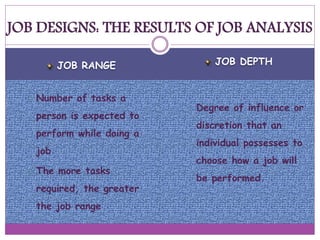
JOB RANGE JOB DEPTH
 Number of tasks a
person is expected to
perform while doing a
job
 The more tasks
required, the greater
the job range
 Degree of influence or
discretion that an
individual possesses to
choose how a job will
be performed.
JOB DESIGNS: THE RESULTS OF JOB ANALYSIS
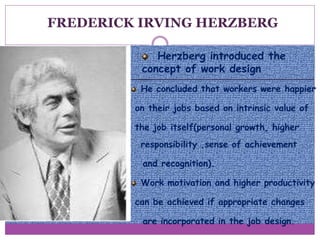
Herzberg introduced the
concept of work design
He concluded that workers were happier
on their jobs based on intrinsic value of
the job itself(personal growth, higher
responsibility ,sense of achievement
and recognition).
Work motivation and higher productivity
can be achieved if appropriate changes
are incorporated in the job design.
FREDERICK IRVING HERZBERG
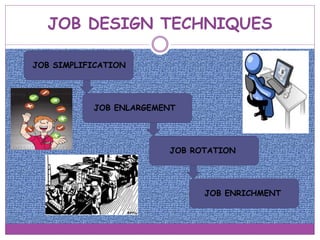
JOB DESIGN TECHNIQUES
JOB SIMPLIFICATION
JOB ENLARGEMENT
JOB ROTATION
JOB ENRICHMENT
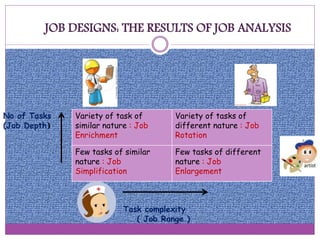
JOB DESIGNS: THE RESULTS OF JOB ANALYSIS
Variety of task of
similar nature : Job
Enrichment
Variety of tasks of
different nature : Job
Rotation
Few tasks of similar
nature : Job
Simplification
Few tasks of different
nature : Job
Enlargement
No of Tasks
(Job Depth)
Task complexity
( Job Range )
JOB SIMPLIFICATION
 Jobs are broken down into very small parts where a fragment called
“task” is repeatedly done over and over again by the same individual.
ADVANTAGES
•Employee therefore is paid
higher rewards.
•Productivity is high.
•Achieves specialization.
•Training cost to the
organization is practically
negligible.
DISADVANTAGES
• A worker is likely to get bored and
remain absent frequently.
•Quality and quantity may suffer in
the long run due to frustration.
•Organization may have to attract
workers by offering higher wages
JOB ENLARGEMENT
Job Enlargement means where two or more simple tasks
are combined and allotted to an employee
 Eg: As in the case of vehicle driver, apart from driving he can
undertake the job of maintenance of the vehicle.
Increases job range, but not depth
Advantage :
More Variety In A Job
Acquiring Additional Proficiency.
Dissatisfaction Of Employees Can Not Be Avoided After A Long
Period Due To Boredom.
JOB ENRICHMENT
The concept of job enrichment was developed by
Fredrik Herzberg in the 1950s.
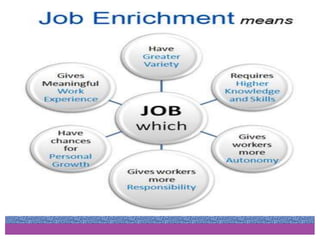
Job enrichment involves providing an employee with
more responsibility for a job and challenges the
individual’s skills at work.
Enrichment involves increasing the decision-making
authority and encouraging the employee with their
tasks.
ADVANTAGES DISADVANTAGES
Job enrichment is useful to both
the workers and the organization.
The worker gets achievement,
recognition and self-actualization.
The worker gets a sense of belonging
to the organization.
The worker finds the job meaningful.
Job enrichment reduces absenteeism,
labour- turnover and grievances.
It motivates the workers to give best
performance.
In many cases, job enrichment does
not give the expected results.
It makes many changes in the job.
So many workers oppose it.
It has limited use for highly
skilled managers and professionals.
The consent of workers is not taken
before implementing job enrichment.
Managers force the workers to
accept job enrichment, which is not good.
JOB ENRICHMENT : MERITS & DEMERITS
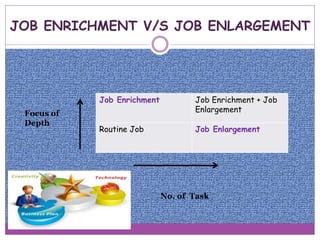
JOB ENRICHMENT V/S JOB ENLARGEMENT
Job Enrichment Job Enrichment + Job
Enlargement
Routine Job Job Enlargement
No. of Task
Focus of
Depth
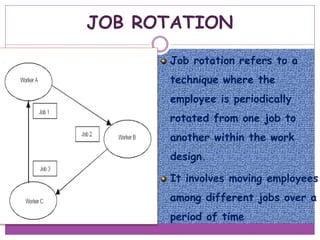
JOB ROTATION
Job rotation refers to a
technique where the
employee is periodically
rotated from one job to
another within the work
design.
It involves moving employees
among different jobs over a
period of time
1.Variety of skills:
o Improve and increase the skills of the employee due to
organization as well as the individual benefit.
2.Improves earning capacity:
o Due to job enlargement the person learns many new
activities.
o Such people apply for jobs to other companies and can
bargain for more salary.
3.Wide range of activities:
o Since a single employee handles multiple activities the
company can try and reduce the number of employee’s.
ADVANTAGES OF JOB ROTATION
 1. Frequent interruption:
o A person who is doing a particular job and get it
comfortable suddenly finds himself shifted to
another job or department this interrupts the work
in both the departments
 2. Reduces uniformity in quality:
o when a new worker I shifted or rotated in the
department, he takes time to learn the new job,
makes mistakes in the process and affects the
quality of the job.
DISADVANTAGES OF JOB ROTATION
CONCLUSION
Job analysis (also known as Work analysis) is a family of procedures
to identify the content of a job in terms of activities involved and
attributes or job requirements needed to perform the activities. Job
analysis provide information to organizations which helps to determine
which employees are best fit for specific jobs.
Job design (also referred to as work design or task design) is the
specification of contents, methods and relationship of jobs in order
to satisfy technological and organizational requirements as well as the
social and personal requirements of the job holder .The aim of a job
design is to improve Job Satisfaction, to improve through-put, to
improve quality and to reduce employee problems (e.g., grievances,
absenteeism).
Job analysis & design 4-12-2014

Job analysis & design 4-12-2014

  • 1.
    JOB DESIGN JOB ANALYSIS & DESIGNINGOF JOBS PRESENTED BY : ANGELA MARY GEORGE S2, MBA (EVENING) IMK,KARYAVATTOM.
  • 2.
  • 3.
    JOB ANALYSIS Job context Jobcontent Job analysis Job requirements •The purpose of job analysis is to provide description of the job..i.e. the result of job analysis is job description which comprises of Job Content, Job Context & Job Requirements •The process of gathering information about jobs through systematic investigation of duties, tasks, activities & responsibilities which are necessary to do a job.
  • 4.
    IMPORTANT APPLICATIONS OFJOB ANALYSIS The Job Analysis provides the foundation for almost everything HR is involved in. Job Descriptions Employee Selection Training Performance Appraisals Job Classification Job Evaluation Job Design and Redesign
  • 5.
    PERFORMING JOB ANALYSIS 1.Select jobs to study 2. Determine information to collect: Tasks, responsibilities, skill requirements 3. Identify sources of data: Employees, supervisors/managers 4. Methods of data collection: Interviews, questionnaires, observation, diaries and records 5. Evaluate and verify data collection: Other employees, supervisors/managers 6. Write job analysis report
  • 6.
    OBJECTIVE OF JOBANALYSIS Based on Job Analysis ,Decisions are Made by the HR Managers To Check That: Whether already existing post is valuable or not. To create a Post The ultimate purpose of job analysis is to improve organizational performance and productivity. A Job analysis gathers and identifies information about three aspects of all jobs: I. Job content II. Job requirements III. Job context JOB DESCRIPTION
  • 7.
    POPULAR APPROACHES TOJOB ANALYSIS BBBBFunctional Job Analysis Position Analysis Questionnaire Critical Incident Method HRIS and Job Analysis Job requirement Job content Job context Job Task & Context
  • 8.
    I. JOB CONTENT Refersto the activities required of the job  factors that define the general nature of a job Functional Job Analysis (FJA)  Quantitative approach to job analysis that utilizes a compiled inventory of the various functions or work activities that can make up any job.  Assumes that each job involves three broad worker functions: (1) data, (2) people, and (3) things.
  • 9.
    FUNCTIONAL JOB ANALYSIS FunctionalJob Analysis (FJA) describes job content in terms of: What the worker does in relation to data, people, and jobs? What methods and techniques the worker uses? What machines, tools, and equipment the worker uses? What materials, products, subject matter, or services the worker produces?
  • 10.
    II. JOB REQUIREMENTS Referto education, experience, licenses, and other personal characteristics an individual needs to perform the job content. 2 Factors which defines Job Requirement on JOB ANALYSIS ARE:- 1.JOB SPECIFICATION 2.JOB DESCRIPTION
  • 11.
    II. JOB REQUIREMENTS 1.JobSpecification Statement of the needed Knowledge, Skills, and Abilities (KSAs) of the person who is to perform the job. 2.Job Description Statement of the Tasks, Duties, and Responsibilities (TDRs) of a job to be performed This is a written statement of what the job holder does, how it is done, under what conditions it is done and why it is done. The job analysis approach used here for identifying the job requirement is POSITION ANALYSIS QUESTIONNAIRE (PAQ),
  • 12.
    POSITION ANALYSIS QUESTIONNAIRE (PAQ), POSITIONANALYSIS QUESTIONNAIRE (PAQ), takes into account human characteristics as well as task and technological factors of jobs and job classes.  A questionnaire covering 194 different tasks that, by means of a five-point scale, seeks to determine the degree to which different tasks are involved in performing a particular job
  • 13.
    The PAQ Identifiesand Analyzes The Following Job Aspects: 1.Information sources critical to job performance 2.Information processing and critical decision making related to job performance 3.Physical activity and dexterity related to the job 4. Interpersonal relationships required for the job 5. Reactions of individuals to working conditions
  • 14.
    Job Requirements Recruitment Selection Performance Appraisal Training and Development Compensation Management Determinerecruitment qualifications Provide job duties and job specifications for selection process Provide performance criteria for evaluating employees Determine training needs and develop instructional programs Provide basis for determining employee’s rate of pay RELATIONSHIP OF JOB REQUIREMENTS TO OTHER HRM FUNCTIONS
  • 15.
    SPECIMEN OF JOBDESCRIPTION TITLE : COMPENSATION MANAGER Code : HR/2310 Department : Human Resource Department Summary : Responsible for the design and administration of employee compensation programmes. Duties v Conduct job analysis. v Prepare job descriptions for current and projected positions. v Evaluate job descriptions and act as Chairman of Job Evaluation Committee. v Insure that company’s compensation rates are in tune with the company’s philosophy. v Relate salary to the performance of each employee. Report to : Director, Human Resource Department.
  • 16.
    SPECIMEN OF JOBSPECIFICATION Education : MBA with specialization in HRM/MA in social work/PG Diploma in HRM/MA in industrial psychology. : A degree or diploma in Labour Laws is desirable. Experience : At least 3 years’ experience in a similar position in a large manufacturing company. Skill, Knowledge, Abilities : Knowledge of compensation practices in competing industries, of job analysis procedures, of compensation survey techniques, of performance appraisal systems. Skill in writing job descriptions, in conducting job analysis interviews, in making group presentations, in performing statistical computations Ability to conduct meetings, to plan and prioritize work. Work Orientation Factors : The position may require up to 15 per cent travel. Age : Preferably below 30 years.
  • 17.
    III. JOB CONTEXT Jobcontext refers to factors such as the: Physical demands and working conditions of the job Degree of accountability and responsibility Extent of supervision required or exercised Consequences of error Job context describes the environment within which the job is to be performed
  • 18.
    CRITICAL INCIDENT METHODOF JOB ANALYSIS Job analysis method by which job tasks are identified that are critical to job success. The job analyst writes five to ten important task statements for each job under study.
  • 19.
    TASK INVENTORY METHODOF JOB ANALYSIS An organization-specific analysis developed by identifying—with the help of employees and managers—a list of tasks and their descriptions that are components of different jobs
  • 20.
    OTHER METHODS OFJOB ANALYSIS PREVIOUS STUDIES : The analyst keeps the past record of the employees and keeps the previous experiences and issues related to the job analysis process of the organization. WORK DIARIES :Workers keep a chronological diary/ log of what they do and the time spent on each activity.
  • 21.
    JOB RANGE JOBDEPTH  Number of tasks a person is expected to perform while doing a job  The more tasks required, the greater the job range  Degree of influence or discretion that an individual possesses to choose how a job will be performed. JOB DESIGNS: THE RESULTS OF JOB ANALYSIS
  • 22.
    Herzberg introduced the conceptof work design He concluded that workers were happier on their jobs based on intrinsic value of the job itself(personal growth, higher responsibility ,sense of achievement and recognition). Work motivation and higher productivity can be achieved if appropriate changes are incorporated in the job design. FREDERICK IRVING HERZBERG
  • 23.
    JOB DESIGN TECHNIQUES JOBSIMPLIFICATION JOB ENLARGEMENT JOB ROTATION JOB ENRICHMENT
  • 24.
    JOB DESIGNS: THERESULTS OF JOB ANALYSIS Variety of task of similar nature : Job Enrichment Variety of tasks of different nature : Job Rotation Few tasks of similar nature : Job Simplification Few tasks of different nature : Job Enlargement No of Tasks (Job Depth) Task complexity ( Job Range )
  • 25.
    JOB SIMPLIFICATION  Jobsare broken down into very small parts where a fragment called “task” is repeatedly done over and over again by the same individual. ADVANTAGES •Employee therefore is paid higher rewards. •Productivity is high. •Achieves specialization. •Training cost to the organization is practically negligible. DISADVANTAGES • A worker is likely to get bored and remain absent frequently. •Quality and quantity may suffer in the long run due to frustration. •Organization may have to attract workers by offering higher wages
  • 26.
    JOB ENLARGEMENT Job Enlargementmeans where two or more simple tasks are combined and allotted to an employee  Eg: As in the case of vehicle driver, apart from driving he can undertake the job of maintenance of the vehicle. Increases job range, but not depth Advantage : More Variety In A Job Acquiring Additional Proficiency. Dissatisfaction Of Employees Can Not Be Avoided After A Long Period Due To Boredom.
  • 27.
    JOB ENRICHMENT The conceptof job enrichment was developed by Fredrik Herzberg in the 1950s. Job enrichment involves providing an employee with more responsibility for a job and challenges the individual’s skills at work. Enrichment involves increasing the decision-making authority and encouraging the employee with their tasks.
  • 29.
    ADVANTAGES DISADVANTAGES Job enrichmentis useful to both the workers and the organization. The worker gets achievement, recognition and self-actualization. The worker gets a sense of belonging to the organization. The worker finds the job meaningful. Job enrichment reduces absenteeism, labour- turnover and grievances. It motivates the workers to give best performance. In many cases, job enrichment does not give the expected results. It makes many changes in the job. So many workers oppose it. It has limited use for highly skilled managers and professionals. The consent of workers is not taken before implementing job enrichment. Managers force the workers to accept job enrichment, which is not good. JOB ENRICHMENT : MERITS & DEMERITS
  • 30.
    JOB ENRICHMENT V/SJOB ENLARGEMENT Job Enrichment Job Enrichment + Job Enlargement Routine Job Job Enlargement No. of Task Focus of Depth
  • 31.
    JOB ROTATION Job rotationrefers to a technique where the employee is periodically rotated from one job to another within the work design. It involves moving employees among different jobs over a period of time
  • 32.
    1.Variety of skills: oImprove and increase the skills of the employee due to organization as well as the individual benefit. 2.Improves earning capacity: o Due to job enlargement the person learns many new activities. o Such people apply for jobs to other companies and can bargain for more salary. 3.Wide range of activities: o Since a single employee handles multiple activities the company can try and reduce the number of employee’s. ADVANTAGES OF JOB ROTATION
  • 33.
     1. Frequentinterruption: o A person who is doing a particular job and get it comfortable suddenly finds himself shifted to another job or department this interrupts the work in both the departments  2. Reduces uniformity in quality: o when a new worker I shifted or rotated in the department, he takes time to learn the new job, makes mistakes in the process and affects the quality of the job. DISADVANTAGES OF JOB ROTATION
  • 34.
    CONCLUSION Job analysis (alsoknown as Work analysis) is a family of procedures to identify the content of a job in terms of activities involved and attributes or job requirements needed to perform the activities. Job analysis provide information to organizations which helps to determine which employees are best fit for specific jobs. Job design (also referred to as work design or task design) is the specification of contents, methods and relationship of jobs in order to satisfy technological and organizational requirements as well as the social and personal requirements of the job holder .The aim of a job design is to improve Job Satisfaction, to improve through-put, to improve quality and to reduce employee problems (e.g., grievances, absenteeism).