• Human Resource Development (HRD) is the
framework for helping employees develop
their personal and organizational skills,
knowledge, and abilities. Human Resource
Development includes such opportunities as
employee training, employee career
development, performance management and
development, coaching, mentoring,succession
planning, key employee identification, tuition
assistance, and organization development.
• The focus of all aspects of Human Resource
Development is on developing the most
superior workforce so that the organization
and individual employees can accomplish their
work goals in service to customers
• Organizations have many opportunities for
human resources or employee development,
both within and outside of the workplace.
• Human Resource Development can be formal
such as in classroom training, a college course, or
an organizational planned change effort. Or,
Human Resource Development can be informal
as in employee coaching by a manager. Healthy
organizations believe in Human Resource
Development and cover all of these bases.
• Human Resource Development focuses o
“Potential”.
Potential means :
• possible, as opposed to actual
• capable of being or becoming
• a latent excellence or ability that may or may
not be developed
Human resource management
• Human Resource Management (HRM) is the function
within an organization that focuses on recruitment of,
management of, and providing direction for the people
who work in the organization. HRM can also be
performed by line managers.
• HRM is the organizational function that deals with
issues related to people such as compensation,
hiring, performance management, organization
development, safety, wellness, benefits, employee
motivation, communication, administration, and
training.
• Human Resource Management focuses o
“Productivity”.
Productivity means :
• the quality, state, or fact of being able to gene
rate, create, enhance, or
bring forth goods and services
• Economics. the rate at which goods and servic
es having exchange
value are brought forth or produced
HRM main focus is on :
• To improve productivity.
Its shows how creative the employees, how
they manage a certain thing , and how they
enhance it to improve standards.
• Improve quality of work life(QOWL)
• Response to Environments
HRM is influenced by internal and external
environments. It is the meticulous balancing
of this that makes HRM successful.
HRM influenced by the ff:
• Unions - the act of uniting two or more things;
the state of being united
;something formed by uniting two or more thi
ngs; combination.
• a number of persons, states, etc., joined or ass
ociated together for some common purpose:
• a group of states or nations united into one po
litical body.
• Business strategies-
• Employee capabilities-
• Culture-
development or improvement of the mind by education or tra
ining
• External Environment- Conditions, entities, events,
and factors surrounding
an organization that influence its activities and choices, and
determine its opportunities and risks. Also called operating
environment. Opposite of internal environment.
• Legislation-
Lawmaking; the preparation and enactment of laws by a legisl
ative body.
• Labour Market -The labour market is a generalized concept denoting the
interaction between the supply (number of persons available for work)
and the demand (number of jobs available) and the wage rate.
• Competition-Competition is an interaction between organisms or species,
in which the fitness of one is lowered by the presence of another. Limited
supply of at least one resource (such as food, water, and territory) used by
both can be a factor
• Standard of living-The financial health of a population, as measured by the
quantity of consumption by the members of that population. The measure
most frequently used to estimate standard of living is gross national
income per capita. One drawback to the standard of living measurement is
that it does not take into account some factors which are important
but hard to quantify, such as crime rate or environmental impact.
• Social change- Social change builds community-
based responses that address underlying social
problems on an individual, institutional, community,
national and/or international level. Social change can
change attitudes, behaviors, laws, policies and
institutions to better reflect values of inclusion,
fairness , diversity and opportunity. Social change
involves a collective action of individuals who are
closest to the social problems to develop solutions
that address social issues
Make the Human Resources Cost
Efficient
• HRM looks at employees as costs rather than
assets . HRM short changes the organization
by hiring people of low potential and attitude
because of cost considerations. They offer the
least amount per the law. The challenge for a
HRM manager is to keep the payroll costs
within budgets handed by the top
managemet.
• HRD believes that every person has potential
arising from his /her strengths.
Potentials are of different types in different
people suiting different roles and situations.
In the same role people may have more or less
potential.
At any given time, whatever the level of
achievement , a person’s potential is under –
utilized.
Potential changes in complexion with better
utilization.
Potential can temporarily erode due to disuse or
misuse.
The HRD Culture
HRD culture promotes :
• Respect for each person’s culture
• Encouragement to the employee for
participation in the affairs of the organization.
• Creates trust by bridging the physical and
psychological gaps
• Employees dignity and self esteem
• Team feeling
• Evolution
• Congruence between individual and the
organizational goals
• Care for the employees
• Openness and candour
• Fairness
• Expert-based power
• Courage of conviction
• Individual autonomy
• Shared values
HRD’s Main Purpose
• Improve morale and motivation through
empowerment and developing potential
• Improve competitiveness through better
productivity , quality consciousness , cost
control , system discipline and excellence the
way the thing s are done
• Bring about teamwork and commitment
• Foster participation of employee in
organization’s strategic intent
• Human development
• Be result oriented
• Ensure a safe workplace
• Develop enlightened employee/ union
relations
• Optimize the utilization of human resources
• Improve work practices
• Develop rational structures to meet the
business strategic needs
• Introduce and organize technological
disciplines.
HRD Process
• Developing an Enabling Culture and Climate
• Information Sharing
• Empowerment
• Structures
• Develop the knowledge capital
• Acts as change agent
• Enlightened unions
• Business strategies
• Leadership development
• Talent scouting
• Teambuilding
• Develop HRD Sub –systems
• Managing Costs
Role of HRD
• Planning
• Staffing
• Appraising and compensating
• Training and development
• Employee relations
• Organizational Environment
New HRD Role
• Business Strategy Formulation
• HR Policy Formulation
• Culture building
• Creation of knowledge (and skill) wealth
• Agents of change
Role of an HRD Manager
• A searcher on a voyage of discovery
• Researcher to bring in best practices
• In-sight based person
• Strategic planner to be a co-partner with
management
• Agent of change
• Counselor
• Advisor
• Developer
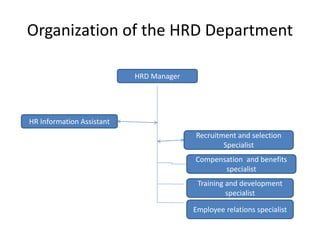
Organization of the HRD Department
HRD Manager
HR Information Assistant
Recruitment and selection
Specialist
Employee relations specialist
Compensation and benefits
specialist
Training and development
specialist

Human resource development powerpoint

  • 1.
    • Human ResourceDevelopment (HRD) is the framework for helping employees develop their personal and organizational skills, knowledge, and abilities. Human Resource Development includes such opportunities as employee training, employee career development, performance management and development, coaching, mentoring,succession planning, key employee identification, tuition assistance, and organization development.
  • 2.
    • The focusof all aspects of Human Resource Development is on developing the most superior workforce so that the organization and individual employees can accomplish their work goals in service to customers
  • 3.
    • Organizations havemany opportunities for human resources or employee development, both within and outside of the workplace. • Human Resource Development can be formal such as in classroom training, a college course, or an organizational planned change effort. Or, Human Resource Development can be informal as in employee coaching by a manager. Healthy organizations believe in Human Resource Development and cover all of these bases.
  • 4.
    • Human ResourceDevelopment focuses o “Potential”. Potential means : • possible, as opposed to actual • capable of being or becoming • a latent excellence or ability that may or may not be developed
  • 5.
    Human resource management •Human Resource Management (HRM) is the function within an organization that focuses on recruitment of, management of, and providing direction for the people who work in the organization. HRM can also be performed by line managers. • HRM is the organizational function that deals with issues related to people such as compensation, hiring, performance management, organization development, safety, wellness, benefits, employee motivation, communication, administration, and training.
  • 6.
    • Human ResourceManagement focuses o “Productivity”. Productivity means : • the quality, state, or fact of being able to gene rate, create, enhance, or bring forth goods and services • Economics. the rate at which goods and servic es having exchange value are brought forth or produced
  • 7.
    HRM main focusis on : • To improve productivity. Its shows how creative the employees, how they manage a certain thing , and how they enhance it to improve standards. • Improve quality of work life(QOWL)
  • 8.
    • Response toEnvironments HRM is influenced by internal and external environments. It is the meticulous balancing of this that makes HRM successful. HRM influenced by the ff: • Unions - the act of uniting two or more things; the state of being united ;something formed by uniting two or more thi ngs; combination.
  • 9.
    • a numberof persons, states, etc., joined or ass ociated together for some common purpose: • a group of states or nations united into one po litical body.
  • 10.
    • Business strategies- •Employee capabilities- • Culture- development or improvement of the mind by education or tra ining • External Environment- Conditions, entities, events, and factors surrounding an organization that influence its activities and choices, and determine its opportunities and risks. Also called operating environment. Opposite of internal environment. • Legislation- Lawmaking; the preparation and enactment of laws by a legisl ative body.
  • 11.
    • Labour Market-The labour market is a generalized concept denoting the interaction between the supply (number of persons available for work) and the demand (number of jobs available) and the wage rate. • Competition-Competition is an interaction between organisms or species, in which the fitness of one is lowered by the presence of another. Limited supply of at least one resource (such as food, water, and territory) used by both can be a factor • Standard of living-The financial health of a population, as measured by the quantity of consumption by the members of that population. The measure most frequently used to estimate standard of living is gross national income per capita. One drawback to the standard of living measurement is that it does not take into account some factors which are important but hard to quantify, such as crime rate or environmental impact.
  • 12.
    • Social change-Social change builds community- based responses that address underlying social problems on an individual, institutional, community, national and/or international level. Social change can change attitudes, behaviors, laws, policies and institutions to better reflect values of inclusion, fairness , diversity and opportunity. Social change involves a collective action of individuals who are closest to the social problems to develop solutions that address social issues
  • 13.
    Make the HumanResources Cost Efficient • HRM looks at employees as costs rather than assets . HRM short changes the organization by hiring people of low potential and attitude because of cost considerations. They offer the least amount per the law. The challenge for a HRM manager is to keep the payroll costs within budgets handed by the top managemet.
  • 14.
    • HRD believesthat every person has potential arising from his /her strengths. Potentials are of different types in different people suiting different roles and situations. In the same role people may have more or less potential. At any given time, whatever the level of achievement , a person’s potential is under – utilized. Potential changes in complexion with better utilization. Potential can temporarily erode due to disuse or misuse.
  • 15.
    The HRD Culture HRDculture promotes : • Respect for each person’s culture • Encouragement to the employee for participation in the affairs of the organization. • Creates trust by bridging the physical and psychological gaps • Employees dignity and self esteem • Team feeling
  • 16.
    • Evolution • Congruencebetween individual and the organizational goals • Care for the employees • Openness and candour • Fairness • Expert-based power • Courage of conviction • Individual autonomy • Shared values
  • 17.
    HRD’s Main Purpose •Improve morale and motivation through empowerment and developing potential • Improve competitiveness through better productivity , quality consciousness , cost control , system discipline and excellence the way the thing s are done • Bring about teamwork and commitment • Foster participation of employee in organization’s strategic intent
  • 18.
    • Human development •Be result oriented • Ensure a safe workplace • Develop enlightened employee/ union relations • Optimize the utilization of human resources • Improve work practices • Develop rational structures to meet the business strategic needs • Introduce and organize technological disciplines.
  • 19.
    HRD Process • Developingan Enabling Culture and Climate • Information Sharing • Empowerment • Structures • Develop the knowledge capital • Acts as change agent • Enlightened unions • Business strategies • Leadership development
  • 20.
    • Talent scouting •Teambuilding • Develop HRD Sub –systems • Managing Costs
  • 21.
    Role of HRD •Planning • Staffing • Appraising and compensating • Training and development • Employee relations • Organizational Environment
  • 22.
    New HRD Role •Business Strategy Formulation • HR Policy Formulation • Culture building • Creation of knowledge (and skill) wealth • Agents of change
  • 23.
    Role of anHRD Manager • A searcher on a voyage of discovery • Researcher to bring in best practices • In-sight based person • Strategic planner to be a co-partner with management • Agent of change • Counselor • Advisor • Developer
  • 24.
    Organization of theHRD Department HRD Manager HR Information Assistant Recruitment and selection Specialist Employee relations specialist Compensation and benefits specialist Training and development specialist