2.1
NumberNumber
SystemsSystems
2.2
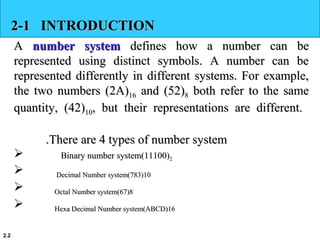
2-1 INTRODUCTION2-1 INTRODUCTION
AA number systemnumber system defines how a number can bedefines how a number can be
represented using distinct symbols. A number can berepresented using distinct symbols. A number can be
represented differently in different systems. For example,represented differently in different systems. For example,
the two numbers (2A)the two numbers (2A)1616 and (52)and (52)88 both refer to the sameboth refer to the same
quantity, (42)quantity, (42)1010, but their representations are different., but their representations are different.
.There are 4 types of number system.There are 4 types of number system
 Binary number system(11100)Binary number system(11100)22
 Decimal Number system(783)10Decimal Number system(783)10
 Octal Number system(67)8Octal Number system(67)8
 Hexa Decimal Number system(ABCD)16Hexa Decimal Number system(ABCD)16
2.3
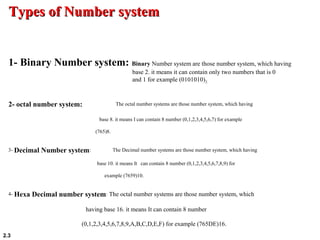
1- Binary Number system: Binary Number system are those number system, which having
base 2. it means it can contain only two numbers that is 0
and 1 for example (0101010)2.
2- octal number system: The octal number systems are those number system, which having
base 8. it means I can contain 8 number (0,1,2,3,4,5,6,7) for example
(765)8.
3- Decimal Number system: The Decimal number systems are those number system, which having
base 10. it means It can contain 8 number (0,1,2,3,4,5,6,7,8,9) for
example (7659)10.
4- Hexa Decimal number system: The octal number systems are those number system, which
having base 16. it means It can contain 8 number
(0,1,2,3,4,5,6,7,8,9,A,B,C,D,E,F) for example (765DE)16.
Types of Number systemTypes of Number system
2.4
S = {0, 1, 2, 3, 4, 5, 6, 7, 8, 9}
The decimal system (base 10)
The word decimal is derived from the Latin root decem
(ten). In this system the base b = 10 and we use ten symbols
The symbols in this system are often referred to as decimal
digits or just digits.
2.5
Example 2.1
The following shows the place values for the integer +224 in theThe following shows the place values for the integer +224 in the
decimal system.decimal system.
Note that the digit 2 in position 1 has the value 20, but the sameNote that the digit 2 in position 1 has the value 20, but the same
digit in position 2 has the value 200. Also note that we normallydigit in position 2 has the value 200. Also note that we normally
drop the plus sign, but it is implicit.drop the plus sign, but it is implicit.
2.6
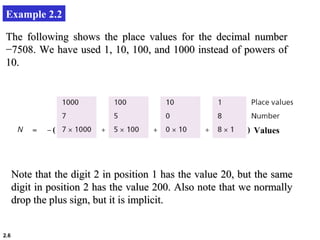
Example 2.2
The following shows the place values for the decimal numberThe following shows the place values for the decimal number
−7508. We have used 1, 10, 100, and 1000 instead of powers of−7508. We have used 1, 10, 100, and 1000 instead of powers of
10.10.
Note that the digit 2 in position 1 has the value 20, but the sameNote that the digit 2 in position 1 has the value 20, but the same
digit in position 2 has the value 200. Also note that we normallydigit in position 2 has the value 200. Also note that we normally
drop the plus sign, but it is implicit.drop the plus sign, but it is implicit.
( ) Values
2.7
Reals
Example 2.3
The following shows the place values for the real number +24.13.The following shows the place values for the real number +24.13.
2.8
The word binary is derived from the Latin root bini (or two
by two). In this system the base b = 2 and we use only two
symbols,
The binary system (base 2)
S = {0, 1}
The symbols in this system are often referred to as binary
digits or bits (binary digit).
2.9
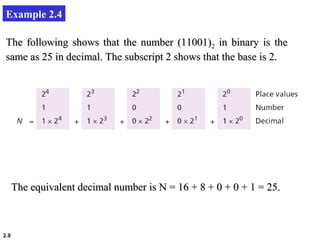
Example 2.4
The following shows that the number (11001)The following shows that the number (11001)22 in binary is thein binary is the
same as 25 in decimal. The subscript 2 shows that the base is 2.same as 25 in decimal. The subscript 2 shows that the base is 2.
The equivalent decimal number is N = 16 + 8 + 0 + 0 + 1 = 25.The equivalent decimal number is N = 16 + 8 + 0 + 0 + 1 = 25.
2.10
Reals
Example 2.5
The following shows that the number (101.11)The following shows that the number (101.11)22 in binary is equalin binary is equal
to the number 5.75 in decimal.to the number 5.75 in decimal.
2.11
The word hexadecimal is derived from the Greek root hex
(six) and the Latin root decem (ten). In this system the base
b = 16 and we use sixteen symbols to represent a number.
The set of symbols is
The hexadecimal system (base 16)
S = {0, 1, 2, 3, 4, 5, 6, 7, 8, 9, A, B, C, D, E, F}
Note that the symbols A, B, C, D, E, F are equivalent to 10,
11, 12, 13, 14, and 15 respectively. The symbols in this
system are often referred to as hexadecimal digits.
2.12
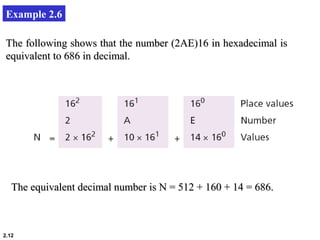
Example 2.6
The following shows that the number (2AE)16 in hexadecimal isThe following shows that the number (2AE)16 in hexadecimal is
equivalent to 686 in decimal.equivalent to 686 in decimal.
The equivalent decimal number is N = 512 + 160 + 14 = 686.The equivalent decimal number is N = 512 + 160 + 14 = 686.
2.13
The word octal is derived from the Latin root octo (eight). In
this system the base b = 8 and we use eight symbols to
represent a number. The set of symbols is
The octal system (base 8)
S = {0, 1, 2, 3, 4, 5, 6, 7}
2.14
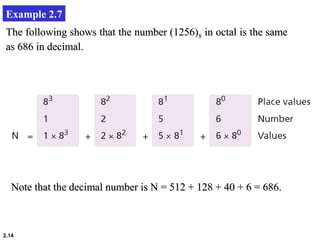
Example 2.7
The following shows that the number (1256)The following shows that the number (1256)88 in octal is the samein octal is the same
as 686 in decimal.as 686 in decimal.
Note that the decimal number is N = 512 + 128 + 40 + 6 = 686.Note that the decimal number is N = 512 + 128 + 40 + 6 = 686.
2.15
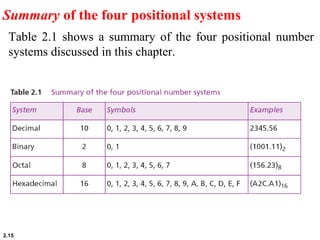
Table 2.1 shows a summary of the four positional number
systems discussed in this chapter.
Summary of the four positional systems
2.16
Table 2.2 shows how the number 0 to 15 is represented in
different systems.
2.17
We need to know how to convert a number in one system to
the equivalent number in another system. Since the decimal
system is more familiar than the other systems, we first show
how to covert from any base to decimal. Then we show how
to convert from decimal to any base. Finally, we show how
we can easily convert from binary to hexadecimal or octal
and vice versa.
Conversion
2.18
Any base to decimal conversion
Figure 2.5 Converting other bases to decimal
2.19
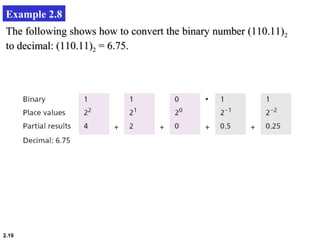
Example 2.8
The following shows how to convert the binary number (110.11)The following shows how to convert the binary number (110.11)22
to decimal: (110.11)to decimal: (110.11)22 = 6.75.= 6.75.
2.20
Example 2.9
The following shows how to convert the hexadecimal numberThe following shows how to convert the hexadecimal number
(1A.23)(1A.23)1616 to decimal.to decimal.
Note that the result in the decimal notation is not exact, becauseNote that the result in the decimal notation is not exact, because
3 × 163 × 16−2−2
= 0.01171875. We have rounded this value to three= 0.01171875. We have rounded this value to three
digits (0.012).digits (0.012).
2.21
Example 2.10
The following shows how to convert (23.17)The following shows how to convert (23.17)88 to decimal.to decimal.
This means that (23.17)8 ≈ 19.234 in decimal. Again, we haveThis means that (23.17)8 ≈ 19.234 in decimal. Again, we have
rounded up 7 × 8rounded up 7 × 8−2−2
= 0.109375.= 0.109375.
2.22
Example 2.17
An alternative method for converting a small decimal integerAn alternative method for converting a small decimal integer
(usually less than 256) to binary is to break the number as the(usually less than 256) to binary is to break the number as the
sum of numbers that are equivalent to the binary place valuessum of numbers that are equivalent to the binary place values
shown:shown:
2.23
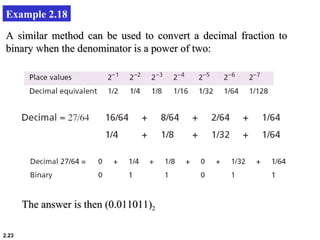
Example 2.18
A similar method can be used to convert a decimal fraction toA similar method can be used to convert a decimal fraction to
binary when the denominator is a power of two:binary when the denominator is a power of two:
The answer is then (0.011011)The answer is then (0.011011)22
2.24
Example 2.19
Show the hexadecimal equivalent of the binary numberShow the hexadecimal equivalent of the binary number
(110011100010)(110011100010)22..
SolutionSolution
We first arrange the binary number in 4-bit patterns:We first arrange the binary number in 4-bit patterns:
100 1110 0010100 1110 0010
Note that the leftmost pattern can have one to four bits. We thenNote that the leftmost pattern can have one to four bits. We then
use the equivalent of each pattern shown in Table 2.2 on page 25use the equivalent of each pattern shown in Table 2.2 on page 25
to change the number to hexadecimal: (4E2)16.to change the number to hexadecimal: (4E2)16.
2.25
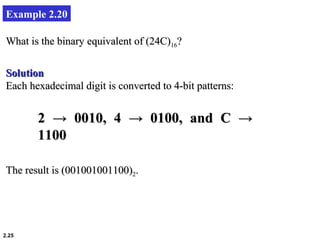
Example 2.20
What is the binary equivalent of (24C)What is the binary equivalent of (24C)1616??
SolutionSolution
Each hexadecimal digit is converted to 4-bit patterns:Each hexadecimal digit is converted to 4-bit patterns:
2 → 0010, 4 → 0100, and C →2 → 0010, 4 → 0100, and C →
11001100
The result is (001001001100)The result is (001001001100)22..
2.26
Example 2.21
Show the octal equivalent of the binary number (101110010)Show the octal equivalent of the binary number (101110010)22..
SolutionSolution
Each group of three bits is translated into one octal digit. TheEach group of three bits is translated into one octal digit. The
equivalent of each 3-bit group is shown in Table 2.2 on page 25.equivalent of each 3-bit group is shown in Table 2.2 on page 25.
The result is (562)The result is (562)88..
101 110 010101 110 010
2.27
Example 2.22
What is the binary equivalent of for (24)What is the binary equivalent of for (24)88??
SolutionSolution
Write each octal digit as its equivalent bit pattern to getWrite each octal digit as its equivalent bit pattern to get
2 → 010 and 4 → 1002 → 010 and 4 → 100
The result is (010100)The result is (010100)22..
2.28
Octal-hexadecimal conversion
Figure 2.12 Octal to hexadecimal and hexadecimal to octal conversion

Number system

  • 1.
  • 2.
    2.2 2-1 INTRODUCTION2-1 INTRODUCTION AAnumber systemnumber system defines how a number can bedefines how a number can be represented using distinct symbols. A number can berepresented using distinct symbols. A number can be represented differently in different systems. For example,represented differently in different systems. For example, the two numbers (2A)the two numbers (2A)1616 and (52)and (52)88 both refer to the sameboth refer to the same quantity, (42)quantity, (42)1010, but their representations are different., but their representations are different. .There are 4 types of number system.There are 4 types of number system  Binary number system(11100)Binary number system(11100)22  Decimal Number system(783)10Decimal Number system(783)10  Octal Number system(67)8Octal Number system(67)8  Hexa Decimal Number system(ABCD)16Hexa Decimal Number system(ABCD)16
  • 3.
    2.3 1- Binary Numbersystem: Binary Number system are those number system, which having base 2. it means it can contain only two numbers that is 0 and 1 for example (0101010)2. 2- octal number system: The octal number systems are those number system, which having base 8. it means I can contain 8 number (0,1,2,3,4,5,6,7) for example (765)8. 3- Decimal Number system: The Decimal number systems are those number system, which having base 10. it means It can contain 8 number (0,1,2,3,4,5,6,7,8,9) for example (7659)10. 4- Hexa Decimal number system: The octal number systems are those number system, which having base 16. it means It can contain 8 number (0,1,2,3,4,5,6,7,8,9,A,B,C,D,E,F) for example (765DE)16. Types of Number systemTypes of Number system
  • 4.
    2.4 S = {0,1, 2, 3, 4, 5, 6, 7, 8, 9} The decimal system (base 10) The word decimal is derived from the Latin root decem (ten). In this system the base b = 10 and we use ten symbols The symbols in this system are often referred to as decimal digits or just digits.
  • 5.
    2.5 Example 2.1 The followingshows the place values for the integer +224 in theThe following shows the place values for the integer +224 in the decimal system.decimal system. Note that the digit 2 in position 1 has the value 20, but the sameNote that the digit 2 in position 1 has the value 20, but the same digit in position 2 has the value 200. Also note that we normallydigit in position 2 has the value 200. Also note that we normally drop the plus sign, but it is implicit.drop the plus sign, but it is implicit.
  • 6.
    2.6 Example 2.2 The followingshows the place values for the decimal numberThe following shows the place values for the decimal number −7508. We have used 1, 10, 100, and 1000 instead of powers of−7508. We have used 1, 10, 100, and 1000 instead of powers of 10.10. Note that the digit 2 in position 1 has the value 20, but the sameNote that the digit 2 in position 1 has the value 20, but the same digit in position 2 has the value 200. Also note that we normallydigit in position 2 has the value 200. Also note that we normally drop the plus sign, but it is implicit.drop the plus sign, but it is implicit. ( ) Values
  • 7.
    2.7 Reals Example 2.3 The followingshows the place values for the real number +24.13.The following shows the place values for the real number +24.13.
  • 8.
    2.8 The word binaryis derived from the Latin root bini (or two by two). In this system the base b = 2 and we use only two symbols, The binary system (base 2) S = {0, 1} The symbols in this system are often referred to as binary digits or bits (binary digit).
  • 9.
    2.9 Example 2.4 The followingshows that the number (11001)The following shows that the number (11001)22 in binary is thein binary is the same as 25 in decimal. The subscript 2 shows that the base is 2.same as 25 in decimal. The subscript 2 shows that the base is 2. The equivalent decimal number is N = 16 + 8 + 0 + 0 + 1 = 25.The equivalent decimal number is N = 16 + 8 + 0 + 0 + 1 = 25.
  • 10.
    2.10 Reals Example 2.5 The followingshows that the number (101.11)The following shows that the number (101.11)22 in binary is equalin binary is equal to the number 5.75 in decimal.to the number 5.75 in decimal.
  • 11.
    2.11 The word hexadecimalis derived from the Greek root hex (six) and the Latin root decem (ten). In this system the base b = 16 and we use sixteen symbols to represent a number. The set of symbols is The hexadecimal system (base 16) S = {0, 1, 2, 3, 4, 5, 6, 7, 8, 9, A, B, C, D, E, F} Note that the symbols A, B, C, D, E, F are equivalent to 10, 11, 12, 13, 14, and 15 respectively. The symbols in this system are often referred to as hexadecimal digits.
  • 12.
    2.12 Example 2.6 The followingshows that the number (2AE)16 in hexadecimal isThe following shows that the number (2AE)16 in hexadecimal is equivalent to 686 in decimal.equivalent to 686 in decimal. The equivalent decimal number is N = 512 + 160 + 14 = 686.The equivalent decimal number is N = 512 + 160 + 14 = 686.
  • 13.
    2.13 The word octalis derived from the Latin root octo (eight). In this system the base b = 8 and we use eight symbols to represent a number. The set of symbols is The octal system (base 8) S = {0, 1, 2, 3, 4, 5, 6, 7}
  • 14.
    2.14 Example 2.7 The followingshows that the number (1256)The following shows that the number (1256)88 in octal is the samein octal is the same as 686 in decimal.as 686 in decimal. Note that the decimal number is N = 512 + 128 + 40 + 6 = 686.Note that the decimal number is N = 512 + 128 + 40 + 6 = 686.
  • 15.
    2.15 Table 2.1 showsa summary of the four positional number systems discussed in this chapter. Summary of the four positional systems
  • 16.
    2.16 Table 2.2 showshow the number 0 to 15 is represented in different systems.
  • 17.
    2.17 We need toknow how to convert a number in one system to the equivalent number in another system. Since the decimal system is more familiar than the other systems, we first show how to covert from any base to decimal. Then we show how to convert from decimal to any base. Finally, we show how we can easily convert from binary to hexadecimal or octal and vice versa. Conversion
  • 18.
    2.18 Any base todecimal conversion Figure 2.5 Converting other bases to decimal
  • 19.
    2.19 Example 2.8 The followingshows how to convert the binary number (110.11)The following shows how to convert the binary number (110.11)22 to decimal: (110.11)to decimal: (110.11)22 = 6.75.= 6.75.
  • 20.
    2.20 Example 2.9 The followingshows how to convert the hexadecimal numberThe following shows how to convert the hexadecimal number (1A.23)(1A.23)1616 to decimal.to decimal. Note that the result in the decimal notation is not exact, becauseNote that the result in the decimal notation is not exact, because 3 × 163 × 16−2−2 = 0.01171875. We have rounded this value to three= 0.01171875. We have rounded this value to three digits (0.012).digits (0.012).
  • 21.
    2.21 Example 2.10 The followingshows how to convert (23.17)The following shows how to convert (23.17)88 to decimal.to decimal. This means that (23.17)8 ≈ 19.234 in decimal. Again, we haveThis means that (23.17)8 ≈ 19.234 in decimal. Again, we have rounded up 7 × 8rounded up 7 × 8−2−2 = 0.109375.= 0.109375.
  • 22.
    2.22 Example 2.17 An alternativemethod for converting a small decimal integerAn alternative method for converting a small decimal integer (usually less than 256) to binary is to break the number as the(usually less than 256) to binary is to break the number as the sum of numbers that are equivalent to the binary place valuessum of numbers that are equivalent to the binary place values shown:shown:
  • 23.
    2.23 Example 2.18 A similarmethod can be used to convert a decimal fraction toA similar method can be used to convert a decimal fraction to binary when the denominator is a power of two:binary when the denominator is a power of two: The answer is then (0.011011)The answer is then (0.011011)22
  • 24.
    2.24 Example 2.19 Show thehexadecimal equivalent of the binary numberShow the hexadecimal equivalent of the binary number (110011100010)(110011100010)22.. SolutionSolution We first arrange the binary number in 4-bit patterns:We first arrange the binary number in 4-bit patterns: 100 1110 0010100 1110 0010 Note that the leftmost pattern can have one to four bits. We thenNote that the leftmost pattern can have one to four bits. We then use the equivalent of each pattern shown in Table 2.2 on page 25use the equivalent of each pattern shown in Table 2.2 on page 25 to change the number to hexadecimal: (4E2)16.to change the number to hexadecimal: (4E2)16.
  • 25.
    2.25 Example 2.20 What isthe binary equivalent of (24C)What is the binary equivalent of (24C)1616?? SolutionSolution Each hexadecimal digit is converted to 4-bit patterns:Each hexadecimal digit is converted to 4-bit patterns: 2 → 0010, 4 → 0100, and C →2 → 0010, 4 → 0100, and C → 11001100 The result is (001001001100)The result is (001001001100)22..
  • 26.
    2.26 Example 2.21 Show theoctal equivalent of the binary number (101110010)Show the octal equivalent of the binary number (101110010)22.. SolutionSolution Each group of three bits is translated into one octal digit. TheEach group of three bits is translated into one octal digit. The equivalent of each 3-bit group is shown in Table 2.2 on page 25.equivalent of each 3-bit group is shown in Table 2.2 on page 25. The result is (562)The result is (562)88.. 101 110 010101 110 010
  • 27.
    2.27 Example 2.22 What isthe binary equivalent of for (24)What is the binary equivalent of for (24)88?? SolutionSolution Write each octal digit as its equivalent bit pattern to getWrite each octal digit as its equivalent bit pattern to get 2 → 010 and 4 → 1002 → 010 and 4 → 100 The result is (010100)The result is (010100)22..
  • 28.
    2.28 Octal-hexadecimal conversion Figure 2.12Octal to hexadecimal and hexadecimal to octal conversion