Definition of AI
Artificial intelligence is the study of how to make
computers do things that people are better at or
would be better at if:
• they could extend what they do to a World Wide
Web-sized amount of data and
• not make mistakes.
It is the science and engineering of making
intelligent machines, especially intelligent computer
programs.
"AI can have two purposes. One is to use the power of
computers to augment human thinking, just as we use
motors to augment human or horse power. Robotics
and expert systems are major branches of that. The
other is to use a computer's artificial intelligence to
understand how humans think. In a humanoid way. If
you test your programs not merely by what they can
accomplish, but how they accomplish it, they you're
really doing cognitive science; you're using AI to
understand the human mind."
•Games, mathematics, and other knowledge-poor tasks
•Knowledge-based systems
•Hand-coded knowledge vs. machine learning
•Low-level (sensory and motor) processing and the resurgence
of sub symbolic systems
•Robotics
•Natural language processing
• Games
•Theorem proving
What About Things People Do Easily?
If you have a problem, think of a past situation where you
solved a similar problem.
If you take an action, anticipate what might happen next.
If you fail at something, imagine how you might have done
things differently.
If you observe an event, try to infer what prior event might
have caused it.
If you see an object, wonder if anyone owns it.
If someone does something, ask yourself what the person's
purpose was in doing that.
Are there limits to how intelligent
machines can be?
 Intelligence:
“the capacity to learn and solve problems”
Artificial Intelligence:
Artificial intelligence (AI) is the intelligence of machines
and robots and the branch of computer science that aims to
create it
 The ability to solve problems
 The ability to act rationally
 The ability to act like humans
Applications of AI:
Natural Language Understanding
Expert Systems
Planning and Robotics
Machine Learning
Game Playing
Expert Systems
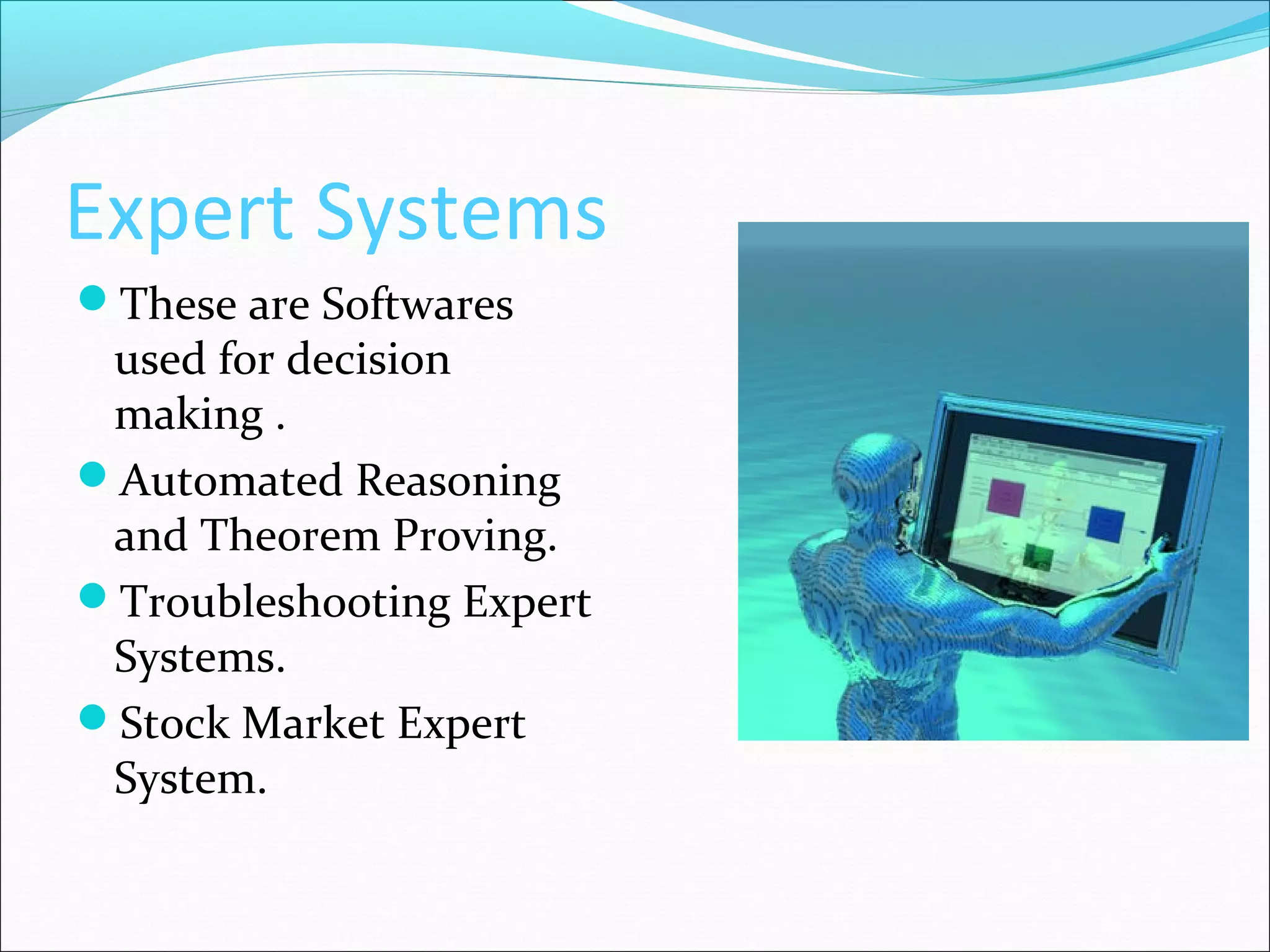
These are Softwares
used for decision
making .
Automated Reasoning
and Theorem Proving.
Troubleshooting Expert
Systems.
Stock Market Expert
System.
Fields of AI
 Graphical User Interface
 Automatic Storage management
 Object Oriented Programming
 Data miming
 computer gaming
Telecommunication:
Automated Online Assistants
Voice dialing
Speech Reorganization
Fields of AI
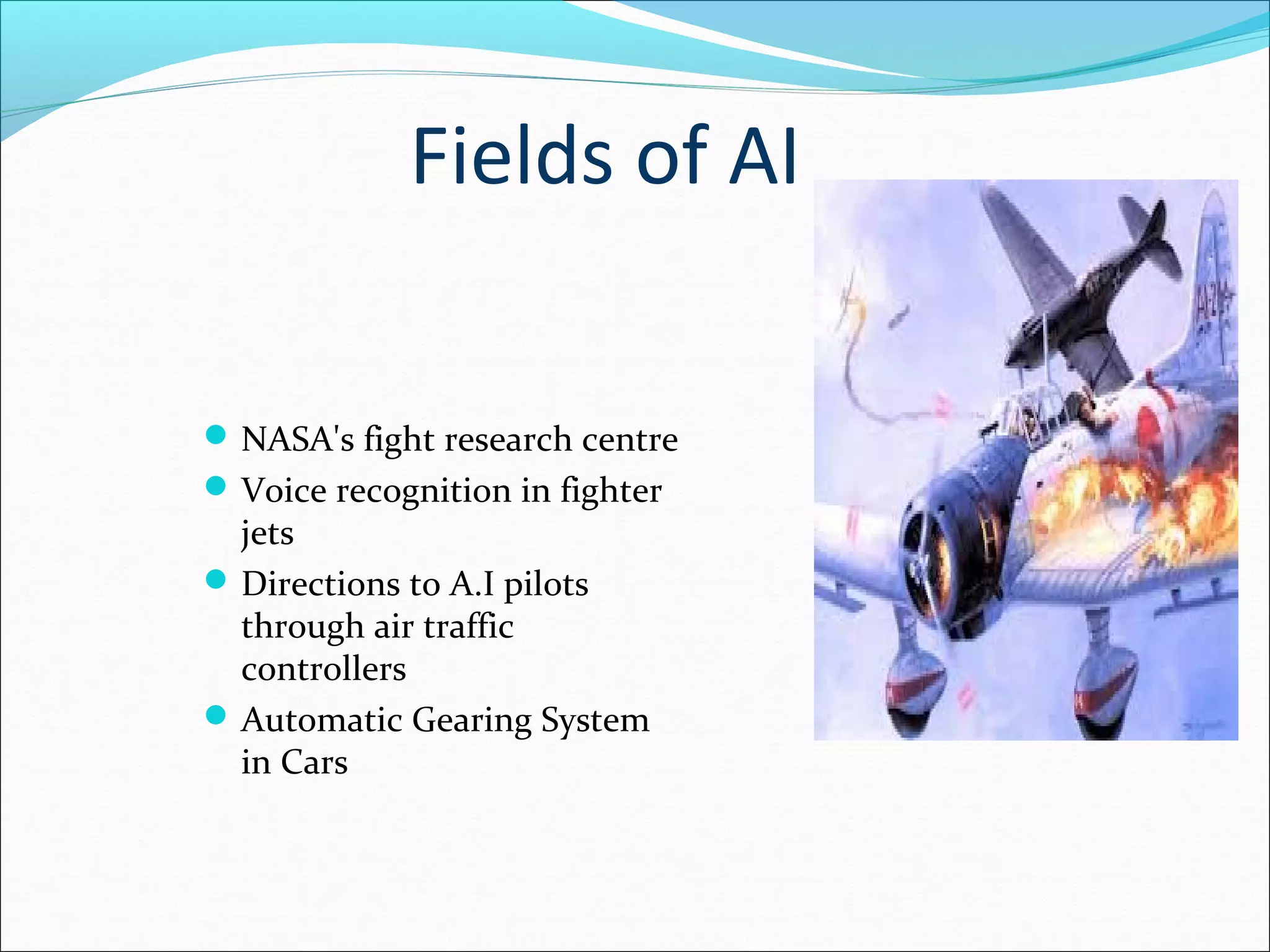
NASA's fight research centre
Voice recognition in fighter
jets
Directions to A.I pilots
through air traffic
controllers
Automatic Gearing System
in Cars
Fields of AI
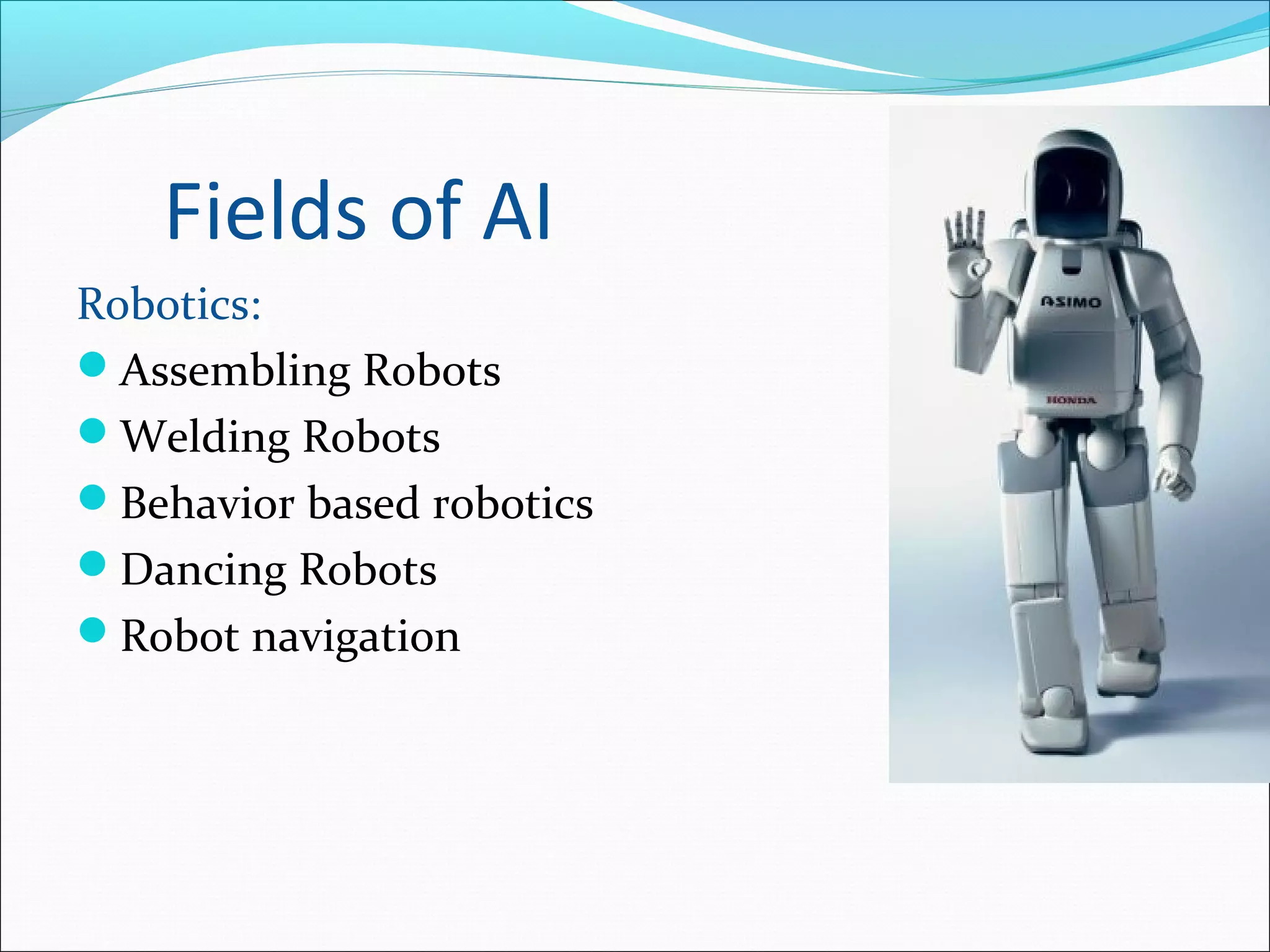
Robotics:
Assembling Robots
Welding Robots
Behavior based robotics
Dancing Robots
Robot navigation
Daily life applications
Home Security
Bank
Post office
Websites
Digital cameras
 News and publishing
Financial trades
Health and medicine
Games and toys
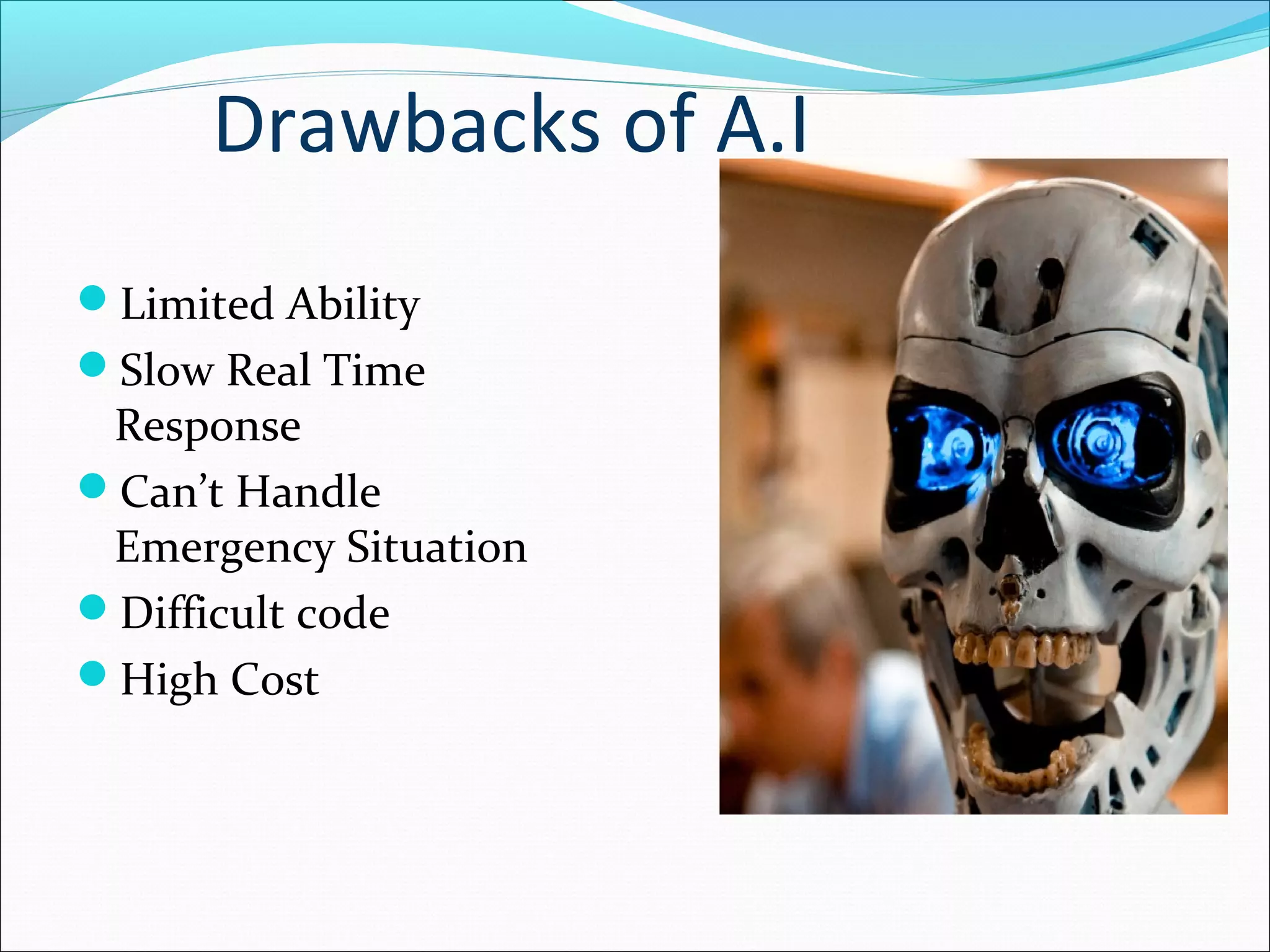
Drawbacks of A.I
Limited Ability
Slow Real Time
Response
Can’t Handle
Emergency Situation
Difficult code
High Cost

Artificial inteligence

  • 2.
    Definition of AI Artificialintelligence is the study of how to make computers do things that people are better at or would be better at if: • they could extend what they do to a World Wide Web-sized amount of data and • not make mistakes. It is the science and engineering of making intelligent machines, especially intelligent computer programs.
  • 3.
    "AI can havetwo purposes. One is to use the power of computers to augment human thinking, just as we use motors to augment human or horse power. Robotics and expert systems are major branches of that. The other is to use a computer's artificial intelligence to understand how humans think. In a humanoid way. If you test your programs not merely by what they can accomplish, but how they accomplish it, they you're really doing cognitive science; you're using AI to understand the human mind."
  • 4.
    •Games, mathematics, andother knowledge-poor tasks •Knowledge-based systems •Hand-coded knowledge vs. machine learning •Low-level (sensory and motor) processing and the resurgence of sub symbolic systems •Robotics •Natural language processing
  • 5.
  • 6.
    What About ThingsPeople Do Easily? If you have a problem, think of a past situation where you solved a similar problem. If you take an action, anticipate what might happen next. If you fail at something, imagine how you might have done things differently. If you observe an event, try to infer what prior event might have caused it. If you see an object, wonder if anyone owns it. If someone does something, ask yourself what the person's purpose was in doing that.
  • 7.
    Are there limitsto how intelligent machines can be?  Intelligence: “the capacity to learn and solve problems” Artificial Intelligence: Artificial intelligence (AI) is the intelligence of machines and robots and the branch of computer science that aims to create it  The ability to solve problems  The ability to act rationally  The ability to act like humans
  • 8.
    Applications of AI: NaturalLanguage Understanding Expert Systems Planning and Robotics Machine Learning Game Playing
  • 9.
    Expert Systems These areSoftwares used for decision making . Automated Reasoning and Theorem Proving. Troubleshooting Expert Systems. Stock Market Expert System.
  • 10.
    Fields of AI Graphical User Interface  Automatic Storage management  Object Oriented Programming  Data miming  computer gaming Telecommunication: Automated Online Assistants Voice dialing Speech Reorganization
  • 11.
    Fields of AI NASA'sfight research centre Voice recognition in fighter jets Directions to A.I pilots through air traffic controllers Automatic Gearing System in Cars
  • 12.
    Fields of AI Robotics: AssemblingRobots Welding Robots Behavior based robotics Dancing Robots Robot navigation
  • 13.
    Daily life applications HomeSecurity Bank Post office Websites Digital cameras  News and publishing Financial trades Health and medicine Games and toys
  • 14.
    Drawbacks of A.I LimitedAbility Slow Real Time Response Can’t Handle Emergency Situation Difficult code High Cost

Editor's Notes

  • #6 Note: They’re formal. Don’t need a lot of messy knowledge.
  • #7 From Push Singh Open Mind paper