Yashodeep k. More
 The maximum output that a business can produce
in a given period with the available resources
 Capacity is usually measured in production units
(e.g. 1,000 cars per month).
 Capacity is linked to workforce planning: e.g. by
working more production shifts, capacity can be
increased
 Capacity needs to take account of seasonal or
unexpected changes in demand
 E.g. Ice-cream factories needed to quickly
increase capacity during a heat wave
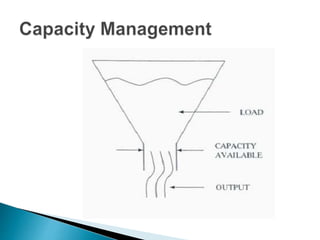
 The ability to meet a customer’s requirements
with the available resources (machinery, factory,
labour, raw materials etc.) at hand.
 Capacity planning is done on the basis of
projections for future product demand, labour
and equipment requirements.
 Time and Capacity are the two main constraints
in capacity management.
Three types of capacity are taken into consideration:
 Potential Capacity:
It is for the long term and indicates the available capacity
at hand which can be utilized to influence the planning of
senior management
 Immediate Capacity:
It is the maximum available capacity which can be
utilized in the short term ( on a day-to-day basis)
 Effective capacity:
It is the part of the total available capacity which can
actually be put into use
 Capacity is the ability to deliver in a defined time
 It is a long-term strategic decision that establishes
a firm's overall level of resources.
 Capacity decisions affect:
product lead times,
customer responsiveness,
operating costs
firm's ability to compete.
 Inadequate capacity can lose customers and
limit growth.
 Excess capacity can drain a company's
resources and prevent investments in more
lucrative ventures.
 When to increase capacity and how much to
increase capacity are critical decisions.
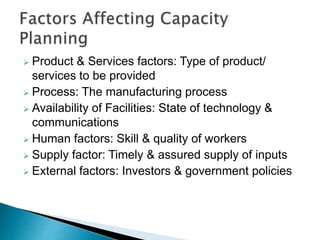
 Product & Services factors: Type of product/
services to be provided
 Process: The manufacturing process
 Availability of Facilities: State of technology &
communications
 Human factors: Skill & quality of workers
 Supply factor: Timely & assured supply of inputs
 External factors: Investors & government policies
 Impacts ability to meet future demands
 Affects operating costs
 Major determinant of initial costs
 Involves long-term commitment
 Affects competitiveness
 Affects ease of management
 Globalization adds complexity
 Impacts long range planning
 How much to increase capacity depends on:-
1. The volume and certainty of anticipated
demand
2. Strategic objectives in terms of
growth,
customer service,
competition
3. The costs of expansion and operation.
Units
Capacity
Time
Demand
Units
Capacity
Time
Demand
Units
Capacity
Time
Demand
Units
Incremental
expansion
Time
Demand
Capacity lead strategy Capacity lag strategy
Average capacity strategy Incremental vs. one-step expansion
One-step
expansion
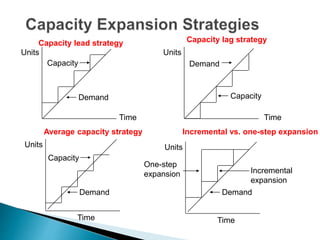
Capacity lead strategy:-
 Capacity is expanded in anticipation of demand
growth.
 This aggressive strategy is used
to lure customers from competitors
who are capacity constrained
or to gain a foothold in a
rapidly expanding market.
Units
Capacity
Time
Demand
Capacity lag strategy:-
 Capacity is increased after an increase in demand
has been documented.
 This conservative strategy produces a higher
return on investment but may lose customers in
the process.
 It is used in industries with
standard products and cost-based
or weak competition.
 The strategy assumes that
lost customers will return from
competitors after capacity has expanded.
Units
Capacity
Demand
Time
Average capacity strategy:-
 Capacity is expanded to coincide with average
expected demand.
 This is a moderate strategy
in which managers are certain
that they will be able to sell
at least some portion of the
additional output.
Units
Capacity
Time
Demand
Incremental vs. one-step expansion:-
 Capacity can be increased incrementally or in one
large step.
 Incremental expansion is less risky but more
costly.
 An attractive alternative
to expanding capacity is
outsourcing, in which
suppliers absorb the
risk of demand uncertainty.
Units
Incremental
expansion
Time
Demand
One-step
expansion
Forecast
Demand
Compute
Needed
Capacity
Compute
Rated
Capacity
Evaluate
Capacity
Plans
Implement
Best Plan
Qualitative
Factors
(e.g., Skills)
Select Best
Capacity
Plan
Develop
Alternative
Plans
Quantitative
Factors
(e.g., Cost)
Capacity Planning Process
 Resource planning involves long rate capacity
resource requirement and is directly linked to
production planning.
 Rough-cut capacity planning : Takes capacity
planning to the next level of detail, check the
feasibility of the MPS, provide warnings of any
bottlenecks, ensure utilization of work centers and
advise vendors of capacity requirement
 Capacity requirements planning is directly linked
to the material requirements plan.
 It is concerned with individual orders at individual
work centers and calculates work center loads and
labor requirements for each time period at each
work center.
 A manufacturing planning is concerned with
planning and controlling all aspects of
manufacturing, including materials, scheduling
machines and people, and coordinating suppliers
and customers.
There are 5 levels in the manufacturing planning
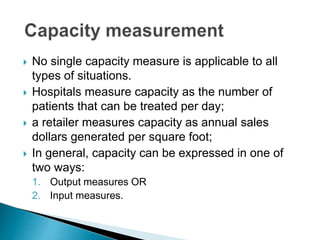
 No single capacity measure is applicable to all
types of situations.
 Hospitals measure capacity as the number of
patients that can be treated per day;
 a retailer measures capacity as annual sales
dollars generated per square foot;
 In general, capacity can be expressed in one of
two ways:
1. Output measures OR
2. Input measures.
Output measures:-
 The usual choice for facilities that produce
standard products in high volumes, in a limited
number of models using production processes
with rigid flow patterns
Input measures:-
 The usual choice for facilities that produce custom
products in low volumes using processes with
flexible flow patterns.
 It calculates a rough estimate of the workload
placed on critical resources by the proposed MPS.
 Critical resources include bottleneck operations,
labor and critical materials.
 Basically there are three approaches to perform
rough cut capacity planning:-
1. Capacity planning using overall factors
2. “Bill of labor” approach
3. “Resource Profile” approach
Capacity planning using overall factors (CPOF) :
It is the least detailed approach.
Capacity requirement is quickly computed but is
insensitive to shifts in product mix.
“Bill of labor” approach :
It involves multiplying two matrices, “the bill of labor” and
the “master production schedule”.
This approach picks up shifts in product mix, but does not
consider lead time offsets.
It strictly assumes a lot-for-lot policy for setting lot sizes.
When other techniques, such as economic order quantity
etc is used, then this approach gives a very rough
estimate.
“Resource Profile” approach :
 It is exactly same as “Bill of labor approach”,
except that it takes lead-time offsets into account.
 Again, it strictly assumes a lot-for-lot policy for
setting lot sizes as in the case of “bill of labor
approach”.
 It is the process by which a company figures out
how much it needs to produce, and determines if it
is capable of meeting those production goals.
 Small businesses must conduct capacity
requirements planning regularly to keep up with
changes in supply and demand.
 Depending on the industry and type of
businesses, capacity requirements planning can
happen monthly, quarterly or annually.
 It is necessary to set the capacity after considering
the current situation, in order to make Capacity
Requirements Planning more practical.
 In this planning, the following three capacities are
used:
1. Standard Capacity
2. Maximum Capacity
3. Set Capacity
Standard Capacity:
 The ability to produce items in a standard process.
 The standard capacity is usually set for each
process, and such time margin as morning
meeting time and break time as well as
attendance rate are also considered.
 In addition, Capacity may be registered for each
operation date.
Maximum Capacity:
 the ability to produce the maximum
quantity/quality of items in a process.
 It can be set according to the actual performance
or as an overload tolerance.
Set Capacity:
 The ability to be set based on the relationship
between the maximum capacity and load.
 When setting the capacity, such factors as
overtime work, shift, and the increase or decrease
in staff transfer are considered.
 It ensures that a company can meet the changing
demands for its products and services.
 Discrepancies between capacity requirements and
the actual production output can cause product or
personnel shortages that leads to long delays in
delivering products or services, or lead the
company to leave some customer’s orders
completely unfilled.
 Not being able to meet customer demand will
often mean losing customers to competitors.
 Poor capacity requirements planning can also lead
to over-production of products that do not sell.
 This unused inventory ties up the company’s
revenue and depresses reported earnings.
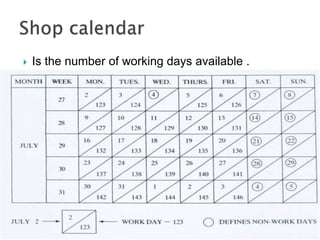
 Is the number of working days available .
 Different companies plan and schedule
manufacturing production using different
strategies.
 Some companies make goods only after receiving
a customer order while others make goods and
distribute them to retailers where customers buy at
their discretion.
 A company strategy has a direct impact on the
amount of inventory it carries and that translates
into cash available for other needs.
 Companies that use the chase strategy, or
demand matching strategy, produce only enough
goods to meet or exactly match the demand for
goods.
 Restaurant, which produces meals only when a
customer orders, therefore matching the actual
production with customer demand.
The chase strategy has several advantages
 It keeps inventories low, which frees up cash that
otherwise can be used to buy raw materials or
components.
 Reduces inventory carrying costs that are
associated with holding inventory in stock.Cost of
capital, warehousing, depreciation, insurance,
taxes, obsolescence and shrinkage are all
inventory carrying costs.
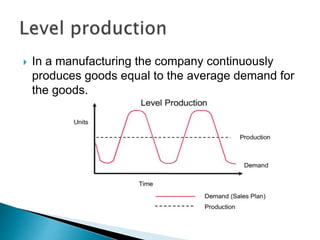
 In a manufacturing the company continuously
produces goods equal to the average demand for
the goods.
 Scheduling consistently arranges the same
quantity of goods for production based on the total
demand for the goods.
 So, if for three months a company wants to
produce 20,000 units of a certain item and there
are a total of 56 working days, it can level
production to 358 units per day.
 Goods are produced before customers place
orders.
 The retail environment is an example of make-to-
stock as goods are produced and put into
inventory at the retailer location.
 The make-to-stock strategy typically allows
manufacturers to produce goods in long
production runs, taking advantage of production
efficiencies.
 Because the make-to-stock environment produces
goods on a consistent basis, a master production
schedule determines the exact number of units to
produce for each production run.
 Companies that use a make-to-order strategy
produce goods after receiving an order from the
customer.
 Most often a company that uses the make-to-order
strategy produces one-of-a-kind goods.
 Examples include custom-tailored clothing,
custom machinery and some fine jewelry.
 Certain fast-food restaurants use an assemble-to-
order strategy.
 A customer walks in, places an order for a
hamburger and the hamburger gets assembled
from a stock selection of ingredients.
 This strategy forces the restaurant to carry enough
ingredients to make every hamburger combination
a customer might request.
 Automobile manufacturers also use the assemble-
to-order strategy. A customer can pick and choose
from many features including interior fabrics,
exterior paints, and seat, engine, wheel or tire
options. Once the dealer places the
customer’s order, the manufacturing
plant assembles the standard component parts to
the customer’s exact specifications. In
this environment the production scheduler uses a
final assembly timetable.
 Capacity management occurs at all levels of the
planning process.
 It is directly related to the priority plan, need the
level of detail and time spans will be similar to the
related priority plan.
 CP is concerned with translating the priority plan
into the hours of capacity required in
manufacturing to make the items in the priority
plan and with methods of making that capacity
available.
 Material requirements planning and capacity
requirements planning should form part of a
closed-loop system witch not only includes
planning and control functions but also provide
feedback so planning can always be current
Thank You…

Capacity management

  • 1.
  • 2.
     The maximumoutput that a business can produce in a given period with the available resources  Capacity is usually measured in production units (e.g. 1,000 cars per month).
  • 3.
     Capacity islinked to workforce planning: e.g. by working more production shifts, capacity can be increased  Capacity needs to take account of seasonal or unexpected changes in demand  E.g. Ice-cream factories needed to quickly increase capacity during a heat wave
  • 5.
     The abilityto meet a customer’s requirements with the available resources (machinery, factory, labour, raw materials etc.) at hand.  Capacity planning is done on the basis of projections for future product demand, labour and equipment requirements.  Time and Capacity are the two main constraints in capacity management.
  • 6.
    Three types ofcapacity are taken into consideration:  Potential Capacity: It is for the long term and indicates the available capacity at hand which can be utilized to influence the planning of senior management  Immediate Capacity: It is the maximum available capacity which can be utilized in the short term ( on a day-to-day basis)  Effective capacity: It is the part of the total available capacity which can actually be put into use
  • 7.
     Capacity isthe ability to deliver in a defined time  It is a long-term strategic decision that establishes a firm's overall level of resources.  Capacity decisions affect: product lead times, customer responsiveness, operating costs firm's ability to compete.
  • 8.
     Inadequate capacitycan lose customers and limit growth.  Excess capacity can drain a company's resources and prevent investments in more lucrative ventures.  When to increase capacity and how much to increase capacity are critical decisions.
  • 9.
     Product &Services factors: Type of product/ services to be provided  Process: The manufacturing process  Availability of Facilities: State of technology & communications  Human factors: Skill & quality of workers  Supply factor: Timely & assured supply of inputs  External factors: Investors & government policies
  • 10.
     Impacts abilityto meet future demands  Affects operating costs  Major determinant of initial costs  Involves long-term commitment  Affects competitiveness  Affects ease of management  Globalization adds complexity  Impacts long range planning
  • 11.
     How muchto increase capacity depends on:- 1. The volume and certainty of anticipated demand 2. Strategic objectives in terms of growth, customer service, competition 3. The costs of expansion and operation.
  • 12.
    Units Capacity Time Demand Units Capacity Time Demand Units Capacity Time Demand Units Incremental expansion Time Demand Capacity lead strategyCapacity lag strategy Average capacity strategy Incremental vs. one-step expansion One-step expansion
  • 13.
    Capacity lead strategy:- Capacity is expanded in anticipation of demand growth.  This aggressive strategy is used to lure customers from competitors who are capacity constrained or to gain a foothold in a rapidly expanding market. Units Capacity Time Demand
  • 14.
    Capacity lag strategy:- Capacity is increased after an increase in demand has been documented.  This conservative strategy produces a higher return on investment but may lose customers in the process.  It is used in industries with standard products and cost-based or weak competition.  The strategy assumes that lost customers will return from competitors after capacity has expanded. Units Capacity Demand Time
  • 15.
    Average capacity strategy:- Capacity is expanded to coincide with average expected demand.  This is a moderate strategy in which managers are certain that they will be able to sell at least some portion of the additional output. Units Capacity Time Demand
  • 16.
    Incremental vs. one-stepexpansion:-  Capacity can be increased incrementally or in one large step.  Incremental expansion is less risky but more costly.  An attractive alternative to expanding capacity is outsourcing, in which suppliers absorb the risk of demand uncertainty. Units Incremental expansion Time Demand One-step expansion
  • 17.
    Forecast Demand Compute Needed Capacity Compute Rated Capacity Evaluate Capacity Plans Implement Best Plan Qualitative Factors (e.g., Skills) SelectBest Capacity Plan Develop Alternative Plans Quantitative Factors (e.g., Cost) Capacity Planning Process
  • 18.
     Resource planninginvolves long rate capacity resource requirement and is directly linked to production planning.  Rough-cut capacity planning : Takes capacity planning to the next level of detail, check the feasibility of the MPS, provide warnings of any bottlenecks, ensure utilization of work centers and advise vendors of capacity requirement
  • 19.
     Capacity requirementsplanning is directly linked to the material requirements plan.  It is concerned with individual orders at individual work centers and calculates work center loads and labor requirements for each time period at each work center.
  • 20.
     A manufacturingplanning is concerned with planning and controlling all aspects of manufacturing, including materials, scheduling machines and people, and coordinating suppliers and customers.
  • 21.
    There are 5levels in the manufacturing planning
  • 22.
     No singlecapacity measure is applicable to all types of situations.  Hospitals measure capacity as the number of patients that can be treated per day;  a retailer measures capacity as annual sales dollars generated per square foot;  In general, capacity can be expressed in one of two ways: 1. Output measures OR 2. Input measures.
  • 23.
    Output measures:-  Theusual choice for facilities that produce standard products in high volumes, in a limited number of models using production processes with rigid flow patterns
  • 24.
    Input measures:-  Theusual choice for facilities that produce custom products in low volumes using processes with flexible flow patterns.
  • 26.
     It calculatesa rough estimate of the workload placed on critical resources by the proposed MPS.  Critical resources include bottleneck operations, labor and critical materials.  Basically there are three approaches to perform rough cut capacity planning:- 1. Capacity planning using overall factors 2. “Bill of labor” approach 3. “Resource Profile” approach
  • 27.
    Capacity planning usingoverall factors (CPOF) : It is the least detailed approach. Capacity requirement is quickly computed but is insensitive to shifts in product mix.
  • 28.
    “Bill of labor”approach : It involves multiplying two matrices, “the bill of labor” and the “master production schedule”. This approach picks up shifts in product mix, but does not consider lead time offsets. It strictly assumes a lot-for-lot policy for setting lot sizes. When other techniques, such as economic order quantity etc is used, then this approach gives a very rough estimate.
  • 29.
    “Resource Profile” approach:  It is exactly same as “Bill of labor approach”, except that it takes lead-time offsets into account.  Again, it strictly assumes a lot-for-lot policy for setting lot sizes as in the case of “bill of labor approach”.
  • 30.
     It isthe process by which a company figures out how much it needs to produce, and determines if it is capable of meeting those production goals.  Small businesses must conduct capacity requirements planning regularly to keep up with changes in supply and demand.  Depending on the industry and type of businesses, capacity requirements planning can happen monthly, quarterly or annually.
  • 31.
     It isnecessary to set the capacity after considering the current situation, in order to make Capacity Requirements Planning more practical.  In this planning, the following three capacities are used: 1. Standard Capacity 2. Maximum Capacity 3. Set Capacity
  • 32.
    Standard Capacity:  Theability to produce items in a standard process.  The standard capacity is usually set for each process, and such time margin as morning meeting time and break time as well as attendance rate are also considered.  In addition, Capacity may be registered for each operation date.
  • 33.
    Maximum Capacity:  theability to produce the maximum quantity/quality of items in a process.  It can be set according to the actual performance or as an overload tolerance.
  • 34.
    Set Capacity:  Theability to be set based on the relationship between the maximum capacity and load.  When setting the capacity, such factors as overtime work, shift, and the increase or decrease in staff transfer are considered.
  • 35.
     It ensuresthat a company can meet the changing demands for its products and services.  Discrepancies between capacity requirements and the actual production output can cause product or personnel shortages that leads to long delays in delivering products or services, or lead the company to leave some customer’s orders completely unfilled.
  • 36.
     Not beingable to meet customer demand will often mean losing customers to competitors.  Poor capacity requirements planning can also lead to over-production of products that do not sell.  This unused inventory ties up the company’s revenue and depresses reported earnings.
  • 37.
     Is thenumber of working days available .
  • 38.
     Different companiesplan and schedule manufacturing production using different strategies.  Some companies make goods only after receiving a customer order while others make goods and distribute them to retailers where customers buy at their discretion.  A company strategy has a direct impact on the amount of inventory it carries and that translates into cash available for other needs.
  • 39.
     Companies thatuse the chase strategy, or demand matching strategy, produce only enough goods to meet or exactly match the demand for goods.  Restaurant, which produces meals only when a customer orders, therefore matching the actual production with customer demand.
  • 41.
    The chase strategyhas several advantages  It keeps inventories low, which frees up cash that otherwise can be used to buy raw materials or components.  Reduces inventory carrying costs that are associated with holding inventory in stock.Cost of capital, warehousing, depreciation, insurance, taxes, obsolescence and shrinkage are all inventory carrying costs.
  • 42.
     In amanufacturing the company continuously produces goods equal to the average demand for the goods.
  • 43.
     Scheduling consistentlyarranges the same quantity of goods for production based on the total demand for the goods.  So, if for three months a company wants to produce 20,000 units of a certain item and there are a total of 56 working days, it can level production to 358 units per day.
  • 44.
     Goods areproduced before customers place orders.  The retail environment is an example of make-to- stock as goods are produced and put into inventory at the retailer location.
  • 45.
     The make-to-stockstrategy typically allows manufacturers to produce goods in long production runs, taking advantage of production efficiencies.  Because the make-to-stock environment produces goods on a consistent basis, a master production schedule determines the exact number of units to produce for each production run.
  • 46.
     Companies thatuse a make-to-order strategy produce goods after receiving an order from the customer.  Most often a company that uses the make-to-order strategy produces one-of-a-kind goods.  Examples include custom-tailored clothing, custom machinery and some fine jewelry.
  • 48.
     Certain fast-foodrestaurants use an assemble-to- order strategy.  A customer walks in, places an order for a hamburger and the hamburger gets assembled from a stock selection of ingredients.  This strategy forces the restaurant to carry enough ingredients to make every hamburger combination a customer might request.
  • 50.
     Automobile manufacturersalso use the assemble- to-order strategy. A customer can pick and choose from many features including interior fabrics, exterior paints, and seat, engine, wheel or tire options. Once the dealer places the customer’s order, the manufacturing plant assembles the standard component parts to the customer’s exact specifications. In this environment the production scheduler uses a final assembly timetable.
  • 51.
     Capacity managementoccurs at all levels of the planning process.  It is directly related to the priority plan, need the level of detail and time spans will be similar to the related priority plan.  CP is concerned with translating the priority plan into the hours of capacity required in manufacturing to make the items in the priority plan and with methods of making that capacity available.
  • 52.
     Material requirementsplanning and capacity requirements planning should form part of a closed-loop system witch not only includes planning and control functions but also provide feedback so planning can always be current
  • 53.